






Abstract
This study examines industrial upgrading in manufacturing firms in Dongguan, China in the context of the Dongguan government’s recent policy initiative to boost its manufacturing sector by encouraging industrial upgrading. To implement its so-called ‘Replacing Humans with Robots’ policy, which we see as an expression of the central government’s ‘Made in China 2025’ policy, the Dongguan government offers incentives to manufacturers’ region to automate their production lines with a range of assets including computer numerical control (CNC) machines and industrial robots. Applying Humphrey and Schmitz’s (Regional Studies 36[9]:1017–1027, 2002) taxonomy of industrial upgrading, our mixed-methods ethnographic and documentary research identified three types of upgrading at the factories we studied: process, product and functional upgrading. While our data draw on the perspectives of factory owners and managers, they bear important implications for workers. Future studies are needed to elaborate those implications.
Introduction
Over the last decade, business conditions in southern China have gradually become tougher. Since mid-2007, many manufacturers in Guangdong have experienced greater stress because of the combined effects of (a) unfavourable central government policies that have penalised low-end, low-cost manufacturing: a regulation requiring exporters to pay a deposit on imports of almost 2,000 raw materials (Ministry of Commerce [MOC] of the People’s Republic of China, 2008); (b) cancellation or reduction of tax refunds on goods, such as metals, plastics, textiles and furniture (MOC, 2007); (c) a stronger yuan, escalating prices for energy and raw materials; (d) stringent pollution control requirements in Guangdong; (e) the introduction of welfare benefits for employees; and (f) the introduction of a labour law stipulating the benefits and responsibilities of employers and employees, insurance coverage and overtime pay (China Labor Contract Law, 2007).
Of these factors, a rising minimum wage, which has increased by an average of 18.6 per cent since 1 March 2011, seems to have caused the most problems for manufacturers. To be sure, the minimum wage varies across Guangdong Province. Shenzhen, for example, raised minimum pay by 20 per cent to 1,320 yuan as of 1 April 2011, and Dongguan raised the minimum wage by 19.6 per cent to 1,100 yuan as of 1 March 2011 (the second increase in 10 months) (People’s Government of Guangdong Province, 2010, 2011).
In addition, the global financial crisis of 2008, which began in Western economies, reduced overseas export orders for Chinese goods. That event, which played out over several months, has had lasting effects on Chinese manufacturers, including many firms in Dongguan, which have had to find ways to streamline their operations.
It was in this challenging context, in which the global business environment threatened the viability of many firms, that the Dongguan government sought a strategy that would provide firms operating there with a competitive advantage. To mitigate the tightening business conditions in the province, its policymakers rolled out an initiative it termed ‘Replacing Humans with Robots’ (jiqi huanren), which fits neatly into the central government’s ‘Made in China 2025’ (hereafter ‘MiC2025’) plan announced by Premier Li Keqiang in 2015 to bolster the manufacturing sector. When introducing MiC2025, Premier Li vowed that the government would address the country’s desire to move up the innovation value-added chain within a decade (Xinhua Net, 2015) through the deployment of ‘intelligent manufacturing’ (defined as the integration of communication technology and advanced manufacturing across product design, production, management and service) (Lüthje, Luo, & Zhang, 2013; Ministry of Industry and Information Technology [MIIT], 2016). 1
This article examines the rationale for industrial upgrading and the process by which such upgrading takes place. We explore the following questions: why do manufacturers choose to engage in industrial upgrading? How do they reconcile their rationales with their overall business goals? What are the implications of industrial upgrading for manufacturers?
This article first reviews the literature that has informed this research and to which this study contributes. Then, we briefly describe the study’s methodology. The subsequent section investigates the context in which we conducted our research in Dongguan and explains the Dongguan government’s ‘Replacing Humans with Robots Policy’. We then describe our findings in depth and analyse features of those findings. Finally, we conclude by discussing future research prospects.
Literature Review and Theoretical Framework
The existing body of literature on industrial upgrading allows us to conduct a nuanced analysis of this research to investigate manufacturers’ rationale for engaging in upgrading as well as some of the challenges they encounter during the process. Gereffi (1999) sdefines the broader concept of industrial upgrading as ‘a process of improving the ability of a firm or an economy to move to more profitable and/or technologically sophisticated capital and skill-intensive economic niches’ (pp. 51–52). Yang (2012) sshows how current institutions that are conducive to export-oriented processing in the Pearl River Delta evolved in response to emerging obstacles to the ongoing restructuring, particularly the market reorientation from export to domestic sales. Frederick and Gereffi (2011) employ a global value chain approach to analyse the upgrading trajectories of leading apparel exporters. They show how Chinese apparel suppliers have benefited (by expanding their global market share) over the course of these upgrading trajectories as a result of growing apparel demand in Asia as well as to regionally integrated production networks. In the recent works by Jonas Nahm (2017), Nahm and Steinfeld (2014) and Sun and Grimes (2018), China’s efforts to move up the value chain, particularly on the issue of technology transfer in sectors like solar and automotive, have been highlighted. Nahm highlighted supplier networks in which foreign suppliers contribute to the upgrading of Chinese lead companies by means of collaboration.
In the literature on industrial upgrading, Humphrey and Schmitz’s (2002) study is noteworthy because it unpacks the broad and rather general notion of ‘industrial upgrading’ into diverse processes and thereby offers a viable theoretical framework for the present study. Humphrey and Schmitz inquired into the scope of local upgrading strategies wherein producers operate in global chains. Employing a global value chain approach (à la Frederick and Gereffi), they argue that the success of local-level upgrading efforts is impacted by the way clusters are inserted into global value chains.
In their very widely cited article, Humphrey and Schmitz (2002) differentiated four types of industrial upgrading, broadly interpreted. Process upgrading involves improving production or machinery by reorganising the production system to enhance production efficiency (i.e., produce more with fewer inputs). Product upgrading involves moving into higher-grade product lines. Whether moving into these more sophisticated products line succeeds depends on the unit values of the new products created through the upgrading process. Functional upgrading involves expanding a firm’s business functions into areas such as design, marketing and branding (Humphrey & Schmitz, 2002). This type of upgrading is often associated with a move up a product’s value chain such that a manufacturer captures a greater share of the overall profits associated with the product. Finally, inter-sectoral upgrading occurs when firms move into entirely new industrial sectors or chains (for instance, if knowledge acquired in producing televisions is used to make screens for tablets and other computer equipment). This schema is echoed by Pietrobelli and Rabellotti (2007, 2011) who argue that supplier firms often find it easier to accomplish process and product upgrading than functional or inter-sectoral upgrading. This is because the latter two types of upgrading tend to threaten the hierarchical control of lead firms.
Given the relatively recent advent in the Chinese export manufacturing sector of a shift from the long-standing low-wage, labour-intensive model of production to one that leverages technology and information to drive production, it is no surprise that the relevant literature has seen few studies focusing on industrial automation in China. Our study is one of only a few to focus on small- and medium-sized enterprises (SMEs), which, prior to the Dongguan government’s implementation of its ‘Replacing Humans with Robots’ policy, did not receive as much government support to invest in R&D activities.
By distinguishing between types of upgrading, we can create a useful theoretical matrix with which to inform the ensuing empirical analysis. As this analysis shows, manufacturers in Dongguan have engaged in the first three types of industrial upgrading—product, process and functional. In our research, we adopt the manufacturers’ perspective to try to uncover both the rationales and processes involved in industrial upgrading.
Methodology
We deployed a grounded approach in our study. Our fieldwork, which we carried out between September 2015 and January 2016, involved participant-observation sessions and interviews with management personnel in eight firms that had installed robots in their production lines (see Table 1).
Participant-Observation/Interview Subjects
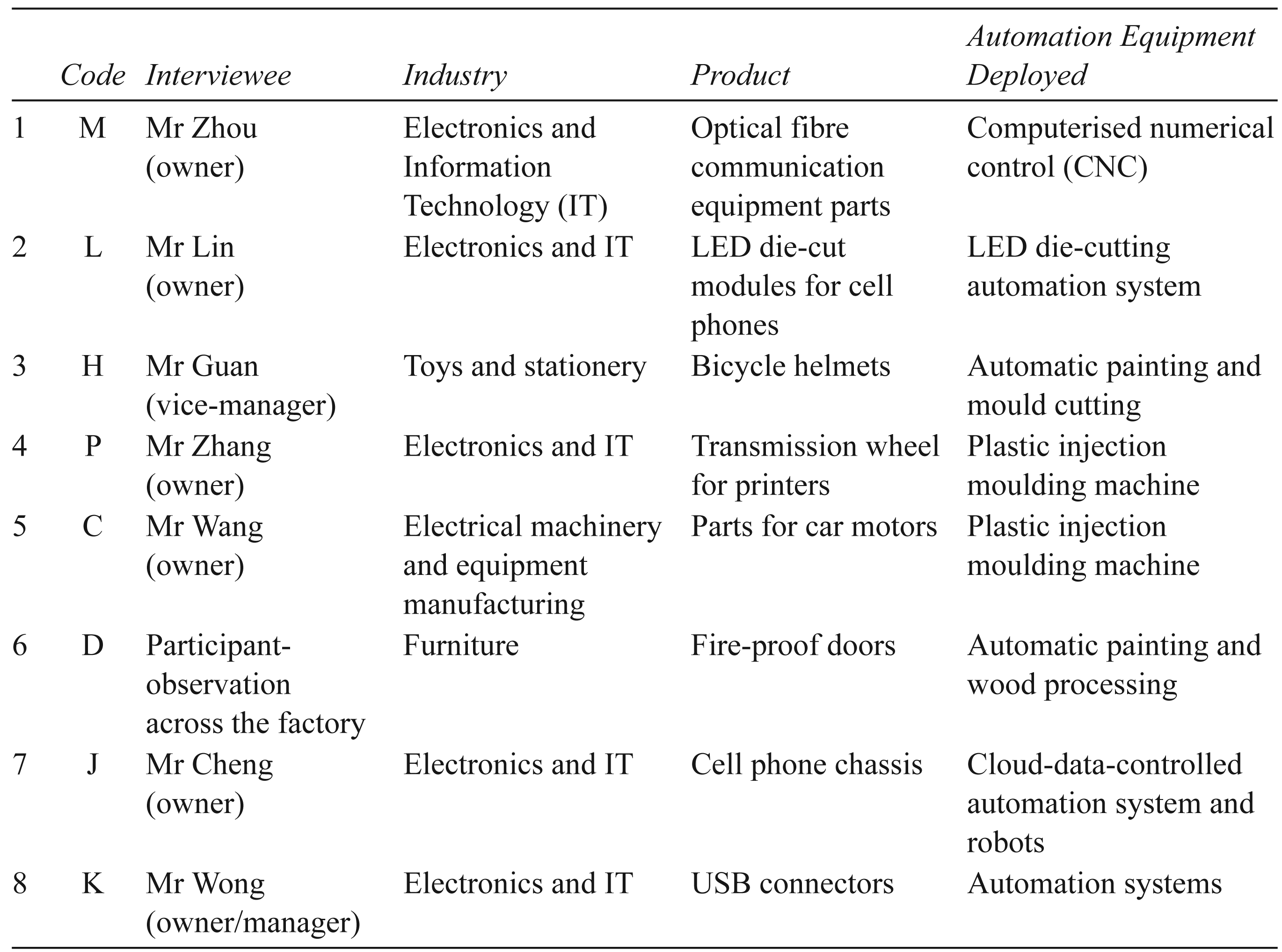
The eight user-firm factories, operating in the electronics and information technology (IT), toys and stationery, furniture and electrical machinery and equipment manufacturing industries, all adopted automation machinery. Four of the eight received Dongguan government subsidies under the ‘Replacing Humans with Robots’ programme. Although the eight firms span a diverse range of industries, they are comparable insofar as are all based in Dongguan—a city that, while it has arguably suffered the most damage from the tougher business conditions experienced by manufacturers in the Pearl River Delta, has also been trying the hardest among its counterparts in the PRD to extricate itself from the downward turn in manufacturing by using policy instruments to encourage manufacturers to engage in industrial upgrading. Thus, our cases share a common characteristic. They all involve firms facing a stark choice: embrace industrial upgrading or risk extinction in their respective industries.
Each of the four industries from which we chose sample firms is part of a broader set of nine pillar industries, as classified by the Dongguan government. A further factor was that, in the ‘Replacing Humans with Robots’ plan, ‘electronics and IT’ and ‘electrical machinery and equipment manufacturing’ were the two that received the largest amounts in government subsidies. 2
Based on our overarching research questions regarding why and how manufacturers engage in industrial upgrading, we divided our interview questions into two broad categories. The first category was focused on exploring the necessity of and/or incentives for engaging in industrial upgrading. In other words, what factors persuade manufacturers to pursue the path of industrial upgrading rather than maintaining the status quo (being heavily reliant on workers)? Here, we further categorised our questions according to our theoretical framework based on the four broad types of upgrading identified by Humphrey and Schmitz (2002). We hoped to pinpoint specifically whether a manufacturer’s reasons for upgrading could be described as product, process, functional or inter-sectoral in nature. We designed the second area of questioning to probe more deeply into the implications of industrial upgrading once it begins: specifically, what happens to the production process, to the company’s profitability and to the workers?
Dongguan: Recent Historical Trajectory of Industrialisation and Policies for Industrial Upgrading
Dongguan, located in the Pearl River Delta, hosts over 80,000 manufacturers in a 2,460 km2 area (Gouch, 2016). In 2014, the city (formerly a county) had a population of 8.3 million, divided between 1.9 million permanent residents with urban hukou (household registrations) and 6.4 million rural migrants, most of whom were employed in factories (Dongguan Statistical Bureau, n.d.).
As we began our work, firms operating under the production model we found in place would typically produce parts and equipment to be marketed by other firms (‘original equipment manufacturers’) that manufactured finished goods under their own brand names. While playing this role helped factories in Dongguan generate profits that were impressive for domestic manufacturing firms, it also subjected them to volatile global market trends and ultimately ceded control of the sales and marketing of the products that incorporated their parts to the global brands.
It was in this challenging business environment, in the context of the manufacturing scheme that privileged global original equipment manufacturer (OEM) brands, that the Dongguan government hastened, in August 2014, to install its ‘Replacing Humans with Robots’ plan, formally known as the ‘Promotion Plan for “Replacing Humans with Robots” for Dongguan Enterprises 2014–2016’ (Dongguan shi tuidong qiye ‘jiqi huanren’ xingdong jihua 2014–2016). The idea was to rescue its economy by converting the workshop of the world into an intelligent manufacturing hub through production and industrial upgrading. The Dongguan government emphasised what it called ‘pushing forward the technological dividend instead of demographic dividends’ (tuidong jishu hongli tidai renkou hongli; Dongguan Municipal Government, 2014, August 4), intending within 3 years to allocate the proceeds of a 200-million-yuan annual fund, with which it would reimburse manufacturers for 10–15 per cent of their expenses for procuring new equipment if they spent at least 1 million yuan in upgrading (Dongguan Municipal Government, 2014). In this effort, Dongguan’s vice-mayor pledged to significantly boost robot intensity in the region (i.e., the ratio of robots to human workers) by 2020, which would include not only factories that employed robots in their production lines but also firms that manufacture the robots and other automation equipment (Pang & Zheng, 2016).
Can industrial upgrading help firms overcome the tougher business conditions we have described and, more importantly, how does the process of industrial upgrading actually occur? In seeking to answer these questions, we consider why Dongguan manufacturers engage in industrial upgrading.
Why Manufacturers Engage in Industrial Upgrading
The path from technological development to increased profits is not always linear. Firms engaged in upgrading production or moving up the value chain through automation face challenges. Thus, in spite of the apparent inevitability of upgrading, with its benefits for labour-intensive manufacturers in Dongguan, it is important to understand the countervailing factors that can complicate the process.
Process upgrade leading to improved productivity and greater output.
According to five firms in our study that engaged in process upgrading, the objective was primarily to increase productivity.
Mr Lin, for example, who owned a firm that manufactured LED backlight modules (Factory L), saw his factory caught in a cycle that he found impossible to avoid in the rapidly developing electronics industry. Fierce competition had forced him in 2013 to enter the burgeoning cell phone segment. He soon adopted automatic die-cutting lines to facilitate this shift in focus, procuring three new production lines at a cost of 700,000 yuan per line from a local supplier in 2015. This enabled Factory L to operate a dust-free shop floor, but overall, he had to invest more than 3 million yuan in the upgrade:
I switched from personal computers to cell phones due to a greater quantity of orders [for cell phones]. Look at our present orders! Our clients place orders of 1KK, million by million. In comparison, we received an order for only tens of thousands of PCs. That’s a significant difference. We still have a few workshops making PC materials, which do not require a dust-free environment. However, the production value of those workshops is not high.
As a result of Factory L’s investment in new equipment, the facility was able to produce 100,000 die-cut optical sheets daily, enabling only 120 workers to produce 2.6 million sets of the sheets per month—all thanks to repeatedly upgrading its production equipment. Indeed, the factory was built in 2007, and since then, Mr Lin had implemented three upgrades of his production lines, a process that he added was not merely a matter of modifying existing machinery but rather involved replacing old machinery. As a result, the entire process relied less than ever on human labour.
To illustrate this devaluation of human labour, consider that, prior to this series of upgrades, the factory utilised one operator for each die-cutting machine. The operator would position a sheet of film on a machine, punch a key and cut the sheet into a pre-set shape. With the automated system, however, it was possible to feed a roll of film continuously through the machinery, increasing efficiency tenfold. Mr Lin no doubt would have appreciated this benefit under any circumstances, but he was facing falling profits and therefore saw improving efficiency as necessary to meet demand:
In China, the cell phone industry has always witnessed price drops. On average, we encounter a price reduction every two months, sometimes even once per month. [The industry] places very high demands on us. A new model takes only half a year from investment to production. After half a year, it’s very possible that the model has already disappeared [from the market], especially for smaller brands. In this situation, the factory has to be highly adaptable. It requires you to perform mass-quantity production in a short period of time, because in half a year you will have to change to produce new models. How to produce so many units quickly in such a short period? It has to be through automation. There is no way humans can change and produce such large quantities so quickly.
All of this was taking place in a business environment marked by increasingly fierce competition. Although the higher production capacity enabled by these upgrades would have made it possible for only 250 factories of this type to satisfy the global market for cell phones, Mr Lin faced at least 100 competitors in Dongguan alone. He was therefore seeking a solution to a growing crisis in the region:
As a processing factory, we don’t have any bargaining power. The key is that in the Pearl River Delta, there are too many factories like ours. The problem of extreme competition is very severe. The only way to make money in such a cut-throat market environment is to lower your labour costs by upgrading your production.
Factory L had leveraged process upgrading to reduce its workforce dramatically. Whereas previously it employed 20 workers per production line, now three operators sufficed, representing an 85 per cent workforce reduction. At the time of the study, though, none of the workers who were no longer needed to keep the production lines moving had been laid off. Instead, most had been transferred to quality control, a function that continued to rely primarily on human labour, wherein workers inspected production units under bright lights. It is of course possible that Mr. Lin will see fit to automate this process as well.
The process through which Mr. Lin had increased Factory L’s productivity so dramatically made perfect economic sense in light of two noteworthy factors. Wages in Dongguan had been increasing steadily for a decade, while the relatively high price of automated production machinery was steadily decreasing during that time. These trends meant that the average payback period for investments in process upgrading had shrunk to only 2 years. It is no wonder that manufacturing firms in Dongguan were embracing the government’s push for automation; in doing so, they not only reduced costs but also boosted productivity.
According to Humphrey and Schmitz’s (2002) taxonomy, the industrial upgrading Mr. Lin has chosen to pursue falls into the category of process upgrading because his firm is adopting automation to directly reorganise the production system, with a greater reliance on machines and a concomitantly reduced reliance on workers. Such a transformation allows Mr. Lin to produce a greater volume of output with fewer capital inputs: technology’s primary and central role is to enhance production efficiency, a goal that Mr. Lin has successfully achieved.
Product upgrade for enhanced product quality.
Mr Zhou followed an alternative path to upgrading, namely product upgrading. He knew well, as Mr Lin’s experience demonstrates, that process upgrades can increase productivity, but such upgrades were increasingly prevalent across industries, making it difficult to achieve competitive advantage that way. If all one’s competitors are upgrading their processes, one can at best keep pace with them by doing so as well, but that does not guarantee moving ahead of them. Mr Zhou, therefore, opted to achieve quality improvement by upgrading his product line, which involved manufacturing parts for high-end optical-fibre communication equipment. His production lines would not only produce more units of output per unit of input, they would also produce higher quality output.
To this end, Mr Zhou built a separate facility, Factory M, which he registered as a ‘private science and technology enterprise’ (minying keji qiye). This enabled Mr. Zhou to achieve a competitive advantage through quality ‘differentiation’ (chayi hua). As he put it, ‘I targeted high-end parts.’
In 2013, Mr Zhou set up Factory M and purchased, at a per-unit cost of between 300,000 and 400,000 yuan, a number of brand-new computer numerical control (CNC) machines. Mr Zhou noted that upgrading was effectively compulsory in the high-precision metal processing industry. The 4- and 5-axis CNC machines can process metal parts along four or more dimensions, saving the step of unloading a half-processed product from one machine and reloading it on another machine.
Although the CNCs no doubt help raise the quality of products produced in Mr Zhou’s factory, Mr Zhou acknowledges that the machines by themselves (or in isolation) are not responsible for his competitiveness:
There are more advanced machines that sell at 1 million to 2 million yuan each. I can’t afford them. Machinery is something everybody can buy, but a good production process (gongyi liucheng) needs to be designed. One component is hardware and the other is software.
This view reflects the necessity to train workers with the knowledge and skills needed to engage in the design and production process. This reflects an implicit recognition of the limits of technology. Despite Mr Zhou’s acceptance of the importance of technology (hence his investment in it), he is acutely aware that the true value of machines can be extracted only if the usage of the machines (i.e., technology) goes hand in hand with the relevant and appropriate skills embedded in humans (i.e., workers).
With more than 40 of its approximately 50 workers employed in manufacturing—including some 300 CNC operators over two shifts—Factory M utilises 30 CNC machines in its production lines. Every operator controls between 3 and 5 CNCs, a number that varies based on cycle time (how much time it takes to load and unload each product). One supervisor oversees workers of several ranks during each shift (see Table 2).
Production Department Employee Title and Wages (in yuan)

To achieve his product upgrade, Mr Zhou created an apprentice programme through which workers learn the skills they need to manage key tasks like changing fixtures and jibs and adjusting machines to switch tasks. As noted earlier, some of these skilled workers become adept enough to participate in designing production runs. As apprentices, workers in Factory M receive an entry-level salary of just 2,000 yuan per month, while CNC operators are paid nearly 3,000 yuan per month. The apprentices can, however, see their salaries rise quickly to 2,500 yuan after 3 months, 3,000 yuan after 6 months, and beyond by similar increments. Moreover, while operators enjoy little in the way of upward mobility in the organisational chart, apprentices can eventually rise to the ‘Technician I’ level through promotions. Still, Mr Zhou saved considerably on the cost of labour and was able to recoup his investment in product upgrading within only 1 year.
This record makes Factory M an exception among Chinese SMEs to the longstanding production model that utilises labour-intensive production of low-value-added output that feeds into the OEM system dominated by well-known brands. As Klorer and Stepan (2015) argued, this legacy model discourages the cultivation of a skilled labour force. By contrast, Mr Zhou was demonstrating how to build such a force through his innovation apprenticeships, reflecting his long tenure in a danwei5—he had worked at a state-owned research institute supporting the mining industry, with an affiliated factory that produced coal-mining machinery, from 1979 to 1997.
As we have noted, in Mr Zhou’s case (Factory M), the trigger for engaging in product upgrading stemmed from a focus on improving quality. Beyond driving the product-upgrading process, this quality focus facilitated backward-vertical integration in Factory M, which ran from machines back to workers. This reflected Mr Zhou’s sense that if his upgrading initiative was to succeed, he would have to make sure that the costly machines he had procured would be operated by suitably trained workers. This marks a clear contrast with what was occurring at Factory L.
Consider how the process upgrade implemented at Factory L differs from the product upgrade implemented at Factory M. At Factory L, the process seems to have treated workers as a liability to be dispensed with while at Factory M, the workers became critical components of the manufacturing process. Even if Factory M was able to reduce its labour force through its own process upgrade to multi-axis CNC machines, the remaining employees played a more vital role in the firm’s capacity to implement a product upgrade, enjoying the benefits of skills training and subsequent promotions. This in fact was the rationale behind the apprentice programme, which effected backward-vertical integration by instilling workers with suitable skills, which in turn made them valuable assets in the production process. Factory M needed both machines and skilled operators to achieve Mr Zhou’s goals. Without either the machine or the worker, the production process with its strong emphasis on quality is rendered inoperative.
The case of Mr Zhou’s factory illustrates the second type of industrial upgrading distinguished by Humphrey and Schmitz’s (2002) taxonomy: product upgrading. This form of industrial upgrading, as the aforementioned case illustrates, involves the manufacture of a higher-quality product, one that can command a higher selling price. The central emphasis, unlike in the first case of Factory L, is not primarily on increasing production output; rather, in this case, the driver of the process of automation is a desire to improve overall product quality through the combined use of automated machinery and skilled workers.
Functional upgrading from original equipment manufacturing to own brand manufacturing.
When we conducted our research in late 2015, Mr Zhou’s company was running well if measured by profitability. Due to the gradually decreasing demand for high-precision parts, though, he was nevertheless worried about maintaining a healthy order book over the longer term. Despite his background in engineering, he has not been able to manufacture his products under an indigenously created brand name. Rather, he is still confined to manufacturing components and parts which he sells to others to use under their own brands. This lacuna represents a type of transition that functional upgrading can help achieve—that is, ascending the value chain through brand development (rather than focusing narrowly on increasing output or quality).
Recently, in both the Chinese media and academic discussions of industrial upgrading and the MiC2025 plan, the term ‘smile curve’ has gained popularity (see Figure 1; see also Mao & Zheng, 2013; Wang, 2015). The concept of the smile curve implies that, along the value chain of the personal computer industry, upstream R&D as well as downstream brand-based marketing can yield more added value as compared with the upgrades implemented in Factory L and Factory M, involving mid-stream assembly and processing activities (Wei, Li, & Ning, 2010).
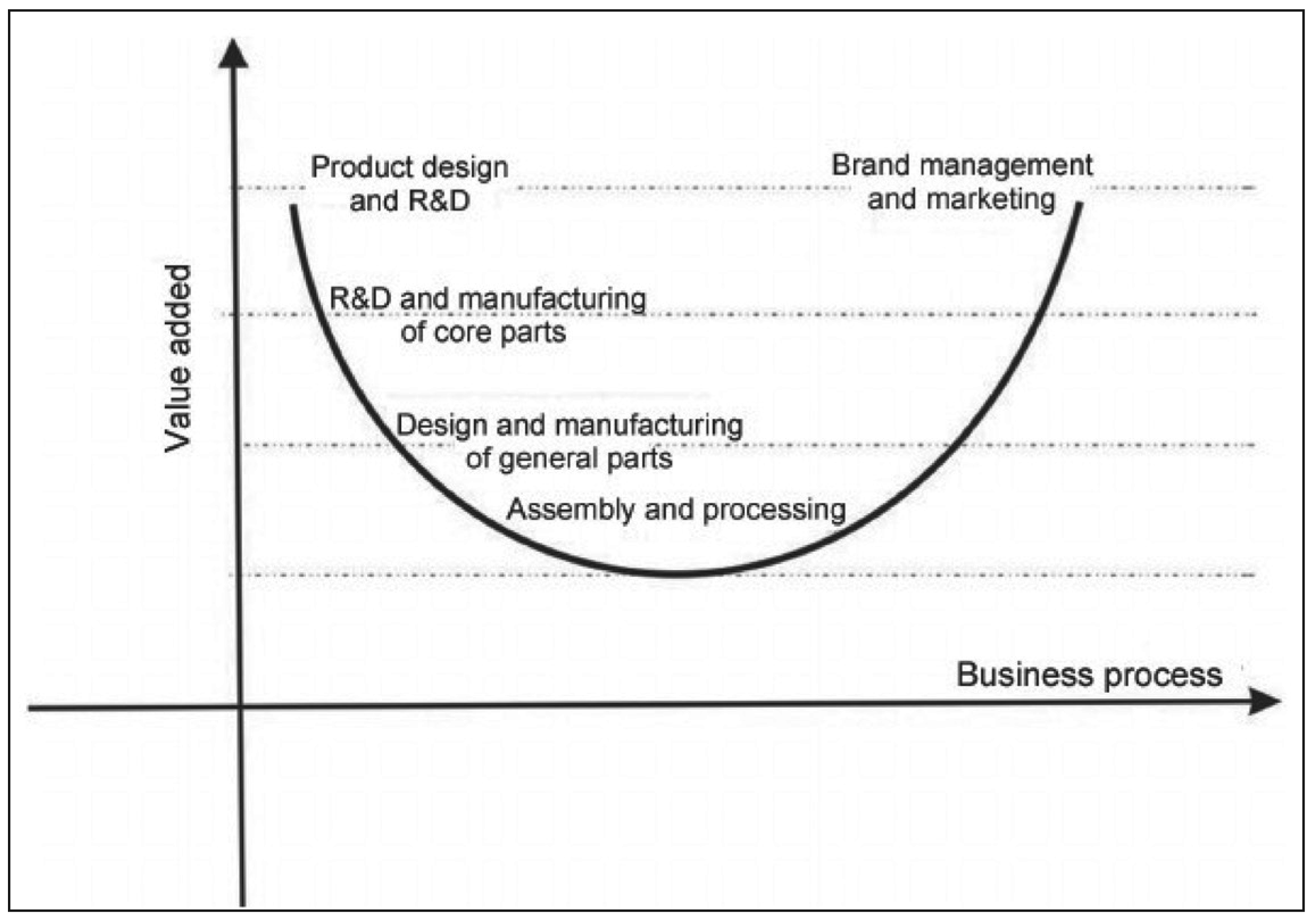
Other scholars propose an OEM–original design manufacturing (ODM)–own brand manufacturing (OBM) developmental trajectory and argue that latecomers should follow this path of ‘technological learning’ by developing processing capabilities first, followed by product-design capabilities, and finally their own product-branding capacities (Hobday, 2000; Liu, Liu, & Lin, 2008). The ‘smile curve’ thesis espouses the benefits of foreign direct investment in facilitating spillover of innovation and helping to achieve productivity growth. However, this thesis fails entirely when facing challenges created by the inequality of the international division of labour that evolved into a new stage in the 1980s in the process of globalisation where multinational corporations began outsourcing their production lines overseas and utilising cheap sources of manufacturing labour in developing countries (Xue & Chan, 2013).
Several manufacturers whom we interviewed complained about the low profit margins experienced by OEM factories such as theirs, irrespective of whether they operate as components suppliers or engage in assembly operations. Mr. Guan of Factory H, for example, told us that while his company sold a motorcycle helmet for the US$25 ex-factory price, the retail price would typically be six times higher, which meant that the majority of the product’s profits were captured by another entity in the value chain. Similarly, Mr Wang of Factory C, which has tried very hard to develop its own brands, hazarded an estimate that OEM accounted for only 30 per cent of product value, while 70 per cent of that value is captured by brand owners for design, development and marketing.
With a net profit rate of only 3–4 per cent, Factory H is now engaging in functional upgrading to develop its own-brand bicycle helmet for the domestic (Chinese) market. By so doing, Factory H has in fact has elevated to ODM and developed a strong R&D department. The vice-manager explained to us the incompatibility between OEM/ODM and OBM:
Some of the top brands in sports helmets have asked us to produce their helmets. If I create my own brand, they won’t be willing to give orders to me as I’ll be their competitor. If you were the top brand, would you give me an order? Obviously not! Why? Because how does the top brand manufacturer know that I won’t copy him? To be safe, they won’t give me any orders, so as not to share knowhow with me. And when that happens, we receive orders only from second- and third-tier brands who want to make use of me, utilize my R&D capacity to create better products for themselves.
The ‘knowhow’ involved with helmet design pertains to understanding safety protection, selecting appropriate lightweight materials, identifying where in the helmet to maximise safety and creating a fashionable appearance. He explained that for the own-brand helmet that he produces for the domestic Chinese market, he cannot use any of the ‘knowhow’ that his clients possess. Moreover, he also needs to clearly report the ‘knowhow’ involved in the new design of his company’s domestic brand to his clients and obtain their approval.
Factory H produced the entire helmet from scratch. Despite that, he knows very well that his clients are able to keep the essence of their own technology a secret. Some scholars argue that the global division of labour will reduce global inequality in technological development when advanced multinationals consider technology spillovers to developing countries that are gradually catching up in their competencies. Over time, firms that carry out low-value-added functions seek to move up the value chain by developing their own brands rather than merely being suppliers (Mudambi, 2008).
Although it seems unlikely that technological change itself can help Factory H overcome this OBM barrier to international markets, the management team feels an urgent need to engage in functional upgrading. The factory was established in 2011 and began functional upgrading in 2014 by adopting automated painting, CNCs, and robotised bicycle helmet vent-hole cutting as well as installing other automated equipment. From 2014 to 2016, the factory invested 4.5 million yuan in upgrading production and reduced the workforce from 93 to only 36 workers. This had the dual results of doubling production and improving the production qualification ratio.
In this case, one catalyst for functional upgrading derives from difficulties in recruiting younger workers who are willing to endure the noisy, dusty, injury-prone environment of the shop floor where helmet vent holes are cut and work in the often-toxic conditions that characterise helmet painting. From this perspective, functional upgrading benefits the employer by allowing the company to move up the value chain through creating its own brand of product, but it has a mixed impact on workers.
This final case of factory H corresponds to the third form of industrial upgrading distinguished in Humphrey and Schmitz’s (2002) taxonomy: functional upgrading. One significant implication of functional upgrading is that new functions, such as design, marketing and branding, are taken on board by the manufacturer who had previously not performed such tasks (and was content with merely supplying other firms who took on the responsibilities of designing, marketing and branding). Factory H is an example of automation employed for allowing a manufacturer to move up the value chain so as to capture a greater share of the overall profits from the final sale of an item (in this case a helmet) to the final customer.
Conclusions
We have presented three cases of industrial upgrading in Dongguan that were fuelled in part by the government’s ‘Replacing Humans with Robots’ policy. Although the data we report reflect the perspectives of factory owners and managers, those perspectives contribute to understanding an issue that runs throughout this research. What are the implications of the types of industrial upgrading we document for individual workers and the broader Chinese workforce? While this question might not indicate the existence of a serious problem insofar as the general climate that prevails continues to feature a labour shortage in the region we studied, the sustainability of the ‘Replacing Humans with Robots’ policy will surely face greater scrutiny as its launch moves into large-scale implementation. From the perspective of workers, there are two issues worth considering.
First, the path towards industrial upgrading, while paved with various incentives and driven by market forces (from the perspective of manufacturing plant owners/managers), raises important questions about the livelihoods of individual workers. What happens to workers who are laid off after the manufacturers who employ them reduce their workforces through automation? Their choices seem to fall along a spectrum that ranges from reskilling (retraining) to upskilling (through education) to simply moving to another factory that has not yet embraced the wave of industrial upgrading that the government is trying to promote (Huang & Sharif 2017).
Second, at an aggregate level, there seems little doubt that Dongguan’s drive towards industrial upgrading will eventually push a sizeable segment of the workforce into either unemployment or underemployment. The extent to which such changes in employment occur depend on the strength of the market imperatives forcing employers to change, the attractiveness of the incentives offered to them, and the rate at which employers take up those incentives. This is an issue that neither the ‘MiC2025’ plan nor employers in general are comfortable addressing seriously (Sharif & Huang, 2019). This neglect can only delay the inevitable, given the building momentum of the push towards industrial upgrading that is occurring throughout southern China in particular.
In terms of the research presented in this article, two standout themes tie the cases together. The first is the desire to enhance profitability. This is seen in the three motivations that explain why manufacturers choose to engage in industrial upgrading: increasing quantity of output, increasing the quality of the manufactured product and moving up the value-added chain with a view to reaping a greater share of the profits associated with the product sales.
Conceptually, these motivations map onto the theoretical framework of multiple types of upgrading that were identified in Humphrey and Schmitz’s (2002) taxonomy of upgrading. None of the SMEs in our sample seemed, however, to engage in inter-sectoral upgrading (moving into entirely new sectors or chains). Perhaps, this is to be expected, given that our sample comprised SMEs rather than large firms or SOEs. SMEs are much less likely than the latter types of firm to command the organisational slack and spare resources required to engage in inter-sectoral upgrading. To this extent, our findings echo those of Pietrobelli and Rabellotti (2007), who showed that supplier firms (like those in our research) find it easier to accomplish process and product upgrading than functional and inter-sectoral upgrading. That said, our final case did involve an SME that was attempting to threaten the hierarchical control of lead firms by engaging in functional upgrading.
We have seen that workers have found themselves on the front lines of the production upgrading that the Dongguan government has encouraged through its recent automation initiative. With such upgrading likely to spread across manufacturing sectors in the Pearl River Delta, the roles that workers are asked to play raise questions about how to promote and safeguard their interests. Where manufacturing firms lack incentives to defend or promote their workers’ interests, only the state has the rationale—and resources—to do so. This leads us to wonder when or how, in the context of the central government’s MiC2025 plan, the state will acknowledge Chinese workers in a way that reflects the focus and resources that are pouring into various modes of industrial upgrading. We hope that future research will focus on the implications of industrial upgrading for workers whose livelihoods are at stake.
A second theme is that all of our cases discuss industrial automation. Whereas earlier authors have focused on industrial upgrading along the global value chain (cf. Humphrey & Schmitz, 2002), few have discussed the issue of upgrading in the context of industrial automation, even less so in southern China. We do so by employing their theoretical framework drawn from the global value chain literature to parse out the various forms of industrial upgrading and show how these distinct forms of upgrading act as the rationales for manufacturers to engage in upgrading activities. Future research should encompass not only the three forms of upgrading we observed—process, product and functional—but also the fourth form, inter-sectoral upgrading, to understand how each form of upgrading differentially affects workers.
Footnotes
Declaration of conflicting interests
The authors declared no potential conflicts of interest with respect to the research, authorship and/or publication of this article.
Funding
The authors received no financial support for the research, authorship and/or publication of this article