







Abstract
The Triple Helix relationship among government, industry, and universities is regarded as a crucial source of technological innovation and sustainable economic development. However, little is known in existing research about how the Triple Helix achieves collaborative innovation within hybrid organisations. Drawing on institutional logics theory, this study addresses this gap from the perspective of entrepreneurship. We propose a new concept, the ‘Triple Helix entrepreneurship’, and regard it as the core mechanism that drives Triple Helix within hybrid organisations to achieve collaborative innovation. Based on a case study of the International Institute of Acoustic Technology (IAT) in ‘Suzhou•China Acoustic Valley’, we identify the specific connotations of Triple Helix entrepreneurship along four dimensions: logic configuration, role positioning, mission pursuit, and value evaluation. We further explain how this entrepreneurship drives the process of collaborative innovation among the Triple Helix within hybrid organisations, and how it differs from other types of entrepreneurship. Our case study not only provides new insights into the microfoundations of the Triple Helix theory, but also expands, at the cognitive level, the strategies by which hybrid organisations cope with institutional complexity, while further enriching the typology of entrepreneurship.
Introduction
Deep collaboration among government, industry, and universities has become a key engine for enhancing national innovation capacity (Wang et al., 2024; Zhou & Wang, 2023). The Triple Helix theory provides an important analytical framework for understanding how these three actors interact in the process of collaborative innovation (Etzkowitz & Leydesdorff, 2000). This theory points out that, in order to achieve close collaboration among the three helixes, all parties must move beyond the traditional scope of product innovation and actively cultivate hybrid organisations that link different institutional spheres, such as incubators, science parks, and venture capital firms (Etzkowitz, 2003). However, existing literature has mainly focused on the creation process of such hybrid organisations (Champenois & Etzkowitz, 2018) and their impact on innovation performance (Hu et al., 2023; Jiang et al., 2023; Wonglimpiyarat, 2016). Few studies have explored the interaction processes among different helix entities within hybrid organisations (Perkmann et al., 2019; Scillitoe & Chakrabarti, 2010), particularly the processes of how the three helixes achieve collaborative innovation within such hybrid organisations (Champenois & Etzkowitz, 2018).
Research indicates that multiple competing and conflicting institutional logics coexist within hybrid organisations (Ingstrup et al., 2021). Effectively managing the complexity among these multiple institutional logics is a critical step in determining the efficiency and quality of innovation within hybrid organisations (Reay & Hinings, 2009). Previous solutions have focused on the separation and integration of organisational structures (Greenwood et al., 2011; Pache & Santos, 2013; Perkmann et al., 2019). In this article, we propose a more dynamic governance mechanism: entrepreneurship. As a product of specific institutional logics, entrepreneurship not only manifests as a pattern of cognition and behaviour unique to actors and shaped by the institutional environment (Ocasio et al., 2017), but is also embedded in a complex field constructed by multiple institutional logics (Greenwood et al., 2011), with important functions in identifying, leveraging, and even reconstructing institutional rules, integrating heterogeneous resources, and creating emerging value (Besharov & Smith, 2014). Therefore, we propose that within hybrid organisations (acknowledged as embedded within multiple institutional logics; see Cai, 2015), collaborative innovation among the Triple Helix depends on entrepreneurship. However, existing literature has failed to explore entrepreneurship in this context, its connotations, and how it facilitates the collaborative innovation of the Triple Helix within hybrid organisations remain understudied.
Through in-depth field investigations and interviews, we endeavour to address the gaps in the existing research. We select the International Institute of Acoustic Technology (hereafter ‘IAT’), a hybrid organisation situated within ‘Suzhou•China Acoustic Valley’, as our research subject. The Acoustic Valley was chosen as the research backdrop not only because it brings together the key participants of the Triple Helix model-government, industry, and academia-but more importantly, because it provides a unique research and innovation ecosystem that enables and nurtures organisations like IAT. IAT serves as the micro-level infrastructure and operational platform for the Triple Helix to achieve collaborative innovation within Acoustic Valley, and as a crucial vehicle for the emergence of entrepreneurship. Specifically, through the analysis of the above research targets, this study aims to answer the following questions: (a) What kind of entrepreneurship emerges in the Triple Helix context, and what are its distinct connotations? (b) How does this entrepreneurship drive the Triple Helix to achieve collaborative innovation within hybrid organisations? (c) How does this entrepreneurship in the Triple Helix context differ from other types of entrepreneurship?
Literature Review
The Triple Helix Model and Its Microfoundation
The Triple Helix theory provides a critical analytical framework for understanding the close cooperation among government, industry, and universities. Specifically, Triple Helix collaboration manifests in three primary forms (Etzkowitz & Leydesdorff, 2000; Ranga & Etzkowitz, 2013). First, the statist model, in which the state controls academia and industry. China largely followed this model in the early stage of its market-oriented reforms (Yang & Liu, 2021). Second, the laissez-faire model, in which each helix remains independent and separate from the others. In this model, industry is the driving force, while government and universities serve as auxiliary supporting structures (Etzkowitz, 2003). Finally, the balanced model, in which government, industry, and universities overlap and complement one another. In this model, three helixes can achieve innovation collaboration through overlapping roles and partnerships while maintaining institutional independence and parity (Ivanova & Leydesdorff, 2014). It is therefore the direction toward which most countries are currently striving.
The Triple Helix theory points out that, in the process of dynamic interaction, Triple Helix gives rise to new organisational forms and institutional arrangements—namely ‘innovation in innovation’, such as venture capital firms, incubators, science parks, and other types of hybrid organisations (Etzkowitz, 2003). These organisations sit at the intersection of different institutional spheres and therefore integrate resources and elements from all three domains of the Triple Helix, becoming key carriers and micro-level foundations for studying collaborative innovation within the Triple Helix (Etzkowitz, 2008; Ranga & Etzkowitz, 2013). Champenois and Etzkowitz (2018) refer to these hybrid organisations as ‘boundary spaces’ to describe boundary forms that integrate elements from overlapping domains. Within such spaces, various shared forms of knowledge and innovative solutions from government, industry, and universities are brought together, effectively promoting cross-domain resource integration and the evolution of innovation ecosystems.
Many countries have invested heavily in fostering these hybrid organisations (Aerts et al., 2007; Etzkowitz et al., 2005; Wright et al., 2006). Taking China as an example, since 2010, governments across China have institutionalised their support for hybrid organisations by explicitly designating entities such as ‘new-type R&D institutions’ as priority targets in relevant legislation (Jiang et al., 2023). Organisations such as Tsinghua University Research Institute in Shenzhen and the Jiangsu Industrial Technology Research Institute are representative examples of this model. These organisations have achieved remarkable results in promoting the commercialisation of scientific and technological achievements and in driving regional economic development (Li et al., 2020; Shui et al., 2024). For example, Wang et al. (2024) find that new-type R&D institutions contribute to the cultivation and construction of provincial innovation ecosystems. Zhou and Wang (2023) also show that such institutions help to foster emerging technology firms.
Multiple Institutional Logics and Entrepreneurship
Research indicates that in a Triple Helix context, hybrid organisations integrate multiple institutional logics—such as bureaucratic, corporate, and professional logic (Ingstrup et al., 2021; Sarpong et al., 2017). Institutional logic is defined as ‘socially constructed, historically contingent material practices, assumptions, values, beliefs, and patterns of rules through which individuals produce and reproduce their material lives, organise time and space, and ascribe meaning to their social reality’ (Thornton & Ocasio, 1999). Institutional logics not only shape the interests, identities, and beliefs of social actors (Thornton et al., 2012) but also shape and create the rules of the game (Thornton & Ocasio, 1999). It is characterised by both multiplicity and complexity (Thornton et al., 2012). The relationships between institutional logics are diverse, encompassing conflict, competition, or integration (Reay & Hinings, 2009), and these dynamics significantly influence the strategies and actions adopted by organisations.
When these logics coexist and compete within a hybrid organisation, on the one hand, they can give rise to innovative breakthroughs that simultaneously exhibit academic frontiers and responsiveness to social needs (Song et al., 2022); on the other hand, they can easily lead to ambiguity and conflict in terms of organisational identity, goals, and governance (Perkmann et al., 2019; Sauermann & Stephan, 2013). Therefore, how to balance these incompatible institutional logics is crucial for collaborative innovation within hybrid organisations. However, the existing literature mainly analyses how institutional logics influence the structures and types of hybrid organisations from a macro perspective (Cai, 2014, 2015). Few studies have explored how to manage institutional complexity within hybrid organisations to enable Triple Helix collaborative innovation.
According to institutional theory, entrepreneurship is shaped by particular institutional logics (Ocasio et al., 2017). Different institutional logics generate entrepreneurial behaviours with distinct institutional representation, such as innovation, adventure, and initiative. By shaping key issues and constructing the decision-making content of problem-solving solutions, institutional logic directs the allocation of entrepreneurs’ attention, thereby activating identities, goals, and schemas in specific contexts (Thornton et al., 2012). Thus, entrepreneurship represents the cognitive-level microfoundation of institutional logics. This cognitive foundation organically integrates institutional at the macro level with organisational practices at the micro level. In this study, the Acoustic Valley converges the multiple institutional logics adhered to by different innovation actors. These logics not only construct a unique innovation ecosystem for the IAT but also cultivate a highly dynamic entrepreneurship, providing continuous intrinsic motivation for collaborative innovation within the IAT. Therefore, it is necessary to conduct a systematic analysis of the internal structure and operating mechanisms of this form of entrepreneurship.
Method
Research Methodology
We adopt a single-case study method for the following reasons. First, our aim is to explore how entrepreneurship drives the Triple Helix to achieve collaborative innovation within hybrid organisations, which falls into the typical ‘how + why’ category of research questions (Yin, 2013). The Acoustic Valley within which IAT is placed provides a crucial research context for analysing the internal mechanisms and processes of this issue, serving as a key part of achieving this aim. Second, compared with multiple-case studies, a single-case study allows for more in-depth analysis of phenomena and more refined construct development (Eisenhardt, 1989).
Case Selection Principles
We select IAT in Suzhou•China Acoustic Valley for three reasons: (a) Principle of typicality and representativeness. IAT is a new type of research institution, representing a classic Triple Helix hybrid organisation; (b) Principle of heuristic value. IAT has already achieved substantial results in acoustic areas, offering useful practical and theoretical insights for similar organisations; (c) Principle of data accessibility. Our team has conducted multiple site visits and built cooperative relationships with internal members.
Data Collection
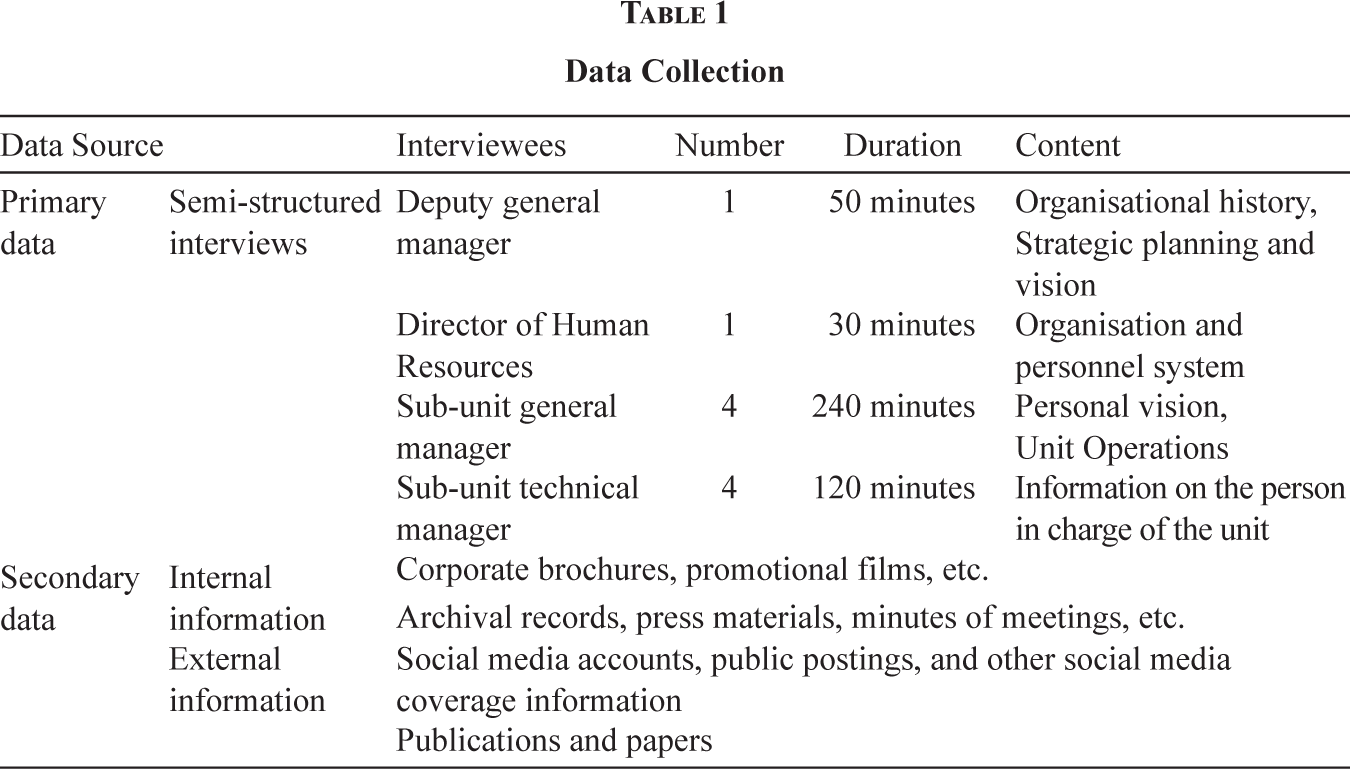
To ensure the authenticity and reliability of the data, we followed the principle of triangulation (Eisenhardt, 1989) and collected data through multiple channels (as shown in Table 1), including: semi-structured interviews (Date: February to April 2025); participatory observation; and archival documents.
Data Collection
Overview of Suzhou•China Acoustic Valley
For studying coordinated innovation among the Triple Helix, Suzhou•China Acoustic Valley provides an ideal example. This Acoustic Valley brings together multiple forces, including government, industry, and universities, thereby enabling detailed observation of their interactions and collaborations. The following sections will detail the landscape of the Acoustic Valley.
Establishment Background
Suzhou•China Acoustic Valley, is located in the Changshu Economic and Technological Development Zone. It was jointly launched in 2020 by multiple entities, including the Chinese Acoustical Society, Nanjing University, and the Suzhou Municipal Government, with implementation led by the Changshu Municipal Government. The Acoustic Valley was established during a pivotal period of rapid growth in China’s digital economy and digital transformation of traditional industries. It represents a typical case of the Changshu Municipal Government responding to the central government’s call to accelerate the cultivation of future industries and strategic emerging sectors, and to foster new productive forces.
Leveraging Suzhou and the Yangtze River Delta’s advanced manufacturing clusters, the Acoustic Valley focuses on acoustic technology innovation and breakthroughs. It aims to build a national-level modern industrial demonstration centre integrating innovation chains and industrial chains. Since its launch, the Acoustic Valley has grown into a comprehensive innovation ecosystem integrating industrial resources, technological breakthroughs, talent cultivation, and urban development. It has been successively incorporated into the ‘Implementation Plan for the 14th Five-Year Plan of the Yangtze River Delta Integration Development’, the ‘Outline of the Development Plan for the Southern Jiangsu National Independent Innovation Demonstration Zone’, and the ‘Suzhou Municipal 14th Five-Year Plan’. It has also been listed by the Suzhou Municipal Government as a key industrial innovation cluster receiving priority support. 1
Construction Progress
To advance the development of Acoustic Valley, the Suzhou and Changshu Municipal Governments have successively introduced a series of supportive policies.
Regarding funding, the government has actively established a systematic financial support framework. Through a ‘government-guided, market-driven’ mechanism, the government has integrated state-owned, private, and industrial capital sources to establish the China Acoustic Valley Equity Investment Fund with a total scale of 1 billion yuan. Simultaneously, to expand financing channels for enterprises, the government has built an acoustic industry financial service platform. This platform features specialised funds tailored to different growth stages, with a total fund scale exceeding five billion yuan, covering the entire lifecycle from startup to IPO. 2 Regarding talent, the government implemented the ‘Acoustic Talent Matrix Project’, introducing initiatives such as the ‘Acoustic Top Talent (Team) Leadership Programme’, the ‘Acoustic Core Talent Residency Programme’, and the ‘Seagull Plan’ for overseas talent. 3 These programmes provide financial incentives, employment/HR support, and honorary titles to individuals or teams.
Through these policy initiatives, to date, ‘Suzhou•China Acoustic Valley’ has accumulated over 27 billion yuan in investments. Acoustic Valley possesses several acoustic innovation platforms, including IAT, Suzhou Acoustic-Optical Micro-Nano Technology Research Institute, Suzhou Guorong Frontier Technology Research Centre, and Jiangsu Provincial Acoustic Industry Technology Innovation Centre. The Jiangsu Provincial Acoustic Industry Technology Innovation Centre has been recognised as a provincial-level new R&D institution, Suzhou’s Mass Entrepreneurship and Innovation Centre incubation base, and an acoustic industry-academia-research collaborative innovation base. 4 Currently, Acoustic Valley is developing a series of high-standard parks, including the China Acoustic Valley Science and Technology Industrial Park, the Acoustic Valley Innovation Acceleration Centre, and the Yangtze River Delta (Changshu) International Advanced Manufacturing Industrial Park.
Industrial Layout
With the mission of driving acoustic technology innovation and building an acoustic industry innovation ecosystem, Suzhou•China Acoustic Valley has organised its industrial layout around six key areas: materials acoustics, information acoustics, medical acoustics, marine acoustics, engineering acoustics, and electroacoustics. The Acoustic Valley prioritises supporting acoustic technology development in advanced acoustic functional materials, smart electroacoustics, and automotive acoustics, serving diverse sectors including aerospace, communications, healthcare, and environmental applications. It plays a vital role in driving regional economic growth and enhancing the quality of life. In the future, the Acoustic Valley will concentrate on three core industries—material acoustics, electroacoustics, and marine acoustics—to pioneer new industrial avenues in smart cockpits, urban noise reduction, consumer electronics, and marine exploration.
Enterprises and Talents Attraction
Suzhou•China Acoustic Valley has attracted a large number of enterprises and high-level talents to settle in (see Table 2). To date, over 200 enterprises have settled in Suzhou•China Acoustic Valley. Currently, the Acoustic Valley has formed a distinctive industrial cluster represented by outstanding enterprises such as Hengtong Huahai, Nanzhi Xincai, Jinyi New Materials, Baijiali and Himalaya. Among them, Hengtong Huahai is a national-level unicorn enterprise, Jinyi New Materials was selected as a gazelle enterprise in the Southern Jiangsu National Independent Innovation Demonstration Zone, and Baijiali was recognised as a national ‘Little Giant’ enterprise specialising in niche markets and a national high-tech enterprise. Himalaya is the industry leader in China’s online audio market. These enterprises cover multiple niches, including acoustic sensing, smart audio, noise control, and ultrasonic technology.
Institutions and Core Scientific Research Metrics of Suzhou, China, Acoustic Valley
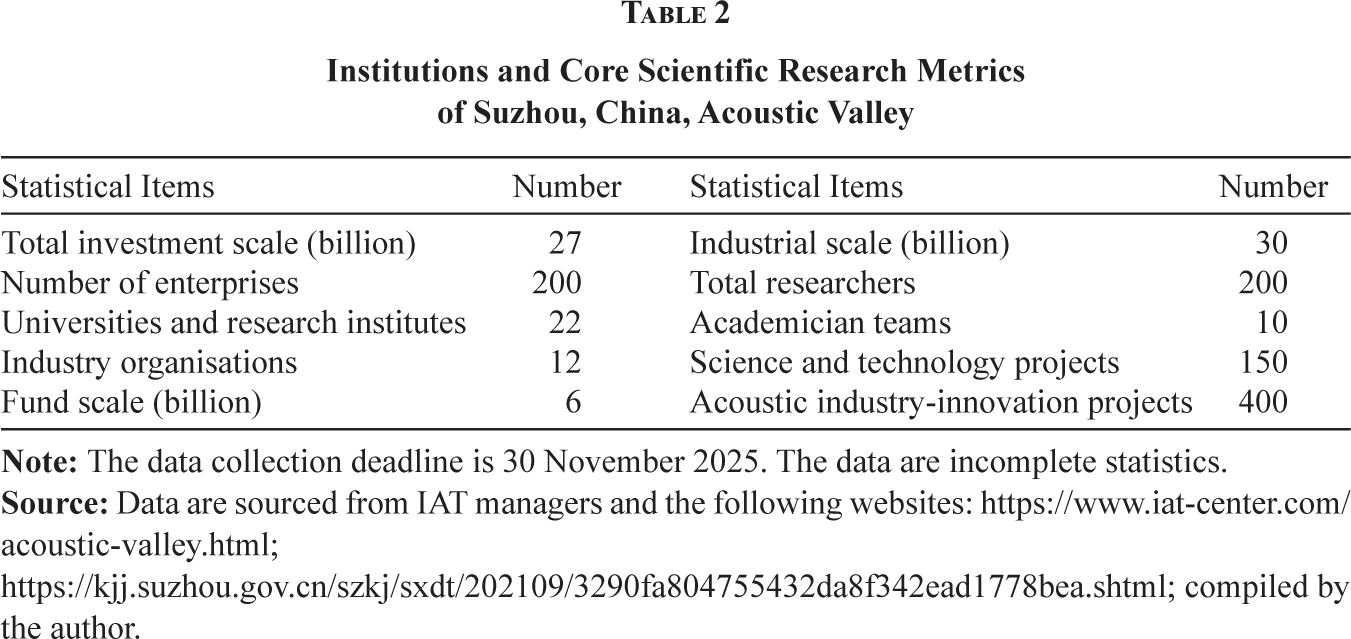
Additionally, the Acoustic Valley attracts numerous universities and research institutions, and collaborates with Nanjing University, Harbin Engineering University, Suzhou University of Technology, and the Chinese Acoustical Society to establish multiple joint R&D platforms and talent training bases. For instance, the Acoustic Valley and Nanjing University jointly founded the ‘Suzhou•China Acoustic Valley Joint Laboratory’ and the ‘Suzhou•China Acoustic Valley’ Technology Transfer Centre. It has also partnered with Suzhou University of Technology to establish the Modern Acoustics Technology Industry College. The Acoustic Valley actively recruits top global talent in acoustics. To date, it has successfully attracted over 200 high-level acoustic innovation professionals, including more than ten academician teams. Through university-enterprise collaborations and industry-education integration, the Acoustic Valley has cultivated a large pool of applied talents.
Innovation Achievements
In terms of fundamental innovation, ‘Suzhou•China Acoustic Valley’ has undertaken over 400 acoustic technology projects and introduced more than 150 acoustic industry-innovation projects. In application innovation, enterprises within the Acoustic Valley actively explore cutting-edge technologies driven by both national strategy and market demand. For instance, Bai Jiali has dedicated itself to developing quiet, eco-friendly building materials, applying polyethene terephthalate (PET) acoustic materials in construction and office settings to provide customers with green, comfortable, low-noise living environments. The urban ‘noise map’ developed with IAT’s participation offers crucial technical support for urban noise reduction. The Acoustic Joint Testing Centre has obtained China National Accreditation Service for Conformity Assessment (CNAS) and China Inspection Body and Laboratory Mandatory Approval (CMA) accreditation. Earth Mountain Microelectronics Technology Co., Ltd. successfully developed the world’s first digital micro-electro-mechanical system (MEMS) acoustic-emitting chip. These representative achievements not only serve as exemplary technological advancements across the entire acoustics industry but also provide scientific solutions for social governance and urban development.
Additionally, Acoustic Valley attracts enterprises by hosting events such as acoustic conferences and forums, including the inaugural China Acoustic Industry Innovation and Development Conference, the first Acoustic Quality Design and Evaluation Conference, the China (Suzhou) Acoustic Industry Expo, and the Automotive Intelligent Cockpit Acoustic Evaluation and Design Conference. Regarding standard-setting, in 2023, Acoustic Valley collaborated with CCID Consulting Co., Ltd. to release the China Acoustic Industry Development Index (Changshu Index). This index is China’s first nationally named regional acoustic industry development index, dedicated to scientifically assessing the dynamics of China’s acoustic industry and providing a foundation for industry planning. 5
In summary, almost all enterprises within the Acoustic Valley face multiple demands from government, industry, and academia. How these enterprises manage the heterogeneous needs and diverse claims of different participants becomes a critical factor determining the quality of their innovation. Therefore, in the next section, this study focuses on IAT—a core enterprise within the Acoustic Valley—to conduct an in-depth analysis of how the Triple Helix achieves collaborative innovation within this hybrid organisation. This provides a crucial foundation for revealing the microfoundations of the Triple Helix.
Collaborative Innovation of the Triple Helix in Hybrid Organisations: The Case of IAT
As noted above, our main objective is to explore the collaborative innovation process of Triple Helix in hybrid organisations. We propose that the process is driven by entrepreneurship. To distinguish it from previous forms of entrepreneurship, we label entrepreneurship within the Triple Helix context as ‘Triple Helix entrepreneurship’. In the following section, we will elaborate on the connotations of this form of entrepreneurship along four dimensions—logic configuration, role positioning, mission pursuit, and value evaluation—and explain the process mechanisms through which it drives collaborative innovation within hybrid organisations.
Case Background
Our target case is the International Institute of Acoustic Technology (IAT). IAT is a new type of R&D institution and hybrid organisation jointly funded and established in 2020 by the Changshu Municipal Government and Nanjing University. As the innovation hub of Acoustic Valley, IAT not only undertakes core functions such as acoustic industry strategy, technology platform establishment, talent recruitment, and enterprise incubation, but also handles MEMS manufacturing, acoustic testing and certification, corporate consulting, and technology transfer. The number of patents in different industrial areas of IAT is shown in Table 3. It operates five major public testing platforms and has cumulatively incubated or is incubating more than sixty enterprises, such as Huizhiyuesheng (Suzhou) Medical Technology Co., Ltd. and Suzhou Acoustic Inspection and Testing Co., Ltd.
Patent Data of IAT
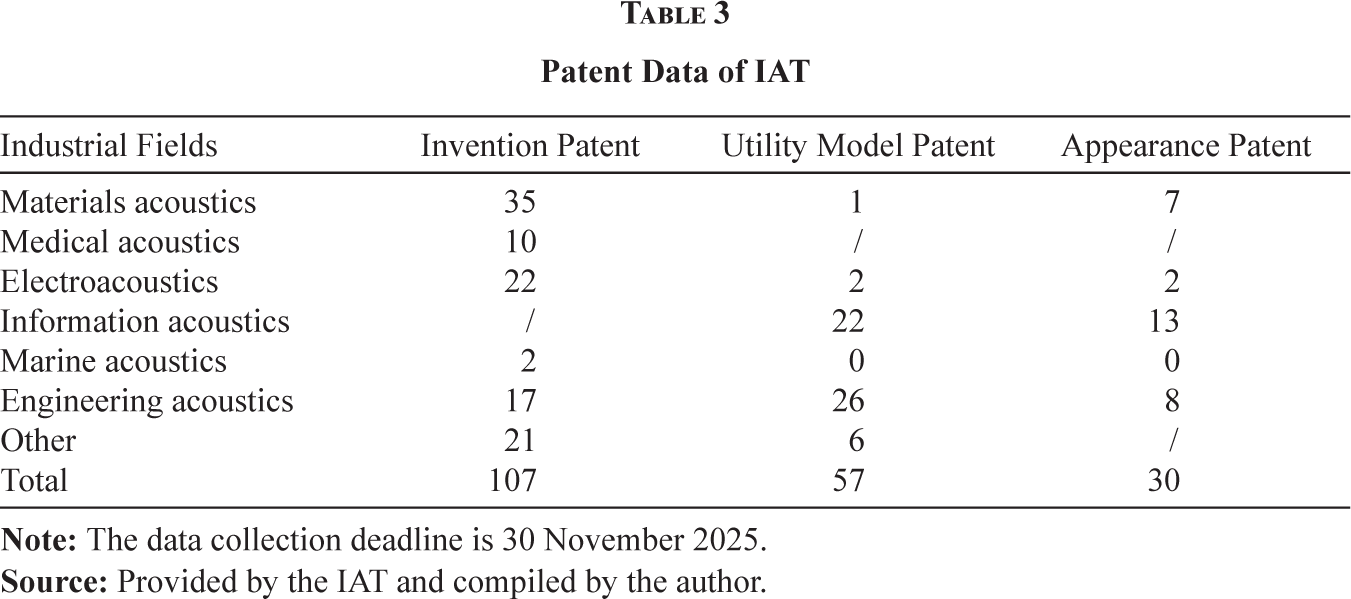
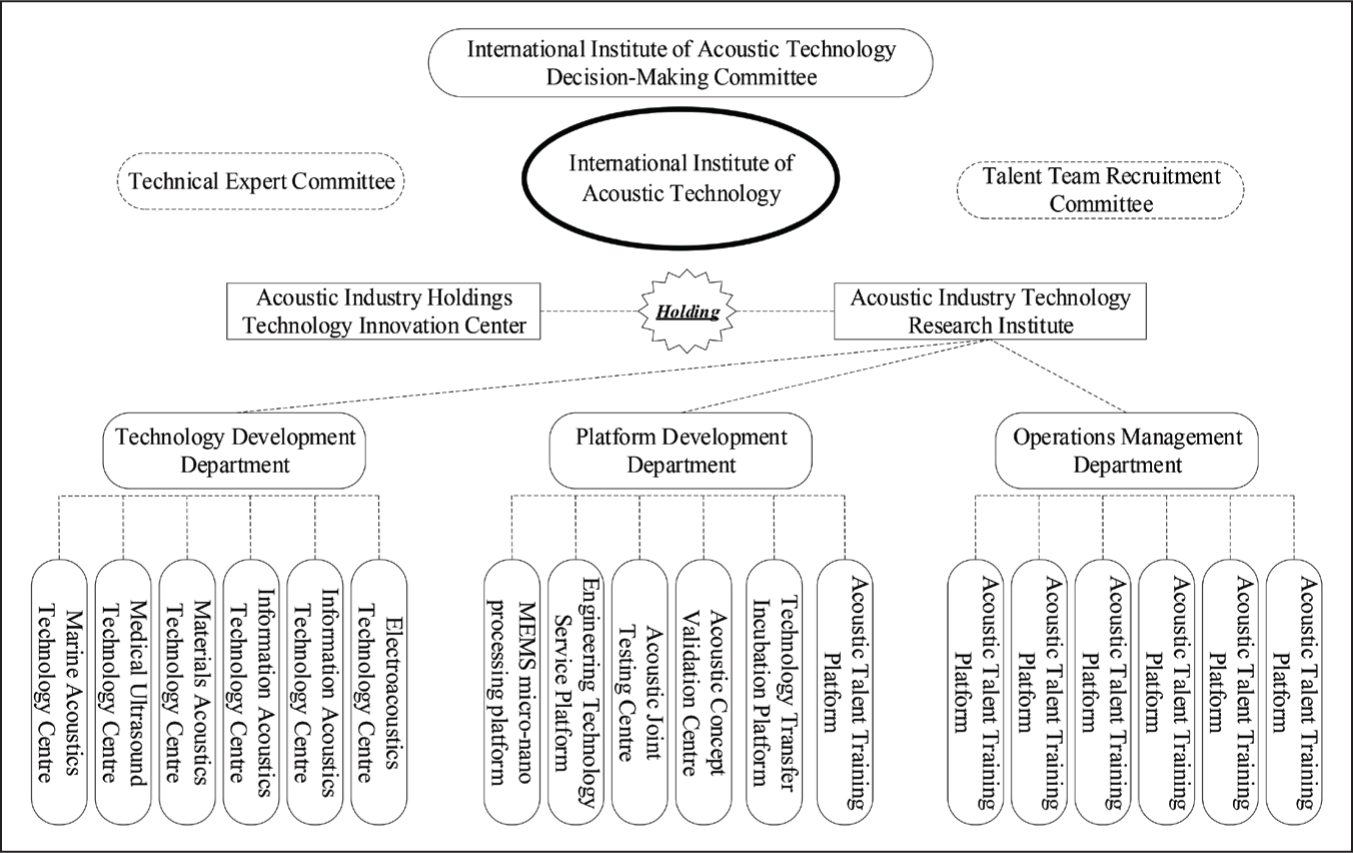
Figure 1 illustrates the organisational structure of IAT. The Decision-Making Committee, serving as IAT’s highest decision-making body, comprises members from government, academia, and industry. It is primarily responsible for strategic decisions and major project assignments. IAT consists of two entities: (a) a government-affiliated institution, the Jiangsu Acoustic Industry Technology Innovation Centre; and (b) a corporate entity, the Suzhou Acoustic Industry Technology Research Institute Co., Ltd. (hereinafter ‘SAT’). The former undertakes IAT’s public service functions, such as undertaking national projects and establishing experimental platforms. The latter serves as IAT’s market operation entity. It comprises three main divisions: The Technology R&D Department focuses on achieving theoretical breakthroughs in cutting-edge technologies and incubating acoustic enterprises. The Platform Development Department primarily provides material preparation, testing and analysis, team building, and personnel training. The Operations Management Department primarily undertakes the strategic execution, daily operations, and business collaboration tasks for IAT.
Organisational Structure of IAT
The Connotation of Triple Helix Entrepreneurship
The Institutional Logic Configuration of Triple Helix Entrepreneurship
Since the Acoustic Valley converges forces from multiple sectors, including government, industry, and universities, the IAT finds itself at the intersection of multiple institutional logics: administrative, academic, and market. All three institutional logics shape the Triple Helix entrepreneurship, yet these logics also confront conflicts and competition.
Administrative Logic
Administrative logic refers to the way government departments use administrative means to regulate and guide firms’ economic activities, ensuring their innovation behaviour aligns with national strategic needs. As mentioned above, to accelerate the overall development of the Acoustic Valley, the Suzhou and Changshu Municipal Governments have introduced a series of preferential policies, such as taxation, public finance and intellectual property protection, providing strong support for resident enterprises and high-end talent. As a core enterprise within the Acoustic Valley, IAT not only benefits from these government policies but is also responsible for actively implementing the above policies. When initiating research projects, IAT’s managers must align with national and local policy priorities. For example, IAT produced an urban ‘noise map’ for Changshu, providing critical data support for the monitoring and control of urban noise pollution.
Academic Logic
Academic logic refers to the beliefs and norms that govern the behaviour of universities, research institutions, and their researchers. IAT brings together s cholars and talent teams from many well-known universities and research institutes at home and abroad. Its executive dean is a professor from Nanjing University, and to date it has introduced five national-level top acoustic talent teams, and has carried out exchanges and cooperation with multiple research institutions such as Nanjing University, Harbin Engineering University and the Institute of Acoustics of the Chinese Academy of Sciences. In the last five years, IAT has cumulatively trained forty-eight PhDs and forty-four Masters. Numerous master’s and doctoral students conduct scientific research and practice there (internal archives). As a result, IAT has a very strong academic atmosphere, and each research team systematically advances scientific innovation around basic research, the publication of high-level papers, and the application for high-value patents.
Market Logic
Market logic is a behavioural logic oriented toward the pursuit of profit and profit maximisation (Thornton et al., 2012). Although IAT undertakes public service functions such as business incubation and platform building, its ultimate goal is to promote the transformation and industrialisation of technological achievements. As the market-oriented operating entity of IAT, SAT is committed to advancing technology transfer through independent R&D and project incubation. At present, IAT’s technologies and products have been applied in multiple fields. For example, its active noise reduction technology has helped many manufacturing enterprises solve production noise problems. In addition, IAT actively builds strategic partnerships with upstream and downstream enterprises—for instance, collaborating with automobile manufacturers (such as FAW Group, Geely) to develop in-vehicle electroacoustic products, and working with Suzhou Rail Transit Group on vibration and noise reduction projects for rail transit (internal archives).
It is through this market logic focused on industrialisation that IAT has steadily built a technology incubation service system spanning from technological innovation to industrial application. Operated primarily by SAT, IAT runs two major incubation platforms: the ‘Yangtze River Delta Acoustics Innovation and Entrepreneurship Incubator’ and the ‘Suzhou Acoustic Functional Materials and Devices Industry Incubator’. These incubators provide entrepreneurial services to emerging acoustic enterprises with market investment potential. To broaden financing channels for new ventures, the government has partnered with venture capital firms to establish multiple industrial investment funds within the Acoustic Valley, such as the Suzhou Acoustic Valley Dongzheng Zhixiang Venture Capital Fund. 6 The introduction of these venture capital funds has provided a key source of financial support for IAT’s enterprise incubation.
Leveraging its robust industrial resource integration capabilities, IAT has also established a technology transfer pathway spanning the entire industrial chain. First, by closely connecting up- and downstream enterprises, IAT can accurately identify the industry’s technological needs, providing front-end directional guidance for technology transfer. Second, through establishing an industry-academia-research collaborative network, IAT breaks down organisational barriers hindering knowledge flow, creating convenient channels for technology transfer. Finally, through operating mature incubator platforms, IAT rapidly configures industrial resources to provide comprehensive commercialisation services for technology transfer. Additionally, the government has established an Innovation and Entrepreneurship Service Centre within the Acoustic Valley (IESC), offering services such as policy consultation and project application. These services synergise effectively with IAT’s internal technology transfer pathways, jointly driving the successful transformation of acoustic technology innovations.
Challenges Arising from the Coexistence of Multiple Institutional Logics
Although when it comes to major issues, IAT can engage in consultation and discussion by regularly convening meetings of the ‘IAT Decision-Making Committee’, the differences in the institutional logics followed by departments still give rise to considerable tensions and frictions in the institute’s operations. For example, the staff of the Technology R&D Department primarily consists of expert teams whose thinking and behaviour are deeply influenced by academic logic. Many researchers have only a limited understanding of market needs and modes of industrialisation. This, in turn, creates substantial challenges for the Operations and Management Department. As one manager in the Operations and Management Department, Mr Wang, complained: The standard for industrialisation is whether something is suitable, but scientists’ research tends to be more basic and cannot meet the market.
In addition, some government policies focus on major breakthroughs or take boosting local GDP growth as their primary goal, making them difficult to fully implement in practice. A senior manager at the institute remarked,
We have received a lot of policy support from the government …. But the purpose behind these funds and policies is also very clear: they want us to turn cutting-edge technologies into products that can be brought to market and use technology to drive the local economy. For us … this is a considerable challenge.
The Entrepreneur’s Role Positioning Within Triple Helix Entrepreneurship
Although the entrepreneurs at IAT are confronted with diverse institutional demands from different organisations, our study finds that most of them demonstrate an outstanding capacity for balance and integration. Borrowing the concept of Besharov and Smith (2014), we refer to these entrepreneurs as ‘pluralists’. Pluralists are able to recognise and accept conflicting value systems within the organisation. They view opposing values as mutually reinforcing parts of an integrated whole (Besharov & Smith, 2014). For example, Xie, the deputy general manager of SAT, is a typical pluralist. Xie has experience in both government and business. At IAT, Xie assumes managerial responsibilities while also being deeply involved in technological R&D. This boundary-spanning experience enables him to deeply understand and flexibly address the demands of different domains.
Specifically, the entrepreneurs at IAT mainly play the following roles. First, they act as ‘integrators’ of diverse resources, capable of providing solutions to bridge different institutional elements. For example, in order to reconcile conflicts among IAT’s various departments, Deputy General Manager Xie established a coordination mechanism of ‘strict ex ante approval, ample authorisation during implementation, and routine ex post follow-up’. At the project initiation stage, projects are rigorously reviewed to ensure that they meet policy requirements; during the implementation stage, full authority is delegated to the technical teams, with the General Administration Department providing comprehensive support until the product is launched. In the commercialisation stage, IAT continues to provide services to enterprises through consulting, diagnosis, and other means, so as to ensure that their acoustic systems operate properly.
Second, they serve as ‘coordinators’ across different departments and domains. The entrepreneurs at IAT not only mediate relationships among various internal departments, but also coordinate the relationships between the firm and the government, and between the firm and the market. Drawing on their sensitivity to policy requirements and market trends, they precisely match resources coming from government, industry, and academia. On the basis of respecting and understanding the core demands of all parties, they facilitate consensus among all actors and promote their cooperation. For example, Lin, the general manager of IAT’s subsidiary B, remarked: Some challenges may arise from the inapplicability of certain policies … I am also trying to make some changes, such as communicating our plans with the government in advance and expressing our needs.
Finally, the entrepreneurs at IAT are advocates of pluralistic values. They not only personally identify with and embrace multiple value propositions, but also transmit this pluralistic value orientation to employees through meetings, training programmes, internal publications, and organisational rules, thereby shaping a corporate culture that is inclusive of diverse values. For example, on its homepage, IAT defines its mission as ‘tackling key core technological challenges in the field of acoustics, promoting the industrial application of scientific research achievements, and helping to accelerate the formation of a local innovation cluster in the acoustic industry’. As Wang, the HR director of SAT, stated, In our employee training, we focus on guiding staff to understand the value logics of different departments and on cultivating their ability to balance multiple values.
The Entrepreneur’s Mission Pursuit Within Triple Helix Entrepreneurship
For entrepreneurs within IAT (such as managers and founders), their core mission is to transform laboratory-based technological breakthroughs into products or services with practical application value, and ultimately to drive these toward industrialisation. Industrialisation is the key criterion for assessing whether an innovative achievement has progressed from technological value to economic value. It not only signifies that the technology itself has achieved market adaptability, but also indicates that it has given rise to a sustainable industrial ecosystem and value chain capable of creating greater value for regional development.
The industrialisation of scientific and technological achievements is of great significance for all three helices—government, industry, and universities. First, for local governments, industrialisation is a key pathway to achieving high-quality economic development: it not only cultivates new engines of economic growth and creates more jobs, but also enhances the region’s technological competitiveness. Second, for industry, the industrialisation of a new technology can directly drive industrial upgrading and restructuring, helping firms develop new products and services and build differentiated competitive advantages. Finally, for universities, the industrialisation of scientific and technological achievements provides the most solid market feedback on the value of academic research.
From the perspective of industrial orientation, IAT mainly focuses on six sectors: medical acoustics, materials acoustics, engineering acoustics, information acoustics, ocean acoustics, and electroacoustics. Around these areas, the entrepreneurs actively promote the transformation of technological achievements into practical applications. For example, Yang, the marketing manager of IAT’s subsidiary A, noted: We may achieve a technological breakthrough, but how to bring it to the market is a very important process. The company’s technical director likewise stated: From the very beginning, we conduct a preliminary assessment of what kind of products we should develop and which markets we can capture, and we use various meetings to discuss how to achieve the industrialisation of the technology.
An interesting phenomenon is that, driven by industrialisation, the value orientations of some academic researchers are quietly shifting. They no longer prioritise publishing papers as their primary objective; instead, they seek to build technological barriers through products in order to maintain a leading technological edge. As Yang noted, Many firms choose not to apply for patents in order to prevent competitors from copying them. Some R&D teams have also begun to take the market launch and profitability of technological innovations as their main objectives. As Wang, the technical director of the Information Acoustics Technology Research Centre, explained: What we want is to transform acoustic information into acoustic products, bring them to market, and make a profit.
The Entrepreneur’s Value Assessment Within Triple Helix Entrepreneurship
Because IAT is located at the intersection of the government–industry–university Triple Helix, we find that their value is mainly reflected in three aspects: research achievements, market outputs and industrial benefits.
Research Achievements
The entrepreneurs at IAT shoulder an important mission: to respond to national strategic needs and lead breakthroughs in the field of acoustics. Therefore, whether they can achieve groundbreaking progress at the level of basic research is a key dimension for evaluating their value. In IAT’s value evaluation system, indicators such as the number of high-level academic papers published, the amount of research funding obtained, the number of major national projects undertaken, the number of patents granted, the proportion of high-level talents in R&D teams, and the effectiveness of major experimental platform construction are all important measures reflecting the value of these entrepreneurs.
Market Outputs
The speed and quality of the commercialisation of scientific and technological achievements are a core dimension for evaluating the value of entrepreneurs at IAT, and constitute an important bridge for moving basic R&D results toward industrial application. The value of IAT’s entrepreneurs in this regard is concentrated in tangible market-side outputs, such as technology transfer income, the contract value of technology services, and the number of incubated firms, as well as market performance indicators once products are on the market—for example, product cost control, market share, scale of financing and valuation growth, degree of internationalisation, and user satisfaction.
Industrial Benefits
Industrial benefits are the core dimension used by government departments to evaluate the value of entrepreneurs at IAT. As the core institution of the Acoustic Valley, high expectations are placed on IAT’s entrepreneurs in terms of enhancing industrial benefits—for example, the number of jobs created, and the effectiveness with which their scientific and technological achievements are applied in fields such as environmental protection, public health, and urban governance. In addition, their contributions to regional tax revenue, the popularisation of acoustic knowledge, and the formulation of standards and norms for the acoustic industry are also important evaluation indicators.
Process of Triple Helix Achieving Collaborative Innovation Within Hybrid Organisations
Building on the above case-based analysis of the connotations of Triple Helix entrepreneurship, this section will further explain the process by which this entrepreneurship drives the Triple Helix to achieve collaborative innovation within hybrid organisations.
As shown in Figure 2, Triple Helix entrepreneurship plays a core driving role in the process by which hybrid organisations realise collaborative innovation. This process begins with the individual entrepreneur’s internalisation and integration of the three institutional logics of administration, academia, and the market. Only when entrepreneurs gain an in-depth understanding of the behavioural norms and value orientations underpinning each institutional logic can they systematically integrate multiple institutional logics and become ‘pluralists’. This cognitive-level integration is the starting point of all innovation activities. It enables entrepreneurs to transcend the constraints of any single institutional logic and to identify and create strategic opportunities for collaborative innovation amid diverse value demands.
Process of Triple Helix: Achieving Collaborative Innovation Within Hybrid Organisations
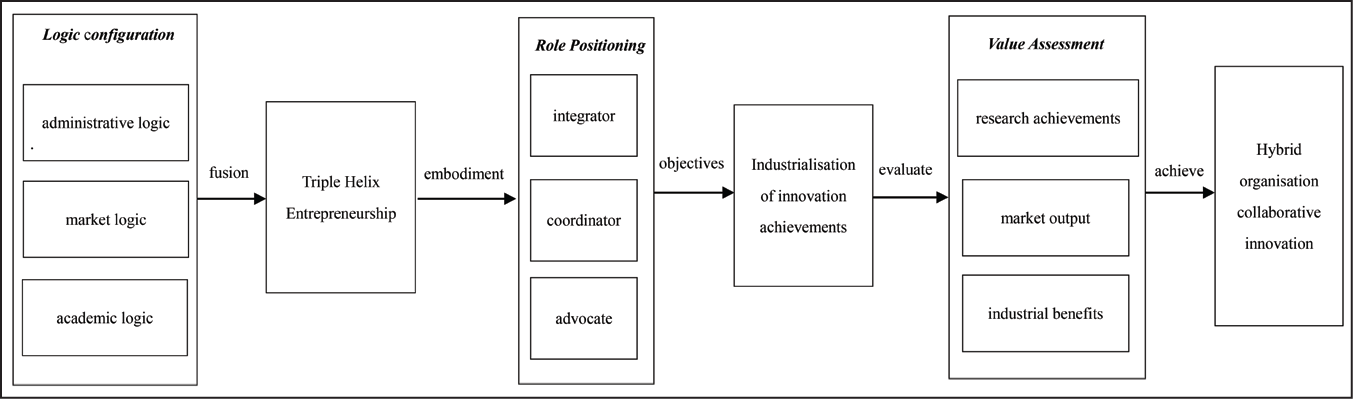
At the level of strategy implementation, Triple Helix entrepreneurship is externalised in three core roles played by entrepreneurs: integrator, coordinator, and advocate. As integrators, they provide solutions for aligning government demands, industrial concerns, and academic norms; as coordinators, they transmit information and build bridges, foster consensus among diverse actors; as advocates, they use institutional design and cultural shaping to cultivate organisational recognition and acceptance of multiple institutional logics. These internalised entrepreneurial roles establish diverse value assessment criteria centred on their core mission—the industrialisation of scientific and technological achievements. Guided by these criteria, they continuously adjust resource allocation models to ultimately achieve collaborative innovation within hybrid organisations.
Comparison of Triple Helix Entrepreneurship with Other Types of Entrepreneurship
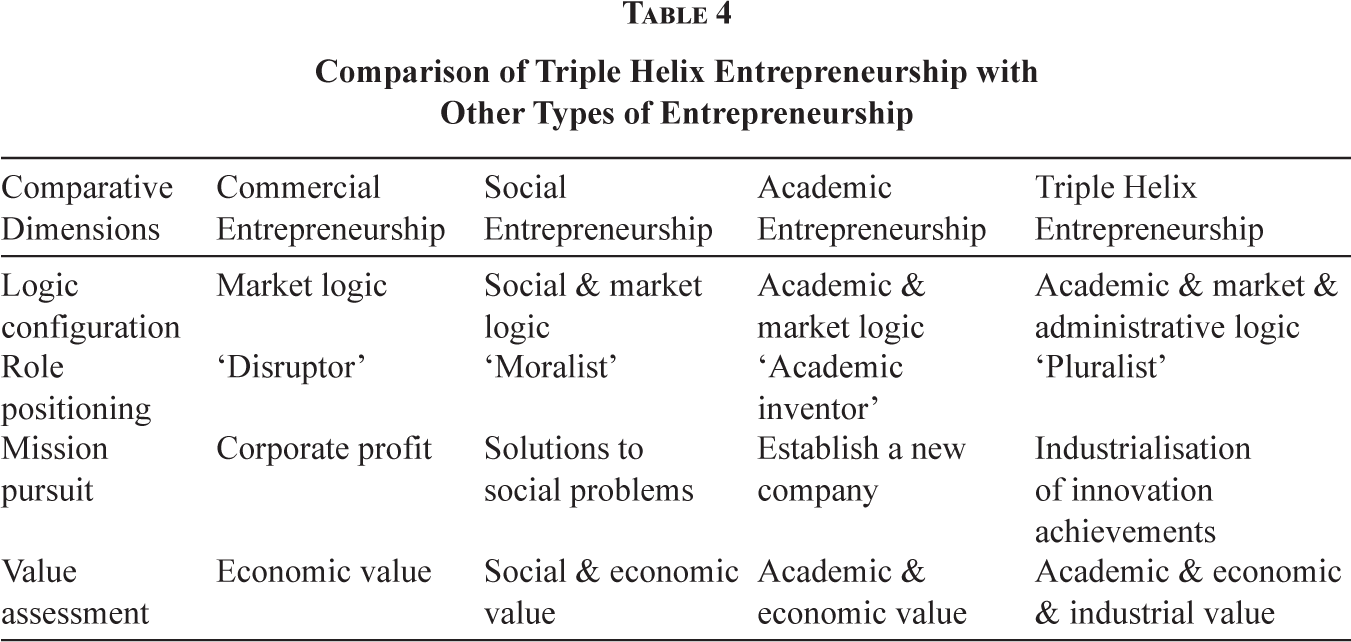
To further deepen our understanding of Triple Helix entrepreneurship, we systematically compare it with three mainstream forms of entrepreneurship— commercial entrepreneurship, social entrepreneurship, and academic entrepreneurship—across four dimensions: logic configuration, role positioning, mission pursuit, and value evaluation (see Table 4). As shown in the table, unlike any previous form of entrepreneurship, Triple Helix entrepreneurship possesses a unique combination of logic and operational mechanisms. This entrepreneurship provides a crucial coupling mechanism for cooperation among government, industry, and academia.
Comparison of Triple Helix Entrepreneurship with Other Types of Entrepreneurship
Concluding Discussion
In this article, through a case analysis of IAT in ‘Suzhou•China Acoustic Valley’, we identify a new form of entrepreneurship—Triple Helix entrepreneurship— and argue that it is the core mechanism driving Triple Helix collaborative innovation. Triple Helix entrepreneurship is the capability of entrepreneurs to internalise and integrate multiple institutional logics—administrative, market, and academic—at the cognitive level. Entrepreneurs possessing these capabilities adopt the industrialisation of innovation achievements as their core orientation. They serve as integrators, coordinators, and advocates within the organisation. Guided by diverse value indicators such as scientific innovation, market output, and industrial benefits, they effectively promote collaborative innovation among the Triple Helix within hybrid organisations. Notably, distinct from the concept of ‘boundary spanner’ highlighted by Champenois and Etzkowitz (2018), Triple Helix entrepreneurship strongly emphasises the diverse value required for hybrid organisations to engage in ‘institutional work’ within their daily practices. This entrepreneurship is not bound to specific individuals, but rather permeates the organisation’s culture, creating a favourable cognitive environment for collaboration among the Triple Helix.
Moreover, our case study also demonstrates that collaborative innovation within the IAT is inseparable from the unique innovation ecosystem provided by Acoustic Valley. Elements such as industrial policies, talent resources, market channels, and cross-departmental collaboration networks gathered within Acoustic Valley offer a favourable ecological environment for innovation and entrepreneurial activities. Our purpose in coming here is to start a business, stated Wang, a member of an entrepreneurial team within IAT. The conditions offered here are highly favourable for our venture—such as technological infrastructure, policy support, and industrial resources …. Such statements not only confirm the compatibility feature of the Triple Helix entrepreneurship integrating multidimensional institutional logic, but also further illustrate that the open innovation ecosystem provided by Acoustic Valley creates an institutional environment for the emergence of this entrepreneurship and for innovation and entrepreneurial activities within IAT.
Theoretical Implications
We contribute to the existing literature in the following three ways. First, we extend the microfoundations of the Triple Helix theory. Although recent studies have made valuable explorations (Champenois & Etzkowitz, 2018; Liu & Huang, 2018; Peng et al., 2019), the theory continues to face criticism for lacking a solid microfoundation (Cai & Etzkowitz, 2021; Viale & Pozzali, 2010). We responded to this question from an entrepreneurial perspective, thereby enriching our understanding of the microfoundations of the Triple Helix theory.
Second, we reveal the process mechanisms of collaborative innovation within hybrid organisations, thereby providing an important theoretical reference for studying organisational innovation under conditions of institutional complexity. Prior research holds that organisations can adopt hybrid strategies (such as blended hybridity and structural hybridity) to couple different institutional elements from a structural perspective (Perkmann et al., 2019). This article proposes a more dynamic solution, suggesting that entrepreneurship provides a cognitive pathway to resolve the tensions between different institutional logics.
Finally, we supplement existing types of entrepreneurship. The mainstream forms of entrepreneurship in the literature mainly include commercial entrepreneurship, social entrepreneurship, and academic entrepreneurship. We identify and develop a new type of entrepreneurship—Triple Helix entrepreneurship— and systematically analyse the characteristics of individuals who embody this form of entrepreneurship along multiple dimensions, including logic configuration, role positioning, mission pursuit, and value evaluation.
Practical Implications
Our findings offer important practical implications. First, our case indicates that cultivating individuals with Triple Helix entrepreneurship is essential for value co-creation among government, industry, and universities. For example, recruiting ‘pluralists’ with cross-sector experience or openness to diverse values should be prioritised. Within the organisation, job rotation, joint project teams, and similar arrangements can be used to enhance employees’ ability to integrate multiple institutional demands.
Second, the actors within hybrid organisations should strive to build a more inclusive institutional environment and equal partnerships. The government should appropriately delegate authority, focusing on strategic guidance and institutional empowerment; the industrial sector should pay attention to policy requirements, respect the knowledge contributions of researchers; and the academic sector should regard the technological transformation and contributions to industrialisation as evaluation criteria for the publication of papers.
Finally, in advancing Triple Helix collaborative innovation, all participants should prioritise industrialisation as the primary goal. Governments can establish dedicated industrial development funds or exemplary industrial application platforms to encourage joint technological breakthroughs between universities and enterprises. Universities can enhance researchers’ market-oriented thinking and technology transfer capabilities by offering industrialisation-oriented courses and inviting corporate executives to deliver lectures.
Limitations and Future Research
We also acknowledge several limitations of this study. First, we adopt a single-case research design, which constrains the generalisation of our findings. Future research could expand the sample size and geographic scope to extend our conclusions. Second, given that IAT is a relatively young organisation, its current collaborative effects may partly stem from institutional dividends and initial investment advantages. Future studies should therefore adopt longitudinal research designs to track IAT’s level of collaborative innovation over a longer time horizon. Finally, our interviewees were mainly concentrated among IAT’s internal management and core team members, with relatively few interviews conducted with frontline employees and external stakeholders. Future research could broaden the range of interview participants.
Footnotes
Acknowledgements
We sincerely thank Haisheng Xie for comments and suggestions on an earlier version of this manuscript.
Authors’ Contribution
Zhangbao Luo: Conceptualisation, Methodology, Investigation, Writing – original draft preparation, Revising. Shengyang Liu: Modify, Monitor, Data analysis. Dejun Cheng: Writing-original draft preparation, Revising. All authors commented on previous versions of the manuscript. All authors read and approved the final manuscript.
Data Availability Statement
The data supporting the findings of this study can be obtained from Shengyang Liu upon reasonable request.
Declaration of Conflicting Interests
The authors declared no potential conflicts of interest with respect to the research, authorship and/or publication of this article.
Funding
The authors disclosed receipt of the following financial support for the research, authorship and/ or publication of this article: This work was supported by the National Natural Science Foundation of China (grant nos. 72072084, 72472070).