







Abstract
Abstract
Social media marketing has garnered a lot of attention in recent times. Regulators, however, do not have any established frameworks to exert a level of control on social media marketing activities. Furthermore, some research studies have shown that control at an organizational level does not appear to be either formal or particularly strong. There are other areas that require investigation as well, such as confusion on the use of personal accounts for marketing the organizations’ products and services, the pressure of releasing media content at speed and the possibility of misuse of any information that is disseminated. There is no doubt social media is an attractive channel for marketing purposes given its free usage and scale of adoption by consumers; however, there is a considerable risk it can be misused as well. Hence, it can be argued that strong control systems should be in place. The case of multiple fatalities in a mob-lynching in India, allegedly as a result of the so-called ‘fake news’ being disseminated via the social media platform Whatsapp, has caught the attention of the Indian government, which is seeking to exert more control over social media channels. Thus, this article critically examines the issue of control over social media marketing in India, and makes suggestions for the creation of a robust control and regulatory framework for the same. This study broadens our understanding of the roles of regulatory framework in social media marketing context.
Introduction
Social media has become a necessary platform and an essential division of our community in terms of economic and cultural benefit. According to some reports, Google is removing about 100 ‘bad advertisements’ per second that are posted by scammers (Business Standard, 2018). It removed around 3.2 billion advertisements in 2017 that had not adhered to its advertising policies. What is perhaps most surprising is how such advertising appeared on Google system in the first place. Some would argue it should have a control system already in place to identify and block such non-compliant advertising at source instead of having to remove it after they have been posted. An example of advertising that has fallen foul of Google’s policies has given rise to crypto-currency. Along with Facebook and Twitter, these social media platforms have banned some advertisements related to speculative financial products (Business Standard, 2018). ‘There are many companies which are advertising binary options, ICOs [initial coin offering] and crypto-currencies that are not currently operating in good faith’, said Rob Leathern, Product Management Director at Facebook (Business Standard, 2018). In the light of these activities, this article aims to review control and regulatory set-up governing social media marketing.
A control environment has two dimensions: internal and external. For the purpose of this article, we will apply these to the notion of control: internal control and external control. The internal control environment refers to the control system within an organization, whereas the external control environment refers to regulatory forces enacted by a government or other agencies. These are not mutually exclusive rather they are very much related to and influence each other, operating on the principles of cybernetics (Maciariello & Kirby, 2014). Such types of control systems have been referred to as a Mutually Supportive Systems Model. In this regard, this article plans to look into the design aspects of the internal and external (control and regulatory) aspects of social media marketing by observing internal control environment set-ups that have been built to deal with social media marketing within certain organizations. In addition, it will look into external control environment set-ups outside organizations that have been built by the government and other regulatory authorities. A key concept of control systems is that of ‘goal congruence’ (Anthony & Govindarajan, 2007), and as such the study will try to establish if there is a goal congruence between the two control environments or not. If it is absent, it would suggest that the control and the regulatory systems are contradicting each other rather than complementing each other.
Given the very large number of social media users globally, both internal organizational control and external regulatory aspects are significant. For example, the incidences of lynching in India (The Guardian, 2018), which led to the killing of around 25 people due to fake news allegedly spread through the social media communications platform such as Whatsapp, is an example of what the possible negative viral consequences can be if controls are ineffective. Furthermore, such occurrences are relevant to government policy, which some have argued should lead to the management of social media companies being held accountable by way of criminal proceedings in light of such incidents (Times of India, 2018). Social media marketing practices, if left uncontrolled, could be seen to have similar grave consequences in the future.
Interestingly, the Indian Marketing Analytics Industry’s present annual revenue is pegged to be around $2.03 billion and is expected to grow at a compound annual growth rate of 23.8 per cent till 2020. As per a Business to Customer Marketing Automation Report India, 2017, launched by Research NXT and Netcore Solutions, 29 per cent of marketers believed that it is important to have the right marketing mix in order to gain better Customer Lifetime Value (CLV). According to the report, 28 per cent of marketers were considering the use of analytics, while 18 per cent had already included analytics at the core of their marketing strategy. The report also emphasized that analytics is going to play an important role in automating and improving customer engagement. This, in turn, is going to help the marketers get a better conversion rate optimization by enabling brands to engage in a personalized manner with their customers, leading to an increased CLV.
Theoretical Background
Social Media and India – Some Facts
The issue of controlling and regulating social media marketing assumes significance in the wake of a sporadic rise in the usage of such platforms. If we consider the example of India, Jain (2016) provides the following details about the leading social media platforms in the country:
Social Media Platforms Operating in India:
• India has world’s largest number of Facebook users with over 195 million users – over 4 million more subscribers than the US.
• Twitter, the micro blogging site, has 23.2 million Monthly Active Users (MUAs) in India, which is the second largest in the Asia-Pacific region after Japan with 26 million MUAs.
• LinkedIn is the most frequently used social network for recruiting, because it results in the most successful hiring.
• YouTube, the video-sharing site, has more than 60 million unique users in India with users spending over 48 hours a monthly viewing video‘content.
• After Facebook and Twitter, Pinterest is the third most popular social network in India, while Instagram has 16m users in India.
• Overall, there are over 462 million internet users in India and 200 million active social media users. India is the second largest online market behind China. This information underlines large user base of social media in India, and also the scope for further growth. For platforms such as Facebook, it will be ahead of countries like the US and China as a target market due to its growth potential, while in turn making the country a suitable target for investigation into aspects of control and regulation. A projection by Deloitte (2015) estimates digital marketing channels in India are expanding quickly (see Table 1).
Regulatory frameworks for social media communications were not considered by up to 50 per cent of the 1,007 German organizations studied by Linke and Zerfass (2013). The authors present the following break-up of various dimensions of the regulatory framework being either present, planned or not considered in Table 2.
Digital Ad Spend Estimates for India

Break-Up of the Dimensions of a Regulatory Framework Across a 1,007 German Corporations

Of the brands surveyed by the Ernst & Young’s India Trends Study (2016), 44 per cent reported that they did not have any formal social media policy. While 28 per cent of the brands stated that their social media policy was aligned with other polices in their organization, 16 per cent stated that only a draft policy was ready to be implemented. Only 8 per cent mentioned that they had a well-documented manual. Misuse of personal information and deceptive or false claims are the two major legal risks associated with social media marketing (Sarabdeen, 2014). It is worth noting that directives from European Union, the US Laws, Australian Laws and the UAE Laws were enacted from 2000 to 2003, before social media was a common activity.
In India, alcohol companies have been found to utilize social media to lure the urban youth with direct and surrogate advertisements of their products (Shaikh, Pathak, & Kapilashrami, 2015). Current social media policies and laws are ineffective in controlling the phenomenon. The authors have stated that changes in law pertaining to alcohol marketing to include social media also in its scope are necessary. Social media sites should change their policies to prevent alcohol marketing and promotion especially to under-aged users. Data privacy should be implemented by design or by default (PWC, 2018). Rather than putting in checks and balances externally, privacy of data should instead be designed into the very fabric of data processing systems. This implies that organizations will have to re-examine how they approach the use of technology in their entities. Taking stock of the situation in the US, Pillsbury Winthrop Shaw Pittman LLP (2016) mentioned that social media marketing is regulated by a host of laws and agency oversight, including the Securities & Exchange Commission, the National Labor Relations Act, the Federal Trade Commission (FTC), Food & Drug Administration and Health Insurance Portability and Accountability Act (HIPAA). In 2018, marketers in the US are subject to increased regulatory scrutiny of marketing practices at the core of many popular digital media campaigns, and actions in that market reveal that the FTC and other regulatory authorities are expanding enforcement actions. The threat to the reputation of an organization is another risk that is commonly related to social media (Ristuccia & Rossen, 2014). Organizations can, therefore, develop plans to identify and protect against risks to reputation stemming from social media to indemnify them against censure from regulatory bodies.
Privacy, security and trust are the three risk-prone areas in the data-driven economy (ASSOCHAM & PWC, 2018). As a result, a heightened focus on providing privacy to the end consumer and protecting data has gained tremendous importance. Information that was once considered by consumers to be in safe custody has been known to escape the confines of a corporation and go viral (Chaher & Spellman, 2012). Scholars have previously expressed words of caution that company boards must be vigilant enough to safeguard their company’s image from any perceived misuse of confidential information. Trademark and copyright issues, general legal standards applicable to social media marketing, compliance with terms and conditions of social media outlets, implementation of terms and conditions, user-generated content, monitoring and screening of social media content, sweepstakes, competitions and other promotions are all risks that have been identified by companies utilizing the power of social media for marketing and business expansion (Landau Steinman & Hawkins, 2010). In summary, there are around five to seven critical control and regulatory issues that have been identified by researchers in this field. The status of policies dealing with social media at an organizational level is not fully realized with around half of organizations not considering any implementation. This supports the supposition that there is a lack of internal control relating to social media marketing at an organizational level in Indian firms. In terms of the external regulatory environment in the country, while nations such as the US have a framework in place, in the Indian context such a notion is still in its early stages.
Research Methodology
Key Research Questions
This study aims to address the following three basic questions:
RQ1. Is there a formal system in place for organizations to control social media marketing in India?
RQ2. Is there a framework in place at the governmental level that regulates various aspects of social media marketing by firms in India?
RQ3. Is there ‘goal congruence’ between the two control systems in RQ1 and RQ2?
Research Hypotheses
Based on the research questions and the literature review, the following research hypotheses has been formulated:
Hypothesis 1(a): Social media marketing strategy is not a popular activity either with social media agencies or organizations in India.
Hypothesis 1(b): Formal social media or social media marketing policies are not visible in most organizations in India.
The rationale for investigating social media marketing strategy and policy is because these activities are the bases for control within organizations. In the absence of these, one can deduce that a formal control system does not exist.
Hypothesis 2(a): A framework at a governmental level that regulates various aspects of social media marketing by firms is not visible to organizations in India.
Hypothesis 2(b): Any framework at the level of industry bodies in India that offer guidance on various aspects of social media marketing by firms are not visible to organizations.
Hypothesis 3: There is no attempt to attain ‘goal congruence’ between the hypotheses H1a and H1b and the hypotheses H2a and H2b.
Methodology
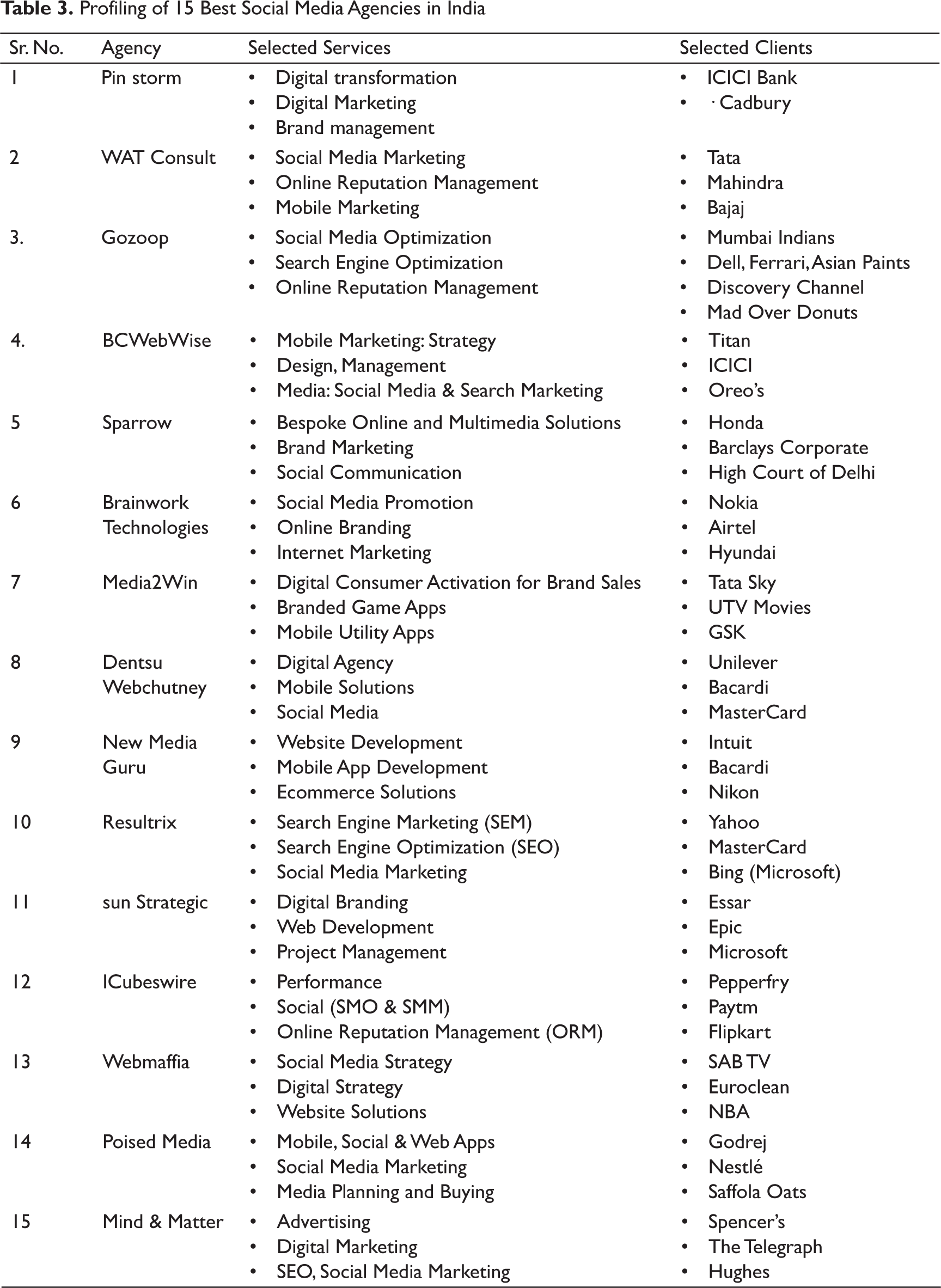
Social media marketing is a relatively new activity in India, and there are a number of specialized social media agencies offering services across the country. For the purposes of this study, the inputs supplied by top agencies to their clients are examined in order to gain an insight into activities pertaining to social media marketing. This should provide an idea of whether some kind of strategic or policy inputs are provided by these leading agencies. In order to test the first set of hypotheses (H1a and H1b) formulated for the study, the services provided by the top 15 Social Media agencies in India and top 10 of their client organizations were studied to understand the presence of any social media marketing strategy and formal policy for social media or social media marketing. For the second set of hypotheses (H2a and H2b) formulated for the study, the government regulations and the literature were studied to gauge coverage and depth of the regulatory situation in India. Furthermore, the codes from the Advertising Standards Council of India (ASCI) were also examined. Finally, for the third hypothesis of goal congruence (H3), reconciliation between the hypotheses above was attempted to analyse internal controls and external regulatory frameworks.
The Top 15 Social Media Agencies in India
Digital Vidya, a social media website, has listed ‘15 Best Social Media Agencies in India’ in 2017. Table 3 gives a snapshot of these agencies, their specialties and their top clients:
Profiling of 15 Best Social Media Agencies in India
Companies Selected
There are around 90 companies/products in the full list of 15 social media agencies’ clients. Using random selection, 10 of them were chosen for the study of existence of social media marketing strategy and/or policy.
Resources for Sensing the Regulatory Environment
Government regulations in India relating to media communications, comparative analysis with laws of other nations and the ASCI guidelines were consulted to fully understand the external regulatory environment governing social media marketing.
Data Analysis
Control Environment Analysis
The analysis was completed on the services provided by the top 15 social media agencies in India to a selection of 10 clients.
Analysis of Inputs Provided by Top 15 Social Medial Agencies
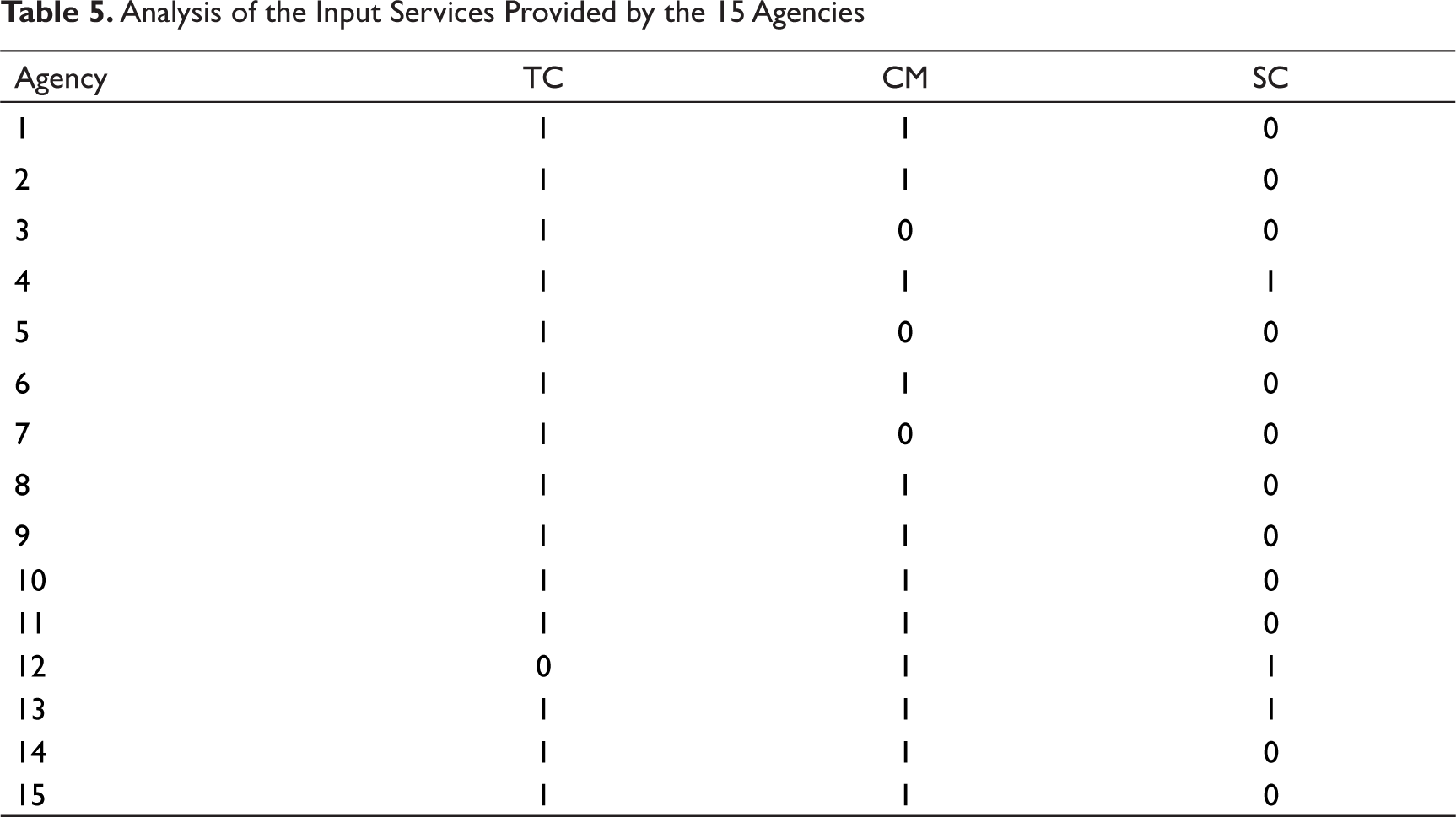
The input services provided by the leading 15 agencies were classified into three categories: Technical Content (TC), General Management Content (MC) and Strategic Content (SC). This classification was necessary to judge management levels in the organizations where the services were used and the correlation matrix set between content provided by the leading agencies, as well as the management levels in the organizations consuming this content. This was structured as per Table 4.
Input Service Categorization and Corresponding Management Level

Analysis of the Input Services Provided by the 15 Agencies
Basic Statistical Analysis of the Input Services of the 15 Firms
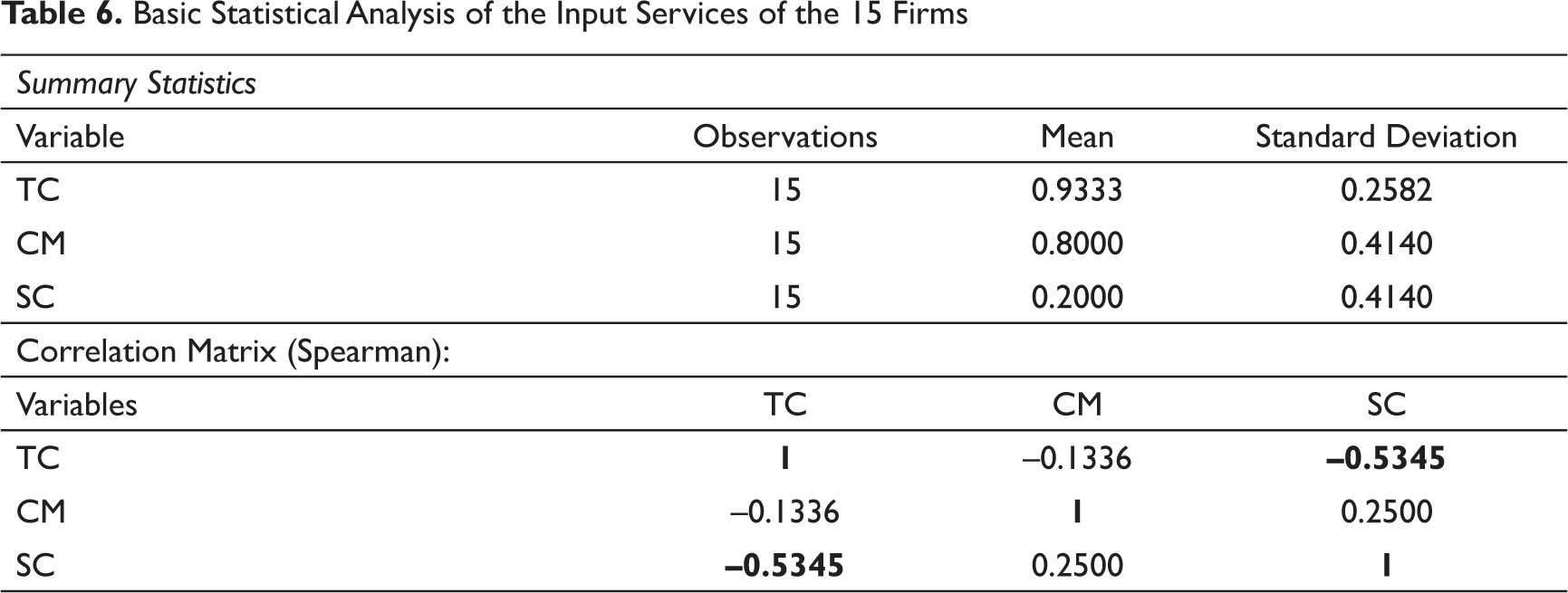
A simple 1 or 0 marker was used to identify if a particular category of service was provided or not. A marker of 1 signified that the service was provided whereas a 0 signified that the service was not provided. Basic statistical procedures were performed on the aforementioned data, and the results were as follows (Table 6):
Analysis of Inputs Provided by Top 15 Social Medial Agencies
Organizations/Brands Selected for Study

Case study approach: A case-to-case search of the organizations/brands social media activities was undertaken, keeping in mind potential issues such as internal controls, possibility of controls getting diluted and large-scale involvement of users. It revealed the following narratives for each brand/organization:
Nestlé: NewsCred Insights (2014) provided an account of Nestlé’s struggle with social media marketing for four years until 2014. It stated ‘After facing a social media and PR catastrophe four years ago, and lacking the internal procedure to handle it correctly, the brand executives at Nestlé knew it needed to revamp its entire digital marketing plan. Nestlé’s Pete Blackshaw, Global Head of Digital and Social, and Mark Brodeur, Global Head of Digital Marketing Innovation, shared the lessons of this experience at the 2014 Ad Age Digital Conference’ (NewsCred Insights, 2014).
Oreo’s: Whitfield (2018) on the basis of analysis of Oreo’s social media marketing campaign on Facebook, Twitter, Instagram and other social media platforms, observed that Oreos used social media by encouraging other users to share content on its behalf. This had the effect of reaching a new audience and seeing people develop user-generated content around the Oreo’s brand.
SAB TV: Afaqs News Bureau (2016) reviewed a special social media marketing campaign by SAB TV called ‘Khidki.’ The review quoted Anooj Kapoor, senior executive vice-president and business head of SAB TV saying,’ ‘Sourcing user-generated content from a powerful social medium like Twitter, and presenting it to a larger universe on the SAB platform, is an experiment which I am confident will pave newer ways for content development in Indian television’ (Afaqs News Bureau, 2016).
The Telegraph: The Innovation Enterprise Channel (2018), ahead of their Digital Publishing Innovation summit, spoke to Mike Wright, Head of Trending Content for the Daily Telegraph newspaper. Two relevant extracts of the interview are given here: ‘How are you maintaining content integrity in an environment filled with fake news and click bait? At the Telegraph we are simply adhering to the standards of quality journalism that have defined the organization for 160 years.
What can the audience expect to take away from your session at the Digital Publishing Innovation Summit?
Discovery Channel: Pigott (2016) reviewed the social media marketing strategy of Discovery Channel, concluding ‘Far from being a paint-it-by-numbers solution to marketing, Discovery Channel’s marketing team learned that audience behaviors were more nuanced than they had hitherto imagined and that even the same individual using different platforms had different expectations’ (Pigott, 2016).
DLF: Jain (2015) made following observations about DLF ‘Their dynamic social media presence is one that stands out… they have a presence on Facebook, Twitter, Google+, LinkedIn, Pinterest, YouTube and Instagram. Their social media updates are all up-to-date and are well integrated across all channels. The brand also has a blog’ (Jain, 2015).
ICICI: Socialsamosa.com (2015) commented on the bank’s social media strategy, stating that it used it to support customer service, product research, customer insight, and creating a loyal community. It concluded that by winning the faith of its stakeholders and engaging in dialogue with them, ICICI bank had achieved its goals in this area.
ITC: Mahayan (2018), in an interview with Shailendra Tyagi, Chief Executive Officer (Education and Stationary Products Business) of ITC, quoted him as saying social media had altered the fundamentals of marketing and information sharing globally by freeing brands to communicate with people in real time through several different channels.
Lipton Ice Tea: Hernandez (2018), writing for socialhospitality.com, said it was important for the company that Lipton continued to develop and update its marketing plan, and by utilizing social media platforms such as Facebook and Twitter it had set itself apart from other tea companies.
MasterCard: Epion.com (2016) reviewed the social media marketing strategy of MasterCard. It said: ‘To MasterCard, the use of social media was more of a security and publicity threat waiting to happen. An employee could accidentally share secure information or create a PR nightmare. Instead of continuing to shy away from social platforms MasterCard decided to engage their employees. MasterCard launched its Ambassador program for employees and approached the problem head on…. MasterCard was so large that the use of employees from different departments allowed for content to be relevant to more than one kind of client and employee’ (Epion.com, 2016).
Regulatory Environment Analysis
The analysis was with reference to two broad sources: the Indian government and central agencies such as the ASCI.
Regulatory Framework at the Indian Government Level
Exchange4media.com (2018) quoted a Government of India order stating that the government has constituted a committee for framing regulations for online media, news portals and online content. ‘It has been decided to constitute a committee to frame and suggest a regulatory framework for online media/ news portals, including digital broadcasting and entertainment/infotainment sites & news/media aggregators’, the order read (Exchange4media.com, 2018). As per this order, the committee comprises 10 members, including Secretary, I&B-Convener; Secretary, MeitY; Secretary MHA; Secretary, Department of Legal Affair; Secretary, DIPP and CEP, MyGov. The committee will also have representation from the Press Council of India, News Broadcasting Association and Indian Broadcasters Federation. Thus, it is clear whether separate legislation exists in India to deal with regulation of online media. While the content telecast on private satellite TV channels and transmitted/re-transmitted through the cable TV is regulated in terms of the Programme and Advertisement Codes prescribed under the Cable Television Networks (CTN) (Regulation) Act, 1995, and the Cable Television Networks Rules, 1994, framed there under, TV channels are required to adhere to the Programme and Advertisement Codes mentioned in the CTN ACT, where there exists a mechanism for dealing with any violations. Furthermore, the Press Council of India has its own guidelines to regulate the print media. However, ‘there are no norms or guidelines to regulate the online media websites and news portals including digital broadcasting like entertainment/infotainment & news/media aggregators’, the order read (Exchange4media.com, 2018). ‘Therefore, it has been decided to constitute a committee to frame and suggest a regulatory framework’.
Regulatory Framework in Bits and Pieces and the Contradictions
In a blog post ipleaders.in (2015), there was mention of other regulatory provisions in different Indian laws relating to marketing and advertising. For instance, The Drugs and Magic Remedies (Objectionable Advertisements) Act 1954 prohibits certain kinds of advertisements such as the procurement of miscarriage of women or prevention of conception in women, the maintenance and improvement of the capacity of human being for sexual pleasure and correction of menstrual disorders in women. Section 4 and Section 5 prohibit the advertisement of drugs and magic remedies, which may put some false impressions either directly or indirectly respectively. Though in this era of competition in the pharmaceutical industry, there is a need of advancement in the law.
The Cigarette and other Tobacco Products (Prohibition of Advertisement and Regulation of Trade and Commerce, Production, Supply and Distribution) Amendment Act 2003 provides that
‘no person will engage in or purported to be engaged in the production, supply or distribution of cigarette or any other tobacco product shall advertise, and no person having control over a medium shall cause to be advertised cigarettes or any other tobacco products through that medium, and no person shall take part in any advertisement which directly or indirectly suggests or promotes the use or consumption of cigarettes or any other tobacco products (Cigarette and other Tobacco Products (prohibition of Advertisement and Regulation of Trade and Commerce, Production, Supply and Distribution) Amendment Act, 2003) Furthermore, an amendment was introduced in section 7 of the Act 2003 that ‘the specified warning including a pictorial depiction of skull and cross bones and such other warning as may be prescribed, the words such specified warning including a pictorial warning as may be prescribed shall be substituted’ (2003).
Furthermore, the Food Safety and Standard Act (2006) prohibits the false representation about the sale, supply, use and consumption of articles of food or adoption of any unfair or deceptive practice including the practice of making any statement. Section 25 (2) of the Act provides for certain norms as per the Act while prohibiting, restricting or otherwise regulating the import of article of food under the Foreign Trade (Development and Regulation) Act, 1992 (22 of 1992). Furthermore, certain legal norms such as the Bureau of Indian Standards Act, 1986, Infant Milk Substitute, Feeding Bottles and Infant Foods (Regulation of Production, Supply and Distribution) Act, 1992 and the Infant Milk Substitute, Feeding Bottles and Infant Foods (Regulation of Production, Supply and Distribution) Amendment Act, 2002 also followed the same guidelines.
Moreover, certain regulations were made; for instance, the Telecommunication Regulatory Authority of India (TRAI) had come with a regulation on 22 March 2013, titled, Standard of Quality of Service (Duration of Advertisement in Television Channels) (Amendment) Regulations 2013, restricting advertising time on television channels to 12 min/h. As per TRAI, some channels show an advertisement for more than 30 min. The reason for this regulation is prescribed by stating that the length of advertisements during programmes on a given TV channel is closely related to the quality of the viewing experience of the consumer, which is akin to the quality of the service provided by service providers to viewers. In India, Section 66A of the Information Technology Act, 2000, has been in the news quite often. On 24 March 2015, online speech or communication received a boost as the Supreme Court declared a specific provision – Section 66A of the Information Technology Act, 2000 – as unconstitutional. This section of the 2000 act was highlighted by the arrests of Shaheen Dhada and Rinu Srinivasan under provisions of Section 66A for criticizing the shutting down of Mumbai after the death of Shiv Sena leader Bal Thackeray on social networking website Facebook.
The case became famous and is known as Shreya Singhal versus Union of India as a landmark decision in the free speech regime. The apex court struck down Section 66A of the IT Act for being ‘open ended, undefined, and vague’ and for the words used in the text of the provision being ‘nebulous in meaning’. The provision in section 66A was titled ‘punishment for sending offensive messages through communication service’ (2003) and it included information shared via a ‘computer resource or a communication device’ known to be ‘false, but for the purpose of causing annoyance, inconvenience, danger, obstruction, insult, injury, criminal intimidation, enmity, hatred or ill will’ (2003). The wide net cast by the section was objected by the apex court which declared, ‘Section 66A is cast so widely that virtually any opinion on any subject would be covered by it, as any serious opinion dissenting with the mores of the day would be caught within its net’ (2015). Sen (2017) writing for livemint.com has expressed, ‘the manner in which courts have handled issues of free speech and access to information, in accordance to Section 66A of IT Act, 2000, does not augur well’.
Regulatory Framework at Agency Level
Exchange4media.com (2016) have commended the ASCI code in respect of social media saying, ‘consumers would find it heartening that ASCI’s code of self-regulation is quite comprehensive and covers all media including the internet or the digital media’. Again, the definition of advertising in ASCI code establishes, ‘media are any means used for the propagation of advertisements and include press, cinema, radio, television, hoardings, hand bills, direct mail, posters, internet, etc’. ASCI take up complaints on advertisements appearing on websites, e-commerce portals, social media platforms as well as movie promotional videos/YouTube trailers that people have objections to for being offensive. It has quoted Benoy Roychowdhury, Chairman, ASCI, mentioning:
public should keep in mind that for any objections regarding digital advertisements, they can approach the ASCI, as not just product or service ads but even promos or trailers of commercial cinema or TV programs are also considered as advertisement. If viewers see any ads violating the provisions of ASCI code such as making misleading claims, showing obscenity or promoting hazardous behavior, etc. on Internet or any other media they should complain to ASCI.
Speaking about what mechanism does the ASCI have to reign in extremely offensive advertisements, he adds, [A]s per ASCI’s Codes of Self-Regulation, Chapter II requires that ‘Advertisements should contain nothing indecent, vulgar, especially in depiction of women, or nothing repulsive which is likely, in the light of generally prevailing standards of decency and propriety, to cause grave and widespread offence.’ In case an advertisement is seen to cause serious breach of this or any other Code, ASCI have the power to curtail the ad by moving ‘Suspension Pending Investigation’ (SPI). SPI is invoked in extreme cases only.
Key Observations and Discussion
Social media marketing agency inputs to their client organizations are clearly channelled more towards technical content and general management and less towards a more strategic level. Means of these scores based on the analysis of the 15 firms were 0.9333, 0.80 and 0.20 respectively for technical content, general management and strategic content.
A review of the 10 organizations/brands reports mixed results in terms of controls within these organizations. While on the one hand, we witness that they are attempting to leverage the potential reach of a large social media audience, on the other hand, there are concerns surrounding this activity such as the spread of fake news (as evidenced by the example of The Telegraph), lack of internal procedures (Nestlé), earning the faith of stakeholders and creating transparency (ICICI), and data security (MasterCard). In some cases, it was found that organizations have implemented reasonable controls. For example, MasterCard has set out guidelines for how to share and what content was appropriate (vetted by all departments). The Telegraph has also considered strategic initiatives to deal with an overwhelming amount of content on social media, especially in the era of fake news. A collective consideration of the review of the 10 organizations/brands highlights an attempt to engage with a very large audience. User-based content creation has been emphasized by most of the organizations/brands as driving the possibility of misuse and laxity of controls. Given that there is little evidence of strategic orientation from expert agencies, and also that there are concerns expressed by organizations/brands about the dangers of social media marketing practices, it can be inferred that the presence of social media marketing strategy and any formal policies for social media or social media marketing are still in their primitive stages. As in the case of Nestlé, experimentation is moving towards a kind of formal and robust control mechanism. In the light of this, first two hypotheses are accepted. That is, H1a – social media marketing strategy is not a popular activity either with social media agencies or organizations in India, and H1b – formal social media or social media marketing policies are not visible in most organizations in India.
Based on the review of the external regulatory set-up at the Indian government and agency level, it is quite evident that the area of social media marketing regulation is also far from satisfactory, but it is in an evolutionary stage. To regulate, there is a need for strong legislation, the absence of which implies a lack of deterrent. At the same time, what some might say were draconian provisions such as Section 66A of the Information Technology Act (2000) could be deemed more controversial than acceptable. In light of this, the second set of hypotheses (H2a and H2b) is accepted.
It is interesting to observe the way the Indian government is attempting to formulate legislation to regulate social media marketing. The committee that has been set-up to offer recommendations on this issue comprises of certain key representatives from government bodies, yet there is no representation from corporate bodies in the industry. Nor is there any representation on this committee from the social media platforms such as Facebook and Whatsapp. Goal congruence, under such circumstances as the repeal of Section 66, is therefore absent. An uncontrolled environment may be followed by a knee-jerk reaction leading to too tightly controlled an environment and the very purpose of social media marketing would be hit. Thus, the final hypothesis can be accepted that there is no attempt to attain ‘goal congruence’ between the two main hypotheses. If there had been goal congruence, the Indian government would have involved stakeholders from industry organizations and the social media platforms while formulating its regulations. Subsequently, the Times of India reported on 1 September 2018 that the Committee formed to give recommendations on the formulation of regulations had suggested that heads of social media houses would be charged with criminal offences if fake news issues were detected.
Suggestions and Conclusion
It is a crucial juncture for the social media in terms of the regulatory framework that might appear as a result of incidents such as mob-lynching. This paper argues that for the success of any control system, goal congruence is the key factor. What follows from the conclusions of this paper is that the Indian government, industry organizations and social media platforms should come together to ensure their actions complement each other rather than contrast or contradict each other. For this to happen, it is suggested that the government makes it mandatory (through legislation) for organizations to adopt an internal social media marketing policy to see that activities are primarily controlled internally. Such experiments have been made in the past. For example, in the backdrop of the famous Vishakha case, the Government legislated with the Sexual Harassment of Women at Workplace (Prevention, Prohibition and Redressal) Act, 2013. An important feature of this Act is that all the organizations with 10 or more employees are required to constitute an Internal Complaints Committee at each office or branch with 10 or more employees, thus making it compulsory to enforce an internal control mechanism at an organizational level. A similar type of provision could be seen in the statute to control social media marketing.
From the corporate side, it is expected that the firms would duly recognize risks associated with social media marketing and take appropriate steps to mitigate those at their own level instead of drawing punitive actions from the government. Thus, respect, social responsibility and concern from corporate bodies added to due consideration of the intentions and benefits of social media marketing from the government can lead to an overall control system working on the principle of goal congruence. Only with both sides working together like this can success be anticipated in tackling the problems of social media marketing and regulation in India.
Footnotes
Declaration of Conflicting Interests
The author(s) declared no potential conflicts of interest with respect to the research, authorship, and/or publication of this article.
Funding
The author(s) received no financial support for the research, authorship, and/or publication of this article.