






Abstract
In most countries, the efforts to attract and retain health workers have been focused on extrinsic measures of motivation, with very less focus on a better understanding of job satisfaction—an important intrinsic factor and construct. The main aim of this study was to assess job satisfaction, its seven dimensions, and motivation among health service providers (doctors and nurses) employed within the public sector in India. The study was conducted in three districts representing two states in India. The study participants represent the doctors and nurses from public health and service delivery centres. Data were collected from a total of 307 healthcare providers (152 doctors and 157 nurses).
‘Measure job satisfaction’ tool was adapted that contained 41 items capturing seven dimensions of job satisfaction on a five-point Likert scale with a higher score indicating a higher level of job satisfaction and vice versa. In addition, one single statement was used to assess motivation.
Average scores were calculated for each of the seven dimensions of job satisfaction, motivation and for overall job satisfaction. Parametric tests such as t-test and analysis of variance (ANOVA) were used for comparisons of job satisfaction scores according to the place of work, years of work experience, appointment type and health professional categories. The statistical analysis was carried out using SPSS version 22.0. Exploratory factor analysis was carried out to assess the relationship between job satisfaction and motivation and regression analysis of motivation was carried to assess predictors of job satisfaction, demographic and work-related factors’ effect on motivation.
The average scores for most of the dimensions of job satisfaction were low for both doctors and nurses with the lowest scores reported for the dimensions of ‘professional support’ and ‘personal satisfaction’ while the highest score reported for ‘satisfaction with pay’. Significant results in the difference of mean scores were found for all seven dimensions of job satisfaction except for ‘prospects’ at different levels of place of work, ‘standard of care’ at different levels of length of service and ‘training’ for different levels of types of appointment. The mean scores of motivation were found to be significantly different for different levels of place of work and also between the doctors and nurses. The regression analysis of motivation on various predictors of job satisfaction suggests that personal satisfaction and satisfaction in prospect were highly significant while other variables such as gender and place of posting were marginally significant. Understanding of job satisfaction can provide useful insights to both extrinsic as well as intrinsic aspects of work motivation, which arguably is the most critical area of health systems research that could potentially feed into streamlined and improved health workforce management policies aimed at addressing the shortage and retention of the health workforce.
Introduction
While the issues surrounding the health workforce have gained significant national and global attention, shortages of health workforce continue to plague health systems in many countries (WHO, 2006, 2014, 2016). Such shortages can be detrimental for health systems and can affect health systems in different ways. For example, shortages of doctors and nurses can jeopardise the health system in many low and middle income countries (LMICs) (JLI, 2004; WHO, 2006) and can significantly affect health services (JLI, 2004; WHO, 2006) and quality of health services especially in rural areas, (Gupta et al., 2003) and therefore, an adequate number of health workforce is critical to achieving a minimum level of the health indicators (JLI, 2004; WHO, 2006). While the causes for shortage vary from country to country, what has been recognised is that the shortage of health workers poses great challenges to health services delivery, and therefore adequate health workforce and its equitable distribution and retention is very critical to the effective functioning of health systems.
India in particular faces an acute shortage of healthcare providers with a very high concentration in urban areas (Rao et al., 2011). As per 2011 Census data, 60% of the Indian health care workforce lives in urban areas and of that, 70% is employed by the private sector. While various measures have been taken to address the shortage of healthcare workforce especially in rural areas, the problem remains grave in many Indian states. For example, the most notable effort has been the launch of the National Rural Health Mission (NRHM) in India that aims to provide accessible, affordable and quality health care to the rural population, especially the vulnerable groups with a special focus on health workforce (Ministry of Health and Family Welfare, 2011). The need for an adequate number of well-trained and motivated health workforce for providing better health has been underscored in the NRHM (Ministry of Health and Family Welfare, 2011). Similarly, the introduction of Indian Public Health Standards (IPHS) at primary, secondary and tertiary care to ensure quality health services, with a special focus on manpower was introduced in 2006. Despite these major efforts, problems concerning the shortage of health workforce remain grave and a lot needs to be done.
Health workforce shortages have been described to be ‘symptoms of a poorly managed health workforce and health care system’ (WHO, 2016) and such shortage issues are often a reflection and translation of poor motivation and low level of job satisfaction among health care providers to work in the public sector and rural and underserved areas (Peters et al., 2010), which results in high absenteeism. Hence, there is a great need to address the issues related to effective retention and management of the health workforce with a particular focus on addressing job satisfaction and motivation.
There is relatively moderate empirical evidence about health worker job satisfaction and motivation in many developing countries (Willis-Shattuck et al., 2008) with an even more severe dearth of research on job satisfaction among public sector health service providers in India (Peters et al., 2010). Research in this area from elsewhere indicates a strong positive relationship between job satisfaction, patient’s satisfaction and quality of care (Al-Aameri, 2000). Furthermore, a low level of job satisfaction in physicians is found to have an adverse impact on the relationship between doctors and patients (Freeborn, 2001). Job satisfaction also has been found to have a strong relationship with other work-related issues like turnover and retention of health care providers. Job-related dissatisfaction among nurses is found to enhance the chances of the intention of quitting job and increased burn out (Pathman et al., 2002; Rouleau et al., 2012; Zangaro & Soeken, 2007). Both motivation and job satisfaction have been identified as critical to the performance and retention of health workers (Mbindyo et al., 2009; Tzeng, 2002).
Thus, a better understanding of the drivers of job satisfaction among health service providers (doctors and nurses as a focus of this study) employed within the government sector, working at various health centres from village to district level, is an important area of research that can potentially not only fill up the research gap in the area but also provide a basis for considering and streamlining policies and management approaches to improve work conditions in relation to job satisfaction constructs included in the current research. Despite the governments’ efforts in the direction to address the shortage of doctors, it still remains a key issue. Hence, particularly in the Indian public health sector context, a better understanding of factors that affect job satisfaction is very critical.
With this backdrop, the main aim of this study was to assess the overall job satisfaction, various dimensions or constructs of job satisfaction and compare the differences in the job satisfaction and its constructs with regard to the profile of the participants such as type of health centre, length of service, type of appointment and type of service provider. Additionally, the study aimed to assess motivation and different predictors of motivation. The study was carried out among health service providers (doctors and nurses) employed in the public health system in India.
Methods
Study Area and Participants
The study was conducted in three districts representing two states in India, one a western state and the other a northern state (the states and districts have not been named in the manuscript due to anonymity reasons). The study participants represent all the public health delivery centres from the three districts, right from the lowest village level sub-centres (SCs) 1 , Primary Health Centers (PHCs) 2 , Community Health Centers (CHCs) 3 , Block Hospital (BHs), and up to the District Hospitals (DHs) 4 . Both the states selected for the study have poor and less than the national average health indicators and both the states suffer from a critical shortage of health service providers (doctors and nurses), specifically in rural areas (health indicators and demographics of the study site are not presented due to anonymity reasons). The study participants comprised of doctors working with PHCs, CHCs, BHs and DHs and nurses working with SCs, PHCs, CHCs, BHs and DHs in the three selected districts.
Sampling, Study Tool and Data Collection
Due to limited funds and time available for the data collection, three districts were included in the study. The study aimed at including all the doctors from PHCs, CHCs, BHs and DHs (doctors do not work at SCs) and nurses working with the SCs, PHCs, CHCs, BHs and DHs from the three selected districts in the study. In order to have a wide geographical representation, three districts from 2 states (one western and one northern state) were included in the study. The selection of the states was based on purposive sampling with both the states having poor and less than the national average health indicators and both the states having a shortage of health service providers (doctors and nurses), specifically in rural areas.
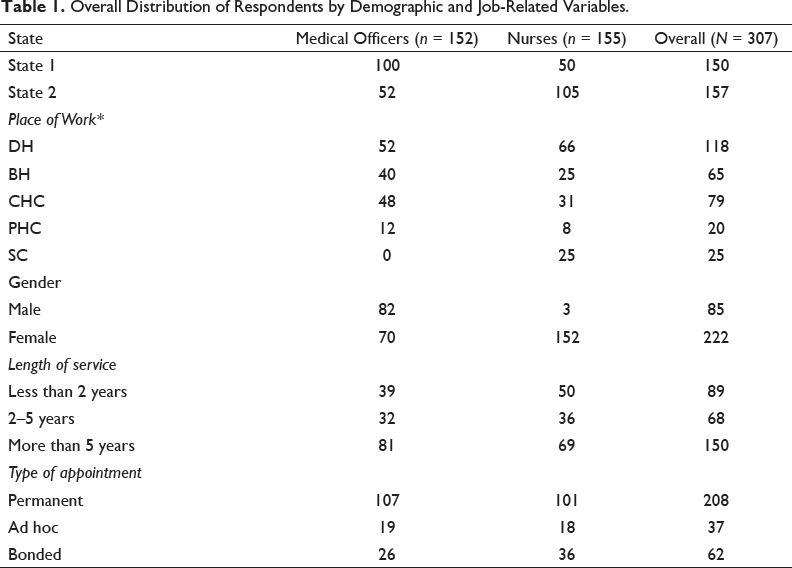
Due to resource and time constraints, two districts from a western state and one district from a northern state were included based on convenience (proximity and ease of access). Further data were collected from the doctors and nurses available from SCs, PHCs, CHCs, BHs and DHs from the three selected districts. Due to factors such as critical shortage, absenteeism as well as work-related engagements, data were collected from a total of 307 healthcare providers of which 152 were doctors while 157 were nurses.
Data were collected using a tool that collected demographic and work-related information such as state, district, designation, gender, length of service, type of service and so on. In addition to this, a job satisfaction tool called ‘Measure Job Satisfaction (MJS)’ was adapted for the current study (Traynor & Wade, 1993). The MJS tool was pilot tested with 20 health service providers before the final commencement of the study. Motivation came out as an important variable during the pilot testing. Hence, the MJS tool was slightly modified and one additional question on motivation was added to the study tool. The MJS tool has 40 items included as statements in the tool that captured the following seven dimensions of job satisfaction: personal satisfaction, satisfaction with workload, satisfaction with professional support, satisfaction with training, satisfaction with salary or pay, satisfaction with prospects and satisfaction with standard of care. The participants were asked to rate each of the 40 statements on a five-point Likert scale from 1 to 5 based on ‘how satisfied they feel about each of the item/dimension’, with a higher score indicating a higher level of job satisfaction and vice versa. The MJS tool has high established reliability with an overall Cronbach Alpha value of 0.95 for all the 40 items combined. Also, for each of the seven dimensions of job satisfaction, the Cronbach Alpha value is reported to be 0.85 (Traynor & Wade, 1993).
As the study also aimed to assess motivation that came out as an important dimension during the pilot test, the study tool was slightly modified and one additional question on motivation was added to the study tool. The study participants were asked to rate the question on motivation on a five-point scale (WHO, 2006, 2014, 2016; JLI, 2004; Gupta, 2003) and were asked ‘how motivated they feel with their current job’ with higher scores indicating higher motivation and vice versa. The authors used a single item to measure the construct motivation as few studies have found that often an unambiguous and sufficiently narrow construct single-item measure is able to capture it reasonably (Nagy, 2002; Wanous et al., 1997).
To ensure the quality of the study data on demographic and work-related details, 40 items on job satisfaction and a single item on motivation were collected through a self-administered tool by one of the members of the research team (SL) who visited each study participant personally at their respective health facilities. On average, participants took about 21 minutes to finish the MJS tool. The data collection took a total of three months to complete.
Statistical Analysis
The data were analysed together based on health service provider subgroup, that is, doctors and nurses. For each of the seven dimensions of job satisfaction, average scores were calculated that could possibly range from 1 to 5 with higher scores corresponding to higher job satisfaction. Average scores were also calculated to assess overall job satisfaction (for all the seven dimensions combined) and for one statement for motivation. As the data were normally distributed, parametric tests such as t-test and analysis of variance (ANOVA) were used for comparisons of job satisfaction and motivation scores according to place of work, years of work experience, appointment type and health professional category.
The validity of the tool was measured during the tool development stage where the tool was pretested, and a moderate correlation was observed among different statements for each of the seven dimensions or constructs of job satisfaction. The statistical analysis was carried out using IBM SPSS version 22.0.
ANOVA was carried out to assess any significant statistical difference between the mean scores for overall job satisfaction, motivation and different dimensions of job satisfaction based on demographic and work-related factors. Exploratory factor analysis was also carried out to assess the relationship between job satisfaction and motivation. Finally, regression analysis of motivation was carried to assess predictors of job satisfaction, demographic and work-related factors’ effect on motivation.
Research Ethics
Informed verbal consent of the participants was taken before data collection. Participation in this study was voluntary and confidentiality was guaranteed. Necessary permission for the study was taken from appropriate state-level health authorities from both the states. The ethical approval for the study was obtained from the institutional ethical review committee at Indian Institute of Public Health Gandhinagar (IIPHG).
Results
Demographics
Overall Distribution of Respondents by Demographic and Job-Related Variables.
Mean Scores for Motivation, Job Satisfaction and Its Seven Dimensions
Operational Definition of the Seven Dimensions of Job Satisfaction.

The results suggest that the average score of doctors for overall job satisfaction is relatively low. Similar low patterns of scores are evident for all the seven dimensions of job satisfaction for doctors except that of ‘satisfaction with pay’ which is significantly higher than the others. Further, this pattern is evident for nurses too where except for ‘satisfaction with pay’, the other scores are significantly lower. Looking at the overall job satisfaction scores for nurses and doctors, nurses seem to be slightly more dissatisfied than doctors. As far as the comparison of job satisfaction constructs is concerned for nurses and doctors, the biggest difference was found with ‘satisfaction with training’ where nurses’ scores are much lower than doctors’ scores. Interestingly, the lowest and second-lowest mean scores for all the seven constructs for both nurses and doctors were for ‘professional support’ and ‘personal satisfaction’ dimensions of job satisfaction.
Mean and Standard Deviation (SD) Scores for All The Respondents.

Comparison of Mean Scores for Motivation, Job Satisfaction and Its Seven Dimensions Based on Demographic and Work-Related Variables
The test of ANOVA was carried out to report the difference in the mean scores for overall job satisfaction, the seven dimensions of job satisfaction and motivation for study participants based on demographic and work-related factors like place of work (DH, BH, CHC, PHC, SC), length of service, type of appointment (permanent, ad hoc and bonded) and type of health service provider (doctor and nurse). Table 3 summarises these mean and SD scores of seven dimensions of job satisfaction and also of a single measure of motivation.
It is interesting to observe from Table 4 that the pattern observed at an aggregated level in the context of Table 3 prevails also at the disaggregated level. Table 4 presents the results of F values and p values of the analysis of variance test for equality of means of different levels of a factor.
As far as place of work is concerned, the difference in mean scores is statistically significant at 5% level of significance for all seven dimensions of job satisfaction and the single item of motivation except for ‘prospects’. With regards to length of service, the difference in mean scores is statistically significant at 5% level of significance for five of the seven dimensions of job satisfaction but not so in the case of ‘training’ and ‘standard of care’, and motivation. When it comes to type of appointment, the difference in mean scores is statistically significant for all dimensions of job satisfaction except ‘training’ and motivation. And finally based on type of profession, the difference in mean scores is statistically significant for all the seven dimensions of job satisfaction and also for motivation.
It is interesting to observe that the means of ‘motivation’ is significantly different for different levels of place of work and also between doctors and nurses. Further, the mean scores for motivation are highest at the SC level, among those who have the most work experience, highest for the nurses group but surprisingly lower scores for permanent in comparison to bonded while only marginal difference in mean scores for permanent, ad hoc and bonded. See table 4 for details.
Mean, SD and F Values by Demographic and Major Job-Related Variables for All Seven Dimensions of Job Satisfaction and Motivation.

Note: Figures in bold indicate significance at 0.05 level.
Relationship Between Job Satisfaction and Motivation
The exploratory factor analysis was carried out to assess the relationship between job satisfaction and motivation suggesting statistically satisfactory results. However, there are a few aberrations. For example, in factor 1 along with the loadings of PS 1–PS 6, the loading of Sat 6 (6th item of Satisfaction with workload) came out as high. In some cases, all the items related to a factor are not high. For example, the loadings of Sat 6 (which is high for factor 1) and Sat 9 are low. Also, the seven factors together explain 62.28% variation. See Table 5 for details.
Factor 1: Personal satisfaction
Factor 2: Satisfaction in training
Factor 3: Satisfaction in workload
Factor 4: Satisfaction in professional support
Factor 5: Satisfaction in standard of care
Factor 6: Satisfaction in pay
Factor 7: Satisfaction in prospect
Exploratory Factor Analysis.

Rotation Method: Varimax with Kaiser Normalisation. a Rotation converged in 7 iterations.
Motivation and its Predictors
Finally, the regression analysis of motivation on various predictors of job satisfaction was carried out
to assess whether different predictors such as health profession, gender, length of service, type of service, place of posting and mean scores for personal satisfaction, satisfaction with pay, dummy, satisfaction with training, satisfaction with prospect, satisfaction with standard of care, satisfaction with professional support and satisfaction with workload have an effect on motivation. The results show that R is 38.6%. The results clearly show that personal satisfaction and satisfaction with prospect are highly significant (p values are 0) while gender (p value = .064) and place of posting (p value = .055) are marginally significant. The others are not significant, especially length of service, type of job and pay indicating that these do not have a significant effect on motivation.
Discussion
The study generates evidence on a largely neglected research topic and points out a critical gap in the literature pertaining to a better understanding of job satisfaction among public sector health service providers, where shortages are most evident. The range of health service providers included in the study, from the top to the bottom public health delivery centres (village level right up to the district level), adds to the credibility of the study. Further, despite the severe shortage and high absenteeism of doctors and nurses, the study managed to include over 300 participants from three districts, which is a good number to make some context-specific generalisations of the study findings to other Indian states as well to some extent to other LMICs facing similar health workforce issues.
The study results suggest that both the category of health service providers (doctors and nurses) had very low mean scores for overall job satisfaction at 2.52 and 2.14 respectively. Comparing the two groups of service providers, the scores were significantly lower for nurses. Hence addressing the job-related dissatisfaction is important because evidence from LMICs as well as developed countries suggests that poor job satisfaction among health care professionals is linked to reduced efficiency and intentions to quit (Humphries et al., 2015; Nojima et al., 2015).
Disaggregated mean scores based on seven dimensions of job satisfaction narrate a similar story of poor mean scores for all the seven dimensions for doctors and nurses, with the highest mean scores for ‘satisfaction with pay’ for both the groups. The overall mean score for motivation was also high for doctors and nurses. A similar level of satisfaction with salary was reported from a study done targeting health care professionals (Nojima et al., 2015). Further, our study findings suggest that there might be a strong link between salary and motivation, which has been found in other studies done targeting health care professionals from various countries (Lambrou et al., 2010; Peters et al., 2010; Tzeng, 2002).
These findings indicate the need for health systems policymakers and implementers to devise management strategies beyond providing good salaries or the need to think beyond extrinsic factors. Empirical evidence with Indian public sector doctors suggests similar findings that while money is important, it is not one of the most important factors for work motivation (Purohit & Bandyopadhyay, 2014). Evidence from yet another study corroborates it suggesting that while financial incentives are important to attract doctors and nurses to rural postings, these do not make effective retention strategies (Rao et al, 2010).
Scrutinising the mean scores for other dimensions of job satisfaction, the lowest score among doctors was reported for ‘personal satisfaction’ while for nurses it was for ‘professional support’. But like doctors, the nurses’ group also seemed to be highly dissatisfied with the dimension of ‘personal satisfaction’ with the second lowest mean scores. Personal satisfaction as a construct included several aspects such as feeling of worthwhile accomplishment, personal development, challenges involved in work, interesting work and opportunities available to use skills in work. Clearly, the scores for both doctors and nurses were very low for this dimension suggesting that both the groups of service providers did not get a feeling of worthwhile accomplishment from their work, did not find their work interesting, their work did not provide them enough opportunities to use their skills and the respondents did not perceive their work to be challenging enough. One of the research studies from India reported similar findings where nurses perceived that their job did not provide them enough opportunities to use their skills and this was found as a major contributor to work-related stress (Purohit & Vasava, 2017). Interestingly the regression results from our study also suggest that personal satisfaction is a strong predictor for motivation with highly significant values.
Therefore, from a human resource management perspective, the current study results are particularly relevant as empirical evidence from other studies in India suggests a great need for policymakers to think beyond extrinsic factors and focus more on intrinsic factors as doctors are most motivated by interesting work and challenges involved in work (Purohit & Bandyopadhyay, 2014). While the dimension of ‘personal satisfaction’ is clearly very important, it is also complex and more difficult to address as it is made up of intrinsic factors or in other words, it encapsulates job content rather than job context factors such as salaries, HR policies and so on, which can be addressed through streamlined systems, interventions and policies.
Looking at the other dimensions of job satisfaction, low scores were also reported for workload. There is enough evidence from several studies that supports that nurses are often overloaded with work. For example, a study of nurses in India found that addressing high workload is a key factor for developing effective human resource for health (HRH) strategies for improved retention for nurses. Another study with auxiliary nurse midwives (ANMs) found workload to be the most important factor contributing to work-related stress (Purohit & Vasava, 2017). However, high workloads are not just common to Indian nurses. A study conducted with nurse managers in Sweden also reported greater workloads (Johansson et al., 2013).
Low scores were also reported for training in the current study. This dimension captured various aspects of training such as training opportunities available, time available off work to attend training programs and relevance of training programs to career advancement. The average scores for this dimension were particularly low for nurses. Lack of training and professional support has a bearing on dissatisfaction, reported in literature of other countries (Fang et al., 2015; Kumar et al., 2013). Training provides an impetus for challenging duties and professional development (Chimwaza et al., 2014), and training and education opportunity have been reported to be important factors for motivation in health care professionals (Chikanda, 2005). Hence, there is an urgent need for health departments to provide training in the needed areas.
The study respondents also seemed to be dissatisfied with the ‘prospects’ suggesting their concerns around career progressions, promotions as well as continued employment. Further, the regression results from our study also suggest that ‘satisfaction with prospects’ is a strong predictor for motivation with highly significant values. Empirical evidence, not only from LMICs but also from developed nations such as Australia, suggests that nurses feel contained in their roles with a lack of career advancement opportunities, an important factor for turnover rates (Eley et al., 2013; Kar & Suar, 2014). One of the seminal studies done in the area on work-related stress in India with nurses indicates similar findings where professional stagnation and very limited opportunities for personal and professional growth were found as important factors contributing to stress (Purohit & Vasava, 2017). As far as the public sector is concerned, where shortages are most notable, career progression among doctors and nurses has been found to be a cause of worry with often very slow or no vertical growth among nurses (Purohit & Vasava, 2017). This slow growth can be attributed to many reasons some of which are: standard criteria for promotion and career professional for doctors and nurses, inefficient promotions systems, biased and irrelevant promotion policies and systems (Purohit & Martineau, 2016b). Dissatisfaction with career progression has a great impact on the standard of care and services provided by health professionals (Al-Aameri, 2000; Wada et al., 2009). Having vertical growth and achieving higher positions have been found to be important factors for motivation among doctors (Henderson & Tulloch, 2008).
The health workforce is a critical component to health system strengthening (WHO, 2000). Absence of unspecific nature or poor implementation of health workforce policies, specifically around workforce management, has been a major area of concern (Purohit & Martineau, 2016c; Purohit et al., 2016). Further, inefficient, inequitable and lack of employee-centric nature of human resource management related policies and practices in the public health sector suggest huge gaps in the area of workforce management (Purohit & Martineau, 2016a, 2016b, 2016c; Purohit et al., 2016). Hence, aiming to address the key factors for lowered job satisfaction and motivation among health care providers is an area that is a cause of concern but undoubtedly an area that requires priority attention.
The study results indicate two important policy aspects within the construct of job satisfaction that require research attention- extrinsic and intrinsic. The importance of both intrinsic and extrinsic aspects has been shown to be important for work motivation among public sector doctors in India (Bhatia & Purohit, 2014; Purohit & Bandyopadhyay, 2014). The low scores for several dimensions of job satisfaction not only indicate that the health service providers have issues around the extrinsic factors like workload, professional support and standard of care, which are extrinsic to the work. The poor job satisfaction scores and predictors for motivation for the dimensions such as ‘personal’ and ‘prospects’ scores strongly indicate reduced job satisfaction and motivation arising out of the intrinsic conditions like uninteresting and non-challenging work, lack of responsibilities as well as prospects that go beyond promotion and may include aspects such as lack of recognition and so on. All these are inherently job content factors that need to be examined closely. Evidence from other studies on issues around motivation with public sector doctors suggests that doctor’s motivation to continue with their current job is driven both by extrinsic and intrinsic factors (Purohit & Bandyopadhyay, 2014).
Various dimensions of job satisfaction may be inter-related and inter-connected which may have a strong bearing not only on different dimensions but also on overall job satisfaction and motivation. For example, in the current study, doctors and nurses working in the public health sector were dissatisfied with personal satisfaction. Dissatisfaction on personal satisfaction dimension might be due to heavy workload, less professional support, limited training opportunity, inadequate career prospects or poor standard of care of health care services. The evidence from global literature on job satisfaction among health workers suggests several important links of job satisfaction with other human resource management variables. A study conducted with health workers in China indicates that job satisfaction and work engagement are strong predicators of turnover intentions (Zhang et al., 2018). Furthermore, factors that prevent job satisfaction and reduced burnout are linked to reduced retention or higher turnover rates in both the indigenous and non-indigenous health workforce (Katz et al., 2010). Another study with health workers from Australia confirms that job dissatisfaction is linked to poor training, remuneration and limited career pathways (Taylor et al., 2009). Studies suggest that job satisfaction can be improved among health workers if they are provided opportunities for professional growth and support for professional mentorship (Watson et al., 2013). Lastly, a systematic review identified poor work environments, heavy workloads and low salaries as key barriers to the retention of health workers (Lai et al., 2018).
Limitations
Due to time and financial constraints, it was only possible to have limited participation of doctors and nurses from 3 districts and only of those who were available at the health facilities on the day of the data collection. Further, due to the cross-sectional nature of the study, the research provides a snapshot of health worker perspectives at one point in time. The study did not examine work commitment, performance and intentions to quit, so the study does not report how job satisfaction and motivation play out as far as health worker’s work commitment, performance and intentions to quit are concerned. We strongly believe that such analyses will be important to managers, street-level bureaucrats and policymakers, who may want to see how job satisfaction may affect the availability and distribution of the health workforce. Finally, the finding of the study cannot be completely generalised in the public sector across different states due to inadequate sample size and the non-probability sampling method used. Furthermore, the results of the study cannot be generalised for professionals working in the private sector due to varied working conditions such as diverse environmental, professional, social and economic considerations.
Conclusion
The research underscores the importance of job satisfaction, why job satisfaction needs to be critically examined and its importance in streamlining health workforce related policies with a focus on improved management. Additionally, the study’s findings throw light on dimensions of job satisfaction that require policy attention.
The results of the study are in line with findings from research studies from many other LMICs and developed nations suggesting the need to focus on approaches that address both extrinsic and intrinsic factors to improve job satisfaction and work motivation among health service providers. Hence there is a need to look at the issue of job satisfaction as a complex one that requires a bundle (combing the factors that prevent extrinsic and intrinsic factors of job satisfaction) of factors and strategies (Buchan, 2004) to address key human resource management related indicators such as increased burnout, poor motivation and retention and high turnover. It is therefore suggested that the health ministries, departments and systems need to pay close attention to devising bundle of strategies that address both the extrinsic as well as intrinsic factors as a potential answer to addressing the shortage of doctors and nurses.
Footnotes
Acknowledgement
We thank all the study participants for taking part in the study. We would also like to thank the state and district health authorities for allowing us to carry out the study.
Authors’ Contributions
SL and BP contributed to conception and study design. SL contributed to the literature review, data collection while BP provided mentoring support. BP wrote the first draft of the manuscript and provided basic ideas for data analysis while TB carried out the detailed data analysis and interpretation of results with very significant contribution. SL, BP and TB were involved in redrafting the manuscript and revising for important intellectual contents. All authors have read and approved the final manuscript.
Availability of Data and Materials
The datasets generated and analysed during the current study are not publicly available in order to maintain anonymity of the study sites. However, these may be available from the corresponding author on reasonable request.
Declaration of Conflicting Interests
Ethics Approval and Consent to Participate
Informed verbal consent of the participants was taken before data collection. The participation in this study was voluntary and confidentiality was guaranteed. Necessary permission for the study was taken from appropriate state level health authorities. The ethical approval for the study was obtained from the institutional ethical review committee at Indian Institute of Public Health Gandhinagar (IIPHG).
Funding
The authors received no financial support for the research, authorship and/or publication of this article..