







Abstract
The aims of this research were to uncover whether nurses’ fear of catching COVID-19 resulted in burnout, whether their psychological capital remediated the fear of catching COVID-19 and burnout, and whether it moderated the prospective association between fear of catching COVID-19 and burnout. A deductive, explanatory and cross-sectional design has been employed in this research. The sample consisted of 734 nurses from Istanbul, Turkey. A questionnaire survey was conducted to collect data between 14 April and 11 May 2021. Discrepancies between average scores of variables were investigated according to the pandemic-related criteria through t-test and analysis of variance (ANOVA) test. The partial least squares structural equation modelling technique was used to analyse proposed relationships. Findings indicated that nurses from public pandemic hospitals reported the highest levels of burnout and fear of infection and the lowest levels of psychological capital components. Fear of COVID-19 infection resulted in burnout more weakly among nurses who had a high level of psychological resilience. Optimism impacted burnout negatively. Hope impacted the fear of catching COVID-19 negatively.
Introduction
The new coronavirus disease, COVID-19, was diagnosed for the first time in Wuhan, a city located in the Hubei province of China, on 8 December 2019. Very soon, it turned out to be a pandemic (World Health Organization, 2020). It seems that viruses and the pandemics caused by them will be one of the important threats to mankind in the coming decades. So far, many nurses lost their lives to COVID-19. Despite continuous efforts directed at vaccination and the development of drugs, nurses may fear being infected by new variants of the COVID-19 virus or other viruses in the coming days. Such fear may consume the psychological, mental and physiological resources of nurses and may result in burnout. Likewise, some studies have already implied and revealed the association between fear of COVID-19 infection and burnout among nurses (Basar et al., 2022; Giusti et al., 2020; Hu et al., 2020). As distinct from previous studies, in this research, we primarily aimed to uncover the moderating role of nurses’ psychological capital in the relationship between their fear of COVID-19 infection and burnout.
Burnout refers to a psychological syndrome in which an individual depletes their resources, feels exhausted and becomes alienated from others and incapable of completing tasks (Maslach & Leiter, 2017). Burnout develops due to the existence of several workplace stressors (Maslach & Leiter, 2016) and some individual characteristics (Kim et al., 2017). Because it poses apparent threats to the health and well-being of nurses, it is likely that fear of COVID-19 infection also acts as a stressor for nurses. From this point of view, in line with the theoretical reasoning regarding the potential of nurses’ fear of COVID-19 infection to consume their resources, we propose that nurses’ fear of COVID-19 infection can result in burnout.
Due to its undesired consequences, it can be important to uncover phenomena that have the potential to diminish the level of nurse burnout. One of these phenomena can be the psychological capital of nurses (Dimino et al., 2020). Psychological capital corresponds to a positive psychological state, belief or evaluation of an individual related to their own development, capacity and/or potential in social, cognitive, professional and more of the same aspects. The psychological capital of an individual is fed by four psychological sources: self-efficacy, resilience, optimism and hope (Luthans et al., 2007).
Self-efficacy corresponds to the confidence of an individual in their abilities to achieve tough objectives through activating and using motivation, cognitive resources and behaviours appropriately. Those who have a high level of self-efficacy are too confident and trust in their competencies to deal with challenging tasks and situations and control the consequences of their deeds (Nolzen, 2018). Therefore, the self-efficacy of nurses can be a means to cope with their fear of COVID-19 infection and its undesired consequences, such as burnout. Likewise, the findings of Hu et al. (2020) support this claim. Accordingly, negative relationships can be expected between nurses’ self-efficacy and fear of contracting COVID-19 and between nurses’ self-efficacy and burnout. Depending on the same reasoning, it can be expected that fear of COVID-19 infection will result in burnout more weakly among nurses with a high self-efficacy level.
Resilience corresponds to an individual’s ability to recover fast, sustain, bounce back and even become stronger than before, after facing challenging situations, adversities and ambiguities (Luthans et al., 2019). Those who have a high level of resilience can use their psychological resources wisely and can successfully stand up to negative experiences, endure difficulties, gather their strength and adapt to new conditions (Luthans & Youssef-Morgan, 2017). Because COVID-19 poses a clear threat to nurses, the resilience of nurses can also be a means to cope with it and its undesired consequences, such as burnout. The findings of Hu et al. (2020) support this proposition too. Hence, negative relationships can be expected between nurses’ resilience and fear of contracting COVID-19 and between nurses’ resilience and burnout. These explanations indicate that the resilience of nurses can also moderate the effect of fear of COVID-19 infection on burnout. That is, it can be expected that fear of COVID-19 infection will result in burnout more weakly among nurses with a high resilience level.
Optimism corresponds to a positive perspective that an individual generally possesses and his or her tendency to expect to gain positive outcomes, such as success, achievement, high performance and similar benefits (Alessandri et al., 2018). Because those who have a high level of optimism expect positive outcomes, they become more motivated to pursue their goals and struggle with difficulties (Youssef & Luthans, 2007). These assessments point out that nurses can use optimism as an additional psychological resource to control their fear of COVID-19 infection and its undesired consequences, such as burnout. Therefore, nurses’ optimism can be expected to decrease the level of their fear of COVID-19 infection and burnout as addressed by Cotel et al. (2021). Additionally, depending on the motivational role of it, nurses’ optimism can moderate the effect of their fear of COVID-19 infection on burnout. That is, it can be expected that fear of COVID-19 infection will result in burnout more weakly among nurses with a high optimism level.
Hope corresponds to an individual’s positive psychological condition that motivates him or her to successfully direct their energy to achieve specific goals and when needed, to plan alternative pathways that lead to the achievement of those goals (Mathe et al., 2017). Those who have a high level of hope are more determined, do not give up when grappling with difficulties, and have the ability to find or create alternative ways that serve the same purpose (Friend et al., 2016). Based on this assessment, the nurses’ hope is also expected to reduce the level of their fear of COVID-19 infection and burnout as addressed by Feldman et al. (2021). In addition, as these explanations indicate, nurses’ hope can also moderate the effect of their fear of COVID-19 infection on burnout. That is, it can be expected that fear of COVID-19 infection will result in burnout more weakly among nurses with a high hope level.
In this context, in line with the objectives of the research, answers are looked for some questions to better figure out the situation in the hospitals where this research was conducted and to make some inferences regarding theoretical and practical concerns. They are listed as follows:
What are the participants’ levels of fear of COVID-19 infection, burnout and psychological capital?
What are the discrepancies between the average scores of research variables in terms of various demographic and COVID-19-related categories?
Does nurses’ fear of COVID-19 infection result in burnout?
Does nurses’ psychological capital reduce the level of their fear of catching COVID-19 and burnout?
Does nurses’ psychological capital moderate the relationship between their fear of COVID-19 infection and burnout in a way that fear of COVID-19 infection results in burnout more weakly among nurses with a high psychological capital level?
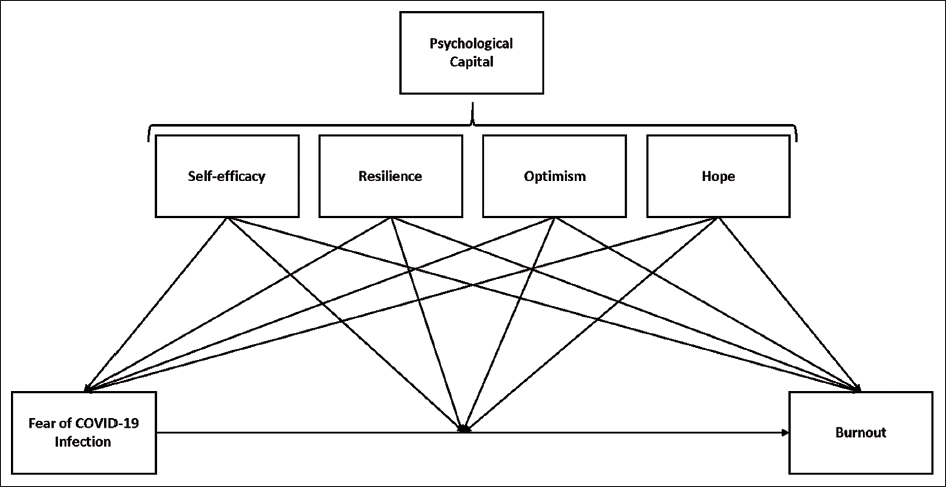
A conceptual model indicating the proposed relationships is presented in Figure 1.
Conceptual Model.
Methods
Research Design and Participants
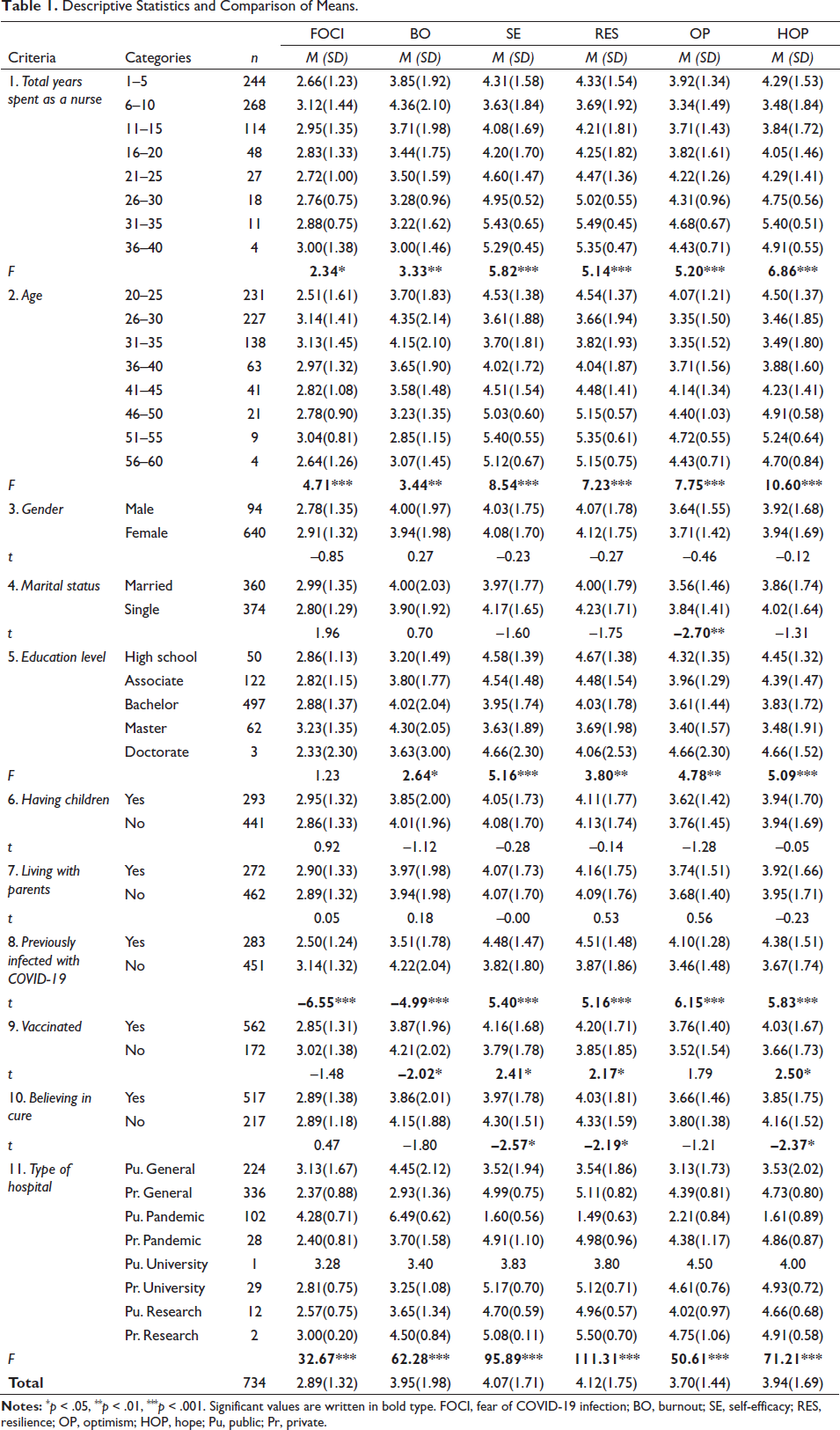
In this research, a deductive, explanatory and cross-sectional design was used. The sample consisted of 734 nurses. A convenience sampling technique was employed to determine the sample. When recruiting participants, two inclusion criteria were considered. Nurses who were older than 18 years and worked in public or private hospitals in Istanbul during the pandemic could participate. The demographics of the participants are presented in Table 1.
Descriptive Statistics and Comparison of Means.
Data Collection Procedure
A questionnaire survey was conducted to collect the data. The questionnaire form was prepared electronically on surveey.com, an online survey system. It comprised three sections. In the first section, information about the aim and scope of the research and instructions on how to fill out the questionnaire were given. In this section, the anonymity of the participants and their institutions was also addressed and emphasised. In the second section, questions about the demographics of participants, such as tenure, age, gender, marital status and education level were asked. We also asked them to indicate at what type of hospital they work, whether they believe that a cure will be discovered for COVID-19, whether they were infected previously, whether they live with their parents, whether they were vaccinated and whether they have children. In the third section, items of previously developed measures (i.e., measures of fear of COVID-19 infection, burnout and psychological capital) were listed. To collect the data, a link to the electronic questionnaire form was shared with the nurses in their social network groups. Nurses have several social network groups/accounts on several platforms, such as WhatsApp, Instagram and Facebook where they communicate, socialise and update themselves about the latest happenings. In this way, the data were collected from those who voluntarily participated in the survey between 14 April and 11 May 2021.
Participants’ level of fear of catching COVID-19 was measured with Ahorsu et al.’s (2020) scale which was translated into Turkish by Satici et al. (2020). It comprises seven items and one dimension. Each item was measured out of 5 points (1: Strongly disagree, 5: Strongly agree). A sample item was ‘I am most afraid of Coronavirus-19’. In this research, the scale proved the sufficient level of validity (i.e., factor loadings varied between 0.73 and 1.01) and reliability (i.e., Cronbach’s α = 0.96).
Participants’ level of burnout was measured with Malach-Pines’s (2005) scale which was translated into Turkish by Tumkaya et al. (2009). It comprises 10 items and 1 dimension. Each item was measured out of 7 points (1: Never, 7: Always). A sample item was ‘I feel tired’. In this research, the scale proved the sufficient level of validity (i.e., factor loadings varied between 0.83 and 0.99) and reliability (i.e., Cronbach’s α = 0.98).
Participants’ level of psychological capital was measured with Luthans et al.’s (2007) scale which was translated into Turkish by Cetin and Basim (2012). It comprises 21 items and 4 dimensions (i.e., self-efficacy, resilience, hope and optimism). Each item was measured out of 6 points (1: Strongly disagree, 6: Strongly agree). A sample item was ‘I feel confident analysing a long-term problem to find a solution’. In this research, the scale proved the sufficient level of validity (i.e., factor loadings varied between 0.94 and 0.96 for self-efficacy, 0.92 and 0.96 for resilience, 0.84 and 0.91 for optimism, and 0.86 and 0.93 for hope) and the reliability (i.e., Cronbach’s α = 0.98, 0.97, 0.93 and 0.97 for each dimension, respectively).
Ethical Considerations
An ethical approval, no.: E-65836846-044-207878, has been taken from the ethical committee of the university where the authors work on 13 April 2021. Consent was obtained from those who worked in a hospital in Istanbul and who were willing to participate in the research voluntarily by enabling them to select ‘yes’ or ‘no’ on the first window of the electronic survey, where instructions and information about the aim and scope of the research were stated and anonymity of the participants and their institutions were ensured too. By this means, only those who clicked on ‘yes’ were allowed to move forward and fill out the questionnaire form.
Data Analysis Strategy
A couple of tests were done on IBM SPSS Statistics version 24 to find answers to the first and second research questions. One-way analysis of variance test was performed to compare average scores between three or more categories. Independent samples t-test was performed to compare average scores between two categories. Afterwards, a correlation test was done on IBM SPSS Statistics version 24 and a regression test was done on SmartPLS version 3.3.3 using the partial least squares structural equation modelling technique to find answers to the third, fourth and fifth research questions.
Results
Descriptive Statistics and Comparison of Mean Values
Participants’ demographics, their levels of fear of COVID-19 infection, burnout, self-efficacy, resilience, optimism and hope, and a comparison of means of these variables according to the demographics and COVID-19-related criteria are presented in Table 1.
Findings in Table 1 indicate that the means of all variables significantly differed according to the categories of the first, second, eighth and eleventh criteria. Means of variables except that of fear of COVID-19 infection significantly differed according to the categories of the fifth criterion. The mean of optimism significantly differed according to the categories of the fourth criterion. Means of self-efficacy, resilience and hope significantly differed according to the categories of the ninth and tenth criteria. Means of burnout also significantly differed according to the categories of the ninth criterion. There were no significant differences between the means of variables according to the categories of the third, sixth and seventh criteria.
Test of Proposed Relationships
Correlation coefficients between variables are presented in Table 2.
Correlation Coefficients between Variables.
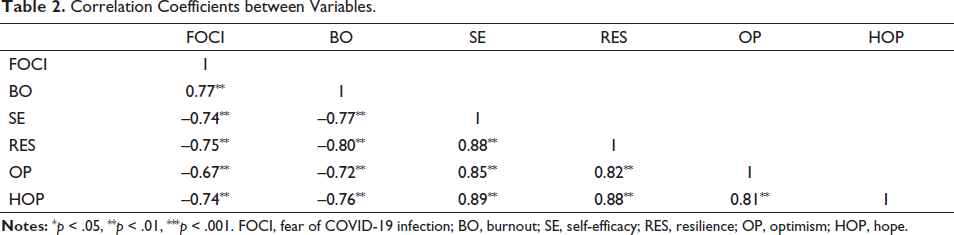
Results indicate that there were significant relationships between variables which provided evidence for the theoretical reasoning on which this research was based. The subsequent analyses were performed in two phases. In the first phase, the effect of fear of COVID-19 infection on burnout and the effect of psychological capital on burnout and fear of COVID-19 infection were investigated. The structural equation model is presented in Figure 2.
Phase 1 of Analyses.
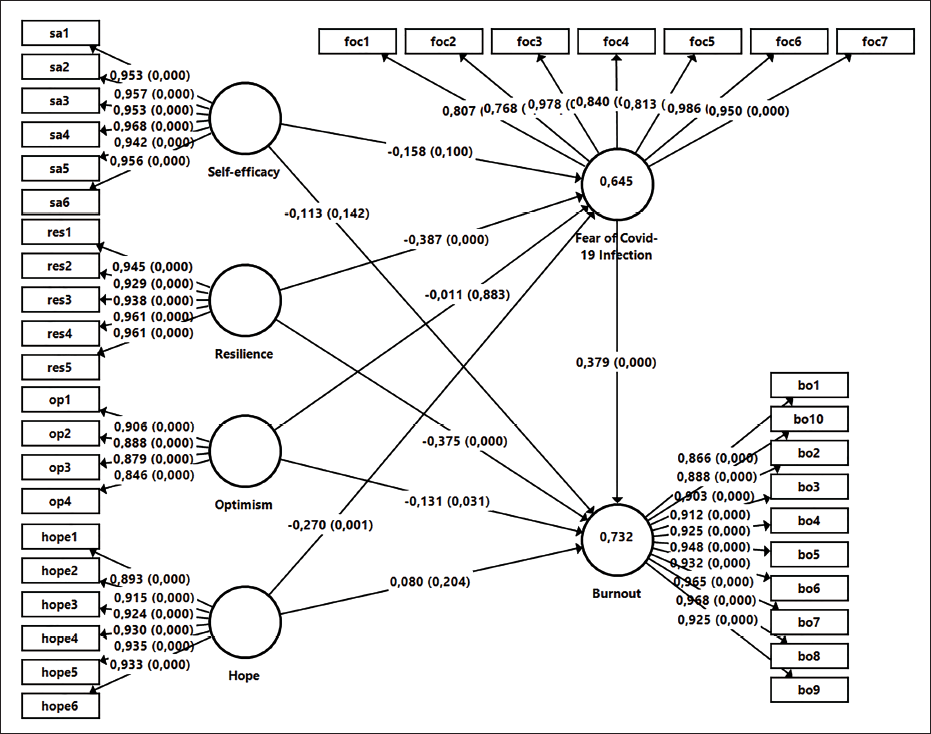
According to the findings, fear of COVID-19 infection had a significant and positive effect on burnout (β = 0.37, p < .001). Resilience had significant and negative effects on both fear of COVID-19 infection (β = –0.38, p < .001) and burnout (β = –0.37, p < .001). Optimism had a significant and negative effect on burnout (β = –0.13, p < .05). Hope had a significant and negative effect on fear of COVID-19 infection (β = –0.27, p < .01). Dimensions of psychological capital explained 64 per cent of the variance in fear of COVID-19 infection and all independent variables explained 73 per cent of the variance in burnout. In the second phase, moderation analyses were done. The structural equation model is presented in Figure 3.
Phase 2 of Analyses.
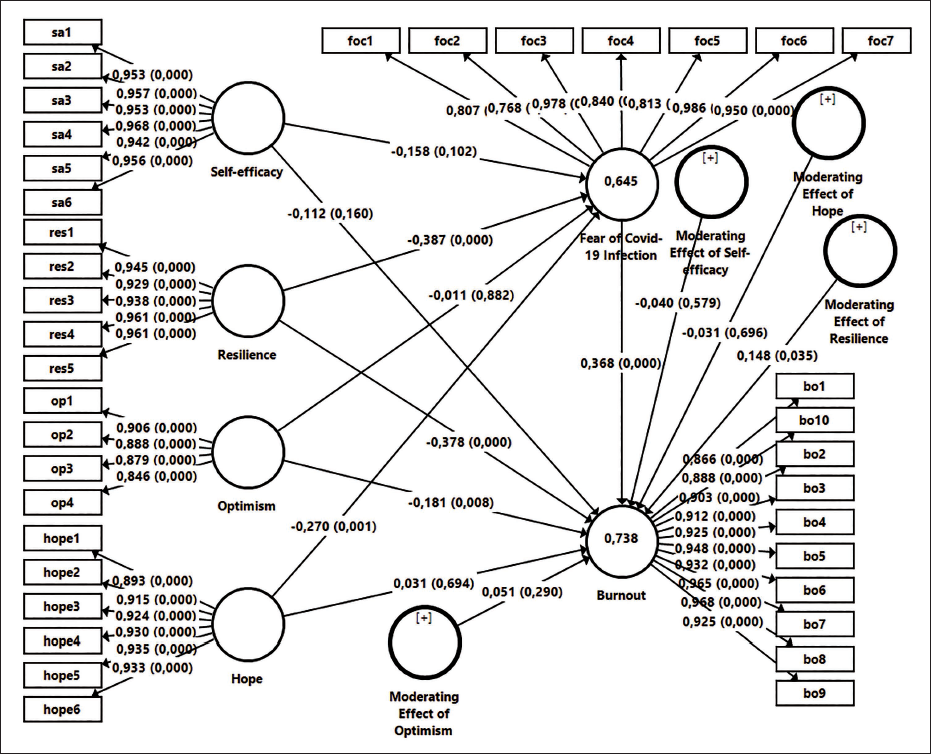
SmartPLS uses a specific procedure to analyse moderating effects of variables. As can be seen in Figure 3, moderating effects of self-efficacy, resilience, optimism and hope are shown with separate circles connected to burnout. Results indicate that only resilience had a significant moderating effect on the relationship between fear of COVID-19 infection and burnout (β = 0.14, p < .05). That is, fear of COVID-19 infection resulted in burnout more weakly among nurses with a high resilience level. Likewise, after adding moderator variables into the model, the effect of fear of COVID-19 infection on burnout slightly decreased from (β = 0.37, p < .001, Figure 2) to (β = 0.36, p < .001, Figure 3).
Discussion
Because pandemics threaten the existence of mankind on this planet very seriously, it is important to investigate factors that help survive. In the fight against pandemics, healthcare givers, especially nurses, have an undeniable role as they directly contact patients and help them recover. In this respect, the most significant and unique aspect of this research was operationally uncovering and underscoring the important remedial role of the psychological capital of nurses in dealing with their fear of COVID-19 infection and burnout. In terms of demographic and COVID-19-related criteria, participants whose experiences in the profession ranged between 6 and 10 years and whose ages varied between 26 and 30 years, as well as those who have not been infected and worked in public pandemic hospitals, had the fear of COVID-19 infection to the highest extent. On the other hand, nurses who were from public pandemic hospitals reported the lowest levels of psychological capital components (i.e., self-efficacy, resilience, optimism and hope). Hence, when tackling with fear of COVID-19 infection, priority should be given to nurses in these categories. Moreover, inoculated participants reported lower fear of COVID-19 infection and burnout scores and higher scores in components of psychological capital than those who were not inoculated, which indicated the positive psychological effect of vaccination.
In addition, findings supported and proved Hu et al. (2020), Giusti et al. (2020) and Basar et al. (2022) in that, fear of COVID-19 infection resulted in burnout. Although we found significant correlations between self-efficacy and fear of COVID-19 infection and self-efficacy and burnout, supporting Hu et al. (2020), we could not find a significant effect of self-efficacy on them and on the relationship between fear of COVID-19 infection and burnout. Findings also revealed that resilience impacted fear of COVID-19 infection and burnout negatively, improving the findings of Hu et al. (2020). However, to the best of our knowledge, as distinct from previous studies, for the first time, we discovered the moderating role of resilience on the relationship between fear of COVID-19 infection and burnout. Such that, fear of COVID-19 infection resulted in burnout more weakly among nurses with a higher resilience level. Additionally, although findings revealed a negative relationship between optimism and fear of COVID-19 infection, the former did not impact the latter significantly. Nevertheless, we uncovered the significant and negative effect of optimism on burnout, improving the findings of Cotel et al. (2021). Finally, as far as we know, for the first time, we discovered a significant and negative effect of hope on fear of COVID-19 infection.
A lack of significant effect of self-efficacy on burnout and fear of COVID-19 infection, a lack of significant effect of optimism on fear of COVID-19 infection, and a lack of significant effect of hope on burnout and a lack of moderation effect of self-efficacy, optimism and hope on the relationship between fear of COVID-19 infection and burnout might have occurred due to the fact that every component of psychological capital was entered into the analyses together and at one time. However, among components of psychological capital, resilience was the only one that moderated the relationship between fear of COVID-19 infection and burnout and influenced both fear of COVID-19 infection and burnout negatively. Therefore, psychological resilience might have been one of the most significant and effective psychological resources for nurses. As far as we know, this study was the first to investigate the aforementioned relationships between fear of COVID-19 infection, psychological capital and burnout of nurses through the structural equation modelling technique. Because, in this technique, every independent and dependent variable was entered into the analysis together and at one time, the level of accuracy of findings can be higher than that of prior research. Hence, it might have improved the theoretical contributions, as well as the validity and reliability of the findings.
However, despite important findings, there were some limitations too, such as using questionnaires as the only means to collect data, the inability to contact nurses face to face, the inability to conduct longitudinal research and time constraints. In this respect, in the future, researchers can use other data collection techniques too. They can test the same research model in a longitudinal study and in different cities or countries to check and improve the validity and generalizability of the findings. Moreover, researchers can design new studies by adding new variables to the conceptual model, such as personality types, perceived support and professional identification of nurses, and by improving the sample size. Therefore, we believe that the findings opened new avenues for future research.
This study was important in the sense that it operationally uncovered that the psychological capital of nurses could be a remedy to alleviate their fear of COVID-19 infection and burnout, as well as the effect of fear of COVID-19 infection on burnout. As long as healthcare professionals pay attention to our findings and bring them into action by consciously investing in their psychological capital and improving its capacity, they can enhance their individual resources in a way to cope effectively with the current and future likely pandemics. Accordingly, nursing managers, such as head nurses and their staff and even other managerial personnel in every clinic, department and service of hospitals can update their strategic plans, goals and courses of action related to the pandemics in a way to develop new procedures and interventions, such as surveys, rehabilitation activities, training programmes, interviews, seminars, feedback sessions and/or meetings to improve nurses’ psychological capital. By this means, nurses can be enhanced psychologically and nursing managers can get ready to bear the responsibility of fostering activities that contribute to the psychological capital of nurses. Besides, nurses should be aware of the remedial role of their psychological capital and should utilise it consciously to cope with negative aspects of their profession, such as pandemics. All these efforts should be directed and focused especially more on psychological resilience since findings indicate that it was the most influential and effective component of psychological capital against the fear of COVID-19 infection and burnout.
Because many pandemics occurred in the past new ones can happen in the future. History shows that pandemics have similar characteristics especially, in terms of their psychological consequences. Therefore, mankind should be better prepared for likely pandemics that can happen in the coming decades by learning from their past experiences. Accordingly, we believe that the findings of this research give insights into the psychological aspects of not only the COVID-19 pandemic but also likely pandemics that can happen in the future.
Footnotes
Acknowledgement
We cordially thank every participant for their valuable contributions to this research.
Author Contributions
Study conception and design: Ufuk Basar, Murat Yalcintas, Oyku Iyigun.
Data collection: Ufuk Basar, Murat Yalcintas.
Data analysis and interpretation: Ufuk Basar.
Drafting of the article: Ufuk Basar.
Critical revision of the article: Oyku Iyigun.
Data Availability Statement
The data that support the findings of this study are available from the corresponding author upon reasonable request.
Declaration of Conflicting Interests
The authors declared no potential conflicts of interest with respect to the research, authorship and/or publication of this article.
Funding
The authors received no financial support for the research, authorship and/or publication of this article.