





Abstract
Interest in psychological empowerment and employee engagement has increased substantially over the last decade among practitioners and academicians. However they have emerged independent of each other with little diligence as to how they are associated. The study attempts to predict employee engagement through dimensions of psychological empowerment. This article will contribute to our understanding of the relationship between psychological empowerment and employee engagement. The study is based on primary data collected from 101 employees working in three service organizations in central Kerala. Statistical techniques like correlation and multiple regression analysis were employed to measure the significance and strength of relationship between psychological empowerment and its dimensions (meaning, competence, self-determination and impact) and employee engagement. Correlation analysis revealed a significant positive association between psychological empowerment and employee engagement. Further analysis showed that all the dimensions of psychological empowerment, other than self-determination are predictors of employee engagement. Findings of the study are discussed, together with limitations and suggestions for future research.
Keywords
Introduction
Employee engagement is an emerging concept in business, management, organizational psychology and human resource development fields (Wollard and Shuck, 2011). Empirical evidences show that employee engagement is associated with various positive individual and organizational outcomes. According to Saks (2006), job engagement is positively related to job satisfaction, organizational commitment and organizational citizenship behaviour, and negatively related to intention to quit. Researches show that high levels of engagement are positively associated with well-being of employees and negatively related to burnout (Schaufeli and Bakker, 2004). Consequently, employee engagement has emerged as a critical element for business success (Slatten and Mehmetoglu, 2011).
The Compensation Trends Survey 2012, conducted by Deloitte Human Capital Advisory Services in the Indian market, employee engagement has been ranked as the third human resource challenge, first and second being retaining critical talent and hiring of skilled talent respectively. Indian industry is realizing that technology, IT infrastructure, large-scale operations and capital are ‘entry criteria’ and not competitive tools anymore and the competitive edge will come from a company’s ability to innovate, create and use the energies of its people (Bhatnagar, 2005). Researchers have made significant studies in exploring the potential relations between engagement and performance-related outcome variables that suggest enhancing engagement could create a compelling competitive advantage for organizations across the globe (Shuck et al., 2011). However a review of the available literature suggests that the complex process by which employees’ engage in the workplace have yet to be fully explored. Wollard and Shuck (2011) stated that little is known about antecedents of employee engagement and the variables that contribute to the overall development of employee engagement. Therefore more attention is needed to determine the enablers of employee engagement in the Indian context. This article aims to address this issue by considering the role of psychological empowerment as an antecedent of employee engagement in the Indian context.
Literature Review
Psychological Empowerment
Employee empowerment has been recognized as an essential contributor to organizational success. The motivational approach to empowerment was pioneered by Conger and Kanungo (1988). They defined empowerment as ‘a process of enhancing feelings of self efficacy among organizational members through the identification of conditions that foster powerlessness and through their removal by both formal organizational practices and informal techniques of providing efficacy information’. Later Thomas and Velthouse (1990) defined empowerment as intrinsic task motivation manifested in a set of four cognitions: meaning, competence, self-determination and impact. Based on this concept Spreitzer (1995) defined psychological empowerment as a motivational construct manifested in four cognitions: meaning, impact, competence and self-determination.
Organizational environment influence the cognitions of empowerment (Thomas and Velthouse, 1990). Quality of work life—favourable conditions and environments of workplaces that support and promote employee satisfaction by providing employee rewards, job security and growth opportunities—empower employees (Lau and May, 1998). Researchers have observed that job security and rewards enhance psychological empowerment (Bordin et al., 2006; Spreitzer, 1995). Empowering employees is essential for organizations to react quickly to changes in the environment. Empowerment in the workplace leads to job enrichment. Niehoff et al. (2001) have found that empowerment affects loyalty through job enrichment. Job enrichment involves designing jobs with high levels of meaning, direction and knowledge of results (Yang and Lee, 2009). Hackman and Oldhams’ (1980) model of job enrichment has five core job dimensions: skill variety, task identity, task significance, autonomy and feedback. The first three dimensions affect the desired outcomes through experienced meaningfulness of the work. Autonomy affects the desired outcomes through experienced responsibility. Feedback has an effect on the desired outcomes through knowledge of the actual results. The desired personal and work outcomes as a result of job enrichment include high internal work motivation, high quality performance, high job satisfaction, low absenteeism and low turnover. Psychologically empowered employees positively influence individual and organizational outcomes (Liden et al., 2000). Albrecht and Andreetta (2011) noted that psychological empowerment is positively associated with engagement and commitment.
Employee Engagement
Kahn (1990) defined the concept of work engagement as the harnessing of organizational members’ selves to their work roles; in engagement people employ and express themselves physically, cognitively and emotionally during role performances and in disengagement, people withdraw and defend themselves physically, cognitively or emotionally during role performances. He described three psychological conditions necessary for engagement as psychological meaningfulness, psychological availability and psychological safety. Building on this work May et al. (2004) quantitatively explored the determinants and mediating effects of three psychological conditions on work engagement. The results revealed that three psychological conditions exhibited significant positive relations with engagement. Kahn’s model has not been empirically examined in diverse settings and to date. May et al. (2004) work provides the only empirical examination of Kahn’s model. In the evolution of employee engagement concept, an important contribution comes from the burnout literature, which considers employee engagement as a positive antipode of burnout (Maslach et al., 2001). He noted that engagement is characterized by energy, involvement and efficacy—direct opposites of the three burnout dimensions, exhaustion, cynicism and ineffectiveness. According to Maslach and Leiter (1997) burnout is an erosion of engagement and as per this approach engagement can be assessed by the opposite pattern of scores on the Maslach Burnout Inventory–General Survey (MBI–GS) dimensions. They consider burnout and engagement to be the opposite poles of a continuum that is entirely covered by the MBI. Schaufeli and Bakker (2004) argued that instead of being two opposite poles burnout and engagement are independent negatively correlated states of mind. They remarked that engagement cannot be adequately measured by the opposite profile of MBI scores since they are not perfectly complementary and mutually exclusive states. Schaufeli and Bakker (2004) defined engagement as a positive, fulfilling work related state of mind that is characterized by vigour, dedication and absorption. Vigour is characterized by high levels of energy and mental resilience while working, the willingness to invest effort in ones work and persistence in the face of difficulties. Dedication is characterized by a sense of significance, enthusiasm, inspiration, pride and challenge. Absorption is characterized by being fully concentrated and happily engrossed in ones work, whereby time passes quickly and one has difficulties with detaching oneself from work. The present study builds on this definition. This approach captures the feelings of energy (vigour), enthusiasm (dedication) and involvement (absorption) which are central features to the concept of engagement. This definition considers engagement as an independent construct and not in relation to burnout. The most frequently referenced definitions of employee engagement are the ones by Kahn (1990) and Schaufeli and Bakker (2004). They share a common focus on the manifestations of engagement: cognitive-absorption, emotional-dedication and physical—vigour (Welch, 2011).
One theme observable in the engagement literature is some overlap between employee engagement and other constructs like organizational commitment, organizational citizenship behaviour and job involvement. There is considerable research and theory which treats engagement as a unique construct. According to Saks (2006) organizational commitment refers to a person’s attitude and attachment towards their organization where as engagement is the degree to which an individual is attentive and absorbed in the performance of their roles. Organizational citizenship behaviour involves voluntary and informal behaviours that can help coworkers and the organization and engagement is ones formal role performance rather than extra role and voluntary behaviour (Saks, 2006). Job involvement is the result of a cognitive judgement about the need satisfying abilities of the job and is tied to one’s self-image and engagement has to do with how individuals employ themselves in performance of their job and involves the active use of emotions and behaviours (May et al., 2004). Employee engagement deserves more attention along with other similar organizational constructs.
Measuring Engagement
The most widely used instrument for measuring engagement is Utrecht Work Engagement Scale (UWES) developed by Schaufeli et al. (2002) which consists of 17 items. A shortened version of nine items is available (Schaufeli et al., 2006). UWES-9 is the widely used version and it reflects the core aspects of engagement (vigour, dedication and absorption), has been validated in many countries and has acceptable psychometric properties. May et al. (2004) developed a scale which contains three components of psychological engagement: cognitive, emotional and physical engagement. But the three factor structure did not emerge and hence the overall score was used. The psychometric properties of this scale need to be established before considering it as a sound measure of engagement. These three dimensions have resemblance with the three dimensions of UWES, vigour, dedication and absorption. Saks (2006) measured employee engagement through job engagement and organization engagement. The instruments employed to assess these constructs are similar to the job involvement and organizational commitment scales (Mohapatra and Sharma, 2010). Though Saks concurs with Kahn’s model consisting of cognitive, physical and emotional dimensions, the instrument does not measure engagement based on the three dimensions. The instrument needs to be validated in diverse samples for considering it as reliable measure. Therefore it is reasonable to suggest that UWES is the most reliable measure of engagement available to date and in the present study UWES-9 is used.
Psychological Empowerment and Employee Engagement
According to Meyerson and Kline (2008) psychological empowerment relates to how competent people feel in an empowered work environment and those who feel more competent about their ability to perform their work successfully should feel more satisfied with their work, be more affectively committed to their organization, have lower intentions to quit and also demonstrate more positive work performance than those with lower levels of psychological empowerment. Based on the research evidence the present study focuses on the four cognitions of empowerment as possible conditions that will contribute to employee engagement. According to Thomas and Velthouse (1990) meaning, one of the cognitions of empowerment, is the value of a work goal or purpose, judged in relation to an individual’s own ideals or standards. May et al. (2004) noted that meaning in work is seen as a method to foster employees’ motivation and attachment to work, thus resulting in engagement. Competence or self efficacy is an individuals’ belief in his or her capability to perform activities with skill (Gist, 1987). Maslach et al. (2001) found a strong correlation between self efficacy and engagement. Self-determination reflects autonomy in the initiation and continuation of work behaviours and processes (Spreitzer, 1995). According to Job Demands Resources model of work engagement job resources like, autonomy start a motivational process that leads to work engagement (Bakker and Demerouti, 2008). Impact implies organizational involvement and reflects whether individuals feel that they are making a difference in their organization (Spreitzer et al., 1997). It involves a sense of progression towards a goal and individuals’ belief that their actions are making a difference in their organizations, which contributes to employee engagement (Stander and Rothmann, 2010). However, Albrecht and Andreetta (2011) observed that there is less evidence to support an association between impact and engagement, and similarly the association between empowerment and engagement has not been a subject of significant empirical research. Despite the significant academic interest in psychological empowerment there is a dearth of research investigating the use of psychological empowerment in a South East Asian context (Bordin et al., 2006). Very few work is present in the area of psychological empowerment in India, and this ascertains the gap in research in the field of psychological empowerment in the Indian context (Bhatnagar, 2005). Within a Western context, concepts such as psychological empowerment have been demonstrated to be successful in winning the hearts and minds of employees as well as increasing employee performance (Avolio et al., 2004; Seibert et al., 2004). In line with this psychological empowerment can be considered as an antecedent of employee engagement. Therefore, the more psychologically empowered an employee is the more would be the employee engagement.
The objectives of this study are:
To examine the levels of psychological empowerment experienced by employees in the selected organizations. To measure the levels of employee engagement experienced by employees in the selected organizations. To analyze the impact of psychological empowerment and its dimensions on employee engagement.
Based on the discussion the following hypothesis was formulated:
Methodology
Overview of Sample and Procedures
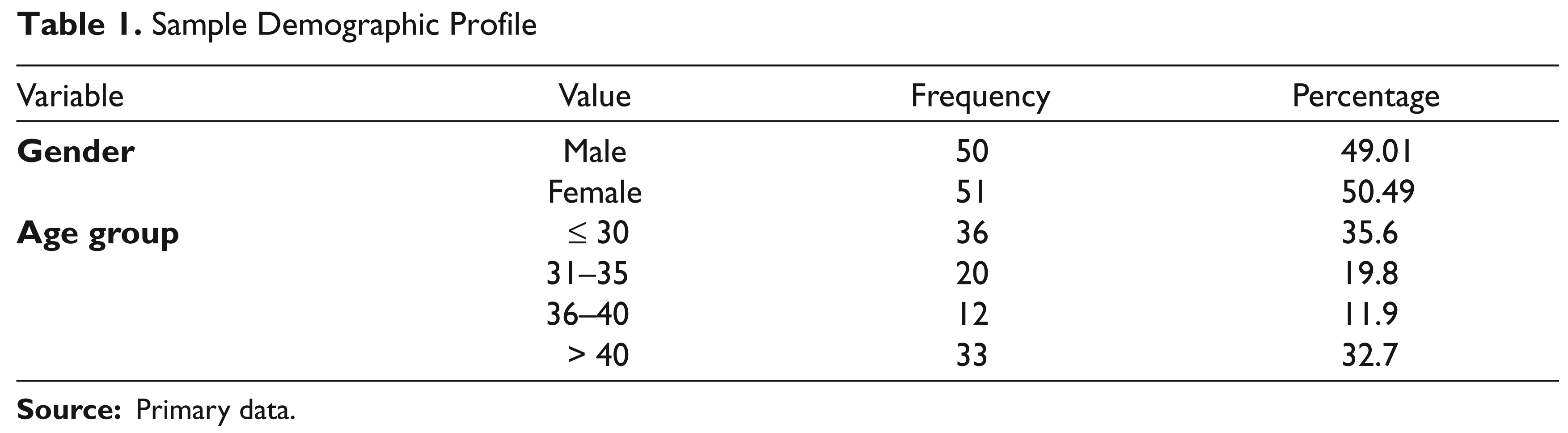
The target population consisted of 439 non-managerial employees from three organizations (one in the healthcare sector, one in the insurance sector and one in the telecom sector) in central Kerala, South India. The organizations were selected in part because of their geographical location. The academic background and professional allegiance prompted the researcher to contact the human resource managers of these organizations who facilitated data collection from the targeted participants. 25 per cent of the population was decided to be the sample size which was 110. As a precautionary measure to get sufficient data the sample size was increased to 120. 101 usable responses were obtained, generating a response rate of 23 per cent.
Table 1 presents the demographic characteristics of the 101 participants.
Sample Demographic Profile
Measures
Spreitzer’s (1995) 12-item scale was used to measure psychological empowerment. Responses were rated on a five point Likert scale with anchors—(1) strongly disagree to (5) strongly agree. The Cronbach Alpha Coefficient of the 12—item instrument was found to be 0.843.
Schaufeli et al. (2006) nine item scale was used to measure employee engagement. The responses were measured using a five point Likert scale ranging from strongly disagree (1) to strongly agree (5). The Cronbach Alpha Coefficient was found to be 0.885. The composite score of work engagement was used as recommended by Schaufeli et al., (2006). Both the scales have acceptable internal reliability according to Nunnallys’ (1978) 0.7 criterion.
Analysis and Results
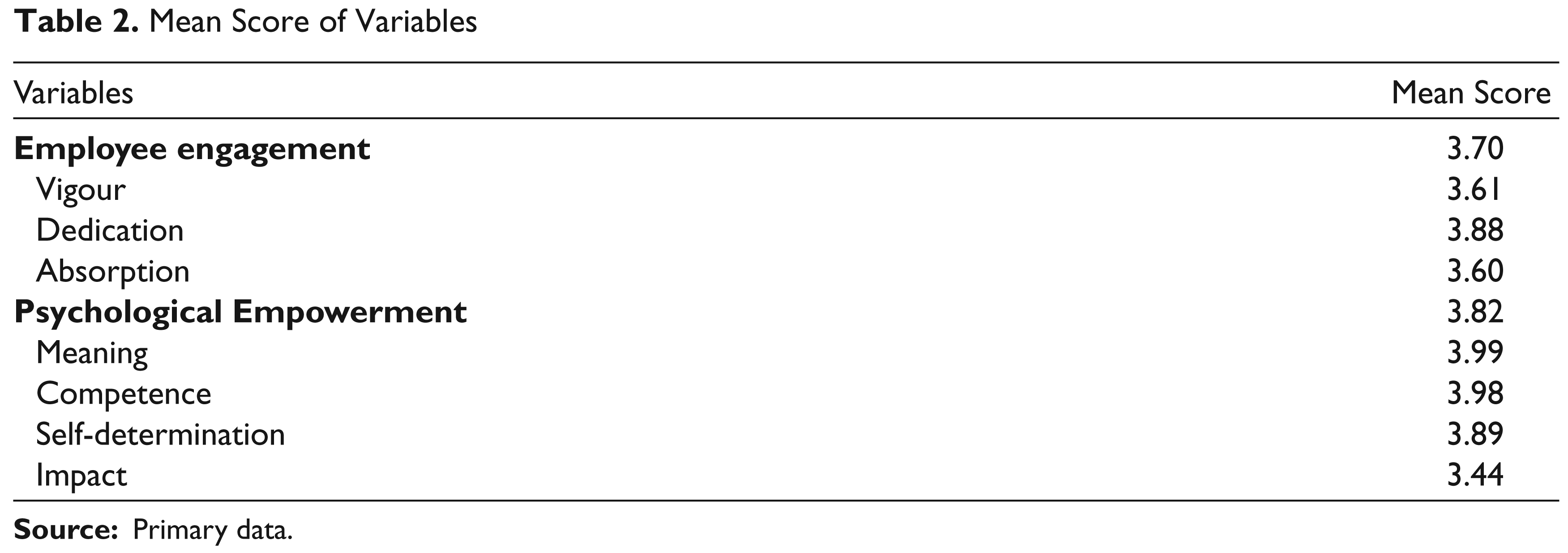
To assess the levels of psychological empowerment and employee engagement means, score of these variables and their dimensions are found. The mean scores are given in Table 2.
Table 2 shows that mean score of employee engagement measured using UWES-9 was 3.70, which means that level of engagement is above average. Among the three dimensions, dedication has the highest mean of 3.88 and absorption has the lowest mean of 3.60. The mean of psychological empowerment is 3.82 and is above neutral position. Of the four dimensions of psychological empowerment, meaning has the highest average score of 3.99, closely followed by competence (3.98). Impact reported the lowest mean of 3.44, which shows that there is a scope for betterment. In spite of the provision for the responses to be varying between ‘strongly agree’ and ‘strongly disagree’ across five anchor points, most of the respondents seemingly preferred to be non controversial in their evaluations thereby gravitating the scores largely between ‘three’ and ‘four’ on the response format.
A correlation analysis was done to find out the relationship between psychological empowerment and employee engagement. Table 3 represents the means, standard deviations and inter-correlations of the study variables.
Mean Score of Variables
Results show that there is significant positive relationship between psychological empowerment and employee engagement (r = 0.78, p < 0.01). All the dimensions of psychological empowerment are significantly and positively related to employee engagement. Out of the dimensions meaning (r = 0.795, p < 0.01) correlates highly with engagement followed by competence (r = 0.594, p < 0.01), impact (r = 0.508, p < 0.01) and self-determination (r = 0.461, p < 0.01). Analysis shows that higher levels of psychological empowerment are associated with higher levels of employee engagement.
To study the extent to which the dimensions of psychological empowerment explained the variance in employee engagement a step wise regression analysis (backward method) was conducted. The correlation matrix (Table 3) shows that there are no substantial correlations (r > 0.9) between the predictor variables. As a rule of thumb if the average VIF of a variable exceeds 10, then it is said to be highly collinear (Gujarati, 2008). We did not find any variables whose VIF exceeds 10. Hence data are free from the problem of multicollinearity.
Means, Standard Deviations and Intercorrelations of Study Variables
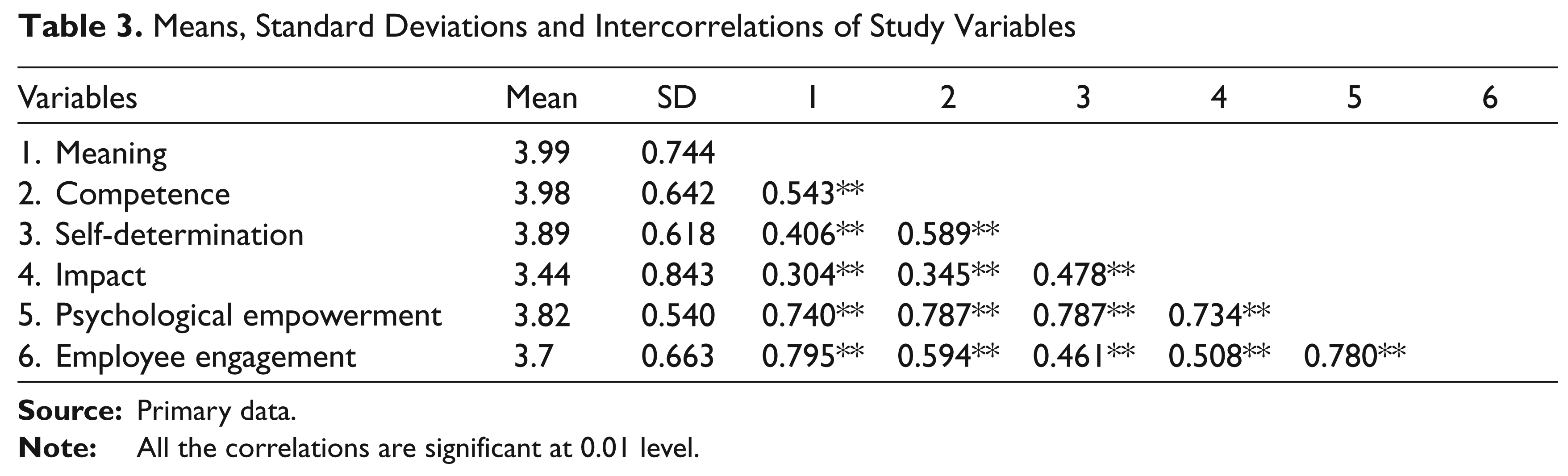
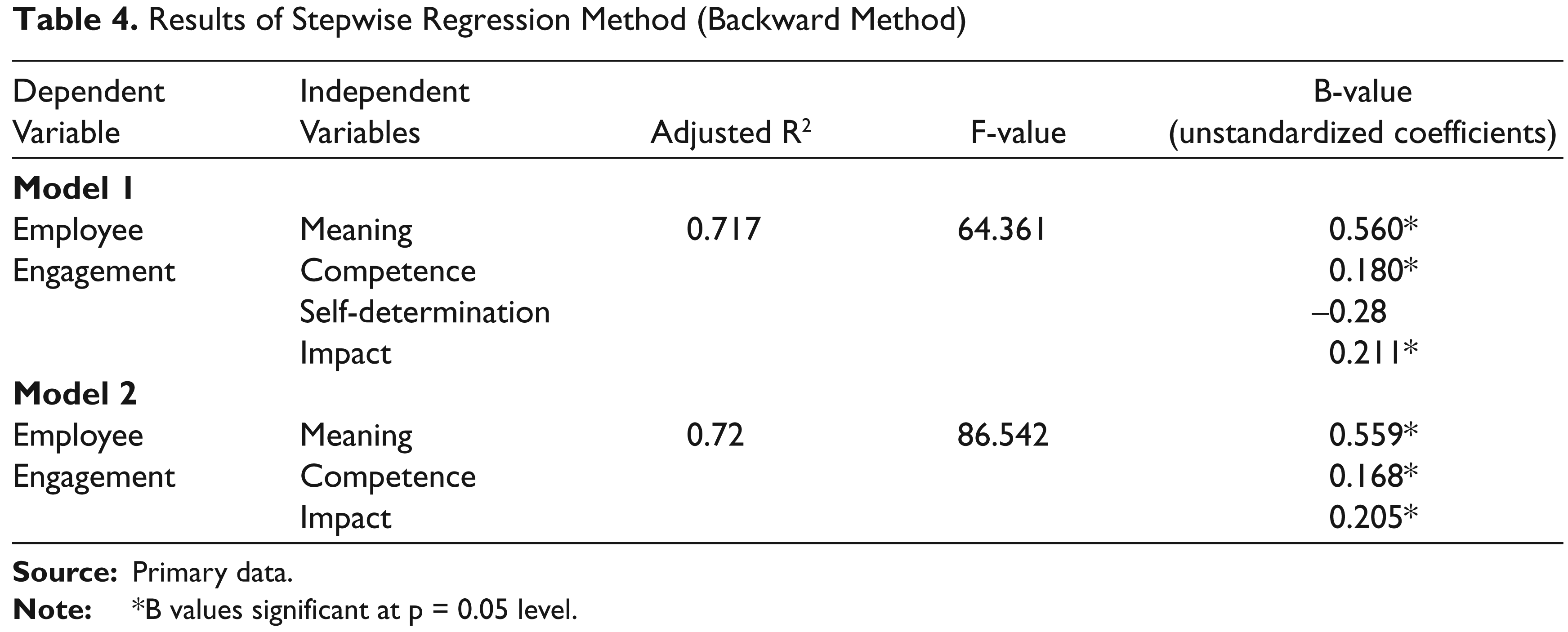
Table 4 shows that 71.7 per cent of the variation in the employee engagement is explained by the four dimensions of psychological empowerment together, that is, meaning, competence, self-determination and impact. Since self-determination was not a significant predictor it meets the removal criterion and was removed from the model and the model is re-estimated for the remaining predictors. After removing self-determination the predictive power of the model increased slightly from 0.717 to 0.72, which means that meaning, competence and impact explained 72 per cent of the variance in employee engagement. Results reveal that meaning, competence and impact are the significant dimensions of psychological empowerment determining engagement.
Results of Stepwise Regression Method (Backward Method)
Discussion
Mean score of employee engagement shows that absorption dimension has the lowest score. This implies that the participants feel less immersed in their work and they experience fewer difficulties in detaching from work. The mean score of dedication was found to be the highest. These results are similar with the findings of Salanova et al. (2005), where contact employees in the service sector experienced less absorption and more dedication.
Mean score of psychological empowerment report that meaning dimension, has the highest score and impact has the lowest. A high level of meaning implies that the participants feel that their work and job activities are meaningful and important. Low levels of impact means that the respondents experience a lack of control and influence over what happens in their organization. These findings are analogous to the results of Albrecht and Andreetta (2011) where community health service workers were reported to experience high meaning and less impact.
Results of this study support the positive relationship between psychological empowerment and employee engagement. Though these relationship had been tested to some extent in the western context (Albrecht and Andreetta, 2011; Stander and Rothmann, 2010), we are able to provide with this sample further support to the notion that with higher psychological empowerment higher will be employee engagement in the Indian context.
Also the present study attempted to identify the influence of the four dimensions of psychological empowerment on employee engagement. To the best of researchers’ knowledge a dimension wise analysis of this nature was not done previously in the Indian context. Dimension-wise analysis shows that meaning has the highest influence on employee engagement. This finding is in congruence with the finding that meaningful work, psychological meaningfulness highly influence employee engagement (Fairlie, 2011; Kahn, 1990; May et al., 2004). Competence was also found to be a significant predictor of employee engagement. Though there is not much research evidence to show competence determine employee engagement, there exists some supporting views. According to self-determination theory (Deci and Ryan, 1985) work contexts that support psychological autonomy, competence and relatedness enhance well being and increase motivation (Ryan and Frederick, 1997). This motivational process links job resources, support and feedback to organizational outcomes through engagement (Schaufeli and Bakker, 2004). Impact also predicted employee engagement. Stander and Rothmann (2010) also reported association between impact and employee engagement. Relatively there is less evidence to support an association between impact and engagement in the academic literature (Albrecht and Andreetta, 2011). Self-determination was found insignificant in predicting engagement. According to Spreitzer (1995), self-determination reflects autonomy in the initiation and continuation of work behaviour. The result of this study is in contrast with other studies (Mauno et al., 2010; Slatten and Mehmetoglu, 2011), which have reported strong association between autonomy and employee engagement. Salanova et al. (2005) conducted a study among contact employees from 114 service units linking organizational resources and work engagement to employee performance. In this study autonomy, one of the dimensions of organizational resources (training, autonomy, technology) had no significant association with absorption and vigour (dimensions of work engagement). This finding is consistent with the findings of the present study. It may also be noted that the participants of both studies are employees in the service sector. Another reason that may be attributed to this contrasting research finding is that the participants of this study were employees in the non-managerial cadre, who usually experience less autonomy in the Indian context.
A few practical implications can be inferred from the above findings. This study supported the hypothesis: psychological empowerment is positively and significantly associated with employee engagement. To enhance engagement of employees, top management may try to enhance the psychological empowerment experienced by employees. Organizational practices can be streamlined to increase perceived competence and leaders must encourage on employee voice system to enhance true empowerment and thus engagement (Bhatnagar, 2005). Empowerment programmes offered to employees help to enhance employee cognitions of meaning, competence, self-determination and impact and thus improve engagement.
While the present research has provided new insights into the relationship between psychological empowerment and employee engagement, the study is not free from limitations. The study used a specific sample of employees and sample size from each sector was small making generalizations difficult. The study employed a cross-sectional design and hence determination of causal relationships is not possible. Future research can overcome these limitations by using a more diverse sample of respondents and by employing a longitudinal design. All of the data were collected through self report procedures causing a concern for common method bias. The focus of this study was to examine the role of psychological empowerment in enhancing employee engagement. Other potential drivers of employee engagement could also be evaluated. This study did not look into the role of demographic variables in the relationship between psychological empowerment and employee engagement and hence future studies may address this. As the mechanisms underlying the relationship between psychological empowerment and employee engagement is still in the dark, exploring this might be a good avenue for future research.
Conclusion
Employee engagement is a matter of concern for organizations across the globe (Welch, 2011). Repeatedly, the literature suggests that employee engagement is a lever to business success and antecedents of employee engagement need more attention of researchers. The present study addresses this issue by examining the impact of psychological empowerment and its dimensions on the level of engagement. The results of this study indicated that employees experienced both psychological empowerment and engagement at a moderate level. The correlation analysis confirmed that psychological empowerment and its dimensions are significantly and positively associated with employee engagement. A stepwise regression analysis was conducted to determine the impact of dimensions of psychological empowerment on employee engagement. Out of the four dimensions of psychological empowerment, meaning, competence and impact was found to be significant predictors. The effect of self-determination was found to be insignificant. The gross effect of psychological empowerment was significant on the level of engagement of employees in the selected organizations. The four dimensions of psychological empowerment together explained 71.7 per cent of variance in employee engagement. Despite the significant academic interest in psychological empowerment and employee engagement, there is a relative shortage of academic literature investigating the impact of psychological empowerment and employee engagement in the Indian context and beyond. Thus the present study renders insights into the relationship between psychological empowerment and employee engagement in the Indian context.