







Abstract
This article reports a case study on the Bangladeshi leading fashion brand Yellow. The study investigated Yellow’s international marketing process, following the brand’s journey from Bangladesh to Pakistan and South Korea. Conducting desk research and interviewing corporate personnel from Yellow, this case study obtained in-depth information and broader understanding about the internationalization of Yellow. The article investigated Yellow’s reasons for going international, how it chose its international markets and market segments and the challenges Yellow faced on its journey. The article is divided two parts: the first part discusses Yellow’s local expansion and the second part discusses Yellow’s internationalization.
It’s a new era in fashion—there are no rules. It’s all about the individual and personal style, wearing high-end, low-end, classic labels, and up-and-coming designers all together.
Introduction
The fashion industry is comprised a thorough network of different stages of production and sales. The industry includes the process of developing innovative designs, production, marketing and sales of clothing lines while maintaining the global standards and regulations (Sondhi & Singhvi, 2006). For more than a decade, the fashion industry of Bangladesh has contributed substantially to strengthening local economic growth while supporting a global export-friendly trade regime (Curran, 2009; Faroque & Takahashi, 2012; Raihan, 1999). The Bangladeshi fashion industry has manufactured clothes both for leading local brands—Aarong, Ecstasy and Cats Eye—and for leading overseas outlets including Walmart, Tesco, Zara, Marks & Spencer and H&M (Islam, Khadem & Sayem, 2012). Easy access to international TV and online media has had a pronounced effect on young urban and suburban men and women; many now prefer Western styles to traditional apparel (though the demand for the latter is still strong). The public display of Western fashions has become more acceptable; evidence of the emergence of a secular society. In addition, Bangladeshi workers and consumers have found that many aspects of Western dress are more comfortable and suitable for their working environment, but mostly, consumers in Bangladesh find comfort in wearing clothes that are a blend of Westernized and traditional clothing design (Ahmed et al., 2014). Given the huge demand for Westernized clothes, a good number of local fashion houses and boutiques have emerged in recent years. In support of this trend, government and private initiatives are encouraging young entrepreneurs to develop skills in fashion design and marketing. As a result, thousands of young fashion designers are regularly producing creative work, and the leading Bangladeshi fashion houses are presenting their unique designs beyond local borders. Our article investigated one of these fashion brands, Yellow, whose internationalization process provided us with critical insights for present and future studies. This study examines how Yellow, a Bangladeshi fashion apparels’ retailer, evolved into an international fashion retailer. The article methodically discusses the company’s process of interception into the Asian markets, namely, Pakistan and South Korea. In addition, it also takes a thorough look into their adaptive capability towards the ever-evolving fashion needs of the market. At first, the article focuses on the journey of how Yellow acquired the local market. That is, the article will bring to light the marketing strategies, challenges and key success factors that assisted Yellow to get a foothold in the domestic fashion industry. In the later part of the study, it focuses on Yellow’s journey beyond the border, specifically Pakistan. It mainly concentrates on its systematic entry in Pakistan, the demographic issues, demand conditions, comparative advantages, and trade barriers of the new market. In a similar way, the article analyzes the entry and market structure in South Korea. It is then followed by a discussion of the article section. Finally, we have addressed recommendations, conclusion and implications.
The Story of Yellow in the Local Market
Beximco Textiles Ltd, the parent company of the brand Yellow, developed as one of South Asia’s largest vertically integrated textile and garment companies. Although mainly an export-oriented company, in 2004 it ventured into the domestic retail market (Ahsan, 2013) using its in-house design capabilities and technical expertise of fabrics and style to ensure that their high-export-quality clothes were available in local markets at a cheaper price (bdnews24.com, 18 December 2005). The company gave the name Yellow to its chain of exclusive fashion shops (The Daily Star, 14 June 2005), and established Yellow as a youthful and design-driven brand that captured a modern interpretation of fashion. Today, Yellow has become a distinct brand of ready-made garments (RMG) by providing high-quality fashion and lifestyle to the fashion-conscious male and female metro dwellers of Bangladesh (The Daily Star, 18 September 2007).
Yellow’s main strength lies in its unique designs that are transforming traditional Bangladeshi clothes into Western casual clothes. The Yellow line comprises ultra-formal, formal and casual clothes, of which the formal collection is the richest. The ultra-formal line consists of a whole range of impressive patterns including checks, stripes, macro-checks in black and white, micro-checks, stripe checks, etc. These are made of pure Egyptian cotton, and this particular line also includes silk and polyester ties imported from China, with a host of funky patterns, such as polka dots and pinstripes amongst others (The Daily Star, 14 June 2005). The formal line includes executive gears for corporate men and women in both silk and polyester, alongside attractive motifs, Punjabis and semi-formal trousers. This particular line of clothing is often ‘over dyed’ or yarn dyed to make the clothes soft, stain resistant and wrinkle free.
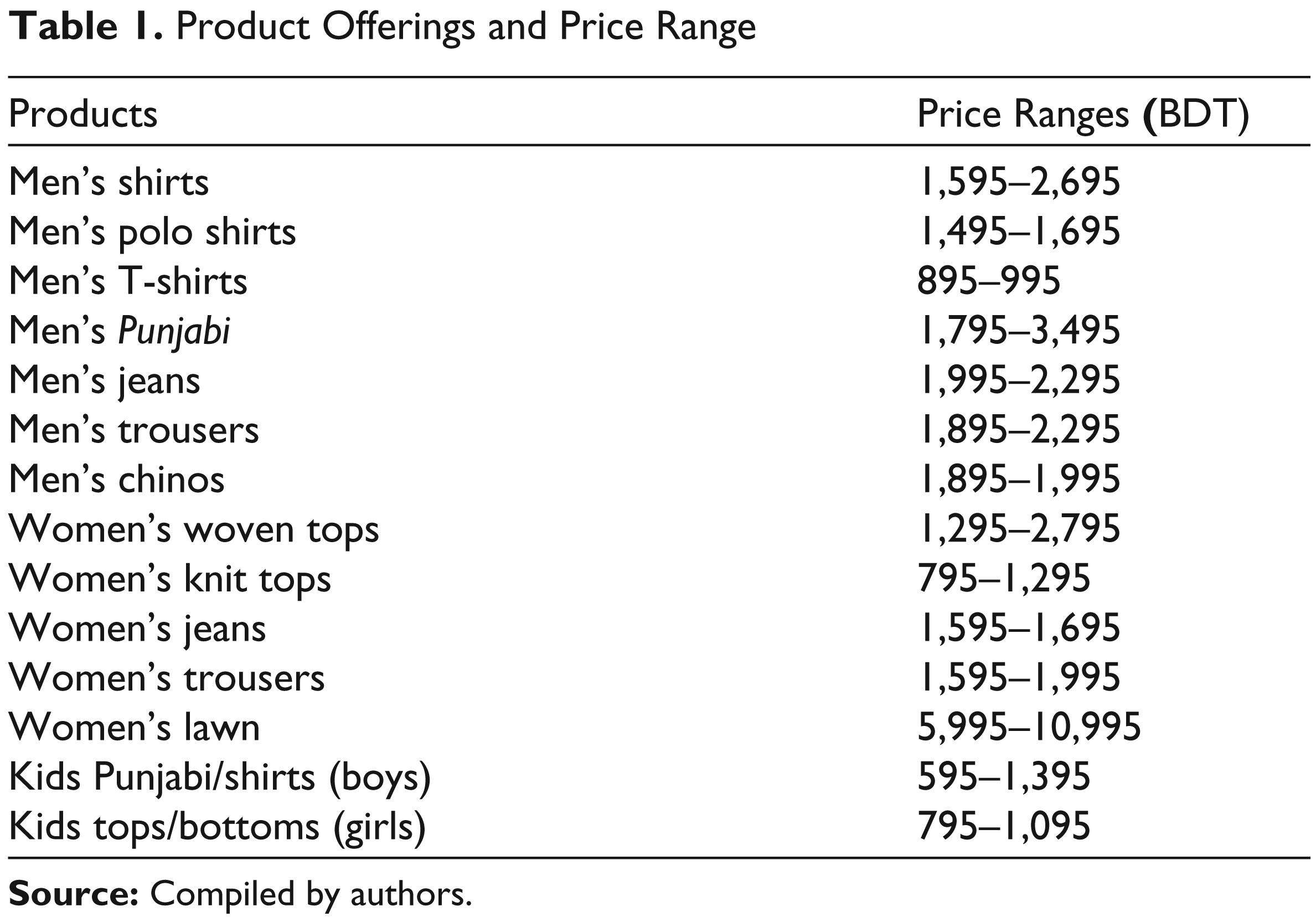
The casual wear line of Yellow is also worth a look, where the brand displays a good collection of the best Beximco denim jeans and shirts of slick designs for men and classy monochrome tops for women (The Daily Star, 18 September 2007). In fact, the casual section of this brand is renowned for its trendy cuts and styles, such as shirts with frayed edges on the bottom and so on (The Daily Star, 14 June 2005). In addition, there is a wide collection of T-shirts, cargos and knits for both men and women under this line. (as shown in Table 1).
Product Offerings and Price Range
The growth of the fashion industry has been a long and continuously evolving journey. Today, the varied artistic designs integrated with technology craft the fashion industry into an intriguing business world (Sondhi & Singhvi, 2006). Hence, ‘the purpose of fashion branding is to establish a differentiated identity for the line of clothing being marketed in a highly competitive, crowded marketplace niche’ (Peirson-Smith, 2013, p. 180), so that Yellow’s knitwear, for example, sets itself apart from other competitors’ version. Yellow has created a favourable and distinct position of its products in the minds of customers. Due to the experience and expertise of Beximco Textiles in the garments industry, the brand has also been able to closely associate itself with the most recent trend in the fashion world of today and tomorrow (The Daily Star, 14 June 2005). In fact, Yellow received an overwhelming response from the consumers when Beximco Textiles launched the first outlet of this brand in the Bashundhara City Shopping Complex—one of Dhaka’s biggest shopping mall (The Daily Star, 18 September 2007). Beximco Textiles’ chief executive officer and Beximco Group director Syed Naved Husain stated that it was because of their affordable price range and fashionable, high-quality garments that customers flocked to buy the products of Yellow (The Daily Star, 27 December 2005). Above all, their finest cotton and ultra-comfortable clothing line has marked the presence of this brand in the RMG sector of Bangladesh.
The tremendous success of this first outlet prompted Beximco Textiles to venture further in the local market, so the company opened two more shops in Dhaka city, in the key residential areas of Gulshan and Dhanmondi (The Daily Star, 18 September 2007). At present (December 2014), Yellow has 11 retail outlets across various areas of Bangladesh.
The Marketing Strategies of Yellow in the Local Market
From its initiation, Yellow has carried out comprehensive plans, techniques and strategies in order to create its position in the market and to increase value within its parent company, Beximco Textiles. Over the years, Beximco Textiles has built strong working relationships with its core clients through a continuous dialogue and has successfully included leading high-value brands in its list. Additionally, the company works with world-class technology partners, such as Invista, Huntsman, CHT, Rudof and Clariant. In recent times, the company has even expanded its textiles business through capacity additions. Post the expansion, the company’s annual capacity of knit fabric has increased to 80 million lbs from the previous 11 million lbs and the annual capacity of apparel knits has reached 145 million pieces from the previous 20 million pieces (Beximco, 2014). This immense increase in the capacity of their sister-concern Beximco Textiles has allowed Yellow to deliver the very best quality to its customers.
Moreover, since the infrastructure of its parent company is well developed compared to other textile counterparts of the same industry, Yellow has been able to further deliver customers with valued products that have led to huge customer satisfaction towards the brand. Yellow constantly improves itself and its clothing lines to ensure consistent demand, and sometimes to increase demand for their products as well. The brand’s main objective is thus to build long-lasting partnerships with its customers by offering quality, service, up-to-date market information and superior garments (Beximco News, 19 December 2005).
From the consumers’ perspective, fashion brands not only play a dominating role in establishing the status but also assist in developing the image we present to others (Kort et al., 2006). In addition, the reception of the brand depends on not only the garment itself but also media exposure and even the retail outlet it is associated with (Tungate, 2008). In terms of advertising and promotion, the detailed marketing strategies implemented by Yellow also emphasize on capturing and retaining customers by fulfilling their needs, wants and demands and by delivering satisfaction to the target markets better than its competitors. The marketing team of the brand constantly works towards understanding which global trend will work in Bangladesh and other Asian countries and which trend will be successful in the international markets. In addition, the sister-concern, Beximco Textiles, is well aware of other countries’ trends and taste in retail apparels due to its involvement in the export business. Accordingly, Yellow gathers information from both its marketing team and the parent company’s market experience and uses this information to devise strategies and design products in order to satisfy both the local and international markets. Against this backdrop of creating value for the customers, Yellow has further developed strategic advantages for the brand using technologies and its human resource capital.
Yellow’s latest technologies enable it to stay effectively connected not only to its internal employees but also to its suppliers. This constant flow of information, without any hindrance, between all the involved stakeholders increases work efficiency, reduces workload and even reduces the chances of any errors in work. All these result in a higher productivity for the brand. Furthermore, Yellow allows its suppliers to have access to some of its internal information so that the supplier can take proactive actions as a defence mechanism regarding any crisis that may occur. In all, these benefits of using highly developed technologies are ultimately delivering higher value to the customer. Due to a better and more efficient work environment of Yellow, the customers get their desired combination of outfits in a timely manner and the products are both of high quality and innovative styles and designs.
Yellow always attempts to provide its customers with a trendy and full of style clothing line and one of their key techniques to do this is to give special attention to the hiring and retaining of highly creative and skilful human capital. Getting better designers, hiring people with substantial education in fashion designing or just people with sheer prodigy in the field of creative arts is part of this brand’s strategy to provide high customer value. Since employees are essential to the delivery of quality services, Yellow ensures that they acquire the best talents in the field through their recruitment process.
Usually, the recruitment process of Yellow follows a generalized procedure to acquire fine talents, starting from personal references to newspaper advertisements along with the involvement of human resource agents and other media networks. The brand mainly prefers to recruit talents by observing the level of creativity in a person. It also likes to recruit people referred by experts or people whose work they are familiar with in the creative field. In addition, it sometimes employs people who may not possess designing creativity but have a great sense of motivating other people in the company or expert in the administrative or marketing areas of an organization.
The brand makes it a point to coordinate all of their employees, be it the brand managers, designers, functional managers or the production managers, for every clothing line they launch. They even provide their designers complete creative independence, instead of restricting any of their creative ideas, so that they can come up with original styles and unique and new designs. Furthermore, Yellow follows a rotation policy of designers in their organization in order to prevent confinement of similar ideas and designs and to bring in variations in their clothing lines.
Since Yellow is more of a lifestyle brand, it takes a lively and varied approach towards each of its designs and products. For instance, one core rule that is followed by the brand is that once the ideas and designs are approved, every single member of the design team must sign an agreement of discretion for the product. This ultimately creates value for the customers, as they are exposed to a completely original range of clothes, styles and a design through Yellow’s planning strategy.
The Success of Yellow in the Local Market
Being a vertically integrated self-sufficient company, Beximco Textiles manufactures everything from yarn to fabric to garments in its own factories. Textile manufactures often work with certain patterns of fabric that allow fashion apparel manufacturers to be creative when using their materials (Pinto & Souza, 2013). The company’s in-house laboratory, printing, embroidery and laundry capabilities allow it to make garments for the retail market in a highly cost-efficient manner and sell them at an affordable price range. The company also maintains its own fashion design and product development department, where designers study the globally based trend forecasts and design clothes according to the market needs (Beximco News, 19 December 2005).
All this has created a favourable position for Yellow, and with a philosophy to ‘bring the right product at the right time and, of course, at the right price’ (Beximco News, 19 December 2005), this brand has made quite a mark in the retail market of Bangladesh (The Daily Star, 18 September 2007). Through the local outlets of Dhaka (capital of Bangladesh) and the port city of Chittagong, Yellow has paved a way for the fashion-conscious people of Bangladesh to access world-class garments right at their doorstep.
Yellow Goes International
In the current scenario of globalization and integrating economies, the fashion industry has evolved into a global industry (Sondhi & Singhvi, 2006). This trend can also be well described by the traditional but most frequently utilized model—Uppsala model of internationalization—proposed by Johanson and Vahlne (1977). According to this model, the obvious step of a dynamic business firm, after gaining enough experience form the local market, is to invade the foreign market. While the process of designing and marketing of the brand takes place in one part of the world, the manufacturing progresses in another (Luvaas, 2013). Challenges such as intense competition in domestic market, technological advances, geopolitical rebalancing and low cost of production make foreign expansion a lucrative strategy for businesses (Evans, Mavondo & Bridson, 2008). Similarly, innovative designs and effective production processes are gradually assisting Bangladeshi brands to develop a foothold in the global fashion industry (Ahmed et al., 2014). In this regard, the success of Yellow is remarkable.
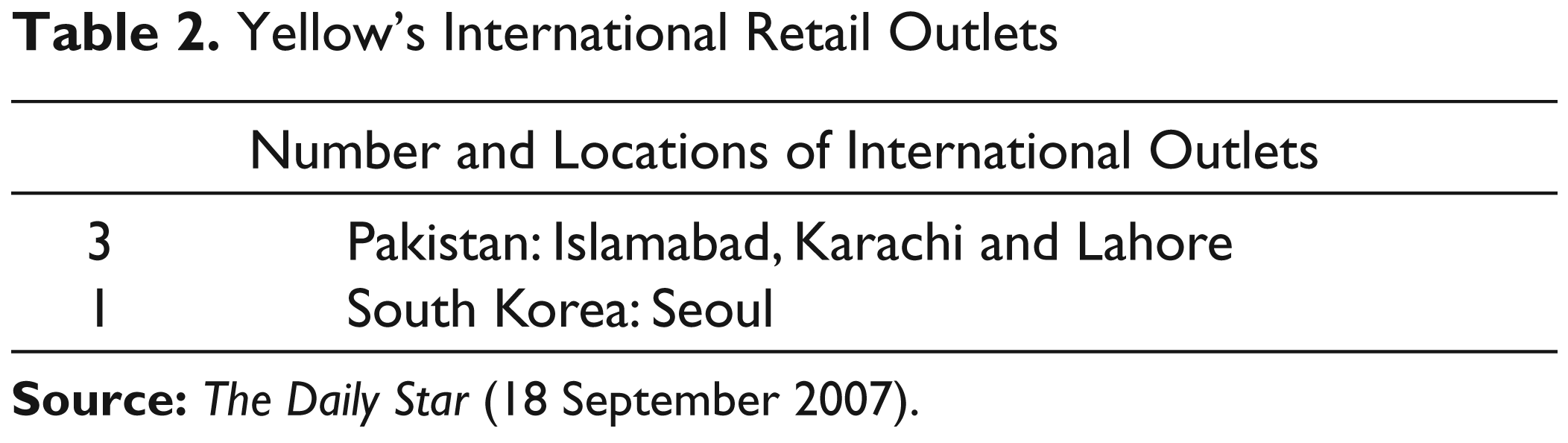
Even though Beximco Textile is a known name in the global market through its export business, Yellow’s success has taken it to a new level internationally. Like any company, Yellow’s efforts to go international have been motivated by the desire to increase profitability and to diversify customer base (Vida & Fairhurst, 1998). Over time, Yellow gained competitive advantages, especially with its in-house design capabilities, with teams based in Bangladesh and Spain, and talented designers from the world’s renowned design institutes including the Fashion Institute of Technology, the London School of Fashions, Parsons, National Institute of Fashion Technology (NIFT) and National Institute of Design (NID) (Beximco News, 19 December 2005). Studies in international marketing have found that in addition to the company’s easy access to raw materials and in-house design and manufacturing capabilities, it possessed first-mover advantage and a unique market share, and being based in Bangladesh, it had the advantage of cheaper labour costs and the economic downturn at home. By successfully exploiting this situation, Beximco was able to take its local fashion brand to the international market. It now owns four international shops (Table 2).
Yellow’s International Retail Outlets
The following sections give a more detailed explanation of how Yellow internationalized the brand.
Yellow in Pakistan
Pakistan is a developing nation of 199 million potential consumers with an average estimated GDP per capita of over USD 5,000 as of 2015. Hence, a large pool of potential consumers with high purchasing power can be targeted for fashion-based goods. In Pakistan, the textile industry accounts for majority of their export earnings. However, due to inability to adapt to the changing fashion needs of the global market, the textile industry has declined as an export source (World Fact Book, 2016).The rise in fashion consciousness, brand recognition and the emergence of profitable markets intrigues both the global and local brands to explore new consumer base (Zeb, Rashid & Javeed, 2011). In recent times, young Pakistani men and women have been enjoying more than ever before the freedom to wear Western fashions (Turner, 2012). No formal dress code has been imposed by the government, as there has been in other Middle Eastern countries. Another unique feature of Pakistan is that its summer lasts for up to 8 months a year, a boon for manufacturers of casual wear. In 2005, Yellow’s realization that the presence of homogenous segments in Pakistan and its own first-mover advantage encouraged it to open an outlet in Karachi, Pakistan, and try to overcome the local competition. Although there were Pakistani brands that had adopted the blending of traditional and Western styles, Yellow’s unique designs were greatly appreciated in Pakistan. The then Pakistan Senate Chairman, Mr Muhammad Mian Soomro, stated that Beximco Textile’s initiative had helped Pakistan to come to the forefront of the international fashion industry (Beximco News, 23 October 2005; The Daily Star, 24 October 2005). Many companies in Pakistan have tried to copy Yellow, posing threats to the brand’s progress in the market. However, Pakistan’s limited government regulations protect Yellow’s unique design, logos and brand. More recently, Yellow strengthened its position in the markets of Pakistan with the launch of its fall–winter collection 2012, in which the clothes, made from high-quality fabrics, were stylish and contemporary. Yellow today has outlets in Lahore, Islamabad and Karachi.
Demand Conditions in Pakistan
Demand conditions are defined as ‘the nature of home demand for the industry’s product or service’ (Porter, 1990, p. 71). The demand condition in Pakistan is characterized by the growth of a middle class with a fast rising disposable income, a youthful population and demographic diversity in clothing. Consumers in Pakistan spend a reasonable amount on their clothing. Therefore, growing fashion awareness and high purchasing power of consumers make Pakistan a lucrative market for foreign firms to explore (Shaeen, 2008). Rich consumers in Pakistan are interested in luxury fashions and are tending towards buying renowned international brands (Abideen & Latif, 2011). The most attractive and potential segment for Yellow is the middle-class consumer in Pakistan, as this segment is substantial and accessible. Studies show that for the Pakistan middle class, both price and value are important decision criteria when shopping for fashion clothing. This segment’s higher perceived value of fashion clothing has been influenced by the product design and quality, brand names and stores which feel atmospheric and exclusive (Naeem, Akram & Saif, 2011). Yellow has the upper hand in meeting these criteria, especially as its unique blend of traditional and Western designs gives it the exclusivity desired by middle-class Pakistani consumers. In addition, more people are moving from rural areas to city suburbs, where their preference for traditional dress blends with their motivation to acculturate with contemporary urban fashions.
Comparative Advantages of Pakistan
Yellow’s decision to open business in Pakistan was motivated by the cheap labour costs and easy access to raw materials—Pakistan has its own supply of cotton and fabric, and has more small and medium-sized factories than Bangladesh (Edward Hertzman, Director of Business Development at Synergies Worldwide, cited in The Express Tribune, 21 October 2011). Pakistani apparel is one of the lowest cost options for foreign investors; as Hertzman comments, labour costs in Pakistan are ‘less than Bangladesh, China, India and Vietnam’. Hertzman’s comments justify Yellow’s decision to enter into the Pakistan market, as the low labour costs and fine quality cotton allowed Yellow to produce high-quality products cheaply, and Pakistan’s mass market could afford the brand’s price range. Thus, despite Pakistan’s unstable political situation and continuing threat of terrorism, the advantages for Yellow are unarguable.
Trade Barriers in Pakistan
Pakistan is increasingly softening its trade barriers with South Asian countries to encourage more investment (Ramay & Abbus, 2013). Pakistan has eliminated some trade barriers and introduced favourable trade policies, making the currency capital flow more easily and facilitating foreign companies to internationalize. As Bangladesh is a member of South Asian Free Trade Area (SAFTA) and South Asian Association for Regional Cooperation (SAARC), it is privileged to face lower tariffs, and the several bilateral agreements between Pakistan and Bangladesh help Yellow to face any trade barriers when entering Pakistan’s clothing industry.
Yellow in South Korea
South Korea is a well-developed nation of 49.11 million potential consumers with an average estimated per capita GDP in 2015 of over USD 36,500; thus, many consumers are able to afford fashion-based goods (World Fact Book, 2016). There has been a rapid increase in the consumption of imported products in Korea. At the same time, consumer awareness of global brands is considerably high in Korea (Chung & Pysarchik, 2000).
Yellow’s journey to South Korea is relatively recent. Yellow considered several demographics and psychographic variables when considering its entry into the South Korean market. The first factor was the Korean consumers’ ethnocentric disposition: Extended studies suggest that this ethnocentrism leads to hostility towards foreign brands. Nevertheless, Yellow took up the challenge, arguing that any negative attitudes towards their products could be managed by appropriate marketing efforts, especially as its target segments (aged 18–40) are more liberal and accepting of foreign culture.
The recent influx into Korea of overseas clothing brands (Cho & Workman, 2013) suggests that young consumers are appreciating diversity in fashion design and are more inclined to purchase unique designs. In this respect, Korean consumers are unlike Pakistani consumers, who favour the functional values of cost, comfort and durability. In fact, as Koreans are becoming more experienced shoppers, they are tending to evaluate the intrinsic attributes of clothes, such as their design and cut, rather than the extrinsic attributes, such as price (Jin & Koh, 1999). Research (Jung & Sung, 2008) suggests that the importance Korean consumers place on a product’s country of origin has significantly influenced their positive feelings towards imported fashions. In that case, Yellow has a comparatively limited advantage than Western retailers as it has a strong presence with brand equity and a high budget for product promotion.
Importantly, a recent study (Kang & Park-Poaps, 2010) suggests good news for Yellow: Some consumers do not follow the general crowd, but instead aim for the hedonic value attached to unfamiliar fashion designs. The symbolic value of a brand name has been diminished for these consumers; they seek a unique appearance, especially with unusual blends of traditional and Western styles, and Yellow’s designs have such features. Other opportunities also exist for Yellow to grow in the Korean market: the mean age of Koreans is 35.7 years; young Korean men and women are becoming educated about fashion and prefer to customize their clothes; and these young consumers are more independent, self-confident and adventurous. Moreover, as in Pakistan, Koreans are leaving rural areas and moving to big cities.
Against all these opportunities, Yellow has no online presence in the international markets—be it Pakistan or South Korea. This is particularly unfortunate in their South Korean venture, as recent studies (Choo et al., 2014) have found that young Korean consumers are increasingly buying their clothes online. In particular, the interactive function of websites has a significant effect on young consumers’ fashion preferences and product exploration. It seems that Yellow is finding it difficult to develop web content, mainly because of language barriers, and this is forcing them to operate through physical stores only.
Discussion
In order to promote Asian brands in the world market, integrated efforts are being taken by the stakeholders. In recent years, the demand for Bangladeshi products has substantially increased in the international market. However, the leading firms are directed by international buyers through their own design specifications. Hence, the Bangladeshi apparel manufacturers are prevented from establishing their brands in the international market.
On the bright side, there is considerable scope to gain competitive advantage through an integrated value chain system. With low production cost in Bangladesh, local brands can focus on international designs that are comfortable, fashionable and carefully customized for the foreign market (Balaram, Yadav & Baisya, 2003). It is evident that the garments sector in Bangladesh has received commendable success and recognition in the fashion industry of developed countries (Hossain et al., 2014). In terms of sales, global fashion brands are rapidly acquiring a strong foothold in Asian markets, such as China, Japan and South Korea, mainly due to high brand and fashion awareness (Bryck, 2003; Morton, 2002).
According to Doherty and Alexander (2004) and Wigley and Chiang (2009), the retail sector of the fashion industry is the most internationalized. In addition, the retail business of this industry tends to be more successful in comparison to any other. There are two vital reasons for retailers opting to invest in foreign markets: saturation of the domestic market and to capitalize on a niche demand in the foreign market (Akehurt & Alexander, 1995).
Studies suggest that saturation of domestic market is the founding cause of internationalization. Saturation can occur when a strategy of diversification can no longer bring further growth in the market. Other reasons for international expansion may also include lower governmental regulation, larger market size, fewer competitors or the ability to fill a niche demand in the foreign market.
Internationalization of retailers in the fashion industry is dominated by factors, such as geographic distance of markets, similarity in the culture, language, political systems, trade practices, level of education and the extent of industrial development (Faroque & Takahashi, 2015). Besides, in today’s multicultural business settings, managers often find it challenging to execute businesses effectively in a foreign market. However, managerial attitude has been identified as one of the barriers to international growth for some retailers and has been found to impact the pace of global market growth (Hutchinson et al., 2009). In recent years, retailers have expanded aggressively abroad. Initially, the entrance is governed by the proximity of the foreign market but with progress, the geographic extent of foreign market penetration widens over time (Swoboda & Elsner, 2013).
Recommendations, Conclusions and Implications
This case study discussed the international marketing process of Yellow, a Bangladeshi fashion brand owned by Beximco. In particular, the case explored why Yellow entered the Pakistani and South Korean fashion markets, and the factors Yellow considered when considering those markets. Our correspondence with Yellow’s personnel and our observations based on their recent performance and publically available information suggest that although Yellow has made some progress in Pakistan and South Korea, it has had relatively less success in those countries than its initial prediction.
Past studies suggest that such failure in retail internationalization usually arises due to cross-cultural factors, such as adaptability, entry mode and location disadvantage (Burt et al., 2002). Yellow needs to adapt its store formats to the competitive realities of the markets of both Pakistan and South Korea in order to strengthen its position. This could mean coming up with an overall internationalization strategy where Yellow’s global ambition of quality, value and service would be converted into something more concrete. In addition, the peculiarities of Yellow’s retail operations, emphasis on the traditional look of its apparels and the lack of clear retail positioning and design, all posed problems in the global situation for Yellow. Moreover, Yellow does not have any experience of decentralized control of businesses in the global arena which led to further problems and barriers in its retail internationalization.
Recommendations for Future Expansion
Recently, Yellow has been using these international shops not only for clothing but also for ceramic products, and in addition they have a section in each shop that exhibits Beximco’s denim products targeted towards business-to-business (B2B) customers. This recent diversification further evidences Yellow’s growth in the international market to be impeded by the psychic distance between Bangladesh and Pakistan/South Korea. Psychic distance is the degree to which one culture is comfortable dealing with another culture (Evans et al., 2008; Sousa & Lages, 2011). Yellow needs to understand the psychic distance between its home country Bangladesh and the international market. Understanding psychic distance is important; as Evans and Mavondo (2002) suggest, the perception of greater psychic differences will lead a company to extend its research and preparation before entering a market, thus increasing the chance of success. Yellow is more psychologically proximate to the Pakistani market than to the South Korean, and Yellow’s obtained knowledge from Pakistan could help Yellow to understand the greater psychic distance of Korea.
This article also suggests that a lack of knowledge of cultural and social differences in consumer taste, adaptation of fashion clothing and social conditions have also affected Yellow’s growth in Pakistan and South Korea. If Yellow is to expand further, it needs to be aware of differences in culture and social conditions. For this, knowledge sharing between customer and organization is a crucial aspect of marketing that could affect Yellow’s success in overseas markets. In today’s fast fashion retail climate, the back and forth of knowledge sharing is known to be a beneficial communication line of great importance for international companies (Johanson & Vahlne, 2009). Extended studies (Evans, 2013; Lauring & Selmer, 2011) suggest that reverse knowledge sharing—that is, information collected from customers, trend spotters and managers—would allow both explicit and implicit knowledge to be exchanged from the foreign units. In this way, essential detailed knowledge of product sales, customer reactions to new products and local trends can be gained and exploited. As Yellow seems to have
ambitions to be globally recognized, both brands are increasingly networked with a range of cultural intermediaries —buyers, stores, and fashion media alike enabling their design collections to be actively communicated locally, regionally, and globally (Peirson-Smith, 2013, p. 193).
Conclusions and Implications
The purpose of this study was to gain a better understanding of how Yellow performed when it entered the international arena. To understand the phenomenon, this case study discussed the factors Yellow considered when going international, its local market strategies and the possible factors Yellow needs to consider for further expansion in the international market. It is important to note that this is a single-case study (Yin, 2009), and only one specific retail clothing company has been examined, so generalizations applying to all such organizations are hard to make.
Nevertheless, this study has provided some indications of how retail clothing companies perform when they internationalize. In the process, the case demonstrates that models of internationalization focusing on growth patterns and development alone are inadequate and it is necessary to understand how and why failures in internationalization occur. In fact, internationalization studies need to consider market entry failure or withdrawal in terms of corporate management, retail and global market and business method issues (Burt et al., 2002). We hope that the discussion in general will help marketers to understand some aspects of strategic market planning that will allow organizations to allocate resources as efficiently as possible, and to understand the particular types of data that should be collected in their target markets to avoid wasting resources.
Footnotes
Acknowledgements
The authors are grateful to the anonymous referees of this journal for their useful suggestions to improve the quality of the article.