







Abstract
There is a growing pressure from the stakeholders and regulatory bodies to promote green consumption. Heightened environmental consciousness is also contributing to greater adoption of green products and services. But still there exists a value–action gap in the way the consumers’ think and respond. This study explores the psychological factors which affect the green purchasing behaviour (GPB) of young consumers in India. Our primary question was ‘what are the factors which play a vital role in the adoption and curtailment of green purchasing behaviour of young Indian consumers?’ Exploratory factor analysis (EFA) revealed existence of five underlying variables namely environmental attitude (EA), environmental consciousness (EC), GPB, environmental involvement (EI) and perceived effectiveness of environmental behaviour (PEEB). Subsequently, regression analysis was performed to explain the role of EI of these young consumers in overall GPB. The study makes significant contribution to existing literature by providing valuable insights into the psyche of young consumers.
Keywords
Introduction
The parallel march of growing consumer demand, population explosion and environmental deterioration has brought us to a point where environmental issues dominate political, business, public and academic discourse (Friedman, 2009). In fact, going green appears to be in fashion in present times. There is greater willingness among consumers to engage in green issues (Yeung, 2005). A consumer’s decision to buy a product carries the potential to contribute to a more or less sustainable natural environment. This realization is encouraging ethical and sustainable lifestyles while at times also resulting in greater complexity in green buying behaviour (Moisander, 2007). Demand for environmentally safe products has been increasing substantially and was estimated to be over US$200 billion in 2006 (Gupta & Ogden, 2009) making these environmentally alert consumers a distinct segment for companies (GMA & Deloitte, 2009).
Environmentalism has been gaining momentum in India too (Punyatoya, 2014). Due to the possibility of coming under the scanner of regulatory bodies, Indian companies have started incorporating green management practices and even disclosing more environmental information like LEED certification etc. (Chaklader & Gulati, 2015). Since long back, Indian consumers have been consciously taking initiatives to reduce environmental hazards (Jain & Kaur, 2004). Ecologically aware and active consumers can be of immense help in addressing environmental concerns. But despite the huge potential in young consumers in an emerging economy like India, very little reliable data is available for international green marketers to expand the concept of green. Researchers like Keegan and Green (2000) were the pioneers in the field in the context of emerging economies.
In the wake of growing environmentalism, literature has been evolving for the past decade exploring factors affecting the green behaviour of consumers (Cheah & Phau, 2011; Kaiser, Oerker & Bogner, 2007). Researchers have evinced interest in exploring various antecedents that affect green purchasing behaviour (GPB) of the general population (D’Souza, Taghian & Khosla, 2007; Mostafa, 2006; Snoj, PisnikKorda & Mumel, 2004). Young consumers have also been studied vis-à-vis their pro-environmental attitude (EA) and findings have revealed their influential role in green consumption (Hume, 2010; Lee, 2010). Researchers, while presenting findings in Western context, have posited that young consumers readily accept new and ground-breaking ideas (Martinsons et al., 1997; Ottman, Stafford & Hartman, 2006).
The present study contributes to existing literature from two perspectives. First, we present a modified and refined scale for generating data from young consumers regarding factors affecting GPB. Studies focusing on young consumers are few and far between in the Indian context. Second, the study examines impact of factors studied on GPB on the basis of total variance explained while performing factor extraction procedure on the data obtained using refined instrument.
This article is structured as follows. It presents a review of the literature available on constructs considered for the study. This serves as groundwork for identifying study objectives; demographic profile of the respondents is presented followed by presentation of scale measurements and its reliability. Results of exploratory factor analysis (EFA) and multiple linear regression are then presented. This article will significantly advance understanding of the concept and help in identifying alternative approaches to green consumerism among the young consumer cohort. The article concludes with discussion, global implications, limitations and future research directions.
Literature Review
An all-embracing body of research exists on factors affecting green behaviour, most of them conducted from the perspective of consumption patterns, investigating the links between consumers’ EAs and behaviours (Cleveland, Kalamas & Laroche, 2005; Leonidou & Leonidou, 2011; Urien & Kilbourne, 2011). Researchers in the developed countries delineated the effect of various antecedents on GPB (Busse & Menzel, 2014; Carrete et al., 2012). Studies in the Indian context are also gaining momentum and attempting to explain pro-EAs, albeit focusing on adult buyers (Kumar et al., 2013; Singh, 2011). Researchers have provided empirical evidences about the green buying behaviour of consumers revealing positive inclination towards environment-friendly products (Jain & Kaur, 2004; Punyatoya, 2014). Still the results are inconclusive, depicting some value–action gap in the way consumer thinks and actually behaves. Researchers have suggested the importance of psychological factors in the studies on the attitudes of consumers while delving on green consumer behaviour.
Environmental Attitude
Although the value–action gap theory reveals some unconvincing results, researchers contend that there is a linkage between EA and green behaviour (Lee, 2011; Nath et al., 2013). Some researchers have claimed a positive relationship between EA and pro-environmental behaviour (Chen & Chang, 2012; Khan & Kirmani, 2015; Kotchen & Reiling, 2000; Punyatoya, 2014). Kaiser et al. (2007) in their study on developing countries suggested a scale for measuring EA of young consumers and the results showed significant correlation between the attitude and pro-environmental behaviour. Nath et al. (2013) delineated the significant role of EA towards adoption of green product. Hence, EA of consumers holds greater importance towards sustainable consumption.
Environmental Involvement
Schultz et al. (2004) defined environmental involvement (EI) as feelings along with beliefs regarding saving the environment. Researchers have posited that EI has both direct and indirect relationship with GPB (Lee, 2011). Lee (2008) in his study on Hong Kong found EI to be second-most important factor in explaining GPB of adolescents. Researchers have opined that the interplay between emotions and EI among young consumers gets reflected in their environmental consideration (Shaffer, 1994).
Environmental Consciousness
Young consumers are the sample elements for the study and researchers posit that young consumers observe and follow the norm of EI in their social circles. Also, peer network might suggest, and reinforce a ‘norm’ of EC and behaviour, including EI and general green purchase behaviour (Ajzen & Fishbein, 1980; Kollmuss & Agyeman, 2002). Previous studies show that EC leads to enhanced intention to pay for eco-friendly products (Singh, 2011; Uddin & Khan, 2016).
Perceived Effectiveness of Environmental Behaviour
This factor reflects the belief that one’s action can or cannot contribute to ameliorate the problems of the environment. Studies in the Western context provide evidence about the impact of perceived effectiveness of environmental behaviour (PEEB) (Manzo & Weinstein, 1987). Lee (2008) revealed that PEEB is an important predictor of GPB in adolescents and showed that it is essential for adolescent consumers to recognize their individual obligation in saving the environment. Interestingly, Indian consumers have rarely been explored on the construct PEEB and there is dearth of literature regarding the subject.
Green Purchasing Behaviour
Green purchasing behaviour refers to buying those products which can be recycled and being responsive to environmental concerns (Mostafa, 2007). GPB has been explored by several researchers who have suggested that it can become a barrier to overall green consumption as well as to marketers (Crane, 2000; Mintel, 1995; Wong, Turner & Stoneman, 1996). Criticality of the theme lies in presenting a detailed picture of factors which possibly contribute to GPB in consumers.
Objectives of the Study
The study aims to achieve the following objectives:
to explore the psychological factors affecting GPB among young Indian consumers, to examine the impact of studied psychological factors on GPB.
Methodology
Data Collection
The study involved a researcher-controlled sample of 161 high school and senior secondary school students enrolled in institutions located in national capital region of India. The sample comprised 55.3 per cent males and 44.7 per cent females out of which around 74 per cent respondents were in the age band of 15–16 years while remaining 26 per cent were in the age group of 17–18 years. Around 91 per cent of respondents were from high school and the remaining 9 per cent were enrolled in senior secondary school. The medium of instruction in the institutions was English. Students’ enrolment in English-medium schools in India has gone up phenomenally over the last decade (Mukherji, 2012). They generally belong to more affluent socio-economic and educationally advantaged background (NCAER, 2013) and are likely to be familiar with the concept of green consumerism. Further, the researchers could deploy validated English version of the scale for purpose of data collection. Researchers have posited that young people more readily accept new and innovative ideas (Ottman et al., 2006) and are heavy-spending group in various types of markets (Moses, 2000). Table A1 presents the demographic profile of the respondents. It may be argued that use of researcher controlled sample may limit the generalizability of the findings, but researchers have suggested use of young student samples apt and reliable for such consumer behaviour studies (DelVecchio, 2000; Yavas, 1994).
Survey Instrument
The questionnaire comprised a section on demographics and another section that initially contained 25-item, 5-point Likert-based scale (1 = Strongly Agree to 5 = Strongly Disagree) covering five constructs. The items were adopted from validated scales employed in various studies and later modified and refined into 18 items based on factor loadings through iterative procedure. Five items of GPB were drawn from Ecologically Conscious Consumer Behaviour (ECCB) scale developed by Roberts (1996), while four items were adopted from scale used by Lee (2011). Five items for the purpose of measuring EI were again based on the scale developed by Lee (2011). In order to measure EA, PEEB and EC, 11 items were adopted and modified from the study by Lee (2008).
Exploratory Factor Analysis and Reliability
The scale developed was first factor analyzed using principal component analysis and oblimin rotation to extract the constructs and to examine the dimensionality of the scale. The value for Bartlett’s test of sphericity was 0.000 and the KMO value was 0.688, suggesting sufficient inter-correlations and adequate sample size. Researchers have suggested that these values meet the assumptions for factor analysis (Coakes & Steed, 2003) (Table A2).
The overall scale was found to be reliable with 0.739 reliability coefficient. Also, the value of reliability coefficient for individual items ranged from 0.710 to 0.762. The Cronbach’s alpha reliability coefficient for all factors in the questionnaire was found to be greater than 0.60 except for EC for which the value of Cronbach’s alpha was comparatively lower. However, low level of reliability coefficients is acceptable in exploratory studies (Kerlinger & Lee, 2000). All 25 items for the five variables were subjected to EFA which revealed that these five factors accounted for approximately 60 per cent of the variance. Factor 1 (EA), accounted for 23.45 per cent of the variance. Five items in Factor 1 yielded loadings greater than 0.50, hence were retained. The accepted criterion for significant factor loadings was 0.50 (Hair et al., 2006). Factor 2 (GPB) accounted for 12.62 per cent of the variance where four items had loadings ranging from 0.54 to 0.75. Factor 3 (EI) which explained 9.43 per cent of total variance was accounted for by four items that has satisfactory loadings. Factor 4 (PEEB), comprising two items accounted for 7.17 per cent of the total variance. Factor 5 (EC) accounted for 6.48 per cent of variance and loadings ranged from 0.53 to 0.74.
Multiple Linear Regression
The study employed linear regression analysis to test the relationship between EA and EI with their GPB. We considered top three factors on the basis of accountability of variance explained by the variables that emerged during EFA. The purpose was to examine the impact of two independent variables (viz., EA and EI) on dependent variable (i.e., GPB). The regression model was found to be statistically significant. The regression model explained 16 per cent (R2) of the total variance and was significant at F (2, 158) = 15.06, p < 0.000. Tables A3 and A4 represent the model summary for the regression model and Anova model, respectively.
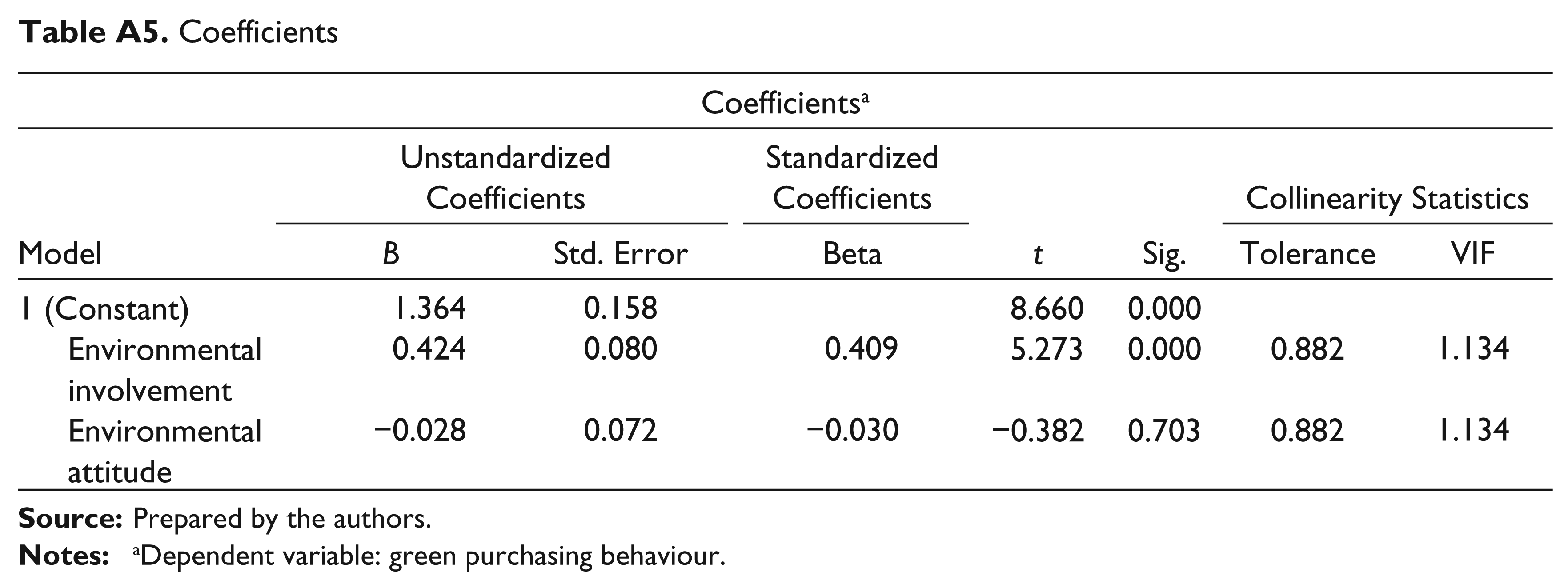
The results of multiple linear regression are consistent with deductions stemming from the literature review and suggest that the impact of EI on GPB is direct. Although, EA was not found to be significant in explaining GPB, but role played by EI was found to be vital in case of young consumers. Variance inflation factor (VIF) scores as well as tolerance scores were used to diagnose possible multicollinearity, which appeared to be well below the threshold limit (Hair et al., 2006) (Table A5).
Discussion
We found that the overall environmental behaviour of study sample comprising young consumer is affected by a number of factors and is in fact a multifaceted concept from their point of view. Consequently, green behaviour seems to be better evaluated specifically rather than generally.
Exploratory factor analysis revealed existence of four underlying factors, namely, EI, EA, EC and PEEB, that have a role to play in GPB. The existence of EA, PEEB and GPB are in line with the findings of previous studies (Lee, 2008). The results exhibit a different design from those experienced in adult samples, where pro-environmental behaviours are more directed by rationality and (perception) factors like eco-literacy, product attributes and environmental awareness (Peattie, 2001).
Among the predictors, EI was the most important predictor of GPB. The multiple linear regression model confirms that the young consumer’s EI is significant in explaining their green purchase behaviour. One major reason for this could be its very nature, as it encompasses notion of environmental protection, symbolizing the elements such as saving the environment, ethical responsibility and love for humanity. Hence, promoting environmental protection should be a call embodied with emotional and soft message delivery which will indirectly result into a more involved green response from young consumers. High level of involvement of younger consumers will probably lead to a greener consumption. Studies have also suggested that younger consumers are more concerned with environmental issues than older consumers (Coddington, 1993; D’Souza et al., 2007). Chan (1998) has examined the worth of adolescents towards local and general environmental issues. Our findings correlate with his observation. More involvement of younger generation is necessary to fast pace sustainable consumption as also is clearly revealed by our regression model.
Conclusion and Global Implications
Environmental degradation is on the rise on account of increasing consumption not only in developed economies but also in densely populated emerging economies, necessitating adoption of alternatives that promote sustainability. But in the field of green consumer behaviour, complex interplay of psychographic and demographic factors makes it difficult to suggest a one-size-fits-all approach.
The study provides deeper insights into the psyche of young consumers and the findings of the study can benefit marketing practitioners and academic researchers alike. The EAs of young Indian consumers and associated behaviour present a promising future. They demonstrate positive signs of pro-environmental behaviour while exhibiting EI. Findings suggest that young consumers have the potential to transform their pro-environmental behaviour into final purchase. Taking a cue from the study by Singh (2011) who posited that around 50 per cent of the Indian consumers are environmentally conscious, it can be safely inferred that Indian market can be targeted profitably by international marketers.
With this knowledge, managers could develop the right green marketing strategies and adequate marketing alternatives to get young consumers involved towards sustainable consumption. Themes like Ever green is Young can be effectively used for promoting green products to the younger generation. Also, the environmental and social benefits must be presented in such a manner that they motivate the young to translate their otherwise positive inclination towards green solutions into actual purchases.
Thus, the potential for green solutions is huge which can be effectively addressed by earning trust of consumers by providing them pro-environmental products employing more pragmatic approaches. The focus should be on environmental features associated with the products that positively impact the ecological conservation. With the advent of Internet, global marketers need to focus on sustainable innovation and environmentally safe distribution channels as emphasized by Hume (2010). O’Shaugnessy and O’Shaugnessy (2002) suggested that young consumers must be explored to foster sustainable change and results of this study provide empirical support for it.
Since young consumers seek to occupy an enhanced level of awareness about consumerism while interacting with socializing agents such as peers and family (Ayadi, 2008; Verma & Kapoor, 2004), marketers can exploit their involvement towards green consumerism. Educational institutions globally can also make use of these socializing agents in promoting EC among young consumers. More involvement of college and school students in environmental activities can initiate a sense of responsibility too that can go a long way in promoting sustainable consumption behaviour.
Limitations and Future Research Directions
The use of a researcher-controlled sample of young consumers may somewhat limit the generalizability of the findings but it is a significant first step in the context of emerging economy like India. The study exclusively focuses on individual perceptions and dispositions rather than on situational factors. Future researchers need to explore effect of other psychographic factors; adult consumers may also be interrogated quantitatively as well as qualitatively for drawing up a larger picture. Similar studies can be replicated in other countries, enabling cross-cultural comparisons of the perceptions and attitude of young consumers to fill the current attitude–behaviour void.
Footnotes
Acknowledgements
The authors are grateful to the anonymous referees of the journal for their extremely useful suggestions to improve the quality of the article. Usual disclaimers apply.
Appendix
Coefficients
| Coefficientsa |
|||||||
| Model | Unstandardized Coefficients |
Standardized Coefficients |
t | Sig. | Collinearity Statistics |
||
| B | Std. Error | Beta | Tolerance | VIF | |||
| 1 (Constant) Environmental involvement Environmental attitude |
1.364 0.424 −0.028 |
0.158 0.080 0.072 |
0.409 −0.030 |
8.660 5.273 −0.382 |
0.000 0.000 0.703 |
0.882 0.882 |
1.134 1.134 |