







Abstract
The shifting market dynamics and harsh rivalry of the worldwide economy have augmented the role of brands to an incomparable level. Brand extension has emerged as a popular strategy in the marketing area. While it brings brands closer to success, it is also imperative and important to understand how consumers evaluate and presume similar or dissimilar extensions and what is the substantial influence of risk and subsistence of parent brand on extension success? Identifying and analysing such relationships could be helpful and important for personal care brands in India to gain an edge over competitors. Data were collected from 500 consumers who were proverbial with the brand extensions of Dettol in similar or dissimilar product categories. Regression analysis showed that though perceived fit and risk directly influence the success of brand extension, nevertheless on incorporating parent brand conviction as a moderator the relationships between perceived fit and brand extension success and risk and brand extension success are strengthened. Limitations and future scope have also been mentioned.
Introduction
Intangible assets are a key driver of innovation and corporate value in the twenty-first century (Coombs & Deeds, 1996; Del Canto & Gonzalez, 1999). Among the firm’s intangible assets, brands have become one of the most manageable and crucial assets of the firm. Brand strategy of a firm becomes more crucial for those marketing fast-moving consumer goods (FMCG), as the industry witnesses rampant product launches through brand extensions or introducing new brands. FMCG is the fourth largest sector in the Indian economy and is expected to grow to $74 billion by the year 2018. 1 From 2009–2013, the average growth in the FMCG sector accelerated at a compounded rate of 17.3 per cent per annum as per the IBEF Report, 2013. This enormous growth is due to favourable demographic trends, increase in income levels, increased urbanization, high demand and consumer aspirations. Despite this, the sector is highly fragmented and proliferation across the categories of brands leads to swindling loyalties of consumers. It has become necessary to launch new products, variants and innovative branding strategies to enhance consumer satisfaction with an ultimate goal of attaining high brand resonance. Launching a new product is not easy there are multitude entry barriers such as increased advertising and launching costs. These can be reduced by leveraging the brand strength of parent brand (PB) and going for effective brand extensions.
There has been a drastic change in the scenario of branding in the last two decades. Brand management in olden times dealt with simple structures consisting of brand and sub-brands in a less complex environment. Whereas organizations today face channel dynamics, market fragmentation and highly competitive business environment, which has changed the way products are marketed. It is becoming imperative to leverage brand assets due to prohibitive cost of creating new brands. Brand managers are dealing with brands that are more intricate and complex, as frequent extensions are launched to cope with market needs, involving a brand structure having multiple layers of brands. Numerous extensions within a portfolio lead to cannibalization of market share. The brand extensions have to be well managed and should have cohesive brand values in order to prevent dilution of brand equity. This article comprises of section ‘Review of Literature’ highlighting the prominent determinants of brand extension which influence the success of brand extension. Data Collection, survey and sampling designs are discussed in the section ‘Research Methodology’. Statistical tools such as factor analysis and moderation are used in the section ‘Analysis’ to discuss empirical findings followed by section ‘Managerial Implication’.
Review of Literature
The growth in brand extensions highlights the importance of identifying determinants of brand extension success, which influence the stretch ability or extension potential of a brand into new markets. Many studies have addressed the determinants of brand extension success (Ahluwalia & Gurhan-Canli, 2000; Bottomley & Holden, 2001; Klink & Smith, 2001; Shine, Park, & Wyer, 2007). Prior research in the area of brand extension throws light on key determinants which influence the success of an extension. The prominent determinants which influence the success of the brand extension are fit, parent brand quality, corporate credibility, parent brand strength, parent brand experience, retailer acceptance, parent brand trust (PBT), risk, consumer innovativeness and marketing support. On the basis of prior studies in brand extension, this study selected three consumer variables of PBT, perceived fit and risk to examine the moderating effect of PBT on the relationship between perceived fit and brand extension success, and on risk and brand extension success.
Parent Brand Trust
According to Chaudhuri and Holbrook (2001), PBT can be defined as the readiness of a consumer to rely on the ability of the brand to perform its stated function. Brand trust is a prerequisite for brand loyalty and high brand equity (Reast, 2005). Higher level of PBT may lead to success of brand extension (Keller & Aaker, 1992). Brand trust leads to a positive attitude of the consumer towards the PB, which supports the efficacy of an extension (Kwun & Oh, 2007; Sheen, 2009; Thamaraiselvan & Raja, 2008). One of the major advantages of any reputed brand enjoys compared to non-reputed brand is brand trust, which influences consumer acceptance a lot (Raj & Roy, 2015). The attitude towards PB can be measured via brand trust, brand affect and quality (Jahangir et al., 2009). In a study of Zimmer and Bhat (2004) it was found that attitude towards the PB remained the same, regardless of whether the proposed extension was having a good or poor fit. Brands that are trusted more by consumers have high probability of having successful extensions rather than less trusted ones (Laforet, 2007; Reast, 2005). According to Reast (2005), brand trust is made up of two components: credibility and performance satisfaction. It is also seen in many studies that if the brand is a leader in the product category, the attitude and trust towards the PB is enhanced. PBT has a stronger influence on brand extension success as compared to similarity or fit (Barret, Lye, & Venkateswarlu, 1999; Iyer & Garber, 2011).
Perceived Fit
Perceived fit is a significant variable which influences the success of brand extension (Völckner & Sattler, 2006). A higher perceived fit leads to better evaluation of extensions (Aaker & Keller, 1990) as it is considered more credible by consumers. A brand extension which is having a good fit may have a reciprocal effect on parent brand equity (Zimmer & Bhat, 2004). Fit describes how closely the extension category and the PB category are related to one another and is an important determinant influencing brand extension success (Aaker & Keller, 1990; Montaner & Pina, 2009; Munteanu, 2015). Consumers readily accept extensions whose categories are more similar to the PB (Ranjbari et al., 2015). When brand extensions are consistent with the parent brand concept, they are related and get favourable reactions from consumers (Paul & Datta, 2013).
There are various factors that can moderate this relationship such as perception towards innovative products. According to Jung and Tey (2010) if a dissimilar brand extension has to be evaluated favourably by the consumers, they should have a positive perception towards innovative products. Influence of fit on brand extension success is also moderated by loyalty and consumer perception towards the PB (Völckner & Sattler, 2006).
Risk
Dowling and Staelin (1994) define it as consumer perception of the uncertainty and unfavourable result of purchasing and consuming a brand or a product. Success of PB reduces the perceived risk associated with the brand extension as the consumers have trust on the PB and the company (Baker, Hutchinson, Moore, & Nedungadi, 1986). The risk is released when a known brand name provides quality assurance and the seller is identified; this consequently boosts the probability of trying a new product and brand extension (Afzal, 2013; Chernatony, Hem, & Iversen, 2003; Heilman et al. 2000; Munteanu, 2015). Perceived risk attached to the extension category affects customer’s evaluation of extension (Hem et al., 2001; Milberg, Sinn, & Goodstein, 2010).
Rationale of the Study
This research study provides evidence for the effectiveness of brand extensions in Personal Care category in India. The economic growth of the country and ever-discerning consumers are leading to multitude of new product introductions. With the changing Indian market scenario in personal care category, the brand portfolios have bloated due to launching of brand extensions in similar and dissimilar categories. This has resulted in overlapping product categories, price, positioning, target segments, product lines and distribution channels. The markets witness clutter ensuing in sales cannibalization and brand redundancy. Given the growing popularity of brand extensions, an understanding of how consumers evaluate brand extensions and how brand extension strategies affect PBs is needed. Identifying such relationships and their influence on brand extension success may provide insight into how organizations may launch improved brand extensions to gain an edge over competitors and improve their market shares.
Objectives
The reviewed literature suggests that perceived fit and risk influence the success of brand extension. It will also be interesting to find out the role of PBT in the relationship between perceived fit and risk on the success of Brand Extension in personal care category which is prone to variety-seeking behaviour and high level of brand switching. The study addresses the twin objectives of identifying the factors which influence brand extension success of personal care brand Dettol and investigating the role of PBT in personal care brand Dettol.
Methodology
As this study focuses on personal care brands, Dettol has been chosen as the target personal care brand. Dettol has consistently improved and maintained high brand rankings. It is associated with germ protection and considered a leader in hygiene and health care segment. It has been ranked 1 as the most trusted brand in the personal care segment and number 2 overall by AC Nielsen, Brand Equity’s Most Trusted Brand Survey, 2013. The brand is a consistent performer occupying a rank among the top 10 brands for 13 years in a row (2000–2013). It has forayed into various related and unrelated extensions, and occupies a major mind share of customers, which will elicit quick response. Dettol entered India in 1933 as an antiseptic liquid for treating cuts and wounds. For the initial 50 years, Dettol was present only as an antiseptic liquid in the Indian market. It is the flagship brand of Reckitt Benckiser India Ltd (RBIL). After consumer study it was revealed that 90 per cent of Dettol consumption came from secondary usage. These usages came from antiseptic liquid being used for bathing, shaving and as disinfectant for cleaning floors. These different usages led to logical brand extensions of Dettol in bathing soap, hand wash, sanitizer, floor cleaner and many more in the subsequent years.
Familiarity with Dettol’s brand extensions was measured by asking the respondents to indicate their familiarity level of extensions on a scale of 1 = not familiar to 5 = highly familiar. Those who indicated no familiarity were excluded from the analysis. The data were collected with the help of convenience sampling to draw out a sample of 586 respondents.
Table 1 shows the items undertaken by the researchers related to Parent Brand Trust, Perceived Fit and Risk. The number of items adapted from different scales are mentioned next. Eleven items indicative of PBT were adapted from Sheinin and Schmitt (1994), Smith (1992) and Aaker and Keller (1990); eight items measuring perceived fit were adapted from Bottomley and Holden (2001), Broniarczyk and Alba (1994) and Aaker and Keller (1990) and four items measuring risk were adapted from DelVecchio (2000) and Kirmani, Sood and Bridges (1999). All these 23 items were measured on a five-point Likert scale. These items were treated with factor analysis which converged into three factors, renamed as PBT, perceived fit and risk. All 23 items had factor loadings greater than 0.50 (Table 1).
Factor Analysis Results for Parent Brand Trust, Perceived Fit and Risk
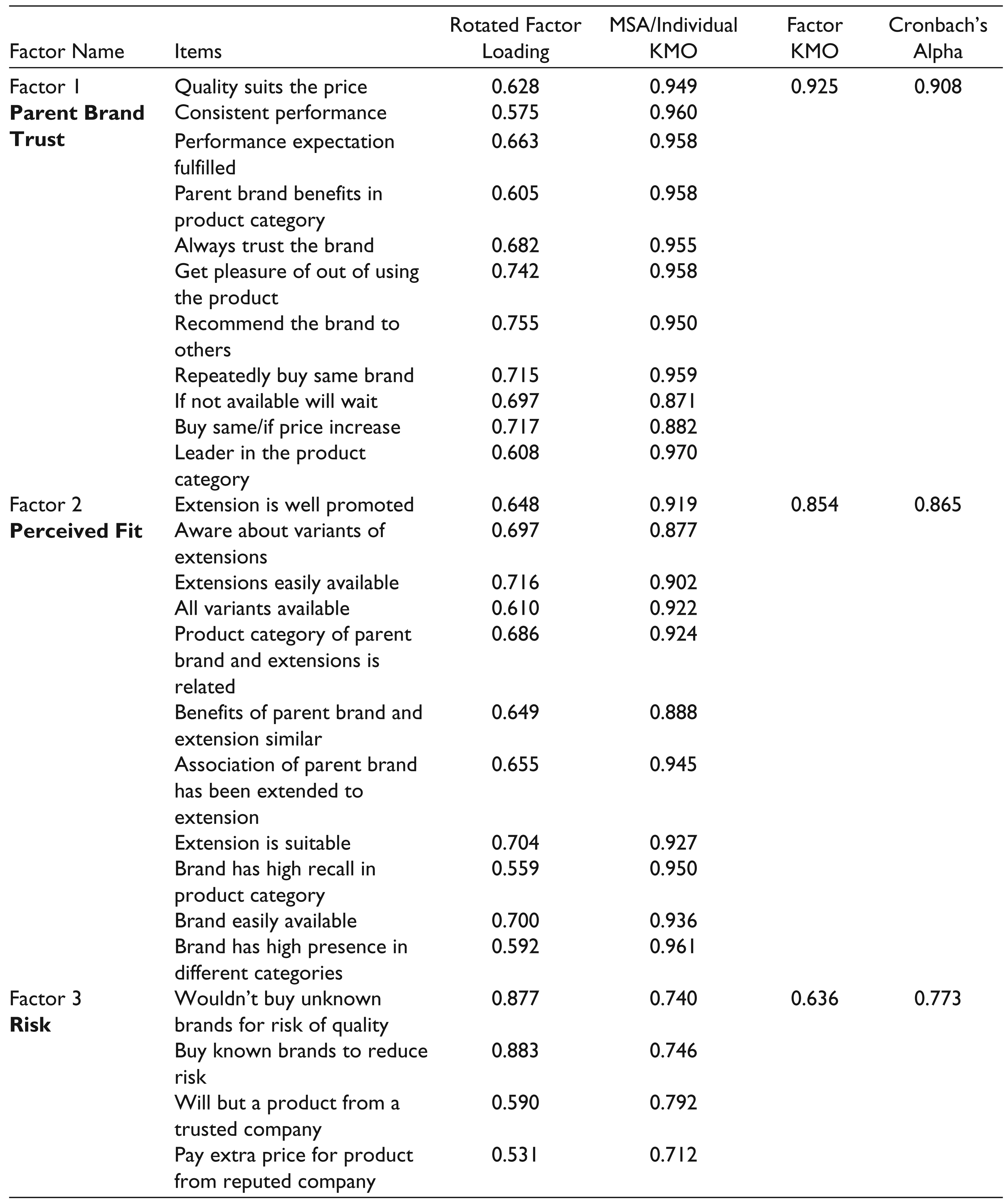
The participants were also asked to answer four questions measuring the overall success of brand extension. The items were adapted from Völckner and Sattler (2006). Factor analysis revealed that four items were loaded on a single factor with a Cronbach’s alpha value of 0.855 and factor loading of individual items in the range of 0.60–0.85.
Sample Description
The respondents were divided into men (52.4%) and women (47.6%). Of the population, 58 per cent were between 18 and 40 years of age, and about 35 per cent had a monthly income between ₹25,001 and ₹50,000 per month. The sample was collected from geographically diverse 11 cities in India broadly having a fair representation of five zones of the country—North, Central, West, East and South.
Analysis
After PCA, multiple regression analysis was carried out to test the relationship between the following three factors: perceived fit, PBT and risk. These were entered step-wise as independent variables (IVs) and success of brand extension as the dependent variable (DV). Perceived fit had the highest Pearson correlation to brand extension success of 0.630, followed by risk (0.613) and PBT (0.401) (refer Table 2).
Correlations between IDV and DV

The analysis of multiple regressions is reported in Table 3. Model 1 refers to the first step, in step-wise multiple regression, where perceived fit was entered first and explained 39.7 per cent of the variance in success of brand extension, F (1,998) = 655.699, p = 0.001. Risk was entered second and the total variance increased to (50.5%), F (1,997) = 219.714, p = 0.001 both models were significant. PBT was entered third, which increased the variance to 51.1 per cent but was found to be insignificant. So Model 2 was accepted, details of which are enclosed in Table 4.
Model Summary

b. Predictors: (Constant), Perceived Fit, Perceived Risk.
c. Predictors: (Constant), Perceived Fit, Perceived Risk, PBT.
d. Dependent Variable: Success.
Values of Beta, Standard Beta, β, Multiple R, T, Tolerance and VIF
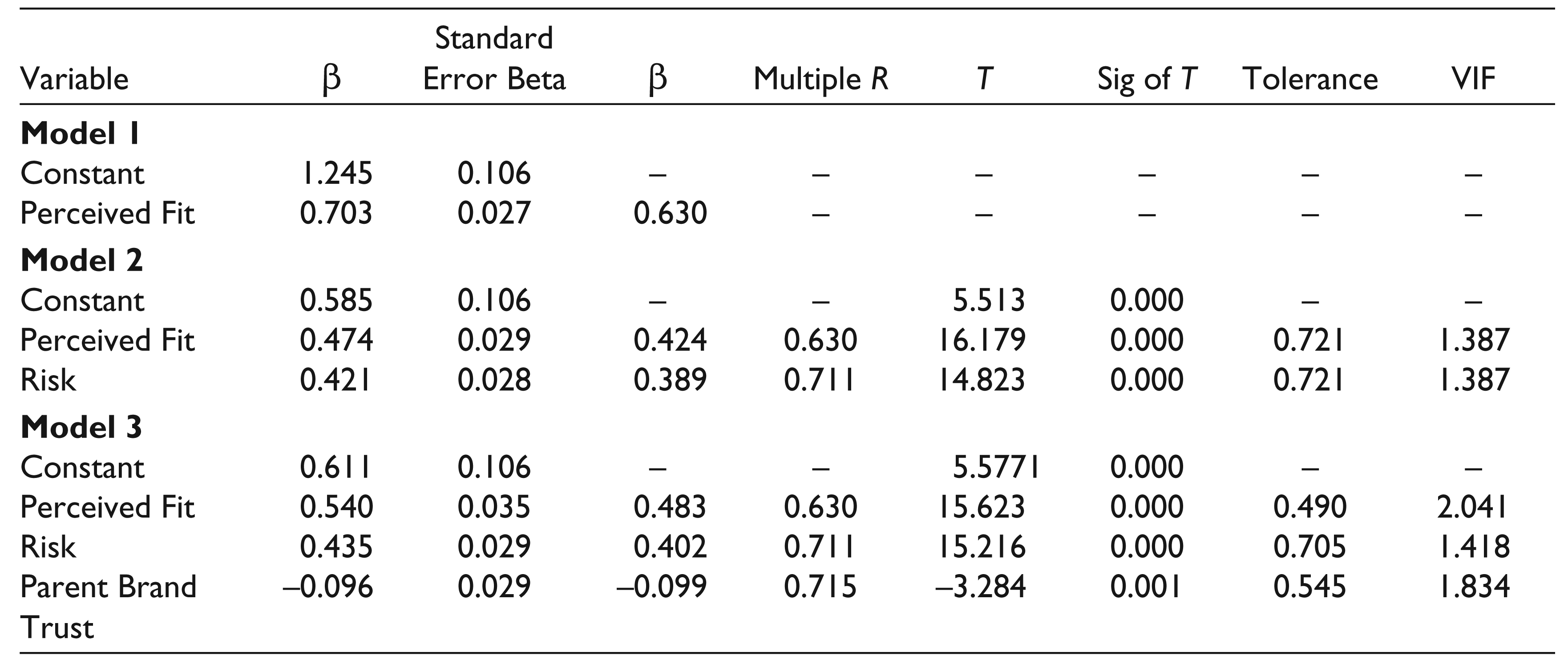
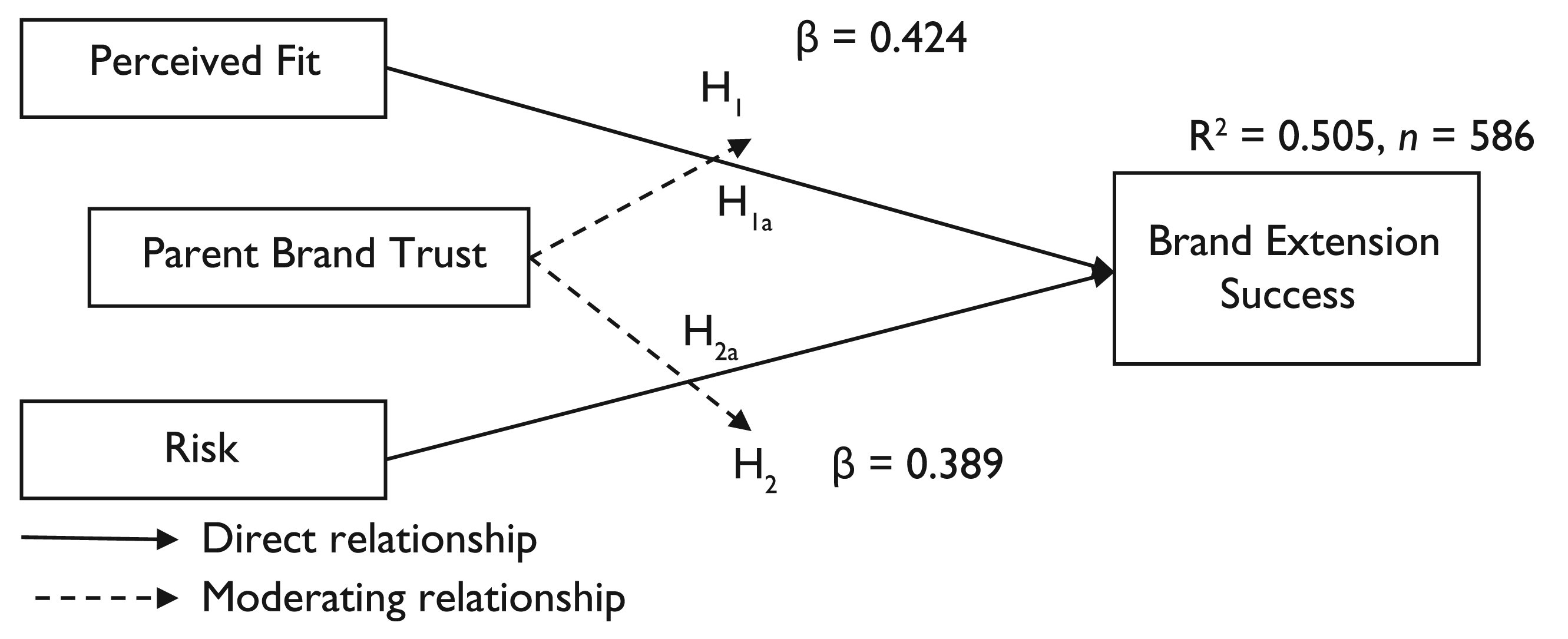
Model 2 has been accepted. Beta is 0.424 for perceived fit (first factor) and 0.389 for risk (second factor). The third model adds PBT, but it is found to be insignificant, which shows it does not clarify a further significant proportion of criteria variance. The values of B for both perceived fit (0.474) and risk (0.421) are positive and indicate a positive relationship between the factors and success of brand extension (Table 4). The value of t associated with b-values is also found to be significant p < 0.005 (Field, 2009), which indicates that the factors are making a significant contribution to the model. Perceived fit has a greater value of t (16.179) and standardized beta (0.029), which shows that it is making a greater contribution to the model.
Collinearity diagnostics can be evaluated by looking at the values of tolerance and VIF. For the current model VIF and tolerance are within the acceptable range (Bowerman & O’Connell, 1990; Field, 2009; Menard, 1995). The model (Figure 1) explains two factors; Perceived fit and risk are influencing the success of brand extension (DV), thus the third factor PBT has been excluded from the model.
To test PBT for moderation, the hierarchical moderated regression analysis (HMRA) was undertaken. The IVs perceived fit and risk were centred and then the centred IVs, moderator (PBT) and dependent variables (DVs) were entered hierarchically in separate blocks.
In HRMA, the statistical significance of the incremental change in R2 is critical in the selection of the final model and the interpretation of results (J. Cohen & Cohen, 1983; Shah & Shin, 2007). For a moderating variable to be significant, the coefficient of the moderator (Dawson, 2013) and coefficients of the interaction terms should be significant (Baron & Kenny, 1986; Yoon, 2013).
Perceived fit and risk (having direct influence) along with PBT (moderator) was entered in Block 1. In Block 2, the interaction terms (PBT × Perceived Fit and PBT × Risk) were entered to test for moderating effects.
The analysis has been reported in Table 5, which shows that the IVs explain a variance of 50.9 per cent (Adjusted R2 = 0.509, p < 0.05) in the data. On addition of the interaction terms to the model exhibits a significant incremental variance (ΔR2 = 0.008, p < 0.05). Among the interaction effects, the interaction terms of perceived fit (β = 0.483, p < 0.05) and risk (β = 0.402, p < 0.05) were significantly related to the success of brand extension. The standard coefficient of the moderator (β = –0.099, ns) was non-significant which shows that PBT is not directly influencing brand extension success.
Moderation: Effect of Parent Brand Trust on Perceived Fit and Risk
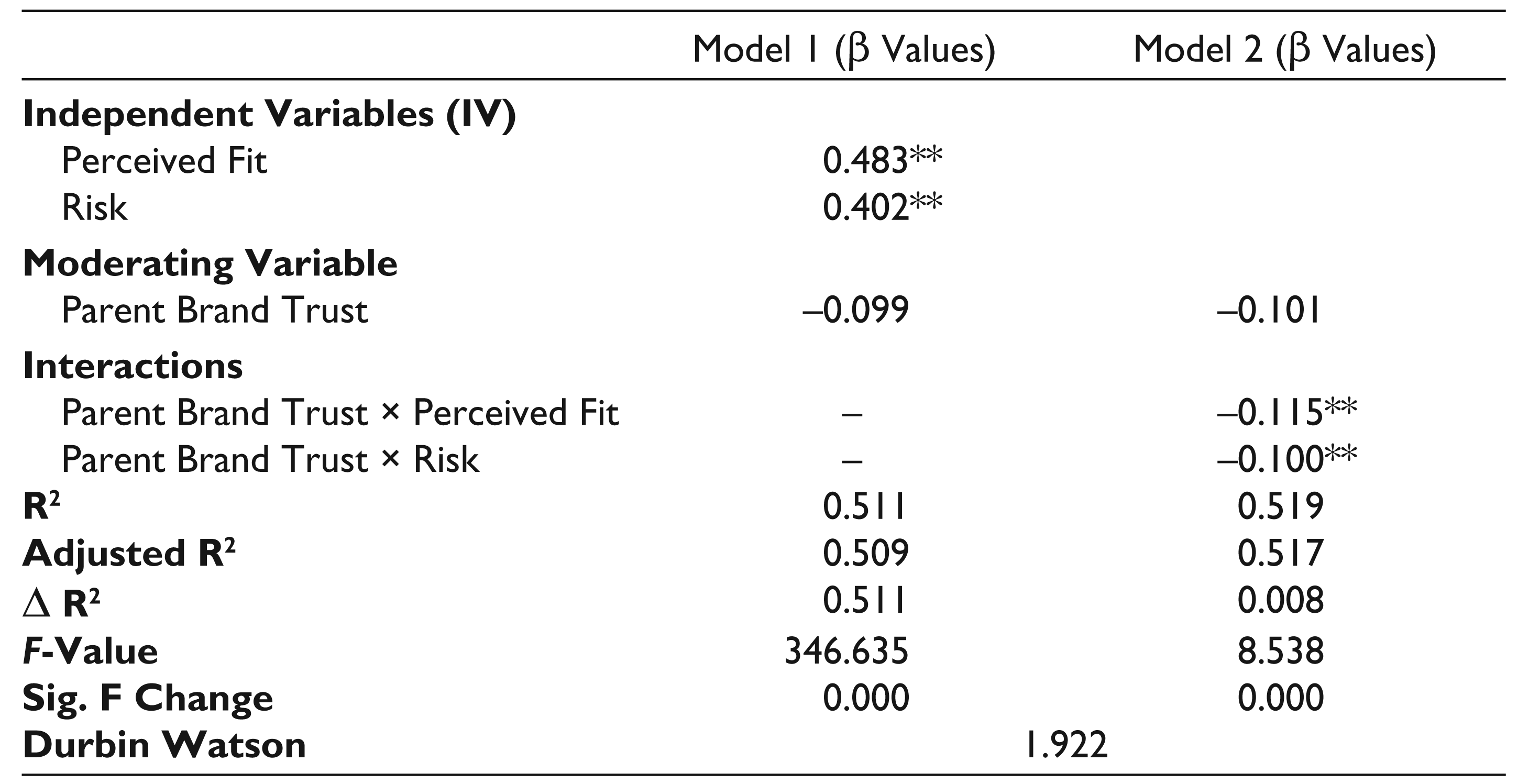
The interaction terms PBT × Perceived Fit and PBT × Risk was added. The standard coefficients of the interaction terms (PBT × Perceived Fit: β = –0.115**; PBT × Risk: β = –0.100**) were found to be significant. This shows that PBT is acting as a moderator. PBT is weakening both the relationships between risk and success of brand extension and perceived fit and brand extension success. The F-statistics and the Durbin–Watson values are also within the acceptable range.
Conclusion
The study investigated the factors which influence the brand extension success of particularly personal care brand Dettol. Three variables PBT, perceived fit and risk were chosen and examined for their impact on brand extension success. For the current study, Dettol, generally perceived as a solution for protection from germs, was chosen as the PB. The final result is summarized in Figure 1.
The brand extension literature has emphasized the importance of similarity between the desired category of extension and the parent product category, associations and brand perception. The brands have extended into related categories where the fit is high between PB and extension the chances of success are high.
The results of multiple regressions suggest a positive and direct impact of perceived fit and risk on success of brand extension, which is moderated by PBT. The results of the study reinstate this statement that when Dettol has been extended into high fit categories like soap, hand wash, sanitizer and facial wipes, the extensions have been successful. But the brand loyalty and trust have moderated the relationship between fit and success of brand extension. It weakens this relationship (PBT × Perceived Fit: β = –0.115**). Customers who trust Dettol have also tried the unrelated extensions like multipurpose liquid and kitchen gel.
PBT is weakening the relationship between risk and success of brand extension (PBT × Risk: β = –0.100**). Risk is released when a known brand name provides a quality assurance and the seller is identified and this consequently boosts the probability of trying a new product and brand extension. This can be attributed to the fact that if the consumer has high trust in the company, the perceived risks associated with buying new categories reduces and they are likely to try dissimilar extensions. The success of Dettol kitchen gel and multipurpose liquid can be attributed to this reason. PBT is weakening the relationship between fit and brand extension success and also the relationship between risk and brand extension success.
Managerial Implication
This research provides an important insight into the brand extension strategy of a personal care brand, Dettol, from theoretical and managerial viewpoints. As reflected in the findings, there is a moderating role of PBT on perceived fit and risk and success of brand extension. It indicates that Dettol is a trusted heritage brand and its strength of PBT has led to the success of subsequent related and unrelated extensions. Organizations may address brand trust as a multidimensional aspect and consider including two dimensions of corporate credibility based trust and performance satisfaction based trust in order to influence the acceptance of the PB as well as the extensions. Trusted brands act as important risk-reducing devices. Though, parent brand Dettol’s strong association with smell and wounds might have impeded the success of Dettol Kitchen, its strong image as a disinfectant and trust of consumers have resulted in the success of unrelated extension as well. The functional and financial risk is significantly reduced in this case. While launching unrelated brand extensions, Dettol needs to be cautious as each brand has a stretchable limit. Brand extensions should have reciprocal effect on the PB as well to strengthen the existing brand image. Line extensions can be tried by organizations in case the questioned brand is not enjoying high equity.
Limitations and Future Research
The study also has few limitations. It studies the moderating influence of PBT on brand extension success, but there are other factors like consumer innovativeness and marketing support which may moderate the relationship of brand extensions success and its determinants. Future research can be done using other moderators. The consumer study can also be strengthened with the help of retailer study as well for the same framework. Such research studies provide insight into marketing and brand managers to take prudent decisions with respect of launching brand extensions.
Declaration of Conflicting Interests
The author(s) declared no potential conflicts of interest with respect to the research, authorship, and/or publication of this article.
Funding
The author(s) received no financial support for the research, authorship, and/or publication of this article.
Footnotes
Acknowledgements
The authors are grateful to the anonymous referees of the journal for their extremely useful suggestions to improve the quality of this article. Usual disclaimers apply.