







Abstract
Academic leaders have a very important role to play in higher educational institutions, and for the development of academic leaders attention has to be paid to their emotional intelligence to ensure transformational leadership and effective decision-making in their institution. There are few issues which are faced by all the academic leaders due to multiple roles, attitude, behaviour and emotions related to job/role. This is because with the passage of time, the roles of academic leaders have also changed. In the present study, the focus is on transformational leadership style of academic leaders as it is more prevalent in the higher education sector. In light of the findings of the empirical studies conducted on the subject, the present study is conducted in higher education sector with the objectives to examine the state of emotional intelligence and transformational leadership among academic leaders, to examine association between emotional intelligence and transformational leadership among the academic leaders under study, to study the association of various demographic factors of faculty members on their perception regarding emotional intelligence and transformational leadership. The present study is exploratory cum descriptive in nature. The data were collected from full-time faculty members working in selected universities of north India and their perception regarding emotional intelligence and transformational leadership of their academic leaders was measured. It was found that there is a significant and direct association between emotional intelligence of leaders and transformational leadership style as perceived by the faculty members. The demographic variables (gender and age) were found to significantly influence the variables under study as perceived by the faculty members about their academic leaders (HODs). Besides having theoretical implications that open pathways for conducting further research, the findings of the study may serve as a reference for service practitioners in designing strategies that will ensure superior performance of academic leaders in higher educational institutions.
Introduction
The success of any organization, largely, depends on human capabilities and competencies to identify the right objectives and choose the best possible alternative to attain the same. The quality of organizational performance largely depends upon the quality of decisions. In organizations, the main role of leaders is dynamic and inspirational where they inspire followers and stimulate their intellectual skills, enhance their capabilities and competencies enabling them to take right decisions and decide about appropriate ways and means to accomplish desired performance.
Business environment is undergoing tremendous changes, and of these there are many changes which organizations cannot escape from and as such leaders have a main role to adapt these changes and overcome associated challenges. It is the quality of leadership that can make a difference during these challenging times. Among other things, emotions have a tremendous influence on leadership and quality of decisions. Emotional intelligence is all about teamwork, leadership, partnership and vision. Employees with less control over their very own feelings or comprehension of others may think that it is exceptionally hard to deal with circumstances, which may influence their execution after some time (Makkar & Basu, 2017). The emotionally intelligent leaders help a business to excel consistently in all these areas. An organization which has emotionally intelligent leaders has motivated, productive, efficient and committed staff, aligned with the business. Emotional intelligence is applicable to every human interaction business: from staff motivation to customer service, from brainstorming to company presentations. An organization/institution where people are emotionally intelligent can work together to maximum effectiveness.
It is expected that leaders who are high on emotional intelligence are key to organizational success; therefore, leader should have the ability to sense employees’ feelings about their work environments, to intervene when problems arise and to manage their own emotions. Leader affects the followers’ attitudes and behaviours towards accomplishing the stated goals. Some of studies conclude that managers and leaders who can use their feelings and their knowledge constructively will have certain advantages over those who cannot. Organizations need strong leadership for optimum effectiveness where it is essential to understand that leadership is considered the vital part of effective decision-making and overall management. Past researchers found that emotional intelligence is an essential part of an effective leadership and has a strong association with decision-making and organizational performance. Abraham (2006) and Jones and Abraham (2009) determine that an emotionally intelligent person has a high commitment to organization and uses positive emotions to boost the decision-making process.
Every organization/institution has a shared factor that is leadership, without which no organization/ institution can exist. The presence of an organization/institution is firmly tied with the capacity or style of leadership (Kesari & Verma, 2018). Among the different leadership styles, transformational leadership style has been found the most effective leadership style (Bass, 1999; Leithwood, 1992). Transformational leaders emphasize followers’ intrinsic motivation and personal development. They seek to combine followers’ aspirations and needs with desired organizational outcomes. By and large, transformational leaders are able to foster followers’ commitment to the organizations and inspire them to exceed their expected performance (Bass, 1998; Bass & Riggio, 2006). In complex organizations and dynamic business environment, transformational leaders are often seen as ideal persons of change who could lead followers in times of uncertainties and high risk situations (Voon, Lo, Ngui, & Ayob, 2011).
Education plays a significant role in the development of a country. It is the education that helps in transforming the economy of a country. Educational institutions are considered as source of knowledge and awareness producing institutions which train manpower and keep them ready as organizational inputs for different sectors of economy. Similarly, in India, the higher education sector has taken big strides since independence and has contributed tremendously towards producing qualified and skilled human resource, thus enabling to keep human resource ready for all sectors of its economy. However, the quality of output from this sector has continuously been the subject of criticism at the hands of academicians, scholars, social leaders and employers both in private and public sectors. Although there are several aspects that need to be monitored and managed in educational institutions, yet, one of the features in increasing the effectiveness, adeptness and ultimate attainment of results is the appropriate leadership behaviour of academic administrators (leaders). This is in view of the fact that like in all other sectors, leadership in education sector is also considered as one of the important factors of improvement in output quality.
This is against this background that there is an emerging need to understand emotional intelligence and leadership behaviour of the academic leaders as they are important for an institution to excel in every field. So, it is required to know how subordinates working under academic leaders perceive their leader in the light of emotional intelligence attributes and leadership attributes. This study determines the emotional intelligence and leadership behaviour of academic leaders through a comprehensive, reliable and valid scientific enquiry. Gaining a better understanding of leaders’ emotional intelligence and leadership behaviour would be useful to suggest measures to higher educational institutions for increasing the level of both the two attributes by chalking out strategies that will be useful for the academic leaders in the longer run and for the institution to achieve excellence.
Moreover, the present study has focused on transformational leadership style only. Research has shown that in educational sector, transformational leadership style is dominant over other styles because it is associated with creative behaviours, enhancement of skills, which are crucial for education sector (Martin, Trigwell, Prosser, & Ramsden, 2003; Middlehurst, Goreham, & Woodfield, 2009). The first section contains the literature review, identification of gaps, development of objectives and hypotheses. The methodology is discussed in the second section including sample, instruments and data collection design. The third section contains the analysis, conclusions and implications of the study.
Further, this study attempts to answer the following specific research questions:
Review of Literature
Emotional Intelligence
The first term of emotional intelligence is attributed to Wayne Payne (1985) who introduced the term emotional intelligence in his doctoral dissertation entitled ‘A Study of Emotion: Developing Emotional Intelligence; Self-Integration; Relating to Fear, Pain and Desire’. Intelligence has an emotional base and using our emotions as a source of energy to accomplish the self-defined goal is what emotional intelligence (EI) consists of (Chadha, 2005). Emotions affect relations with other people as well as one’s self-identity and ability to complete a task. To put this in proper context, Goleman (1995) popularized the concept of emotional intelligence. Salovey and Mayer coined the term ‘emotional intelligence’ in 1990 describing it as ‘a form of social intelligence that involves the ability to monitor one’s own and others’ feelings and emotions, to discriminate among them, and to use this information to guide one’s thinking and action’ (Salovey & Mayer, 1990). In the 1990s, Daniel Goleman became aware of Salovey and Mayer’s work, and this eventually led to his publication of book ‘Emotional Intelligence–Why It Can Matter More Than IQ’.
The definition of emotional intelligence refers to the ability to understand and manage both your own emotions, and those of the people around you. People with a high degree of emotional intelligence usually know what they are feeling, what this means and how their emotions can affect other people (Imanzadeh, Esmaeilzadeh, Elyasi, & Sedaghati, 2012). Bradberry and Greaves (2009) identified four essential emotional intelligence skills that can be learnt and categorized them into two types of competencies to deal with them: personal and social competencies. These are self-awareness, self-management, social awareness and relationship management. Self-awareness is the ability to recognize ones’ own emotions and how they affect ones’ thoughts and behaviour. Self-management refers to the ability to manage your emotions, response according to situations and other people. On the other hand, social awareness refers to the ability to understand the emotions, needs and concerns of other people. Relationship management is the ability to use your awareness of your own emotions and those of others to manage interactions successfully.
Transformational Leadership
The concept of transformational leadership had been introduced by James MacGregor Burns (1978) in his descriptive research conducted on political leaders, but nowadays it is used in psychological studies (Bass & Riggio, 2006). Referring to Bass, transforming leader is a continuum process in which a leader and a follower reciprocally help each other to advance to a higher level of morals and motivation, and it creates significant changes for individual’s life and organizations.
Burns (1978) argued that the leader–follower relationship takes place in either a transactional or a transformational form. He describes transactional leadership as a leader’s ability to motivate a follower based upon economic, political or psychological rewards where both parties understand each other’s role and what is at stake. In contrast, Burns asserts that transformational leadership involves the leader and follower engaging in a purposeful relationship to achieve a higher level of motivation and ethical aspiration. Bass and Avolio (1994) gave the model of full range leadership, which includes transformational, transactional and laissez-faire styles. Transformational leadership is the most effective managerial behaviour, in which a leader builds positive relationships with followers to move from lower to higher levels of performance. Transactional leadership centres solely on the leader’s ability to set up agreements or contracts with followers to accomplish specific goals based upon rewards and punishment rather than a relationship. Laissez-faire leaders passively manage employees using a hands-off approach. According to Bass’s (1985) transformational leadership theory, there are four essential elements that make this approach practical. These four elements are idealized influence, inspirational motivation, individualized consideration and intellectual stimulation. Idealized influence refers to the ability of leaders to demonstrate self-confidence and power by acting as role models for their followers. Inspirational motivation refers to the capabilities of leaders to articulate a vision that is appealing and inspiring to followers. On the other hand, individualized consideration refers to the degree to which the leader attends to each followers needs, acts as a mentor or coach to the follower and listens to the follower’s concerns and needs. Intellectual stimulation refers to the degree to which the leaders stimulate their followers to use innovation and creativity to develop new ways of accomplishing goals and objectives.
Emotional Intelligence and Transformational Leadership
A growing body of studies has shown that emotional intelligence is fundamentally associated with transformational leadership (e.g., Barling, Slater, & Kelloway, 2000; Leban & Zulauf, 2004; Mandell & Pherwani, 2003). Palmer, Walls, Burgess, and Stough (2001) found significant correlations between emotional intelligence and several factors of the transformational leadership model, specifically, the ability to monitor and manage emotions correlated with the inspirational, motivational and individualized consideration factors of transformational leadership. Similarly, Gardner and Stough (2002), and later Barbuto and Burbach (2006) showed that the emotional intelligence of leaders accounted for the majority of the variance in transformational leadership. Collectively, the findings of previous studies provide evidence that leaders who scored high on emotional intelligence were perceived by followers as exhibiting more transformational leadership behaviours. The qualities of empathy, motivation, self-awareness, trust and emotional stability, all qualities of a transformational leader, are also considered to be important elements of emotional intelligence (Bar-on, 1997; Goleman, 1998; Mayer & Salovey, 1997).
Cook (2006) studied the effects of emotional intelligence on elementary principal’s leadership performance. The results showed that emotional intelligence had a strong effect on leadership. Demographic factors like gender, age and years of experience had no significant effects on emotional intelligence. Similarly, Zahed-Babelan and Rajabi (2009) found that a positive correlation exists between transformational leadership style and emotional intelligence and negative correlation exists between transactional leadership style and emotional intelligence, but no significant relationship between laissez-faire leadership style and emotional intelligence was found. Following the cue, Hebert (2011) conducted investigation on the correlation between transformational leadership and emotional intelligence on quantitative study of school principals. It was found that principals and future principals could better develop effective leadership skills by becoming more aware of their strengths and weaknesses in the area of emotional intelligence, along with improving their transformational leadership behaviours. Similarly, Hamidi and Azizi (2012) studied the relationship between emotional intelligence and leadership styles of principals who worked in high schools of Sanandj city in Iran. Results revealed that there was significant relationship between emotional intelligence and two styles of leadership, and the relationship between self-awareness and leadership styles were not statistically significant. Gardner and Stough (2002) investigated the relationship between leadership styles and emotional intelligence in senior level managers. It was found that a strong positive relationship existed between transformational leadership and total emotional intelligence scores and a significant negative correlation was found between laissez-faire leadership and total emotional intelligence score. Like others, Mandell and Pherwani (2003) examined the predictive relationship between emotional intelligence and transformational leadership style, the gender differences within each construct and interaction effects between gender and emotional intelligence. The study established that emotional intelligence significantly predicts transformational leadership style. A significant difference was also found between the emotional intelligence scores of male and female managers.
Similarly, Sayeed and Shanker (2009) examined the relationship between emotional intelligence and transformational leadership style. The results revealed that there was significant relationship between emotional intelligence and dimensions of transformational leadership. Cox (2011) observed that a highly emotional individual can either envision organizational improvements as well as decision-making besides instilling sense of enthusiasm, trust and self-confidence or enhance their ability to solve problems. Following the cue, Rehman (2011) examined the impact of emotional intelligence on the relationship among leadership styles, decision-making styles and organizational performance, and she concluded that emotional intelligence moderates the relationship between leadership styles and decision-making styles on one hand, and organizational performance on other hand. Though there has been much research demonstrating the effectiveness of transformational leadership behaviour in organizations (Judge & Piccolo, 2004; Northouse, 2012), there has been a dearth in research investigating the antecedents of these behaviours (Harms & Credé, 2010). The objective of transformational leadership is to develop the dialogue and cooperation among the team members and improve the organizational learning through the intellectual stimulation, inspirational motivation openness, open trust and relationship (Mortazavi & Nazemi, 2006). Relational leadership and passing the knowledge are two specific areas that leaders must emphasize, which produces an environment of possibilities through continuous and correct communication and relationship building (Halpern, 2006). Researchers who have explored transformational and charismatic leadership must also include motivational effect in their study (Shamir, House, & Arthur, 1993). The relationship between transformational leadership and altruism stems from the wide acknowledgement that transformational leaders help followers to transcend their own self-interest for the sake of the mission and vision of their group or organization (Gardner & Avolio, 1998; Shamir et al., 1993). Transformational leadership begins with awareness—awareness of own thoughts and feelings, and how these thoughts affect actions (Sur & Prasad, 2011). Goleman (1995) emphasized that empathy is pivotal for leaders because it is positively related to the innate motivation of followers. According to Bass and Steidlmeier (1999), leaders are truly (authentic as opposed to pseudo) transformational when they increase awareness of what is right, good and important, and when they raise followers to become leaders who go beyond their self-interest for the good of their organization. As several antecedents of leadership behaviours need to be examined by scholars, yet the proposed study will focus on emotional intelligence and its dimensions among academic leaders as some of the significant antecedents of the leadership behaviour to plug the literature gap.
Therefore, in view of above discussion, following hypothesis has been formulated: emotional intelligence (managing relations, self-motivation, commitment and altruism, self-awareness, empathy, emotional stability, value orientation and integrity) positively and significantly influences transformational leadership.
Rationale
Academic leaders need to understand their own emotions and recognize and understand the feelings of those around them. Academic leaders are more successful when they pay attention to their social interactions with others in the workplace and the impact they as leaders have on those around them. It is also important for leaders to understand the impact that others’ emotions have on them. When leaders are aware of the emotional side of the workplace along with the technical processes of getting tasks and goals accomplished, they are better able to take best decisions and to create a working environment that encourages excellence in the institution. This is against this background that there is an emerging need to understand emotional intelligence and leadership behaviour of the academic leaders as they are important for an institution to excel in every field. So it is required to know how subordinates working under academic leaders perceive their leader in the light of emotional intelligence attributes and leadership attributes. This study determines the emotional intelligence and leadership behaviour effectiveness of academic leaders through a comprehensive, reliable and valid scientific enquiry.
Research Model
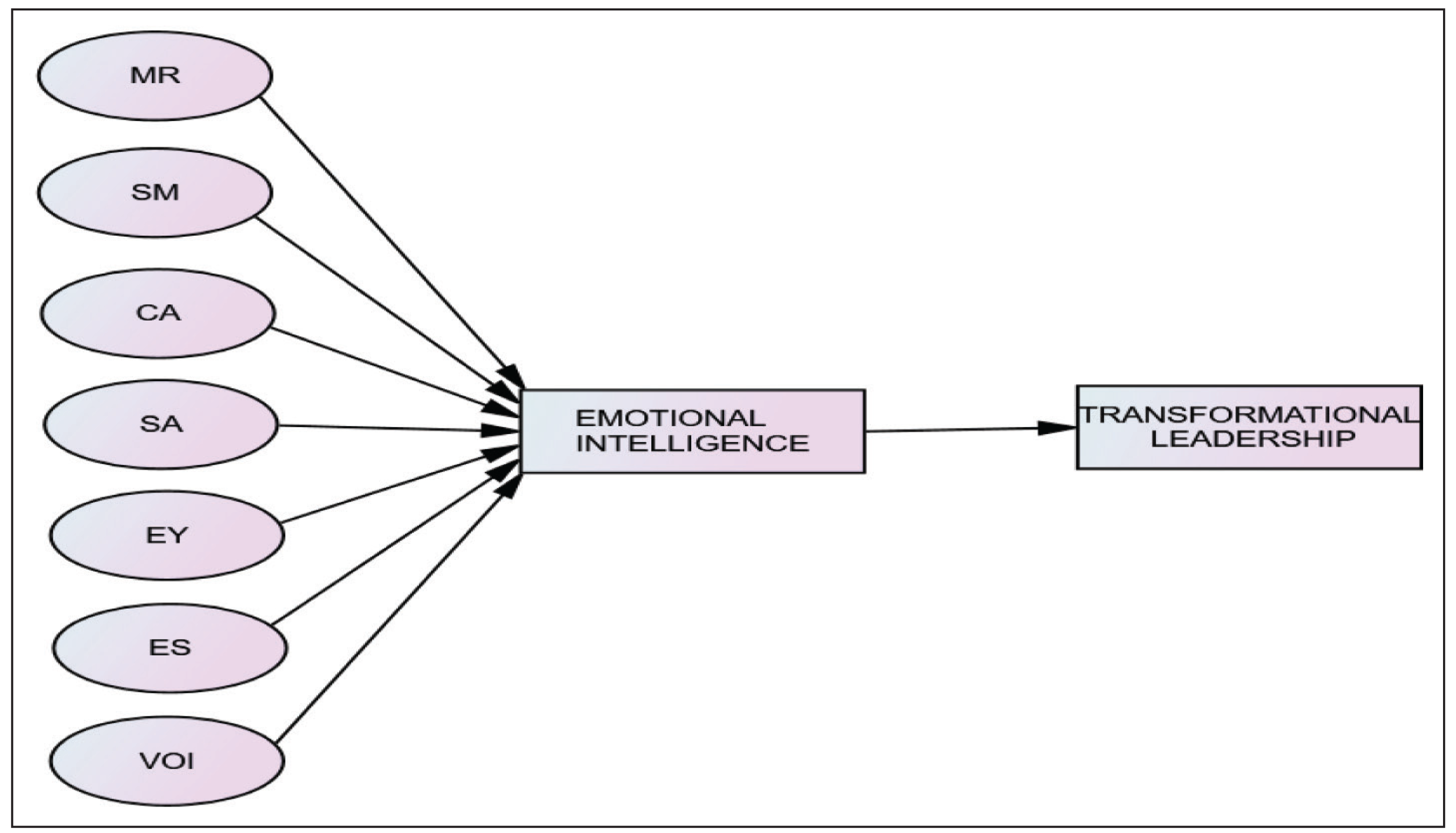
The model for this study has been developed after an elaborate literature review. It contains emotional intelligence as a predictor variable constituting of managing relations, self-motivation, commitment and altruism, self-awareness, empathy, emotional stability, value orientation and integrity. In order to test the various causal relationships between the variables in the model, structural equation modeling (SEM) was employed. Initially, the measurement model was developed, it was followed by the structural model, and both were tested through different model fit indices and various path estimates were determined. The proposed model is depicted in Figure 1.
Research Methodology
The present study was exploratory cum descriptive in nature and the sample comprised of professors, associate professors and assistant professors from selected universities of north-Indian states under study. The sample size was calculated according to the number of items in the study. The research instrument contained 48 items, so their itemized sample size worked out as 240 (48 items × 5). Every item requires minimum 5 respondents and maximum 10 respondents for determination of representative sample size (Hair, Anderson, Tatham, & Black, 1998). In total, 250 questionnaires were distributed out of which 205 were found to be fit for analysis. The employees included from universities under study were governed by the principles of proportionate sampling. The data for the study were collected both through the primary and secondary sources. The measuring items used for the study were sourced from existing validated scales and literature. The questionnaire consisted of two sections. Section ‘A’ included demographic information of respondents, while Section ‘B’ included statements of emotional intelligence and transformational leadership. The demographic characteristics were gender and age. The emotional intelligence scale and transformational leadership scale used in the present study were adapted from previously published works. The items were, however, modified so as to suit the current research context and purpose. The emotional intelligence scale has been adapted from Hyde, Pethe, and Dhar (2002), and transformational leadership scale from Bass and Avolio (1995). To capture the responses of the sample elements, a five-point Likert scale (ranging from 1: strongly disagree, 2: disagree, 3: undecided; 4: agree to 5: strongly agree) was used throughout the study. There were total 48 items in the questionnaire. Emotional intelligence scale comprised of 28 items and transformational leadership scale comprised of 20 items, respectively. Also, common method bias was tackled in the present study. The two primary ways to control for method biases are through (a) the design of the study’s procedures and/or (b) statistical controls (Podsakoff, MacKenzie, Lee, & Podsakoff, 2003). The bias in the study has been tackled through procedural remedies (Podsakoff et al., 2003). Leader’s emotional intelligence and transformational leadership skills have been measured by their subordinates working under them. Thus, leader’s own perception about their emotional intelligence and transformational leadership skill is not the centre of attention of the study which would have resulted in biased results.
Exploratory Factor Analysis
The refinement of the instruments was done through exploratory factor analysis (EFA) followed by confirmatory factor analysis. EFA was performed for the exploration of dimensions. The analysis was initially performed on 54 items; based on the results, the items were reduced to 48. The standard criterion used to determine the number of factors was based on eigenvalue which should be equal to or more than one (>1). In addition to this, the suitability of the data was assessed through two tests: Kaiser–Meyer–Olkin measure of sampling adequacy (KMO) and Bartlett’s test of sphericity. The items whose loadings were greater than >0.50 were retained, while as those whose loadings were below <0.50 were dropped in the final component matrix. EFA results identified six items unreliable because of their low items loading in communalities (i.e., <0.50) and cross loadings in rotation matrix, so these items were eliminated from the respective certain construct and improved loadings (Field, 2009; Hair et al., 1998). The model fit was also in the acceptable range for both the scales.
It is to be mentioned here that in emotional intelligence scale, items of factor altruistic behaviour as well as one item of factor self-development showed their loadings in the factor ‘commitment’. Therefore, both were combined and accordingly renamed as ‘commitment and altruism as one factor. Items of factor value orientation also showed their loadings in the factor ‘integrity’ and thus renamed as ‘value orientation and integrity’. Also, one item of self-development showed its loading in the factor ‘emotional stability’. The items which loaded in the other factors were closely related to the factor in which they showed their loadings.
Confirmatory Factor Analysis (CFA)
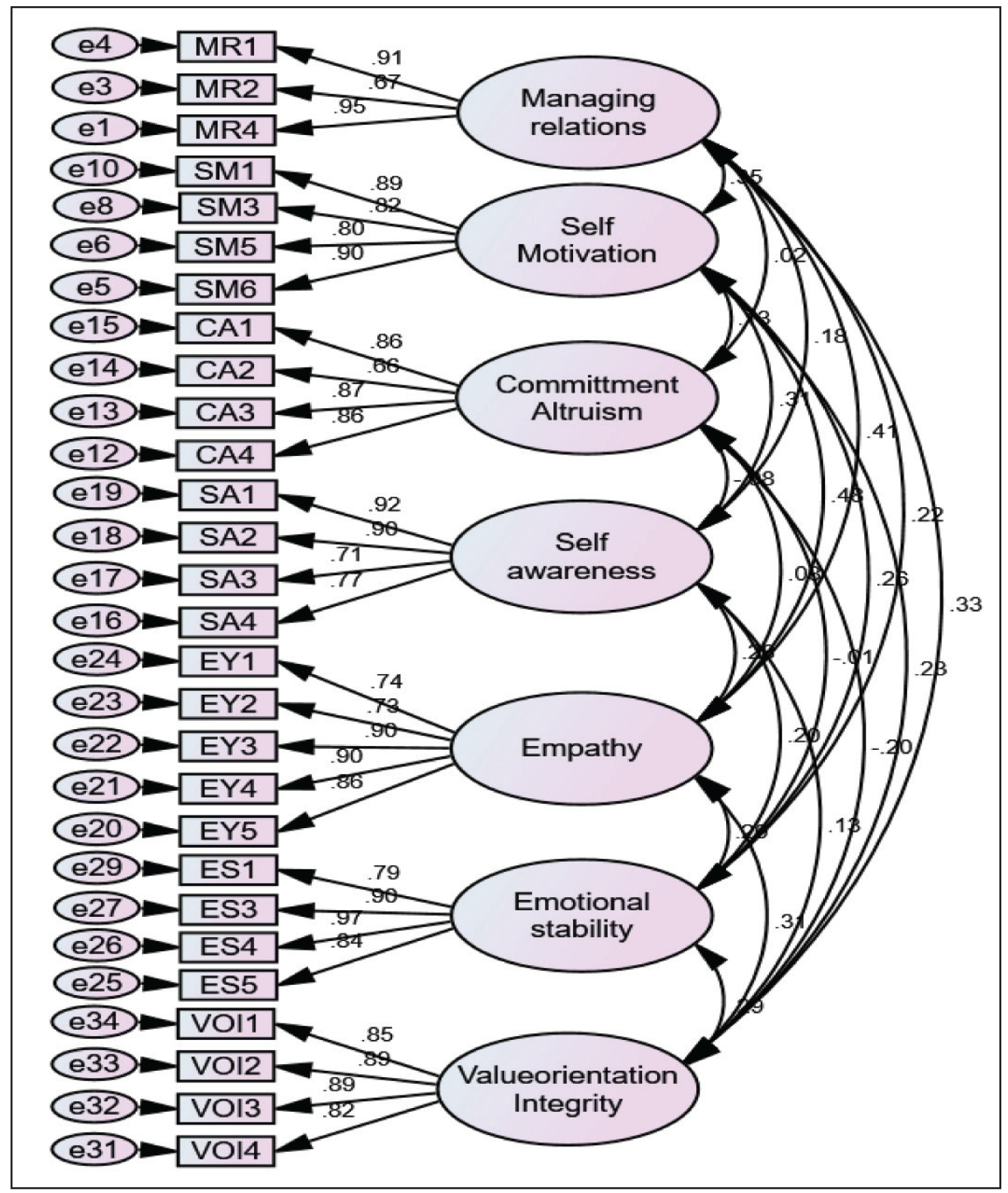
The emotional intelligence construct comprised of seven sub-scales, namely, managing relations, self-motivation, commitment and altruism, self-awareness, empathy, emotional stability, value orientation and integrity. Items MR3, SM2, SM4, CA5, ES2 and VOI5 were deleted due to poor CFA loadings. The results from the CFA (Figure 2) revealed a better model fit when six items were removed. The fit indices of the specified model have also yielded good results (CMIN/DF = 1.619, GFI= 0.943, CFI=0.922, RMSEA=0.072, RMR=0.057). From the model, it is clear that most of the factor loadings are well above 0.70 threshold with only one loading above >0.60 which is also acceptable and hence supports the EFA findings (Hair et al., 1998).
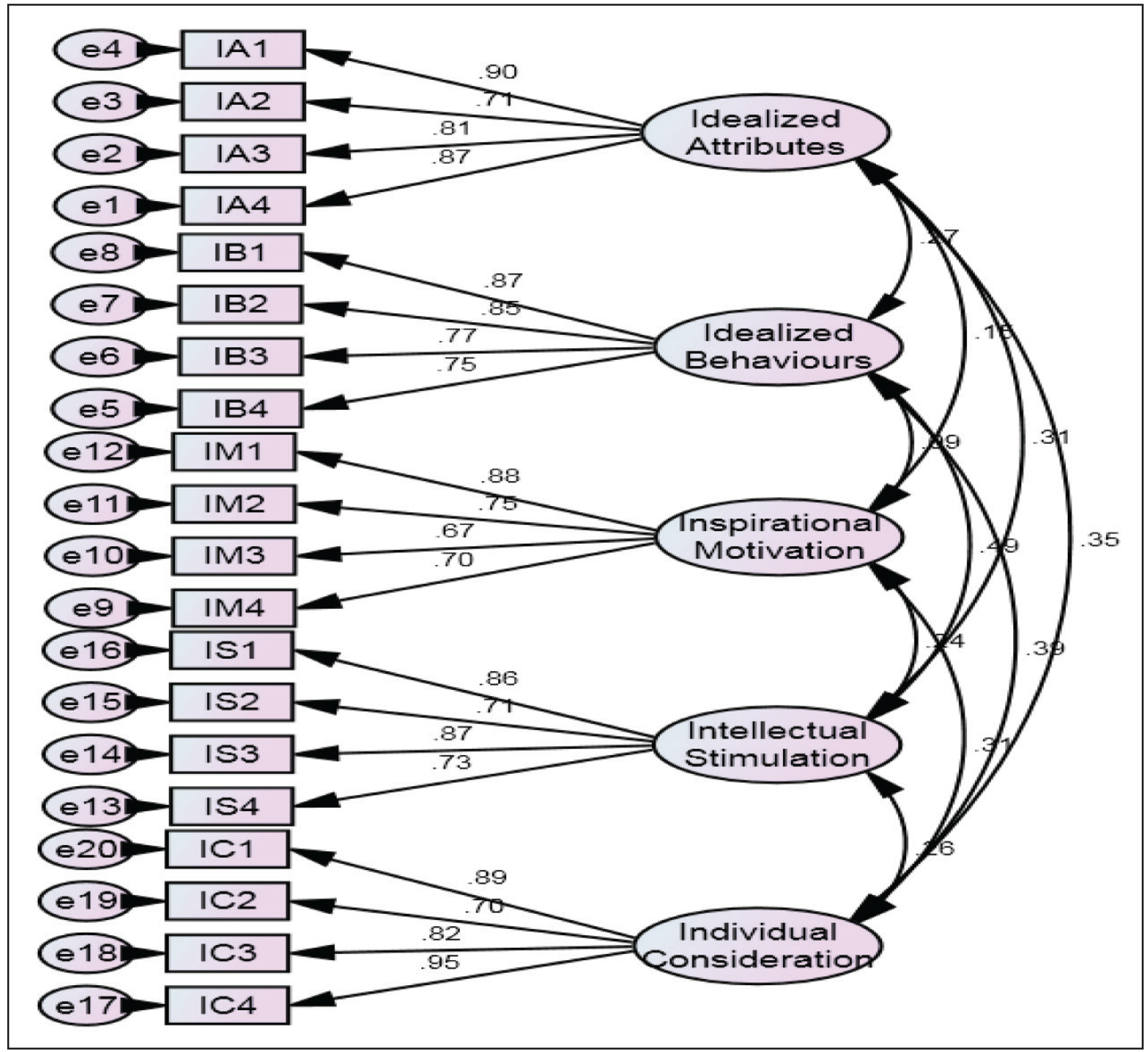
The transformational leadership construct comprised of five sub-scales, namely, idealized attribute, idealized behaviour, inspirational motivation, intellectual stimulation and individual consideration. The result of CFA (Figure 3) on all sub-scales showed that all the manifest (observe) variables are highly loaded on their latent construct; hence, no item was eliminated from the sub-scale of transformational leadership. The fit indices of the specified model have also yielded good results (CMIN/DF= 1.496, GFI= 0.839, CFI=0.945, RMSEA=0.064, RMR=0.063). From the model, it is clear that most of the factor loadings are well above 0.70 threshold with only one loading above >0.60 which is also acceptable and hence supports the EFA findings (Hair et al., 1998).
Reliability and Validity
Reliability of the Final Scale
Reliability of the final questionnaire after CFA was assessed through overall Cronbach alpha and composite reliability . The final scale comprised of 48 items. The findings associated with the results of two measures are discussed in the following subsections.
Overall Cronbach Alpha
The overall ‘Cronbach alpha’ calculated through SPSS is 0.833 which is much higher than the acceptable level in social science research (Hair et al., 1998). Cronbach alpha value for the two constructs, that is, emotional intelligence (α—0.871) and transformational leadership (α—0.841) (Table 1) also reflected the internal consistency (i.e., each question within a measure is actually measuring the same phenomenon).
Composite Reliability
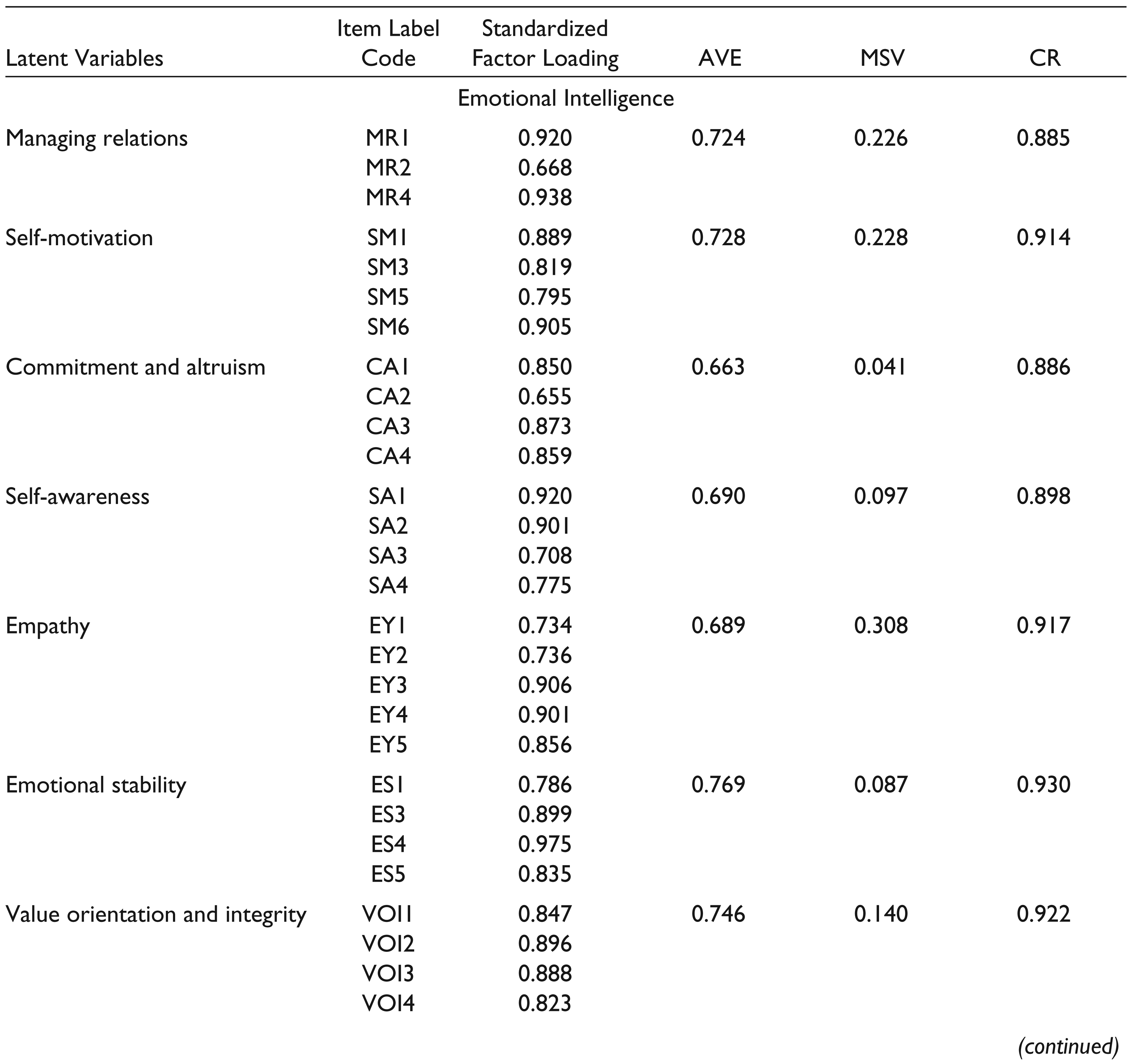
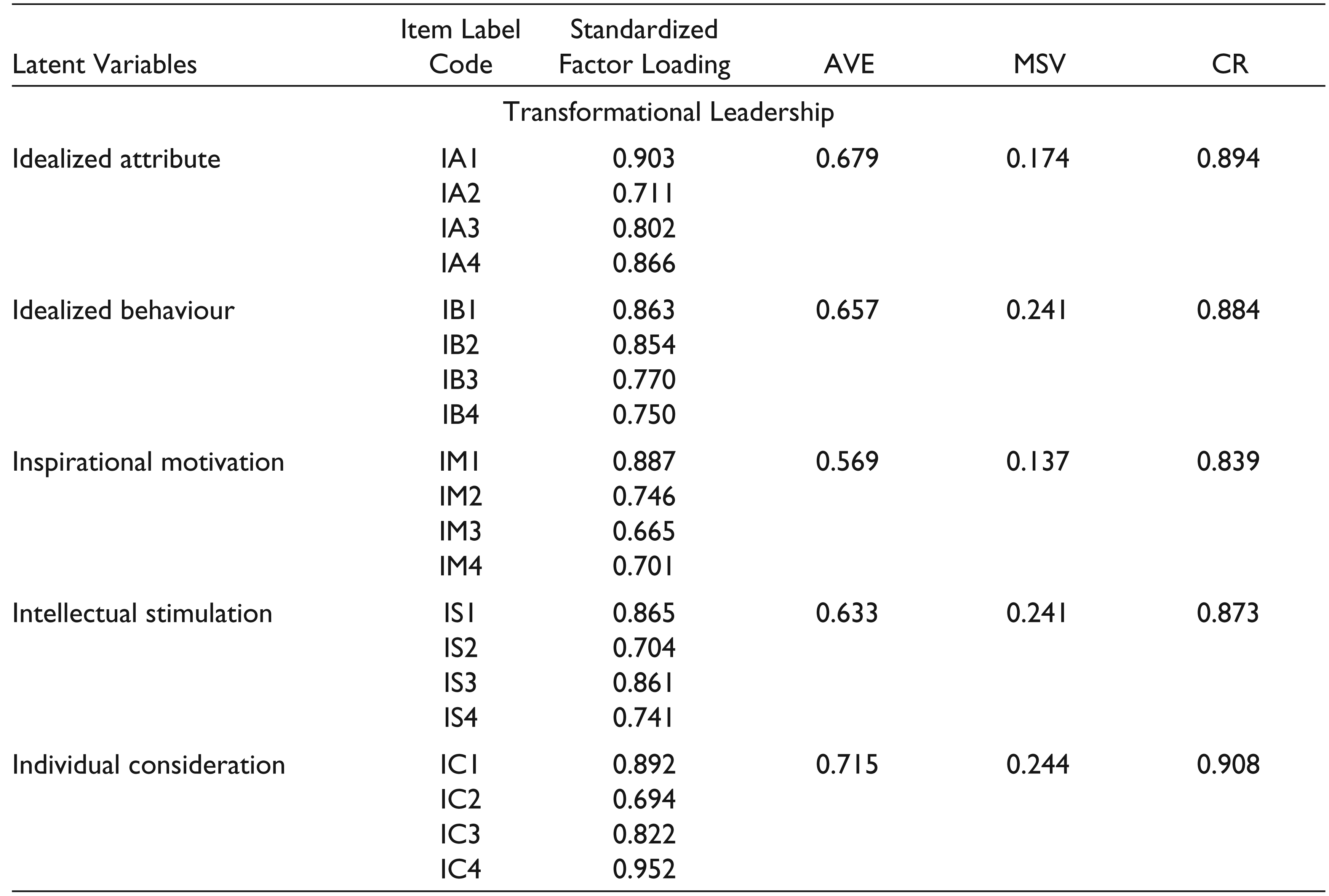
The value of all the dimensions for CR as shown in Table 2 is greater than 0.70, thereby achieving composite reliability as well.
Overall Cronbach Alpha Coefficients

Results of the Measurement Model
Validity
Convergent Validity
Convergent validity was established through standardized factor lading (SFL), construct reliability (CR), and average vriance explained (AVE). Criteria for ensuring convergent validity are CR>0.7, CR>AVE and AVE>0.5 (Hair, Black, Babin, & Anderson, 2010). AVE of extracted 12 individual dimensions were found to be more than 0.5 (Table 2). Thus, the final scale comprised of the 48 items in total for all the variables under study.
Further, in the present study, majority of all variables are satisfactorily loaded on their latent dimensions (SFL > 0.6). All individual constructs satisfied all prerequisites (i.e., factor loadings of each variable and fit criterion) of convergent validity. The results are exhibited in Table 2.
Discriminant Validity
Discriminant validity was also established on the basis of AVE and maximum shared variance (MSV) for the variables under study. Criteria for establishing discriminant validity is MSV<AVE (Hair et al., 2010). Within the present study, MSVs for each of the 12 individual constructs have been determined. Thus, measurement model established discriminant validity as MSV of all individual constructs have been found to be lower than their respective AVE estimates (Table 2).
Analysis
Sample Characteristics of the Respondents
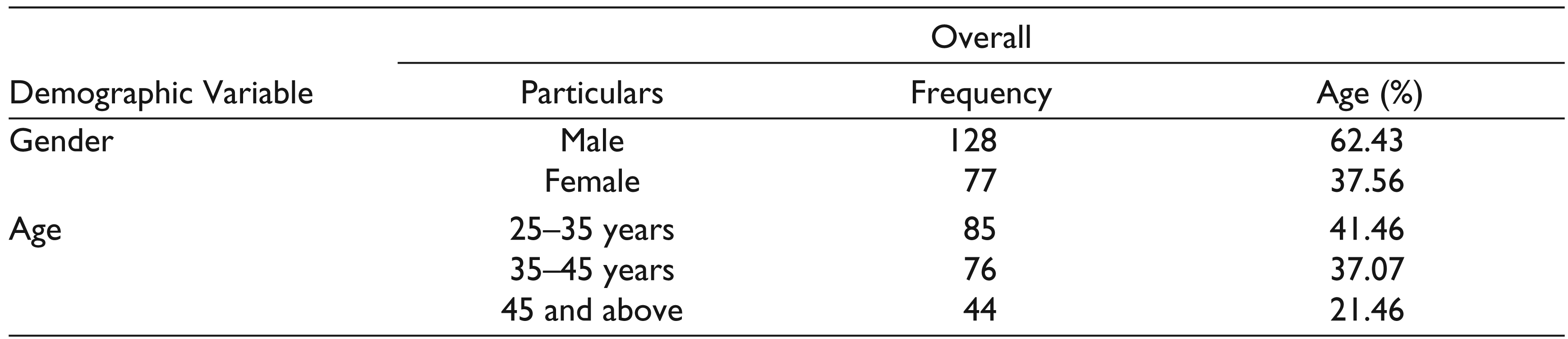
Descriptive statistics was employed to know the descriptive information across various demographic variables on a total sample of 205. The various demographic variables which were considered for the study were gender and age. The analysis of the sample revealed the characteristics as indicated in Table 3.
Emotional Intelligence
The perception of faculty members about their HOD’s emotional intelligence and its dimensions is provided in Table 4. A mean score of 3.80 or percentage score of 76.0 per cent indicates that an above average level of emotional intelligence is perceived by faculty members about their HOD’s in the sampled universities. The standard deviation of 0.470 also supports that the results are reasonably trustworthy. The perception of faculty members of the sample universities regarding the dimensions of emotional intelligence also appears to be at an above average level with mean scores of 3.89, 3.58, 3.75, 3.71, 3.86, 3.88 and 3.99 reported for managing relations, self-motivation, commitment and altruism, self-awareness, empathy, emotional stability and ‘value orientation and integrity,’ respectively (Table 4).
Sample Characteristics
Emotional Intelligence of HOD’s as Perceived by Faculty Members
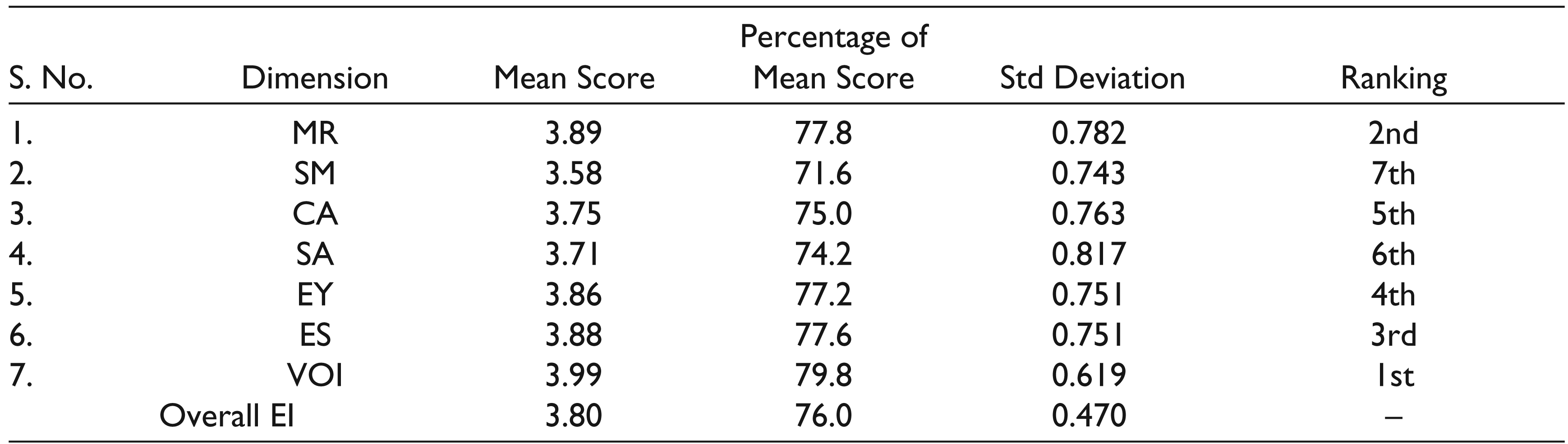
Among the seven dimensions of emotional intelligence, the respondents have reported highest for value orientation and integrity followed by managing relations, emotional stability, empathy, commitment and altruism, self-awareness and self-motivation respectively.
Emotional Intelligence Across Universities and Its Comparison
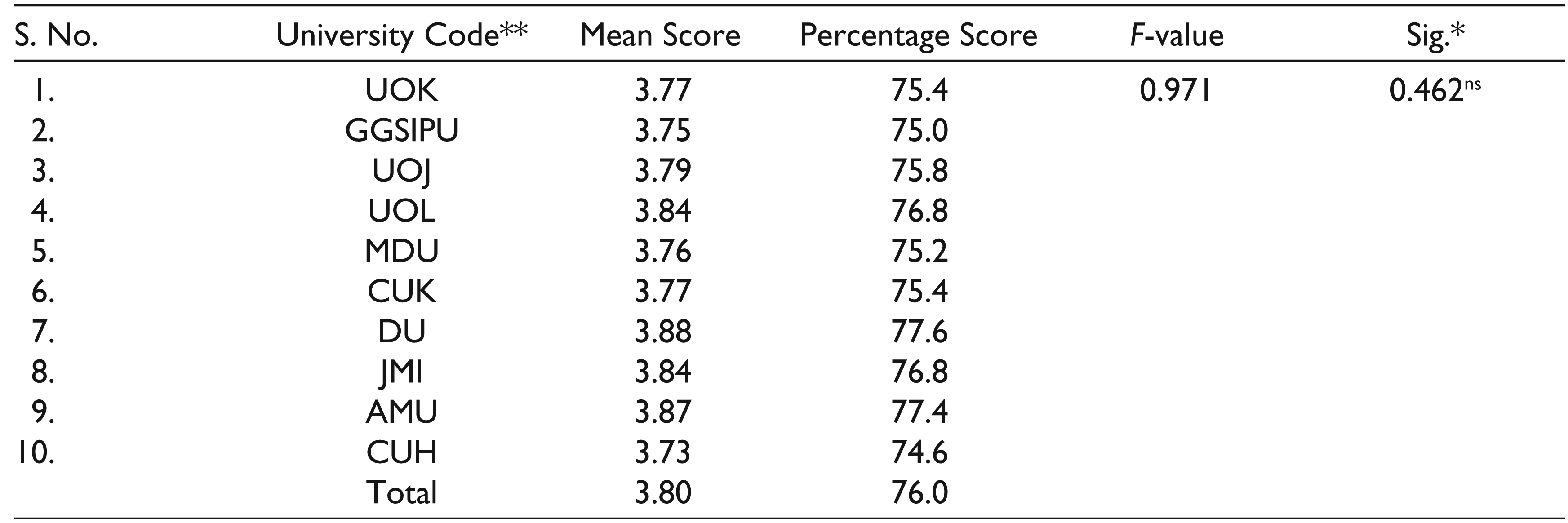
In the present study, an attempt is also made to analyse and compare the perception of faculty members regarding emotional intelligence of their HOD’s across the 10 sample universities. Overall, the faculty members of all the 10 sample universities report a fairly positive and satisfied perception with respect to the emotional intelligence of their HOD’s in their respective institutions.
From a comparative view point (Table 5), the faculty members of Delhi University have reported the most favourable perception regarding the emotional intelligence of their HOD’s, with a mean score of 3.88 or percentage mean score of 77.6. Among the 10 sample universities, faculty members of Central University of Haryana have reported the lowest mean score (3.73) with respect to the emotional intelligence level of their HOD’s. Additionally, Delhi University is followed by Aligarh Muslim University with the mean score of 3.87 or the percentage score of 77.4, Jammia Millia Islamia and University of Lucknow with the mean score of 3.84 or the percentage score of 76.8, University of Jammu with the mean score of 3.79 or the percentage score of 75.8, Central University of Kashmir and University of Kashmir with the mean score of 3.77 or the percentage score of 75.4, Maharishi Dayanand University with the mean score of 3.76 or the percentage score of 75.2 and finally Guru Gobind Singh Indraprastha University with the mean score of 3.75 or the percentage score of 75.0.
A one-way Anova test was employed to examine whether the differences in the mean scores of the 10 respondent universities are statistically significant or not. The results revealed that the difference is merely an outcome of chance factor and not statistically significant (F-value =0.971; sig=.462), indicating that the perception of the respondent faculty members about their HOD’s from different Universities is more or less the same.
University-wise Comparison Regarding Emotional Intelligence
Transformational Leadership
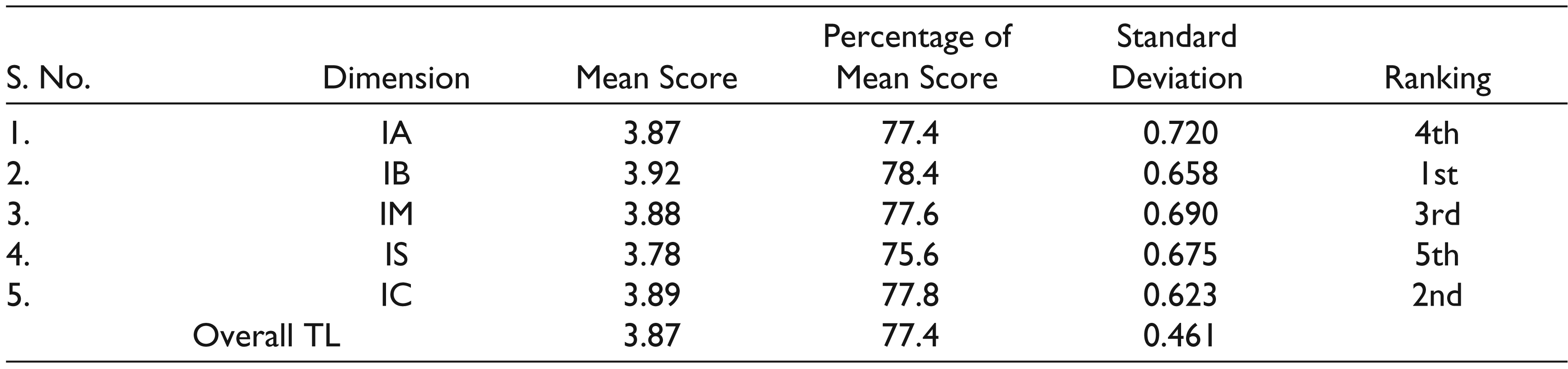
The perception of faculty members about their HOD’s transformational leadership and its dimensions in the sample universities is provided in Table 6. A mean score of 3.87 or percentage score of 77.4 per cent indicates that an above average level of transformational leadership is perceived by faculty members about their HOD’s in the universities under study.
The standard deviation of 0.461 also supports that the results are reasonably trustworthy. The perception of faculty members of the sample universities regarding the dimensions of transformational leadership also appears to be at an above average level with mean scores of 3.87, 3.92, 3.88, 3.78 and 3.89 reported for idealized attribute, idealized behaviour, inspirational motivation, intellectual stimulation and individual consideration, respectively.
Among the five dimensions of transformational leadership, the respondents have reported highest for idealized behaviour followed by individual consideration, inspirational motivation, idealized attribute and intellectual stimulation, respectively.
Transformational Leadership Across Universities and Its Comparison
In the present study, an attempt is also made to analyse and compare the perception of faculty members regarding transformational leadership of their HOD’s across the 10 sample universities. Overall, the faculty members of all the 10 sample universities report a fairly positive and satisfied perception with respect to the transformational leadership of their HOD’s in their respective institutions.
From a comparative view point (Table 7), the faculty members of Delhi University have reported the most favourable perception regarding the transformational leadership of their HOD’s, with a mean score of 4.03 or percentage score of 80.6 per cent. Among the 10 sample universities, faculty members of Guru Gobind Singh Indraprastha University have reported the lowest mean score (3.76) with respect to the transformational leadership level of their HOD’s. Additionally, Delhi University is followed by Aligarh Muslim University and University of Jammu with the mean score of 3.89 or with the percentage score of 77.8, Central University of Kashmir with the mean score of 3.88 or the percentage score of 77.6, Maharishi Dayanand University with the mean score of 3.87 or the percentage score of 77.4, Jamia Millia Islamia with the mean score of 3.86 or the percentage score of 77.2, University of Lucknow and Central University of Haryana with the mean score of 3.85 or percentage score of 77.0, University of Kashmir with the mean score of 3.81 or the percentage score of 76.2, and Guru Gobind Singh Indraprastha University with the least mean score of 3.76 or the percentage score of 75.2.
Transformational Leadership of HOD’s as Perceived by Faculty Members
Transformational Leadership Across Universities and Its Comparison
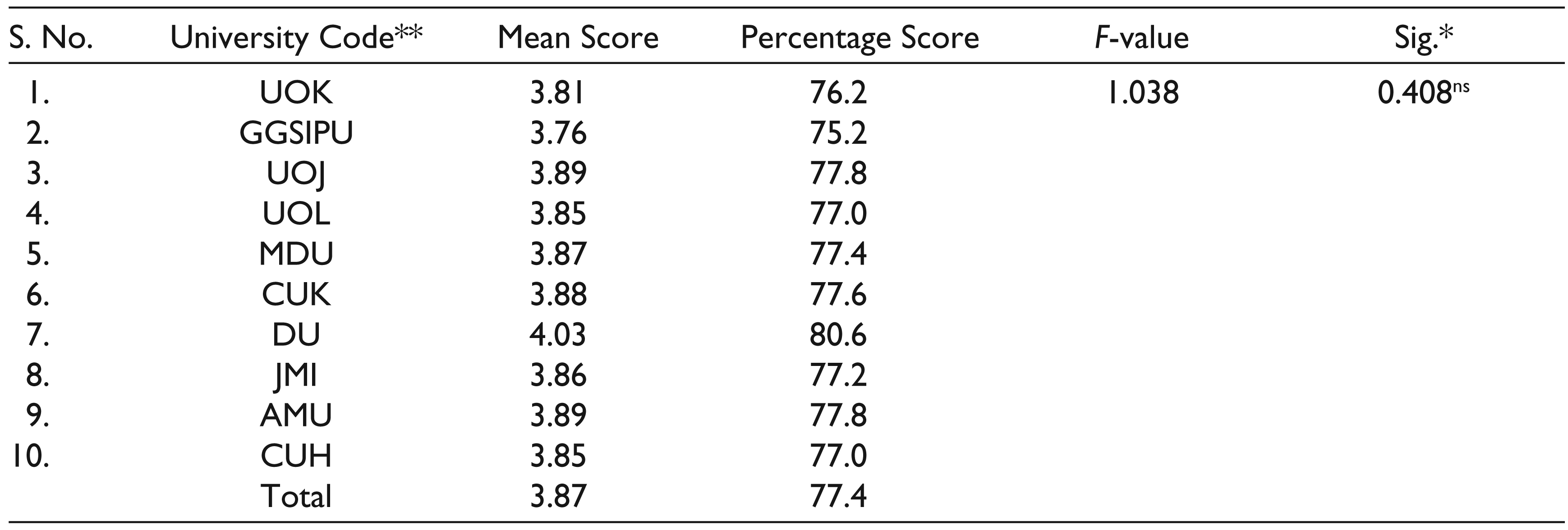
The results revealed that the perception of the respondent faculty members towards their HOD’s from different Universities is more or less the same (F-value =1.038; sig. = 0.408) as confirmed by Anova test.
Impact of Emotional Intelligence on Transformational Leadership
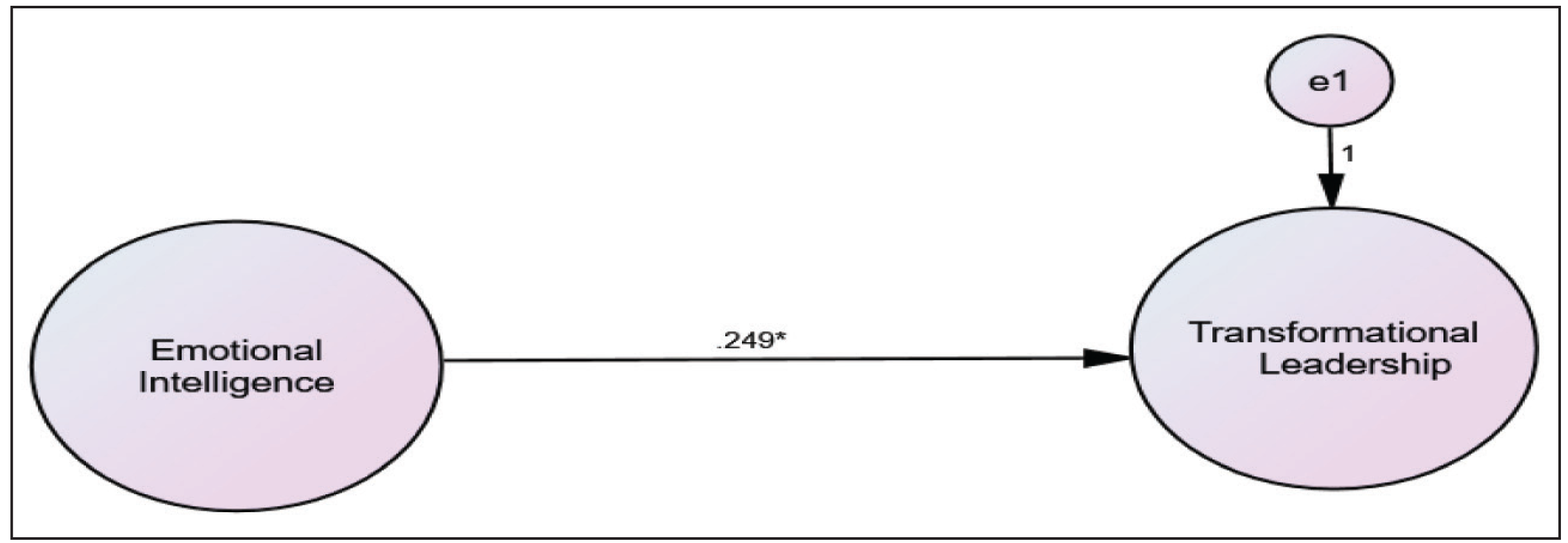
The results indicate that the transformational leadership is significantly predicted by the emotional intelligence (β = 0.249; p <0.05) (Figure 4). The model fit indices of the model are within the acceptable range (CMIN/DF= 1.236; GFI = 0.917; AGFI = 0.903; CFI = 0.915; RMR = 0.047; RMSEA = 0.038).
Further, the dimensions of the emotional intelligence (managing relations, self-motivation, commitment and altruism, self-awareness, empathy, emotional stability, value orientation and integrity) also have a significant positive influence on transformational leadership. The model fit indices of the model are within the acceptable range (CMIN/DF= 1.347; GFI = 0.953; AGFI = 0.937; CFI = 0.925; RMR = 0.037; RMSEA = 0.058).
Of the seven dimensions in the emotional intelligence, value orientation and integrity (β = 0.279; p <.0001) is the most influential predictor of transformational leadership followed by managing relations (β = 0.216; p <.001), emotional stability (β = 0.194; p <.001), self- motivation (β = 0.192; p <.001), empathy (β = 0.186; p <.001), commitment and altruism (β = 0.178; p <.005), and self-awareness (β = 0.143; p <.005) (see Table 8 and Figure 5).
Impact of Emotional Intelligence on Transformational Leadership
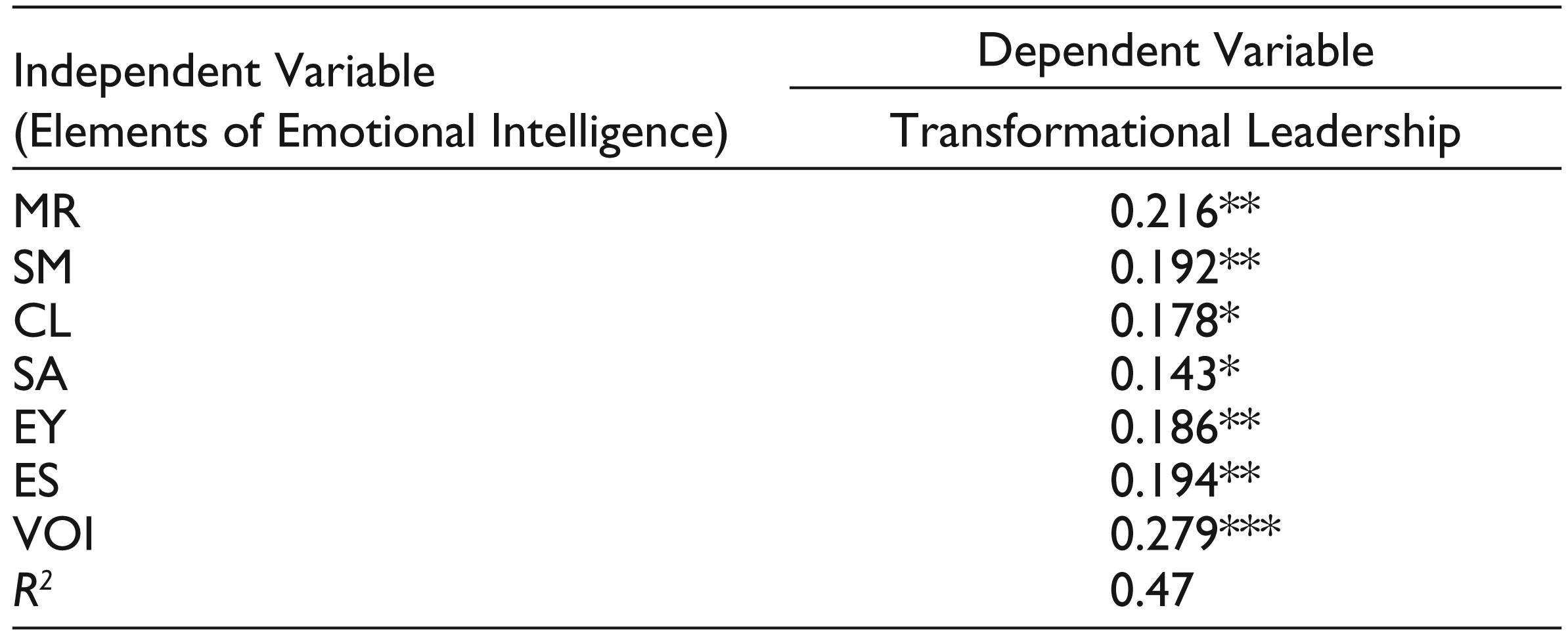
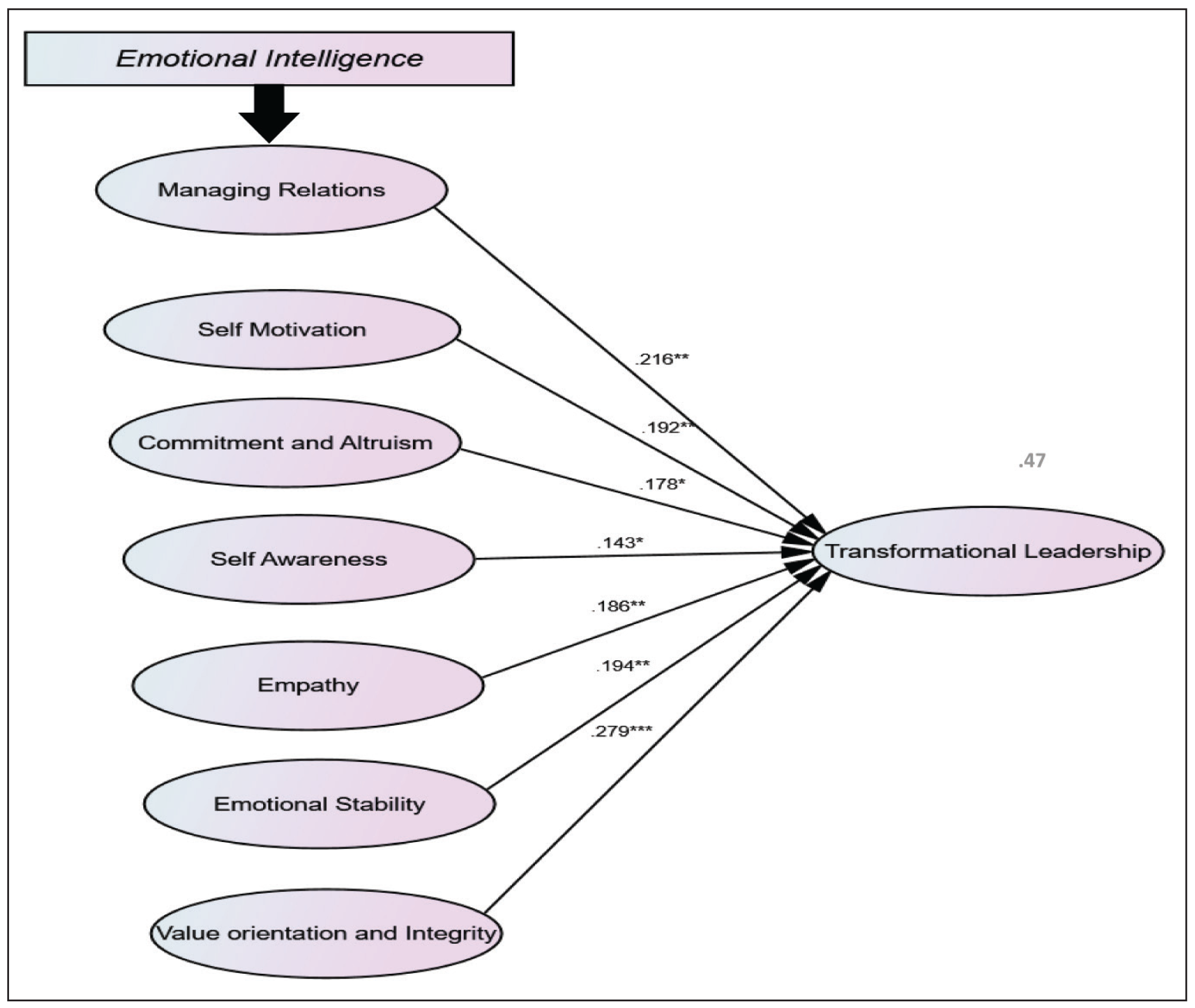
It is also clearly evident from Table 4 that the seven components in emotional intelligence (managing relations, self-motivation, commitment and altruism, self-awareness, empathy, emotional stability, value orientation and integrity) collectively explain 47 per cent of the variance in transformational leadership (R2 = 0.47).
Thus, it is proved emotional intelligence positively and significantly influences transformational leadership behaviour among the academic leaders. Hence, hypothesis H1 is strongly supported by the statistical evidence and hence accepted.
Perceptual Gap
The differences in the perception of respondents related to the variables that have been examined in this study are considered quite relevant irrespective of their statistical significance. Thus, the following section inspects the differences in perceptions of respondents about the variables under study.
Emotional Intelligence and Gender
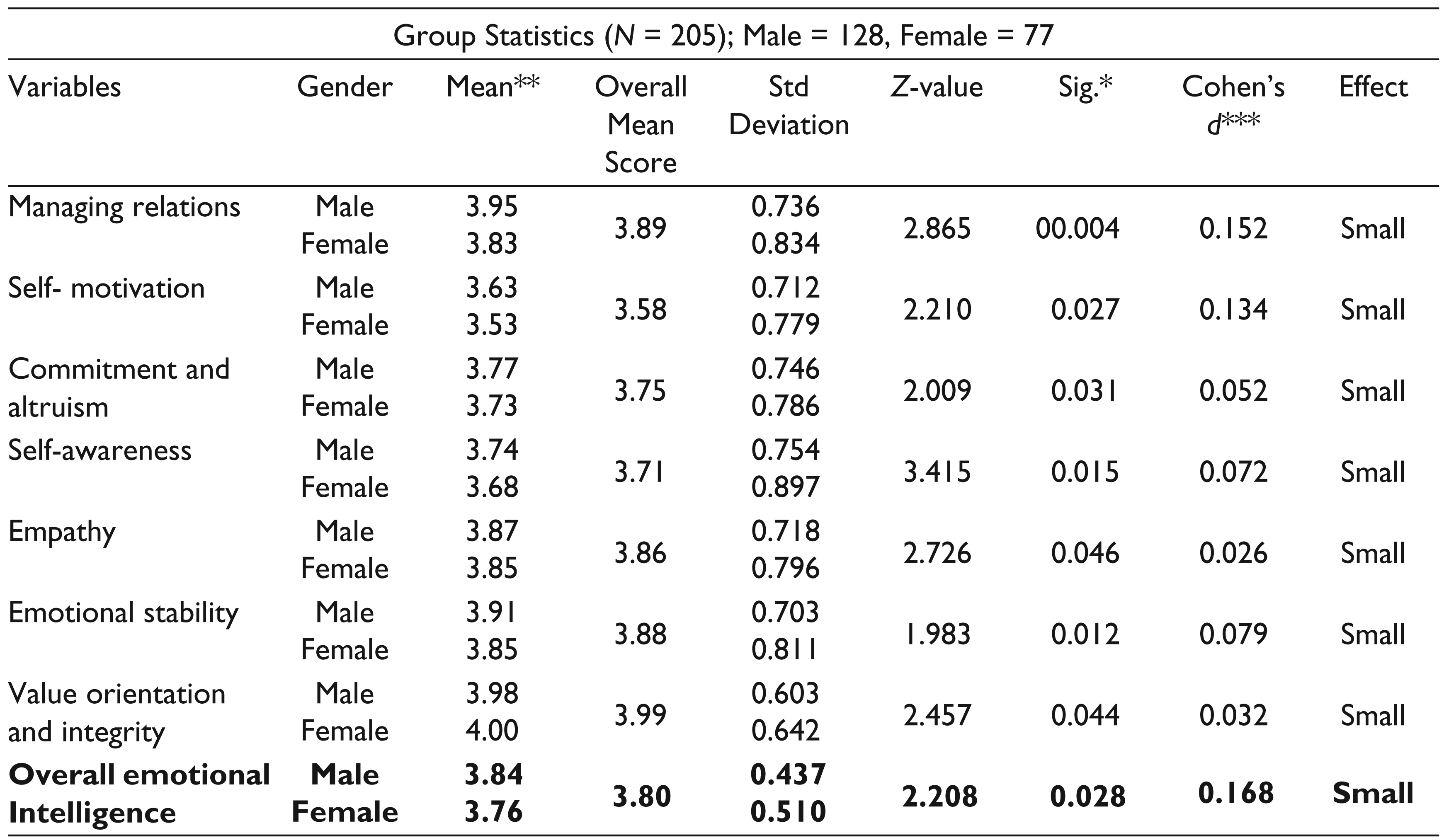
Table 9 shows a comparison of male and female group of respondents. Z-test was used because it compares emotional intelligence dimensions and emotional intelligence variable as a whole between the male and female respondents. It becomes clear from the table that the overall mean scores of male respondents were high as compared to female respondents in almost all the dimensions of emotional intelligence except in value orientation and integrity (VOI). In the overall emotional intelligence variable, mean scores of male respondents was also high as compared to female respondents. The highest mean score was observed for VOI from the male respondents (3.98, 0.603) and lowest for self-motivation (SM) (3.63, 0.712). However, females were also found high on VOI (4.00, 0.642) and low on SM (3.53, 0.779). Overall, the mean score observed from emotional intelligence as a whole from the male respondents is 3.84 and from female respondents is 3.76.
Emotional Intelligence and Gender
***Cohen’s
Further, Z-test was utilized to ascertain whether the difference in the mean scores of the respondent male and the female faculty members of the sample universities with respect to their perception about emotional intelligence of their HOD’s and its dimensions is statistically significant or merely an outcome of a random variation. The results indicate that the perceptual differences of faculty members are statistically significant when the differences are evaluated on the basis of gender as the p-value is less than .05 in every dimension of emotional intelligence and also as a whole indicating that the male employees are more satisfied with their HOD’s emotional intelligence as compared to the female employees of the sample universities (Table 9). Also, effect size was calculated by Cohen’s d (1992) and it was found that there is small effect across all dimensions of emotional intelligence with gender.
Transformational Leadership and Gender
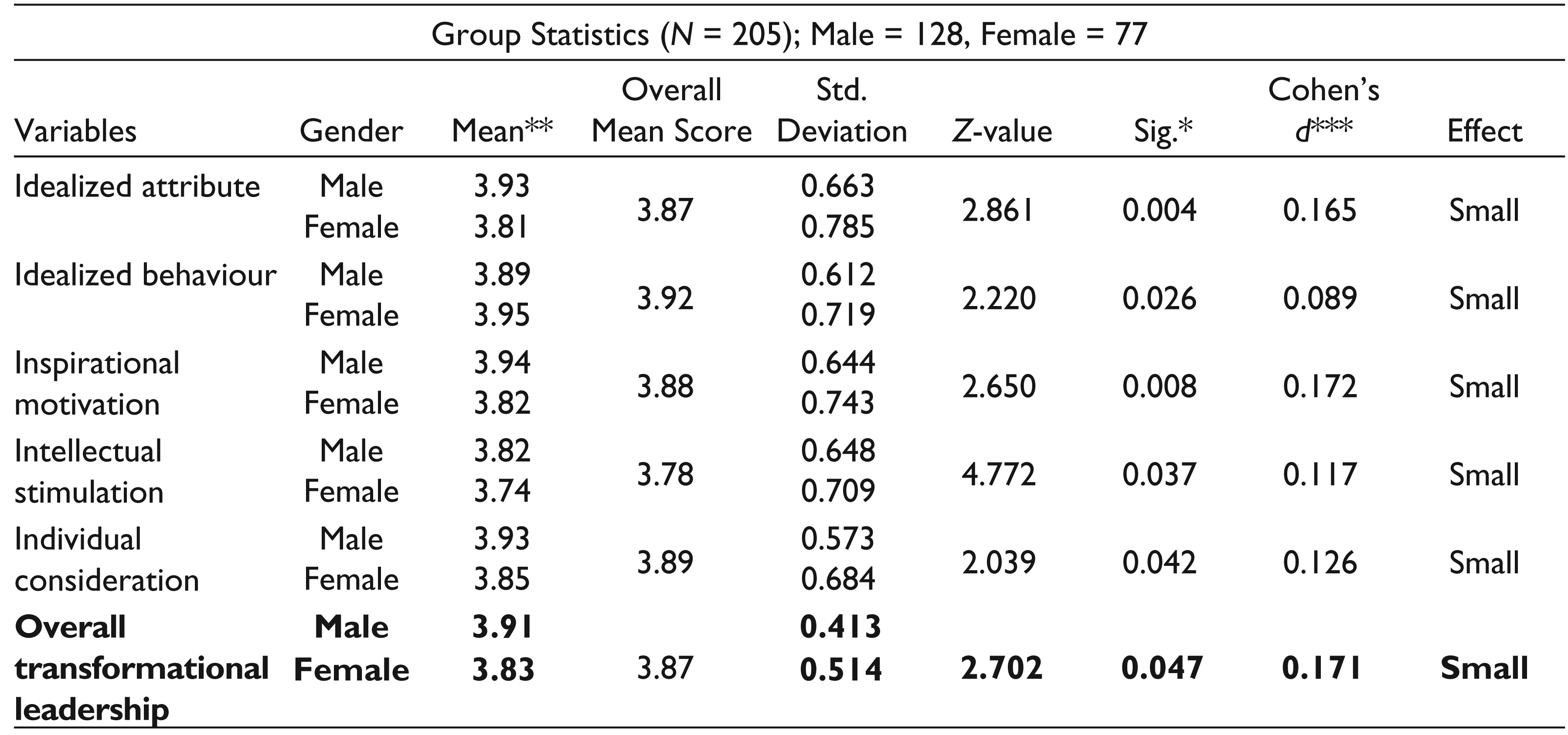
Table 10 shows a comparison of male and female group of respondents. Z-test was used because it compares transformational leadership dimensions and transformational leadership variable as a whole between the male and female respondents. It becomes clear from the table that the overall mean scores of male respondents were high as compared to female respondents in almost all the dimensions of transformational leadership except in idealized behaviour (IB). In the overall transformational leadership variable, mean scores of male respondents were high as compared to female respondents. The highest mean score was observed for inspirational motivation (IM) from the male respondents (3.94, 0.644) and lowest for intellectual stimulation (IS) (3.82, 0.648). However, females were found high on IB (3.95, 0.719) and low on IS (3.74, 0.709). Overall, the mean score observed from transformational leadership as a whole from the male respondents is 3.91 and from female respondents is 3.83.
The results of Z-test indicate that the perceptual differences of faculty members are statistically significant when the differences are evaluated on the basis of gender as the p-value is less than .05 in every dimension of transformational leadership and also as a whole, the perceptual differences of faculty members are statistically significant indicating that the male employees are more satisfied with their HOD’s transformational leadership as compared to the female employees of the sample universities (Table 10). Here also, effect size was calculated by Cohen’s d (1992) and it was found that there is small effect across all dimensions of transformational leadership with gender.
Emotional Intelligence and Age
Table 11 shows a comparison between the mean scores of respondents across different age groups. For managing relations (MR), the highest mean score was for age group 25–35 years (3.96) and lowest for age group 35–45 years (3.77), for self-motivation (SM) highest was for age group 25–35 years (3.70) and lowest for age group 35–45 years (3.46), for commitment and altruism (CA) highest was for age group 25–35 years (3.84) and lowest was for age group 35–45 years (3.65). Similarly, for self-awareness (SA), the highest mean score was for age group 25–35 years (3.81) and lowest was for age group 35–45 years (3.61), for empathy (EY) highest was for age group 25–35 years (3.93) and lowest was for age group 35–45 years (3.78), for emotional stability (ES) highest was for age group 45 and above (3.95) and lowest was for age group 35–45 years (3.77) and for value orientation and integrity (VOI) highest was for 35–45 years (4.02) and lowest was for age group 25–35 years (3.96). The overall highest mean score for variable emotional intelligence was in the age group 25–35 years (3.87) and lowest was for age group 35–45 years (3.72).
Transformational Leadership and Gender
***Cohen’s
Emotional Intelligence and Age
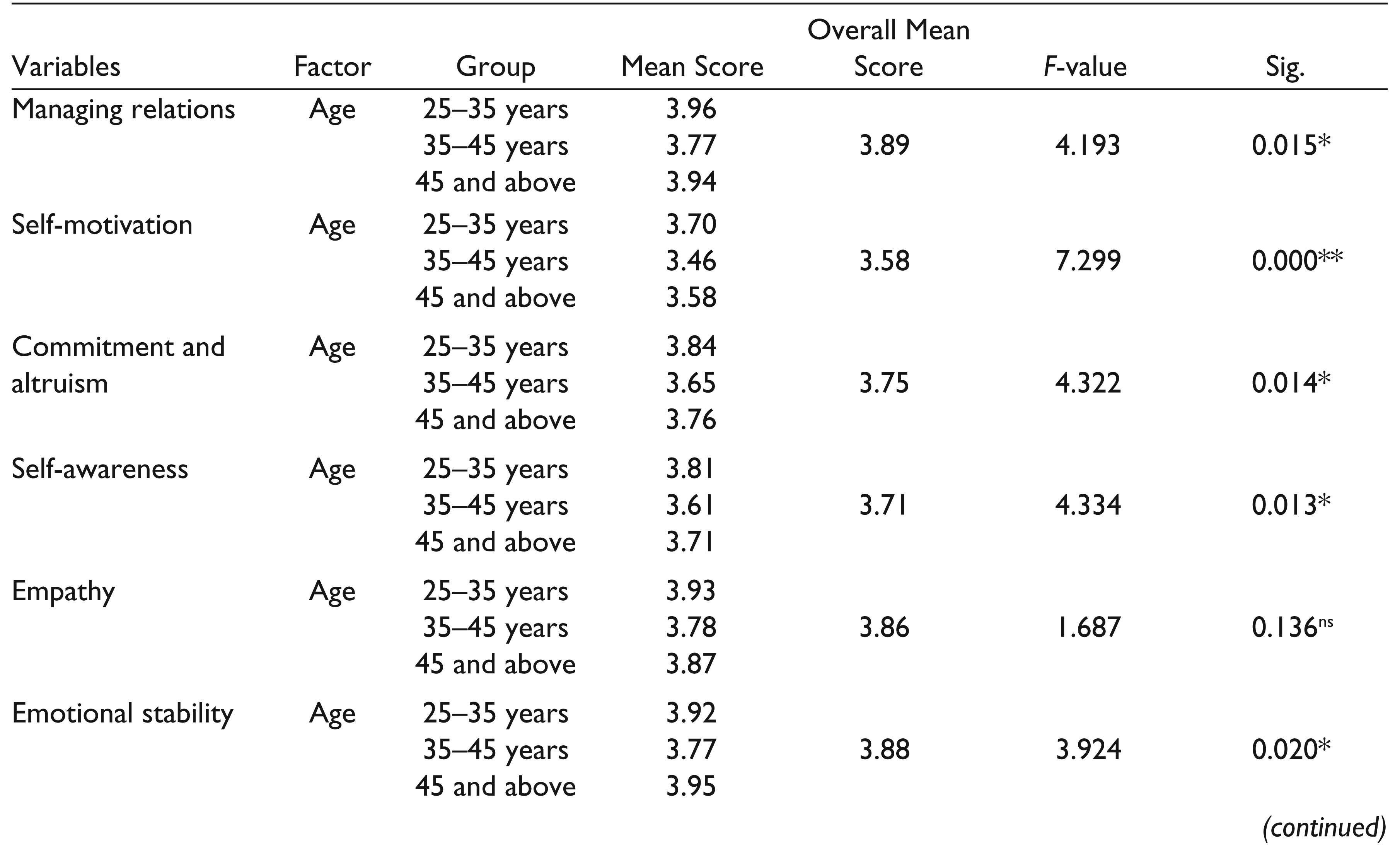
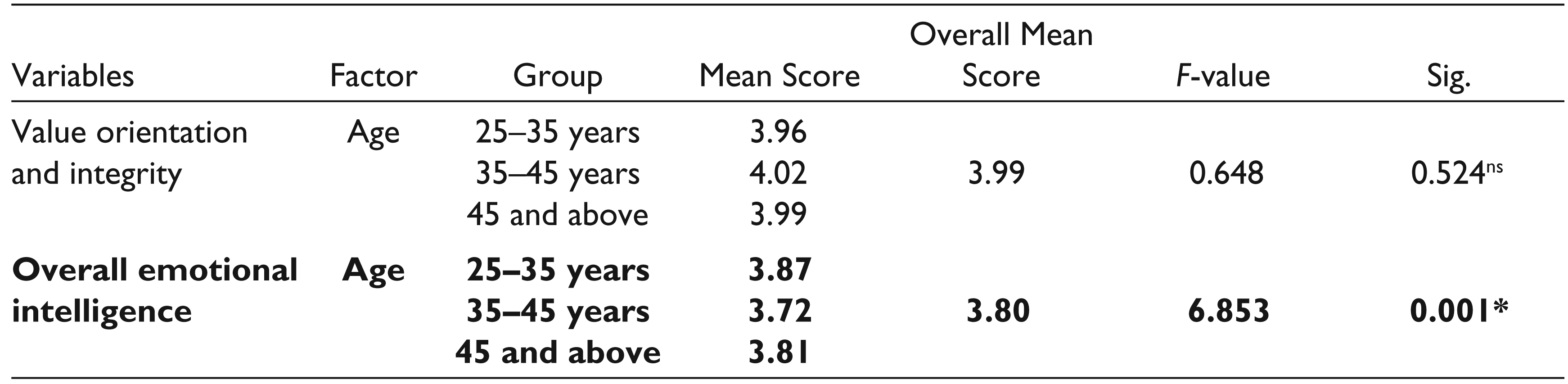
In order to analyse the perception of faculty members towards the various emotional intelligence dimensions and emotional intelligence variable as a whole across different age groups, one-way ANOVA was used, and F-value was computed. The calculated results revealed that there is significant difference in the perception of faculty members across different age groups towards the understudy dimensions of emotional intelligence as their calculated p-values are less than 0.05 other than empathy (EY) and value orientation and integrity (VOI) whose p-values are greater than.05. The results also revealed that there is significant difference in the perception of faculty members across different age groups towards the variable emotional intelligence as a whole as its calculated p-value is less than.05.
Transformational Leadership and Age
Table 12 shows a comparison between the mean scores of respondents across different age groups. For idealized attribute (IA), the highest mean score was for age group 25–35 years (3.97) and lowest for age group 35–45 years (3.78), for idealized behaviour (IB) highest was for age group 25–35 years (3.97) and lowest for age group 35–45 years (3.88), for inspirational motivation (IM) highest was for age group 25–35 years (3.99) and lowest was for age group 35–45 years (3.76). Similarly, for intellectual stimulation (IS), the highest mean score was for age group 25–35 years (3.84) and lowest was for age group 35–45 years (3.74), for individual consideration (IC) highest was for age group 25–35 years (4.00) and lowest was for age group 35–45 years (3.82). The overall highest mean score for variable transformational leadership was in the age group 25–35 years (3.95) and lowest was for age group 35–45 years (3.81).
In order to analyse the perception of faculty members towards the transformational leadership dimensions and transformational leadership variable as a whole across different age groups one-way ANOVA was used and F-value was computed. The calculated results revealed that there is significant difference in the perception of faculty members across different age groups towards the understudy dimensions of transformational leadership as their calculated p-values are less than .05 except idealized behaviour and intellectual stimulation whose p-values are greater than .05.
Transformational Leadership and Age
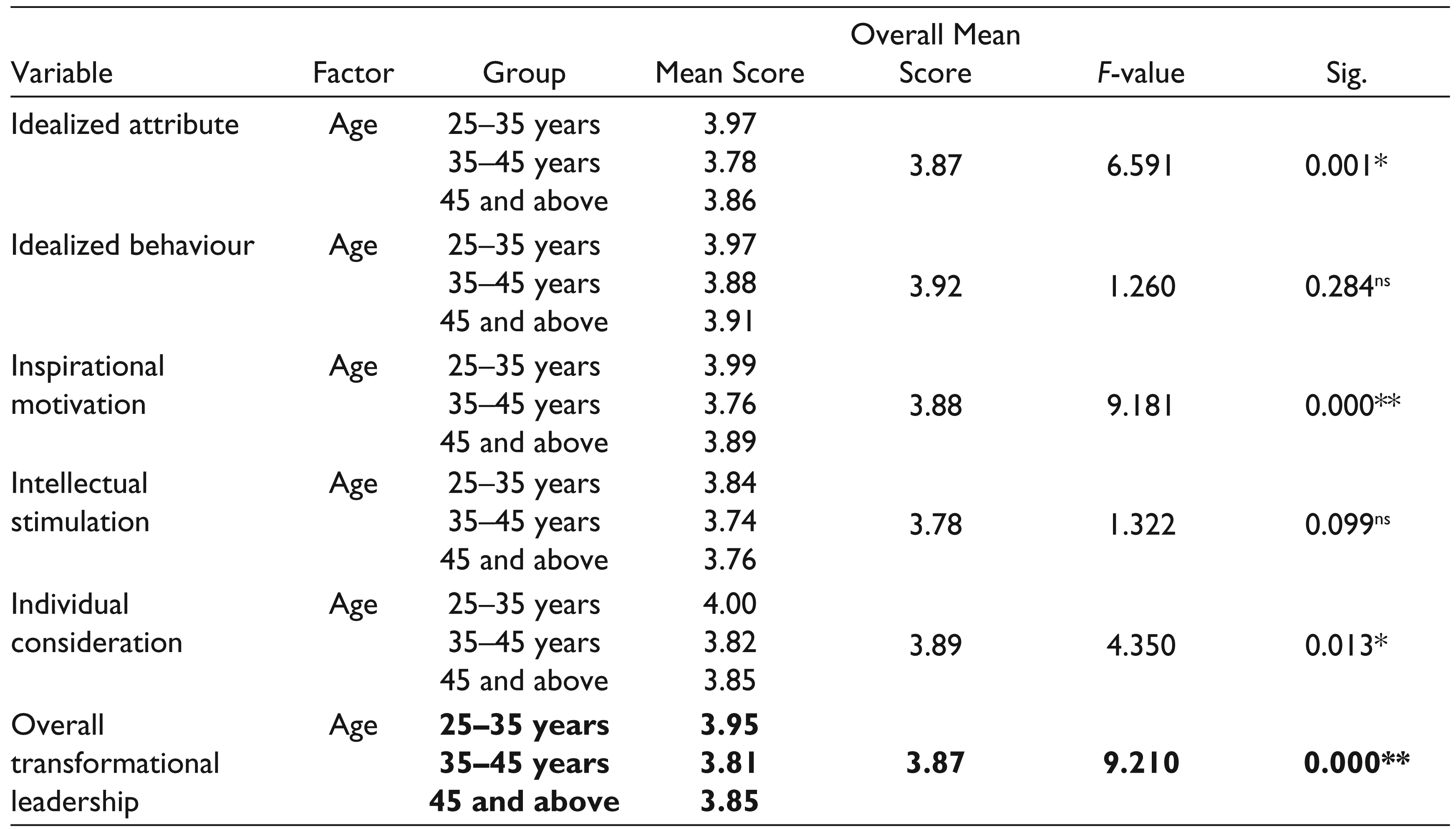
The results also revealed that there is significant difference in the perception of faculty members across different age groups towards the variable transformational leadership as a whole as its calculated p-value is less than .05.
Conclusion
One of the effective factors for productivity, efficiency, job satisfaction and other desired work-related attitudes of faculty members in universities is leadership style of their academic leaders. The results of recent researches indicate that emotional intelligence is an important variable in charismatic and transformational leadership styles. The results indicated that there is a significant and direct relationship between transformational leadership style of HOD’s and emotional intelligence of HOD’s as perceived by the faculty members. This is supported by many studies (Barling et al., 2000; Martell & DeSmet, 2001; Palmer et al., 2001; Sivanathan, 2002; Wang & Huang, 2009).
Universities should encourage effective leading styles to trigger desired motivation. The role of leadership in universities is largely determined by the institutional culture. Universities that adopt a greater number of prescribed practices are likely to empower teamwork, enhance employee satisfaction and enjoy superior performance. However, it has been pointed out that the implementation of these practices is not always an easy task. It has been argued that academic leaders’ beliefs, values and interpersonal competences are of critical importance to the overall style of leadership that they adopt. Academic leaders who possess emotional intelligence are sure to adopt transformational leadership. This study was an attempt to investigate the relationship between managing relations, self-motivation, commitment and altruism, self- awareness, empathy, emotional stability and value orientation and integrity components of emotional intelligence and transformational leadership in institutions of higher learning in India giving emphasis on the academic leader–faculty member subordinate interaction on team basis. In particular, this study investigates faculty members perception regarding their academic leaders’ emotional intelligence as well as transformational leadership. The study contributed to our understanding of the linkage among emotional intelligence and transformational leadership. Overall, the results provided support for the model, which suggests that academic leaders emotional intelligence (EI) competencies such as managing relations, self-motivation, commitment and altruism, self-awareness, empathy, emotional stability and ‘value orientation and integrity’ are positively associated with transformational leadership thereby increasing team effectiveness among faculty members. Transformational leaders create an atmosphere of change, and they may be obsessed by visionary ideas that excite, stimulate and drive other people to work hard. They have the capacity to motivate team members to do more than normally expected. In addition, transformational leaders have an emotional impact on subordinates. The findings of the study revealed that academic leaders of institutions of higher learning try to lead effectively using different competencies of emotional intelligence. In particular, they handle conflict with tact and diplomacy, manage negative feelings and create team consensus in their faculty members.
The faculty members of selected sample universities perceive the emotional intelligence of their academic leaders to exist at an above average level. This is due to the reason that the leaders from selected sample universities are able to manage interactions successfully with their faculty members, are able to ensure clear communication, and are able to effectively solve conflicts within an institution. The faculty members also perceive this because their academic leaders are aware about their emotions and are able to distinguish between what is right and what is wrong. They are always there to help their subordinates in any sort of situation and always remain empathetic towards them. The leaders in selected sample universities lay great emphasis on relationship building with their subordinates. Further, the faculty members of all the universities under study perceive that their academic leaders focus more on value orientation and integrity. This is very important particularly in the institutions of higher learning. If a leader cannot distinguish between what is right and what is wrong, the faculty members working under his/her leadership will not give their best at work. The academic leaders are also honest whether in taking decisions or some other issues related to the department. The faculty members of sample universities also perceive the transformational leadership of their academic leaders at an above average level indicating that the faculty members are satisfied with the way their leaders are leading them. The leaders are providing every chance to the faculty members by giving interesting work assignments and do not take any decision that is ethically wrong. The leaders continuously motivate their faculty members and have also created a team atmosphere with a shared vision for the future of their departments. It is also because due attention is paid to every staff member by the academic leader if in need of something whether it is support in the form of providing assistance in attending seminars/conferences, or allowing them for attending refresher courses, conferences, workshops, lectures, etc. The faculty members of the universities under study perceive that their academic leaders focus more on always sharing risks and handling issues related to conduct, ethics, standards and values of the department.
This study contributes to our understanding of the linkage among emotional intelligence and transformational leadership in higher education sector of India. Higher educational institutions are the backbone of any society. It is this sector that provides skilled, qualified and competent human resource. Unfortunately, no Indian University is figuring in the list of top 100 Universities of the World. In this study an effort has been made to provide an insight into how the quality of Indian Universities can be improved with the help of emotional intelligence and transformational leadership.
The overall mean scores of male respondents were higher, compared to female respondents in almost all the dimensions of emotional intelligence excepting with value orientation a integrity. It was found that the mean scores of male respondents were higher as compared to female respondents vis-à-vis the overall emotional intelligence variable as a whole, indicating that the male faculty members are more satisfied with their academic leader’s emotional intelligence as compared to the female faculty members. The results indicated that the perceptual differences between the male and female respondent faculty members are statistically significant as the p-value is less than .05. The result of the Z-test revealed that gender influences on how the faculty members perceive the emotional intelligence of their academic leaders. Further, the overall highest mean score for variable emotional intelligence was in the age group 25–35 years and lowest was for age group 35–45 years. The results indicated that the perceptual differences between the different respondent age groups about emotional intelligence of their academic leaders are statistically significant as the p-value is less than .05, indicating that age influences on how the faculty members perceive the emotional intelligence of their academic leaders.
The overall mean scores of male respondents were higher, compared to female respondents in the overall transformational leadership variable as a whole, indicating that the male faculty members are more satisfied with their academic leaders’ transformational leadership as compared to that of the female faculty members of the sample universities. The results indicated that the perceptual differences between the male and female respondent faculty members are statistically significant as the p-value is less than .05. The result of Z-test showed that gender influences on the way faculty members perceive transformational leadership of their academic leaders. Further, the overall highest mean score for variable transformational leadership was in the age group 25–35 years and lowest was for age group 35–45 years. The results indicated that the perceptual differences between the different respondent age groups about transformational leadership of their academic leaders are statistically significant as the p-value is less than .05, indicating age influences on how the faculty members perceive the transformational leadership of their academic leaders.
Implications
Though there has been much research demonstrating the effectiveness of transformational leadership behaviour in organizations (Judge & Piccolo, 2004; Northouse, 2012), there has been a dearth in research investigating the antecedents of these behaviours (Harms & Credé, 2010). Very few studies have been conducted where the subordinates perception about the emotional intelligence and transformational leadership of leaders is measured. Most of the studies that have been conducted on emotional intelligence and transformational leadership are based on leaders’ own perception about themselves thus resulting in bias, and further several studies on emotional intelligence and transformational leadership in India have been conducted on sectors other than higher education sector. The results obtained from the present study have certain significant implications. It contributes to the body of existing literature as these variables (emotional intelligence and transformational leadership) have never been related particularly in Indian higher education setting. Further, if the higher learning institutions want to excel, attention must be given to developing programmes for the leaders emotional intelligence competency and transformational leadership. In fact, monitoring emotional intelligence among academic leaders triggers transformational leadership and consequent quality decision-making. This study shows that emotional intelligence could predict transformational leadership. More importantly, developing leader’s emotional intelligence competency is paramount in order to increase their transformational leadership behaviour and effective decision-making. Besides, academic leaders who are involved in social interaction need emotional intelligence competency to work effectively in a social setting. Therefore, developing the emotional intelligence competencies might help the academic leader to improve work performance, such as, maintaining high academic standards in the department/university, quality teaching, and research. Within dynamic market environment leaders who have been able to identify their own emotional intelligence and the emotional intelligence of others will be better placed to lead and take effective decisions.
Limitations and Directions for Future Research
In the present study, the universities of north India were included to investigate the influence between the variables under study, including greater number of institutes from other regions as well in the future research could reveal more generalizable results. The study focused on higher education sector only. The scope of the research could be widened by including more levels like primary, middle and undergraduate levels in the future research. Perception of faculty members towards their HOD’s was the focus of the present study. In the future studies, non-academic staff should also be included in order to generalize the results.
Footnotes
Declaration of Conflicting Interests
The authors declared no potential conflicts of interest with respect to the research, authorship, and/or publication of this article.
Funding
The authors received no financial support for the research, authorship, and/or publication of this article.
Acknowledgements
The authors are grateful to the anonymous referees of the journal for their extremely useful suggestions to improve the quality of the article. Usual disclaimers apply.