







Abstract
It is generally believed that when compared to men, women have slower career advancement prospects. Usually, women in the workforce face several obstacles, commonly referred to as glass ceiling (GC), that weaken their career advancement prospects. The present study aims to develop a scale to measure the GC obstacles faced by women employed in the banking sector. The scale was developed and validated through a three-step process: item development, scale development and scale evaluation. The items were generated through literature review and focus group discussions (FGDs). The items developed were fine-tuned in consultation with academic experts. The scale was developed and validated, through a study, covering 411 women employees working in different banks in the state of Kerala. Exploratory factor analysis (EFA) brought out seven dimensions of GC, namely family responsibilities (FR), discriminatory promotion practices (DPP), employee relations (ER), personality traits (PT), lack of organizational support (LOS), gender stereotypes (GS) and lack of training (LT). The scale was evaluated using reliability and validity measures, and it demonstrated adequate reliability, discriminant and convergent validity. The confirmatory factor analysis (CFA) was carried out using AMOS. Towards the end of the article, there is also a discussion on managerial implications, limitations of the study and directions for future research.
Introduction
In India, women constitute about half (48.1%) of the total population (Catalyst, 2020). The gender gap in the higher education sector has also narrowed in the country (Pratim, 2019). The share of women undergraduates and women with M Phil degrees exceed 50%, (53.0 and 69.6%, respectively), postgraduates account for 45.91% and PhD holders account for 41.8% (Catalyst, 2020). Despite all these developments, the female workforce participation in India is less when compared to that of the male workforce. As of 2020, women aged 15 and above constitute only about 20.3% of the labour force in comparison to that of men, which is 76% (World Bank Group, 2020). Subsequently, India is ranked at 108th position (out of 144 countries) as per the global gender gap report, 2017, which is one of the lowest among Group of Twenty (G20) group of countries (World Economic Forum, 2018).
Lack of safe and secure work environment, restrictive cultural norms, lack of flexible work schedule (Centre for Social Research, 2009; Mehta, 2020; Ratho, 2020) and gender wage disparity (World Economic Forum, 2020), among others, were the causes identified for the lesser proportion of women in the labour force. Studies conducted after the outbreak of COVID-19 reveal that the novel pandemic situation along with increased unemployment rates kept women at a disadvantageous position in the labour market (Catalyst, 2020; ILO, 2020; Kamdar, 2020). The share of women at the senior managerial level is also less when compared to that of men. A recent study conducted in India suggests that the workforce participation rate is higher for rural women when compared to that of urban women (Mehta, 2020). Men assume the role of the breadwinner of the family, and women are expected to consider family over career (Verma, 2018). A notable point is that only a less number of women are seeking jobs, which means that the majority of qualified women are not searching for any (Mehta, 2020).
A study conducted in India by the International Labour Organization (ILO) on managers with children under the age of 6 revealed that women account for 10.2% and men for 89.8% of the total managerial share (ILO, 2019). Similarly, according to the reports published by the Reserve Bank of India, in 2018, females constitute 27.3% of the total employee share of the nationalized banks, 22.2% in private sector banks and 31.8% in foreign banks. With respect to the category of employees, women constitute 24.7% of officers, 27.7% of clerks and 17.3% of subordinates (Reseve Bank of India, 2018). Women comprise about one-fourth (24.6%) of the employee share in India. This is too low when compared to that of the developed nations. Women represent over 50% of the workforce in the financial service industry in many countries such as Australia, Finland, France, Germany, Japan, Norway, Spain and the USA (Catalyst, 2019). The search for reasons that contribute to the low presence of women in the labour force as well as their low career advancement prospects often lands up in glass ceiling (GC).
The Indian banking sector has undergone drastic changes during the past few decades. The opening up of the economy in the 1990s paved the way to the commencement of various private and foreign banks, which led to a rapid expansion of branches all over the country. The work environment has also changed as a result of an increase in the portfolio of banking products. Banking services have moved from interactive to digital. Consequently, the nature of banking jobs involves tremendous work pressure. Nevertheless, it must be mentioned that the Indian banking sector has witnessed the entry of more women employees into their fold now than ever before. Therefore, it becomes pertinent to research the GC barriers faced by women in the banking sector, especially since there is a lack of empirical work in this regard.
This research article is divided into seven sections. The first section has already highlighted the introductory part. The second focuses on literature review; the third constitutes the objectives of the study; the fourth states the methodology of the study; and the fifth presents the analyses along with their results. Conclusion and managerial implications are underscored in the sixth section. Finally, limitations and future research directions are discussed in the last section.
Literature Review
A literature search was conducted to explore the previous studies published in the area of GC during the past few years. The relevant literature was generated from databases, including SAGE Online Journals, Taylor and Francis Online, JSTOR, Elsevier, EBSCO, Wiley Online Journals and Inderscience. The keywords searched include ‘glass ceiling’, ‘barriers to women employees’, ‘glass ceiling in financial service sector’ and ‘women’s career in India’. The search identified 108 articles and four theses in the relevant area, as well as recent reports published by various national and international organizations. At first, GC was identified from the literature, and then the antecedents of GC barriers have been summarized.
Women in the workforce face several barriers, which prevent them from pursuing a particular profession and reaching a senior position in an organization. This phenomenon is commonly referred to as ‘glass ceiling’. GC barriers can be covert and overt (Agars, 2004; Dimovski et al., 2010; Insch et al., 2008; Lyness & Judiesch, 2008; Oakley, 2000; Ottu & Inwang, 2013). GC inequality can be clearly differentiated from other kinds of inequality since it forbids women and ethnic minorities from reaching higher positions (Cotter et al., 2001). GC acts as a key barrier that prevents the career advancement of women (Afza & Newaz, 2008; Bombuwela & Chamaru, 2013; Chugh & Sahgal, 2007; Keenawinna & Sajeevanie, 2015; Verma, 2018). GC researchers have attempted to explore the different barriers associated with GC, which are summarized in the following paragraphs.
The policies and practices followed by an organization can either act as a barrier to or a facilitator of career advancement of women (Knutson & Schmidgall, 1999; Lyness & Thompson, 1997; Priyadarshini & Azeez, 2018). Notable discriminatory practices adopted by the organization that can create GC include the absence of gender equality policies (Wesarat & Mathew, 2017) with respect to recruitment and selection processes (Al-Manasra, 2013; Kolade & Kehinde, 2013), remuneration (Britt, 2002; Sampson & Moore, 2008; Schruijer, 2006; Sharma & Kaur, 2014), performance appraisal (Igbaria & Baroudi, 1995; Sharma, 2016; Sharma & Kaur, 2014, 2019; Wesarat & Mathew, 2017) and training and development opportunities (Adamson, 2012; Al-Manasra, 2013; Daley, 1996; Ismail & Nakkache, 2015; McCarthy, 2001; Metz, 2003; Oakley, 2000; Posholi, 2013; Sandhu & Ritu, 2007; Sharma & Kaur, 2019; Wesarat & Mathew, 2017).
Promotion practices followed by the organization can create GC (Akpinar-Sposito, 2013a; Britt, 2002; Oakley, 2000; Parker et al., 1998). In certain cases, the work carried out by men and women are evaluated differently. The promotion policies followed by the organization can be unfair (Bombuwela & Chamaru, 2013), biased (Afza & Newaz, 2008; Bergman & Hallberg, 2002; Mathur-Helm, 2006; Sharma & Kaur, 2019; Wesarat & Mathew, 2017) and subjective (Liff & Ward, 2001). In some organizations, accepting an international assignment is a vital criterion for promotion. Women managers are very often denied such international assignments (Aeran, 2014; Britt, 2002; Datta & Agarwal, 2017; Insch et al., 2008; Lyness & Judiesch, 2008; Lyness & Thompson, 1997; McCarthy, 2001; Ng & Sears, 2017; Princess et al., 2015; Rath et al., 2016).
The organizational culture in which an employee works can act as a barrier to women employees (Knutson & Schmidgall, 1999; Lemons & Parzinger, 2001; Payne, 2005; Princess et al., 2015; Priyadarshini & Azeez, 2018; Sharma, 2016; Sharma & Kaur, 2019; Vianen & Fischer, 2002; Wesarat & Mathew, 2017). Barriers related to organizational culture includes inhospitable organizational culture (Mathur-Helm, 2006; Townsend, 1997), lack of a support system at work (Bergman & Hallberg, 2002; Dimovski et al., 2010; Posholi, 2013; Sampson & Moore, 2008; Sandhu & Ritu, 2007; Subramaniam et al., 2016), long hours of work culture (Ogden et al., 2006), fewer career developmental opportunities at the workplace (Bergman & Hallberg, 2002; Dimovski et al., 2010; Jain & Mukherji, 2010; Lyness & Thompson, 1997; Sharma & Kaur, 2019), lack of organizational support for work–life balance (Al-Manasra, 2013; Bergman & Hallberg, 2002; Sandhu & Ritu, 2007) and organizational injustice (Alshammari, 2016). Lack of senior management commitment to career advancement of women along with complex organizational structure is an important barrier that creates GC (Njiru, 2013).
The interpersonal relationship that an employee develops at the workplace can act as an aid for getting promotion. In most cases, men have dominance in building these relationships, and women employees are sidelined. The relationship with colleagues can act as a GC barrier (Subramaniam et al., 2016). The major issues in this area include relationship with superiors (Lathabhavan & Balasubramanian, 2017; McKeen & Burke, 1991; Rath et al., 2016), relationship with co-workers (Subramaniam et al., 2016), relationship with subordinates (Kilian et al., 2005), male colleagues’ perception of women as inferior and subordinate (Rath et al., 2016), conflicting relationships at the workplace (Mathur-Helm, 2006) and lack of respect between workers (Subramaniam et al., 2016).
Another common barrier related to GC faced by women is sexual harassment (Afza & Newaz, 2008; Bergman & Hallberg, 2002; McKeen & Burke, 1991). Women lack safety and security in the workplace (Alessandri et al., 2018; Bergman & Hallberg, 2002; Dimovski et al., 2010; Lathabhavan & Balasubramanian, 2017; Subramaniam et al., 2016). Many a time, the number of women employees is less when compared to that of men in the workplace. Consequently, when women employees face any work-related difficulties, they may not have anybody to seek help (Al-Manasra, 2013; Bergman & Hallberg, 2002; Dimovski et al., 2010). Another barrier is that women simply cannot be themselves at work (Bergman & Hallberg, 2002).
Women employees face gender discrimination in the workplace (Adamson, 2012; Al-Manasra, 2013; Bergman & Hallberg, 2002; Jamali et al., 2007; Misra & Sirohi, 2019; Njiru, 2013; Rath et al., 2016; Sachdeva, 2014; Sharma & Kaur, 2014; Straub, 2007). Differential treatment of women at the workplace leads to GC (Elacqua et al., 2009). Another barrier is the paucity of qualified women in the pipeline to be considered for promotion (Elacqua et al., 2009; Gupta et al., 1998; Townsend, 1997). Women employees need to prove their competence all the time when compared to men (Bass & Avolio, 1994; Choi & Park, 2014; Mathur-Helm, 2006). In some cases, women are judged more leniently by their subordinates (Bass & Avolio, 1994), but on the other hand, women have to perform more than men to get promoted (Al-Manasra, 2013; Jamali et al., 2006; Kolade & Kehinde, 2013; Misra & Sirohi, 2019).
Stereotypical or a negative perception about the abilities and capabilities of women acts as a common and most researched GC barrier (Agars, 2004; Bass & Avolio, 1994; Bombuwela & Chamaru, 2013; Choi & Park, 2014; Gupta et al., 1998; Heilman, 2012; Jackson, 2001; Jain & Mukherji, 2010; Kilian et al., 2005; Knutson & Schmidgall, 1999; Payne, 2005; Saadin et al., 2016; Townsend, 1997). Commonly identified stereotypical barriers in GC literature include the following beliefs: managerial positions are more suited for men than women (Bass & Avolio, 1994), women leave their job to have babies (Liff & Ward, 2001), they are less committed to their work (Bharadwaj & Nagarkoti, 2012; Choi & Park, 2014), they are less ambitious than men (Vianen & Fischer, 2002) and they often take subjective business decisions (Sandhu & Ritu, 2007).
It is also commonly believed that women lack enthusiasm in taking up challenging assignments (Jain & Mukherji, 2010), visible and challenging assignments (Afza & Newaz, 2008; Azmi et al., 2012; Kilian et al., 2005; Sharma & Sehrawat, 2014), critical developmental assignments (Britt, 2002), job rotation programmes (Adamson, 2012) and assignments that increase internal visibility (Jackson, 2001). As a result of these gender stereotypical beliefs and attitudes, the skills of women are underestimated (Sharma et al., 2011), a negative attitude towards women is developed (Dimovski et al., 2010; Jamali et al., 2006; Omotayo et al., 2013; Princess et al., 2015), the performance of women is not fairly judged (Ginige et al., 2007; Oakley, 2000; Priyadarshini & Azeez, 2018) and the opinion of women is not heard at meetings (Bergman & Hallberg, 2002; Chary, 2016; Dimovski et al., 2010; Jamali et al., 2006).
Women employees often play the double role of balancing household- and job-related responsibilities. Family responsibilities performed by women act as a major GC barrier (Adamson, 2012; Flynn et al., 2015; Gupta et al., 1998; Jain & Mukherji, 2010; Kilian et al., 2005; Kolade & Kehinde, 2013; Lemons & Parzinger, 2001; Mathur-Helm, 2006; Njiru, 2013; Princess et al., 2015; Subramaniam et al., 2016; Tiwari et al., 2019). A study was carried out by Sharma and Dhir (2019) to identify the major challenges faced by working mothers in India. They identified three broad categories of challenges, namely the working women’s lack of organizational support, their diffidence and lack of social support. The factors related to family responsibilities that create GC include the parental status of women (Adamson, 2012), their childcare responsibilities (Bihagen & Ohls, 2006; Naff, 1994; Stalinski, 2014), their breaks in career due to childbirth and childcare (Al-Manasra, 2013; Choi, 2018; Lyness & Thompson, 1997; Sampson & Moore, 2008), their combining of twin responsibilities (Al-Manasra, 2013; Bergman & Hallberg, 2002; Kumar & Sundar, 2012; Thapar & Sharma, 2017), the possibility of pregnancy (Adamson, 2012; Gupta et al., 1998), the priority given to motherhood rather than career (Smith et al., 2012), the lack of support from spouse (Bergman & Hallberg, 2002; Rath et al., 2016; Sandhu & Ritu, 2007) and the lack of support from family members in doing household chores (Sharma & Kaur, 2019).
Family priorities affect the promotion prospects of women employees due to the availability of limited time to perform office duties (Njiru, 2013), fear of transfer to faraway places (Choi, 2018; Kumar & Sundar, 2012), limited scope to do overtime work (Afza & Newaz, 2008) and inability to take relocation decisions (Centre for Social Research, 2009; Gupta et al., 1998; Rathore, 2017; Wesarat & Mathew, 2017). Consequently, very often women find it difficult to strike a balance between work and family (Akpinar-Sposito, 2013b; Alshammari, 2016; Bombuwela & Chamaru, 2013; Chauhan, 2020; Emmaniel & Balaji, 2014; Krentz et al., 2020; Lyness & Judiesch, 2008; Mehta, 2020; Mitra, 2019; Nanjundeswaraswamy, 2019; Njiru, 2013; Ogden et al., 2006; Priyadarshini & Azeez, 2018; Saadin et al., 2016; Sandhu & Ritu, 2007; Stalinski, 2014).
Human capital variables also lead to GC (Becker, 1985; Harris et al., 2015; Metz & Tharenou, 2001; Mitra, 2003). Human capital includes education (Azmi et al. 2012; Lemons & Parzinger, 2001; Mathur-Helm, 2006; Naff, 1994; Schruijer, 2006), experience in the concerned organization (Azmi et al., 2012; Kilian et al., 2005; Mathur-Helm, 2006; Metz, 2003; Naff, 1994; Schruijer, 2006) and experience in outside fields (Adamson, 2012). Good personality traits are required by an employee to advance in their career (Metz, 2003). Most common personality trait-related barriers faced by women employees include lack of leadership capabilities (Adamson, 2012; Azmi et al., 2012; Heilman, 2012; Oakley, 2000), lack of managerial skills (Sandhu & Ritu, 2007), lack of confidence (Bombuwela & Chamaru, 2013; Greig 2008; Mathur-Helm, 2006; Posholi, 2013; Sharma & Kaur, 2019), fear of success (Bharadwaj & Nagarkoti, 2012), challenge aversion (Jain & Mukherji, 2010), lack of competence and managerial potential (Dreher, 2003), and not being as competitive and ambitious as men (Greig, 2008; Jain & Mukherji, 2010).
To date, researchers have developed multiple scales to measure the GC (Afza & Newaz, 2008; Elacqua et al., 2009; Jackson, 2001; Jamali et al., 2006; Metz, 2003). Most of these scales were developed and tested in the Western context, although a few were also developed in the Indian context. For example, Jain and Mukherji (2010) conducted a study in the Indian corporate sector to understand the existence of GC faced by women from the male employee’s point of view. Corporate culture, gender stereotypes and challenge aversion were the main GC barriers faced by women according to men’s perspective. The scale developed by Sharma and Kaur (2019) identified three major barriers, namely personal barriers, organizational barriers and societal barriers, that create GC among women managers, working in various service sector organizations in India. However, the availability of an updated and comprehensive validated measurement scale in the post-reform banking sector to measure the GC among women employees is very limited. Consequently, a research gap emerges, as there is a lack of empirical work in this regard. The present study fills this gap in the literature. In addition, the validity and dimensionality of a previously developed scale should be assessed continuously across industry, time, culture and occupation (Griffin et al., 2004). The psychometric properties of the scale change due to the influence of these external elements, and this necessitates the calibration of the scales.
Objectives of the Study
The key objective of this article is to construct and validate a multidimensional measurement scale to determine the GC barriers faced by women employees in the banking sector. The specific objectives are to test the validity and reliability of the instrument, as well as to identify the dimensions of GC.
Research Methodology
The researchers exercised their judgement in selecting the most appropriate state of the country for collecting data. The state that has the highest proportion of women employees in the scheduled commercial banks in the country was identified, as per the reports published by the Reseve Bank of India (2018). The state thus chosen was Kerala in India. The purposive sampling technique was used to select the sample. The respondents were identified through two stages of sampling. In the first stage of sample selection, the banks were divided into three categories, namely public sector banks, private sector banks and cooperative banks. Thus, the districts that had the highest number of bank branches in the state were identified, and Thiruvananthapuram, Ernakulam and Thrissur were selected (SLBC, 2020). In the second stage of sample selection, 10% of the bank branches located in the rural areas, semi-urban areas and urban areas of the selected districts were identified. The measuring instruments were given to 700 women employees, and 420 completed instruments were obtained. After the screening, 411 samples were deemed fit for further analytical procedures, which was indicative of a 59% usable response rate for the study.
To check whether the sample size was adequate, the table suggested by Krejcie and Morgan (1970) was used. Accordingly, for a population of 35,000–40,000, an adequate sample size is 380. A number of similar studies have provided reliable results even with a lesser sample size (Misra & Sirohi, 2019). Hence, the sample size of 411 was found to be adequate for the study.
Scale Development
This study was empirical in nature. Various studies related to scale development were reviewed, (Hinkin, 1995; Özpehlivan & Acar, 2016; Tabouli et al., 2016) to determine the practices followed in developing and validating the measuring scale. In line with the study carried out by Schwab (1980), a three-step procedure—item development, scale development and scale evaluation—was adopted to effectively develop the measurement scale and to validate it.
Item Development
Based on an extensive review literature, 54 items that created GC were identified. Subsequently, focus group discussions (FGDs) were conducted with eight women employees who had at least 5 years or more of work experience in the banking sector. Consequently, they could assess each item based on its relevance and provide suggestions for modification and incorporation of new items. In light of the FGDs, a few items were added to the instrument, and a few items were deleted. For example, several members of the FGDs opined that the career advancement of married women generally depended upon family requirements. Usually, promotions were linked with transfer to faraway places that often create great difficulty in looking after the family along with their job, which resulted in work–life balance issues. So, such items were included under the construct ‘Family Responsibilities’, and the measuring instrument was modified accordingly. In addition, the guidance of two subject experts was also taken to develop the conceptual explanation grounded in theory. Therefore, the content validity was established by following the above-mentioned procedures, namely literature review, FGDs and consultation with subject experts.
Scale Development
The fine-tuned instrument consisted of two parts. Demographic details such as age, marital status, educational qualification, designation and work experience were included in the first part. The second part consisted of 32 items under six headings, namely organizational practices, organizational culture, gender stereotypes, interpersonal factors, family responsibilities and personality traits, which were measured using the 7-point Likert scale. To attenuate the response pattern bias, reverse-coded (negatively worded) statements were used. Exploratory factor analysis (EFA) was carried out for data reduction and refining of the constructs. The measurement scale was evaluated using the confirmatory factor analysis (CFA).
Scale Evaluation
The reliability and validity of the scale were evaluated. The reliability using Cronbach’s alpha was calculated for each construct, in particular, and for the scale as a whole. The exhibition of the construct validity of a measure was a vital step in scale evaluation. The psychometric property of the scale was evaluated using the construct validity by assessing discriminant and convergent validities.
Data Analysis
A brief summary of the variables, namely age, marital status, organization type and designation, is presented in Table 1.
Sample Description.
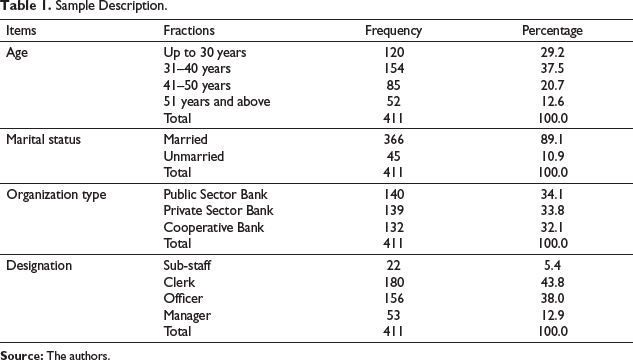
From Table 1, it is apparent that the majority (37.5%) of women bank employees belong to the age group of 31–40 years. The smallest proportion (12.6%) belongs to the higher age group of 51 years and above. The other two categories, that is, up to 30 years and from 41 years to 50 years make up 29.2% and 20.7%, respectively. It was found that the majority of the respondents were married (89.1%), and that unmarried respondents accounted for 10.9%. Table 1 shows that there is almost equal representation for women employees from the public sector, the private sector and the cooperative banks in the selected sample size. The sample on the designation revealed that the major category of the respondents fell under the clerical category (43.8%), followed by the officer category (38.0%). In addition, 12.9% of the respondents were managers, and 5.4% of the respondents were sub-staff.
Exploratory Factor Analysis
The 32-item scale was subjected to EFA. Through the EFA, it was possible to identify and extract the key components that explain most of the variance in the instrument among others. Through selecting suitable options, the items were sorted by size, small coefficients below 0.5 were suppressed and Eigenvalue >1 was the restriction criterion. Upon checking the communalities, three items were found to have an extraction value <0.5, and these items had low factor loadings under the rotation component matrix (Varimax with Kaiser normalization). In order to avoid discrepancies, these three items were dropped, and the factor analysis was further conducted on the remaining 29 items.
The Kaiser–Meyer–Olkin (KMO) is a widely used tool to verify the sampling adequacy. KMO tests suggest the appropriateness of the sample size to run EFA. According to Kaiser (1974), a value greater than 0.6 is treated as adequate to perform EFA. Values above 0.7, 0.8 and 0.9 are considered fair, meritorious and marvellous, respectively (Kaiser, 1974). The KMO value obtained is 0.860, which is considered meritorious. The individual KMO values range between 0.779 and 0.934, which is above the minimum threshold level of 0.5 (Field, 2009). The extracted value of communalities for 29 items is between 0.568 and 0.883, which is greater than the acceptable limit. Subsequently, all the items of the instrument are appropriate for factor analysis. Barlett’s test of sphericity identifies whether there exists any correlation between the items of the measurement instrument. If there is correlation between variables, it is possible to reduce the variables, and it will be suitable for running the EFA. The results of Bartlett’s (8810.448, sig. 0.000) indicate that there exist non-zero correlations, and the values are significant. Hence, the test result indicates that the correlation matrix is an identity matrix.
By conducting the EFA, upon extraction under the principal component analysis, the total variance explained under three groups, namely eigenvalues before extraction of factors and after extraction but before rotation were applied and, after rotation, were generated. Following the Kaiser’s rule (Kaiser, 1960), there were seven components above the restriction criterion (eigenvalue > 1). An eigenvalue < 1 indicates that the component explains less variance and, hence, should not be retained. Table 2 summarizes the results of the EFA.
Summary of Exploratory Factor Analysis
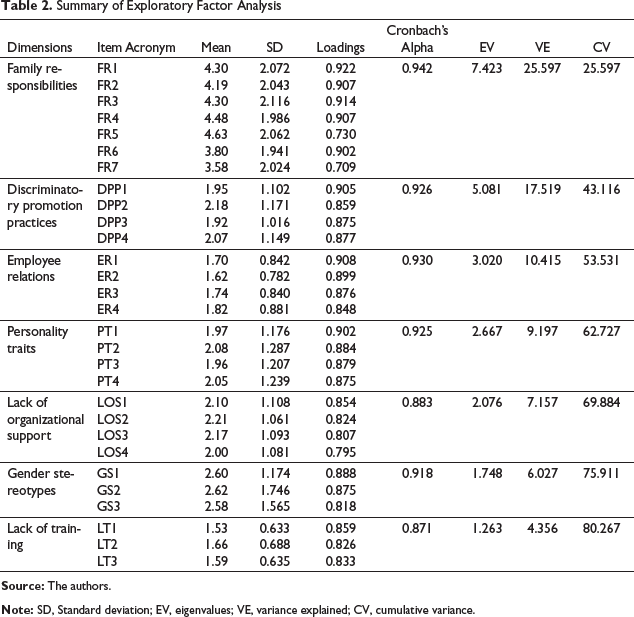
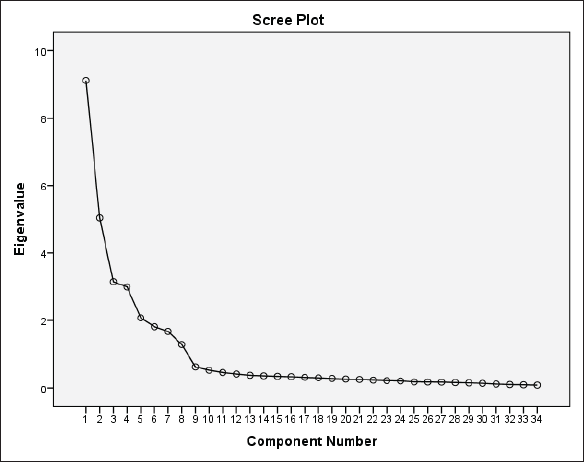
It can be understood from Table 2 that all together, these 29 items under seven components explained 80.26% of the total variance. From the rotation component matrix, under the varimax rotation, it was clear that each item was loaded to one component only and had high factor loadings. In addition to eigenvalue one criterion (Kaiser Criterion), the scree plot, which was a graphical measure used to decide the number of components to be retained, was also considered. Figure 1 presents the scree plot of extracting the factors. According to this figure, there are three points of inflexion on components three, five and seven. After that, the line becomes flatter without many bends. As per the Kaiser criterion, since the eigenvalues support the extraction of seven factors, the same are extracted (Field, 2009). From the factor analysis, seven dimensions were identified, namely family responsibilities (FR), discriminatory promotion practices (DPP), employee relations (ER), personality traits (PT), lack of organizational support (LOS), gender stereotypes (GS) and lack of training (LT). The scree plot partially proves this extraction.
Reliability of the Instrument
The internal consistency of the instrument for each dimension, and finally for the entire GC scale as a whole, is calculated using Cronbach’s alpha. Cronbach’s alpha values of 0.70 are considered to be acceptable (Fornell & Larcker, 1981). The Cronbach’s alpha value of seven dimensions ranges from 0.871 to 0.942, which points out to a good reliability (Nunnally, 1978). The alpha coefficient for the total instrument (all 29 items taken together) is observed as 0.889, which indicates homogeneity of the items in the scale.
Validity of the Instrument
Discriminant Validity
According to Fornell and Larcker (1981), in order to ensure discriminant validity, ‘the square root of average variance extracted (AVE) of a particular construct should be greater than the correlation shared by that particular construct with other constructs in the model’. The discriminant validity of the constructs is presented in Table 3.
Discriminant Validity of the Instrument.
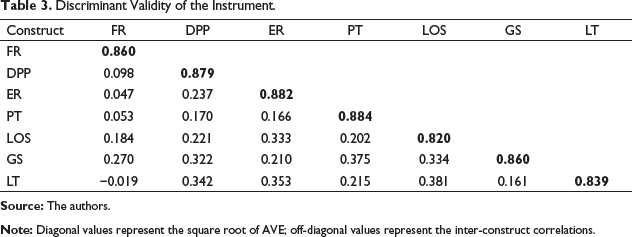
Discriminant validity illustrates whether the seven dimensions extracted are distinct among themselves. The diagonal value represents the square root of the AVE, and the off-diagonal values demonstrate the inter-construct correlations. The diagonal value of each construct must be greater than their corresponding off-diagonal values to ensure discriminant validity. It is clear from Table 3 that the square root of AVE of each individual construct is greater than the inter-construct correlations, thus providing with adequate discriminant validity.
Convergent Validity
According to Krabbe (2017), convergent validity refers to ‘how closely the scale is related to other variables and other measures of the same construct’. It is used to assess whether the identified constructs are different from one another. Convergent validity was assessed using composite reliability coefficient (CRC) and AVE. For all the extracted dimensions, the alpha value was above the minimum threshold limit (0.7).
Confirmatory Factor Analysis
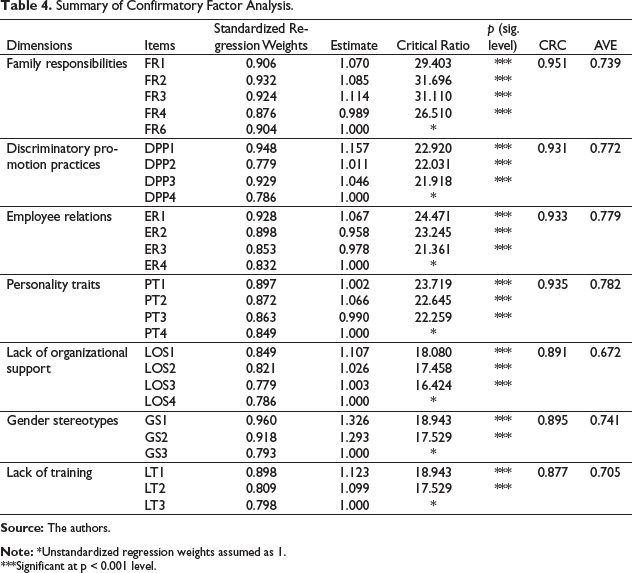
CFA was performed on seven constructs, consisting of 29 items extracted through EFA, to confirm the factor structure. The fit indices like root mean square error of approximation (RMSEA), Tucker–Lewis’ coefficient (TLI), goodness of fit index (GFI), adjusted GFI (AGFI), normed fit index (NFI), comparative fit index (CFI) and χ2 likelihood ratio statistic was considered to assess the model fit. According to Bentler (1992), the value of CFI, TLI, GFI, AGFI and NFI should be close to 1.0 to get a perfect fit. Hair et al. (2009) recommended a value above 0.90 as considered fit for these indices, whereas, the value of RMSEA must be below 0.08, as stated by Kline (2005). The value of 0.0 indicates a perfect fit. The generally accepted chi-square value ranges between 1.0 and 3.0 (Hair et al., 2009). The result of CFA is presented in Table 4.
Summary of Confirmatory Factor Analysis.
***Significant at p < 0.001 level.
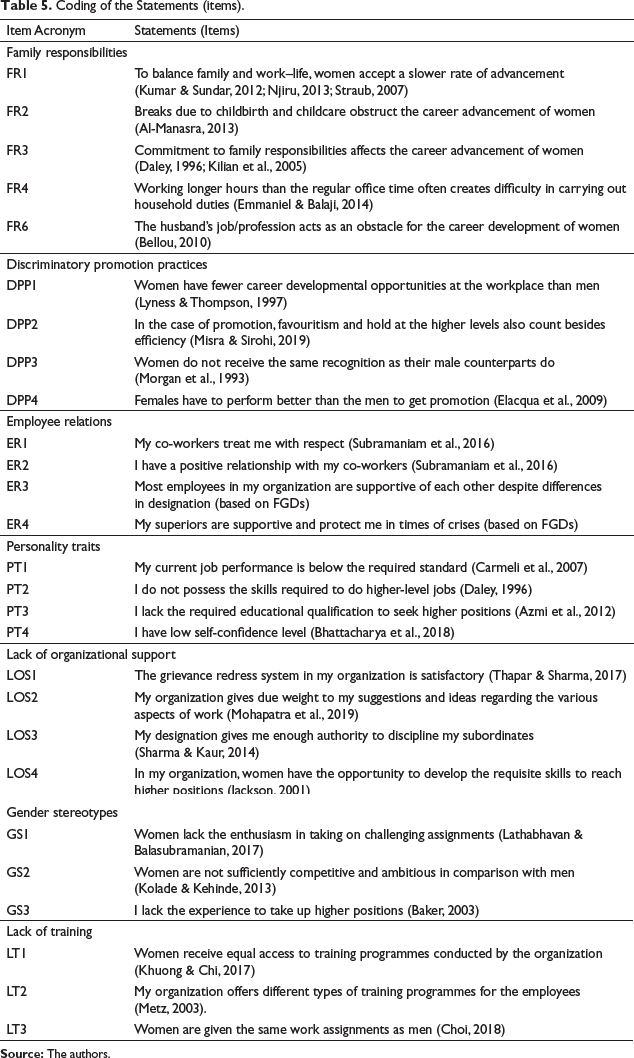
Upon conducting CFA, two items with standardized regression weights below 0.70 were dropped in order to modify the model. These items were FR5 and FR7 under the construct ‘family responsibilities’. Consequently, upon performing CFA, the chi-square statistics was 669.571 (df = 300 and p = 0.000), χ2/df ratio = 2.232, RMSEA = 0.055, GFI = 0.896, AGFI = 0.868, NFI = 0.933, TLI = 0.955 and CFI = 0.961. The values for GFI and AGFI were below the threshold limit of 0.90. According to Baumgartner and Homburg (1996) and Doll et al. (1994), values above 0.80 were considered fit, and hence they met the requirements. Overall, it can be said that the instrument demonstrated satisfactory moderate fit. The measurement model confirmed through AMOS is presented in Figure 2. The items developed and validated, and their code, are presented in Table 5. These extracted factors can be assumed as sub-scales for measuring GC.
In addition, a measurement invariance test was conducted to assess whether the measurement of an item establishes equivalence across the groups (Cieciuch et al., 2014). The test measured the invariance of the developed scale across different samples drawn from the same population (Byrne, 2009). The CFI did not change significantly when compared between the samples, that is, the public sector banks, private sector banks and cooperative banks.
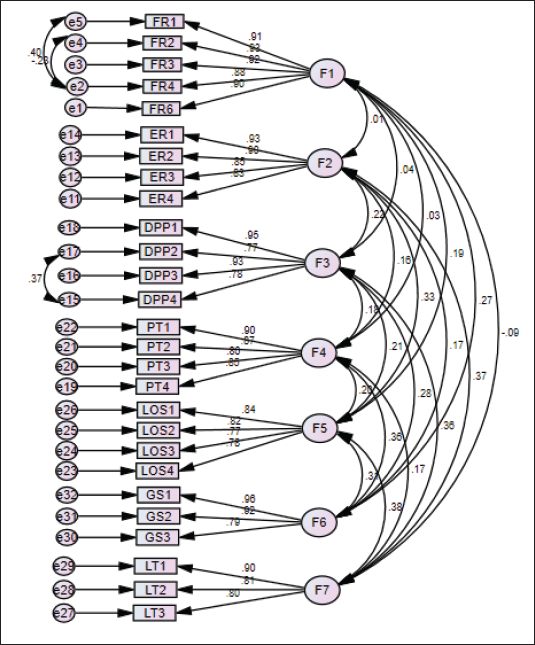
Coding of the Statements (items).
Discussion and Conclusion
Studies conducted in India (Central Statistics Office, 2018a, 2018b; Lathabhavan & Balasubramanian, 2017; Verma & Basu, 2019) found a comparatively low proportion of women both at the entry level and at the higher managerial levels. The COVID-19 situation also widens this gap (Catalyst, 2020; Mehta, 2020). Therefore, it is vital to address gender inequality issues from women’s perspective and to understand the key challenges they face. This study was conducted to construct and validate a scale for measuring the GC faced by working women in the Indian banking sector. The measuring instrument was developed subsequent to literature review and FGDs. Additionally, expert opinion was also taken prior to the scale finalization.
The scale depicts significant psychometric properties. The KMO and Bartlett’s test of sphericity suggest the appropriateness of the sample for the extraction of factors. The items constitute adequate communalities value. The items identified are specific to the Indian context. Consequent to the factor analysis upon orthogonal rotation, seven factors were identified, namely FR, ER, PT, DPP, LOS, GS and LT. The factor loadings of all items were greater than 0.70, and the scale had good internal consistency. All the items were fit for the scale according to Kaiser’s rule. In total, these components explained 80.26% of the variance. In support of the findings, a scree plot was also obtained. The instrument demonstrated adequate convergent and discriminant validities. The instrument was validated using CFA. Furthermore, the scale was internally consistent, reliable and valid across the different samples drawn from the different sectors of banks: public sector banks, private sector banks and cooperative banks. Therefore, it was confirmed that the scale developed was multidimensional and covered all the important GC barriers faced by women employees in the banking sector.
Managerial Implications
The validated GC instrument has several practical implications. The instrument can be used by human resource managers in the banking sector to assess the gender-related problems faced by women employees that restrict the latter’s career advancement prospects besides impacting upon them economically. With this knowledge, the management can develop superior policies that foster the career growth of women employees. Although the scale is developed primarily for the banking sector, the items addressed in the scale are universal issues faced by women employees in various professional sectors. Hence, this comprehensive scale can be applied to measure the GC barriers of various service sectors, including insurance, transportation, information technology and healthcare. Both governmental and non-governmental agencies can use this instrument for measuring GC, which can provide them insights to improve the career progression of women. To conclude, the instrument developed integrates the existing empirical and theoretical studies on which the visible and the invisible GC barriers faced by women employees are laid down. The research outcome will help the researchers, practitioners and managements, to measure the opinions of the employees, regarding GC in different sectors.
Limitations and Future Research Directions
This study is not free from limitations. The sample respondents comprise women working exclusively in public sector banks, private sector banks and cooperative banks. Foreign banks, small finance banks, payment banks, etc., are excluded. Further studies can be conducted by including a wider category of banks as well as non-banking institutions. This study considers the perceptions of GC from women employees only. The opinions of male employees are completely disregarded, but may be considered in future. Empirical studies can be conducted on other sectors, including agriculture, industry and defence, among others. The samples for this study are drawn only from one particular state of India. The state chosen, however, has the highest percentage of women employees in the country. Utmost care is taken to include representatives from the rural, semi-urban and urban branches, which is the geographical situation all over the nation. Furthermore, since the issues faced by women employees all over the country are mostly similar, the scale may be applicable to all women employees, irrespective of region or geographical limitations.
Footnotes
Acknowledgement
The authors are grateful to the anonymous referees of the journal for their extremely useful suggestions to improve the quality of article. Usual disclaimers apply.
Declaration of Conflicting Interests
The authors declared no potential conflicts of interest with respect to the research, authorship and/or publication of this article.
Funding
The authors received no financial support for the research, authorship and/or publication of this article.
