







Abstract
This article aims to investigate the effect of countries’ culture on women’s right to economic participation. As a secondary objective, the article aims to analyse the effect of culture on the progress made in the laws of the countries over the last five decades. The dataset comprises the national culture dimensions of Hofstede and the scores related to gender inequalities in the law provided in the Women, Business and the Law (WBL) database from The World Bank. Using multivariate regression analysis, we evaluated the effect of the cultural dimensions on the current WBL scores and on the variation of the WBL scores over the last five decades. The results show that the dimensions of culture (individualism, uncertainty avoidance and power distance) affect women’s right to economic participation and/or the evolution of laws in this direction. The results also suggest that although some countries still have much to advance in their legislation, more and more countries are reaching the goal of having an egalitarian society.
Introduction
One of the most salient and pervasive forms of gender discrimination is the unequal treatment of women and men by the law. (Hyland et al., 2020, p. 475)
An egalitarian society has been a goal of democratic countries in recent years, as there is growing evidence that it can significantly affect all aspects of human life, including economic prosperity and development (Hrivíková, 2020). However, according to Hrivíková (2020), even developed countries are still far from guaranteeing gender equality.
For Bullough et al. (2012), cultural norms can play an important role in the freedom and advancement of women in society, and for the authors it is undeniable that national culture has a clear relationship with the active participation of women in their community. National culture is also related to the barriers faced by women in the business world (Grosvold, 2011; Naidu & Chand, 2017; Toh & Leonardelli, 2012). Cultural factors can, for example, create constraints to women appointments at leadership positions (Chugh & Sahgal, 2007; Gyapong & Afrifa, 2021; Toh & Leonardelli, 2012).
Grosvold (2011) suggests that national culture represents an important factor that influences the participation of women on the corporate board of directors. Furthermore, in some countries women face financial exclusion, as they are culturally disadvantaged in accessing formal financial institutions (Vershinina et al., 2018). In this context, Samineni and Rameshi (2020) point the relevance of enhancing economic opportunities among women through microfinance.
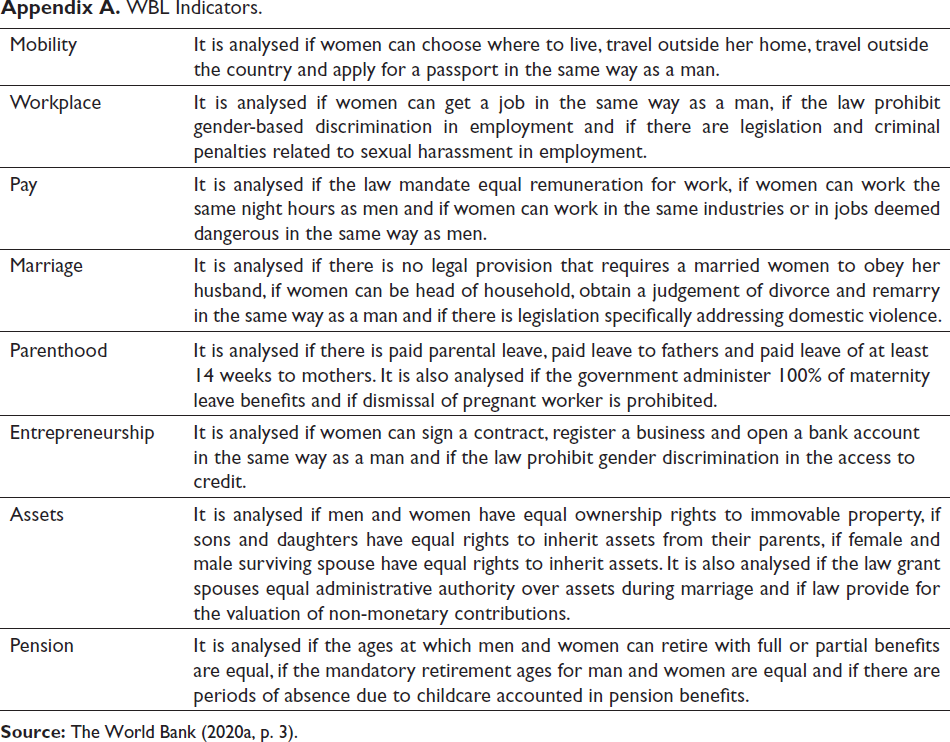
Every year, The World Bank measures gender inequalities in the law of 190 countries in order to identify barriers to women’s economic participation. Overall scores are calculated for each country considering 35 aspects of their body of laws grouped into 8 indicators that represent different phases of women’s career including marriage, parenthood, pension, mobility, workplace, pay, entrepreneurship and assets (The World Bank, 2020a). The results of this World Bank’ study are published in an annual report called Women, Business and the Law (WBL) (The World Bank, 2020a).
In 2020, The World Bank published a WBL report with the scores of 190 economies since 1971. Drawing upon the scores provided in this report, the aim of this article is to analyse the effect of culture on women’s right to economic participation. As a secondary objective, we also analysed the effect of culture on the progress made in the laws of the countries over the last five decades. As pointed by Hyland et al. (2020), WBL is and index that captures gender inequalities in the legislation and the advantage of focusing on legislation is that it provides an objective measure that facilitates cross-country comparisons.
Previous studies have analysed the effect of culture on female entrepreneurship and on women access to higher positions at work. However, there is a gap regarding the analysis of how cultural factors can influence women’s rights to participate in the business environment in a more comprehensive way. Considering that there are different factors that can affect women’s rights, this study aims to contribute to the relevant debate on gender issues.
Literature Review
Throughout history, men and women have been experiencing the world of work in a different way (Bobbitt-Zeher, 2011). Discriminatory practices in the workplace related to wage disparities, gender stereotypes and job segregation are some of the challenges faced by women around the globe (Bobbitt-Zeher, 2011; Mills, 2002).
In the last decades, women’s rights advocates have assumed a protagonism in the United Nations (UN) conferences (Friedman, 2003). Furthermore, governments around the world have established international agreements in order to reduce gender inequities (Reilly, 2007). Equal remuneration laws, efforts to ensure women’s access to education, increased women’s representation in the political and economic public spheres have been widely diffused (Cole, 2020).
However, despite to the substantial changes and improvements, gender inequalities remain persistent in the society (Bobbitt-Zeher, 2011). Traditional, religious and cultural norms continue to inhibit the achievement of gender equality, even when women’s rights are protected by the law and by the government (Cole, 2020).
Farahzadi and Rahmati (2020) identified that national culture represents an important factor that influences the participation of married women on the labour force in Iran. Furthermore, in some countries, women have limited mobility outside the domestic environment (Grossman-Thompson, 2019). Previous studies also suggest that cultural aspects drive the choosing of career and sector of economic activity by women (Avolio, 2021; Mahapatro, 2019).
Gender inequality can, thus, be seen as a cultural, social and legal situation in which men and women have different rights (Kim, 2021). Chitsike (2000) argues that women can only be autonomous in their economic activities if there are no cultural barriers constraining them. In this sense, Hechavarría and Ingram (2019) found that the rates of female entrepreneurship are higher when there is legal, cultural and governmental support for entrepreneurship. The study of Naidu and Chand (2017) also identified that culture moderates the relationship between gender inequality and the success of women ventures, whether they are micro, small or medium enterprises.
Therefore, efforts to expand women’s rights must focus on overcoming cultural constraints on their economic participation (Cole, 2020). The development of policies and strategies that consider the needs and peculiarities of women and the cultural context in which they are inserted can promote opportunities to facilitate women’s economic participation through business activities and help them to deal with day-to-day challenges (Ozgen, 2012). Progressive and moderate changes in the law are also important to change behaviour and customs in the same direction (Hyland et al., 2020). Improvements in the law are, for example, positively correlated with greater participation of women in the workforce and with lower wage gap between men and women (Hyland et al., 2020).
Considering that gender inequalities have been reduced over time and that there are different factors that can affect women’s rights, we expect to expand the literature by considering how cultural dimensions, at a country level, can affect women’s rights to economic participation and the evolution of the countries’ legislation. In the next section we present the study hypotheses, considering four dimensions of Hofstede (2011) and the gender inequalities in the laws related to the participation in economic activities.
Theoretical Background and Hypotheses
To examine the relationship between countries’ culture and the scores in the WBL report, we have considered four Hofstede’s (2011) dimensions of national culture: individualism, masculinity, uncertainty avoidance and power distance. The description of each dimension and the possible effect of Hofstede’s cultural dimensions on the WBL scores are detailed in the subsections below.
Individualism
Societies with high degree of individualism are those where there are weak ties between individuals and where people value personal interests over group interests (Bullough et al., 2012; Hofstede Insights, 2021). According to Block and Walter (2017), in these societies individuals are more prone to pursue their personal goals and self-actualization.
In this sense, the study of Davis and Williamson (2019) identified that individualism is related to gender equality attitudes towards employment, income earnings, political leadership and education. The authors argue that individualism promotes gender equality and that the values perpetuated by individualistic cultures tend to legitimate women’s goals and choices (Davis & Williamson, 2019).
According to Forsberg (2020), there is a positive relationship between individualism and the increase of equality in relationships between men and women. Grosvold (2011) also points that more individualistic countries tend to have more female board of directors. Thus, we hypothesize the following:
Masculinity
Masculinity expresses the degree to which the individual of a country stands their preference for achievement, competitiveness, heroism and material rewards (Hofstede Insights, 2021). In the business context, masculinity is related to tough cultures in opposed to femininity that is related to tender cultures (Hofstede Insights, 2021). Hrivíková (2020) states that the social convention of the separation of gender roles in typically masculine cultures creates a natural obstacle to the achievement of gender equality. For him, these cultures have deeply held interpretations of what is and is not appropriate for men and women in society. Toh and Leonardelli (2012) emphasize that, historically, leadership has been more related to masculinity and according to Cabeza-García et al. (2019), in countries that have masculinity as a cultural characteristic, it is more difficult for women to have access to representative councils, for example.
Regarding entrepreneurship, for Bogatyreva et al. (2019), the transition from entrepreneurial intention to effective entrepreneurial behaviour is facilitated by the environment and the spirit of societies characterized by high masculinity. However, with regard to female entrepreneurship, Pines et al. (2010) points out that women entrepreneurs face a hostile environment in sectors that are essentially from the ‘male’ business world, for example, the information technology sector. Thus, we hypothesize the following:
Uncertainty Avoidance
The degree of uncertainty avoidance reflects society stance regarding uncertainty, ambiguity and unstructured situations (Hofstede Insights, 2021; McGrath et al., 1992). In order to prevent uncertainty and ambiguity, uncertainty-avoiding societies tend to create mechanisms such as laws, codes of behaviour and formalizations (Block & Walter, 2017; Hofstede Insights, 2021).
Regarding entrepreneurship, Wildeman et al. (1998) states that in countries characterized by high uncertainty avoidance scores, people are less satisfied with life and with society, which in turn leads them to seek for self-employment and consequently to higher levels of entrepreneurship. Shneor et al. (2013) point that a culture with higher rates of uncertainty avoidance offers a more conducive environment for the emergence of entrepreneurs regardless of sex. Thus, we hypothesized the following:
Power Distance
In countries that exhibit strong power distance, individuals tend to accept inequalities in the distribution of power in institutions (Hofstede Insights, 2021).
The study of Glick (2005) found a negative correlation between power distance and gender equality. The author states that the countries with the highest scores in this index show a reduced presence of women in the business world. Cabeza-García et al. (2019) found similar results, as they identified that the percentage of women in management positions is lower in cultures where the degree of power distance is high.
Grosvold (2011) countries that exhibit a culture with lower power distance values tend to have less participation of women on the corporate board of directors. Regarding to female entrepreneurship, Cullen’s (2019) study of Turkish female entrepreneurs indicates that high power distance represents important barriers to access training and skills development opportunities or business consulting services, for example, Shinnar et al. (2012) state that in societies with higher levels of power distance women perceive barriers to entrepreneurship (lack of support, lack of competence and fear of failure) to be more significant than in countries with lower power distance values. Considering these previous studies, we hypothesized the following:
Method and Data
In order to achieve the aim of this article, we first collected data from the WBL database (The World Bank, 2020b) that comprised the scores for 190 countries since 1971. These scores are based on 35 aspects grouped into 8 indicators that are presented in the Appendix A. ‘A higher score indicates more gender equal laws. The scores for previous years have been recalculated to account for data revisions and methodology changes’ (The World Bank, 2020b).
For each country of the sample, we collected the WBL scores of the year 1971, the WBL scores of the year 2020, the gross domestic product (GDP) and population size. Then, we collected the Hofstede’s cultural dimensions: individualism, masculinity, uncertainty avoidance and power distance at Hofstede Insights (2021). We excluded those countries with missing values for the cultural factors and the final database comprised 118 observations. It is important to note that Hofstede’s model is a robust theoretical framework widely used in the literature for cross-cultural comparisons and that its validity and reliability have been already confirmed by previous studies (Eisinga et al., 2010; Gyapong & Afrifa, 2021; Lorca & Andrés, 2019). Although some critics argue that Hofstede’s scores are obsolete, his model remains useful and valid (Gyapong & Afrifa, 2021; Hofstede, 2011). The scores for the cultural dimensions indicate the relative positions of each country in relation to the other countries in the set and even if the world is changing, countries tend to remain in the same relative position (Hofstede, 2011).
Initially, we analysed the data through descriptive statistics. Then, using multivariate regression analysis, we evaluated the effect of the cultural dimensions on the current WBL (WBL2020) and on the variation of the WBL over 50 years (the difference between WBL2020 and WBL1971). Therefore, we estimated two models of regression analysis using ordinary least squares: the first with the current WBL as the dependent variable (model 1) and the second with the variation of the WBL as the dependent variable (model 2). Four independent variables (one for each cultural dimension of Hofstede) were considered in both models, in line with the hypotheses established in the study. The GDP and population size were used as control variables.
The highest possible score for each country in the WBL is 100. Considering that countries with the highest scores in 1971 could increase their scores less than countries with the lowest scores, to estimate model 2 we split the sample in two subsamples: the first comprising the countries that presented WBL below 50 in 1971 and the second comprising countries that presented WBL above 50 in 1971. Then, we performed the regression analysis with each of these subsamples. In the estimated models, we also examined the variance inflation factor (VIF) statistics to verify if the models had multicollinearity problems.
Results
Table 1 presents descriptive information related to the countries of the sample. It is important to note that it considers only countries that have complete observations for the study variables. The mean of WBL scores in 1971 was 48.22, whereas in 2020 the average WBL scores is 80.18. This difference represents an increase of about 66% in the WBL scores.
Descriptive Statistics.
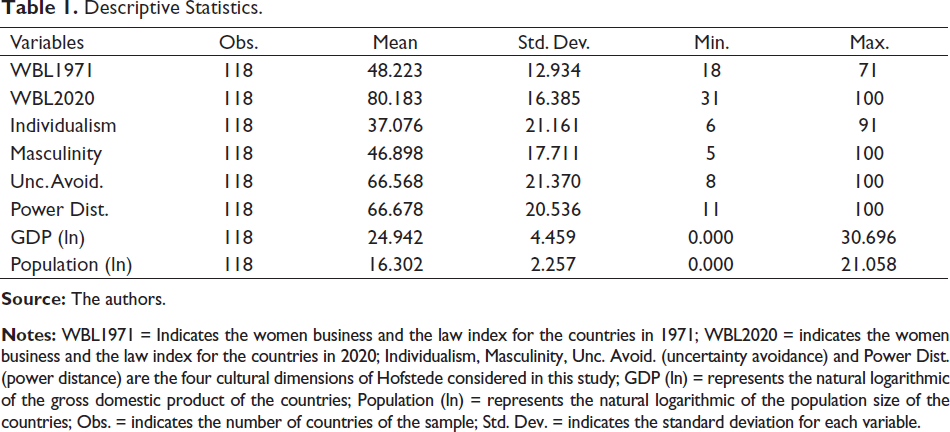
In 1971, the maximum score was 71 for Sweden and Denmark. In 2020, Belgium, Canada, Denmark, France, Iceland, Latvia, Luxembourg and Sweden received the higher possible score (100) in the WBL report. These results show that there was a significant progress in the legislation of the countries of the sample towards gender equality and are in line with the assertions of Friedman (2003) and Cole (2020).
Table 2 shows the results for the regression analysis of model 1. It is important to note that GDP and population size were considered as control variables in all the regression models of this study. As predicted, individualism and uncertainty avoidance presented a positive effect on WBL2020, supporting the Hypotheses H1a and H3a. Regarding H4, power distance presented a negative effect on WBL2020. Population also presented a significant and negative relationship with WBL2020. Masculinity, in turn, did not present a significant effect on WBL2020.
Results for the Regression Analysis (model 1).
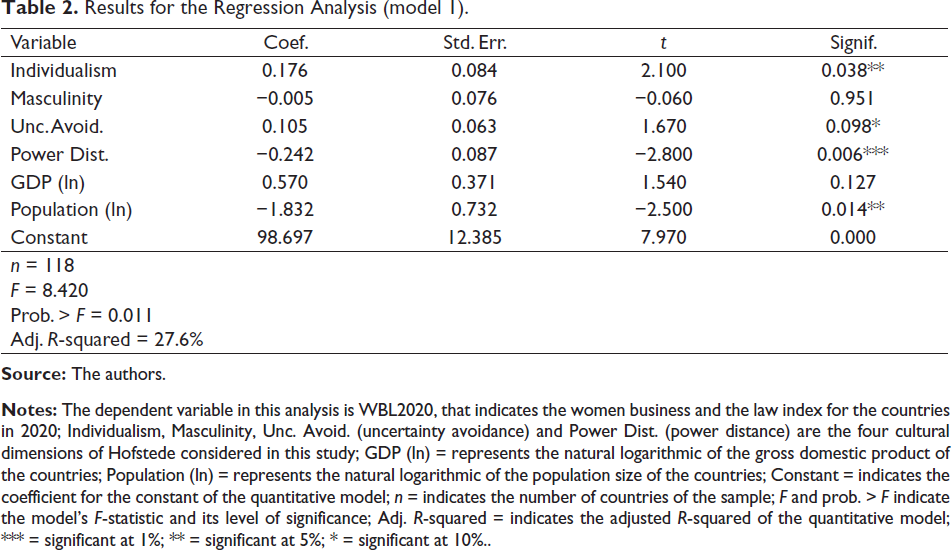
Table 3 presents the results related to model 2. As mentioned in the Method section, the sample was split in two subsamples: one considering those countries with WBL1971 ≤ 50 and the other comprising countries with WBL1971 > 50.
Results for the Regression Analysis (model 2).
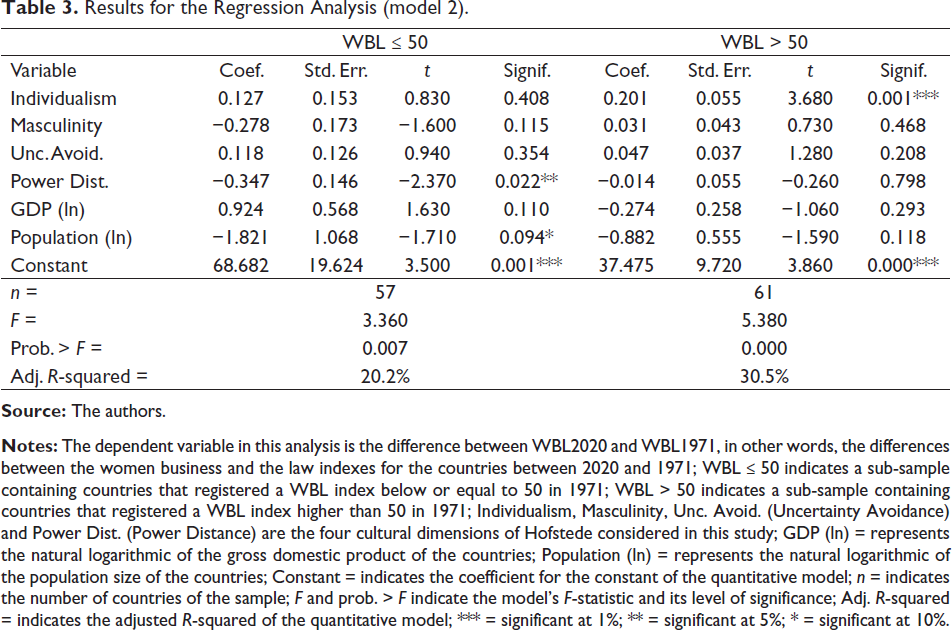
We observed that there were 57 countries with scores ≤50 and 61 countries with scores >50. The results show that for those countries with lower WBL1971, the power distance dimension and population size presented a significant and negative relationship with the progress of their laws and regulations towards women rights. Regarding the countries with higher WBL scores, Individualism presented a strong effect on the advancements in the laws.
Finally, we analysed the VIF statistics in relation to the three regression models of this study. Usually, a VIF below 5 would suggest that there are no concerns related to multicollinearity. The quantitative models reported in Tables 2 and 3 presented VIF statistic lower than 2.5, indicating that they do not have biases related to multicollinearity.
Discussion
The results of this study suggest that in countries with higher individualism, higher uncertainty avoidance and lower power distance scores, women tend to face less legal constraints and less gender inequalities.
The positive effect of individualism for both the WBL variation (considering the countries with WBL > 50) and the WBL2020 is in line with the study of Davis and Williamson (2019) that found a positive relationship between individualism and gender equality in key social life aspects such as employment, income earnings and political leadership. As people in more individualistic countries are more prone to pursue their personal goals (Block & Walter, 2017), women from these countries may be more engaged in fighting gender discrimination, pressuring lawmakers for the creation of laws to guarantee their right to freely exercise their activities.
The negative effect of power distance in women appointments to leadership positions, found by Cabeza-García et al. (2019), Toh and Leonardelli (2012) and Gyapong and Afrifa (2021), was also observed for both the WBL variation (considering the countries with WBL ≤ 50) and the WBL2020. As pointed by previous studies (Cabeza-García et al., 2019; Glick, 2005), strong power distance is related to reduced presence of women in management positions and in the business world in general, which may reflect in the WBL scores.
Finally, as pointed by Block and Walter (2017) and Hofstede Insights (2021), societies characterized by higher levels of uncertainty avoidance tend to create laws, regulations and rules to guide behaviour to minimize uncertainty, which may have an effect, even indirectly, in the development of laws to guarantee and promote women’s economic participation.
Previous studies showed that cultural aspects influence women participation in the business world (Chugh & Sahgal, 2007; Farahzadi & Rahmati, 2020; Grosvold, 2011; Gyapong & Afrifa, 2021; Naidu & Chand, 2017; Toh & Leonardelli, 2012). This study complements previous research by analyzing how cultural factors impact the introduction of laws that facilitate to women’s economic participation. It is important to note that the present study used a comprehensive measure comprising eight dimensions of life domain that may be related to the inequalities faced by women in the business world. As pointed by Chitsike (2000) to encourage women’s economic participation it is fundamental to overcome cultural barriers. Thus, the results of the study indicate the relevance of paying attention to the components of the WBL index, especially in countries with high power distance, low individualism and low uncertainty avoidance, in order to reduce inequality indicators.
In addition, this article analyses aspects related to women’ rights in different countries and the influence of culture in the evolution of these rights. However, besides the legal and cultural aspects, gender equality involves a social component (Kim, 2021). Based on the growing social awareness in favour of gender equality, the laws can change and organizations can contribute to this process since they are an important part of society.
Conclusion
This article aimed to analyse the effect of culture on women’s right to economic participation and the effect of culture on the progress made in the laws of the countries over the last five decades.
The literature shows that, historically, women have been disadvantaged in terms of their rights compared to men, especially due to sociocultural factors. However, the results of this study show that this reality is gradually changing. Although some countries still have much to be done to ensure gender equality, more and more countries are reaching the goal of having an egalitarian society.
It is undeniable that legal restrictions imposed to women in many countries constrain them from being proactive in seeking for opportunities. On the other hand, in countries where women and men have the same rights, women may feel more empowered to engage in their own business or to achieve higher positions at work. In the increasingly global economy, it is expected that countries that still present inequalities between men and women in the aspects analysed in this study continue to advance in their legislation to enable and encourage women access to economic opportunities, reducing gender inequalities.
The study identified that the dimensions of culture (individualism, uncertainty avoidance and power distance) affect women’s right to economic participation and/or the evolution of laws in this direction. These results reveal the important role that overcoming cultural barriers plays in shaping a world without gender-based discrimination where women can have freedom to do the same things as men.
The findings of this study have managerial implications. In a moment that the debate on gender issues has attracted global attention, and that the laws of several countries have evolved to promote gender equality, it is important to extend this debate to the sphere of organizations. Based on the demand for an egalitarian society, managers are encouraged to implement strategies for equal opportunities at a firm level.
One limitation of the study is that it does not consider regional differences of the countries. Therefore, future studies can investigate how local laws in a given country affect women’s economic participation. Furthermore, the study showed that population size has a significant and negative effect on WBL scores and in its variance along the years in countries that presented lower WBL scores in 1971. In this way, new research can also analyse how other demographic characteristics influence women’s economic participation. Finally, considering that differences have been observed in the laws regarding women’s rights between countries, future studies can analyse and compare the practices and internal policies of organizations from different countries.
WBL Indicators.
Footnotes
Declaration of Conflicting Interests
The authors declared no potential conflicts of interest with respect to the research, authorship and/or publication of this article.
Funding
The authors received no financial support for the research, authorship and/or publication of this article.
