






Abstract
The exponential increase in the usage of electronic devices by young consumers in India has added to the menace of e-waste. With legislation and some remarkable initiatives already in place, the pro-environmental behaviour of the young generation is efficacious. The present qualitative study investigates the factors that affect e-waste recycling behaviour. A thematic analysis of the interview transcripts, based on virtual interactions with the young students, supports the role of knowledge acquired through social and print media and educational institutions, concern for the environment and responsibility assumed by different stakeholders on recycling behaviour. The dual dimensions, internal and external, explain the perceived behavioural control, and subjective norms also affect the intention. Awareness is revealed to be playing a pertinent role. The recycling behaviour is manifested in four forms, namely giving away in charity, reselling, reusing and discarding. An interesting outcome of the study is the function of the hidden values that an individual puts on the e-waste, impacting the disposal behaviour. The values can be categorized into three segments, namely economic value, emotional value and future value. The study offers logical implications for electronic device manufacturers, marketers, government and other stakeholders while making a significant contribution to the extant literature in the form of a comprehensive conceptual model explaining the e-waste recycling behaviour of the Indian youth.
Keywords
Introduction
Electrical and electronic equipment (EEE) has become an indispensable part of our lives. The ever-escalated use of EEE though helps us navigate through our daily chores conveniently but has increased our dependence on them. The unprecedented challenges induced by the Coronavirus Disease 2019 (COVID-19) pandemic have led to an upsurge in the use of digital devices. Subsequently, it has raised concerns about judiciously managing the waste of electrical and electronic equipment (WEEE) or e-waste. As per the global e-waste monitor, 2020, the global generation of e-waste was 53.6 Mt in 2019 (21% increase in the past 5 years), and it is expected to reach 74 Mt by 2030. The worrying part is that only 17% of this e-waste was collected and recycled. India stands at the third position among e-waste-producing countries (3.2 Mt in the year 2019), after China and the USA. The per capita production of e-waste in India is much less (5.6 kg per capita) as compared to Europe (16.2 kg per capita) or Oceania (16.1 kg per capita), but it ought not to act as a solace. The infrastructure to recycle e-waste is currently underdeveloped in India. Only 10% of the e-waste generated in the year 2018–2019 was recycled as per the report published by the Central Pollution Control Board (CPCB, 2020). The majority of the e-waste in India is handled by the informal sector (Kumar et al., 2017).
The term e-waste is defined as all types of EEE discarded by the owner without the intention of reusing the same (Aboelmaged, 2020; Kumar et al., 2017). Thus, for the customer, e-waste is considered as all broken, obsolete or out-of-fashion products having a circuit board that reaches the waste stream (Saphores et al., 2012). The European Union (EU) WEEE directive defined e-waste as ‘the waste from electrical and electronic equipment (WEEE) that includes all the components of electronic equipment, its subassemblies, and consumables which are the part of the product at the time it is discarded’ (Eur Lex, 2012).
As e-waste poses severe environmental threats, proper management is crucial, and it is imperative to develop efficient practices of e-waste recycling (Echegaray & Hansstein, 2016). As per the United Nations Environment Programme (UNEP), 2011, efficient practices of e-waste recycling include the collection of EEE, followed by careful segregation into valuable e-waste and harmful components. The reusing, recycling and remanufacturing of significant waste streams have resulted in the development of the concepts like circular economy. It is defined as ‘an industrial economy that is restorative or regenerative by intention and design’ (Ellen MacArthur Foundation, 2013). This can be achieved through long-lasting design, maintenance, repair, reuse, remanufacturing, refurbishing and recycling (Geissdoerfer et al., 2017).
The fuelled consumption of electronic devices during the COVID-19 pandemic requires greater accountability to dispose of the waste generated (The Times of India, 2021). The demand for laptops and tablets has jumped to 200% and 90%, respectively, in the year 2020 in India. Moreover, 45% of the laptop and tablet demand has been driven by the student cohort (Ganjoo, 2021). Several studies have highlighted the severe surge in the use of digital devices after the COVID-19 lockdown (Bahkir & Grandee, 2020; De et al., 2020; Pandya & Lodha, 2021). Given the low percentage of e-waste collection and recycling in India, the present study attempts to investigate the factors influencing the e-waste disposal behaviour among the Indian youth. Since India’s socio-economic, cultural and environmental circumstances vary substantially, it is pertinent to look into the factors determining the e-waste disposal behaviour (Borthakur, 2020). The study is specifically focused on the young customer segment as they are the ones who are buying the maximum number of electronic devices for work or academic purposes. Kanchanapibul et al. (2014) also suggest the need to understand the pro-environmental behaviour of youth as they are the prospective consumers and society representatives. Later, the ill-effects on the environment will be borne by them only (Hume, 2010).
The study is predicated on the theory of planned behaviour (TPB) (Ajzen, 1991) to develop the discussion guide. A qualitative approach is deployed to investigate and explore the dimensions of TPB and describe the evolving nature of e-waste disposal behaviour among the Indian youth. The focus is not to predict the future course of action but rather to identify and elaborate on the antecedents of e-waste disposal behaviour (Chopra et al., 2021). The qualitative methodology is best suited to the authors’ endeavour to comprehend what constructs can be tested (Eisenhardt, 1989; Ryan et al., 2002).
In addition, qualitative research is instrumental to investigate the differences between attitude and actual behaviour (Sinkovics et al., 2005). In-depth interviews help gain useful insights to understand lucidly the respondents’ behaviour. This allows the respondents to discuss freely and also gives the flexibility to the interviewer to intervene whenever necessary (Bernhard, 1988)
The data collected through in-depth interviews were synthesized using the thematic analysis approach. The outcome of the study yields a more robust and comprehensive framework by extending the TPB and identifying the key factors that impact the e-waste disposal behaviour of young Indians.
The subsequent section of the article discusses the rationale of the study, followed by a review of extant literature. The third section discusses the methodology used in the study; the fourth section on data analysis, followed by the discussion and implications in the fifth section. The sixth section lays down the limitations and scope for the future.
Background
E-waste in India
India is among the few Asian countries, with laws to manage e-waste. The rules regarding e-waste management and handling were laid down in 2011 and apply to all producers and consumers/bulk consumers involved in the manufacture, sale, purchase and processing of electrical or electronic components, collection centre, dismantler and recycler of e-waste. Later, the law regarding e-waste was modified and the E-Waste Management Rules, 2016, came into force with effect on 1 October 2016. It has defined over 21 categories of EEE and encompasses all the stakeholders, namely manufacturers, dealers, refurbishers and producer responsibility organisation (PRO).
As of December 2020, there are 44 PROs in India. The number of authorized recyclers/dismantlers in India stands at 312 with the capacity of treating 800 KT annually. This is in striking contrast to the e-waste generation of the country, which is humungous and stands at 3.2 Mt. It explains the reason why 95% of e-waste is being handled by the informal sector in the country (Chatterjee, 2012; Kumar et al., 2017). The informal sector constitutes scrap dealers, who are also known as kabadiwalas in local parlance. These people collect door-to-door e-waste and pass them to recyclers (Raghupathy & Chaturvedi, 2013). These kabadiwalas pay a price to consumers and purchase their e-waste, which motivates consumers (Sinha-Khetriwal et al., 2005) and also generates economic benefits for the poor strata of the country (Pandey & Govind, 2014). However, this sector remains largely ungoverned. The unscientific approach to tackling e-waste has a detrimental impact on health. Toxic smoke, acid solutions and released gases threaten their health as well as their local environment (Kumar et al., 2017). They are involved in extracting precious metals from e-waste through a high-polluting process (Raghupaty et al., 2011). The formal sector, on the other hand, is faced with compliance issues and increased costs to arrange the facilities, which suggest greater reliance on local kabadiwalas (Borthakur & Govind, 2016).
Review of Literature
The rising world population and rapid advancement in technology have led to an increase in waste generation in the world and therefore greater attention to recycling behaviour (Lakatos et al., 2018; Meng et al., 2018). Several studies focus on the disposal of clothes (Aydin, 2017; Bianchi & Birtwistle, 2012; Caulfield, 2009; Claudio, 2007; Joung & Park-Poaps, 2011; Weber et al., 2017) and electronics (Aboelmaged, 2020; Borthakur & Govind, 2016; Delcea et al., 2020; Gilal et al., 2019; Muhammad et al., 2020; Siringo et al., 2020). The most widely used theory to study the disposal behaviour of the consumers is the TPB (Aboelmaged, 2020; Echegaray & Hansstein, 2016; Khan et al., 2019; Razali et al., 2020; Wang et al., 2016). TPB (Ajzen, 1991) postulated three antecedents (attitude, subjective norms and perceived behaviour control—PBC) to measure the intentions and behaviours of humans, and its model has been extended widely by combining it with other theories such as the theory of altruistic behaviour (Valle et al., 2005), value belief norm theory (VBNT) (Sari et al., 2021) and integrated behaviour theory (Sujata et al., 2019) to explain the recycling behaviour of an individual. The researchers have also added various variables in TPB to give a more comprehensive picture of the recycling behaviour of an individual. These are demographic factors (Dwivedy & Mittal, 2013; Echegaray & Hansstein, 2016; Song et al., 2012), habit (Aboelmaged, 2020), convenience (Nguyen et al., 2018; Wang et al., 2016), awareness (Delcea et al., 2020; Khan et al., 2019) and government policies (Sari et al., 2021).
Consumer behaviour is dynamic in terms of various sociocultural factors, demographic factors and situational factors (Cici & Bilginer Özsaatcı, 2021). Recently, Tao et al. (2022) suggested that age variation is evident in all the parameters of consumer purchase behaviour after the COVID-19 pandemic. Age is considered to be an important variable in past studies for researching a particular phenomenon. For example, Yadav and Pathak (2016) specifically studied young consumers’ intention towards green products and suggested implications peculiar to the target group. Tan et al. (2019) also investigated the factors affecting the green product buying decision among young consumers in Malaysia.
The disposal behaviour has also been studied in light of variables such as ambivalence (Borthakur & Govind, 2016; Roster & Richins, 2009), self-identity (Trudel et al., 2016), environmental motivation (Otto et al., 2018) and willingness to pay (WTP) (Damke et al., 2019) for recycling. In the cross-nation study conducted by Borthakur and Govind (2016), it was concluded that countries with higher average income and higher education are more willing to pay for e-waste treatment. The cost of disposal is concluded to be one of the most important factors, which impact the recycling behaviour of an individual (Arain et al., 2020).
The impact of government rules and regulations on the recycling behaviour of an individual has mixed results. Some studies support that the laws and regulations were the strongest indicators of the intention of an individual to recycle e-waste (Nguyen et al., 2018; Sari et al., 2021). On the other hand, a study conducted by Borthakur and Govind (2016) concluded that no policy instrument could be implemented satisfactorily till an individual is made aware of the hazards of e-waste.
Echegaray and Hansstein (2016) concluded that besides the need for suitable policies and legislation for e-waste management, consumer awareness about recycling is significant. Another study by Nguyen et al. (2018) specifically examined the impact of environmental awareness on e-waste recycling intention and found it to be significant. The environmental knowledge about the hazards of e-waste was found to be a significant factor impacting the behaviour of an individual towards recycling (Akhtar et al., 2014; Damke et al., 2019; Iyer, 2018).
Another important dimension examined in the past studies is related to social media usage and its influence (Delcea et al., 2020). Social networking sites help improve environmental awareness. The messages regarding the environmental and social issues can be shared among the netizens at a negligible cost within a very less time (Sujata et al., 2019).
Material and Methods
Research Approach
The objective of the study as mentioned was to better understand the factors affecting the e-waste disposal behaviour by expanding the TPB using a qualitative approach. The idea is to assess the actions of the young users of electronic devices and find out the antecedents of their disposal behaviour and propose a theoretical model; therefore, a qualitative analysis is appropriate (McCracken, 1988; Pradhan, 2018). Scapens (1990) suggests that the qualitative studies lack generalizability; but they are useful in understanding a phenomenon better (Yin, 1994).
The distinguishing features of qualitative research include the direct conversation and dialogue between the respondents and researchers; an opportunity to listen to unspoken narratives, which drive the behaviour and an ‘interactive merging of minds’ (Branthwaite & Patterson, 2011). It helps unfold opportunities to gain deeper insights that can be extrapolated to different issues, say, for example, the case of e-waste disposal in the present study.
Data Collection
The data were collected by conducting semi-structured interviews. As interviewing is a direct qualitative method, the possibility of responses being biased is less (Shank, 2002). One-to-one interviews help obtain deeper and enriched information as compared to other methods (Kvale & Brinkmann, 2009; Thomas et al., 1995).
As the study focused on young respondents, our sample was restricted to undergraduate and postgraduate students in Delhi-NCR, in the age group 18–23 years. A qualified sampling technique was deployed with the qualifying criterion as the respondents who have disposed of any e-waste or bought a new electronic device in the past 18 months. A preliminary questionnaire was circulated among the students of the faculty members in the academic network of the authors. Among those, the qualifying respondents who consented to be part of the study and provided their contact details were approached. There was no fixed list of questions, but the researchers had an understanding related to dimensions that they wanted to explore. The interview comprised some introductory questions related to the recent purchase of EEE, followed by general knowledge and awareness about the problem of e-waste in India. The data were collected in July 2021 with interviews being conducted via Google Meet as physical interactions were limited due to the restrictions imposed by the pandemic. The anonymity of the respondents was assured, and the sole academic purpose was clarified. This ensured removal of any socially desirable element in their responses (Pradhan, 2018).
Nineteen semi-structured interviews, each lasting 25–30 min, were conducted. The issue of sample size and adequacy is often contented in a qualitative study. In the words of Sandelowski (1995), ‘An adequate sample size in qualitative research permits by not being too large-the deep, case-oriented analysis that is a hallmark of all qualitative inquiry, and that result in-by virtue of not being too small-a new and richly textured understanding of experience’. As suggested by Morse (1995) ‘there are no published guidelines or tests of adequacy for estimating the sample size required to reach saturation’. The interviews were continued till the point it reached saturation, and no fresh information was uncovered. A recent study by Hennink and Kaiser (2021) also shows 9–17 interviews or 4–8 focus group discussions reached saturation. As per Jamshed (2014), semi-structured interviews generally cover 30 min to more than an hour to keep them focused on the desired line of action.
The recordings of the interviews were transcribed later by the interviewers in MS Word file format resulting in 40 pages of transcript. The memo notes recording the facial expressions, verbal cues and other important points were taken alongside the interview by the interviewer not directly asking the questions. To avoid bias, both the interviewers conducted interactions alternatively, where one was asking the questions and the other took memo notes.
Description of the Sample
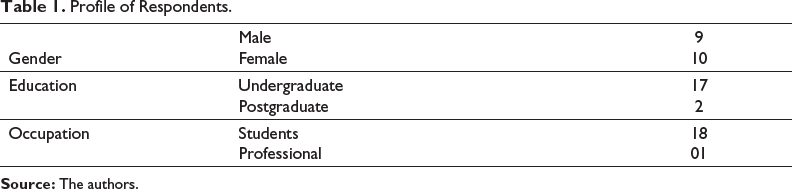
Of the 19 respondents, 9 were males and 10 were females. All the respondents belonged to the age group between 18 years and 23 years. A total of 16 respondents were pursuing undergraduate courses, 2 were in postgraduate and 1 was working as a professional (Table 1).
Profile of Respondents.
Data Analysis
The data were then analysed using thematic analysis. Thematic analysis is a search for themes that emerge as being important to the description of the phenomenon (Daly et al., 1997). The process involves the identification of themes through ‘careful reading and re-reading of the data’ (Rice & Ezzy, 1999, p. 258). It is a form of pattern recognition within the data, where emerging themes become the categories for analysis. There are various methods of analysing the qualitative data; a comprehensive list used in psychology is given by Madill and Gough (2008). The present study uses a content-coding approach (phase-wise) followed by thematic analysis as presented in the following discussion:
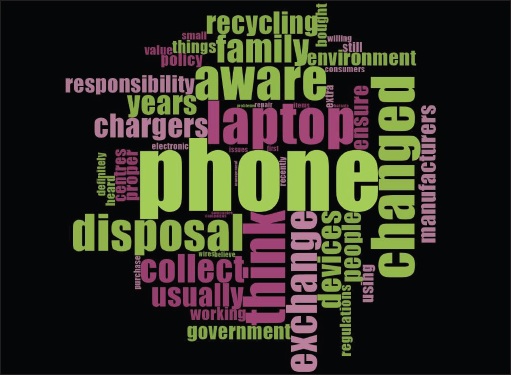
A generic overview of the pattern of the data and the themes around the discussion with the respondents was obtained. The transcripts were entered into the QSR Nvivo software, and by using the ‘auto coding’ option, an overview was taken. The results are presented in the word cloud generated, which depicts the most frequent words as presented in Figure 1.
The deductive a priori template of codes approach suggested by Crabtree and Miller (1999) was used as some of the codes were derived based on the existing theoretical framework of TPB explaining the disposal behaviour. The data-driven inductive approach of Boyatzis (1998) was also incorporated, allowing for the themes to emerge directly from the data using inductive coding.
The independent analysis by the researchers improved the reliability. Credibility is crucial for any qualitative study. As suggested by Lincoln and Guba (1985), prior engagement in the field, diligent data collection and persistent observation, and other criteria to ensure credibility in the findings were met.
An estimate was taken on the average life of the two most frequently used electronics by the young adults, that is, laptops and mobile phones, which were found to be 3.5 years and 5.6 years, respectively as shown in Table 2. The primary reasons for changing the devices included complete use upon a useful life, technical problems, obsolescence, alternate use, etc.
Average Life of Electronics (Laptops and Mobile Phones).

Research Findings
Interview Results and Analysis
The in-depth analysis of the interviews leads to the emergence of the various dimensions explaining the e-waste disposal behaviour. The dimensions are explained as follows:
Awareness.
Despite existing laws and regulations governing e-waste, the awareness level is minimal:
I have no idea about the laws and regulations related to e-waste. Being a Law student, I have read about certain acts and laws related to e-waste but not in detail. I have not heard about any e-waste laws and regulations in the country.
Interestingly, the youth are aware of the environmental hazards caused by e-waste:
I am aware of the hazardous effects of waste in form of toxic chemicals and radiation. I am aware that all these devices contain a lot of ferrous, non-ferrous and some toxic substances which are harmful for human consumption beyond their life. These devices also cause a lot of environmental problems if not disposed of properly.
But the knowledge of the environmental impact of e-waste is not getting translated into concrete actions by them. They are not aware of the steps to be taken to mitigate the negative consequences of e-waste:
I have not seen many recycling centres. I am slightly aware of the e-waste collection centres but have not seen or interacted with any of them in recent years. I have not seen any e-waste collection centres near me. We used to have one in our school, but since then, I have not seen any.
They agree that if the government and manufacturers jointly take the responsibility of creating awareness among the masses, then the results would be favourable.
I think most customers do not have sufficient knowledge about the disposal of e-waste and that is the reason why they do not think about recycling the e-waste. If they are made aware of it, they will be rethinking their decisions.
I think it is the lack of proper knowledge, which is responsible for this kind of behaviour.
If 100 people are made aware, then at least 10 would think to change their minds.
I am not aware of any policies of any manufacturers. I have heard about plastic waste but have not come across many people talking about e-waste.
Economic Value Versus Emotional Value Versus Future Value
The decision to discard or reuse the e-waste is dependent upon the value that one puts on the electronic product. These values are broadly categorized into three segments. First, the economic value, that is, what one gets in exchange in case one decides to discard the electronic product.
Economic value.
I have learnt about a few companies, which have policies where if we hand over the e-waste, a certain discount is offered on a new purchase. I chose to resell because the older one was of no use, and I prefer to get something in return for it. I will try to use my devices to their maximum potential, deriving the maximum economic value.
Second, the emotional value, that is, emotional attachment towards the electronic product because of which one does not want to discard the product:
Emotional value.
Got my first phone in the fifth standard, and I still keep it with me as a memory. I have seen my friends keeping their first phones as memories even if they are not functional anymore. I have kept that old phone with me because that was the first phone gifted by my parents.
Third, the future value, that is, the product might be used in some other way in future:
Future value.
I have kept the old phone to use as a backup in case any other phone in the family faces any issue. My old phone is still with me, which I have kept for emergency purposes. Laptops/mobiles can be modified according to our needs in future.
Attitude
Attitude in the present study constitutes two parts. One is the environmental concern of an individual, and the second is the perception of an individual regarding who is responsible for the e-waste disposal.
Environment concern.
The environmental concern is on two extremes, that is, either very high or nearly no concern at all:
Post the pandemic, people have realized and started paying more attention to the environmental issues. There has been a change in their outlook like I have seen in my family, my cousins who have become conscious of their actions. I have always been enthusiastic about researching and doing small things that create consciousness and make people realize the need to conserve the environment. The money is there on my mind. The environment is important, but, first, I will think about getting some value in exchange.
Responsibility of e-waste.
The question regarding the responsibility of e-waste has received a diverse response. The respondents feel that it is the responsibility of the government to take adequate steps for proper e-waste disposal, while others place equal responsibility on manufacturers and consumers as well:
I think it is the responsibility of the government to ensure that the e-waste is properly managed. They should discourage the planned obsolescence by brands. I think the government should take proactive steps in collaboration with manufacturers to make consumers aware of the hazards of e-waste. I think the manufacturers should bear the responsibility of proper disposal and should offer to buy back at the end of the useful life of the gadget. I believe the consumer is very much responsible for the proper disposal of e-waste, and we should support the government’s initiatives. The government alone cannot solve this menace, it can only make laws, but to follow them and make sure they are not violated is the responsibility of each consumer like us. I believe that it is everyone’s responsibility to carefully manage the e-waste.
Knowledge
Knowledge whether existing or acquired about the products and services plays a crucial role in purchase decisions. Sources such as social media, print media and educational institutions are found to be instrumental in disseminating knowledge.
Social media.
The increased proliferation of social media is felt everywhere. The young respondents in our study also reveal how the campaigns, active group discussions and sharing of knowledge about the initiatives by individuals, groups and organizations affect their intention to recycle electronic waste.
Whatever little knowledge, it is through some campaigns on Instagram and articles on Google.
I have been following various UN platforms where I read about differences in the e-waste policy of India and other western nations.
I have seen campaigns by some start-ups working in the direction of management of e-waste but not from any manufacturers or producers of electronic devices.
Print media.
Articles in newspapers and magazines, covering the recent government initiatives and campaigns provide necessary information to the users for making informed decisions about the disposal of e-waste:
I have read about the hazards of e-waste in a newspaper article but do not have any detailed idea about any laws or regulations. I have read some reports and articles about the hazards caused by e-waste. I have heard about some NGOs collecting e-waste and taking up the responsibility to recycle.
Educational institutions.
Our analysis reveals that the regular interacting points for the young adults like their schools and colleges have an impact on their recycling intention and subsequent behaviour. Programmes and initiatives in the form of competitions and extracurricular activities bring awareness and encourage discourses around the pressing issues.
I got to know and understand this menace through various sessions, activities, and competitions in schools and colleges.
Whatever I know about e-waste and other environmental problems, I gathered knowledge from classes on environmental science in college.
The primary source of my limited knowledge is through various events at college, Eco-Club events. When entrusted with the responsibility of being the co-convener, I have started thinking more about the environment and the issues related to its conservation.
I got to know about these problems through various sessions on sustainability organized in our college.
Perceived Behaviour Control
The perceived behaviour control has two distinct dimensions in the study, internal and external.
External dimension.
The external dimension reflects the availability of resources that may facilitate one’s ability to adopt certain behaviour. In this case, the external resources are defined as the easy access to recycling centres:
I have not seen any of the recycling centres in my vicinity. It’s very hard to find them. I am slightly aware of the e-waste collection centres but have not seen or interacted with any of them in recent years. I have not seen the e-recycling centres as such but have seen kiosks at metro stations where they take old phones.
Internal dimension.
The second dimension in PBC is internal, which defines one’s perceived ability to behave in a particular situation. In this case, an individual would be able to do the proper disposal of the e-waste if one has the confidence of the ability for the same:
Since childhood, we have learnt about recycling plastics and papers a lot more but not about e-waste recycling. In my home, no one has much knowledge and exposure to e-waste recycling. Had they known about it, we would have not collected that old stuff but rather contribute towards saving the environment in whatever little way we can. My family always supported the idea of contributing a bit to save the environment. Last Diwali, we thought of exchanging our old washing machine online, but the amount was not very big; therefore, we dropped the idea and then later gave it to NAMO e-waste only.
Subjective Norms
Parents, family members and friends also influence the behaviour:
I am following the same practice which my mother or my grandmother were following; we usually collect the waste over time and then give it to kabadiwalas. My mother’s habit is to keep everything for future use, to see if it can be used in the future. Why waste? No influence of friends but yes family plays a role, my father always told me to store these things separately.
Intention
The young consumers in our study are willing to pay extra and undertake efforts to ensure the proper disposal of e-waste. Pro-environmental policies and strategies by the manufacturers and transparent mechanism of disposal of electronic waste shape their intention:
I will be willing to pay extra to ensure proper disposal of used devices if the manufacturers have a transparent policy and build trust that they are doing what is being promised. The consumption of digital devices has increased a lot after Covid. All of us in the family have separate tablets and phones. So, a few years down the lane when their useful life will be over, we will ensure proper disposal of the electronic devices. I will try to give back to society in whatever little way I can. I will try to collect my e-waste and ensure to hand it over to e-waste collection centres. I am willing to take the initiative to go to the e-waste recycling centre once in 2 months.
E-waste Recycling Behaviour
The four distinct behaviours emanating from the study are giving away in charity, reselling, reusing, and discarding.
Giving away in charity.
There is a mixed response to charity as a way of disposal of the e-waste. The option of giving away the used electronics is not the first preference among the respondents:
For small items like headphones and chargers, I give them to my house help because they are still using some conventional models of phones. I have never thought of charity or donating them. We usually do some form of donation like food and clothing but not the electronic devices. I am willing to donate my laptops and phones to needy people rather than getting them exchanged because there are still lot many people, especially the underprivileged, who cannot think to afford them. If the laptop is working but is just outdated for me, I will try to give it to someone in need.
Resell
The young users do look at the resale value of the electronic product before taking any further decision regarding its disposal:
We exchanged an iPhone and brought a new phone in exchange. I think of reselling on portals like OLX and Quikr. I am interested to go for exchange of old devices and will try to sell to the same manufacturers from whom I will buy the new device We try to exchange all the expensive electronic items.
Reuse
Many users circulate the old devices to family or friends who have limited use after minor repairs:
I have kept the old phone to use as a backup in case any other phone in the family faces any issue. We also think of rotating and circulating in the family. My old phone was taken by my father then he gave it to my mother who uses it as it has a big screen to play videos. The old one is with us only; we are thinking of getting it repaired so that my younger brother can use it. About my old laptop, I am planning to keep it with me only as a backup because it is in working condition and with some minor repairs my younger sister would be able to use it.
Discard
In India, there exists a customary tradition of accumulating waste and handing it over to kabadiwalas. Small items like chargers and wires, which have no resale value or further utility, are often thrown into bins like regular waste, oblivious of the perils they may bring to the environment.
I usually put away small things like chargers and headphones in the dustbin only.
We usually collect the waste over time and then give it to kabadiwalas.
For the small items like chargers, headphones and earphones, we try to repair them but if they are completely worn out, we throw them in the dustbin.
Most of the time, I try to use the maximum, reuse spare parts, etc. If not of use, then I sell to local scrap dealers or kabadiwalas who come to pick them up from homes.
My mother and brother usually collect these old wires, chargers and headphones over time and then give them to kabadiwalas.
Proposed Conceptual Model
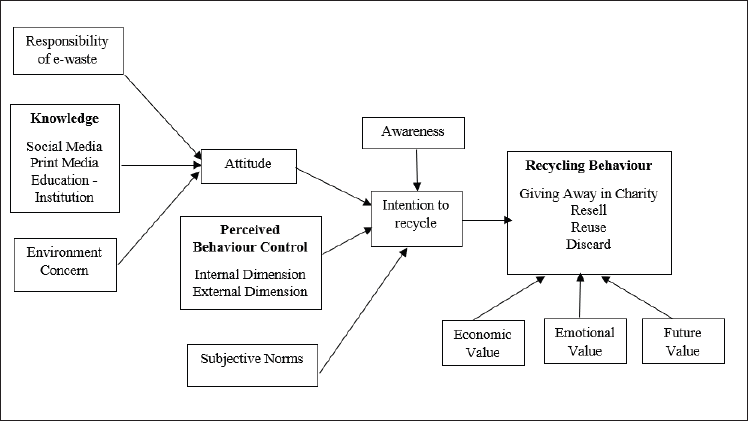
The present study has proposed the conceptual model as shown in Figure 2 after doing an exhaustive analysis of the interview statements.
Discussion
The recycling behaviour of the young consumers is divided into four categories, namely giving away in charity, resell, reuse and discard. These categories are similar to the previous studies (Bianchi & Birtwistle, 2012; Khan et al., 2019; Weber et al., 2017). On further analysis of the statements, it was found that there is a mixed response to giving away the electronic devices to charity: ‘I have never thought of charity or donating them. We usually do some form of donation like food and clothing but not electronic devices’. But the willingness to donate to the needy is present: ‘I am willing to donate my laptops and phones to needy people’.
It is more common to resell the used electronic device and get some economic benefit out of it: ‘If there is an exchange offer going on, we prefer to go for that’. The exchange can either be with the original manufacturer itself or on the independent exchange portals usually at the time of buying a new device. Alternate use, backup for exigencies and reuse within the family are observed. The respondents exhibit mixed behavioural patterns for discarding electronic devices. Few are very conscious and dispose of the electronic waste responsibly, but few others just throw the electronic devices with the normal waste. Most of them are aware of the concept of kabadiwalas or scrap dealers and try to sell their discarded items to them so that they can get some monetary benefits. Most of them are not aware of the e-waste collection centres.
One of the important aspects of the study is the conceptualization of the nature of the value that an individual places on the e-waste. Earlier studies have examined the concepts like ambivalence (Roster & Richins, 2009) and self-identity (Trudel et al., 2016) on the disposal behaviour of an individual. The present study is able to conceptualize the hidden values that an individual puts on e-waste. These values are economic value, emotional value and future value. The individuals looking for economic value for e-waste would look at the exchange opportunities for their old devices: ‘If the products are no longer in working condition, then I will consider getting them exchanged for some economic value’. The individual who is emotionally attached to his electronic device would like to keep it for as long as possible: ‘I have kept that old phone with me because that was the first phone gifted by my parents’. This aspect was considered in previous studies, and it was concluded that in countries like Mexico and India, people store e-waste for up to 8 and 14 years, respectively (Borthakur & Govind, 2016). People would look at alternative uses for their electronic devices and would like to keep them as backup devices so that they can use them in the future: ‘Usually, we keep old things, thinking they may be of some use, some spare parts can be used in future’.
There is a positive intention to dispose of e-waste and a WTP extra for the proper disposal of e-waste: ‘I am willing to pay extra to the manufacturer if they actively engage in management and ensure proper disposal of e-waste’. Awareness is associated with the recycling intention in past studies (Delcea et al., 2020; Echegaray & Hansstein, 2016; Khan et al., 2019; Wang et al., 2016). In the present study, it was found that though the respondents are aware of the environmental hazard of e-waste, they have a limited acknowledgement of the associated laws and regulations. Coherently, they believe that if the manufacturers and the government undertake awareness programmes, it would have a positive impact on their recycling intention: ‘I think it is the lack of awareness because of which people or even youngsters like us refrain from taking adequate measures to handle the e-waste’.
The attitude of the youth towards e-waste is shaped by three factors, namely, their knowledge, environmental concern and whom they think is responsible for the management of e-waste. The knowledge is gained from three sources, that is, social media, print media and educational institutions. Though they are conscious of the environmental hazards, individual concerns precede many: ‘While going for an exchange, my focus was more on monetary consideration rather than thinking about the environment’. Largely, the belief is to have government intervention and assumption of responsibility by them to handle e-waste. A complementary view suggests the sharing of responsibility by the consumers, and a few others think that it is the joint responsibility of all the stakeholders: ‘I feel that it is wrong to blame any single person, responsibility should be distributed and shared by all the stakeholders. Strict laws and regulations will bring a change’.
In the present study, two distinct dimensions of the perceived behavioural control were identified as the external dimension and internal dimension, respectively. These are similar to facilitating conditions and self-efficacy, respectively (Ajzen, 1991). In the present context, the external dimension is defined as the easy accessibility to the recycling centres: ‘I strongly believe that if people come across e-waste collection centers or bins at conspicuous places, they will try to use them’. The internal dimension is defined as the confidence to successfully manage the e-waste. The family plays a pertinent role in forming the recycling intention The results are similar to the previous studies carried out by Khan et al. (2019), Sari et al. (2021) and Valle et al. (2005).
Conclusion and Implications
The objective of this article was to study the factors influencing the e-waste disposal behaviour among young Indian consumers. The results of the qualitative analysis are summarized and presented in the form of a comprehensive conceptual model. In line with the TPB, attitude, PBC and subjective norms affect the intention to recycle the e-waste. Additionally, the perceptions regarding the responsibility to manage e-waste; knowledge through social media, print media and educational institutions; and concern for the environment play an important role in attitude formation. Awareness also impacts the recycling intention. Recycling behaviour is manifested in four forms, namely giving away in charity, reselling, reusing and discarding. Economic, emotional and future values also impact the behaviour.
The study has important academic and practical significance. From an academic perspective, the conceptual model extends the TPB in the context of e-waste disposal behaviour. Previous studies confirmed the use of TPB in explaining pro-environmental behaviours (Dixit & Badgaiyan, 2016; Echegaray & Hansstein, 2016) but had their limitations. The role of external sources and expertise (Strydom, 2018) and awareness regarding the harmful effects on the environment (Akhtar et al., 2014) were precluded. The authors attempted to fill this gap and propose a model that is all-encompassing. The literature also suggests that factors like the shortage of recycling facilities (Sidique et al., 2010) and lack of incentives (Dixit & Badgaiyan, 2016) affect our dealings with the environment. This is reflected in the research model proposed in the study, which puts the responsibility to manage e-waste as an important antecedent affecting the attitude and necessitates a call for action by various stakeholders.
From a practical perspective, the findings would help the government to take decisive steps to tackle the menace caused by e-waste. The legislation is already in place (CPCB, 2016), and some recent initiatives such as electronic waste parks (The Times of India, 2021), websites and toll-free support mechanisms in the capital city (Sharma, 2021) are encouraging. Focus on creating awareness using social and print media, mobilizing youth via educational institutions, shared responsibility and stringent regulations can provide cutting-edge solutions. From the industrial and managerial perspective, this study offers logical implications for the manufacturers to share the responsibility and devise policies that encourage consumers looking for exchange value to safely hand over the used products. Setting up recycling centres, arranging e-waste pick up, partnering with not-for-profit organizations and conspicuous implementation of existing laws and regulations can help the producers. Reconditioning and remanufacturing the e-waste can help in better management and revenue generation as well by extracting valuable components from e-waste. Finally, the consumers should also claim responsibility to avoid the dire health hazards and ensure sustainable consumption of EEE.
Limitations and Scope for Future Research
Despite the cautions in each step of data collection, coding process, interpretation and analysis, the generalization of the research findings needs a more pragmatic and prudent approach. The homogeneous sample of young students is relevant for the study, but with their limited experiences and preferences, a larger sample (cross-generational) from other parts of the country is urged by future researchers. The effects of demographic, psychological and cultural variables, beyond the scope of the current study, unlock the opportunity for future research. The effects of variables like moral norms and convenience in our model would perhaps make it more robust. A quantitative investigation based on the conceptual model with a large sample size and a rigorous approach like the structural equation modelling (SEM) is proposed.
Footnotes
Declaration of Conflicting Interests
The authors declared no potential conflicts of interest with respect to the research, authorship and/or publication of this article.
Funding
The authors received no financial support for the research, authorship and/or publication of this article.
