







Abstract
Cluster initiatives are an essential way to increase the competitiveness of enterprises, especially micro, small and medium enterprises (MSMEs) within the region. Therefore, building a strong cluster brand is a prerequisite for a successful cluster initiative. However, the concept of cluster branding in MSMEs handloom clusters remains unexplored in India. The drive of this research was to examine the role of branding as a strategic asset and how it plays an instrumental role in the overall growth of MSMEs clusters, with a specific focus on handloom clusters of Gujarat, India.
Using the grounded theory approach, semi-structured interviews were conducted in the Surendranagar saree cluster in Gujarat, India. The study led to the formulation of strategies for cluster branding, along with the benefits and impacts on member MSMEs of the handloom cluster. Finally, a framework is proposed as the outcome of qualitative research which may be helpful to the stakeholders in taking the clusters to the next level in the era of globalization and competitive environment.
Keywords
Introduction
In the existing market environment, which is primarily characterized by intensifying regional and global competition, and rapid technological change, most companies are heading towards the growth of collaboration systems as they can improve their competitiveness through partnerships (Porter, 1985). Networks and clusters have emerged as key points in these collaboration solutions. The collaborative innovation network can be described as a group of people, institutions and companies with a common vision of working and exchanging ideas and information over the network (Ketels, 2013). Clusters are geographic concentrations of interconnected enterprises or organizations that create products or provide services in a specific field or industry and networks can be identified within clusters (Negruşa et al., 2014). Companies aim to develop joint solutions and pool resources in order to capitalize on the market potential of certain infrastructure (Crombie, 2011). Under the new organizational structure, inter-organizational relationships have led to new business opportunities that have become viable based on (inter-organizational) collaborative networks (Franco et al., 2020).
Clusters and networks share some common characteristics. Both are conceptually placed between uncoordinated and organic structure, and the connectivity between their actors exists outside of the market’s price mechanism (Learch & Muller-Seitz, 2012). Porter defines a cluster as a self-enforcing mechanism that encourages enterprises in the cluster to pursue competitive strategies (Porter, 1985). We can understand clusters as, ‘geographic concentrations of interconnected companies, specialized suppliers, service providers and associated institutions in a particular field that are present in a nation or region’ (Porter, 1990). Without a doubt, the definition of clusters given in this study is the most widely recognized.
The benefits of being positioned in an established cluster, such as larger local markets for products and services, have been extensively studied in the literature. Reduced transportation expenses, quicker access to resources, a competitive atmosphere that boosts motivation, and specialized talent pools (Porter, 1998). The proximity of enterprises in the same industry allows for direct information and idea exchange, as well as the fluctuation of staff (Carlino, 2001). Networking and cooperation within a cluster is organized and inspired by cluster initiatives to promote cluster development (Solvell et al., 2003).
An efficiently managed cluster initiative is listed as one of the crucial factors of cluster success (Baptista & Swann, 1998). Only clusters with quality in management can maintain their competitiveness in the global economy (Koszarek, 2013). Global competition is no longer between companies but gradually between regions as advocates of location factors (Boschma, 2004; Storper, 1997). As a result, in this competitive environment, clusters must distinguish themselves. And for this motive, many of the clusters are beginning to place a more strategic emphasis on the development of a branding and marketing strategy. Although academics and practitioners recognize cluster branding and marketing as a relevant issue, the existing literature in this field is scarce (Koszarek, 2013; Mauroner & Zorn, 2017; Vainola, 2015). Subsequently, a significant number of cluster creation projects have already been launched and others are on the verge of being launched from the point of view of economic policymaking, technical progress and innovation process, for example, the leather cluster at Santiniketan and Chennai, India and the Alleppey Coir cluster of Kerala, India where mainly the attempts were made for policy making and technological upgradation (Pal, 2013; Sarkar, 2006). But the literature review demonstrated how branding and its impacts on Indian clusters and micro, small and medium enterprises (MSMEs) are greatly neglected. Therefore, this study is an attempt to go beyond technological advancement and policymaking and focus on branding and its importance.
The aim of this study is to provide an outline of the concept of cluster branding and how it provides competitive advantage to member MSMEs. Furthermore, this article discusses strategies and actions that can be taken within cluster policies to promote cluster branding activities. When it comes to the scope of the study, it focuses on the handloom cluster of Gujarat. With regards to finalizing the scope of the study, a thorough literature review was conducted, and it was found that states of the western region of the country, which includes the state of Gujarat have the maximum numbers of established clusters (UNIDO, 2018). And the reason to work in the handloom sector was that the prevalence of textile clusters in Gujarat are historically established and lacked intervention in terms of branding practices.
Literature Review
The research has used several online databases to identify the research gap; sources were electronic databases such as Wiley online library, EBSCO host, Science Direct and PROQUEST. The main objective of the review was to examine research on how knowledge in this subject has advanced in the field (Ghosh & Gurunathan, 2015). The use of peer-reviewed primary studies ensures a high degree of quality, thus supporting the validity of all results and conclusions. The literature review for this article is structured into the following sections, understanding brands and branding, followed by the concept of clusters branding, then understanding the handloom sector and the handloom clusters of India, and finally the summary view of the Surendranagar saree cluster.
Brands and Branding
The use of peer-reviewed primary studies ensured a high degree of quality, thus supporting the validity of all results and conclusions (Kotler, 1988). A trademark is a guarantee that provides a defined set of features, benefits and services (Koszarek, 2013). It is significant to underline that branding symbolizes much more than just mere names or logos. It is a trademark’s blend of tangible and intangible aspects that generates influence and values. It allows for the establishment of a long-term relationship with clients who are frequently influenced by brands while making purchasing decisions. ‘Branding success is defined by the ability to maintain these additional values in the face of competition’ (De Chernatony & McDonald, 2003). Because it is associated with a distinct identity and assurance of authenticity, branding is the belief that one product is rendered more valuable or has more equity than another (Winfield-Pfefferkorn, 2005).
Today, as the world is becoming smaller, due to globalization, it opens up many prospects for businesses to flourish across the globe, but it does present a challenge. This global place also gives birth to a complicated business environment, where no company can think of sustaining in isolation and clusters are no exception (Porter, 1998). However, the branding of such clusters is frequently poorly structured since it tends to simply slap generic brand names on a group of enterprises sharing the same industry (Mihailovich, 2006).
Cluster Branding
The objective of cluster branding is to develop the overall image and reputation of business clusters and destinations (Andersson et al., 2012). We can understand cluster branding as ‘the way a cluster manages its reputation and archives a distinct position based on its identity and what it does most effectively’ (Andersson et al., 2012). Cluster branding, they claim, is mostly about communication and behaviour, rather than marketing communication. Common branding tactics such as corporate and umbrella brand management, on the other hand, cannot be used for cluster branding since corporate branding is a more stable process than cluster branding (Kasabov & Sundaram, 2013). Corporate branding inside major firms with complicated brand portfolios has clear organizational boundaries, whereas managing places or clusters as brandable entities is not so straightforward (Kasabov & Sundaram, 2013).
The main distinguishing feature of cluster branding over corporate branding is that it is a true public good that benefits a variety of stakeholders and serves a variety of goals (Vainola, 2015). Despite the fact that cluster branding is a management issue, it frequently involves actors from both the private and public sectors (Andersson et al., 2012). This is also what makes it challenging. Cluster branding necessitates careful consideration of the management of conflict, disagreement and discord among the various stakeholder groups’ various interests due to the multiple actors involved (Kasabov & Sundaram, 2013). Cluster marketing and cluster branding are two distinct functions that should not be confused with one other. The term marketing is used in the cluster context to indicate the promotion to promote the sale of the cluster’s or cluster members’ products or services and cluster branding, on the other hand, relates to enhancing the cluster’s entire reputation and image (Andersson et al., 2012).
Clusters have established a substantial competitive advantage in terms of lowering transaction costs, gaining an external economy, improving creative purposes, enticing foreign investment to help regional economic growth, and so on, delivering a favourable pullulating climate for the conception of well-known brands (Wang & Zhang, 2011). The branding of the business cluster has the prospective to attract not only resources and investments but also to add to the overall development of the area (Kasabov & Sundaram, 2013) because of the frequent interactions that exist among business clusters and the locations where they are located. A supplementary advantage of branding is that it can aid as a ‘quality label’, which companies in the cluster can use it as a reference (Andersson et al., 2012). It regulates buyers’ judgement of risk and so has a legitimizing consequence, particularly when in the context of SMEs and MSMEs. We can understand that cluster branding as a purpose of cluster management is the procedure of recognizing the character of a specific cluster brand and expressing this basic element among the stakeholders who are being targeted, the aim is to raise brand recognition, credibility and loyalty (Mauroner & Zorn, 2017). Because of the in-depth study, it can be possible to differentiate relevant branding strategies for handloom clusters.
Handloom Sector and Handloom Clusters of India
Handlooms have a long and illustrious history in India. It is India’s ancient manufacturing and trading practice. The handloom industry plays a significant part in the economy, despite its unorganized existence. After agriculture, the textile industry is the second largest employer (Das et al., 2016). It not only serves one of the primary needs, but also contributes significantly to industrial production, job growth and export earnings. And for this study, we can understand handloom clusters as a location with a high concentration of handlooms generating high demand niche fabrics on handlooms (Beddig, 2008). ‘The spinning wheel is a nation’s second lung,’ said Mahatma Gandhi. Weaving by hand is an integral part of India’s cultural heritage (Das et al., 2016). Handlooms are not rare in India. It has a long tradition of manufacturing high-quality handloom pieces with unparalleled experience and craftsmanship throughout the world (Ministry of Textiles, 2021). The handloom sector in India is unique in that it provides significant jobs, fabric manufacturing and value addition while also preserving India’s rich cultural heritage (Ministry of Micro, Small and Medium Enterprises [MSME], 2020).
Despite the widespread availability of handloom goods around the world, the industry’s capacity has been discovered to be substantially underutilized (Phukan, 2012). According to a study conducted by the Ministry of Textiles in 2016, the Indian handloom sector can boost revenue by creating recognition for its superior quality among the young generation through special initiatives in branding, marketing across digital media, embracing social media and e- commerce (Ministry of Textiles, 2016). The report additionally explained how handloom clothing materials have not been as popular among the young generation because of a lack of promotion and publicity. Thus, it is suggested that branding and marketing are the key elements of popularizing handloom products. Branding will not only provide an assertion to consumers but also support the development agenda of the handloom industry. But most of the past studies on cluster handlooms in India have only concentrated on production, environmental sustainability and development of handloom weavers’ skills and techniques. But when it comes to branding strategies, the literature is very scarce, thus the current study is an attempt in that direction.
Summary View of the Surendranagar Saree Clusters (Gujarat)
Gujarat is a state in India that lies on the Arabian Sea’s western shore. The state is bordered on the northwest by Pakistan, and on the north, east, and southeast by the Indian states of Rajasthan, Madhya Pradesh, and Maharashtra. Ahmedabad is the state’s largest city, and one of India’s most significant textile centres. Gujarat has a thriving garment industry that contributes to India’s art and crafts.
Clusters of Gujarat: The government of Gujarat has laid special emphasis on the development of small clusters of cottage industries. A scheme under the commissioner of cottage industries is aimed at the development of artisan clusters. The scheme’s major goal is to help artisans to manufacture high-quality products that are widely accepted in the global market (Govt of Gujarat, 2021). For Gujarat, under the state government scheme, the cluster development scheme has been implemented from 2003 to 2004 for the development of a group of artisans from different sectors in different parts of the state (Govt of Gujarat, 2021). The district industry centre of the concerned district is functioning as the implementing agency of this scheme. Handlooms of Gujarat: It has a wide range of handicrafts. Folktales and festivals are expressed by embroidery, beadwork, wood crafts, printed and woven clothing, pottery, and native paintings. The unique variety of these craftsmen’s and weavers’ works, imbued with the social and cultural hues of the area from which they emerged, are unique in the design and craftsmanship (Garvi Gurjari, 2021). Today, far moved from the hut or the village of the craftsman, handicrafts now adorn the homes of the wealthy, as well as five-star hotels both at home and abroad. Brief History of the Cluster and the Craft: Surendranagar was ruled by typical Gujarat dynasties who ruled over the state’s various regions. The two important crafts of the Surendranagar cluster are: Tangaliya weave and Patola weave.
Tangaliya Weave
A one-of-a-kind art form with a dotted splendour is produced in Gujarat’s Surendranagar district. The Dangasia people who live in this area are the only ones who are familiar with the Tangaliya weaving technique (Patil, 2019). Tangaliya, which derives its name from the tang or knee is a black dotted wrapped skirt with contrasting embellishments made by woven dotted forms worn by women of the Bharwad group (Textiles of India, 2019).
Tangaliya’s distinctive identity is created by twisting tiny dots of extra weft to create the illusion of bead embroidery. The fabric woven on a pit loom is normally narrow in width and 20 feet high and it is then cut in half and stitched together. Beautiful designs and forms are created by the complex process of twisting the extra weft while weaving (Textiles of India, 2019).
Single Ikat Patola Weave
Different types and styles of sarees are worn by Indian women. One form of saree is Patola. Patola is derived from the Sanskrit word ‘Pattkalam’ (Khant & Samani, 2016). Patan Patola is a symbol of our heritage in the form of rich traditional art and crafts. The fabrics are spun on a handloom, and the Patola weaving technique is known for its delicate weaving, which results in a soft finish on both sides of the cloth (Khant & Samani, 2016).
Ikat is the lengthy process of typing and dyeing the weft or wrap, or both, before weaving it into a textile shape. Interweaving tied and dyed warp with plain weft or resisted weft yarns are inserted in plain weft yarn to create a single Ikat fabric (Sathe & Bhatia, 2015). Double ikat is a technique that involves resisting both the wrap and the weft before interlacing them to create an intricate yet well-composed pattern (Sathe & Bhatia, 2015).
Methodology
This research is based on exploratory qualitative methods, which gives the researcher insights when there is little knowledge about the subject (Chawla & Sodhi, 2011). The idea was to develop a theoretical model concerning the branding strategies for handloom clusters. In-depth interviews were conducted in the comfort of their own homes or at their workplaces. This method was followed as it safeguards that the interviewees could respond freely without being judged by others or any external factors (Arora et al., 2019). In addition, for this study, telephonic interviews were considered for data collection, keeping in mind the COVID-19 pandemic, as it became difficult to travel and visit clusters physically for data collection. The interview approach was found to be appropriate for the study because interview replies had more depth and meaning than those expressed on a surface level by questionnaire methods (Breakwell et al., 2006; Eves & Dervisi, 2005; Kim et al., 2003). To explore the data acquired through individual in-depth interviews, the study used a grounded theory (GT) research approach (Corbin & Strauss, 1990). In social science research, the grounded theory approach is extensively employed (Kaur & Malik, 2020).
Glaser and Strauss (1965) proposed GT in response to a pressing need in social research to develop new hypotheses rather than simply testing old ones. Grounded theory is a qualitative research method that uses a methodical approach to construct an inductively derived theory about a phenomenon (Bryant & Charmaz, 2006; Corbin & Strauss, 1990). This approach is mostly used to develop new theories about a phenomenon, emphasizing on the respondent’s reality rather than hypotheses and assumptions about the actual process (Glaser & Strauss, 1965). As a result, it will assist academics in developing a theoretical model by giving data with conceptual labels. This study’s participants were chosen using a criteria-based snowball sampling technique. The references from the original individuals were utilized to generate new subjects in the snowball sampling technique (Breakwell et al., 2006). For instance, for cluster development executives, the contacts were provided by the weaver service centres of that state, which were also interviewed under the support institutions, and further, the cluster managers/cluster development executives provided contacts of the member handloom owners and managers and further these member handloom managers provided contacts of the other members as well. The following are the considerations for sampling techniques.
Sampling Unit: The study considered the saree handloom cluster from Surendranagar district, Gujarat. Sampling elements: Sampling elements of the study were finalized after taking opinions from Industry experts. In this study, a triangulation of multiple data sources was followed, taking in perspective from different stakeholders. This helped to capture a better and fair understanding of the topic. The sampling elements were, Cluster development executives (CDE)/Cluster Managers, Support Institutions and Member Handloom Managers/Owners (member MSMEs companies). The study interviewed one Cluster manager, (CDE), eleven handloom managers/owners and three support institutions. As a result, 15 semi-structured interviews were held. The interviews were of 15–20 minutes. Researchers taped the interviews and took notes on everything that happened.
The data from the interviews were examined using a grounded theory approach, and coding was an important phase in data analysis (as an iterative process) in which data was broken down, conceptualized and categorized multiple times to enable a context-specific theory to emerge (Corbin & Strauss, 2014). As a consequence, a frequent comparison analysis was carried out during the data gathering and processing method.
After each interview, data was transcribed, open coding was used, and codes, subcategories and categories were identified. Then, to find and clarify relationships between categories and subcategories, axial coding was applied. Then, there was the selective coding technique, which found the core category and then associated it to all other recognised categories. The emergent theory’s development could be completed at that point.
All interview transcripts were uploaded to a Microsoft word document, and MAXQDA software was used to code them. Researchers can now employ qualitative software to reproduce the sophisticated data analysis process utilizing qualitative software. The use of qualitative software allows the same process to be carried out without the need for complicated data analysis tools. The use of qualitative software has expanded the range of methods researchers can use to complete the coding cycle (Williams & Moser, 2019). Each phase of coding must still be completed by the researcher; the software just helps the recording of the researcher’s coding and meaning development. In grounded theory, data analysis entails certain techniques that, when used correctly and with attentiveness, result in a theory that is rigorous and well- based in the data (Lawrence & Tar, 2013).
Analysis
This part begins with a detailed overview of the theoretical framework, followed by a discussion of the topics that emerged from the investigation. Based on the responses to the research objectives, a specific conceptual and practical model for establishing and maintaining cluster branding and its impacts on the handloom saree cluster was developed. Categories were gradually developed from the research data using grounded theory. The findings were identified from a critical assessment of the relevant literature followed by integration with respondent viewpoints and documentary records. This demonstrated how all of the data were intertwined in a web of meaning depending on context and literature. As a result, a context- specific theory and model on cluster branding and its implications for the saree handloom cluster was developed. The model was based on the following conditions: causal, contextual and intervening, followed by actions/interactions which were influencing the phenomenon.
Three types of categories emerged: strategies/processes, consequences/outcomes and others. The last stage of the coding procedure (i.e., selective coding) made use of a web of linkages to connect categories in an intertwined mesh of relationships of cluster branding and its impacts concerning the categories mentioned above. The findings indicated the context-specific method to cluster branding and seven causative conditions, four contexts, two intervening conditions, five tactics, and two outcomes all contribute to its influence. The outcomes of cluster branding and their impacts as well as the core category representing the core phenomenon were discovered. Cluster brand promotion and development as assisting the growth of MSMEs, who are the member companies of saree handloom cluster, emerged from participant replies.
The grounded theory conceptual model: A description of the diagrammatic illustration in Figure 1
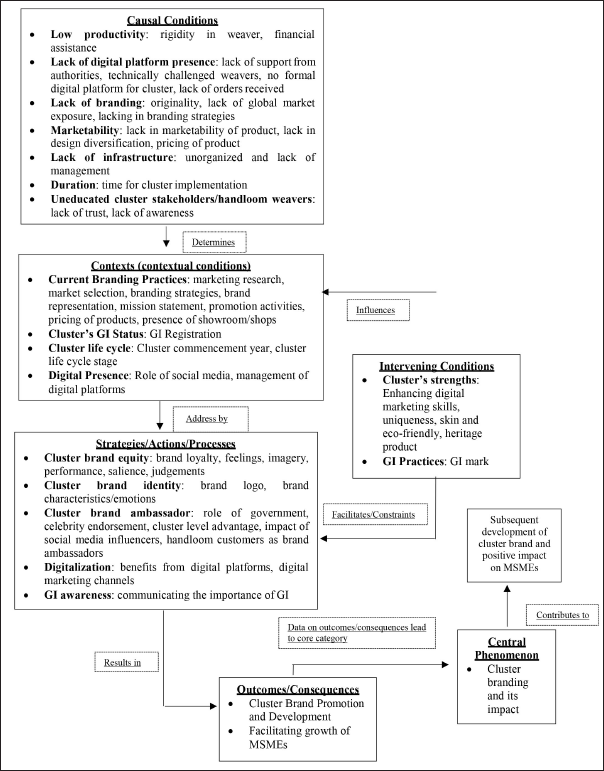
Figure 1 shows the links between all of the selected categories as a series of linkages that characterize cluster branding and its effects (the core category) in terms of causal factors, contexts, intervening conditions, methods and outcomes. Events that lead to the initiation or development of cluster branding, as well as its results were classified as causal conditions. Contexts were used to describe the conditions under which strategies were used to evaluate cluster branding and its effects. Intervening conditions functioned in a manner resulting in either enhancing or constraining the processes in a certain context. They reflect a wide range of conditions relating to cluster branding and its implications.
To control cluster branding, tactics were applied in a specific set of conditions with specific outcomes. The outcomes/consequences of the action and interaction strategies/processes were the outcomes or results of the strategies/processes. All the conditions were linked in a web of meaning using data from the environment as well as literature. As a result, a context-specific theory for cluster branding for saree handloom clusters in western India was developed. The arrows in Figure 1 indicate the chain of cause-and-effect linkages, between the boxes in arriving at the conclusion, cluster branding and its consequences.
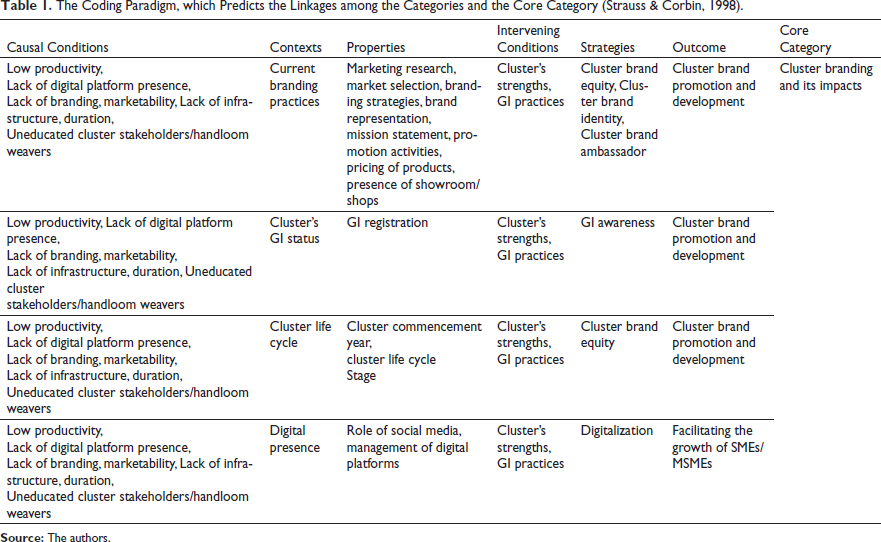
To construct the emerging concept, check the relationships among its pieces, and refine and expand the categories to give theory depth, a paradigm model based on the coding paradigm was created (Table 1). In a sequence of relationships, the paradigm model was utilized to connect categories, attributes and the core category. These connections explained the set of factors of cause and contextual conditions, as well as actions/interactions strategies and their outcomes.
The Coding Paradigm, which Predicts the Linkages among the Categories and the Core Category (Strauss & Corbin, 1998).
Discussion, Key Findings and Recommendations
Based on the above-mentioned factors, the branding strategies for saree handloom clusters were identified. Through the investigation of interview data, the procedure for cluster branding and its effects were identified along with the current condition of the branding aspect in the cluster.
Current Branding Condition of the Surendranagar Saree Cluster
The cluster of Surendranagar is unique as it caters to two types of art, the art of Patola, which is very popular and people know about it, but on the other hand, it caters to the art of Tangaliya which is on the verge of extinction. In the cluster of Surendranagar, there is no sole government body responsible for developing a cluster brand, but there are a lot of support institutions involved with this cluster who are providing a great helping hand in providing a branding aspect to the cluster. The government of Gujarat is also realizing the importance of branding and is working towards it in collaboration with various support institutions for the cluster.
The government of Gujarat is regularly arranging buyer-seller meets for handloom products which are being organized by Gujarat State Handloom and Handicrafts Development Corporation Ltd (GSHHDC) (Patel, 2015). There have been many fashions shows as well promoting the handloom textiles of Gujarat on whole, which has included the art of single ikat Patola and Tangaliya. Support organizations such as EDI, Ahmedabad, etc., are also assisting in the promotion of the cluster. COVID-19 had an influence on traditional markets and weavers across the handloom clusters were experiencing serious financial difficulties. To boost their morale, a virtual exhibition was organized from the 1st to the 3rd of August 2020 (Trade Fair Times, 2020). The virtual exhibition was a great tool to promote and showcase the handloom cluster of Surendranagar, it gave the perfect opportunity for sales and networking. The government of Gujarat is also trying to promote the craft through various ways; they portray it on tourism websites. The GSHHDC has provided marketing backing to the artisans/weavers by acquiring the products and marketing through its chain of Garvi-Gujarat emporia, which have their showrooms all around Gujarat, as well as an e-commerce platform for the various handlooms of Gujarat. But it was noticed that there is no dedicated website by the government only for the cluster of Surendranagar, promoting the two crafts.
Currently, geographical indication (GI) is playing an integral role in the Surendranagar cluster. Both the crafts are GI protected. But still, there is a long road ahead, there is no united cluster logo representing both the crafts. There is a strong need to create a unique brand identity for the cluster.
Cluster branding practices were assessed to provide the current perspective of branding practices and strategies carried by the cluster, this helped to further determine the causal conditions and the relevant strategies of the phenomenon. The operational definition of current branding practice was formed from the consolidation of numerous comments made by respondents, who mainly consisted of the cluster development executives and the handloom owners across all the three states clusters.
Through this category, the following properties emerged, the respondents gave their perspectives on marketing research, market selection, mission statement, promotion activities, pricing of products and the presence of showrooms and shops (Figure 1). It is recommended to the cluster managers and weavers to put in combined efforts for marketing research for the cluster, specifically to understand the target audience and their needs, for example, if the age of the customers is in the mid-twenties to mid-thirties, then it is recommended to produce more plain sarees concentrating on the youth in target audience. This will also help the cluster to brand their identity as something for the youth as well. From this, it appears that the cluster and its members have not recognised the competencies of effective branding and marketing of the cluster. And the same views were supported by a literature review as well, which is why it is strongly recommended that cluster initiatives should focus on increasing their visibility, marketing and branding of the cluster, also now concentrating on the youth of the country, which was found missing during the interviews with important stakeholders of the clusters; if implemented, it will be strategic in the development of brand of the cluster (Koszarek, 2013). This category also helped in the recognition of relevant causal conditions of the phenomenon. The identification and recognition of these causal and contextual conditions helped in the formulation of relevant strategies for cluster branding.
Through the analysis and the findings, it is recommended that the clusters should have a dedicated branding strategy. At the cluster level, adequate planning and execution of the branding strategy are required. The cluster branding model (Figure 1) suggests five categories identified during the analysis process, as strategies for managing the cluster branding phenomenon. The five strategies are cluster brand equity, cluster brand identity, cluster brand ambassador, digitalization and GI awareness.
The cluster’s customers need to be made aware of the importance of the cluster’s products and the cluster’s brand. It is recommended that the cluster should not create a brand just merely about selling but also telling the history and story behind the weave of the saree and the overall product. And these stories can be communicated to the customers by writing them on the social media handles of the cluster and the individual social media handles of the handlooms. The customers need to associate with the overall brand of the cluster. It is also recommended that the cluster branding strategy should be planned and developed keeping in mind the current cluster’s life cycle stage. It is important to understand the different phases of the cluster life cycle to determine what kind of branding activities should take place in each of the phases. The cluster life cycle model according to (Andersson et al., 2012) was recommended for the Surendranagar cluster. The model has four stages which are embryonic, establishing, mature and declining. And through the interviews, it was established that the cluster was somewhere in between the first two stages of the model. Therefore, it is recommended that the cluster branding practices should be more concentrated on increasing attractiveness and differentiation according to the cluster life cycle model by (Andersson et al., 2012). To establish a suitable branding strategy for the cluster, the stage of its life cycle should be carefully identified. The findings recommended that there needs to be special attention given to the GI aspect of the cluster. There is a need for awareness among the cluster’s stakeholders as well as the cluster’s customers. The digitalization aspect of the cluster also needs to be paid special attention to, as indicated, there should be an official digital platform for each cluster. Therefore, it is suggested that there is a strong need for the cluster brand to increase its digital visibility.
Branding Strategies for the Surendranagar Saree Cluster
Cluster Brand Identity: The literature suggests applying identity-based brand awareness as a framework of orientation for managing place brands—and thus also for managing cluster brands. A common group identity among the cluster actors is a key factor for a cluster brand (Mauroner & Zorn, 2017). The operational definition of cluster brand identity was developed by combining the responses of numerous respondents, which refers to a process through which the overall cluster brands and the individual handlooms can distinguish themselves, through the help of visual elements like a brand logo and product characteristics which are unique. Through the participant’s responses it was clear that currently, neither the cluster nor the member handloom companies have any visual elements like an individual logo or a cluster logo which they were using.
When it comes to brand logo at individual handloom level, the handloom owners though had no idea about the importance of a logo but were using silk mark and handloom marks which were registered and provided by the government for all the handloom and silk products; it was not helping the handlooms and eventually the cluster to create its own unique brand identity. Few handloom owners were just using their visiting cards in packaging and considering it as the only part of the visual element of their brand. There needs to be strong importance and recognition of visual elements like the brand logo, in the cluster.
As per the cluster development executives and the members of handloom owners of the cluster, the brand characteristics/emotions emerged as the second property of the category cluster brand identity. And they reflected that emotions like owning a heritage product, a unique craft, proud feeling, feel-good factor and royal feeling factor were generally associated by their customers and with their brand. Brand characteristics like trustworthiness, quality assurance, durability and handcrafted were associated as well. But the issue is though it is reflected through the responses of the handloom owners and the cluster development executives, that their customers think about their brand through the above-mentioned parameters but there is a strong need for the cluster to further communicate these characteristics to the audience, they need to be aware of these characteristics of the brand.
GI Awareness: According to respondents, the GI was frequently used by the handloom owners and the cluster development executives for representation of their brand, instead of the logo. The operational definition formed, through the response’s amalgamation of participants, described that GI awareness refers to a process of creating awareness for the use of GI logo and its importance, eventually making the handloom owners, and the end customers more aware and empowered. Thus, this category was recognised as the strategy for the phenomena implementation.
It is recommended that the cluster needs to have exclusivity, thus they should properly plan their cluster brand identity strategy. The clusters need to work on their visibility; they should distinguish themselves with the help of a brand logo. It is recommended for the clusters to develop an exclusive logo for the cluster as a whole, to create brand identity in the minds of their customers. Through the interviews, it was recommended that the cluster should create a logo, showcasing the core of their weave and product, which could then communicate the essence, and it was recommended to design a logo at the cluster level keeping in mind the characteristics of the product, especially the weave of both the crafts and blend, that is uniqueness and intricacy of the weaves.
Another important guide to creating cluster brand identity was identified through the cluster’s products’ characteristics/emotions. It is recommended that the customers should be told that the products have a heritage value, unique craft; they should feel proud for possessing such handmade products. Thus, there should be a feel-good factor to be associated with the product. It is also recommended for the clusters to highlight product characteristics like trustworthiness, quality assurance, durability and handcrafted. Once these are communicated to the cluster’s customers properly, it will help the clusters in the creation of a strong cluster brand and have positive implications on not only the cluster, but also it will extend to the level of individual member handloom companies.
Cluster Brand Equity: Several respondents’ comments were incorporated into the operational definition of cluster brand equity. It signifies the worth of the cluster and the handloom as a brand. Through this research, the following were the important properties of cluster brand equity that emerged from participants’ responses. These properties tried understanding the concept of cluster brand equity from the perspective of the handloom owners and the cluster development executives first, and not the customers. The customer’s perspective can be taken in future research on the cluster’s brand equity. The following properties were identified during and brand judgement were the properties studied. These properties can be considered as when it comes to brand loyalty, the cluster’s customers are loyal to the cluster and its and the resellers of the products, which is also due to long term relationships. But the same was in establishing a close relationship with their online customers. For example, they can start an #Tangaliyaqueens or #Ikatrani or #mysareemystory involving social media posts involving This process; hence, a step towards creating customer loyalty for the cluster and its products. The brand feelings of the customers were mainly feelings of delight, pride, trustworthiness and satisfaction. The brand imagery reflected fulfilling the social and psychological needs of the cluster’s customers. The brand performance parameters were mainly the qualities of the handloom brand, which the customers measure the cluster and the handloom with. The brand judgements, refer to the handloom owner’s perspective on how their customers are fond of their handloom products and they have positive reviews.
It is recommended for cluster stakeholders to understand the importance of cluster brand equity. It is suggested that the perspectives of the cluster’s customers should be understood and, further, a dedicated cluster equity strategy should be developed. For example, aspects like repeat purchases (identified from responses) and its indicators should be understood well, and how it helps to create brand loyalty in the mind of customers. Though it was found that there is brand loyalty from offline customers like the resellers, the same needs to be developed especially for customers coming from digital platforms. For future research, it is recommended to develop a model for creating brand equity, for clusters specifically keeping in mind business-to-business (B2B) perspectives.
Cluster Brand Ambassador: —The research found that cluster brand ambassador was one of the strategies suggested for the implementation of the phenomena. The category cluster brand ambassador refers to a process of representing the cluster and its products and influences the customers to increase the brand visibility of the cluster. The cluster development executive expressed that though their cluster does not have a formal position of a cluster brand ambassador, they have a very positive outlook towards the strategy. They feel that if this strategy is implemented, it will be very beneficial for the cluster on whole, it can be a great strategy to improve the brand awareness and visibility of the cluster.
This strategy can be very useful for influencing the public to purchase cluster’s products. Even the participants, which included the handloom owners, (the cluster’s member MSMEs companies) expressed that the cluster brand ambassador strategy can very beneficial. According to them, it will help the whole village and all important stakeholders of the cluster and can prove to be a great success. It was found that many of the handloom owners were somewhat familiar with this strategy but lacked the understanding of the concept. This helped in identification of the causal condition, lack of awareness under the category of uneducated cluster stakeholders/handloom owners. During the analysis of the category cluster brand ambassador, five properties were identified. The major strategies were the role of government, celebrity endorsement, cluster level advantage, the impact of social media influencers and handloom customers as brand ambassadors.
Most of the participants explained that the role of government is very important and could be a useful technique for the implementation of cluster ambassador strategy. Though the handloom owners and the cluster development executives explained that they believe that this strategy is very impactful, they cannot implement this strategy individually without the backing of the government. The second property, celebrity endorsements emerged and it has further five important dimensions, enhancing the role of designers as ambassadors, belief in celebrity brand endorsements, the impact of political celebrities, selecting ambassadors from a region of maximum product usage and role of Bollywood celebrities.
Many participants explained that celebrity endorsements are the most important property of the category cluster brand ambassador. Participants explained that even designers have a very impactful role in celebrity endorsement, the respondent expressed that even famous designers can have a very positive impact. Another important dimension that emerged was the impact of political celebrities. Many participants explained that politicians can also help to promote handloom sarees, as ambassadors. This is impactful especially because of the amount of influence it can have on customers. In a developing country like India, politicians wield significant power over the public, therefore this method, if adopted, may have a significant impact. The impact of social media influencers was identified as the category cluster brand ambassador. It contained one-dimensional, positive implications through social media influencers. Due to the recent increase in the usage of social media platforms around the world, a new type of celebrities have emerged, known as the influencers or social media influencers. People are more impacted by their views and opinions as they seem to be more relatable in comparison to big Bollywood celebrities, for instance.
Some of the participants also expressed targeting social media influencers rather than Bollywood celebrities, who will be very expensive to hire and may be less impactful in comparison to social media influencers, as with a change in time, people have more trust in social media influencers, as they are more relatable. This strategy is recommended to aid in the brand awareness regarding the cluster. Due to digitalization, it is also recommended that the cluster development executives should also consider social media influencers for the digital promotion of cluster products. It is a great way to gain new customers. And social media influencers and specifically saree influencers should be contacted. As these influencers, influence their followers by example. Saree influencers can show their followers about the saree in detail (the story behind it) and do they use (drape) the saree. But it is important to choose a social media influencer for their reputation, dedicated following and ability to reach the target audience (for the cluster it would be saree lovers who also wear sarees regularly). Thus, it is recommended that the cluster should shortlist saree influencers specifically and not limit them to general fashion influencers.
Digitalization: Digitalization developed as a category and was reflected as a strategy to strengthen cluster branding and handloom branding according to respondents. It referred to digitalization as a process of incorporation of various digital platforms into a cluster’s business.
Here digitalization referred to the adoption of digital platforms for the specific function of branding of saree handloom clusters.
The process of digitalization has been a process where the cluster’s handloom owners have started adopting various digital platforms and increasing their presence on various social media platforms. Though the cluster is not yet formally present on digital platforms, the handloom owners have gained tremendous advantages while being present on various digital platforms, especially in the times of the COVID-19 pandemic. The handloom owners have gained proper exposure, sales, brand visibility and awareness through digital presence. And most importantly, the process of digitalization has also made them more empowered and helped in the elimination of middlemen.
Though most of the handloom owners have been technologically challenged and thus could not use digitalization as a strategy to its full potential, still there remains huge scope for further development. There needs to be a more active role of support institutions, government agencies and most importantly the cluster development executives. During the research, two characteristics of digitalization were discovered: benefits from digital platforms and digital marketing channels.
Benefits from digital platforms were selected as a property of the category digitalization, as per the objective, based on the analysis of interviews. It contained nine dimensions, positive implications during COVID-19, opportunity to connect to the end customers, aiming to directly communicate and understand customer’s demand, driving sales, empowering, brand awareness and brand recall, international exposure, cost-effectiveness and elimination of middlemen.
Several participants indicated that digitalization can be a very beneficial strategy for brand promotion and development of clusters and member handloom companies (MSMEs). Digital marketing channels were selected as the second property of the category digitalization through the study of interviews. This encompasses seven dimensions, promotion through social media platforms, the role of support institutions in providing training to manage, individual handloom’s website and NGO website and social media platforms.
Several participants expressed the various digital platforms they have been using for implementing digitalization strategy currently, though all the handloom owners are not empowered to use these digital platforms, it can be inferred from the participant’s views that these various digital platforms should be used for implementing the strategy digitalization. To encourage the use and adoption of various digital platforms, support institutions are helping the handloom owners in the cluster to properly manage these digital and social media platforms specifically. For example, the support institutions are helping the handloom owners to manage their Instagram and Facebook accounts, by providing them proper training for managing.
Apart from social media accounts like Facebook and Instagram, there was another platform that has played an integral part in the digitalization strategy and can be very beneficial in the future as well. Many handloom owners are using WhatsApp to stay connected with their past clients, also many of them have joined many resellers groups where the handloom owners keep sharing their latest products pictures. Even for the handloom owner’s customers, it helps in forming brand recall for the handloom and the cluster as a whole. Therefore, this category helped in managing the causal condition, lack of digital platform presence. Through this research, it can also be concluded that digitalization has a significant positive impact on cluster branding and its member companies.
Through the findings, it was evident that digitalization has a significant role in clusters, and has positive implications not only on the cluster but also its member companies. Therefore, it is highly recommended that the cluster development executives and the government through the support institutions should dedicatedly develop a digital platform at the cluster level. It should be done through a website or presence through various social media platforms. Along with this the cluster member companies should also be trained, educated and be made more empowered. Therefore, it is recommended to increase the digital platform visibility of not only clusters overall but also its member companies (MSMEs).
Conclusions
The existing literature helped the study to explore the importance and development of MSMEs clusters. This study establishes the fact that clustering or industrial agglomeration can help micro, small and medium enterprises to grow and develop. This article attempted to understand the need for cluster branding for the cluster management process as an effective branding strategy, which may transform a cluster’s success story. In conclusion, the cluster branding theory in this study delivered a new way for application in the unique research environment. The theory was established to address the demand of both academics and practitioners. It presented the strategies for a thorough and effective cluster branding application. Furthermore, the new theory was established using grounded theory and as a result, it contributed significantly to new information in cluster branding.
Managerial Implications
The findings of this investigation allowed us to draw some implications for theory and practice on the subject under consideration. The study makes a substantial contribution to our understanding of clustering in the handloom sector when it comes to branding. The study’s main result was the creation of a new conceptual framework for the phenomenon of cluster branding. As a result, the limited understanding of cluster branding’s effectiveness has grown. Even though the proposed theory was exploratory, its context specificity provided a new useful bias for cluster stakeholders use. It is undeniable that this subject is a fascinating research area, especially of the effects of branding on handloom clusters. The adoption of cluster branding practices can result in enhanced competitiveness and benefits, proving to be an intangible tool for the growth of member MSMEs. The Policymakers, academics, and society, etc., as a whole will be benefited from this research.
Limitations and Future Research
Each research contains limitations and acknowledging these limitations did not make it any less valuable. As this research was done during the government-imposed lockdown period, it had a number of constraints. The risk of infection made ground level discussion problematic, and non-verbal communication couldn’t be discovered. The discoveries do not represent all of the country’s clusters or industries and, thus, lacked generalizability that can be achieved if quantitative research can be applied and subsequent research will be able to put the model proposed in this work to test. When the COVID limits on travel and meeting respondents are relaxed in the future, further research can broaden the extent of involvement of respondents. The present study was limited to understanding the perspective from the supply side stakeholders of the cluster. But the authors plan to study the customer needs and perspectives as a future research agenda. In addition, the authors also plan to understand the financial aspect and the effectiveness of these branding strategies, and marketing ROI in detail as a part of future research, which will further help to strengthen these recommended branding strategies for the cluster.
Footnotes
Acknowledgement
The authors are appreciative of the journal’s anonymous referees for their highly helpful advice on how to improve the article’s quality. The usual disclaimers apply.
Declaration of Conflicting Interests
The authors declared no potential conflicts of interest with respect to the research, authorship and/or publication of this article.
Funding
The authors received no financial support for the research, authorship and/or publication of this article.
