







Abstract
The COVID-19 pandemic has profoundly affected the geopolitical and sociocultural global systems. Despite massive setbacks, technological advancement has been a driving socio-economic force during the pandemic. In this study, we examine the future prospects associated with politico-cultural, socio-communal and techno-economic trends through a review of both scholarly literature and news sources. We aim to contribute to the current debates by offering a conceptual analysis that identifies the techno-economic trends as moving in ameliorative directions while the socio-political-cultural trends are moving in harmful directions, in terms of social justice and equitable development. The positive effects of technology over the lives of workers and consumers have become tangible particularly in the fields of communications and biotechnology, yet technological developments also enable large scale dissemination of misinformation and generate isolation and inequity. Public policymakers and private entities must boost their efforts for accelerating the positive changes that technologies can bring forth, and curbing their negative effects, in order to alleviate poverty and reduce inequity-worsening tendencies unleashed by the pandemic.
Introduction
The global COVID-19 pandemic not only took a horrific toll in terms of morbidity and mortality since the beginning of 2020, but also seismically jolted the very foundations of the global system in geopolitical and sociocultural terms. Technology came to affect the everyday lives of workers and consumers in increasingly significant ways—mostly in positive ways through emerging vaccines, treatments, contactless and remote operations, as well as video-based schooling, working and socializing. However, technology also created the glaringly negative effects of spreading misinformation and increasing isolation, ennui and inequity. By technological optimism, we refer to worldviews and policy frameworks that believe unequivocally in the power of technology to solve almost all problems, including complex social ones (e.g., Keary, 2016; Krier & Gillette, 1985). We use the term sociocultural fairness to refer to issues of social equity, fairness and accuracy in cultural representations and proactive policies to reach out to and include the marginalized, underrepresented and unrepresented groups. The current abbreviation ‘DEI’ (Diversity, Equity, Inclusion), being used widely in corporate settings, is close to our term ‘sociocultural fairness’. Accordingly, in this article, we examine politico-cultural, socio-communal and techno-economic trends during the pandemic and explore potential ameliorative changes and the challenges ahead to balance technological optimism with sociocultural fairness.
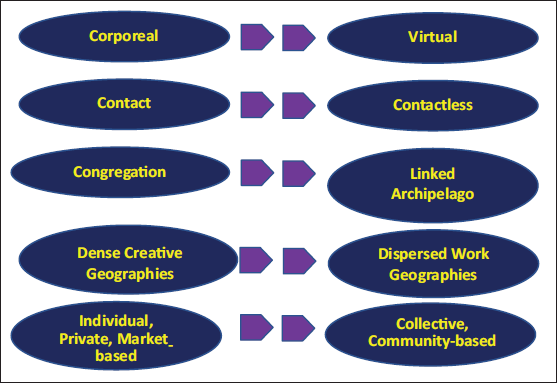
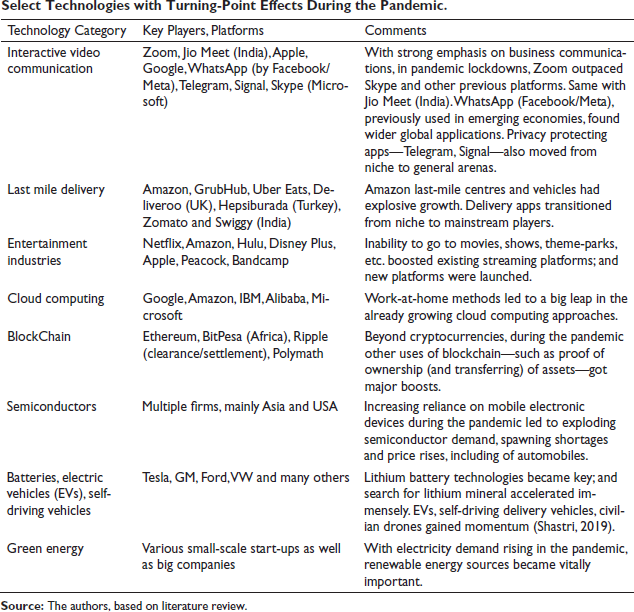
In terms of business processes during the intense pandemic year of 2020, several technologies altered and/or accelerated behavioural and operational changes that were already underway. Our table in the Appendix shows certain technologies that proliferated and accelerated so significantly during the pandemic that they mark the pivotal turning-points of the pandemic period. For example, corporeal events (e.g., meetings, conferences, sales calls, etc.) that required people’s transportation and presence shifted to virtual platforms. Transactions that required proximity, even tactile contact, were replaced by contactless methods. Business events that required congregation, such as tradeshows or sports-entertainment happenings, were replaced by virtual ways in which people who stayed at their homes were connected by tele-visual techniques. Some trends are still in the process of playing out and their effects remain indeterminate. In pre-pandemic times, Florida (2005) had a made compelling case for dense, creative geographies (e.g., Silicon Valley, New York, London) as drivers of innovation and growth. The pandemic, however, has been launching millions of initiatives for dispersed work, with little heed to creative agglomeration and national borders. Before the pandemic, individual and market-based (including massively deregulatory) solutions dominated the political decision-making processes. With the pandemic, there is resurgence in collective-communal methods. Figure 1 outlines such transformations.
Most of the developments we identify in the Appendix have been extensions or hyper-accelerations of the techno-economic trends we have been witnessing since the emergence of online communications. Virtualization of business spaces and transactions as well as social ones has been prefigured by Pierre Levy as early as 1998 (Lévy, 1998). Similarly, O’Reilly (2007) documented the introduction of distributed, participatory production methods and labour forms, and Srnicek (2016) noted the rise of platform capitalism as an economic modality. The hyper-acceleration broke the glacial pre-pandemic pace of techno-economic transformations. Business and non-business organizations were confronted with the stark choice of ‘Adapt or Die’. Many under-resourced entities, business as well as nonprofit, could not adapt and had to shutter their operations. This also led to the hyper-acceleration of the monopolization trend we have been observing across many sectors over the past decades, which is not necessarily entirely technology related, but an outcome of neoliberal economic policies (Dholakia et al., 2020; Ozgun et al., 2017). Thus, the developments we observe in the techno-economic sphere during the pandemic and their effects on the post-pandemic world order, have to be considered in relation to the changes in politico-cultural and socio-cultural spheres.
Previous contributions in this journal have already started exploring such multi-faceted developments. For instance, in the socio-cultural sphere of the pandemic, Bandyopadhyaya and Bandyopadhyaya (2021) recently studied panic buying behaviour of consumers in India. In the politico-cultural sphere, Barai and Dhar (2021) identified some emerging global issues such as a possible tendency to reduce the over-dependence on China for the functioning of the global supply chain. Last but not least, Varma and Dutta (2022) and Hasan et al. (2021) examined the technological advances, such as food-tech start-ups or touchless payment methods, in the techno-economic sphere of the pandemic. Our original contribution, to build on these previous studies, comes via adopting a holistic, macro perspective in analysing the developments in all dimensions. More specifically, our conceptual analysis in the following sections shows that the techno-economic trends are moving in ameliorative directions while the socio-political-cultural trends are moving in harmful directions regarding social justice and equitable development.
In pandemics, the developing regions suffer very serious consequences, which hamper their socioeconomic development. For example, during the 1918–1919 Spanish Influenza Pandemic, the worldwide mortality estimate was between 20 and 50 million deaths, with 10–20 million deaths in India alone (Chandra & Kassens-Noor, 2014). In the COVID-19 pandemic, while the advanced United States has been a major site of disease and deaths, the developing nations of Brazil and India are close behind in mortality and morbidity. Thus, in our discussion in this article, we particularly emphasize the struggles of the marginalized, socioeconomically impoverished populations from the Global South (Das & Chaudhuri, 2022) who have been impacted by policy inequalities, deficient infrastructure and violations of even basic human rights during the pandemic. Accordingly, another contribution of our study is to show the urgent need for public policymakers and private entities (corporations as well as non-profit actors and consumers) to redouble their efforts to boost the positive changes that technologies can bring about while controlling their negative effects and to take action against the poverty and inequity-worsening tendencies unleashed by the pandemic.
Accordingly, the following sections first explore how the geopolitical and sociocultural global system has been affected by the global COVID-19 pandemic. Then, we examine post-pandemic scenarios for the future and future prospects associated with politico-cultural, socio-communal and techno-economic trends, and we discuss policy and conceptual challenges ahead in order to suggest possible ameliorative changes to balance technological optimism with sociocultural fairness.
Background: Pandemic, Globalization and Markets
Since 2020, in our world-wide efforts to deal with the pandemic, the ways we perceive and relate to markets and globalization have changed considerably (Dholakia & Atik, 2020a). Some of the transformations on selected dimensions are as follows:
Markets
Economic concern has become the dominant organizing principle in modern cultures, placing the market in centre place (Dholakia & Fırat, 2016; Fırat & Dholakia, 2017). In this article, Ozgun et al (2017) discussed how marketization has been infused to public domains that were supposed to be immune to market influences, such as the management of hospitals, prisons, universities and the media. During the pandemic, the market has still been at the centre place. Important, even vital, social decisions concerned with the global availability of vaccines, use of masks or social distancing were made with economic concerns in mind. Thus, it is critical to briefly look at how markets have transformed during the pandemic.
Transactions and operations in certain sectors (such as travel, tourism and entertainment) either shut down entirely for months or operated just at barebones levels to sustain some vitally essential services. Commercial activities seen as discretionary and deferrable became just that—discretionary and deferrable. Even with gradual reopening, there were frightful predictions that things in the future would never return to the way they had been. Yet, some markets, especially those that relied on virtual (Dholakia & Reyes, 2013) and remote ways of doing things, entered a phase of explosive growth, even in these dire times. Five big American tech companies—Microsoft, Apple, Amazon, Alphabet (Google) and Netflix—came to constitute nearly one-fifth of the entire capitalization of S&P 500 stocks, which is a level of concentration not seen since the so-called ‘dotcom’ bubble of 2000 (Dholakia & Pandya, 2007). In early June 2020, Microsoft and Apple each became a US$1.5 trillion company. Then, in a few months, Apple raced ahead to become the world’s first US$2 trillion company. Later, Microsoft outran Apple for a while, as the world’s largest firm. Strikingly, only about 12 countries out of about 250 in the world had annual GDP over US$1.5 trillion around that time. In 2019, only eight had GDP over US$2 trillion—pointing to a stark contrast between selected corporate fortunes and most national fortunes. Indeed, in mid-2020, the combined market value of the five tech firms just named became larger than the annual GDP of all but two countries—USA and China. In the middle of the increasing unemployment, with long lines at food pantries and struggling or shuttered Main Street businesses during the pandemic, the investors of these elite tech firms were showered with even more affluence. In just a few early months of the pandemic, the wealth of this miniscule percentage of the population known as the ‘billionaire class’ rose by about one-third (Neate, 2020). ‘In short, pandemic markets ranged from dead, desperate and dwindled—in many service categories—to dazzlingly spectacular in other categories, such as the financial markets featuring technology stocks’ (Dholakia & Atik, 2020a, p. 1).
Globalization
Globalization is another dimension we need to look at because pandemic is a global phenomenon affecting everyone on the planet, in their political, economic and socio-cultural spheres. The delay in early detection of and response to the disease in major countries led to an overburdening of their local health systems, whereas some other nations have put in place effective strategies to contain the infection and have recorded a very low number of cases since the beginning of the pandemic (Khanna et al., 2020). Indeed, the ever-racing globalization lurched and stalled in many ways during the COVID-19 pandemic and notions like de-globalization and de-internationalization have entered into policy discussions and public consciousness. Many news websites singled out ‘de-globalization’ as a topic of central interest to them. While such topics have made appearances in academic literature in limited ways in the past (e.g., Benito & Welch, 1997; Turcan, 2003), they now entered popular media discourses. In this journal, Barai and Dhar (2021), suggested that several nations, especially Western ones, may attempt to reduce the overdependence on China for the functioning of a global supply chain, as well as an attempt to control the lop-sidedness of economic globalization. Some firms are attempting either ‘back-shoring’ of manufacturing to their home nations or ‘re-shoring’ to multiple nations so as to break their dependence on a single nation.
As the pandemic entrenched globally, but also came under a modicum of control in some nations, globalization patterns began to stretch and shift to some extent. Emerging shifts favour the nations that had taken early actions and had managed to stanch the spread of the disease in significant ways. Within this process, the post-World War II role of the United States—as the standard-bearer and orchestrator of globalization processes—received a significant setback in particular because of the country’s politically fractious approach to the pandemic, accelerating the decline of ‘Pax Americana’.
Development
Changing dynamics of markets and globalization during the pandemic affected development processes directly, which is a third dimension closely connected to the former two. In terms of social and economic development and national and regional progress, the pandemic painted a dark picture for several months. A June 2020 assessment of the global economy from the World Bank was striking:
The COVID-19 pandemic has, with alarming speed, delivered a global economic shock of enormous magnitude, leading to steep recessions in many countries. The baseline forecast envisions a 5.2 percent contraction in global GDP in 2020—the deepest global recession in eight decades, despite unprecedented policy support… Despite [some strong policy] measures, per capita incomes in all [emerging and developing] regions are expected to contract in 2020, likely causing many millions to fall back into poverty. (World Bank, 2020, p. xv)
Without supportive international policy actions, there could be no ‘upswing’ (and many painful downswings) on the development dimension. The United Nations Deputy Secretary-General Amina Mohammed (UN News, 2020) asserts:
I am extremely concerned. COVID-19 is a threat multiplier. We have a health emergency, a humanitarian emergency and now a development emergency. These emergencies are compounding existing inequalities. In advanced economies, we’re seeing higher rates of mortality among already marginalized groups. And in developing countries, the crisis will hit vulnerable populations even harder.
With the changing dynamics in these three dimensions (markets, globalization and development) in the background, discussions on post-pandemic scenarios have started taking place on whether things will (or should) ever go back to how they were before the pandemic. After looking at these potential scenarios briefly, we offer in more detail our conceptual analysis on the future prospects, affecting politico-cultural, socio-communal and techno-economic spheres.
Post-Pandemic Scenarios for the Future
Pandemics have sometimes, but not always, altered the course of history (Bristow, 2012; Snowden, 2019). These shifts have not only been dramatic but also often ameliorative—paving the way for new social orders that overcome the inequitable and inhuman ones of the past. For example, a history-based view maintains that it was the Black Plague in Europe that triggered the end of the generational servitude of feudalism and paved the way for contractual sale of labour in the following centuries, under a then-nascent system of ‘capitalism’ (Snowden, 2019). Public intellectuals like Mason (2020) have advanced the view that this pandemic will end exploitative capitalism. Others, however, are coming to the opposite conclusion by pointing to the tendencies that could boost neoliberal technology-enabled giantism (Klein, 2020). Although there are no crystal balls to foresee the future, the discussion of potential scenarios at the outset of this historical crisis is meaningful.
Dholakia and Atik (2020b) have discussed certain scenarios for a possible post-pandemic future through the works of Neufield et al. (2020) and Blumenthal et al. (2020) who perceive opportunities for change towards a better future in such crisis, yet still warn us about darker times ahead. Neufield et al. (2020) state that a ‘… complete return to “old normality” is unlikely and, maybe, to some extent undesirable’ (p. 4), followed by the suggestion that the cultivation of democratic values is necessary for a chance to renew our societies in response to the crisis, towards taking advantage of the technological progress for reshaping the economy in the direction of social equality and sustainability. Also necessary are the commitment to international cooperation and the promotion of a more active role for the state as the expression of the collective will of the people. Blumenthal et al. (2020) emphasize the need for a stronger federal government in the United States for relieving the dreadful effects of the public health crisis in a similar way. In light of these previous discussions, Table 1 proposes three main scenarios for the future.
Post-Pandemic Scenarios for the Future.
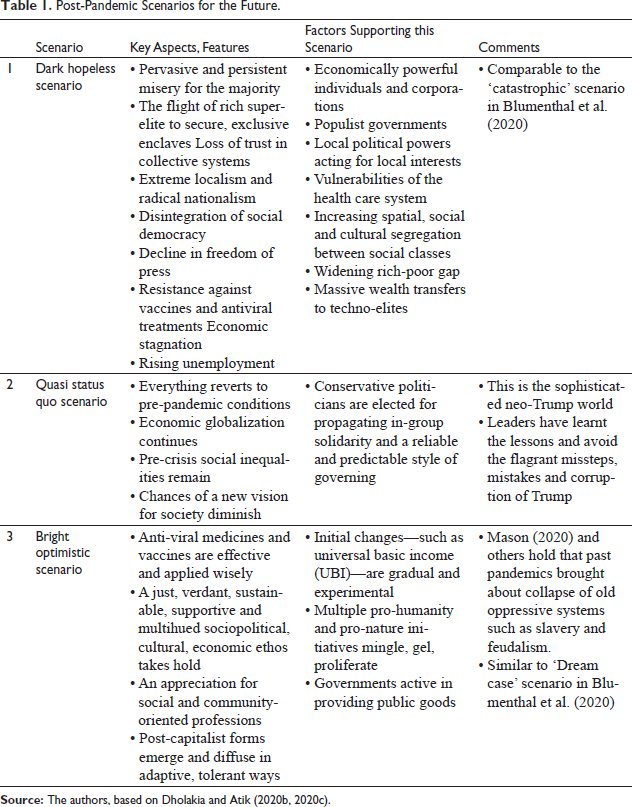
Within the media discourses and political discussions about the post-pandemic world, one strand of thinking imagines a regressive future darker than the immediate pre-pandemic phase, while another strand (albeit a minority one) envisions a brightly optimistic turn towards humanitarianism and ecological peace. Yet another strand of thought foresees an unchanging world—a reversion to pre-pandemic status quo ante. This last one is seemingly a popular strand if we consider what the widely used phrase ‘getting back to normal’ actually implies.
Some of the researchers, commentators and scenario-creating analysts commenting about the post-pandemic world have expressed the hope that it would be good—that is, it would be familiar, comfortable, reassuring—if we could return to ‘normal’, or at least have some semblance of normalcy. A return-to-normal view (with its implied comfort level) assumes that the pre-pandemic state of affairs and state of the world were acceptable, even quite good. Thus, re-achieving that state would be a mark of success.
Yet, this perspective first insinuates that the pandemic, and the crises it brought, is a ‘break’ from ‘normalcy’, rather than its consequence. It does not consider that the crises could have been resolved differently, faster, more effectively, even perhaps without becoming ‘crises’ as such, if the pre-pandemic social, political and economic conditions had been different (Dholakia & Atik, 2020b). Pre-pandemic conditions had been those of massive income inequality coupled by massive systematic disinformation, which resulted in the election of authoritarian populists such as Trump in U.S., Bolsonaro in Brazil, Erdogan in Turkey, Modi in India (Müller et al., 2016; Varma, 2019), whose policies have deepened the public health crisis. Privatization of the healthcare systems in Europe and elsewhere, the promotion of the pharmaceutical industry against public healthcare and the widening economic and social inequalities had been the pre-pandemic conditions that shaped the experience of such a crisis towards the way it had occurred. The appearance of the ‘pandemic’ as an unforeseeable and unpreventable ‘natural disaster’ perhaps triggers this perspective. But even if we cast aside the arguments that the emergence of the pandemic is closely related with manmade conditions such as economic development and thoughtless, rapid urbanization (if not a direct result of those, as depicted in Contagion (Ozgun, 2020) that we discuss in the next section), what we have to keep in mind is that what makes a natural event (such as an earthquake) a ‘disaster’ is how much we are prepared for it, which points to social, economic and political conditions. We do not think the pre-pandemic state of techno-economic, politico-cultural and socio-communal conditions were salutary in this sense and the way the pandemic has been experienced as such at a global scale is very much related to the inadequacy of such conditions.
Second, by implying a break and with its point to ‘a return to normalcy’, this perspective dehistoricizes the event and somehow undermines all that has happened since the beginning of the pandemic, even if we grant some modicum of ‘goodness’ to pre-pandemic conditions. As we mention as ‘positive’ and ‘negative’ impacts above (Dholakia & Atik, 2020b), while the pandemic showed us the need for participatory and collective political structures on the one hand, it brought large shifts in the distribution of wealth on the other (e.g., the closure of mom-and-pop type of businesses against the colossal increases in the revenues of online businesses and techno-capital), which will not be ‘redistributed’ as soon as the pandemic ends. Therefore, merely reverting to pre-pandemic conditions would not only negate the historical continuity involved, but also imply that there is no need—at least no urgent need—for ideas and actions that could propel us to a world that could be significantly (orders of magnitude) better than the pre-pandemic world. To us, development is a never-ending process.
Accordingly, in the sections, our conceptual analysis of future prospects—in politico-cultural, socio-communal and techno-economic spheres—will explore conditions for potential ameliorative changes in the post-pandemic future, instead of going back to pre-pandemic states.
Future Prospects: Politico-Cultural
The pandemic has affected the geopolitical and sociocultural global system associated with consumption and consumers, markets and supply chains, the socio-political ethos, popular culture and more. Cambefort (2020) points to how the pandemic has impacted the global consumption practices and functioned as a catalyst to downsize consumption by making consumers realize the excessive nature of their consumption patterns. According to the author, the pandemic forced people to test simpler lifestyles based on basic necessities for an extended period of time, which may have a lasting impact on their future consumption patterns. Yet, Cambefort also speculates that the experience of the pandemic may bolster anti-globalization sentiment in the future and lead the consumers to prefer local brands over global ones, especially over Chinese brands since the origins of the virus in China has been exploited by the conservative media outlets towards agitating the existing racist sentiments against the Chinese. This brings to mind Belk’s (2017) notion of collective narcissism, which he describes as an emotional belief that the nation’s greatness is being threatened by others. Belk’s notion partially explains the political shift towards conservatism, isolationism, the retreat from globalism and resistance to international refugees in the West. He illustrates this in the case of Brexit and Trump as ‘the loss of control at the hands of others such as the European Union, China, Mexico, Islam; and both legal and illegal immigrants (p. 1)’. In the case of the COVID-19 pandemic, the notion of collective narcissism may have been effective in boosting localism and thus causing further segregation.
Another trend Cambefort (2020) observes is the consumers growing attention to the business practices of companies and brands during the pandemic, and the growing impact of the ethical aspects of the brands’ business conduct on the consumers choice. Although she suggests that some consumers may return to their previous consumption habits after the pandemic, she maintains that the reduced consumption patterns may also prevail for a much longer period.
In his review of Steven Soderberg’s 2011 movie, Contagion, from a post-pandemic perspective, Ozgun (2020) traces the intersects and differences between the plot and the actualities happening during the 2020 pandemic. Ozgun points to the systemic failures and the incapacity of social institutions in responding to the pandemic both in the movie and in real life. Reality departs from the fiction in regard to the degree of inequality between the social classes that the pandemic crystallizes. Yet, for Ozgun, the most interesting divergence of the reality from fiction is how the pandemic appeared as a global economic crisis for governments and markets, rather than a social and humanitarian one ‘People did not riot in panic as in Soderbergh’s film’, Ozgun notes; ‘Instead, they rebelled against not being able to work, or not being able to conduct business, in a semi-orderly fashion’ (p. 7). According to Ozgun, today’s pandemic shows how the ‘conception of body has been transformed from an “affective vessel” to an “economic vessel”’ (p. 6) under the biopolitical order of late capitalism.
Similar to Ozgun, in his review of ‘Elysium’—a film written and directed by Neill Blomkamp–Ulusoy (2020) stresses the striking similarities between the movie and the contemporary reality in regard to how the rich and poor experienced the pandemic differently. Ulusoy finds a critique of capitalism in the film picturing a dystopian world where a small ultra-rich part of the world’s population lives in a pristine high-tech space station called Elysium, enjoying prosperous and luxurious lives, while the rest of the people struggle in desperate poverty and ecological catastrophe on a wretched, terrestrial earth. For Ulusoy, there is a parallelism between the narrative and our social reality, in which, on the one hand the ultra-rich people enjoy private yachts, jets and islands to isolate themselves from the pandemic along with their private doctors and test kits, and on the other, ordinary frontline/essential personnel, ranging from doctors and nurses to janitors and delivery people, take health-risks and work for their survival. ‘Corporations and governments that are driven by the neoliberal agenda place profits and business continuity before the health and well-being of their employees and citizens’ (Ulusoy, 2020, p. 6). Ulusoy also identifies the privilege of economically developed countries in accessing the vaccines first as a sign of the socio-economic polarization at a global scale as such. He suggests ‘the massive polarizations that exist between the wealthy and poor reflect more of what already exists under capitalism/plutocracy today than any imaginary dystopian future’ (p. 8). Ulusoy and Ozgun’s reviews show that the emerging patterns of the COVID-19 pandemic, as well as the possible unfolding post-pandemic scenarios, were already imaginable in literature and film. Therefore, it would be smart and wise to keep an eye on the present creative forms that may foretell the paths and scenarios ahead of us, before the future actually unfolds. The common point of the analyses above is the fact that, the changes in the post-pandemic politico-cultural sphere will be rooted in the pre-pandemic conditions; despite introducing uncertainties on particular issues, the pandemic deepened and accelerated major pre-existing problems.
Future Prospects: Socio-Communal
According to Hong (2020) the pandemic shows the extent of our biological, economical and socio-political vulnerabilities. For him, the involuntary idleness that the pandemic brought about in terms of employment, work and education is concerning. ‘Idleness as an anathema to neoliberalism used to entail disconnection and isolation, but it now can mean hyper-connectivity and hyper-activity, which are the very qualities the ideology promotes’ (Hong, 2020, p. 3). The author foresees that people will seek stronger social relations with ‘various kinds of support, compassion, and the fundamental sense of being, belonging, and believing’ (p. 7). He proposes to re-positivize life in a new market society and re-imagine the social.
In fact, studies from Japan may present potentials for such re-imaginings. Mizukoshi and Hidaka (2020) discuss how Õen consumption (Japanese term for ‘aid consumption’—the act of purchasing products and services just for the sake of supporting struggling merchants) has increased in Japan during the pandemic for boosting and supporting especially small business entities. The authors further clarify the difference between such aid consumption and the familiar concepts of cause-related consumption or ethical consumption. According to them, the difference between aid consumption and cause-related consumption lies in the fact that in the former ‘the purchase itself implies support and help without the presence of other causes’ (p. 2), which is also different from ethical consumption since ‘the purchase itself does not give consumers additional benefits, such as being more natural or healthier’ (p. 2). We need to consider their argument in the context of Lakhani’s review of food charity in the U.S., which points to the exponential rise in food donations in the past few decades due to the corporate capitalist support and involvement in the efforts. Lakhani contrasts such support and involvement with the same corporate entities’ resistance to minimum wage reforms and their stand against government food assistance programs (Lakhani, 2021). Mizukoshi and Hidaka (2020) present aid or Õen consumption as a potential new form of social assistance based on market principles in the unique context of Japan where cultural codes do not favour charitable acts. Yet, it may be useful to consider aid consumption as an alternative to charity or government assistance even in economies that excessively rely on charity for alleviating poverty, such as the United States.
In this journal, Hartono et al. (2021) also observed a certain willingness to donate among different consumer segments in Indonesia, which appears to be more like charitable monetary donation rather than Õen consumption. They also observed that certain consumer segments may tend to avoid ethical buying or charitable giving during a difficult time such as the pandemic. In India, Bandyopadhyaya and Bandyopadhyaya (2021) observed panic buying and an increased amount of stocking after the outbreak of the pandemic, especially in younger populations. According to the authors, elderly people with a more traditional Indian mindset have lesser tendency to panic and a more conservative attitude toward saving and wasting food.
In summary, all these studies show that a shift back to socio-communal values could be observed during the pandemic, such as people’s tendency to display solidarity and support for each other in times of crisis. These also show, however, that such tendencies are bounded by social, cultural, demographic and economic factors, and thus, the back to socio-communal values we observe in certain cultural spheres is not a generalizable trend.
Future Prospects: Techno-Economic
Techno-Economic changes have been overriding the socio-communal needs as Ozgun (2020) and Ulusoy (2020) critically pointed. For example, the role of social media platforms in influencing our economic, political and cultural lives has been frequently problematicized in popular media as well as in scholarly explorations (e.g., Orlowski, 2020). Increasing exposure and vulnerability of people to invasion of privacy as well as more direct forms of corporate and government surveillance under the domination of online communication platforms (Brown, 2018) over everyday communications and information flows has been a major concern among critical scholars (Kwet 2020; Vicdan, 2020). Kwet (2020) draws attention to potential and actual increase in the spread of misinformation with the intensification of social media usage during the pandemic related lockdowns. He associates the monopolistic power of social media giants such as Facebook to contemporary surveillance, censorship and misinformation practices. Vicdan’s (2020) exposition further substantiates how platformization of patient/citizen-led medical research transforms the increasing participation and active role of patients into biosocial surveillance. She argues that ‘platformization of covid further responsibilizes the patient citizen in generating data and tracking the virus, hence giving a sense of control to the patient over medical data generation and patient care through digital biosocial communities’ (p. 4). Platforms such as PatientsLikeMe have been effective in defining and tracking the coronavirus symptoms and comparing the treatments. However, Vicdan draws attention to the profiting of corporations from vast amounts of patient data collected by the platforms, and to how such platforms, at the same time, increase patient–citizen vulnerability and inequalities through surveillance capitalism. Vicdan finally argues for the need to regulate biosocial surveillance towards the interest of patient citizens and public health.
Kwet (2020) points to the practical challenges facing the proposed solutions for fixing the problems with social media platforms, such as the so called neo-Brandeisian one. Neo-Brandeisians propose to solve the monopolization of social media platforms by breaking up ‘companies into component parts and force social networks to interoperate’ (p. 2). Kwet argues, however, that increasing the number of competing and profit seeking social media companies will not solve the problem of intrusion and surveillance, since the resulting companies can also collect users’ data for marketing purposes. For him, the real solution should be ‘to transform social media into a “global commons” that is owned, controlled and governed directly by the people’ (p. 2). He points to Fediverse—an already existing decentralized gathering of interoperable social media networks (such as Mastodon, PeerTube and PixelFed) with millions of users—as an alternative to the monopolies of Facebook, Google, Microsoft and Apple and proposes this as a model for digital socialism, a commons-based socialist solution. Kwet states that ‘a free and open sourced, decentralized ecosystem is the only solution that can break up Big Social Media’ (p. 7).
Kwet’s proposition resonates with the public debates on platform capitalism as an economic modality (Srnicek, 2016) and ‘platform cooperativism’ as an arguable alternative to it (Scholz & Schneider, 2016). Srnicek portrays platform capitalism as a complex regime of economic and social control over corporeality, exercised through composite virtual environments composed of intertwined components such as social media outlets, game worlds, application markets, personal communication applications, news and entertainment media channels, shopping services and business exchange facilities, and even voice-activated domestic assistants. Ozgun (2018, p. 1) notes that, ‘while Google, Apple, Microsoft, Alibaba, Amazon, Uber, Facebook and a few others already dominate such composite virtual markets, the notion of ‘platform’ itself becomes an economic modality, way beyond a business model, for the foreseeable future’. By suppressing other modes of social and economic transaction, the pandemic conditions only further accelerated such foreseeable future and fortified the stronghold of platform capitalism as a dominant economic modality. The exponential increase in the profit rates of online platforms such as Amazon (Weise, 2021) and Netflix (Ozgun & Treske, 2021) during the pandemic times attests to such acceleration. It is not unreasonable to expect that this sharp increase in the profitability of platforms will provide them with advantages in the post-pandemic world, but we can also expect the consumption patterns that the pandemic forcibly transformed will continue to be effective. In fact, we can see that pandemic conditions accelerated the ‘platformization’ of the economies of the countries that had been challenging for the platform capitalism to penetrate due to cultural and social reasons such as access to technology, general education level and so on (e.g., Podder & Hu, 2021).
Platform cooperativism has been coined as an alternative economic form to platform capitalism by critical scholars, and at least offers a critical space for academic debate and inquiry if not concrete solutions. What prompted the emergence and urgency of such critical debate before the pandemic had been the foundational business practices of platform capitalism, such as the inherent monopolistic tendencies of the platforms, their reliance on outsourcing and precarious labour, their unethical global data collection and tax evasion schemes.
The global ‘naturalization’ of platform capitalism under the pandemic conditions certainly bypassed or shrunk this critical space. The social benefits of technological advancements—that are largely sustained by social media, entertainment and retail sales and service platforms in the absence of viable alternatives—increased our dependence on them during the trying times of the pandemic. This resulted in massive growth and expansion of the platform economies, whose monopolistic tendencies were already problematic. While considering ways to extend the social benefits of the technological advancements we observed and practiced during the pandemic, it remains a crucial task to be concerned with the economic dynamics of platform capitalism and their social consequences. We also need to seek alternative structures that can sustain technological development in rather socially equitable ways. The next section presents examples of such ameliorative technologies.
Towards Ameliorative Changes in Techno-Economic Sphere
One way in which technologies could improve the post-pandemic global manufacturing and distribution is via smart automation of supply chains. Lemos et al. (2020) examine FASTEN and Internet-of-Things (IoT) based supply chain system, as a potential solution for supply chain vulnerabilities in a time of crisis. They explore the case of Brazil and many other nations where the COVID-19 pandemic caused an unanticipated surge in demand for hospital safety items such as face shields, N95 masks and ventilators. The authors assert that ‘disruptions in the flows of production, movement and transportation of materials, financial flows and information flows, require greater information sharing, coordination and collaboration between participants, to ensure the continuity of operations’ (p. 10). Their proposed FASTEN platform is capable of adapting and adjusting to such disruptions in the market. The platform facilitates the continuity of affected operations and coordination in the supply chain. According to these authors, as a Smart Manufacturing System Project, FASTEN enables flexibility, improves production efficiency and decreases costs.
In this article, Varma and Dutta (2022) examined a food-tech start-up that fine-tuned its business operations to face the numerous challenges associated with changing customer preferences after pandemic lockdowns. Their study revealed employees’ and customers’ safety, prudent cost management, online presence and doorstep services as key for start-ups to succeed during COVID-19. Similarly, Hasan et al. (2021) observed how technology helped improve the payment methods for slowing down the spread of the virus in the Netherlands. Due to perceived ease of use and safety, consumers adopted contactless mobile payments. Willing to reduce direct contact with marketers, they have also preferred to search for information online before making a purchase (Sayyida et al., 2021).
While post-pandemic instances of rising poverty, misery and inequity can be overwhelming, it is important—for policymakers, managers, community advocates and scholars—to be very alert to the post-pandemic turns and events that improve people’s lives and provide pathways to a brighter future. Zakaria (2021) makes this observation:
Crises always lead people to find new ways to do things, adopt new technologies and cast away old practices. In the United States, the ability of large parts of the economy to function and excel in the digital realm—when the physical economy was broadly shut down—has surprised even techno-optimists.
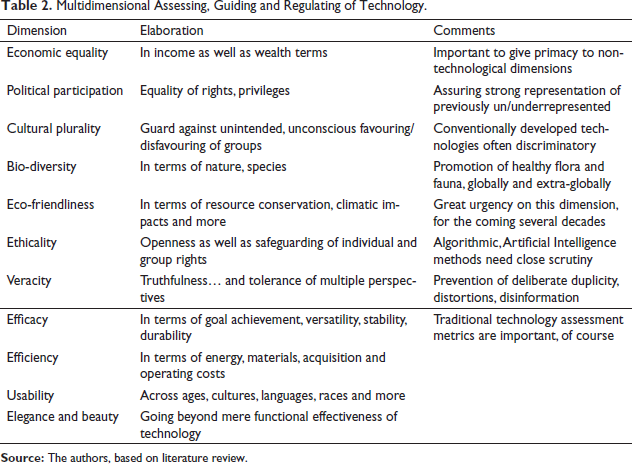
What are lacking or, more appropriately, lagging are frameworks, systems and models to identify, catalogue, adapt and disseminate the ‘best and most hopeful’ strategies and practices that arose in the throes of the pandemic, and will keep arising in the post-pandemic world. Academic researchers and scholars have a clearly important role to play in this regard. To provide ideas and a simple framework for good scholarly work for sanguine, pro-people technologies, Table 2 presents multiple dimensions for assessing, guiding and regulating technologies. While no hierarchy or weighting of dimensions is implied in the table, nonetheless it signals that the traditional technology assessment dimensions should be brought into play only after wider non-technology-specific assessments have been made.
Multidimensional Assessing, Guiding and Regulating of Technology.
Conclusion: Policy and Conceptual Challenges Ahead
The future prospects that we just discussed about politico-cultural, socio-communal and techno-economic trends are pointing at a spectrum of impacts that could range from very regressive to considerably ameliorative. As we argued in this article, from a macro perspective, techno-economic trends may move in strongly ameliorative directions while the socio-political trends may move in harmful directions, regarding social justice and equitable development.
The forces that signal positive change and promise amelioration on the techno-economic sphere clearly seem to gain strength in the pandemic-triggered processes. Technological advancement continued to be the driving socio-economic force during the pandemic and it accelerated strongly, particularly in the fields of communications and biotechnology. In those parts of the world where the pandemic conditions are easing, technology leads the post-pandemic economic recovery, which becomes tangible through the current gains in values of assets owned by the wealthy social segments in these countries. Yet, the intersections of these developments with politico-cultural aspects seem to be rather regressive. For example, despite public resources having been mobilized successfully to develop vaccines in Europe and US, which led to rapid advancements in biotechnologies that could benefit all, via political decisions, the vaccines developed by using public funds have been left to the pharmaceutical companies as profitable intellectual property assets, rather than being open to global commons. The public criticism that forced Merck to license the anti-viral treatment it developed to developing countries without royalties (Nolen, 2021) shows that there are a few signs of ameliorative movement on the politico-cultural and socio-communal fronts, despite the indicators of forces propelling the state of affairs toward the regressive end of the spectrum. Such regressive thrusts could counter and stymie the growing potential of techno-economic advancements. The result could be that, in the near future, the already wealthy individuals and corporations continue to benefit, at the expense of the stagnation or worsening of the politico-cultural and socio-communal conditions of the global masses.
As we discussed by pointing to various aspects and instances above, pandemic times crystallized or accelerated certain problems that had already been inherently or explicitly present in our pre-pandemic social order. These include rising populist and anti-democratic policies, economic and social inequalities, systematic racism and sexism, global economic discrepancies and global-scale flows of misinformation and disinformation. Such crystallizations and accelerations are not unexpected, and if identified correctly within their causes-and-effects, give us a chance to tackle these challenges directly and thoroughly. Paradoxically, and fortunately, pandemic times presented us with unexpected opportunities. The given global and comprehensive scale of the disaster at hand created a situation that can only be handled and resolved through collective will and action, which appeared as an anti-thesis of the individualizing logic and discourse of the market that has not only been dominant but also perceived as the only choice under the hegemony of neoliberal ideologies over the past decades (Dholakia et al., 2020; Ozgun et al., 2017).
Our survival depends on prioritizing our collective well-being above individual interests, imposing our collective will to do so and taking collective action about it. Such unprecedented emergence of collective thinking and action at global scale is perhaps why some ideologues and media pundits gathered around essentially trivial yet objectively counterproductive symbolic gestures and discourses (such as opposing mask mandates, spreading vaccine misinformation, etc.) as ‘expressions’ of ‘individual freedoms.’ With the pandemic regressing at a very slow pace, we are not yet saved from equally disastrous global crises waiting at our doorsteps, or already invading our concerns—for example, the climate change. Obviously, we will have to tackle such issues globally and collectively, and not leave the solution to unwilling governments or bottom-line-driven corporations. Such notions of prioritization of collective/public well-being over individual/private interests and global public mechanisms to generate collective will and exercise collective action are the lessons we learn from the pandemic that have to stay with us and need to be developed in the future.
The stark new reality is that continuous vigilance and diligence, in monitoring business, government as well as daily life operations, have become a way of life. Being mere humans, there is a tendency to lapse into easier and riskier modes of living and doing things. Familiar, known, comfortable and entrenched ways of life are tough to give up or change. Yet, in the future, penetrating questioning of all traditional ways is required, and constant efforts are needed toward discovering and accelerating ameliorative ways. It may take years, even decades, to unravel and understand the massive changes brought about by this globally pervasive and vexingly difficult pandemic. Yet, changes in corporate strategies, government policies and popular activism cannot (and should not) wait for decades. It is important—in terms of practices and research efforts—to identify every possible ameliorative twist and opportunity that this pandemic has created and to take maximum advantage of the possible positive turns that lie ahead. In other words, innovative concepts and conscious actions are required to quell the emerging negative impacts of technology that may be otherwise persistent. Sustained efforts are required to make the post-pandemic world better (and not worse) than the pre-pandemic world for all, particularly in the developing regions.
Appendix
Select Technologies with Turning-Point Effects During the Pandemic.
Footnotes
Acknowledgment
The authors are grateful to the anonymous referees of the journal for their extremely useful suggestions to improve the quality of the article. Usual disclaimers apply.
Declaration of Conflicting Interests
The authors declared no potential conflicts of interest with respect to the research, authorship and/or publication of this article.
Funding
The authors received no financial support for the research, authorship and/or publication of this article.
