







Abstract
The study assessed the association between job insecurity (JI) and organizational citizenship behaviour (OCB) of hotel employees during COVID-19. Furthermore, this study analysed the impact of Organizational identification (OI) and affective commitment (AC) as serial mediators between JI and OCB relationship. A three-wave survey was conducted on a sample of 524 employees of 14 hotels in India. The study used structural equation modelling and PROCESS (Hayes, 2013) Model 6 for testing a few hypotheses. This study found a significant association between JI and OCB of the hotel employees during COVID-19, with OI and AC as serial mediators. The present study’s noteworthy contribution lies in using the job preservation motivation framework to investigate the associations among JI, OCB, OI and AC, which have mostly been unmapped particularly in the hotel sector in India.
Keywords
Introduction
The entire world has been distorted in just a few months due to COVID-19 disease activated by the SARS-CoV-2 virus, leaving a lasting impact on the worldwide economy and every individual. The most significant costs of the pandemic on the global level were job insecurity (JI), unemployment and health risks (Godinic et al., 2020). Over 90% of the world population had to bear many restraints, comprising travel bans both international and domestic, after the pandemic was affirmed globally.
COVID-19 pandemic had immense socio-economic consequences for the hospitality sector (Hemmington & Neill, 2022) which gives rise to uncertain future increasing career anxiety. The outbreak of COVID-19 impacted both the demand and supply sides, with employees facing disturbing difficulties as the sector had the hardest hit (Martins et al., 2020). The World Travel and Tourism Council cautioned that 50 million jobs will be at risk in the global hospitality industry due to COVID-19 (Weidmann et al., 2022). Innumerable people in the hospitality sector lost their jobs due to crisis and were thrown into the poverty chasm (Jones & Comfort, 2020) while others faced extremely high levels of JI. Though it is apparent that contemporary workplaces faced uncertainty even before COVID-19, due to technological, economic and political variations and insecurity; hence, employment stability to all employees cannot be guaranteed, but COVID-19 has aggravated this situation. The direct impact of this adversity, COVID-19, is on the individuals and hotel employees’ income and loss of employment, as they had bad smitten due to lockdown and constraints levied on domestic and international travel halting the tourism sector (Pathak & Joshi, 2020). Consequent to the likelihood of decreasing demand and employees being given temporary leaves, hotel employees are overwhelmed with JI (Quintana et al., 2021).
The lone essential asset for any organization’s growth and excellence is manpower. If this asset is not valued or is neglected the chances for growth are quite dim. A vital contributor to job stress is JI, which has recently caught the attention of researchers in recent years. JI can be defined as a supposed risk to an individual’s work stability and steadiness as it is presently experienced (Shoss, 2017, p. 1914). For example, JI is negatively associated with employee’s health which consequently increases turnover and career change, and diminishes efficiency, contentment, the loyalty of employees, and trust in employers (McGinley & Mattila, 2020). Sverke et al. (2019) advocated that employees, who feel less secure about their jobs, are less likely to reinforce organizational goals. Consequently, the outcomes of JI are not restricted to only an individual level, but they have stern implications for organizations too.
One of the major dilemmas which the corporate world is facing presently due to the current pandemic COVID-19 situation is to build a sense of ownership amid its employees and able to retain them amid the threat of JI. Organizational citizenship behaviour (OCB) is considered as ‘contextual performance’ elucidating to holding up the collective and emotional surroundings in which ‘task performance’ occurs and believed to be fundamental for the endurance of an organization (Organ, 1997, p. 95). Research established that hospitality employees demonstrating high levels of OCBs can produce improved service, consequently influencing ‘customer confidence and word-of-mouth recommendations, and earn customer loyalty’ (Kim et al., 2020), also increases constructive work attitudes among employees (Jain & Rizvi, 2020).
COVID-19 stricken hotel industry needs its employees to depict OCB for organizational efficacy. Several prior studies have indicated a mixed association between JI and OCB. Reisel et al. (2010) reported a negative association between the two, while Wang et al. (2014) reported a positive association. Drawing from social exchange theory, Lam et al. (2015) exhibited that when facing the fear of job loss, employees are forced to behave proactively and depict OCB expecting to compel their employers to return them favourably. Lee et al. (2018) suggested OCB of employees as a coping mechanism when they are facing JI, wherein such employees intend to build a strong bond with employers. The current study attempts to explore the relationship between JI and OCB in the backdrop of COVID-19. To gain a deeper understanding of this relationship, the study explores the mediating roles of organizational identification (OI) and affective commitment (AC). OI transpires when employees feel solidarity with an organization, a sense of belongingness results therefrom, creating uniqueness and exclusivity from other organizations (Chawla & Srivastava, 2016). However, JI represents a circumstantial influence having negative implications for employees’ OI and in turn OCB (Piccoli et al., 2017). Retaining a social identity (i.e., identification) is the pedestal for commitment (Meyer et al., 2006). AC is based on the social exchange perspectives between employee and organization, regarded as two distinct emotional beings, is a more general attitude (Ashforth et al., 2008); whereas the concept of identification comprises a ‘self-defining nature’. Consequently, researchers asserted to examine AC as an ‘attitudinal outcome’ of OI, which implies that as individuals cultivate a sense of oneness with the organization, they build emotional connects with and engage in the organization, leading them to be more committed to it (Meyer et al., 2006). Subsequently, with the past research advocating this theoretic view, we believe that OI will enhance AC.
To what extent the employees in hotels are coping with the fear of losing their job and how this positively affects their OCB and the impact of OI and AC on this relationship during a pandemic remain unrequited, which will be the focus of the present study. The research objectives of the present study are as follows:
To examine the association between JI and OCB.
To investigate whether JI and OCB are associated with OI and AC.
To analyse and understand whether OI and AC mediate the relationship between JI and OCB.
The remaining part of the article is organized in the following manner. A review of extant literature is undertaken to examine the constructs of destination brand advocacy, brand experience, loyalty and trust along with their interrelationships. The hypothesized relationships and research model are presented next. Thereafter, methodological aspects are discussed such as the study approach, sample design and data collection. Analysis of data and discussion of findings are provided subsequently. To conclude, implications of the study and directions for further research are presented.
Literature Review
Research Model
The study extracts from the extended literature and the Job Preservation Motivation (Shoss, 2017), Social Exchange Theory (SET; Blau, 1964) and Social Identity Theory (SIT; Tajfel & Turner, 1979) to posit that how JI impacts the OCB of employees in the hospitality sector, furthermore, examining how this association is affected by OI and AC in the Indian hotel sector in the current times of COVID-19 pandemic. Job preservation strategies take diverse shapes, for instance, research finds that when employees perceive JI, they endorse more safety behaviours when such behaviours are valued by the organizations (Probst, 2004). Based on job preservation motivation, it is envisaged that JI subsequently augments task performance and OCB, as these behaviours have a likelihood of being noted and appreciated by higher management (Shoss & Probst, 2012). Furthermore, job preservation strategies comprise trying to represent themselves as the best employee, for instance by repressing personal values and professing organizational values (Hewlin et al., 2016, p. 1) and being agreeable to accept reductions, for example, lesser salary and prolonged working hours (Otto et al., 2010). Hence, JI may result in ‘work intensification’ as a job preservation strategy by employees (Shoss, 2017).
SET (Blau, 1964) elucidated that there exists an ‘exchange relationship’ (Rousseau, 1995) between employees and their organizations that arises due to the employment relationship. SET suggests that social exchange relationships are formed due to certain organizational precursors leading to interpersonal connections (Cropanzano & Mitchell, 2005). From the psychological perspective, many researchers and scholars, based on the SET have suggested JI as a breach of the ‘psychological contract’ among employees and organizations (Rousseau, 1995). When employees experience positive social exchange relationships with their organizations, OCBs will be enhanced, and turnover intentions will be decreased (Hendrix et al., 1998); on the contrary the outcomes of lack of social exchange relationships are a rise in turnover, lesser dedication and decline in OCBs (Rousseau, 1995) as advocated by social exchange theorists.
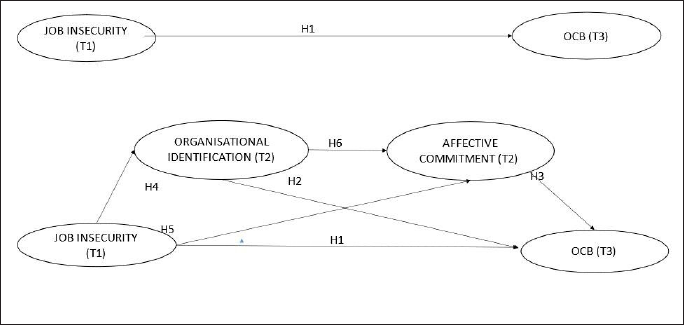
SIT (Tajfel & Turner, 1979) elucidated the association between OI and work-related behaviours in the organizations. SIT is centred on the postulation that individuals tend to have an affirmative self-concept and that their identity is built on the affiliation in one or more societal groups (Gautam et al., 2004). Based on SIT, OI performs a ‘strategic role’ as the more the employees identify with their organization, the more they tend to dedicate their energies to and get involved with the organization (Baruch & Cohen, 2007). Empirical evidence suggests that OI arises when employees see unanimity with their organization and sense attachment with it (Ashforth et al., 2008). Figure 1 clearly explains the theoretical framework investigated by the present research.
Job Insecurity and Organizational Citizenship Behaviour
Jain et al. (2013) illustrated that extremely challenging workplaces obstruct the growth of mutually beneficial social exchange relationships. Consequently, based on SET, employees experience JI which is evident through a decline in OCBs as employees perceive organizational treatments as unfavourable, unfair and unsupportive. Hence, if the employees sense a threat to their job, they automatically start reflecting a negative approach, reflecting a decline in OCB. Researchers assert that there exists a negative association between JI and OCB (Reisel et al., 2010).
On the other hand, contrary to the findings, Repenning (2000) established a positive association between JI and OCB and asserted that the reason for showing OCB is to prove their loyalty towards the company to escape from the threat of JI. Therefore, we propose that based on the job preservation motivation framework, the employees may get motivated to engross themselves keenly in actions to cope with the fear of losing one’s job. Hence, employees seek to exhibit their usefulness to their employer by putting in additional efforts for behaviours that will be noted and appreciated, like ‘task performance and OCB’ (Shoss, 2017; Shoss & Probst, 2012). Thus, due to the COVID-19, the fear of losing one’s job encourages individuals to involve themselves in the OCB, as a coping strategy to preserve one’s job. Therefore, proposed hypothesis is that: H1: There is a significant association between JI and OCB.
Organizational Identification and Organizational Citizenship Behaviour
SIT can elucidate the association between OI and work-related behaviours. The research established that OI creates a range of affirmative employee and organizational outcomes, including OCB (Ashforth et al., 2008). An employee who can connect one’s identity with that of organization certainly has a strong motivation and tends to survive with the problems in a constructive manner (Van Dick et al., 2004), besides will reflect and perform based on the group norms and values as they have assimilated these ideals into their self-concept (Gautam et al., 2004). One of the strongest predictors for an organizational outcome like OCB is OI (Rousseau, 1995). Srivastava and Madan (2016) validated a positive and significant impact of OI on OCB on Indian managers. Consequently, based on SIT, we assert that when employees identify with the organization they tend to collaborate with co-workers and have more positive behaviours towards the organization (Callea et al., 2016), that is, employees tend to engage in OCB. Hence: H2: There is a significant association between OI and OCB.
Affective Commitment and Organizational Citizenship Behaviour
Attachment not only helps on the personal front, but the attachment with colleagues and superiors in the organizational context strengthens the bond thereby helps individuals grow successfully. Nassar (2018, p. 3) described AC as a ‘job-related attitude with positive feelings towards the organization, which further reflects the relative strength of an individual’s identification with and participation in a given organization’. The present study focuses on AC, as it has been identified as the furthermost significant predictors of OCB, besides being a vigorous associate of OCB in comparison to continuance commitment and normative commitment (Ng & Feldman, 2011). Researchers have examined the association between AC and OCB asserting that AC is positively associated with job performance or OCB (Lee et al., 2017; Purba et al., 2015). When employees are emotionally attached, believe in being treated fairly, and experience positive exchange relationships with the organization, they reciprocate by going extra mile for the betterment of the organizations. Thus, based on SET we propose that the employees will indulge in OCB due to their emotional connection with their organizations, that is, their AC. Therefore, proposed hypothesis is that: H3: There is a significant association between AC and OCB.
Job Insecurity and Organizational Identification
SET asserts that individuals pay back the benefits they obtain, subsequently stimulating from employees’ benevolence and usefulness with those they have a social exchange relationship. Hence, when they experience positive social exchange relationships with their organizations and perceive obtaining a lot from their organization their OI increases; however, if employees perceive unfavourable organizational conducts their OI levels decrease (Callea et al., 2016). Piccoli et al. (2017) established that JI leads to decreased levels of identifying oneself with the organization and hence, the fear of losing a job decreases if an employee can identify with the organization. Conversely, upholding a job is an essential aim for most individuals, and hence making affirmative workplace image becomes extremely relevant when feelings of JI engulf (Huang et al., 2012). Consequently, based on the job preservation motivation perspective, due to the current pandemic COVID-19, employees strive to establish unanimity and harmony with their organizations due to the fears of JI and subsequently leading to OI. Therefore, proposed hypothesis is that: H4: There is a significant association between JI and OI.
Job Insecurity and Affective Commitment
JI can be linked with psychological contract theory (Rousseau, 1995) which states a mutual obligation between the employer and employees relating to the obligation of the employer in the context of job security and obligation of the employee in term of the commitment towards their job. Previous research suggests a negative relationship between AC and JI, for example, Chirumbolo et al. (2017); meta-analyses by Jiang and Lavaysse (2018) too established a negative relationship between JI and AC. But, when performance is linked with job continuation, employees may identify that by enhancing their ‘task and contextual performance’ they will be perceived as a valuable resource to the organization, thus increasing the possibility to protect their job (Koen et al., 2020). In line with this reasoning employee’s engagement in ‘task and contextual performance’ is an indication of AC with their organizations. Hence, we believe that due to the crisis induced by the pandemic COVID-19 in the hotel sector, individuals engulfed with the fears of JI will be encouraged to increase their AC with the organizations due to the job preservation motivation framework. Therefore, proposed hypothesis is that: H5: There is a significant association between JI and AC.
Organizational Identification and Affective Commitment
Ashforth et al. (2008) define OI as supposed unanimity between ‘self and organization’; it fosters the use of ‘we’ instead of ‘I’. If employees perceive a fit between their values and the organizational goals are probably to stay in organizations (Meyer et al., 2006). Researchers have argued that there exists a significant association between OI and AC, for example, individuals display higher AC due to their collective self-identity with organizations (Johnson & Chang, 2006). This postulation leads us to theorize an association between OI and AC. Hence, employees are likely to commit themselves willingly to an organization, as they identify with the organization and perceive that their destiny is emotionally entwined with the organization. Therefore, proposed hypothesis is that: H6: There is a significant association between OI and AC.
Mediating Roles Organizational Identification and Affective Commitment
Though there is a dearth of research on the serial mediation of OI and AC on JI and OCB association both in the global and Indian hospitality sector context, yet these variables have been studied across the globe but not simultaneously. For example, Purba et al. (2015) asserted in a study on Indonesians employed in cement factories that AC contains ‘affective feelings’ because individuals’ identification with the organization, mediates the associations between two personality traits (emotional stability and extraversion) and OCB-I and OCB-O. Qian et al. (2022) established that AC mediates the interaction effect of JI and job embeddedness on job performance in a study on Chinese private manufacturing organizations. Furthermore, Callea et al. (2016) asserted the mediating role of OI on the association among qualitative JI, OCB and job performance in a study on Italian employees.
In the present study, we intend to explore OI and AC as serial mediators for JI and OCB association for the first time using a framework of job preservation motivation framework in the context of COVID-19. The common notion is that to perform their job effectively employees need to feel secure, that JI decreases OI, and that high OI augments OCB and job performance (Callea et al., 2016). Taking into consideration the past literature, we intend to build the extant literature by a pioneer postulation based on job preservation motivation framework that due to the current pandemic COVID-19 the feelings of JI increase an employee’s OI, which further augments AC, consequently increasing engagement in OCB. Thus, we propose that the turbulence created by the pandemic COVID-19, the employees in the hotel sector fear job loss, and to cope up with this fear they strive to identify with the organizations, further creating an affective attachment consequently engaging them in OCB as a job preservation motivation strategy. Therefore, proposed hypothesis is that: H7: OI and AC sequentially mediate the impact of JI on OCB.
Methodology
Sample and Data Collection
The data for the present study was collected from the middle-level managers employed across all departments of hotels in India. In consonance with prior studies in the sector, the study used a convenience sampling method for data collection (Farooq et al., 2021). The HR managers of 31 hotels of North India (these were selected based on their ratings—3 or more) were approached by the researchers and were briefed about the purpose of the survey through e-mails and phone calls. Out of these only 14 hotels permitted data collection. To address the issues and problems associated with convenience sampling, the sample was selected based on a larger variation. All the demographic categories of the population (age, education, gender) were included in the sample; besides they were assured of the confidentiality of their responses. With the help of the HR managers, 720 employees were communicated to be a part of the survey, of which 652 gave their consent to be a part of the study. To handle the issue of common method bias (CMB) which arises due to cross-sectional data collection, data was collected in three phases. The participants were given questions about demographic details and JI in a closed envelope, during the first phase of data collection (T1). Of 652 participants, 580 provided the data and gave it over to the researchers after a fortnight, out of which 8 were removed due to inadequate data. After 2 weeks, the second phase (T2) began, where 572 participants were considered apt for data collection for questions related to OI and AC. Of 572 participants (same group as the original), the second phase was completed by 550 participants of whom 4 were discarded leaving 546 for the third phase of data collection. The third phase (T3) which was done after 2 weeks was completed by 530 participants of which 6 were inappropriate due to incomplete forms, hence, leaving a total of 524 considered for analysis. To link the three phases, each of the participants who completed the first stage was given a unique identification code. All the participants were given a gift brochure as a token of appreciation after the completion of data collection.
The G*Power was used (Faul et al., 2009) to ensure the adequacy of the sample size for the proposed model. The power value was computed as 0.92, which was more than the generally accepted minimum level of power, that is, 0.80 (Cohen, 1988).
Instruments
JI was assessed through the four items of the JI scale developed by De Witte (2000). An item like, ‘Chances are, I will soon lose my job’ is a part of the scale. OCB was measured using 16 items scale by Lee and Allen’s OCB (2002). Items like, ‘I’m looking to keep the development of organization’ are a part of the OCB scale. AC was measured through Allen and Meyer (1990) scale with an item like, ‘I would be very happy to spend the rest of my career with this organization’. OI was assessed with a Scale developed by Mael and Ashforth (1992), having six items. An item like, ‘I am very interested in what others think about the organization’ is an example of an OI scale.
Results and Analysis
Table 1 mentions the details of demographic profile of the respondents of the present study.
Demographic Profile.

Common Method Bias
One of the problems that arise due to self-reported measures by the same participant is the problem of CMB for which Harman’s one-factor test was used in concordance with recent studies (Kaur et al., 2021). The researchers used Harman’s single factor test apart from randomly arranging the items to overcome the issue of CMB which normally occurs during cross-sectional data collection. The presence of CMB was ruled out as the factor loading of the first factor came out to be 26.32%, which is less than 50%. The heterotrait-monotrait ratio of correlations (HTMT) was also carried out and it was observed that all the HTMT values were less than the advocated cut-off of 0.85 (Henseler et al., 2015), thereby, eliminating all the chances of CMB.
Reliability and Validity Analysis
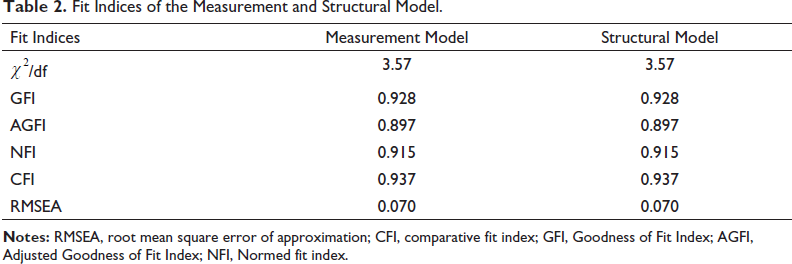
A measurement model was developed and tested to check the model fit. The items that had a loading of less than 0.6 were removed (Cain et al., 2016). Following the recommendation by Kenny (2016), at least two items were maintained for every variable. As shown in Table 2, χ2/df value was less than the acceptable value limit of 5, and the value of RMSEA was found to be 0.07, which was less than the prescribed value of 0.08. Similarly, the values of GFI (0.928), AGFI (0.897), NFI (0.915) and CFI (0.937) also met the desired criteria, thus indicating the model fit. The fit indices of the structural model were also established satisfactory with values of all the dimensions within the specified limits (Table 2).
Fit Indices of the Measurement and Structural Model.
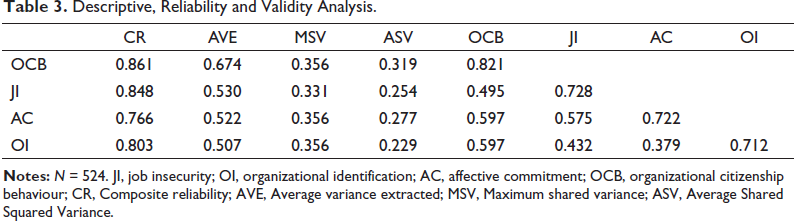
To evaluate the inter-item consistency (Fornell & Larcker, 1981), composite reliability was done and the reliability coefficient values of 0.70 or more were considered. Further, construct validity was tested to determine whether the items are measuring the theoretical construct which was further analysed through the tests of convergent validity and construct validity (Campbell & Fiske, 1959). Item loadings of 0.7 and above explain that one-half of the item’s variance (Fornell & Larcker, 1981), thereby establishing the construct validity. Table 3 shows that the AVE of each scale (represented diagonally) is greater than the correlation values, thereby supporting discriminant validity.
Descriptive, Reliability and Validity Analysis.
Hypotheses Testing
Direct Effects
Results in Table 4 depict the direct relationship between the variables.
Direct Effects.
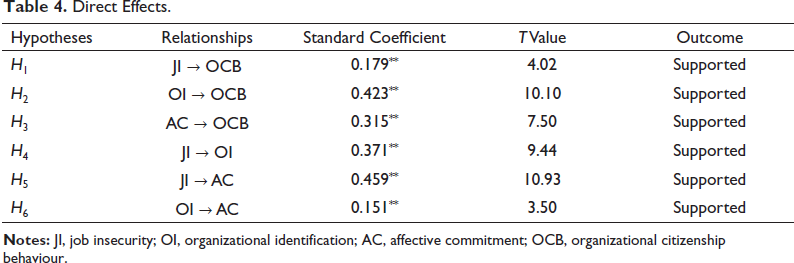
Hypothesis 1 proposed that there is a significant association between JI and OCB. The results supported the first hypothesis of the study and found a significant and positive impact of JI on OCB (β = 0.179, p < .01). It implies that due to the pandemic, the fear of losing one’s job encourages hotel employees to engage themselves in the OCB, as a coping strategy to preserve their jobs.
Hypothesis 2 envisaged that there is a significant association between OI and OCB. The second hypothesis of the study was confirmed when the results witnessed a positive impact of OI on OCB (β = 0.423 p < .01). Hence, when employees connect their identity with that of organization, they certainly have a strong motivation to indulge in OCB.
Hypothesis 3 proposed that there is a significant association between AC and OCB. The hypothesis was also established when the results witnessed a positive impact of AC on OCB (β = 0.315, p < .01). Based on the principle of reciprocity, when employees feel a sense of commitment towards organization, they tend to reciprocate with increased levels of OCB.
Hypothesis 4 anticipated that there is a significant association between JI and OI. A positive association between JI and OI (β = 0.371, p < .01) supported hypothesis 4 of the study. This implies that due to the current pandemic COVID-19, hotel employees strive to establish unanimity and harmony with their organizations due to the fears of JI and subsequently leading to OI.
Hypothesis 5 proposed that there is a significant association between JI and AC. The study results confirmed when a positive association between JI and AC (β = 0.459, p < .01) was established. This implies that based on the job preservation motivation framework, the crisis induced by the pandemic surrounded the hotel employees with the fears of JI which further encouraged them to increase their AC with their organizations.
Hypothesis 6 envisaged that there is a significant association between OI and AC. The hypothesis was also supported when a positive association was established between OI and AC (β = 0.151, p < .01). Thus, based on SIT employees in the hotel sector are likely to commit themselves willingly to their organizations, as they identify themselves with their organizations.
Sequential Mediation Analysis
The study utilized the analytical approach by Hayes (2013) for testing the hypothetical model. The path coefficients were calculated using Model 6 (PROCESS). As mentioned by Van Jaarsveld et al. (2010), the PROCESS Macro besides testing the mediating effect of OI and AC in isolation, also helps in assessing the ‘indirect effect passing through both these mediators’. Figure 2 of the study illustrates the estimates of the path coefficients. The mediation approach suggested by Hayes (2013) ‘directly tests the mediating effects between the predictor and criterion variables via bootstrapping procedure’. The study using bootstrapping at 10,0000 subsamples reflected that at 95% confidence intervals, the indirect effects did not contain zero for any of the study variables, namely, JI, OI, AC and OCB.

Table 5 depicts the serial mediating effects to assess hypotheses 7. It is found that there exists a significant indirect effect (indirect effect = 0.320, Boot standard error (SE) = 0.0361, 95% Boot confidence interval (CI)[lower] = 0.2514, Boot CI[upper] = 3936) for JI and OCB with OI and AC as mediating variables.
Indirect Effects: Job Insecurity as a Predictor Variable.

aRepresents the relationship between Job Insecurity and Organizational Identification.
Hypothesis 7 proposed, that OI and AC sequentially mediate the impact of JI on OCB. The results support hypothesis 7 of the study that JI leads to OI and AC which in turn leads to OCB. These findings are novel and established OI and AC as serial mediators for JI and OCB association using the framework of job preservation motivation framework, SET and SIT in the context of COVID-19.
Discussion
The study suggested and empirically confirmed a research model built on the Job Preservation Motivation framework along with SET and SIT. The present research intended to examine the association between JI and OCB in the hotel sector. The suggested relationships were tested, and research findings provide noteworthy acumens about the positive and significant association between JI and OCB. Based on the job preservation motivation framework (Shoss, 2017), the study accentuated that due to JI hotel employees are motivated to preserve their jobs by identifying with the organization, leading to increased AC, and hence indulging in OCB as a preservation strategy; this is the first study in Indian context linking JI to OCB by modelling OI and AC as serial mediators.
The study examined the association between JI and OCB which was found to be significant. The findings are in conjunction with a proposition of Repenning (2000). Following the job preservation motivation framework employees seek to exhibit their usefulness to their employer by putting in additional efforts for behaviours that will be noted and appreciated, like OCB (Shoss, 2017; Shoss & Probst, 2012). Job preservation motivation framework shows individuals’ efforts to evade loss and thus, the security cushions the employees from fear of losing a job gives them stability and safety at their workplace. Thus, due to the pandemic COVID-19, the fear of losing one’s job encourages hotel employees to engage themselves in the OCB, as a coping strategy to preserve their jobs. Furthermore, the findings suggested that OI was positively and significantly associated with OCB. The results are supported by the prior studies too, which establish that OI contributes immensely to OCB (Ashforth et al., 2008; Srivastava & Madan, 2016). SIT propagates that when employees can connect their identity with that of organization, they certainly have a strong motivation and tend to survive with the problems constructively consequentially increasing the levels of OCB. Hence, the present study further asserted that when hotel employees identify themselves with the organization’s values, beliefs and ideologies, this tends to augment their OCBs.
The study’s findings established a positive association between AC and OCB. The study results are in line with that of Purba et al. (2015) that AC is positively associated with OCB. When employees are emotionally attached, believe in being treated fairly, and experience positive exchange relationships with the organizations, they reciprocate by going extra mile for the betterment of the organizations. Thus, based on SET employees in the hotel sector indulge in OCB due to their emotional connection with their organizations, that is, their AC. Furthermore, the study posited a significant and positive association between JI and OI. Upholding a job is an essential aim for most individuals, and hence making affirmative workplace image becomes extremely relevant when feelings of JI engulf (Huang et al., 2012). Consequently, based on the job preservation motivation framework (Shoss, 2017), due to the current pandemic COVID-19, hotel employees strive to establish unanimity and harmony with their organizations due to the fears of JI and subsequently leading to OI.
The study findings also confirmed that a positive association between JI and AC. Linking with performance job continuation, employees may identify that by enhancing their ‘task and contextual performance’ they will be perceived as a valuable resource to the organization, thus increasing the possibility to protect their job (Koen et al., 2020), giving indications of their attachment, that is AC with the organization. Therefore, based on the job preservation motivation framework, the crisis induced by the pandemic COVID-19 engulfed the hotel employees with the fears of JI which further encouraged them to increase their AC with the organizations. The present study asserted a significant and positive association between OI and AC. The study results are in conjunction with the findings of Johnson and Chang (2006). Hence, based on SIT employees in the hotel sector are probably to commit themselves willingly to their organizations, as they identify themselves with their organizations and perceive that their destiny is emotionally entwined with that of the organizations.
Finally, the study affirmed, that OI and AC sequentially mediate the impact of JI on OCB. The study establishes that the turbulence created by the pandemic COVID-19, the employees in the hotel sector fear job loss, and to cope up with this fear they strive to identify with the organizations, further creating an affective attachment consequently engaging themselves in OCB as a job preservation strategy. The present study explored OI and AC as serial mediators for JI and OCB association for the first time using the framework of job preservation motivation framework, SET and SIT in the context of COVID-19.
Conclusions
The findings are based on the job preservation motivation framework, wherein employees due to the fears of losing a job are motivated to preserve their jobs; this is the first study in the context of the Indian hotel sector linking JI to OCB by modelling OI and AC as mediators. The first research objective was accomplished that there is a positive and significant association between JI and OCB. The second research objective is achieved too, that there is a positive and significant association between JI and OCB with OI and AC. Finally, the third research objective, that OI and AC sequentially mediate the relationship between JI and OCB is accomplished. Hence, the present study distinctively contributed in the following ways: (a) analysing and understanding the positive association between JI and OCB in the context of the global crisis due to COVID-19 on hotel employees (b) using the job preservation motivation framework to examine the association between the study variables, which have not been examined before in the context of the Indian hotel sector, (c) positing the serial mediation effect of OI and AC between the association of JI, OCB in context Indian hotel sector.
Theoretical Implications
The present study’s noteworthy contribution lies in using the job preservation motivation framework to investigate the associations among JI, OCB, OI and AC, which have mostly been unmapped particularly in the hotel sector in India. The findings are based on job preservation motivation framework, wherein employees due to the fears of losing a job are motivated to preserve their jobs, tend to identify with organizations, leading to increased AC and hence indulging in OCB as a preservation strategy; this is the first study in Indian context linking JI to OCB by modelling OI and AC as serial mediators. It is of academic significance too as it is conducted in an uncertain environment in the Indian hotel industry caused by COVID-19. It adds to the body of literature that studies JI perception under crises. It may be the first empirical study probing the positive outcome of JI during the COVID-19 on the commitment and behaviour of employees, and its findings shall add substantially to the hotel industry literature. The study indicates that the JI and OCB are significantly and positively associated, which suggests that individual efforts to evade job loss are based on the job preservation motivation framework (Shoss, 2017). In search of stability and safety at the workplace, individual employees seek the cushion of security. Thus, due to the pandemic COVID-19, the fear of losing one’s job encourages individuals to engage themselves in the OCB, as a coping strategy to preserve one’s job.
Furthermore, this study contributed additionally by establishing the role of two new meditating variables, OI and AC, which were not explored in prior studies on the association between JI and OCB. Thus, the current study stresses the need for escalating existing theories.
Practical Implications
The present study has relevant implications for the hotel organizations, practitioners and educators mentioned as follows. Though the cause of JI in the current pandemic COVID-19 can be manifested as an external issue, however, the changes it induced in the organization perceived as unfair show that employees also hold organizations internal issues a reason for JI, as well (Van Hootegem et al., 2018), the reason being the employees are unsure of their status and role within the organization which increases the feelings of insecurity. Whatever changes happen in the organization for whichever reason, the employees should be taken into confidence so as the fear of ambiguity is minimized. Moreover, lack of clear communication from the organizations about the layoff and streamlining procedures, that is, supposedly can give rise to menace of job loss among employees. Thus, hotel organizations need to disseminate valid information across all levels of employees clearly and crisply, leaving no room for any rumours either through newsletters, emails or information boards.
Furthermore, hotel organizations shall establish a mechanism for continuous and never-ending communication with employees regarding decisions being made and measures taken, paying attention to their opinions, suggestions or feedback related to issues at work, giving employee’s role clarity leading to lesser conflicts, consequently establishing close connection with them which can enhance their commitment levels. Hotel organizations can initiate town-hall and departmental meetings weekly or bi-monthly, where participation from all employees must be encouraged. These meetings provide employees an opportunity to voice their concerns and feedback directly to supervisors and a chance to the supervisors to communicate overall feedback about the department’s performance.
Hotel organizations and their policymakers shall implement interventions to reduce and help employees cope with both external and internal stressors. For example, hotel organizations can initiate counselling and wellness programs like virtual or in-person fitness sessions, tie-ups with health apps to provide solution for physical/mental health to facilitate employees manage stress occurring from COVID-19 which results in increased feelings of JI.
Moreover, based on the study results it can be a possibility that to get away from the threat of JI individuals indulge in OCB as a job preservation strategy to show their trustworthiness towards the organizations, which might be illusory. Hence, hotel organizations can deal with these illusory showcasing and intentions to quit by enhancing the AC of employees to the organization and their aspiration to stay on by creating more stimulating tasks, valuing and recognizing the efforts put in for achieving the job and providing support to the employees. Policymakers shall boost the feelings of belongingness amongst the employees through various initiatives like flexi-time schedules for example permitting work from home, employee engagement activities like childcare facilities, elder care facilities and so on. Individual career planning for example, facilitating the career charts for five years, providing necessary competencies and skills for progression and so on to increase the AC. Involving employees in the decision-making process and enhanced supervisory support are another influential method to augment hotel employee’s belongingness as it builds a stronger sense of ownership and identification with the job.
Based on study results it can be asserted that hotel organizations and policymakers will gain immensely if they promote employees to engage in OCB. Engaging employees in OCB becomes essential in the hotel sector, besides it is an unprompted inventiveness by employees. Due to the pandemic, COVID-protocols need to be adhered to while making sure that customer engagement and customer contentment are accomplished which are prominent features of the hotel sector. Organizations can achieve this only when employees are emotionally attached and identify themselves with the organization. Thus, based on the study results it becomes imperative that hotel organizations strive to create feelings of organizational identity among employees by creating a culture of oneness to deal with the fears created by COVID-19. Hence, if hotel employees found compatibility among personal and organizational values, they tend to identify with their organizations.
Limitations and Directions for Future Research
Limitations give the scope to work further. One of the limitations of the study is that only the participants from the Northern region of India were taken, hence the result cannot be generalized. Thus, future studies can increase the scope of the study, thereby increasing the generalizability. Second, there is a paucity of literature available considering all the study variables, specifically in the context of the Indian hotel sector using job preservation motivation framework for exploring the association among JI, OCB, OI and AC, is a novel perspective. Therefore, the present study provides further opportunities for future research. Third, a contrast between the public and private sector organizations in other Industries across the Indian subcontinent could give a lucid picture of the relationship among JI OCB, OI and AC from the job preservation motivation framework. Fourth, other similar yet pertinent dimensions can also be taken in future studies, like Work Alienation and OCB. Lastly, the impact of demographic variables can also be investigated on JI and OCB association in the context of the job preservation motivation framework.
Footnotes
Acknowledgement
The authors are grateful to the anonymous referees of the journal for their extremely useful suggestions to improve the quality of the article. Usual disclaimers apply.
Declaration of Conflicting Interests
The authors declared no potential conflicts of interest with respect to the research, authorship and/or publication of this article.
Funding
The authors received no financial support for the research, authorship and/or publication of this article.
