







Abstract
This article attempts to address two research questions using a large and longitudinal sample of manufacturing firms: (a) how does supply base (or supply-side) risk affect buying firm performance, and (b) how does the presence of supply chain executive in the firm’s top management team (TMT) moderate the performance effect of supply base risk? The study uses the Prowess database and Bloomberg to operationalize empirical proxies for supply base risk drivers. Panel data regression analyses are used to test the effect of supply base risk on buying firm performance considering Indian manufacturing firms. The results show that the supply base risk has a negative and significant effect on firm performance. Moreover, the findings of the study indicate that supply chain executive representation in the firm’s TMT alleviates the negative effects of supply base risk. This study develops an objective understanding of supply chain complexity by relying on secondary panel data.
Keywords
Introduction
In the current business environment, manufacturing or service-related firms are exposed to various supply chain risks that significantly hurt the firm’s financial performance (El Baz & Ruel, 2021; Foli et al., 2022; Hohenstein, 2022; Modgil & Sharma, 2017; Wicaksana et al., 2022). Supply chain risk can be defined as ‘an unplanned, unintended, and exceptional situation that disrupts the normal flow of goods and materials within a supply chain’ (Sahoo & Ashwani, 2020). Risks associated with supply chains may arise from increased lead time, asymmetric information, supplier failure, and economic shocks (e.g., recession, natural disaster, Covid-19 pandemic) (Adhikari et al., 2023; Hohenstein, 2022; Sudan & Taggar, 2021). Supply chain risk has the potential to (a) impede decision-making ability, (b) fertilize disruptions, and (c) hamper operational efficiency (Bozarth et al., 2009; Chopra & Sodhi, 2014; Manuj & Sahin, 2011). Despite these disadvantages, there is a consensus among scholars and practitioners that supply chains have become increasingly risk-prone due to offshore outsourcing (Ellram et al., 2008). Therefore, the structural characteristics have become a critical aspect of the supply chain risk for improved firm performance (Kim, 2014). It is important to highlight that firms can increase their profit by 3–5% with systematic improvements in their supply chain structure (Kearney, 2007). Therefore, it requires a deep understanding of the structural characteristics of globally interconnected supply chains (Kim et al., 2015).
Prior studies have mostly addressed internal risks within the boundaries of the firms (Bag, 2018; Bhayana & Nag, 2022; Joshi et al., 2023; Sahoo & Ashwani, 2020). However, they largely ignore the risk at the structural level (inter-organizational level) (Revilla & Saenz, 2017). The risks related to supply chain structure tend to expose the vulnerabilities of many firms, especially those who have relied on a larger supply base located in a geographically dispersed area to fulfill their raw materials, components, or finished products requirements (Bode & Wagner, 2015; Lu & Shang, 2017). Therefore, firms need to assess how well they are prepared to manage supply chain risk at the structural level and what they need to do to ensure seamless business operations. The literature has emphasized the need to tackle the supply chain risk as aggressively as they do with financial risks and reassess their supply chain designs from a risk perspective in a way to improve the firm’s financial outcomes (Sodhi et al., 2012; Sodhi & Tang, 2012). However, we have little knowledge about the link between the structural characteristics of supply chain risk and firm performance (Su et al., 2021).
The structural characteristics of supply chain risk include the overall supplier network (e.g., first-tier suppliers, second-tier suppliers and so on) (Lu & Shang, 2017). Prior studies have highlighted risks associated with misconstrued and incomplete information in the supply network involving multi-tier suppliers (Fawcett et al., 2009; Kembro et al., 2017; Wicaksana et al., 2022). Therefore, it is important to share information as far upstream in the supply chain as possible for uninterrupted operational activities (Mason-Jones & Towill, 1999). Melnyk et al. (2009) have also emphasized the relevance of the overall supply network and call for the need for vertical collaboration among supply chain partners to ensure seamless information flow between partner firms to achieve a common objective. Although the overall supplier network is important ( Kim et al., 2015), it is the supply base structure (e.g., first-tier suppliers) that has the most immediate impact on the buying firm performance (Lu & Shang, 2017). It is primarily due to the firm’s reliance on first-tier suppliers for raw materials and parts/components to execute various firm-level activities (Zsidisin et al., 2004). Therefore, we have restricted our focus to supply base risk following past studies (Lu & Shang, 2017; Wilhelm et al., 2016). The supply base is defined as the first-tier suppliers actively managed by the buying firm (Lu & Shang, 2017). Risks related to the supply base (or supply-side risks) arise due to the asymmetric information sharing between buyer and supplier (Menezes et al., 2021). These risks include the size of the supply base, number of suppliers’ countries (e.g., number of supplier’s countries), supplier performance and buyer’s working capital strategy (Bode & Wagner, 2015), which accentuate the uncertainty involved with the inbound supply market (Hallikas & Lintukangas, 2016). According to Bozarth et al. (2009), first-tier suppliers are critical for a buying firm to perform uninterrupted operational activities and greatly influence performance outcomes.
Due to the nearness of first-tier suppliers and their immediate impact on buying firm performance, we have restricted our focus to supply base risk following past studies (Lu & Shang, 2017; Wilhelm et al., 2016). Prior studies have examined the performance impact of supply base risk and reported mixed results (Bode & Wagner, 2015; Bode et al., 2011; Lu & Shang, 2017; Wagner & Bode, 2008). However, it neglects an important risk driver that arises from the buyer’s working capital strategy (e.g., payable days), which may lead to supply chain disruption. Often, buying firms, due to their central (or dominant) position in the supply chain, do not make payment to the supplier as per the contractual agreement. For efficient management of supplier’s working capital, payment to the supplier must be paid within the contractually agreed time (Johnson & Templar, 2011; Templar et al., 2016). However, many a times, buying firms extend their payment period to take advantage of their own’s working capital. This strategy improves the buyer’s working capital efficiency and enhances their cash flow at the cost of the supplier’s working capital efficiency. Such a strategy significantly hampers suppliers’ operational activities (Templar et al., 2016) and leads to supplier failure in delivering on-time, which in turn, negatively affects the buying firm performance in the long run (Deloof, 2003; Juan García-Teruel & Martínez-Solano, 2007). Therefore, it calls for supply chain risk management (SCRM) practice within the firm in a way to coordinate and manage supply base risk to avoid firm-level disruption (e.g., operations, logistics). In the present study, we specifically focus on three key dimensions of supply base risk, namely supply base concentration, supply base globalization and buyer’s payable days in light of firm-level SCRM practice.
SCRM practices have been defined as a set of activities undertaken in an organization to encourage effective management of risks associated with the supply chain (El Baz & Ruel, 2021; Li et al., 2006). It is aimed at identifying potential risk drivers across the supply chain and related strategies to alleviate their negative impact on firm performance (Gunessee et al., 2018; Neiger et al., 2009). While the current trends of greater supply base size and geographically diversified (e.g., globalized) supply networks have aided firms with several opportunities, they have also placed firms at significant risks (Lu & Shang, 2017). According to Bode and Wagner (2015), these risk events have a significant influence on the buying firm performance in terms of profit (e.g., ROA, EBITDA), shareholder and relationship value (Mandal & Sarathy, 2018). Therefore, there is a need to deploy systematic SCRM practices to identify and assess risk sources (Yoon et al., 2018). Prior studies have discussed the relationship between supply base risk and firm performance (Liu et al., 2018; Lockamy & McCormack, 2010); however, they largely ignore the importance of SCRM practices while explaining the association between supply base risk and firm performance.
Based on the above discussion, we have identified three research gaps in the context of supply base risk literature. First, past studies have competing views on the performance effect of supply base risk (Foli et al., 2022; Hohenstein, 2022; Lu & Shang, 2017; Rao & Li, 2022; Wicaksana et al., 2022). Also, almost all the studies on supply base risk have focused on developed economies like the USA (Lu & Shang, 2017). Therefore, there is a need to strengthen and validate the findings of previous studies using the sample of developing economies (e.g., India) (Wicaksana et al., 2022). Second, to our knowledge, no prior studies have captured the firm’s extended payable days as a critical supply base risk (Dang et al., 2022). Finally, prior studies have largely ignored the role of firm-level SCRM practices in dealing with supply base risks using empirical set-up (El Baz & Ruel, 2021; Foli et al., 2022). In light of these three research gaps, we have proposed principal research questions as follows:
RQ1: How does the characteristics of supply base risk affect the buying firm performance?
RQ2: How does SCRM practice moderate the relationship between supply base risk and the buying firm performance?
To address the aforementioned research questions, we investigate the relationship between supply base risk and buying firm performance from the perspective of transaction cost economics (TCE). According to Rosen et al. (2000), ‘TCE is an economic theory that provides an analytical framework for investigating the structure of buyer–supplier transactions’ (p. 85). From supply chain management perspective, transaction costs include the costs of creating, maintaining, changing and governing the economic activities between supply chain partners (Garfamy, 2012). TCE highlights the economic risks inherent in building relationships between buyers (e.g., manufacturers) and suppliers. Drawing from TCE (Furubotn & Richter, 2010; Garfamy, 2012; McIvor, 2009; Rosen et al., 2000), we argue that the buyer–supplier interactions involve cost and lead to various supply base risks. Therefore, it is important to investigate how supply base risk and firm-level SCRM practice affect the buying firm performance in light of TCE. A more detailed discussion on TCE in the context of supply chain management is presented in Section ‘Theoretical Background and Hypotheses Development’.
A major challenge in this line of inquiry is to find an appropriate proxy that captures the SCRM practice within the firm. To alleviate this concern, we draw inspiration from Wagner and Kemmerling (2014) and use the supply chain executive [e.g., chief supply chain officer (CSCO)] representation in the TMT as a proxy to show whether firms implement SCRM practice or not. According to Fawcett et al. (2008), the presence of professional expertise in the TMT enhances the likelihood and speed of translating supply chain strategies into practice. Accordingly, we use the presence of the supply chain executive in the TMT as the measure of SCRM practice because it captures the ability of the firm to convert supply chain strategy into SCRM practice. The section ‘Related Literature’ presents a more detailed discussion on supply chain executive as a suitable indicator of SCRM practice.
This study has made three main contributions. First, it expands our knowledge of risk by directing focus from the broad supply chain level to the more nuanced supply base level. According to Lu and Shang (2017), ‘the supply base has stronger and more immediate performance impacts than the rest of the supply network due to its proximity to the buyer’ (p. 2). Second, by considering the buyer’s working capital strategy where the supplier is not directly involved as a risk source, our study extends the conceptualization of supply base risk. Third, in line with Wagner and Kemmerling (2014), this study operationalizes SCRM practice as the presence of a supply chain executive in the firm’s TMT. Results show that the firms with supply chain executive in the TMT are better able to manage supply base risk and have the potential to mitigate its negative impacts. Finally, consistent with the recent call by various studies for the use of archival data in supply chain research (Fisher et al., 2019; Terwiesch, 2019; Terwiesch et al., 2019), we exploit firm-level information on supply base risk for Indian firms over the period of 2013–2017. Therefore, by relying on secondary data on supply base risk and other characteristics, this study will add to our objective understanding of supply base risk.
The rest of the article is organized as follows. ‘Related Literature’ reviews the literature on supply chain risk and SCRM practices. ‘Theoretical Background and Hypotheses Development’ develops research hypotheses based on the theoretical framework. ‘Data and Methodology’ presents data and methodology. ‘Empirical Results’ reports empirical results. ‘Discussion’ discusses the managerial and theoretical implications. We conclude the article in ‘Conclusion’ with limitations and future scope.
Related Literature
In recent years, supply chain risk has gained much attention from scholars (El Baz & Ruel, 2021; Foli et al., 2022; Wicaksana et al., 2022). According to Manuj and Mentzer (2008), ‘Supply chain risk is the distribution of outcomes related to adverse events in inbound supply that affect the ability of the buying firm to meet customer demand (in terms of both quantity and quality)’ (p. 197). The supply chain risk has two major consequences from a buying firm perspective; first, these risks propel supply chain disruptions leading to operational failure, and second, supply chain disruptions cost a huge financial loss (Knemeyer et al., 2009; Modgil & Sharma, 2017; Rotaru et al., 2014; Sodhi & Tang, 2012; Sreedevi et al., 2023; Tang & Musa, 2011). While overall supply chain risk is important, an in-depth understanding of supply base risk is more critical (Bode & Wagner, 2015; Lu & Shang, 2017) because even a minor glitch in the supply base can result in a disruption in production activities and, thus, an unsatisfied customer base. Hendricks and Singhal (2005) report that the firm’s operating income has been reduced by approx. 30% due to suppliers’ glitches. Therefore, it is important to identify possible drivers of risk to manage the supply base effectively (Hendricks & Singhal, 2005; Hendricks et al., 2009; Jacobs & Singhal, 2017; Rao & Li, 2022).
The conceptual studies on supply base risk have capitalized on three risk attributes with a specific focus on supply base (Bode & Wagner, 2015; Bozarth et al., 2009; Lu & Shang, 2017; Wicaksana et al., 2022): first, number of direct suppliers, defined as first-tier suppliers which are directly connected to the buying firm Choi and Krause (2006); second, number of suppliers’ countries is estimated as the number of countries that a buying firm’s suppliers represent (Bode & Wagner, 2015); and third, supply base tier, defined as the number of tiers in a supply network (Blackhurst et al., 2005). According to Choi and Krause (2006), the average number of subordinate suppliers of a firm’s first-tier suppliers is known as the number of tiers. The performance implications of these risks are difficult to apprehend due to their contradicting nature. For instance, the globalized supplier network enables access to advance technology, cheaper materials and labour (Gilley & Rasheed, 2000). However, expanded supply bases experience more complications in managing operational activities due to higher complexities involved in communication and monitoring (Vachon & Klassen, 2002).
The supply chain risk literature predominantly focuses on the supplier as the source of risk. But, it has largely ignored the role of the buyer’s working capital strategy that may affect the financial condition of the supplier and become a source of risk. For example, during 2009 and 2010, Amazon utilizes accounts payable rather than debt to take financial advantage. A high level of accounts payable indicates that Amazon was able to use the money it owed suppliers to finance a considerable fraction of its operations (Chopra et al., 2013; p. 39). During the said period, Amazon successfully financed its operational activities for around 11 weeks with its suppliers’ capital, thereby exposed its suppliers to financial risks. Taking the cue from supply chain finance literature (Baños-Caballero et al., 2014; Templar et al., 2012, 2016), this article highlights buyer’s payable days as one of the critical risk factors. Payable days refer to the average time taken to pay for supplies received on credit from the suppliers (Ii & Hutchison, 2003). Due to their dominant (powerful) position in the supply chain, buying firms often do not make payment to the supplier as per contractual agreement. For efficient management of supplier’s working capital, payment to the supplier must be paid within the contractually agreed time (Johnson & Templar, 2011; Templar et al., 2016). However, buying firms usually extend their payment period to take advantage of their own’s working capital. This strategy improves the buyer’s working capital efficiency and enhances their cash flow at the cost of the supplier’s working capital efficiency. Such a strategy significantly hampers suppliers’ operational activities (Templar et al., 2016), leading to financially distressed suppliers (Deloof, 2003; Juan García-Teruel & Martínez-Solano, 2007). It is to be noted that if the buyer’s first-tier suppliers get affected, it will consequently affect all the interconnected firms in the supply chain in terms of increased lead time, delivery failure and so on. Although supply chain researchers and practitioners have realized the significance of risk, many firms do not implement risk management practices, possibly because of the lack of knowledge of the strategic behaviour that should be employed in response to supply chain risk (Bode et al., 2011). Therefore, it is important to encourage firm-level SCRM practices to propel the effective management of risk (Hohenstein, 2022; Sharma & Bhat, 2016).
Risk management practices are designed to stimulate a better understanding of the competitive environment across the supply chain (El Baz & Ruel, 2021; Ritchie & Brindley, 2000; Sodhi et al., 2012). Prior studies have considered SCRM practices as a tool to tackle risk and uncertainty arising from the supply base (Rogers et al., 2016). SCRM practices mitigate and transfer the influence and likelihood of risks across the supply chain. A limited number of studies (Hendricks et al., 2009; Li et al., 2017; Wagner & Bode, 2008) have investigated the relationship between supply chain risk, risk management practices and firm performance. For instance, Hoffmann et al. (2013) studied the performance effect of SCRM practices in the context of purchasing and supply management. The results indicate that the maturity of the supply risk mitigation and SCRM practices have a positive impact on firm performance. According to Wagner and Kemmerling (2014), the presence of a dedicated supply chain executive (i.e., CSCO) in the firm’s TMT is critical to successfully implement and execute SCRM practices.
SCRM practice is highly strategic in nature and needs special skills and knowledge for its successful implementation and execution. Therefore, a supply chain executive is required in the TMT who can take the necessary initiatives to improve the effectiveness of risk management practices (Villena et al., 2018). The supply chain executive is the highest executive position in the organization to manage supply chain activities. The firms are now appointing a supply chain executive (e.g., CSCO) in their TMT in a way to manage supply chain risk. For instance, Siemens appointed Barbara Kuxasits CSCO in 2008 and she instantly launched several initiatives to enhance the benefits of supply chain practices more intelligently and aggressively (FD-Wire, 2009). Accordingly, Siemens significantly stretched its supply base and reduced the supply base size in a way to improve the material cost productivity through direct purchases to central units and e-auction purchasing. Similarly, prior studies have reported a strong relationship between the presence of supply chain executive in the firm’s TMT and firm performance (Villena et al., 2018; Wagner & Kemmerling, 2014). It also gives directions for future research avenues on how the functional experience of organizational executives affects a firm’s strategy and performance (Villena et al., 2018). According to Fawcett et al. (2008), the presence of dedicated supply chain expertise in the TMT enhances the possibility and speed of translating supply chain strategies into practice. As a result, supply chain executive is seen as a way through which firms would be able to counter risk and uncertainty progressively as well as effectively (Wagner & Kemmerling, 2014). Therefore, this article has proposed supply chain executive as a suitable indicator of SCRM practice. In this study, we have used several designations for the supply chain executive such as supply chain manager, chief sourcing officer, etc. (as presented in , Table A1).
To summarize, a limited number of studies have addressed the link between supply base risk drivers and buying firm performance in light of SCRM practice. Our study on supply base risk fills these gaps using secondary panel data. In the subsequent section, we discuss the principles of TCE that concern several transaction hazards associated with economic exchanges between buyer and supplier, which leads to supply base risk. Further, the hypotheses of this study are developed in light of the theory of TCE.
Theoretical Background and Hypotheses Development
Theoretical Background
As the supply base involves buyer–supplier interaction, we use transaction cost economics (TCE) to provide a theoretical foundation in a way to explain the relationship between supply base risk and buying firm performance (Ketokivi & Mahoney, 2020; Pirttilä et al., 2020). Following O. E. Williamson (1981) definition of TCE as ‘economic counterpart of (physical) friction’ (p. 552), we view TCE in our context as a cost associated with the risk of doing business with suppliers (Walker & Poppo, 1991). The risk arises primarily from the buyer’s interaction with suppliers to procure materials, parts and services for various firm-level activities (Choi & Krause, 2006). According to Lu and Shang (2017), these buyer–supplier interaction involves ‘negotiation and contracting, monitoring and enforcement, and resolution when dissent occurs’ (p. 4). The theory of TCE has been extensively utilized to related topics such as supply chain complexity (Lu & Shang, 2017), strategic alliance formation (Parkhe, 1993), offshore outsourcing (Ellram et al., 2008) and vertical integration (Rabinovich et al., 2007). In line with prior literature (Ketokivi & Mahoney, 2020; Majumdar et al., 2021; Paolucci et al., 2021; Parkhe, 1993; Williamson, 1981), we have considered three elements of TCE that are relevant to our study: bounded rationality, uncertainty and opportunism. The bounded rationality highlights the buyers’ limited memories as well as cognitive processing power; therefore, it is difficult for them to assimilate all the knowledge and information at their hand. Although firms are fully aware of all the ‘rules’ by which competition works, they still cannot consistently foreknow all the possible outcomes. Bounded rationality has huge cost implications, as suppliers’ behaviour is sometimes difficult to predict, which leads to supply base risk. It is mainly due to two reasons: (1) self-interest of suppliers and (2) inherent difference between firms in terms of ‘internal culture, resources and motivation for supply chain membership’ (Flynn et al., 2016). The buyer–supplier interaction is the source of several supply base risk; therefore, depending on management capability and resources, some firms may able to manage transaction costs effectively compared with others with a ‘good enough’ (probably suboptimal) solution (Ketokivi & Mahoney, 2020; Lu & Shang, 2017).
The uncertainty highlights the difficulty of foreseeing transaction outcomes and associated risks. Risk is mainly embedded in the unpredictability of task implementation (Tushman & Nadler, 1978), due to the variation in the goods, capital and information flow within a supply base (Germain et al., 2008) and involve significant cost (Flynn et al., 2016). For instance, the uncertain delivery lead time can increase operational costs, as the focal firm is forced to change its production plan. Also, risk can arise from individual supply chain members, who might conceal information in their interests (Rabinovich et al., 2007; Shrivastava & Mitroff, 1984).
The opportunism is associated with the self-interest of either supplier or buyer in the buyer–supplier relationship. For instance, the suppliers may give information of conflicting nature with a motive to compete for a greater share of orders from the buying firm. Similarly, a buying firm with a powerful position in the network would be likely to extend the payable period. Such a strategy will improve the buying firm’s liquidity and balance sheet, but it is likely to hurt the supplier’s production activities in the long run due to insufficient working capital. These characteristics of buyer–supplier interaction are likely to result in higher transaction costs and tend to have a huge impact on firm performance as they are often associated with strategic decisions and tactical operations (Flynn et al., 2016).
Hypotheses
We propose a conceptual model to present the relationships between supply base risk and buying firm performance in light of TCE as shown in Figure 1. A negative relationship is denoted by a minus sign and m denotes the moderating effect of supply chain executive on the relation between supply base risk and firm performance.
Conceptual Framework.
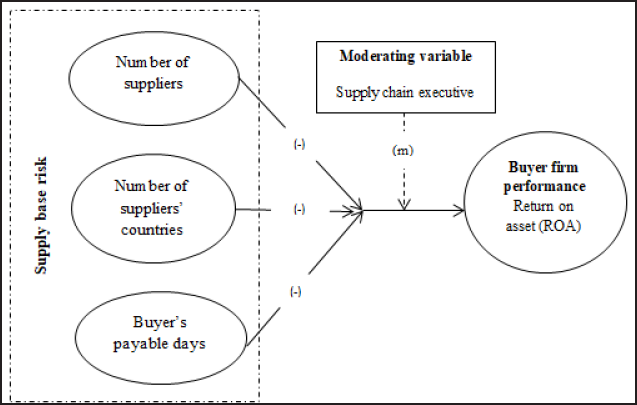
Although contracting multiple suppliers for the same product/component to minimize the risk, reduce supplier dependency and divert part of the risk (Harrigan, 1985; Pant et al., 2020) to their first-tier suppliers in a technology turbulent market (Holcomb & Hitt, 2007; Lu & Shang, 2017; Mackelprang et al., 2015; Menezes et al., 2021), they ignore the risks associated with the larger supply base since a large supply base hinders the buyer’s capability to monitor supplier’s behaviours and exchange relationships (Pilling et al., 1994). In line with TCE, Lu and Shang (2017) state that reliance upon larger supply base results in higher negotiation and contracting costs, monitoring and enforcement cost, and resolution cost when disagreement occurs that eventually increasing overall buyer’s transaction costs. Consistent with TCE, Bode and Wagner (2015) highlight uncertainty (e.g., delivery failure) and opportunism (e.g., conflicting information) as the two main outcomes of a larger supply base (Babich, 2006). The conflicting interests of suppliers are understandable, as they compete for a larger share of orders and, therefore, result in an ill-structured transaction across the supply base. The ill-structured transactions between buyer and supplier propel risk and uncertainty in the supply base that may adversely affect the buying firm performance (Lu & Shang, 2017). Although a larger supply base leads to cost efficiencies and a reduction in supplier dependency and risk, the costs of a larger supply base is likely to outweigh the benefits.
The number of suppliers’ countries is associated with global sourcing (Aqlan & Lam, 2015; Wieland & Marcus Wallenburg, 2012) and represents the geographical spread of the supply base. Past literature has emphasized that a globalized supply base refers to the stretched flow of physical goods with lengthier paths as well as variable lead times, which increases the likelihood of risk events (Blackhurst et al., 2005; Lorentz et al., 2012). For instance, the longer paths relate to more stoppage points and greater dependency on critical infrastructures such as airports and seaports which are potential risk sources such as cargo theft, rough handling, etc. Moreover, it is challenging to maintain symmetric information across the supply base when the geographical distance between buyer and supplier is large, leading to information ambiguity and uncertainty (El Ghoul et al., 2013). According to TCE, a widespread supply base may complicate communication and information processing between buyers and suppliers situated at different locations, which may increase transaction costs (Choi & Krause, 2006; Kunisch et al., 2019; Lu & Shang, 2017). Although IT technologies have reduced the cost of information sharing, it is still difficult to continuously track the financial exposure and other aspects of suppliers (Lu & Shang, 2017). It is primarily due to the differences in culture, technology and import/export laws across countries (Kim et al., 2018; Madhavan et al., 2004). TCE highlights that these geographical differences result in incomplete transactions among supply chain partners, and therefore, they are prone to execution hazards (Rosen et al., 2000).
In the current competitive market, buying firms (having a powerful position in the supply chain) misuse their power within the supply base. According to Templar et al. (2012), it is a very common practice for buying firms to extend payable days from 60 to 90 days in a way to get the working capital advantage at the cost of suppliers’ working capital. Murfin and Njoroge (2015) also report that buying firms offer their suppliers slower payment terms, which may compromise the supplier’s ability to cover financial obligations. Such a strategy may lead to operational failure within the supplier firm, leading to (Menezes et al., 2021) supply base risk (Pirttilä et al., 2020; Templar et al., 2016). For instance, extending the payable days is likely to disrupt the supplier’s operational activities, as stability in operations requires sufficient cash flow (Templar et al., 2012). Also, the operational failure of even a single supplier in the supply chain might result in a domino effect and disrupt the entire value chain (Wagner et al., 2009). According to Rosen et al. (2000), TCE assumes that both buyers and suppliers are self-centred supply chain entities who may act in opportunistic ways in order to capitalize on profit (e.g., working capital) by making false promises for individual benefit. The theory also assumes that transacting parties (e.g., supply chain members) may not be able to accurately foresee every contingency that might arise of any action (e.g., extending payable days) due to the lack of perfect knowledge and understanding of all things (O. Williamson, 1985; O. E. Williamson, 1975). For instance, extending payable days may affect the buyer’s prospects in terms of increased lead time, trust issues, bad reputation in the supply network.
Therefore, based on TCE and the above arguments, it is reasonable to argue that number of suupliers, number of suppliers’ countries and extended buyer’s payable days will have an adverse effect on buying firm performance.
H1: There is a significant negative relationship between number of suppliers and the buying firm performance (proxied by ROA). H2: There is a significant negative relationship between number of suppliers’ countries and the buying firm performance (proxied by ROA). H3: There is a significant negative relationship between the buyer’s payable days and the buying firm performance (proxied by ROA).
Supply chain executives identify SCRM as a source of strategic advantage (Gunessee et al., 2018; Mol, 2003) that significantly enhances supply chain value (Foli et al., 2022; Kim, 2007). SCRM primarily focuses on the management of buyer–supplier relationships to enable efficient information, product, process and technology flow in a way to counter supply chain risk (El Baz & Ruel, 2021; Hohenstein, 2022). Accordingly, the theory of TCE explains the organization of firms and their interactions along a value chain to highlight supply chain and economic risks that firms face (Rosen et al., 2000). Prior literature has emphasized that firms with supply chain executive (e.g., CSCO) in the TMT are better able to manage buyer–supplier transactions and related risks (Fawcett et al., 2008; Villena et al., 2018). In line with Trent (2004), the supply chain executive facilitates the implementation and execution of SCRM practices within the firm to reduce transaction costs between buyers and suppliers. Wagner and Kemmerling (2014) highlight the importance of supply chain executive in the firm’s TMT for effective management of supply chain activities. For instance, in the survey conducted by CSC, the Supply Chain Management Review and Neeley Business School, 51% of the responding firms have supply chain executives who manage various firm-level operational activities (CSC, 2012). Compared to earlier figures of 38% from 2007 (POIRIER & Swink, 2007) and 49% from 2010 (CSC, 2010), more firms report of having a supply chain executive in their TMT. Moreover, leading firms in their industry group are more likely to have a single supply chain executive in charge of various supply chain management activities (CSC, 2010). We argue that firms need to employ dedicated supply chain executive positions because it requires a specific set of skills and knowledge to effectively facilitate implementation and execution of SCRM. Therefore, in light of TCE, we propose that supply chain executive is likely to mitigate the negative effect of supply base risk.
H4: Supply chain executive positively moderates the degree of supply base risk, such that the negative effects of supply base risk on the buying firm performance (proxied by ROA) diminish.
Data and Methodology
Data
The unit of analysis of this study is Indian electronics manufacturing firms; therefore, we map the supply base risk characteristics of 122 electronics manufacturing firms listed on either the Bombay Stock Exchange (BSE) or the National Stock Exchange (NSE) and operationalize supply base risk as number of suppliers, number of suppliers’ countries and buyer’s payable days. In this study, we have used the sample of Indian electronics firms because supply base risk is more prevalent in emerging economies. Moreover, the electronics manufacturing industry tends to have certain distinguishing features as compared to other manufacturing industries such as large product variety, high rate of obsolescence, high demand and supply uncertainty, greater lead time and shorter product life cycles. Thus, there is always a risk of having ‘too much or too little inventory’ that leads to several supply chain problems. This has motivated to take up the study on electronics manufacturing industry using a large and longitudinal sample of Indian firms.
To collect relevant data, we primarily rely on three data sources, namely Prowess, Bloomberg and annual reports, for our empirical sample. Prowess is maintained and monitored by the Center for Monitoring Indian Economy (CMIE). Prowess is a highly reputed secondary data source for firm-level financial data for both private and public Indian firms (Gopalan et al., 2007; Siegel & Choudhury, 2012). Bloomberg terminal is also a widely recognized database for financial as well as supply chain data (Pant et al., 2020). Moreover, it captures firm-level data from across the world.
The supply chain information on Bloomberg Terminal is not readily available. In other words, it cannot be exported in a spreadsheet, unlike financial information. Therefore, we manually collect data on supply base risk over the period 2013-2017 for our sample firms. The information on the buyer’s payable days is directly fetched from the Prowess database. Also, we capture firm-level financial data from Prowess. Annual reports are used to gather information on supply chain executive (e.g., CSCO), as it is not consistently available on Prowess or Bloomberg Terminal.
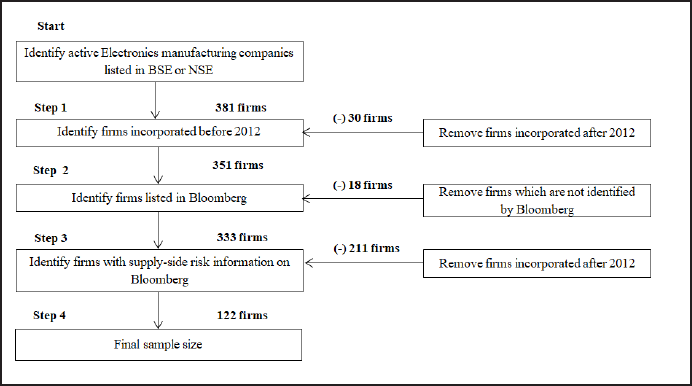
We started our data collection by identifying 1,409 Indian electronics firms from the Prowess database. After restricting our sample to active and publicly traded firms on either the Bombay Stock Exchange (BSE) or National Stock Exchange (NSE) over the period 2013–2017, a sample of 333 firms was obtained. Further, we captured supply base risk data from Bloomberg and found that only 122 firms out of 333 firms had risk-related information on Bloomberg. The firms with missing data on supply base risk are excluded from the sample. Our final empirical sample includes 122 firms, providing coverage of 36.7%. The data construction and cleaning process are explained in Figure 2. Following the thumb rule for the sample size requirement as proposed by Gunessee et al. (2018), the minimum sample size for our study should be 80 (i.e., 10× number of variables).
Data Construction and Cleaning Process.
Dependent Variables
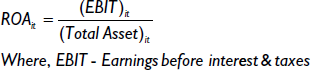
In line with prior studies (Mackelprang et al., 2015; Pant et al., 2021), we used return on assets (ROA) as the proxy for the buying firm performance. ROA is calculated as follows:
Independent Variables
As discussed before, we have considered three supply base risk dimensions in this study. Number of suppliers is measured as the number of suppliers in the supply base (Bozarth et al., 2009). Number of suppliers’ countries is also known as the geographical spread of the supply base, which is evaluated by the number of suppliers’ countries (Von Corswant & Fredriksson, 2002). For example, if a buying firm’s suppliers are located in three different countries, the number of suppliers’ countries is considered as three. In congruence with Baños-Caballero et al. (2012), we measured the buyer’s payable days as the number of days required to pay for goods received on credit from suppliers.
Moderating Variable
The management of the supply base risk involves high-level strategic decision-making (Tuncel & Alpan, 2010; Wagner & Kemmerling, 2014). Therefore, we use the presence of supply chain executive in the firm’s TMT as a moderating variable that may explain the relationship between supply base risk and firm performance. It is a dummy variable and its value is 1 if the supply chain executive is found present within TMT, and 0 otherwise.
Control Variables
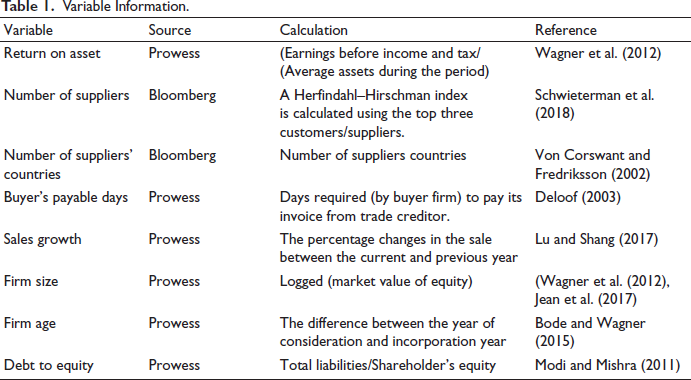
We have used a number of control variables to mitigate the effect of omitted variable bias, such as firm size, firm age, debt to equity and sales growth. The firm size is measured as the log of market value equity. It seems reasonable to believe that the bigger firms would experience more risk events than the smaller firms would. It may be due to their large supply base. The firm age is calculated by subtracting the year of consideration from the incorporation year. It is the measure of knowledge, experience, etc. We also consider debt to equity and sales growth to identify the current financial standing of a firm (Hendricks et al., 2009). Table 1 presents detailed information on the variables used in this study.
Variable Information.
Methodology
To test the relevant hypotheses as presented in ‘Theoretical Background and Hypotheses Development’, we carry out several multiple regression analyses. In particular, we investigate (a) the effect of supply base risk (e.g., number of suppliers, number of suppliers’ countries and buyer’s payable days) on buyer’s firm performance, (b) the moderating effect of supply chain executive on the relation between supply base risk and buyer’s firm performance (using following interaction terms: number of suppliers × supply chain executive, number of suppliers’ countries × supply chain executive and buyer’s payable days × supply chain executive).
Based on the standard Hausman test (see Table 2), we make the choice between fixed effects and random effects estimators and find that the random effect estimator is more suitable for our model (Baltagi, 2008; Baltagi et al., 2003; Torres-Reyna, 2007). Accordingly, we use a random effect panel data regression methodology for all the models.
Output: Hausman Test.
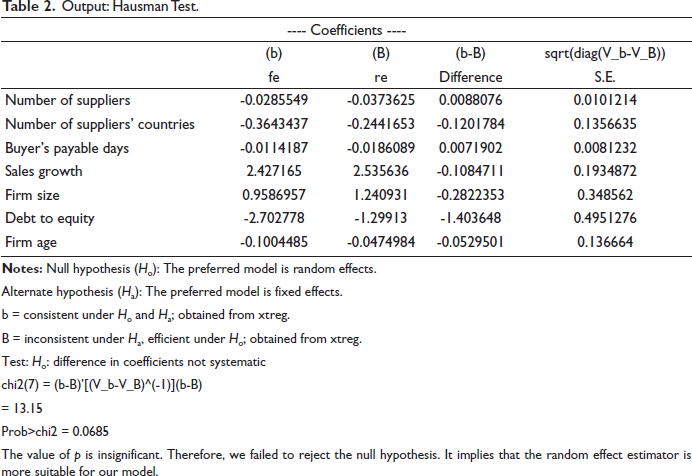
Alternate hypothesis (Ha): The preferred model is fixed effects.
b = consistent under Ho and Ha; obtained from xtreg.
B = inconsistent under Ha, efficient under Ho; obtained from xtreg.
Test: Ho: difference in coefficients not systematic
chi2(7) = (b-B)’[(V_b-V_B)^(-1)](b-B)
= 13.15
Prob>chi2 = 0.0685
The value of p is insignificant. Therefore, we failed to reject the null hypothesis. It implies that the random effect estimator is more suitable for our model.
Supply Base Risk and Buying Firm Performance (H1, H2 and H3)
To analyse the impact of supply base risk on firm performance, we estimate the following model. Moreover, the test statistics are based on robust standard errors that also account for heteroscedasticity (Amin et al., 2015).

Buying firm performance is measured by ROA.
where β0 = Intercept β1…. βn = Coefficients and εit= Error term.
Moderating Effect of Supply Chain Executive (H4)
The supply chain executive can play a decisive role in the firm’s ability to counter supply base risk. In line with Wagner and Kemmerling (2014), we expect that firms with supply chain executives in the TMT can manage risk efficiently and, thus, perform better. To analyse this hypothesis, we estimate the following regression model.

Empirical Results
Supply Base Risk and Buying Firm Performance (H1, H2 and H3)
This section addresses RQ1 and investigates the impact of supply base risk on buying firm performance using panel data regression methodology. Table 3 presents the result obtained from Equation (1). Model 1 tests the effect of only control variables, and subsequently, the risk variables are entered sequentially in Table 3 from Model 2 to Model 4. Finally, Model 5 includes all the risk variables which is also our main regression model.
Effect of Supply Base Risk (Number of Suppliers, Number of Suppliers’ Countries and Buyer’s Payable Days) on ROA.
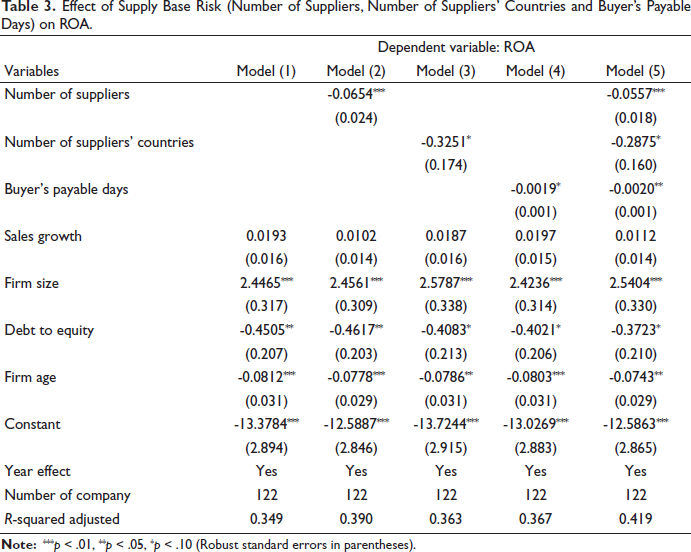
From Table 3 (Model 5), we find that there is a negative (coefficient of -0.0557) and significant (at 1 percentile) relationship between the number of suppliers and ROA. It may be because a large number of suppliers increases relationship and monitoring and transactional cost (Lu & Shang, 2017). Further, our results show that the coefficient on number of suppliers’ countries is negative (-0.287) and significant at 10 percentile. It implies that the geographically diversified supply base of a buying firm has a lower financial performance. The reason is the difficulty in getting homogenous input from the diverse supply base, due to their ‘dissimilarities in technology, culture (western vis-à-vis eastern) and local environments’ (Lu & Shang, 2017). Similarly, we examine the association between buyer’s payable days and financial performance. The results show that the coefficient on buyer’s payable days is negative (-0.002) and significant at 5 percentile level. It suggests that larger payable days negatively impact the financial outcomes of buying firms. From buying firm perspective, larger payable days tend to create trust issues and a bad reputation in the supply network and hamper the buyer’s relationship with its suppliers that lead to lower financial performance.
These results posit that the supply base risk significantly hurts the buying firm performance. Therefore, we failed to reject hypotheses H1, H2 and H3.
Moderating Effect of Supply Chain Executive (H4)
This section investigates RQ2. Table 4 presents the results obtained from Equation (2) that examine the moderating effect of supply chain executive representation in the firm’s TMT on the relationship between supply base risk and buying firm performance. In Table 4, the coefficient of number of suppliers by supply chain executive interaction is positive but insignificant. It implies that supply chain expertise in TMT does not tend to mitigate the negative impact of supply base size on performance. The coefficient of number of suppliers’ countries by supply chain executive interactions is positive (0.6315) and significant (5 percentile level), which is the difference between firms without supply chain executive and firms with supply chain executive groups. It implies that the net effect size (coefficient) of number of suppliers’ countries is positive, that is, 0.2995 (i.e., -0.332+0.6315) and is significant. In other words, supply chain executive representation in the firm’s TMT tends to mitigate the negative impact of a spread out supply base. Similarly, the results reveal that the coefficient of buyer’s payable days by supply chain executive is negative (-0.0091) and insignificant.
Moderating Effect of the Supply Chain Executive Representation in Firm’s TMT on the Relation Between Supply Base Risk (Number of Suppliers, Number of Suppliers’ Countries and Buyer’s Payable Days) and ROA.
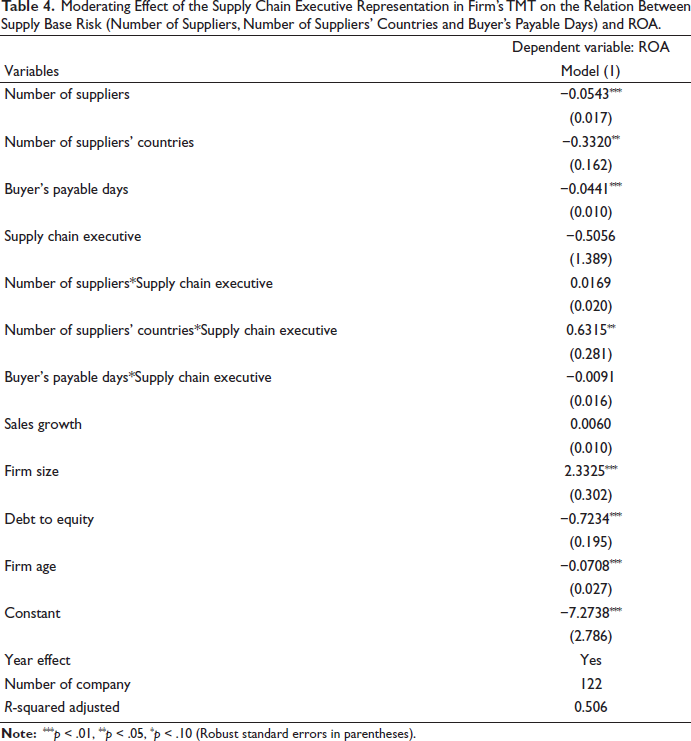
Although the moderating effect is only significant for number of suppliers’ countries, there is a clear indication that buying firm performance tends to improve in the presence of supply chain executive, implying that the supply chain executive is more competent to utilize supply base risks as a means to enhance firm value. Anecdotal evidence also suggests that supply chain executive is better able to facilitate supply base management through various supply chain practices. For instance, Barbara Kuxasits was named Chief Supply Chain Officer at Siemens in 2008, and she wasted no time in implementing several supply chain programmes to maximize the company’s potential for profit (FD-Wire, 2009). Therefore, it can be construed that the results will be more robust and validated if we have a large sample of firms for the analysis, which is conditional on the extent of corporate disclosure on supply chain executives. It has been observed that most of the Indian firms still do not disclose information on supply chain executives, possibly because they do not have any on their board of directors. Together, these results show that the supply chain executive moderates the degree of supply base risk, such that the adverse effects of supply base risk on the buying firm performance diminish.
Findings related to the moderating variable support our argument that supply chain executives are better able to understand the risk and uncertainty associated with the firm’s supply base. Also, these executives are more competent to take effective decisions to translate supply chain strategy into practice that eventually improves performance (Wagner & Kemmerling, 2014). Therefore, H4 is supported.
Discussion
This article examines the association between supply base risk and firm performance in light of the representation of supply chain executive in a firm’s TMT using large and longitudinal data on the Indian electronics industry. We have used the sample of Indian electronics firms because supply base risk is more prevalent in emerging economies. An emerging economy like India fulfills most of the local market needs through imports, mainly due to the lack of a manufacturing-driven sector and developed external markets (Dun & Bradstreet, 2014). It is evident from the fact that the Indian electronics industry generates total revenue of US dollars 32.7 billion (Ernst & Young, 2015), which is only behind China, the United States, Japan and Germany. However, the Indian electronics industry fulfills 65% of the demand from imports (Ernst & Young, 2015). It implies that the success of Indian electronics firms depends on a large number of suppliers from diverse geographical locations. It may be because globalized supply bases facilitate lower-priced materials and labour and advanced manufacturing capabilities and access to the global knowledge base (Bode & Wagner, 2015; Gilley & Rasheed, 2000; KPMG, 2011). Further, larger supply base concentration minimizes the risk of operational disruptions, and most importantly, multi-sourcing often leads to cost savings (Holcomb & Hitt, 2007). However, Lu and Shang (2017), using data on 867 US firms, report that a widespread supply base has a negative marginal impact. They also find that no firm in their sample benefits from a geographically stretched supply base when the ROA is considered. Therefore, it can be construed that a large and widespread supply base has made the Indian electronics industry more vulnerable to risks and uncertainties.
In light of the above discussion, this study attempts to investigate the performance effect of supply base risk considering firm-level SCRM practices. In particular, we examine (1) the relationship between supply base risk and firm performance, and (2) moderating role of firm-level SCRM practices on the relationship between supply base risk and firm performance. To investigate these, we operationalize supply base risk as number of suppliers, number of suppliers’ countries and buyer’s payable days (Kavilal et al., 2017; Lu & Shang, 2017; Pirttilä et al., 2020). More importantly, inspired by Villena et al. (2018), we believe that firms with supply chain executive in their TMT are more likely to adopt SCRM practices and, therefore, conceptualize SCRM practices as the representation of the supply chain executive in the firm’s TMT. Our panel data regression analyses reveal that supply base risk (proxied by number of suppliers, number of suppliers’ countries and buyer’s payable days) has a negative impact on firm performance. These results are consistent with prior studies that state that supply chain risk negatively affects a firm’s profitability, firm’s innovation, asset turnover and ROA (El Baz & Ruel, 2021; Foli et al., 2022; Hohenstein, 2022; Lu & Shang, 2017; Sreedevi et al., 2023; Wagner & Bode, 2008; Wang et al., 2017). Further, we find that supply chain executive representation in the TMT significantly mitigates the negative impact of supply base risk. Therefore, it can be construed that supply chain executive enables efficient and effective firm-level SCRM practices that consequently lead to better financial performance (El Baz & Ruel, 2021; Rogers et al., 2016).
Overall, this study implies that supply base risk may negatively affect buying firm performance, thereby calling for firm-level efficient and effective SCRM practices through employing supply chain executive in the TMT.
Conclusion
This study contributes to a better understanding of the multi-dimensional nature of the supply base risk and its impact on the buying firm performance. In essence, the proposed model posits negative and direct relationships among number of suppliers, number of suppliers’ countries, and buyer’s payable days and the buying firm performance. Also, the model suggests that the firms having a supply chain executive in their TMT demonstrate improved financial performance. It is primarily because the presence of a supply chain executive in the firm’s TMT facilitates effective risk management practices. The empirical results support our predictions and have several important theoretical and managerial implications.
Theoretical Implications
The main research question we wished to examine is whether the supply base risk affects the buying firm performance. Several studies have suggested an association between certain supply base risk and firm performance (Blackhurst et al., 2005; Bode & Wagner, 2015; Choi & Krause, 2006), but empirical evidence has competing views. While Bode and Wagner (2015) report a negative association between supply base risk and firm performance, Lu and Shang (2017) reveal that supply base risk can have a positive influence on buying firm performance to some extent. Therefore, the current study re-examines the performance effect of supply base risk to strengthen the past arguments presented by existing research. To understand this relationship, a theoretical perspective, namely TCE provides us the foundation to link supply base risk and firm performance. The empirical results have supported the distinction of the three dimensions of supply base risk in our model and provided explanatory power for the relationship between supply base risk and buying firm performance. In line with previous research (El Baz & Ruel, 2021; Fan & Stevenson, 2018; Foli et al., 2022; Lu & Shang, 2017; Wagner & Bode, 2008), the findings suggest that each of the three conceptualized drivers of the supply base significantly affects financial performance. In this respect, this study highlights the need for further investigations of risk at the supply chain level (KT et al., 2020). Beyond the negative link between the risk drivers and firm performance, the effect size indicates that the effect of ‘number of suppliers’ countries’ on firm performance is considerably stronger than that of ‘number of suppliers’ and ‘buyer’s payable days’. Hence, the number of suppliers’ countries seem to have the largest effect on the buying firm performance. It may be because geographically scattered suppliers are unable to supply consistent inputs due to their differences in technology, culture and local environments, thus increasing buyer’s manufacturing costs (Lu & Shang, 2017). Also, a widespread supply base may pose logistics and operational challenges due to unforeseeable events such as the more recent COVID 2019 pandemic or the 2011 Japanese tsunami. Therefore, in line with TCE, prior studies (Ogden & Carter, 2008; Sarkar & Mohapatra, 2006) promote the need for a less globalized supply base (supplier’s proximity to buying firm), as it minimizes negotiation, communication and monitoring cost related to the supplier that eventually lowers the transaction costs of buyer firm. Together, these results reveal that the systematic improvement in the supply base mitigates the risk associated with suppliers and eventually improves buying firm performance (Wagner et al., 2011).
This study attempts to contribute to the supply chain risk literature by integrating the structural characteristics of the supply chain with the buying firm’s working capital strategy (Pirttilä et al., 2020). It explains the buying firm’s working capital strategy in the context of supply base risk and conceptualizes it as a buyer’s payable days. The results highlight that the buyer’s payable days play a significant role in determining financial performance. An extended buyer’s payable days can pose a serious threat to the working capital efficiency (Templar et al., 2016) of its direct suppliers, which may lead to a domino effect and eventually supply chain disruptions.
The most important contribution of this study is that it examines the moderating effect of SCRM practice on the relationship between supply base risk and buying firm performance. In light of Wagner and Kemmerling (2014), we operationalize SCRM practice based on the representation of the supply chain executive in the firm’s TMT. Our results suggest that the supply chain executive in the firm’s TMT can significantly mitigate the negative effect of supply base risk.
This study has ramifications for the realm of economics as well. When a company’s supply chain is disrupted as a result of a risk event (Foli et al., 2022), it can result in production delays, higher expenses and reduced income (Lu & Shang, 2017). In turn, this can reduce economic growth, as businesses are obliged to reduce production or delay investment decisions. Consequently, supply base risk can have far-reaching effects on the economic stability of a nation or region as a whole.
Last but not least, this study also makes some methodological contributions to supply chain risk literature. Almost all the studies on supply chain risk rely on either qualitative or survey data (Zhao et al., 2019). Qualitative data may be affected by the responders’ attitudes and cognitive ability (Hammarberg et al., 2016). Therefore, by relying on secondary data on supply base risk and other characteristics, this study will add to our objective understanding of supply base risk and its effect on firm performance (Fisher et al., 2019; Pant et al., 2021; Pant, Dutta, & Sarmah, 2022; Pant, Sarmah, & Vishal, 2022).
Managerial Implications
Our empirical evidence also yields practical implications for managers and policymakers. First, the managers should have a deep understanding of the supply base risk because it significantly affects the buying firm performance (Bode & Wagner, 2015). Second, the study utilizes the buyer’s payable days as one of the critical risk drivers. Although it is not directly associated with the supplier, buyer’s payable days drive the working capital strategy of the suppliers. Our results show that large payable days result in poor buying firm performance. It is because the larger buyer’s payable days tend to hamper the supplier’s working capital (Templar et al., 2016), leading to supply disruption and thus lower buying firm performance. Therefore, managers should classify their suppliers based on financial health, that is, critical and non-critical suppliers. A critical supplier refers to a financially constrained/weak firm, whereas a non-critical supplier means a financially stable firm. Critical suppliers’ working capital largely depends on payable days committed by the buying firm; therefore, policies/strategies by the decision-makers should be in favour of those suppliers. For non-critical suppliers, the managers can negotiate for extended payable days to improve the buying firm’s working capital efficiency. Third, consistent with Wagner and Kemmerling (2014), this study recommends firms to have a dedicated supply chain executive position in the firm’s TMT in a way to alleviate the negative impact of supply base risk.
Our analysis has major policy implications, as effective policies can assist businesses in mitigating the negative effects of supply base risks and ensuring their long-term viability and profitability. This study provides policymakers with various recommendations. First, policymakers must encourage supplier engagement that can assist businesses in identifying and successfully addressing supply base vulnerabilities (Kt & Sarmah, 2021). Policymakers may encourage companies to collaborate with their suppliers by promoting relational capital and integrated R&D investments in a way to mitigate risk (Lu & Shang, 2017). Second, policymakers can promote supply chain transparency by encouraging companies to publish information regarding their suppliers (critical vs. non-critical), cash flow and supply chain practices. Finally, policymakers must encourage companies to strengthen their supply chain resilience by providing resources for risk assessment and mitigation, supporting the use of risk management tools, and establishing platforms to allow risk-sharing and collaboration. It can be accomplished through the development and implementation of SCRM framework (e.g., risk identification, risk assessment, risk mitigation and risk monitoring) that provides guidelines for the management of supply chain risks. These standards can assist businesses in developing comprehensive risk management plans and ensuring that their suppliers and vendors adhere to the same requirements (KT et al., 2020).
Limitations and Future Research Directions
This study has also some limitations, each offering scope for future research. First, this study is restricted to the supply base risk; future research can extend this work on the supply chain level by including risk associated with the customer base and internal manufacturing. Second, this article examines the relationship between the supply base risk and financial performance. However, future studies can use an extensive set of critical performance metrics such as delivery, quality, service, etc. Third, the sample used in our study may be biased; the sample firms are reduced to 122 firms from 333 firms due to the poor availability of data. It may lead to sample selection bias that depends on whether the selection process is correlated with financial performance. Future research can use the classic Heckman selection model to check the reliability of the sample (Heckman, 1979). Additionally, the study can be extended to the other manufacturing/service sector and cross-comparison can be done with the present results. Finally, we get an R-squared value varying from 34.9% to 50% in our regression results. It suggests that a lot of heterogeneity within the firm is still not explained (Markarian & Parbonetti, 2007). Although we present a new approach to comprehend the effect of supply base risk, our study has a few unanswered questions, which need to be investigated further in future research.
Appendix
Functional domain of supply chain executive.
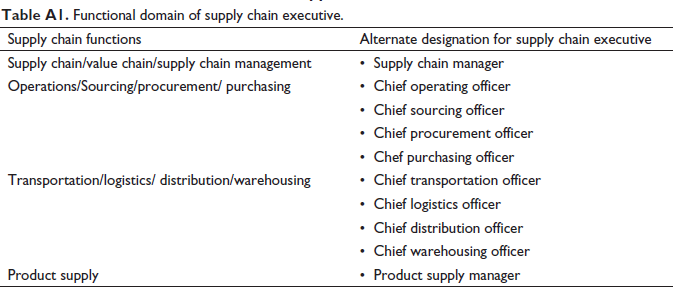
Functional domain of supply chain executive.
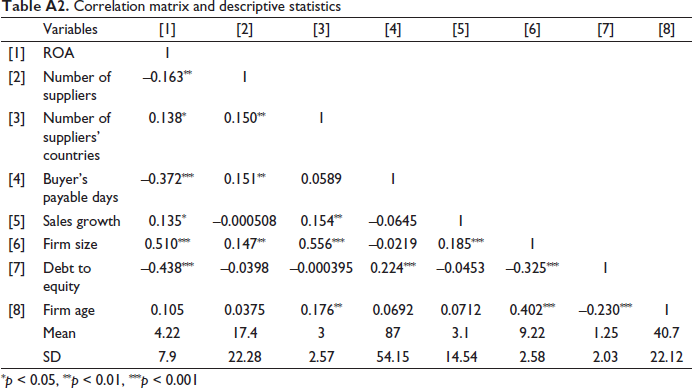
*p < 0.05, **p < 0.01, ***p < 0.001
Footnotes
Acknowledgements
The authors would like to sincerely thank the two anonymous reviewers and editor for their pertinent comments and suggestions for this article, which not only improved the quality, but also the presentation of this article.
Declaration of Conflicting Interests
The authors declare that they have no known competing financial interests or personal relationships that could have appeared to influence the work reported in this article.
Funding
The authors received no financial support for the research, authorship and/or publication of this article.
