







Abstract
This study aimed to examine the impact of food biosafety measures, e-service quality, and product quality on the satisfaction of e-consumers who use food delivery services, as well as to investigate whether brand image moderates the relationship between e-consumer satisfaction and e-loyalty. The sample comprised 1709 Colombian consumers who use food delivery services at home or work. The study found that food biosafety measures, e-service quality, and product quality have a positive impact on e-consumer satisfaction and influence e-loyalty. However, no moderating effect of brand image was found between e-satisfaction and e-loyalty. The study’s novelty lies in providing insights into consumer behaviour changes regarding the online food delivery service (OFDS) during the post-pandemic period, which has resulted in an increased demand for food biosafety globally. These findings offer valuable information to develop strategies that can interpret consumer needs and expectations, learn from new trends in the food delivery industry, and apply lessons learned promptly.
Introduction
The global pandemic in 2020 has significantly impacted the food industry due to increased sanitary standards and the need for high levels of protection from restaurants to reduce the risks of spreading infections (Hakovirta & Denuwara, 2020; Nyokabi et al., 2018; Sharma & Dutta 2023; Untaru & Han, 2021; Varese et al., 2023). As a result, food consumption behaviours have been significantly affected (Islam et al., 2020; Kim et al., 2020), and the COVID-19 pandemic has generated an important change in practices related to food management in the production chain. Moreover, the fast-food restaurant service has gradually dominated the market in recent years, and this trend is due to the rapid growth of technology and new forms of food delivery (Das & Ramalingam, 2022; Hamid et al., 2023).
However, this trend has increased the risks of spreading highly dangerous viruses (Kumar & Shah, 2021; Macías et al., 2021; Su et al., 2022; Thomé et al., 2021). Regulations generated from 2020 have negatively affected the world economy, and priorities and relationship modes of different actors have also changed, including consumers, businessmen, and health authorities (Dsouza & Sharma, 2020). Consequently, new practices such as digitization, remote sales, virtual payments, and QR codes have emerged, creating a win-win situation for the actors involved in online transactions of goods and services (Das & Ramalingam, 2022; Hübner et al., 2016).
The changes brought about by the pandemic have accelerated investments in the development of new skills in food delivery services, such as re-induction and training of all staff to maintain service to consumers and take care of their health. The food delivery operating model was forced to change radically, and restaurants and delivery services that quickly implemented new operating strategies improved their chances of retaining and building consumer loyalty (Dsouza & Sharma, 2020; Nigro et al., 2022; Ng et al., 2023). Biosafety became a critical practice in the fast-food industry, and it is necessary to investigate its impact on the perception of consumer satisfaction (Macías et al., 2021; Thomé et al., 2021).
In this fascinating exploration of the post-pandemic world, we delve into the complex web of consumer perception toward online food delivery services. It’s a journey that takes us through the fascinating interplay of the elements that shape the way we order and enjoy our meals.
The context is set by Zhong and Moon’s groundbreaking work in 2020, which highlights the need to consider the role of branding in food delivery services. It’s not just ordering a meal; it’s about experience, satisfaction and loyalty that follow.
But this is just the beginning. Our journey ventures into uncharted territory, where we question the nature of electronic service quality (e-SQ) in this rapidly changing landscape. Emerging factors and the complex relationship between e-SQ and electronic consumer satisfaction (e-CS) attract our attention. The stakes are high, and finding understanding has never been more important.
The plot thickens as we explore the significant impact of product quality (PQ) and its myriad attributes on consumer choice and online loyalty. Nanim in 2017, Roy and his team in 2020, and Singh’s ideas in 2021 provide the core roadmap for our mission. We do not just order food; we make decisions that have profound implications for the platforms we choose on a regular basis.
We have built a robust model composed of a mosaic made up of biosecurity, e-service quality, and product quality, all of which are closely linked to e-consumer satisfaction and e-loyalty. In this age of contagion risk, we see biosecurity having a huge impact, shaping consumer habits as they explore the world of processed foods. The conclusions are clear: maintaining consumer confidence through biosecurity measures is not only prudent but necessary.
The novelty of this study is that we carry out a groundbreaking exploration of post-pandemic consumer behaviour because it investigates the complex sector of online food delivery services (OFDS), focusing on Colombian cities. Its pioneering contribution lies in highlighting the profound impact of biosecurity measures on e-consumer satisfaction, especially in packaging handling. Exploring essential nuances, the research emphasizes the central role of fast, accurate service and high-quality food products in improving customer experience and loyalty. Significantly, it challenges mainstream assumptions by questioning the necessity of branding to form OFDS consumer loyalty, thereby adding a layer of complexity to this dynamic. By delving into the specifics of developing countries like Colombia, this research provides invaluable global implications, highlighting the universal need for rigorous biosecurity procedures and strategic Customer-centric strategy in the changing online food delivery landscape.
The article is structured as follows: The introduction provides an overview about the impact of the 2020 global pandemic on the online food delivery services; and explores how biosecurity measures, e-service quality, and product quality influence e-consumer satisfaction and e-loyalty in the post-pandemic world, challenging assumptions about branding’s role in OFDS. The theoretical background presents a complete overview of the following variables: food biosafety measures, e-service quality, product quality, e-customer satisfaction, e-loyalty, and brand image, and discusses the key concepts, principles and theories related to the topic research. The methodology describes the quantitative research design carried out with participants from five Colombian cities, the questions used in the survey and the rigorous way in which the data was collected and analyzed. The results and discussion present the most relevant findings on the evaluated hypotheses and their respective in-depth analysis; Implications and significance are discussed in the context of the existing literature on OFDS, and each hypothesis is systematically addressed. The conclusion summarizes the key findings and their contributions, highlighting 10 important managerial implications and 3 interesting lines of research in the context of OFDS.
Literature Review
The expectation-disconfirmation theory (EDT) from Oliver (1980) is the theory that explains satisfaction and loyalty in consumption. Based on EDT, the organization can increase satisfaction by increasing the perceived performance of the product or by reducing expectations. In the satisfaction assessment process, first-time buyers can get a feel for the expectations of a particular product or service before purchasing. This theory holds that consumer satisfaction is determined by a comparison between the expectations created by the consumer and the actual performance or experience with the product or service received. This model includes four elements: expectations, perceived performance, dissatisfaction, and satisfaction, as shown below: expectations define customer expectations regarding the performance of products and services. EDT can identify multiple perspectives of customers in the purchasing process.
Over time, several studies have designed their research based on EDT, and they have used product quality and service quality as independent variables to measure consumer satisfaction, finding found a strong association between these variables (Bloemer & Kasper, 1995; Chai et al., 2009; Singh, 2021; Uddin 2019; Wu and Mohi, 2015). On the other hand, customer satisfaction is the factor that regulates loyalty. Several researchers have studied this relationship for decades. The results of their investigations show the existence of positive and negative relationships between these two variables; as well as the presence of non-linear relationships where it is possible for customers to be loyal, without feeling too satisfied (Carranza et al., 2018; Fornell et al., 1996; Oliva et al., 1992; Sivadas & Baker 2000; Zhong et al., 2020).
Food biosafety measures are essential for protecting food against biological hazards and infectious diseases during production, processing, transportation, and delivery to the final consumer (Khalil et al., 2018). The implementation of biosafety measures focuses on prevention, control, mitigation, and/or elimination actions to ensure the safety and quality of food (Adams et al., 1995; Khalil et al., 2018). The COVID-19 pandemic in 2020 has intensified the need for food biosafety measures, resulting in the implementation of various protocols and restrictions by companies and governments worldwide (Nyokabi et al., 2018; Untaru & Han, 2021).
Several biosafety measures have been implemented, such as contactless delivery, mask-wearing, disinfection, and digital payments, to eliminate the risk of infection during the preparation, transportation, and delivery of food (Das & Ramalingam, 2022; Rosemberg et al., 2023). Consumers have become more concerned about food biosafety measures, and studies have shown that the application of these measures positively affects the degree of acceptance of OFDS (Almunawar & Anshari, 2022; Kostromitina et al., 2021; Wang et al., 2021).
Despite growing consumer concern about food biosafety measures, little research has been conducted on their impact on satisfaction with OFDS (Thomé et al., 2021). This knowledge gap highlights the need for more research to better understand how these measures affect consumer satisfaction in this context. Then, to address this gap, future research should focus on conducting more studies on the impact of food biosafety measures on consumer satisfaction. Structural equation models could also be used to verify if biosafety explains consumer satisfaction (Thomé et al., 2021).
Moreover, it is essential to develop measurement scales on consumer perception of food biosafety, especially for OFDS. The growing concern of consumers regarding food biosafety highlights the importance of systematically analyzing their perceptions to understand the effects on consumer satisfaction (Alhelalat et al., 2017; Macías et al., 2021).
According to the above, food biosafety measures are crucial for ensuring the safety and quality of food during production, processing, transportation, and delivery to the final consumer. The COVID-19 pandemic has intensified the need for these measures, resulting in the implementation of various protocols and restrictions worldwide. While consumers are concerned about food biosafety, there is a lack of research on the impact of these measures on consumer satisfaction. Future research should focus on addressing this knowledge gap by conducting more studies and developing measurement scales on consumer perception of food biosafety for OFDS. Therefore, we proposed the following hypothesis:
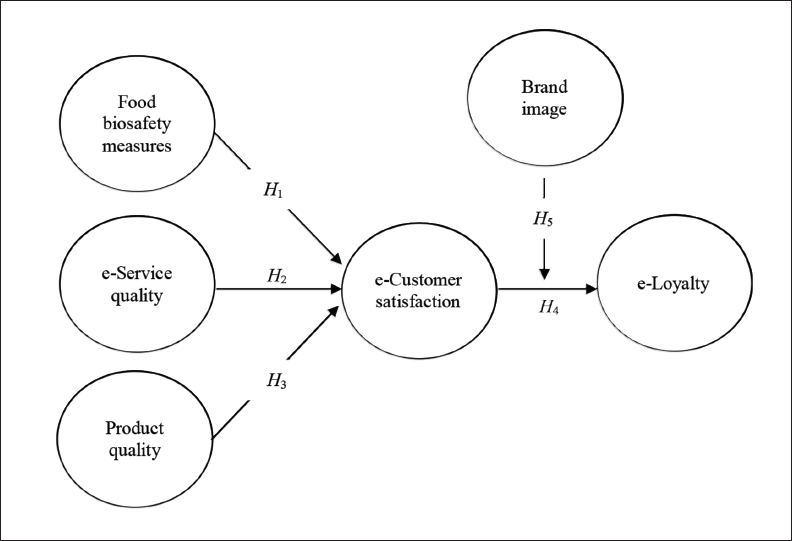
H1. Food biosafety measures implemented by OFDS-have a positive influence on e-consumer satisfaction.
Parasuraman et al. (1988) established the concept of service quality according to five dimensions: reliability, responsiveness, tangibility, assurance, and empathy. This concept refers to the quality of goods and services offered by an organization relative to its competitors, which is a critical factor for competitiveness and positively affects repurchase intention (Ghobadian & Jones, 1994). Later, Parasuraman et al. (2005) defined e-service quality (e-SQ) as “the extent to which a website facilitates efficient and effective shopping, purchasing and delivery” (p. 217). This includes the entire transaction process, from initial information search to website browsing, ordering, consumer service interactions, delivery, and ultimately, satisfaction with the purchased product (Wolfinbarger & Gilly, 2003). Therefore, e-SQ encompasses the pre-purchase phase—ease of use, product information, ordering information, and personal information protection—to the post-purchase phase—delivery, consumer support, fulfilment, and return policy (Ladhari, 2010).
Research shows that both the quality of the service and the quality of the product are the greatest predictors of consumer satisfaction (Carranza et al., 2018; Singh et al., 2021; Uddin, 2019). Both variables influence consumer satisfaction and loyalty (Lai et al., 2009). However, Liu et al. (2016) stated that service quality positively influences consumer satisfaction and loyalty; while Dsouza & Sharma (2020) determined that service quality does not impact consumer satisfaction. Recent research highlights that e-service quality is the main factor to guarantee e-consumer satisfaction with OFDS at home (Macías et al., 2020). Suhartanto et al. (2019) found that e-service quality plays a crucial role in enhancing both the quality of food and the perceived value of OFDS, leading to increased e-consumer satisfaction and e-loyalty towards these providers.
Since e-service quality is not only a competitive advantage but also a success factor that determines how well the service offered meets consumer expectations, it is vital to continue measuring it (Chun & Nyam, 2020). Nandankar et al. (2021) suggested that future research should delve into OFDS to understand the different complexities of e-service quality, including order quality, quantity of items, accuracy of orders, payment methods, delivery policies, return policies, and delivery speed.
In the context of the pandemic, the latest e-service quality model by Parasuraman et al. (2005) is appropriate because it helps understand the nature of current services. Chen et al. (2020) argue that as of 2020, mainly fast-food restaurants have massively migrated to the digitization of their services. Although the pandemic significantly increased the use of OFDS, there is a lack of research in this regard (Kumar & Shah, 2021). Therefore, studies that allow us to discover new aspects about the behaviour of food consumers who use the applications are welcome (Talwar et al., 2023).
This study focuses on capturing the consumer’s perception regarding the quality of the delivery service of OFDS. Thus, the study evaluates e-service quality by considering factors proposed and adapted from Erkmen and Hancer (2019), which measure whether OFDS provides prompt and timely service, whether the delivery person makes the consumer feel comfortable and is willing to assist them, and whether the food is delivered exactly as requested by the consumer. We suggest that the quality of the service offered by the delivery company influences consumer satisfaction, and we proposed the following hypothesis:
H2. The quality of the OFDS offered have a positive influence on e-consumer satisfaction.
Product quality, according to Chen and Dubinsky (2003), refers to a consumer’s evaluation of a product’s superiority or excellence. E-commerce success, in line with the OFDS, is influenced by minimizing product costs while maximizing quality. To achieve this objective, Yu et al. (2018) recommend evalua-ting features, such as food quality, which encompasses elements like food taste, freshness, temperature, menu variety, and safety.
Several studies have highlighted the importance of product quality in OFDS and its impact on consumers’ restaurant selection (Le et al., 2023; Nanim, 2017; Roy et al., 2020; Seghezzi & Mangiaracina, 2021; Shahzadi et al., 2018; Yi et al., 2018). Trimigno et al. (2015) found that consumers highly value attributes such as presentation, flavour, nutritional value, processing, and storage. On the other hand, Nanim (2017), Chun and Nyam (2020), and Roy et al. (2020) found that consumers highly appreciate attributes such as freshness, food temperature, menu variety, presentation, and taste. These attributes are critical in meeting consumers’ needs and expectations (Dsouza & Sharma, 2020; Singh et al., 2021; Uddin, 2019). For example, younger consumers highly prefer good quality food products, and each time they obtain them, their satisfaction increases, generating an attitude of repurchase and loyalty (Ulkhaq et al., 2016). Belarmino et al. (2021) found that temperature, freshness, and correct order are crucial in e-consumer satisfaction with the OFDS. Chun and Nyam (2020) also found that the quality of food is the main predictor of consumer satisfaction. Therefore, it can be concluded that product quality positively impacts e-consumer satisfaction and increases repurchase intention. This not only contributes to loyalty but also increases the revenue of restaurants (Uddin, 2019), thanks to OFDS (Belarmino et al., 2021).
As this study aimed to understand consumers’ perceptions of food products via online channels, it is essential to evaluate their perception of the product quality received. Therefore, we adapted and evaluated product quality by considering several factors: whether the food smells good (Zhong & Moon, 2020), whether the ingredients are fresh, whether the food presentation is visually appealing, and whether the food maintains the correct temperature (Muskat et al., 2019). The significance of these questions lies in the fact that we consider product quality delivered by the OFDS to be a crucial factor in influencing e-consumer satisfaction.
According to the above, product quality plays a crucial role in OFDS, and its importance cannot be overstated. Consumers highly value attributes such as presentation, flavour, freshness, nutritional value, processing, storage, menu variety, and safety. Good quality food products are highly preferred by younger consumers, and each time they obtain them, their satisfaction increases, generating an attitude of repurchase and loyalty. Furthermore, product quality positively impacts e-consumer satisfaction and increases repurchase intention, contributing to loyalty and increasing restaurants’ revenue. It is therefore necessary to evaluate product quality by considering factors such as the food’s smell, freshness, presentation, and temperature, as these influence consumers’ perception of the product quality received via OFDS. We proposed the following hypothesis:
H3. The quality of the products delivered by the OFDS has a positive influence on e-consumer satisfaction.
Roy et al. (2020) defined consumer satisfaction as the evaluation of a product’s purchasing experience and satisfaction quality. In the context of OFDS, Chotigo and Kadono (2021) consider e-consumer satisfaction to be the level of fulfillment that consumers experience while using food delivery apps. Alalwan (2020) adds that satisfaction is measured in comparison to previous online shopping experiences. E-consumer satisfaction refers to the satisfaction that the consumer experiences, in relation to a previous purchase in which he used OFDS (Anderson & Srinivasan, 2003). Hence, the concept of e-consumer satisfaction refers to the satisfaction that consumers experience in relation to their previous OFDS purchases.
Recent research indicates that e-consumer satisfaction is likely to increase if consumers perceive the technology to meet their expectations (Chotigo & Kadono, 2021; Slack et al., 2020). Moreover, e-consumer satisfaction partially mediates the relationship between e-service quality and e-loyalty (Suhartanto et al., 2019). The formation model of behavioural intention including e-service quality, food quality, perceived value, and e-consumer satisfaction is also reliable (Suhartanto et al., 2020).
To increase profits and expand their consumer base, businesses need to understand their consumers and provide satisfactory experiences. Reichheld and Covey (2006) emphasize that the essence of consumer satisfaction theory lies in identifying the behaviours that consumers exhibit. Companies should determine if the level of satisfaction experienced leads to loyalty, repurchase, and word-of-mouth recommendations. Satisfied consumers who repurchase also tend to recommend the products or services to potential consumers, leading to less price sensitivity (Singh et al., 2021; Uddin, 2019). Therefore, consumer satisfaction is a key factor that businesses should consider increasing loyalty and improve their results (Shahzadi et al., 2018).
Consumer satisfaction can predict future consumer behaviour (Koay et al., 2022; Ryu et al., 2012). By satisfying consumers, businesses can build lasting relationships (Darley & Luethge, 2019; Ji & Prentice, 2021), leading to repurchases, positive word-of-mouth, and less price sensitivity (Untaru & Han, 2021). In addition, using online solutions can increase e-consumer satisfaction and repurchase intention (Kumar & Shah, 2021). Therefore, studies should include OFDS since a high level of satisfaction can evoke positive feelings in consumers (Cronin et al., 2000).
According to the above, e-consumer satisfaction is an essential factor that businesses should consider building lasting relationships and increase loyalty. To achieve this, businesses must provide satisfactory experiences that meet consumers’ expectations. Future research should focus on identifying the factors that influence e-consumer satisfaction, leading to higher repurchases and word-of-mouth recommendations.
Consumer satisfaction and loyalty are two critical concepts in the e-commerce industry. Previous studies have established a positive correlation between consumer satisfaction and loyalty, with a higher level of satisfaction leading to higher loyalty (Singh et al., 2021; Uddin, 2019; Yi et al., 2018; Zhong & Moon, 2020). Moreover, Roy et al. (2020) found that a satisfied customer is not only likely to recommend the product or service but also has a high repurchase intention, leading to increased loyalty.
Loyalty, according to previous research, refers to the manifestation of favourable attitudes towards a brand, resulting in repeat buying behaviour and the generation of word-of-mouth (Anderson & Srinivasan, 2003; Assael, 1984; Engel et al., 1986; Gremler, 1995; Keller, 1993; Malhotra, 2021; Uddin, 2019). Service and product quality have been identified as predictors of consumer satisfaction and have a positive impact on loyalty (Chen et al., 2020; Lewis & Soureli, 2006; Malhotra, 2021; Zeithaml et al., 2020). However, Su et al. (2022) suggest that other latent dimensions of functional and technical quality of OFDS should be explored, and that the relationship between the quality of these solutions and e-loyalty should be examined, in other market segments in developing or developed countries.
E-loyalty has evolved beyond just repurchasing to include positive word-of-mouth and motivating others to purchase the same product or service (Uddin, 2019). This behaviour increase the company profits (Auh et al., 2019; Uddin, 2019). To evaluate e-consumer satisfaction and e-loyalty, several factors should be considered, such as expressing positive feedback, recommending to others, and repurchasing (Al-Amin et al., 2020; Parasuraman et al., 2005).
According to the above, previous research has established a positive relationship between consumer satisfaction and loyalty, with a high level of satisfaction leading to increased loyalty. E-loyalty encompasses not only repurchasing but also positive word-of-mouth and motivating others to purchase the same product or service. In addition, service and product quality are predictors of consumer satisfaction and loyalty. Future research should explore other dimensions of quality and examine the relationship between the quality of online solutions and e-loyalty. We proposed the following hypothesis:
H4. e-Consumer satisfaction with the delivery service positively influences e-loyalty.
Brand image is a crucial concept in the field of marketing, defined as the perceptions that consumers have of a brand, reflected in the brand associations in their memory (Keller, 1993). It plays a crucial role in facilitating customer decision-making and brand recognition; thus, companies must strive to establish a positive image of their brands that resonates with their target audience (Keller, 2015).
Recent research has shed light on the significance of brand image in the food industry. Nitiwanakul (2021) found that brand image is a key factor influencing young consumers’ selection of OFDS, while senior consumers are affected by the value perceived by the customer. Similarly, Malhotra (2021) found that brand image moderates the relationship between service quality and loyalty through consumer satisfaction, but not between product quality and loyalty. Similarly, Ryu et al. (2008) and Yi et al. (2018) asserts that brand image affects customer satisfaction, and this satisfaction promotes consumer loyalty, thus ensuring future behavioural intentions. While Unal and Aydin (2013) show that brand image becomes a predictor of satisfaction and has a positive influence on consumer loyalty; recent research has determined that companies adopting biosecurity measures during the pandemic have significantly boosted brand image and improved fast food consumer satisfaction (Dsouza & Sharma, 2020; Untaru and Han, 2021).
About the relationship between consumer satisfaction and consumer loyalty is important to note that, previous research on brand image has produced conflicting results. While Anwar et al. (2011) found that brand image helps customers realize their needs and satisfaction and differentiates the brand from competitors. Andreassen and Lindestad (1998) found that brand image has no direct and significant impact on loyalty. However, it is positively correlated with service and product quality as well as consumer satisfaction. Similarly, Cretu and Brodi (2007) and Lai et al. (2009) suggested that brand image is not a determinant of loyalty, while Ryu et al. (2008) and Yi et al. (2018) argue that it predicts future behavioural intentions of consumers and influences loyalty, as well as perceived value and consumer satisfaction.
Despite the importance of brand image for consumer satisfaction and loyalty, this area of research has not been fully explored. Empirical evidence on this area of knowledge has shown a direct relationship between brand image and consumer satisfaction and loyalty. However, despite thorough literature review, none of the articles demonstrated a moderating effect of brand image on the relationship between consumer satisfaction and loyalty. This is supported by Zhong and Moon (2020), who suggest that future research will examine the moderating effect of brand image between consumer satisfaction and loyalty. That is why, in the current post-COVID 19 context characterized by an exponential increase in relations between consumers and OFDS, this study evaluated the impact of brand image as a moderating variable between e-consumer satisfaction and e-loyalty. Considering the above, we proposed the following hypothesis:
H5. Brand image moderates the relationship between e-consumer satisfaction and e-loyalty.
Given the gaps identified in the existing literature, we propose a model to test the relationship between food biosafety measures, e-consumer satisfaction (e-CS), and e-loyalty, as illustrated in Figure 1. Specifically, the model aims to examine two key hypotheses: (a) the extent to which food biosafety measures affect e-CS, and (b) the moderating role of brand image in the relationship between e-CS and e-loyalty.
Conceptual model.
Materials and Methods
Instrument Design, Data Collection and Data Analysis
This is a cross-sectional quantitative study with a sample size of 1832 participants from different socioeconomic backgrounds in the five most important cities in Colombia: Bogotá, Medellín, Cali, Barranquilla, and Bucaramanga. The population consists of 11,218.376 million people aged between 20 and 64 in these cities (Colombia-Pyramid of population, s.f.). Simple random sampling was employed to ensure a representative and unbiased sample, as recommended by Cochran (1977), where everyone has the same probability of being selected. The data were collected using an online survey, which was validated by a panel of experts, comprising two marketing specialists, one research specialist, and one statistician, following the recommendations of Hoyos and Serna (2021). The pilot test was then conducted on 50 participants to ensure the clarity and relevance of the questions.
The model hypothesized in this study consisted of six variables. Initially, the influence of the independent variables Food biosafety measures, e-Service quality and Product quality on the dependent variable e-Customer Satisfaction was tested. After testing the relationship between the variables described above, e-Customer Satisfaction became an independent variable to test its relationship with the dependent variable e-loyalty, while the moderating variable Brand image was included in the model to measure its moderating effect on the relationship between e-Customer Satisfaction and e-Loyalty.
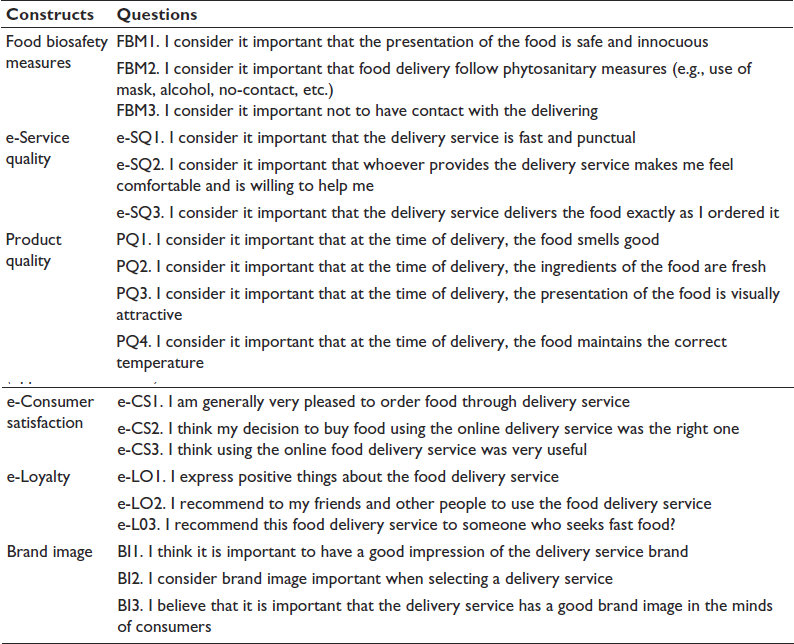
A total of 19 questions were included in the questionnaire. Regarding the measurement of the independent variables, Food Biosafety Measures used three questions adopted from the research of Dsouza and Sharma (2020), e-Service quality used three questions from Erkmen and Hancer (2019), Product quality used four questions, PQ1 was taken from Zhong and Moon (2020) and PQ2-PQ3-PQ4 were taken from Muskat et al. (2019), while e-Customer Satisfaction used three questions adapted from Al-Amin et al. (2020). For the measurement of the moderating variable Brand image three questions taken from the study by Erkmen and Turegun (2022) were used and finally to measure the dependent variable e-Loyalty three questions adapted from the study by Parasuraman et al. (2005) were used (See Appendix Table A1). For the quantification of the questions of each variable, a five-point Likert scale was used, where five represented strongly agree and one represented strongly disagree.
A composite measure of the dependent variable was calculated to assess whether there was a significant difference between the characteristics in the sample. No significant differences were found by sex, age, and socioeconomic level. In other words, the mean of the composite measure does not vary significantly between the sample characteristics. The results of this procedure confirmed the decision not to include these variables in the research model.
We conducted a Confirmatory Factor Analysis (CFA) to evaluate the convergent and discriminant validity of the model variables. Convergent validity was assessed through factor loadings, composite reliability (CR), and average variance extracted (AVE), while discriminant validity was evaluated by comparing the square root of AVE to the inter-construct correlations. We used Excel and SPSS 24 to compute these values. Structural equation modelling was used to test the hypotheses, with several fit indices used to ensure model fit, including: χ2/df, GFI, CFI, TLI, NFI, RMR, and RMSEA. We used the AMOS 24 programme to calculate these indices.
Demographic Characteristics of Respondents
We administered 1832 surveys, and 1709 were left after 123 opt-outs. We surveyed men and women aged 20–64 from Colombia’s top five cities and various socioeconomic backgrounds (Table 1).
Demographics.
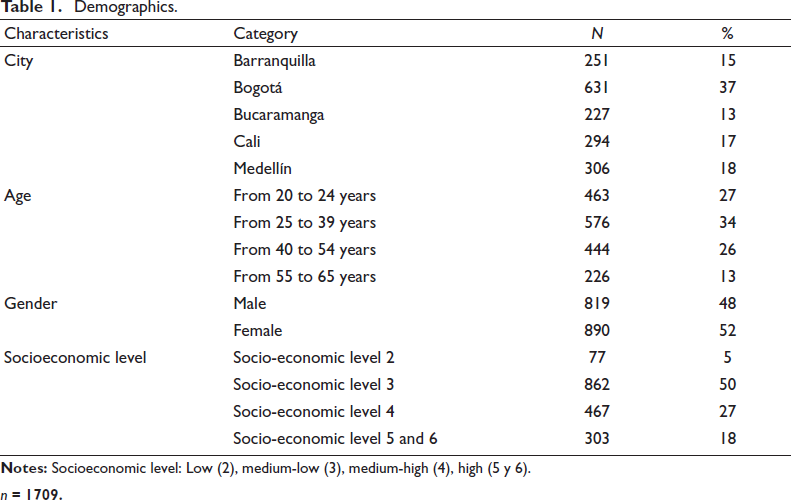
n = 1709.
Results and Discussion
Model Estimation Adjustment and Hypothesis Testing
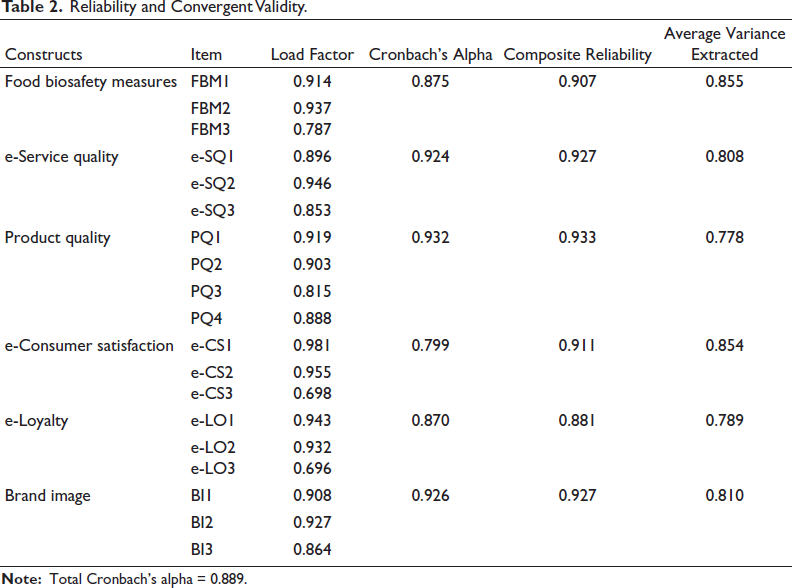
We used CFA to test a six-factor measurement model (biosafety measure, e-service quality, product quality, e-consumer satisfaction, brand image, and e-loyalty). Results confirm reliability and convergent validity, meeting the criteria of Fornell and Larcker (1981) and Ping (2004). Internal consistency is ensured with Cronbach’s alpha and CR greater than 0.7, and AVE greater than 0.5, as recommended by Lisawadi et al. (2018). Convergent validity is also confirmed since AVE values are lower than CR values (Table 2).
Reliability and Convergent Validity.
To assess discriminant validity, we compared the square root of the AVE values with the correlations between each pair of constructs. Discriminant validity was confirmed when the square root of the AVE values were greater than the correlations between the constructs, following Chin (1998) and Ping (2004). Consequently, the model demonstrates both convergent and discriminant validity, as shown in Tables 2 and 3, enabling further analysis using SEM.
Discriminant Validity.
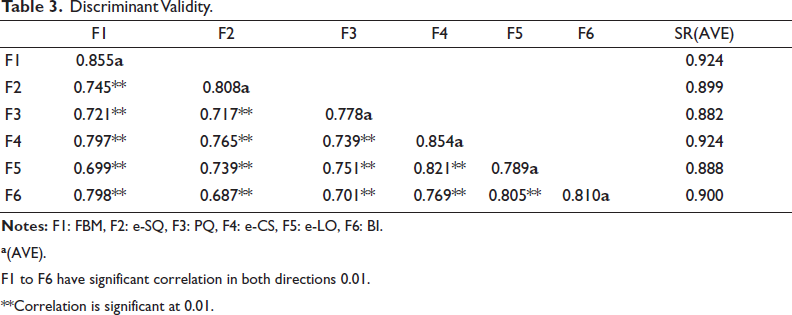
a(AVE).
F1 to F6 have significant correlation in both directions 0.01.
**Correlation is significant at 0.01.
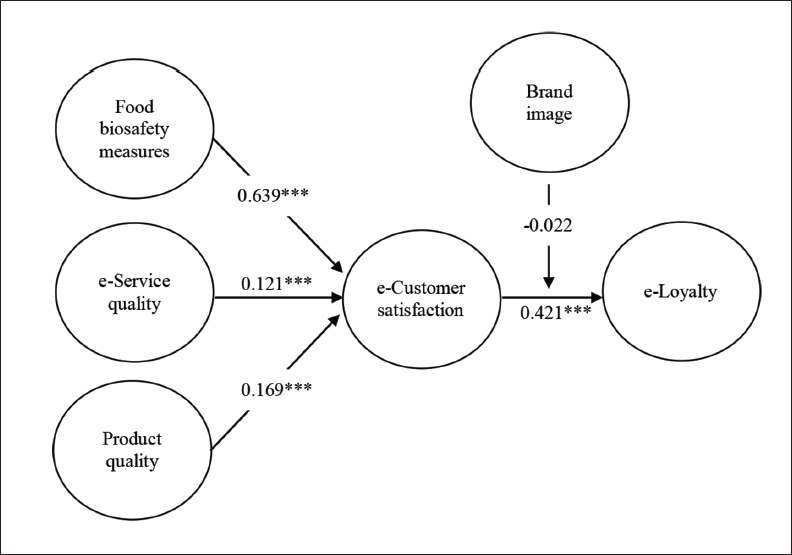
We used SEM with maximum likelihood to examine the six model constructs and identify their relationships, finding a good fit consistent with literature (Hair et al., 2019). Our results (χ2 (df): 237 (149), χ2/df: 3.621, GFI: 0.927, NFI: 0.958, TLI: 0.941, CFI: 0.969, RMR: 0.021, RMSEA: 0.078) met SEMs adjustment values (Carrión & Arias, 2022; Carrión et al., 2023; Hair et al., 2019; Hoyos et al., 2023). We accepted four hypotheses and rejected one from our structural model, demonstrating that FBM (β = 0.639***), e-SQ (β = 0.121***), and PQ (β = 0.169***) positively influence e-CS, which positively affects e-LO (β = 0.421***), while BI (β = −0.022) has an inverse relationship without moderating the relationship between e-CS and e-LO. Table 4 and Figure 2 present the correlation results supporting our hypotheses, and other findings are discussed in the article.
Direct Relationships.
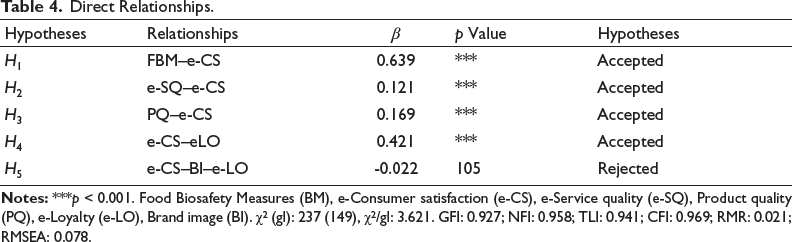
Food Biosafety Measures (BM), e-Consumer satisfaction (e-CS), e-Service quality (e-SQ), Product quality (PQ), e-Loyalty (e-LO), Brand image (BI).
χ2 (gl): 237 (149), χ2/gl: 3.621.
GFI: 0.927; NFI: 0.958; TLI: 0.941; CFI: 0.969; RMR: 0.021; RMSEA: 0.078.
Discussion
In the context of evolving consumer behaviour after the pandemic, this study delves into the complex world of online food delivery services (OFDS). The study examines the impact of biosecurity measures on electronic consumer satisfaction and explores the moderating role of brand image in the relationship between electronic consumer satisfaction electronic consumer loyalty. Conducted in five Colombian cities, this study transcends its geography, providing broader implications for pandemic situations around the world.
Building on recommendations from previous research (Burlea-Schiopoiu et al., 2022; Chan & Gao, 2021; Su et al., 2022; Zhao & Bacao, 2020), this study responds to the call for discovery OFDS customer service in many different aspects region. This highlights the imperative for food delivery companies to adjust their strategies, given the primary importance of improving e-customer satisfaction in this context (Su et al. associates, 2022). The main objective of the study was to analyze the factors affecting OFDS and brand loyalty of Colombian consumers, and to consider the important impact of biosecurity measures and brand image. Our results strongly support the first hypothesis (H1), echoing previous work by Untaru and Han (2021) and shedding light on changing consumer behaviour because of the pandemic, as Leone et al have emphasized (2020). Research shows the profound influence of food biosecurity measures on food purchasing and consumption behaviour, underscoring their essential importance in the current context.
This study fills the gaps identified in the literature, by addressing important aspects of consumer perception of food safety, particularly in relation to packaging handling food by delivery personnel (Choi et al., 2021; Macías et al., 2021). Furthermore, it contributes significantly to the limited research on post-pandemic consumer behaviour by demonstrating a positive correlation between food biosecurity measures and online customer satisfaction line in the field of OFDS (Li et al., 2022; Tavitiyaman et al., 2022).
By expanding the scope of our investigation, our study introduces new dimensions of the quality of OFDS-related services and products, as evidenced by our questionnaire. Additionally, he finds that consumer shopping experiences in times of crisis, such as a pandemic, exhibit cultural differences (Das & Ramalingan, 2022).
This study was inspired by Rosemberg et al. (2023), further emphasize the importance of understanding consumer perceptions of food biosecurity measures and their impact on online customer satisfaction. Our results are in agreement with the work of Almunawar and Anshari (2022), Kostromitina et al. (2021) and Wang et al. (2021), reaffirmed the positive association between food biosecurity measures and e-consumer satisfaction. Importantly, our study supports the findings of Dsouza and Sharma (2020, which indicates that the implementation of biosecurity measures positively affects online customer satisfaction, ranging from that affects online loyalty. These results confirm Colombian consumers’ preference for OFDS food biosecurity measures, echoing previous research (Dsouza & Sharma, 2020; Hakovirta & Denuwara, 2020; Macías et al., 2020).
H2 also finds strong support, indicating that e-service quality has a positive impact on e-consumer satisfaction in OFDS. This highlights the central role of consumers’ perceptions of e-service quality in meeting their expectations and ensuring their satisfaction. It is consistently consistent with existing research (Carranza et al., 2018; Singh et al., 2021; Uddin, 2019) and fills the knowledge gap identified by Nandankar et al. (2021). The study explains that prompt and on-time service, polite and helpful delivery personnel, and accurate order delivery appear to be the main drivers of positive customer experience and increased satisfaction. e-consumers. These results are consistent with the results of Chun and Nyam (2020), which emphasizes the need to meet consumer expectations to promote e-consumer satisfaction.
H3 also has significant empirical support, demonstrating that product quality significantly affects e-consumer satisfaction in OFDS. This highlights Colombian consumers’ appreciation for quality products, a finding that is consistent with previous research that highlighted quality as a key factor in product selection (Roy et al., 2020). The study results are consistent with the findings of Chun and Nyam (2020) and Roy et al. (2020), who emphasizes the central role of factors such as nutritional value, taste, and presentation in e-consumer satisfaction. Furthermore, these results echo the study of Belarmino et al. (2021), Muskat et al. (2019) and Zhong and Moon (2020), highlighting the importance of food attributes such as smell, freshness, presentation, and temperature in improving online food consumer satisfaction.
Despite the extensive analysis of H2 and H3 in measurement models, it should be noted that there is still very little research on electronic consumer satisfaction and loyalty in Colombia. However, this study provides important insights into Colombian consumer behaviour, consistent with Su et al. (2022) to examine the behaviour of food consumers in developing countries. This is also in line with the prediction of Research and Markets (2020), which predicts significant growth as consumers appreciate food taste from Latin America and Asia.
H4 received strong support, showing that e-consumer satisfaction significantly affects the electronic loyalty of OFDS Colombian consumers. This highlights the central role of food biosecurity measures, product quality and e-service quality processes in meeting consumer needs and thus improving satisfaction and loyalty of e-consumers (Yi et al., 2018). This study enriches the existing literature by emphasizing the emerging importance of food biosecurity measures as a determining factor affecting e-consumer satisfaction catalyzed by the recent pandemic in OFDS. This result is consistent with the results of Kumar and Shah (2021), which emphasizes that increasing e-consumer satisfaction leads to increased purchase intention and loyalty to electronics.
Furthermore, this study highlights the profound impact of e-consumer satisfaction in fostering long-term relationships between OFDS consumers and suppliers. This supports previous research by Darley and Luethge (2019) and Ji and Prentice (2021), as well as the finding by Untaru and Han (2021) that higher electronic fidelity correlates with increased purchases and increase the level of active word of mouth. This is also consistent with the argument that e-consumer satisfaction is a pillar of e-loyalty, as Shahzadi et al. (2018), Yi et al. (2018), Roy et al. (2020) and Singh et al. (2021). Importantly, this study creatively explores this relationship in the context of OFDS, which has gained unprecedented popularity in the post-pandemic era.
However, the study deviated from expectations by rejecting H5. It found no moderating effect of brand image on the relationship between e-consumer satisfaction and e-consumer loyalty among Colombian OFDS consumers. Although this result challenges the study of Ryu et al. (2008), indicated that brand image influences e-loyalty, which is consistent with previous studies showing that brand image may not be necessary for OFDS consumers (Andreassen & Lindestad, 1998; Cretu & Brodi, 2007; Lai et al., 2009). This finding directly responds to Zhong and Moon’s (2020) call to identify the moderating factors in the relationship between e-consumer satisfaction and e-loyalty, giving depth to nuanced dynamics are taking place in the OFDS domain.
Conclusion and Managerial Implications
The study explores the complex landscape of online food delivery services (OFDS) in a post-pandemic context, focusing on Colombian cities but with global implications. The study significantly advances our understanding by highlighting the important influence of biosecurity measures, especially when dealing with packaging, on e-consumer satisfaction. Contrary to popular belief, research challenges the assumption that brand image is essential for OFDS consumer loyalty, highlighting the nuanced drivers of consumer behaviour. In particular, the study emphasizes the paramount importance of e-service quality and product quality in shaping positive consumer experiences, emphasizing prompt, courteous service and other customer service characteristics, as well as high quality food properties.
In addition, the research makes a significant contribution by filling existing knowledge gaps. It not only highlights the positive correlation between food biosecurity measures and online customer satisfaction but also highlights the emerging importance of these measures in light of the recent pandemic and the challenges involved in OFDS. The results of this study echo previous research, highlighting the complex relationship between e-consumer satisfaction and loyalty, with customer satisfaction serving as the foundation for foster long-term relationships between consumers and suppliers. In addition, the study sheds light on the unexplored area of e-consumer behaviour in Colombia, providing valuable insights into consumer preferences in developing countries. Overall, this study enriches the understanding of OFDS dynamics, guiding businesses, and policymakers to adjust strategies to meet changing consumer needs and ensure ensuring the highest standards of service and product quality in the increasingly popular online food delivery sector.
The results of this study have important managerial implications for OFDS companies operating in Colombia. To thrive in this dynamic landscape and maintain long-term relationships with customers, managers must adopt a comprehensive, customer-centric approach. Effective resource allocation is fundamental and requires strategic investment in key areas such as food biosecurity measures, online service quality and product quality.. These factors have been identified as important to e-customer satisfaction and loyalty, requiring investments in training, infrastructure, and technology to maintain consistent excellence.
Collecting customer feedback is a fundamental step, emphasizing actively soliciting and considering customer opinions. Implementing customer loyalty programs is instrumental in improving online customer satisfaction and loyalty.. These programs must be carefully designed to not only reward loyal customers but also attract and satisfy customers, thereby fostering a sense of value and appreciation. Partnering with e-commerce platforms appears to be a strategic decision, allowing OFDS companies to expand their online presence and reach a wider customer base. This partnership opens new avenues for customer engagement and brand visibility.
Quality control and exceptional customer service are non-negotiable OFDS companies must invest in stringent quality control measures to ensure that products consistently meet or exceed customer expectations. At the same time, a well-trained and customer-focused workforce will significantly improve the overall customer experience. It is essential to regularly monitor performance metrics. Managers must establish robust mechanisms to track customer satisfaction and loyalty, allowing for a data-driven approach to quickly adjust and improve service quality when problems arise.
Research highlighting the limited impact of branding on online customer satisfaction highlights a shift in priorities. Companies must allocate efforts and resources wisely, emphasizing quality and service rather than abstract perceptions of brand. This change ensures customer loyalty based on consistent and tangible values. It is necessary to make strategic business investments, directing resources to areas that have a direct impact on customer satisfaction, such as product quality control, improving customer service and efficient delivery logistics fruit.. These investments not only improve the customer experience but also drive customer loyalty and positive word-of-mouth referrals.
Likewise, it is very important for OFDS companies to explore, create change, expand online reach, and align with the changing preferences of consumers who use this service.
In short, Colombian OFDS companies should adopt a customer-centric approach to achieve long-term success. Continuous efforts to improve food biosecurity, product quality and online services, along with active engagement with customers through feedback mechanisms and programs, foster strong customer relationships. Emphasizing quality and service as key drivers of online loyalty, rather than relying solely on brand image, reflects changing consumer perceptions in the OFDS market.
Finally, the study’s main limitation is that the questionnaire did not consider age cohorts, which makes us unaware of potential behavioural differences among different generations in OFDS consumption. Future research on online food delivery services (OFDS) could pursue three intriguing lines of research. First, studies should explore the influence of biosecurity measures on electronics consumer satisfaction in diverse cultural contexts outside of Colombia. This comparative analysis will shed light on the cultural factors that influence the adoption and effectiveness of biosecurity procedures, providing insight into regional differences in human behaviour consumption. Second, researchers can further explore different aspects of e-service quality and product quality in OFDS. Examining aspects such as order accuracy, delivery speed, packaging quality and sensory experiences (such as taste and aroma) will provide a comprehensive understanding of the deciding factors customer satisfaction and loyalty. Finally, exploring the impact of branding in different global contexts may prove useful. Research conducted in various regions or countries will provide a better understanding of how brand perception and reputation influence consumer loyalty, considering cultural differences different brand values and importance in different markets.
These lines of future research aim to deepen our understanding of OFDS customer behaviour, satisfaction, and loyalty, thereby informing food delivery companies’ strategies and enabling them to adapt their services to meet customer expectations effectively.
Appendix A
Footnotes
Acknowledgements
The authors thank Eduardo Pardo for statistical support.
Declaration of Conflicting Interests
The authors declared no potential conflicts of interest with respect to the research, authorship and/or publication of this article.
Funding
The authors received no financial support for the research, authorship and/or publication of this article.
