







Abstract
Green supply chain management (GSCM) has increased significantly within today’s businesses due to heightened awareness of environmental issues associated with business operations and the pursuit of ecological sustainability. Green supplier selection (GSS) entails a multi-criteria decision-making (MCDM) approach incorporating qualitative and quantitative criteria. It is critical as businesses strive to incorporate green product design, marketing, purchasing, packaging and recycling in their supply chain management (SCM). This study uses a fuzzy technique for order of preference by similarity to ideal solution (TOPSIS) approach to assess and choose environmentally responsible green suppliers. The fuzzy TOPSIS method assesses decision-maker opinions and ranks the most suitable green suppliers. This study also employs linguistic variables to appraise the criteria and alternatives in an ambiguous setting. The proposed approach aims to determine the weight of criteria based on environmental performance in GSCM. The vendor exhibiting the most elevated evaluation is recognized as the premier environmentally sustainable supplier. Ultimately, the relevance of the methodology is illustrated.
Keywords
Introduction
Protecting and preserving the environment has become a top global priority in industrial practices, primarily due to the depletion of natural resources. In response to this urgent issue, government authorities have implemented regulatory measures to ensure that environmental performance is integrated across all business operations. In green supplier selection (GSS), suppliers are evaluated based on their performance meeting environmental sustainability metrics. Scholarly discussions have recognized various green criteria, including adherence to environmental regulations, implementation of environmental management systems, product recyclability, pollution control measures, waste generation and management, resource consumption patterns and eco-design principles (Saputro et al., 2022).
Green supply chain management (GSCM) has emerged as a crucial concern for modern businesses, driven by growing public awareness of environmental issues related to business activities and efforts to achieve environmental sustainability. One of the most significant challenges procurement managers face is the selection of the best suppliers while meeting multiple criteria.
The academic literature extensively examines green supply chain (GSC) strategies, with various criteria and methodologies allocated to them. Fuzzy analytic hierarchy process (FAHP), failure mode and effects analysis (FMEA) and grey relational analysis (GRA) are commonly used in green supply strategies to address decision-making uncertainty. However, few studies have explored how organizations may implement GSCM practices to identify environmentally sustainable suppliers. Therefore, this study explores how a company can select green suppliers based on a fuzzy approach.
The GSS process integrates economic and environmental concerns into inter-organizational supply chain management (SCM) practices. While many studies have used fuzzy analytic hierarchy process (AHP) or fuzzy technique for order of preference by similarity to ideal solution (TOPSIS) approaches to evaluate and select suppliers, few have proposed an integrated fuzzy TOPSIS method for selecting suppliers, especially green suppliers. The study’s objective is to formulate a fuzzy TOPSIS methodology aimed at judicious selection of environmentally sustainable suppliers for an organization from the available alternatives. The issue has been characterized as a multi-criteria decision-making (MCDM) technique under conditions of uncertainty, which can prompt the need to handle imprecise judgments from decision-makers.
Literature Review
The process of GSS is a complex decision-making activity that involves multiple criteria and subjective evaluations. Various researchers have explored the integration of fuzzy theory procedures for choosing green suppliers in the context of GSCM. Additionally, studies have focused on the relationship between GSCM practices and firm performance, as well as the implementation of supply chain risk management, which involves the collaboration of multiple firms.
Moreover, the concept of the circular economy, which aims to maximize resource utilization and minimize waste emissions through resource reuse and recycling, has gained attention. Researchers have also investigated innovative product-service systems, integrated logistics operational models, and the impact of GSCM on firm competitiveness and green performance in specific contexts such as container shipping.
Yang et al. (2013) proposed an effect on green performance and firm competitiveness in Taiwan’s container shipping context. Sheu et al. (2005) proposed an integrated logistics operational model for GSCM. Amindoust et al. (2012) used fuzzy interference to rank the sustainable supplier. Lai and Wong (2012) proposed green logistics management and performance: empirical evidence from Chinese manufacturing exporters. Gupta et al. (2024) described green hydrogen in India as a prioritization of its potential and viable renewable source. Shen et al. (2013) used a fuzzy MCDM approach for evaluating green suppliers. Kumar and Nath (2019) described information technology (IT) adaptation in the sugar supply chain. Rajani et al. (2022) used the structural equation modelling (SEM) approach for the demand management strategies role in the sustainability of the service industry and impact on the performance of the company.
Tuzkaya et al. (2009) used a fuzzy MCDM method for suppliers’ performance evaluation. Kansara et al. (2023) explained COVID-19 cases in the structural transformation of the fuzzy analytical hierarchy process. Kumar et al. (2013) determined the relationship among enables of e-Applications in the Indian agri-food supply chain. Afzal and Hanif (2022) stated that GSCM has attracted considerable interest from scholars in various nations. Conversely, adopting GSCM, their consequential effects on organizational performance are still in the initial stages. Awasthi et al. (2010) used a fuzzy MCDM technique for supplier evaluation. Bag et al. (2024) described product-service systems capabilities for circular supply chains in the Industry 4.0 era.
Diabat et al. (2013) described an exploration of GSC practices in the automotive industry. Chatterjee et al. (2018) suggested a rough approximation of a fuzzy soft set-based decision-making approach in supplier selection problems. Saputro et al. (2024) used a fuzzy technique for GSS. Gupta et al. (2019) proposed GSS using fuzzy MCDM techniques. Mousakhani et al. (2017) used a type-2 fuzzy approach for GSS. Sharma and Bhat (2016) described risk mitigation in the supply chain. Sharma and Tripathy (2023) proposed fuzzy TOPSIS and quality function deployment (QFD) approaches for evaluating and selecting suppliers.
A limited quantity of empirical modelling initiatives has been conducted that integrate MCDM methodologies with fuzzy sets with objective environmental considerations for GSS. This research suggests an MCDM approach based on fuzzy TOPSIS methodology for addressing GSS issues within an automotive manufacturing enterprise.
The process of selecting green suppliers has the most significant scholarly attention. This article proposes green supplier evaluation criteria encompassing quality, delivery time, technological capability, eco-design, recycling capacity and social and environmental responsibility, which facilitate the establishment of closer green buyer-supplier collaborations. Furthermore, various methodologies, including fuzzy multi-criteria decision approaches, FAHPs and integrating artificial neural networks, have been used for evaluating green supplier performance and environmental performance. Adopting GSCM practices is an ongoing area of research that focuses on different nations and industries.
Materials and Methods
Fuzzy Linguistic Variables
The notion of linguistic variables proves an advantage when circumstances can be articulated with greater precision or clarity, utilizing universally recognized qualitative expressions within the decision-making paradigm (Chen & Hwang, 1992). Linguistic variables are the elements or syntactic structures inherent to a natural language. The current investigation used a conversion scale ranging from 1 to 9 to quantify linguistic expressions into triangular fuzzy numbers (TFNs). The importance of the weights linked to the five criteria is explicated through the utilization of the subsequent linguistic descriptors: Very good (VG), good (G), fair (F), poor (P) and very poor (VP), as detailed in Table 1. In Table 2, the linguistic alternatives are specified as very strong (VS), fairly strong (FS), medium (M), fairly weak (FW) and very weak (VW).
Linguistics for the Criteria.
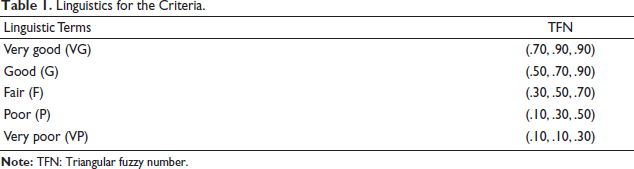
Linguistics for the Criteria.
Linguistics for Alternative.
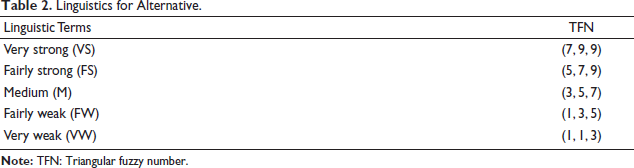
The fuzzy TOPSIS was conceptualized by Hwang and Yoon (1981) as a method for addressing complex multiple-attribute decision-making scenarios. This methodological framework articulates two options: the positive and negative ideal solutions (NISs). The fuzzy TOPSIS approach demonstrates the least proximity to the positive ideal solution (PIS) while simultaneously ensuring the greatest separation from the NIS. The PIS is derived from the optimal performance metrics associated with each criterion, whereas the NIS comprises the suboptimal performance metrics.
The TOPSIS methodology is employed to ascertain the hierarchical ranking of attributes in practical applications. Büyüközkan and Çifçi (2012) proposed a hybrid fuzzy MCDM model to evaluate green suppliers. This research introduces a fuzzy TOPSIS methodology for identifying environmentally responsible suppliers. The procedure of the fuzzy TOPSIS methodology is delineated as follows (Chen, 2000):
Step 1: In the MCDM dilemma, let us assume the existence of m alternatives that necessitate evaluation for n assessment criteria and K decision-makers, employing TFN,
Step 2: The criteria weight can be computed as:


Step 3: The fuzzy matrix about the criteria and alternatives is formulated as follows:
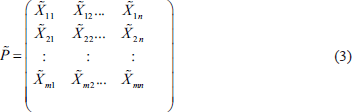
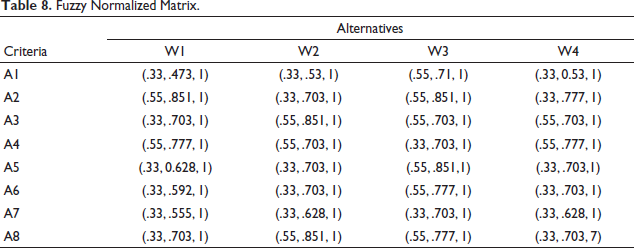
Step 4: Normalized the fuzzy decision matrix denoted as





The variables B and C represent the criteria for benefits and costs, respectively.
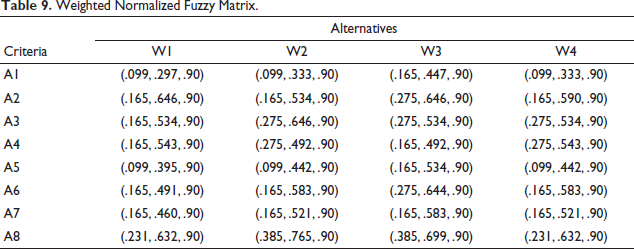
Step 5: Weighted normalized fuzzy matrix

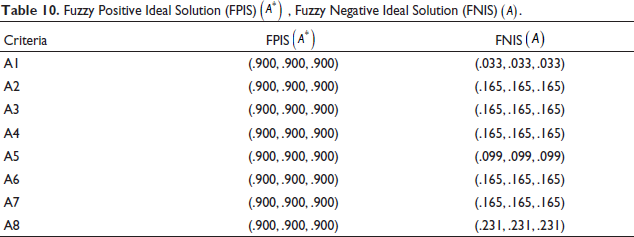
Step 6: The fuzzy positive ideal solution (FPIS) and fuzzy negative ideal solution (FNIS) are as follows:


Where
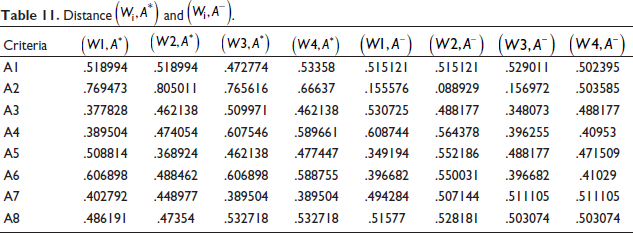
Step 7: Distance calculated as follows:


Step 8: Find the coefficient of closeness

Step 9: Ascertain the hierarchical sequence of all options based on their respective closeness values. The most favourable alternative exhibits proximity to the (FPIS,
The fuzzy model has been integrated into an automotive manufacturing enterprise with more than 12 years of experience in production. The company has built a strong network within domestic markets. With increasing customer demand, the company’s management team needs help selecting suppliers, focusing on environmental factors and maximizing profit margins.
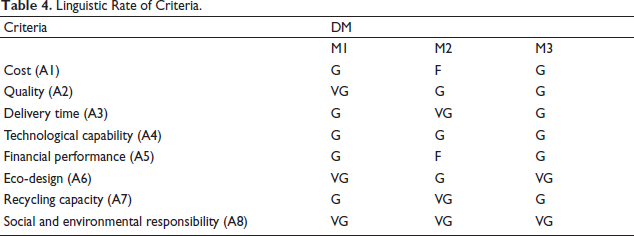
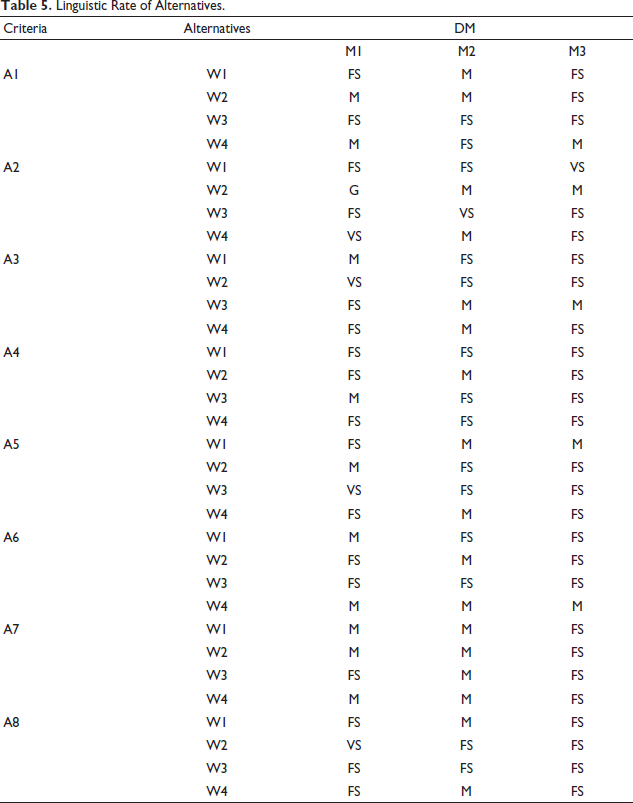
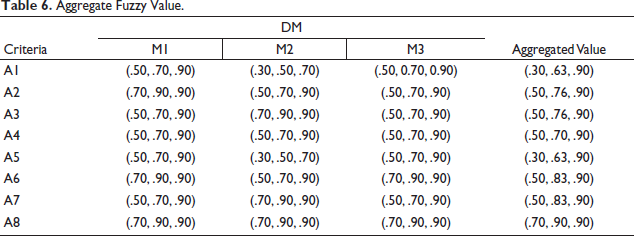
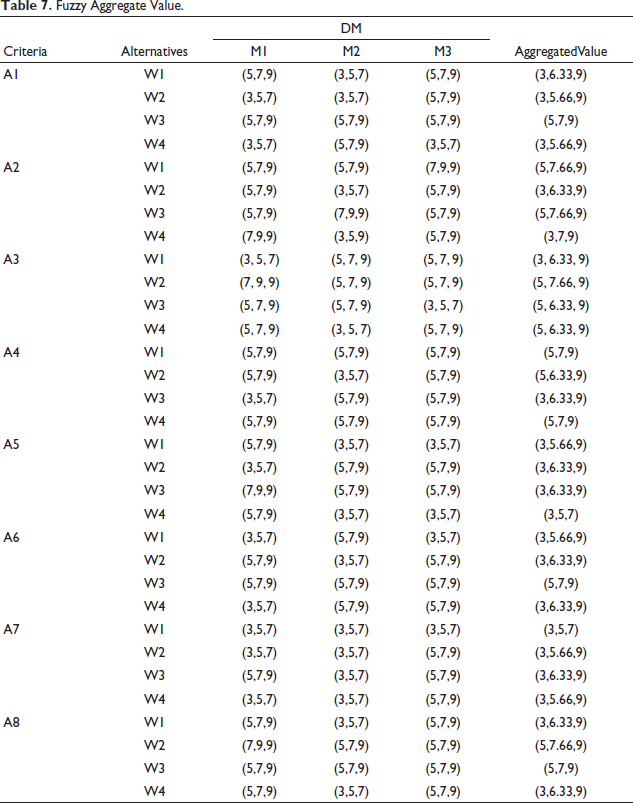
A committee tasked with decision-making, composed of three individuals identified as M1, M2 and M3, conducted a thorough evaluation and subsequently identified the most suitable environmentally responsible supplier from a pool of four suppliers (W1, W2, W3 and W4). The criteria, denoted as A(i) where i = 1, 2,…, 8, has been meticulously selected for assessing and selecting green suppliers. The criteria are delineated as follows: cost (A1), quality (A2), delivery time (A3), technological capability (A4), financial performance (A5), eco-design (A6), recycling capacity (A7) and social and environmental responsibility (A8). Table 3 shows that the cost criterion (A1) falls under the cost category, indicating that a lower value is preferable. In contrast, all other criteria are classified as benefit-type, where a higher value is deemed advantageous. Refer to Tables 3–12 for details.
Green Suppliers Selection Criteria.
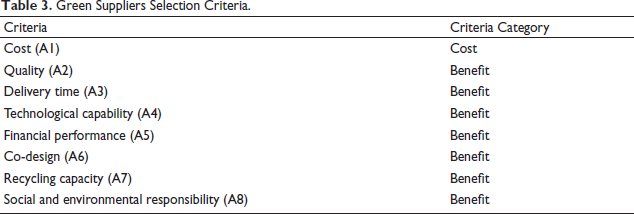
Green Suppliers Selection Criteria.
Linguistic Rate of Criteria.
Linguistic Rate of Alternatives.
Aggregate Fuzzy Value.
Fuzzy Aggregate Value.
Fuzzy Normalized Matrix.
Weighted Normalized Fuzzy Matrix.
Fuzzy Positive Ideal Solution (FPIS)
, Fuzzy Negative Ideal Solution (FNIS)
.
Distance
and
.
Coefficients of Closeness
.
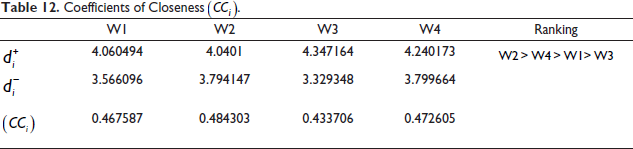
By relating the coefficients of closeness
This investigation is a comparative analysis of various MCDM technologies. The decision-maker’s qualitative expressions have been converted into TFNs. The proposed methodology demonstrates relative ease of application in practical scenarios. This manuscript will contribute to the literature on advancing fuzzy methodologies to address challenges associated with sustainable supplier selection.
Practical Implications
The current study has outlined several implications based on research findings, which can be categorized as follows:
The study uncovers the innovative application of fuzzy TOPSIS and linguistic variables in supplier selection, uniquely contributing to the existing literature. The elements, including organizational environmental ethos, levels of eco-centric managerial innovation, and degrees of sustainable process innovation, may not be paramount in the supplier selection process for the automobile production industry. However, it underscores the necessity of conducting a more rigorous analysis of these forms of innovation across various industrial contexts.
The most influential criteria for selecting suppliers in the automobile manufacturing sector are quality, technological capability, eco-design, recycling capacity and social and environmental responsibility based on green performance. Culturing green dynamic capacity is a strategy to foster a more ecologically sustainable supply chain while augmenting suppliers’ attractiveness to various stakeholders. The findings of this research, a comprehensive set of recommendations, are articulated for managers operating within automotive facilities and professionals engaged in procurement activities.
The contributions of this article are compared with existing extensions of fuzzy theory, which can describe uncertainty and imprecise information with a degree for evaluating suppliers. Furthermore, the fuzzy TOPSIS methodology has been examined to assess the fuzziness in the context of supplier selection. This study revealed practical implications for supply chain managers. The managers may implement a set of sustainable criteria for selecting suppliers and evaluate the effect of such criteria on the performance of the supply chain. This research can thus guide supply chain managers in understanding the relationship between a supplier and its associated selection criteria.
Strategic determinations concerning the acquisition of materials for automotive operations emphasize the ecological performance of suppliers, which may result in an augmented market presence and the fortification of the company’s reputation through initiatives centred on environmental responsibility. There is a pronounced focus on developing supplier selection criteria, predominantly concentrating on elements that influence environmental sustainability performance. Supply chain collaborators can contribute to environmental sustainability while enhancing their financial conditions.
Formulating industry-specific benchmarks for assessing ecological performance is advocated to improve the supplier selection methodology. Acknowledging ecological benchmarks in supplier selection highlights its significance in fostering sustainable and environmentally responsible supply chain methodologies.
Conclusion
In sustainable SCM, selecting green suppliers is crucial for improving sustainable performance. It is essential to develop an MCDM process for supplier selection that incorporates environmental considerations and considers risk factors to enhance competitiveness and promote the values of GSS.
This study is focused on developing a quantitative uncertainty evaluation using fuzzy set theory with linguistic variables. The proposed method provides highly reliable results that reflect these uncertainties by applying fuzzy set theory to articulate the inherent uncertainties within the model. It is essential to evaluate GSCM criteria simultaneously to achieve optimal results. The study presents a combined framework to address environmentally sustainable suppliers, a critical activity for a company looking to improve business performance and enhance operational efficacy.
Based on the results, the fuzzy TOPSIS approach has been recommended to integrate sustainability criteria into the supplier selection process more effectively. The proposed model demonstrates consistency in weight calculation utilizing this methodology—the outcomes generated after the methodology is compared to findings from other scholarly works like Khan et al. (2018), Memari et al. (2019) and Wei and Zhou (2023) by considering the criteria cost, delivery timelines, technological capabilities, recycling practices and social and environmental responsibilities. The comparative analysis revealed that suppliers possess the potential to enhance their competitive edge by advancing their environmental management capabilities.
Limitations and Future Scope of Research
This study uses the fuzzy TOPSIS methodology to handle the linguistic uncertainty variables that manifest in the decision-making process to select the best green supplier. Certain scholars have endeavoured to utilize intuitionistic fuzzy sets as a substitute for the fuzzy TOPSIS methodology, positing that this alternative may yield superior outcomes. This investigation has considered eight criteria; nevertheless, subsequent research endeavours could incorporate additional environmentally pertinent criteria to enhance the selection process for eco-friendly suppliers. In this study, the interrelationships among the selection criteria are not considered; these factors may constrain the applicability of the proposed framework. Future research may be conducted to examine the interrelationships among the criteria pertinent to GSS. This research presents an innovative application of a fuzzy TOPSIS methodology aimed at identifying and selecting environmentally sustainable suppliers within the framework of organizational operations. The proposed methodology can be further enhanced by combining fuzzy TOPSIS with other methods like Fuzzy AHP-CoCoSo and Fuzzy SWARA-FMEA for real-life applications.
Appendix A
The TFN and distance of two fuzzy numbers:
Definition 1: The TFN is represented as 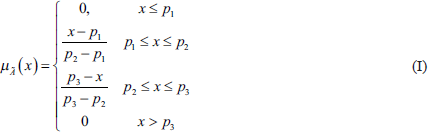
where
Definition 2: Let 
Footnotes
Author’s Contribution
Bibhuti Bhusan Tripathy: Conceptualization, methodology, data analysis, draft preparation, validation and review and editing.
Sarbjit Singh Oberoi: Investigation, formal analysis, resources, validation, review and editing.
Declaration of Conflicting Interests
The authors declared no potential conflicts of interest with respect to the research, authorship and/or publication of this article.
Ethical Declaration
The authors abide by all the ethics involved in this academic work and have not submitted it to any other journal.
Funding
The authors received no financial support for the research, authorship and/or publication of this article.
