







Abstract
With a global surge in health, environmental and economic repercussions accompanying dirty fuels and technologies, coupled with limited studies on how external funds could influence the transition to clean energy. This study employs the system generalized method of moments (system GMM) to investigate the interactive effect of remittances and financial inclusion on access to clean energy and technologies, as well as the threshold effect of remittances on access to clean energy and technologies across 42 Sub-Saharan African (SSA) countries from 2000 to 2022. The empirical finding shows that an additional increase in migrant remittances yields a 27.2% increase in access to clean energy and technologies. Also, an increase in the level of financial inclusion also results in a 0.2% increase in access to clean energy and technologies. In the presence of financial inclusion, migrant remittance produces a 24.1% increase in access to clean energy and technology. At an 18.6% threshold, migrant remittance begins to positively influence access to clean energy and technology in SSA. The government should therefore implement policies that align with the threshold level to promote clean energy transition in SSA. This study extends existing studies on remittances and access to clean energy and technologies by delving into threshold outcomes.
Introduction
Enhancing access to clean energy and reducing energy insecurity are central development priorities in advanced and emerging economies. Sustainable Development Goal (SDG) 7 aims to ensure universal access to affordable, reliable, sustainable and modern energy services. Clean energy supports economic growth, improves food and health security and enables progress across development goals. Despite a global commitment to energy transitions, large disparities persist in developing regions as only 58% of households in developing countries used improved cooking facilities in 2018 (Vassiliades et al., 2022). The energy access gap is most pronounced in Sub-Saharan Africa (SSA), where 853 million of the population relied on traditional biomass for cooking in 2018, while only 29% had access to clean cooking fuels (Ofori et al., 2023; Yadou et al., 2024). Earlier estimates suggested access rates as low as 17% (Armah et al., 2019). By 2020, close to 3 billion individuals relied on wood and other biomass fuels, and projections suggest that by 2030, an additional 674 million people will continue to lack electricity, while over 2.4 billion may still be without access to clean cooking fuels (Ang’u, 2023; Yadou et al., 2024). Household cooking and heating contribute about 25% of global black carbon emissions (Abba Yadou et al., 2024), while indoor air pollution causes over 2.5 million avoidable deaths annually, disproportionately affecting women and children (Ang’u, 2023).
Against this background, migration has gained attention as a channel supporting energy transitions. International migration promotes development through income growth, poverty reduction and knowledge transfer, reinforced by remittances (Koczan et al., 2021). Remittances to low- and middle-income countries reached $529 billion in 2018, $546 billion in 2019 and $626 billion in 2022 (Acheampong, 2023). While remittances ease household liquidity constraints, their impact depends on access to formal financial systems (Pan et al., 2023). Continued reliance on informal channels reflects barriers to financial inclusion (Fodouop Kouam, 2022; Lum et al., 2024). Evidence from some developing economies, particularly Bangladesh and Ghana, links remittances and financial inclusion to clean energy adoption (Abokyi et al., 2024; Hassan, 2020).
Our study is motivated by four fundamental components from academia and policy. The four primary pillars of this study are (a) the pressing issue of environmental contamination globally, and in SSA specifically; (b) the continuous debates in the literature about the connection between remittances and ecological degradation; (c) how this study contributes to the relevant literature; and (d) the study’s significance to the sustainable development programme to the SDGs. Developing regions like SSA countries are more susceptible to energy scarcity and environmental degradation because of a variety of factors, including some of the world’s most repulsive electricity grid networks (Asongu et al., 2019). It is suggested that SSA would be most adversely affected by the harm caused by climate variability (Asongu & Odhiambo, 2021, 2022). Ofori et al. (2023) maintain that considering that the total amount of electricity produced in the SSA region is equal to that produced in New York, USA, the current literature largely supports the idea that, in addition to the lack of inclusive development, which is a major barrier to regional development, issues with climate change, environmental degradation, low use of renewable energy and selective growth can be linked to several things, including a lack of funding and financial development (Adejumo et al., 2021; Asongu & Odhiambo, 2019; Asongu et al., 2020; Joshua & Alola, 2020; Joshua et al., 2020; Nathaniel & Bekun, 2020).
There are two strands of inquiry in the literature about the relationship between ecological degradation and carbon dioxide (CO2) production. First, inclusionary finance promotes the green economy by lowering CO2 emissions (Saidi & Mbarek, 2017; Xiong & Qi, 2018; Zafar et al., 2019; Zaidi et al., 2019). Second, remittances that promote inclusivity can reduce environmental sustainability by increasing carbon emissions (Al-Mulali et al., 2015; Bekhet et al., 2017; Cetin et al., 2018; Hassan & Mahmud, 2024; Kouandou, 2025; Shahbaz et al., 2016). Notwithstanding the established importance of reliable funding sources in promoting environmental sustainability and a green economy, there is still debate in the literature about how inclusive finance impacts clean energy access and its equipment and expertise in SSA. The current study evaluates how financial inclusion reinforces or dulls the impact of remittances on access to renewable energy and technologies in SSA, thus adding to the body of existing information.
One key limitation in the existing literature is the limited policy engagement with the nexuses under examination. This study argues that establishing whether remittances affect clean cooking adoption is insufficient; policymakers also require instruments capable of shaping these nexuses. Chen et al. (2023) address this gap by analyzing education, energy consumption and remittance flow in low-income countries, showing that education without financial inclusion constrains households’ ability to receive remittances. Consequently, policies aimed at accelerating clean cooking adoption in SSA must jointly consider remittances and financial inclusion. These priorities align with the SDGs, the African Union Agenda 2063 and the Paris Climate Agreement. Building on institutional evidence from Acheampong et al. (2021) and Amuakwa-Mensah et al. (2018), the study provides new empirical insights into SSA’s transition to clean fuels.
The closest study to this exposition is Abba Yadou et al. (2024), who employed fixed- and random-effects models to highlight the connection between migrant remittances and energy transition in a panel of 45 African countries. Our work expands on Abba Yadou et al. (2024) in three key areas. (a) It highlights the conditional importance of financial inclusion in the relationship between remittances and access to clean energy and technology, rather than evaluating the relationship between remittances and clean energy. When an intervening parameter of access to clean energy and technologies is brought into consideration, this enables the evaluation of whether the findings of the foundational study withstand empirical scrutiny. It is important to emphasize that financial inclusion serves as a transmission channel for remittances to reach migrant households. (b) The policy cutoff point at which remittances start to have a beneficial impact on access to sustainable energy and technology. Although remittances have been coming to SSA, policymakers must understand how they start to negatively or positively impact access to clean energy and technologies, which is the subject of the current study. (c) The outcomes from the system generalized method of moments (system GMM) estimations have broad policy implications because the calculations that follow are based on the mean estimates of the outcome variable. Although the estimates are based on the previous levels of accessibility to clean energy and technology variables and are tailored differently across countries with low, intermediate and high stages of environmental sustainability, analyzing the main dealings without considering the original points of the outcome variable may lead to unproductive policy implications.
This study contributes to the literature and policy on three main counts. First, it shows that despite decades of emphasis on renewable energy, about 45% of SSA countries had not adopted renewable energy by mid-2015, largely due to financing constraints, highlighting the post-2015 relevance of remittances (Asongu & Odhiambo, 2021). Second, it demonstrates that households lacking financial inclusion are unable to mobilize sufficient resources to acquire renewable energy technologies, reinforcing evidence that energy access remains elusive for sustainable development in the sub-region (Acheampong et al., 2021). Third, beyond documenting nexuses, the study advances policy relevance by estimating actionable thresholds for migrant remittances that condition the clean energy and technology relationship. Using interactive regressions, it identifies levels at which remittances effectively complement financial inclusion, expanding the policy toolkit through threshold-based insights consistent with the literature (Asongu & Odhiambo, 2021). To provide an answer to this broad question, our study seeks to achieve the following objectives:
Examine the interactive effect of remittances and financial inclusion on access to clean energy and technologies in SSA countries. Estimate the threshold effect of migrant remittances on access to clean energy and technologies in SSA countries.
The remainder of the work is structured in this manner. Section 2 discusses the literature review. Section 3 discusses the data and methodology, whereas Section 4 presents and analyzes the empirical findings. The study is concluded in Section 5 with recommendations for additional research.
Review of Literature
Effect of Migrant Remittances on Access to Renewable Energy and Technology
Investigation regarding the association between access to contemporary energy services and migrant remittances has focused more on the unit level than on the broader scale. According to Hassan (2020), remittances have a bigger impact on rural households’ usage of gas as a cooking fuel in southern Bangladesh than other accessible sources at the micro level. Furthermore, the likelihood of petrol use in the nation rises by 2% with every 10% increase in migrant remittances. Micro-level international migration through migrant income growth and remittances can help enhance access to modern, inexpensive energy globally (Scott et al., 2023). Furthermore, remittances from migrants are reportedly utilized in poor nations to finance the adoption of various sustainable energy technologies (Mendelson, 2013). For example, ArcFinance’s initiative in Haiti uses migrant remittances to finance renewable energy in households with limited access to it, accelerating the shift away from dirty energy. In Ecuador, a sustainable energy technology programme that intends to increase rural populations’ access to energy has been linked to a financial remittance system (Lillo et al., 2021). However, these diverse examples do not provide compelling evidence of a link between migrant remittances and the use of renewable energy. The alternative effect in the choice of energy groupings may rise in tandem with household income from multiple sources, including remittances. In order to preserve their productivity and human capital from the negative effects of polluting fuels, households that receive remittances typically use more clean energy for cooking (Abokyi et al., 2024; Hassan, 2020). Migrant remittances frequently improve the well-being of recipient families, resulting in a more significant energy transition, by lowering poverty (Hosan et al., 2023), improving health and education (Abba Yadou et al., 2024), easing credit constraints (Mbaye, 2022) and improving household financial access (Abba et al., 2023). The effect of remittances on the energy transition in poor nations has, however, received very little attention in macroeconomic research. For example, research by Shrestha and Kakinaka (2022) demonstrates that a 1% increase in remittances raises the share of high-efficiency energy sources in household energy use by 0.24% over time. Tian et al. (2023) claim that energy pricing and remittances both reduce energy use.
Effect of Financial Inclusion on Renewable Energy and Technology
Financial inclusion enhances welfare, according to several studies in the body of the existing literature on the relationship between financial inclusion and access to renewable energy and technology (Hsu et al., 2021; Luan et al., 2022). When liquefied petroleum gas (LPG) was promoted as the primary cooking fuel through modest loans for transportable gas stoves and LPG cylinders, beneficiary families accepted LPG at a higher rate than the control group (Hsu et al., 2021). According to Ofori et al. (2023), the study examined a pilot microfinance programme in Kenya that helps low-income remote families get LPG for cooking. Few studies have examined the relationship between cooking fuels and financial inclusion in developing nations. Two authors who have contributed to this corpus are Hsu et al. (2021) and Twumasi et al. (2020). Hsu et al. (2021), based on an early-stage microfinance scheme, investigated how microfinance affected Kenyan families’ use of clean cooking fuel and discovered that microcredit promotes LPG consumption. Due to its concentration on low-income rural households, the study’s conclusions cannot be applied to other Kenyan groups. One of its disadvantages is this. Despite using a variety of data from rural families in four Ghanaian regions, Twumasi et al. (2020) also found a positive correlation between credit and LPG use in the nation. Similar to Hsu et al. (2021), it is challenging to extrapolate the findings of this study to other populations. Additionally, the two investigations that examined loan availability also employed a more limited definition of financial inclusion than the one utilized in this study. Budget shares, which are generally more exogenic to instrumental factors than dollar quantities (or any other currency figures), are another way that our outcome measurements are assessed differently. The World Health Organization (WHO) classified paraffin as a dangerous cooking fuel; however, Twumasi et al. (2020) classified it as a clean culinary fuel (Abokyi et al., 2024).
Despite the growing literature on factors that influence access to energy and technologies, to the best of our knowledge, no research has examined the interactive effect of migrant remittances and financial inclusion on access to energy and technologies. Further, there is no study on the migrant remittance threshold needed to exert influence on access to energy and technologies. In light of the above, the following testable hypothesis can be considered within the remit of the empirical section.
H1: Remittances and financial inclusion have a significant effect on access to clean energy and technologies in SSA countries.
H2: There is a critical threshold of financial inclusion needed for remittances to influence access to clean energy and technologies in SSA countries.
Methodology
The empirical models that describe the relationship between remittances, financial inclusion and access to clean energy and technology are described below, along with the data selection and the estimation methods employed in this study, in accordance with Ofori et al. (2023).
Data Description
Using data from 2000 to 2022, the current study focuses on a panel of 42 SSA countries (as shown in Appendix A) to examine if the research questions outlined in the previous section are empirically worthwhile, building on Ofori et al. (2023). Due to incomplete study variable data, we have excluded a number of SSA nations. The information was gathered from two primary sources: (a) the World Bank’s World Development Indicators (WDI) and (b) the Financial Development and Structure Database (FDSD). The dependent variable is the percentage of the population with access to clean fuels and cooking technology, in line with recent studies (Abba Yadou et al., 2024; Acheampong et al., 2021; Martey et al., 2022). Clean cooking is actually unavailable to over 2.5 billion people, or one-third of the world’s population. One of the main causes of illnesses and deaths among women and children in low- and middle-income countries is still the lack of clean cooking energy and technologies. For example, access to clean cooking technologies and energy in SSA grew from 15% in 2015 to 17% in 2020; however, despite this gradual increase, 940 million people in SSA lacked access to clean cooking in 2020, making it a critical concern in this region (Acheampong, 2023). Additionally, SSA is the only region in the world where the number of people without access to clean cooking continues to rise rapidly.
Our main factors are financial inclusion and migrant remittances. Remittances from migrants as a percentage of gross domestic product (GDP) were reported by Hassan (2020) and Scott et al. (2023). Goal 7.1 indicator of the SDGs states that, by increasing the income of remittance recipients, migration can promote improved access to modern energy. Remittances are one possible source of finance for the SDGs. By decreasing poverty and income inequality and improving family wealth and the standard of living for recipient households, remittances help achieve SDG 7. Abokyi et al. (2024) assert that one of the most important instruments for achieving the SDGs of the United Nations (UN) is financial inclusion. Awaworyi Churchill et al. (2020) employ other money service providers and credit availability as stand-ins for financial inclusion.
GDP, internet connectivity and urbanization are the control variables that are used. The energy shift can be explained by the population’s dispersion and remoteness between rural and urban areas, each of which has distinct obstacles to acquiring clean energy (Cantarero, 2020). Consequently, it is easier to locate hygienic cooking facilities in urban areas than in rural ones. Households in advanced urbanization are more likely to use modern energy sources since traditional energies (such as biomass, wood and charcoal) are more reasonably priced in rural areas. Thus, rapid urbanization coincides with the broad transition from solid fuels to renewable energy (Shari et al., 2022). It is believed that information and communication technology (ICT) can ensure the availability and usage of significantly cleaner cooking fuels (Murshed, 2020). The energy transfer from biomass to contemporary cooking techniques has been attributed to technological obstacles (Schunder & Bagchi-Sen, 2019). The use of ICT facilitates the transition from conventionally used firewood and kerosene fuels to more ecologically friendly alternatives like electricity and LPG, per research on home cooking fuel use in Nepal (Acharya & Marhold, 2019). Ofori et al. (2023) state that the research conducted by Yasmin and Grundmann (2019) indicates a positive outcome. The variables’ sources and descriptions are compiled in Table 1.
Description of Variables and Data Sources.
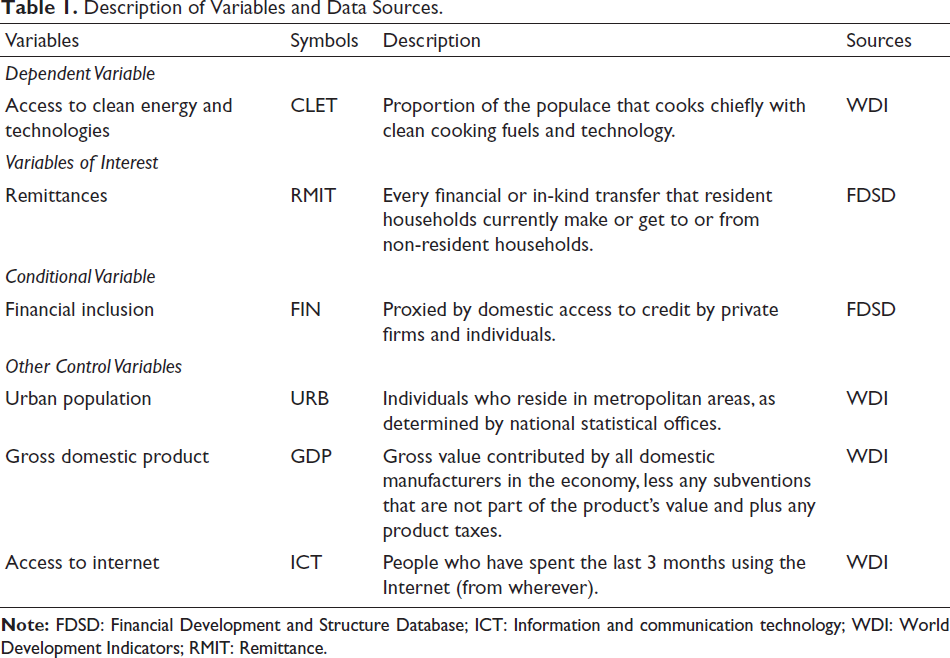
Description of Variables and Data Sources.
GMM Specification
The estimation strategy adopted in this study aligns with empirical evidence emphasizing the importance of matching econometric techniques to data characteristics (Kou et al., 2019; Vu & Asongu, 2020). Three main considerations motivate the use of the two-step GMM estimator. First, prior studies indicate that GMM is appropriate when the cross-sectional dimension exceeds the time dimension, as is the case where countries outnumber time periods (Abas & Fosu, 2019; Assefa & Mollick, 2017). Second, the dynamic specification, which includes a lagged dependent variable, requires strong persistence in the dependent series. Following GMM-centred guidance, the correlation between level and first-difference series should exceed .800, a condition satisfied in this study (Tchamyou, 2020). Third, endogeneity is addressed through internal instruments to mitigate simultaneity and reverse causality, alongside time-fixed effects to control for unobserved heterogeneity (Asongu et al., 2019; Tchamyou, 2020). Accordingly, the study employs Roodman’s (2009) dynamic GMM with forward orthogonal deviations, which yields more robust estimates and improves upon the traditional Arellano and Bond (1991) approach (Asongu et al., 2020; Boateng et al., 2018; Tchamyou, 2020).
Empirical Model
Following the results of Alhassan et al. (2014), the system GMM technique will be employed in this investigation because it has been demonstrated to have more predictive power than the difference GMM method by Alhassan et al. (2014) in small samples with short timeframes, which is comparable to the data used in this study. Therefore, considering the apparent difficulties in identifying reliable external instruments, the system GMM technique seems feasible when relying on internal instrumentation.

Where i refers to the country (i = 1, 2, 3, ..., 42); t refers to time period from (2000 to 2022) (t = 1, 2, 3, ..., 30), where Yit is the outcome variable, Yit–1 is the lag of the outcome variable; ai is the intercept, Xit is the vector of explanatory variables (regressors, control variables and intervening variables), εit is the error term presumed to be serially uncorrelated.
The baseline empirical model is expressed as follows:

Where CLET is access to clean energy and technologies, RMIT is remittances, FIN is proxied by domestic access to credit by private firms and individuals, and V is a set of control variables. Finally, following the theoretical model adopted by Asongu and Odhiambo (2019) and Ofori et al. (2023), we outline a functional form in Equation (4), where access to clean energy and technologies is directly influenced by remittances, financial inclusion and our array of control variables.

Where CLET is access to clean energy and technologies, RMIT is remittances, FIN is proxied by domestic access to credit by private firms and individuals, URB is urban population, GDP is gross domestic product and ICT is access to information, communication and technology. We now turn our attention to the specification of our empirical models, building on the work of (Ofori et al., 2023). In order to focus on the direct effects of the pertinent variables on access to clean energy and technology, we first create two baseline models, as shown in Equations (4) and (5).


We also capture the indirect effects of our variable of interest, RMIT, through our intervening variable, FIN, on CLET. We modify Equation (5) into a standard panel specification, as shown in Equation (6), respectively:

Blundell and Bond’s (1998) instrumental variable framework, commonly referred to as system GMM, is employed to estimate Equation 6. This choice is motivated by several methodological considerations. First, system GMM is well-suited to panel settings in which the cross-sectional dimension exceeds the time dimension (N > T), a condition satisfied in this study with 42 countries over a relatively short period (Blundell & Bond, 1998). Second, the estimator addresses potential misspecification in dynamic growth-type models by accounting for initial conditions, which are often omitted in standard specifications (Baltagi, 2008). Consistent with this logic, the study explicitly incorporates the initial level of access to clean energy and technology to capture path dependence. To address endogeneity arising from simultaneity and reverse causality, the study follows Arellano and Bond (1991) by instrumenting the differenced lagged dependent variable and other endogenous regressors with their past levels, initially relying on first-difference GMM estimators. However, as highlighted by Ahn and Schmidt (1995), first-difference GMM may inadequately handle unobserved heterogeneity and weak instrumentation when variables are highly persistent. Blundell and Bond (1998) therefore propose system GMM, which jointly estimates equations in levels and first differences using appropriate internal instruments. Empirical evidence shows that this approach produces more efficient and less biased estimates (Windmeijer, 2005). To further enhance robustness, the instrument set is collapsed following Roodman (2009) to mitigate instrument proliferation and overfitting concerns (Mehrhoff, 2009). This approach has been successfully applied in related studies, including Ofori et al. (2023).
Using the dynamic system estimate approach, Equation (6) is converted into Equations (7) and (8) to cover the level and first-difference specifications of access to clean energy and technology, in accordance with Ofori et al. (2023).


where
The following equations in levels, Equation (9), and the first difference, Equation (10), summarize the standard system GMM estimation procedure.


Where
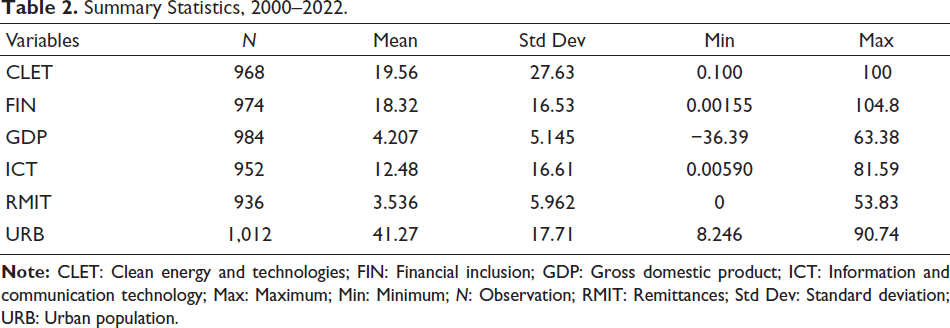
This study uses a double-censored Tobit model to further account for the dependent variable’s narrow range, which is in line with the empirical literature (Ajide, 2020; Asongu et al., 2017). As a result, this motivation aligns with the study’s data behaviour, as Table 2’s summary statistics reveal that access to clean energy and technologies varies from 0 to 100. The standard Tobit model (Tobin, 1958) is as follows in Equation (11):

Summary Statistics, 2000–2022.
where
Instead of observing 
where γ is a non-stochastic constant. In other words, the value of
Summary Statistics
Table 2 displays the summary statistics. The pairwise correlations between these variables are shown in Appendix B. Table 2 shows that over the study period, access to clean energy and technologies averaged 19.6%. During the study period, remittances showed a 3.5% average, whereas financial inclusion showed an average of 18.32%. According to this, less than half of the people in SSA countries have access to clean energy and technology during the study period, indicating the region’s slow transition to renewable energy. Likewise, the low proportion of remittances to GDP in SSA suggests that equivalent remittances in SSA countries continue to be a minor component, as does the bank credit accessible to the private sector and individual renewable energy sources.
Relative and Conditional Effects of Financial Inclusion in the Relationship Between Remittances and Access to Clean Energy and Technologies?
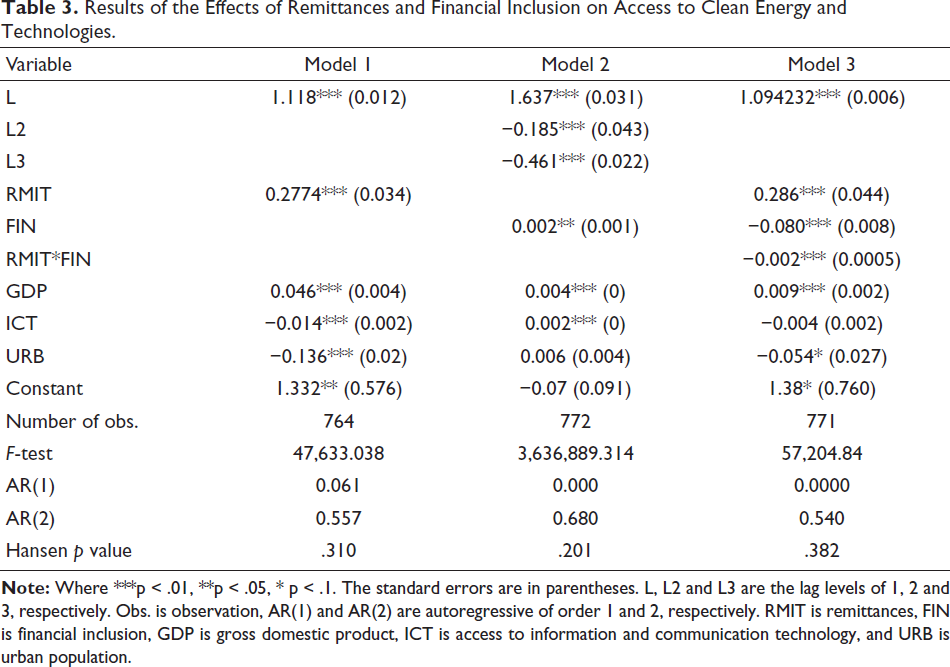
Three different estimation results on the impact of remittances and financial inclusion, as well as the idea that remittances and financial inclusion interact to affect access to clean energy and technologies, are presented in this section. Table 3 displays the outcomes of the GMM model. The baseline model of remittances and financial inclusion (Equations (1) and (2)) is shown in columns 1 and 2, and the interaction between remittances and financial inclusion (Equation (3)) is shown in column 3. The current value of access to clean energy and technologies in the region is positively correlated with its previous value, as confirmed by the statistically significant coefficient of the past value of access to these resources at the 1% across all models. We conclude that there is no problem with serial correlation because the supplied autoregressive (AR) tests are not substantially different from zero, hence failing to reject the null hypothesis that the coefficient on the lagged residuals is equal to zero. Hansen also examines whether the GMM model’s overidentifying constraints are sound. Beyond the number of estimated parameters, the model is subject to these extra moment conditions. The overidentifying constraints are legitimate, and the GMM estimator is consistent because the Hansen tests presented were not statistically significant.
Results of the Effects of Remittances and Financial Inclusion on Access to Clean Energy and Technologies.
Results of the Effects of Remittances and Financial Inclusion on Access to Clean Energy and Technologies.
In Model 1, the remittance coefficient is positive and statistically significant at least 1%. In particular, Model 1 demonstrates that access to clean energy and technologies in SSA increases by 27.7% for every $1 rise in migrant remittances, all other factors being equal. The result is justified by the recognized structural dynamics in SSA, where migrant remittances significantly contribute to household welfare, productive investment and energy availability (Acheampong et al., 2025; Feld, 2021). Remittances, in contrast to official income sources, are usually unconstrained, countercyclical and sent directly to households, enabling families to allocate money towards priority needs and level out consumption amid economic shocks (Khan, 2025). These results are consistent with other studies that demonstrate remittances increase household access to clean technology and energy (Hassan, 2020; Scott et al., 2023; Shrestha & Kakinaka, 2022). In Model 2, at least at the 5% significance level, access to energy and technologies increases by 0.002 with an increase in financial inclusion. Therefore, a 2% increase in access to clean energy and technologies results from a unit rise in financial inclusion, ceteris paribus. Accordingly, people are marginally more likely to have access to renewable energy and technologies as their financial services (such as banking and credit) improve. Financial inclusion facilitates the adoption and affordability of such resources for communities or people, even if the impact is minimal. This result supports the findings of studies (Hsu et al., 2021; Twumasi et al., 2024) showing that households with greater financial resources use them to purchase renewable energy, such as LPG for their homes. Comparatively, the effect of remittances on access to clean energy and technologies outweighs that of financial inclusion in SSA countries, and this could be attributed to the point that remittances provide direct and unrestricted liquidity that households typically allocate to high-priority, lumpy purchases such as off-grid solar kits, clean cookstoves or mini-grid connections, thereby overcoming the upfront capital constraint that formal credit or gradual financial inclusion procedures alone may not resolve (Mukoka & Nyamusa, 2023; Zennati et al., 2025).
Remittances and financial inclusion are negatively and statistically significantly correlated in Model 3. This implies that remittance inflows and financial inclusion work together to decrease access to renewable energy and technology in SSA. Agradi (2023) identified a contrary finding, demonstrating that financial inclusion and remittances have a positive impact on clean energy and technology access. However, the marginal effect, often referred to as the conditional impact, needs to be computed in order to determine the true impact of remittances on access to sustainable energy and technologies. Equation (3) illustrates the marginal impact of remittances on access to renewable energy and technologies. Table 4 displays the results of the marginal effects. Based on Equation (3), we estimate a net effect of 0.2411, which is determined by considering the mean value of FIN (18.32), the effect of the association between RMIT and FIN (−0.0025), and the unconditional effect of RMIT (0.2869).

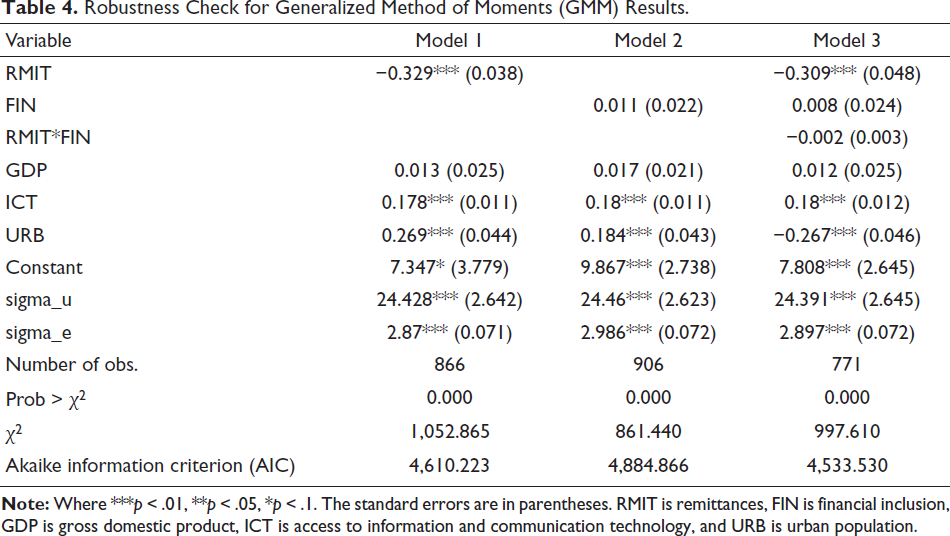
Robustness Check for Generalized Method of Moments (GMM) Results.
The impact of remittances is lessened when access to renewable energy and technologies is significantly nullified (damped) by financial inclusion. This is quite surprising. Access to renewable energy and technologies, and the beneficial effects of remittances, are reduced when financial inclusion is present. While financial inclusion plus remittances has a smaller effect (0.2411), remittances have a larger influence on access to green energy and technologies. Our result makes financial sense based on several factors. First, consumers have direct and frequently more dependable funding sources for sustainable energy technology investments thanks to credit availability. Bank credit provides a stable and organized financial alternative to remittances, which can be erratic and contingent on the state of the economy in the sender’s nation (Twumasi et al., 2022). This lessens overreliance on remittances by enabling households to plan efficiently and invest in sustainable energy solutions. Second, compared to unofficial or less regulated financial sources, bank loans are usually available with better conditions and cheaper interest rates (Maity & Sahu, 2020). This increases the appeal and affordability of borrowing for investments in clean energy. The exclusive effect of remittances on access to sustainable energy technology may be mitigated as a result of families choosing bank loans over remittances for such investments.
The policy threshold at which migrant remittances are required for SSA to transition to clean energy and technology is also covered by the empirical findings of our study. In order to overcome the problems with interactive regressions that Brambor et al. (2006) observed, this work takes inspiration from recent research on interactive regressions (Nchofoung & Asongu, 2022; Nchofoung et al., 2022; Tchamyou, 2020). Such computation includes both the conditional and unconditional incidence of the main channel(s) dependent on the moderating variables, as shown in Table 5, according to the underlying interactive-centric literature. The study’s primary channels are migrant remittances and financial inclusion, while the control variables are urbanization, financial inclusion, GDP and information and communication technologies.
Threshold Effect of Remittances on Access to Clean Energy and Technologies.
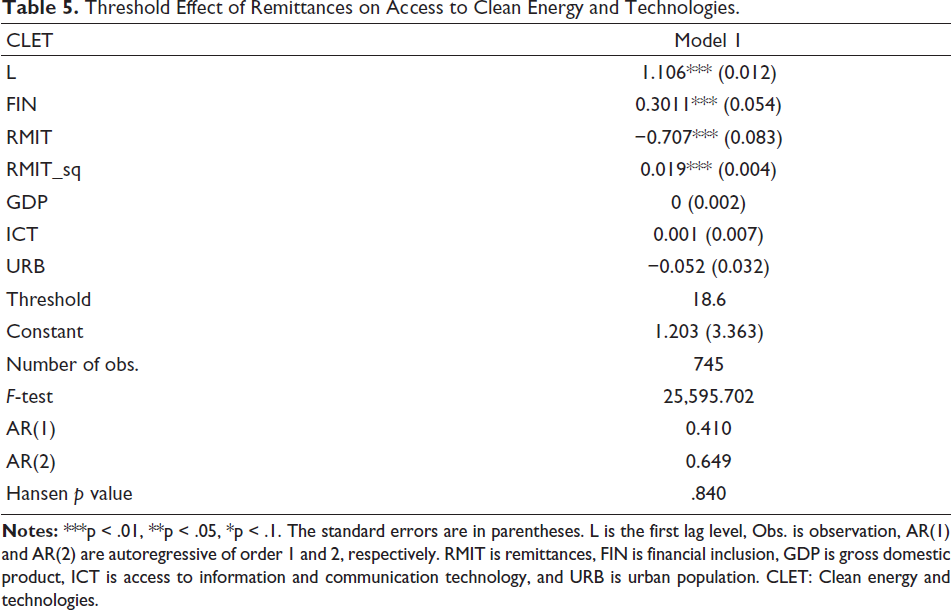
Threshold Effect of Remittances on Access to Clean Energy and Technologies.
From Table 5, at the 1% significance level, a 1 unit increase in remittances results in a 0.707-unit reduction in access to clean energy and technologies. Thus, when remittances increase by $1, there is a 70.7% decrease in access to clean energy and technologies. This is counterintuitive. This phenomenon can be explained and justified by considering that remittances flowing into SSA countries are primarily used for short-term household consumption and welfare-smoothing needs, such as food, housing improvements, healthcare and education, rather than for capital-intensive clean energy technologies, which frequently require large initial investments (Gamette et al., 2025; Ngubane et al., 2025). Consequently, larger remittances thereby lessen the motivation for households to switch to clean energy, which results in a discernible decrease in access to clean energy and technology even in the face of larger income inflows. When the likelihood ratio is zero, the estimated threshold is 18.6%. Access to clean energy and technologies is severely and adversely impacted by migrant remittances. Access to clean energy and technologies is positively impacted by migrant remittances when the percentage is beyond 18.6%. On the other hand, SSA households’ access to renewable energy and technologies is diminished when migrant remittances are less than the 18.6% threshold. Remittance increases access to clean energy and technology when remittances exceed 18.6% in SSA. In the SSA region, migrant remittances have increased dramatically since the year 2000; however, remittance volume fell to 2.7% in 2019 and 2.6% in 2022 (Barkat et al., 2024).
Four robustness checks were conducted to test the results. First, we run the same predictor variables in the baseline model with respect to remittances, financial inclusion and the interacted term between remittances and financial inclusion. We arrived at a contrary result to the one in Model 1 in Table 4.
In the first model, the remittance coefficient is negative and statistically significant at least 1% level. In particular, Model 1 demonstrates that in SSA, access to sustainable energy and technologies declines by 32.9% for every $1 rise in migrant remittances. Similarly, in Model 3, at the 1% significance level, when migrant remittances increase by $1, there is a 30.9% decline in access to clean energy and technologies across SSA countries. Such a counterintuitive phenomenon occurs when migrant remittances only reach wealthy homes that are more interested in using the money for other competing household requirements like health and education than for energy. Furthermore, the migrant cash that the non-rich households get may be used for non-energy needs, such as food and other necessities, in addition to energy access. This problem could hinder efforts to transition to clean energy in the SSA by contributing to the lack of access to sustainable energy and technology in the region. This finding runs counter to research showing that migrant remittances encourage the adoption of renewable energy and, in certain situations, clean energy in developing nations from the Global South (Agradi, 2023; Barkat et al., 2024; Zafar et al., 2019).
Robustness Check for the Threshold Analysis
The assessment of the policy threshold for remittances on access to clean energy and technologies constitutes the last robustness check. The use of threshold modelling to find non-linear correlations is growing in popularity, as presented in Table 6. From the robustness checks, the twofold of the remittance variable is not statistically significant at any of the levels demonstrating non-linearity; however, when remittances alone increase by $1, access to clean energy and technology decreases by 23.5% in SSA countries. This is contrary to our expectations and underpinned by the case that many SSA households increasingly rely on individualized coping strategies such as purchasing fossil-fuel-based electricity, paying for informal power connections or using stand-alone generators rather than advocating for or depending on grid expansion and clean energy programmes (Bendaanane & Belz, 2025).
Threshold Using the Square of Remittances.
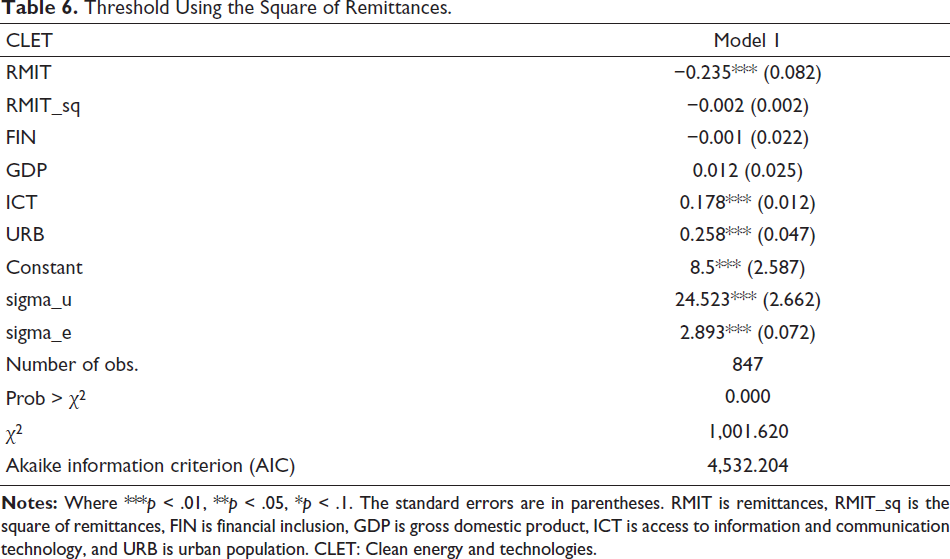
Threshold Using the Square of Remittances.
The current study has contributed to the body of knowledge and policy discourses by examining the relationship between remittances, financial inclusion and access to clean energy sources and technologies in 42 SSA nations. The SDGs’ policy implications are examined, particularly as they relate to income inequality, climate action and cheap and clean energy. We used data from 2000 to 2022. The main outcome variable is represented by access to clean energy and technologies, which is the proportion of the general population that cooks using clean fuels and technologies. One of the main policy variables is remittances are represented by any current cash or in-kind transfers received by resident families. The other policy variable is financial inclusion, which is represented by the financial resources that other depository firms make available to the private sector. In the case of the other control variables, urbanization, GDP and information and communication technologies are included. Empirical data utilizing the system GMM show that access to clean energy sources and technologies is greatly enhanced by both financial inclusion and remittances. In terms of the moderating effect, financial inclusion and migrant remittances combine to create a favourable overall impact. However, access to clean energy and technologies is dampened by financial inclusion, which lessens the impact of remittances.
The study finds that migrant remittances support the energy ladder hypothesis by financially empowering low-income households to transition towards cleaner energy and related technologies through improved income capacity. Specifically, remittance inflows exert a positive effect on clean energy access once a critical threshold of 18.6% is attained, underscoring the role of non-linear dynamics in energy transition processes within energy-poor regions such as SSA (Waleed & Mirza, 2023; Yadav et al., 2021). Building on and extending prior evidence (Abba Yadou et al., 2024; Bekhet et al., 2017; Hassan & Mahmud, 2024; Kouandou, 2025), this study identifies a remittance threshold of 18.6% beyond which access to clean energy improves markedly, underscoring the importance of policy-relevant non-linearities. Future research should therefore explore household-level transmission channels, while policymakers should align financial inclusion and remittance mobilization strategies to accelerate equitable clean energy transitions in Africa.
Specifically, policymakers can use the outcomes of this study to identify how the channels under consideration could affect the outcome variable. By implication, the results have policy relevance to facilitate the transition to clean energy by providing access to clean energy and technologies. This crucial level of remittances from migrants depends on the initial or current levels of energy and technology access. Governments can actively shape the renewable energy transition by strengthening migrant remittance channels and operationalizing the estimated remittance threshold identified in this study. The threshold is policy relevant because it lies within the observed minimum and maximum values of the moderating variables, making it feasible rather than aspirational. To realize energy transition objectives, governments in SSA should recalibrate policy frameworks so that remittances effectively support clean energy adoption. Given their regulatory authority, states are well-positioned to facilitate remittance inflows through reduced transaction costs, improved transfer infrastructure and targeted incentives for low-income households to allocate remittances toward clean energy technologies. Regional remittance targets above the 18.76% benchmark should be communicated clearly to financial institutions and allied agencies to encourage higher, more stable remittance inflows across the sub-region consistently.
This study leaves room for future research, particularly when it comes to examining how other external financial aid, such as foreign direct investment, foreign development aid and financial development, influence the transition to clean energy access and use by reducing CO2 emissions. Future research should take into account country-level studies in order to accommodate the distinct social, economic, political and cultural circumstances of each nation, given the unique features of SSA nations. Other estimating techniques, such as bootstrapping, could be employed for a robust study, given the fundamental flaw in the system GMM’s application, notwithstanding its advantages.
Footnotes
Authors’ Contributions
Pius Gamette: Conceptualization, methodology, validation, formal analysis, investigation, data curation, writing—original draft, writing—review and editing.
Eric Shynada Loglo: Formal analysis, investigation, writing—original draft, writing—review and editing, validation.
Francis Tawiah Anaisie: Methodology, validation, formal analysis, investigation, resources, data curation.
Clement Oteng: Conceptualization, formal analysis, investigation, writing—original draft, writing—review and editing.
Delali Aku Tunyo: Methodology, validation, formal analysis, investigation, writing—review and editing.
Availability of Data
There is no data associated with this research
Declaration of Conflicting Interests
The authors declared no potential conflicts of interest with respect to the research, authorship and/or publication of this article.
Ethical Declaration
The authors abide by all the ethics involved in this academic work and have not submitted it to any other journal.
Funding
The authors received no financial support for the research, authorship and/or publication of this article.

Appendix A. List of Countries Used for Study.
Angola, Benin, Botswana, Burkina Faso, Burundi, Cabo Verde, Cameroon, Central African Republic, Chad, Comoros, Democratic Republic of the Congo, Cote d’Ivoire, Djibouti, Equatorial Guinea, Eritrea, Eswatini, Ethiopia, Gabon, Gambia, Ghana, Guinea, Guinea-Bissau, Kenya, Lesotho, Liberia, Madagascar, Malawi, Mali, Mauritius, Mozambique, Namibia, Niger, Nigeria, Rwanda, Sao Tome and Principe, Senegal, Seychelles, Sierra Leone, South Africa, Tanzania, Togo, Uganda and Zambia.