







Abstract
The study explores the scope of integrating metaverse and social commerce platforms and their impact on consumers’ purchase intention. The study also explores the moderating role of avatar customization using the Measurement Invariance of Composite Models and Multi-Group Analysis approach. The authors developed the research model by combining the Technology Readiness Index and Technology Acceptance Model and coupling it with three other critical constructs, that is, content quality, social support and social presence. The research employs a cross-sectional quantitative approach, where a sample of 593 responses was drawn from respondents having prior experience with metaverse and social commerce platforms. The gathered data were analyzed using SmartPLS4, a programme designed for partial least squares structural equation modelling. The analysis demonstrated the significance of all hypotheses except for discomfort, and also, the moderating role of avatar customization was found to be insignificant. This study will help developers and businesses to develop more immersive and engaging platforms that will create a new way of shopping.
Introduction
In today’s digital era, the line between the physical and virtual realms is increasingly blurred, leading to a paradigm shift in how consumers interact, engage and conduct transactions. Metaverse has the ability to develop stronger relationships, and digital mediums are becoming increasingly popular among consumers and brands (Mou & Benyoucef, 2021), fostering the emergence of a hyper-connected digital universe known as metaverse-based social commerce platforms (MBSCPs). The idea originated from ‘Neal Stephenson’s literary work Snow Crash’ in 1992 (Dhingra & Abhishek, 2024); three decades later, the concept of the metaverse has now become a reality, thanks to significant investments from tech giants like NVIDIA, Microsoft and Facebook, among others (Giang Barrera & Shah, 2023).
The term ‘metaverse’ refers to a space where virtual reality (VR) and augmented reality (AR) are blended to create a digital environment (Lim et al., 2026), where people can socialize, communicate and participate in various activities (Ghanbarzadeh & Ghapanchi, 2021). Existing studies indicate that the metaverse remains in an early stage of development, with its full scope and implications yet to be clearly understood (Dwivedi et al., 2022; Jaung, 2022). Therefore, it has been recommended that scientific research should be carried out to provide more information about the concept ‘The market for metaverse was valued at US $74.4 billion in 2023 and is expected to grow at a Compound Annual Growth Rate (CAGR) of 37.73% to reach a US $507.8 billion value by 2030’, with an estimated user base of 2.633 billion (Statista, 2023). This illustrates the significance of studying the metaverse.
Conversely, ‘social commerce’ refers to using social media for e-commerce activities (Lin et al., 2017). The term was initially used in 2005 when Yahoo introduced its ‘Yahoo Shoposphere’. The popularity grew as customers could purchase goods and services through e-commerce only. However, social commerce could also use social media platforms to establish social relationships with the company and other customers (Busalim & Hussin, 2016). In terms of revenue, ‘social commerce is estimated to generate approximately US $992 billion in sales revenue in 2022, and projected to reach around US $8.5 trillion by 2030’, as these platforms gain further popularity in the future (Chevalier, 2023). This demonstrates social commerce’s importance even further.
The widespread digitization following the COVID-19 pandemic has revitalized metaverse and social commerce platforms. MBSCPs are immersive and engaging platforms that offer social commerce activities for purchasing, sharing, commenting and interacting in the metaverse space (Al-Makhmari et al., 2024). These platforms will combine the features of metaverse and social commerce to provide a new digital space (Balhareth et al., 2024), which will revolutionize traditional methods of shopping and interacting. The emergence of MBSCPs represents more than mere channel expansion; it indicates a fundamental transformation of the retail environments and social dynamics that influence consumption. These platforms transform retail into immersive, socially embedded ecosystems in which consumers participate as avatars, interact in real time and collaboratively generate value through shared experiences. As a result, retail in the metaverse extends beyond transactional exchange, becoming an ongoing process of social engagement, identity formation and experiential consumption within digitally mediated marketplaces. Some examples of these platforms currently available are ByondXR, NFT Alley and Decentraland. These platforms will help marketers to better present their products in a more immersive way and, at the same time, assist consumers by making their purchases more convenient and engaging.
This article is essential in the field, as MBSCPs are emergent technology-based platforms with only a limited number of empirical studies on the subject, thereby providing opportunities for exploration. The literature lacks research that examines the integration of metaverse as well as social commerce platforms. Therefore, this research contributes to the literature by addressing the gap through investigating users’ purchase intentions in MBSCPs. There is no current study that uses the combination of ‘Technology Acceptance Model (TAM), Technology Readiness Index (TRI), and content quality, social support, and social presence’ to study this concept. Therefore, the proposed research model uniquely integrates these constructs to provide a comprehensive understanding of user behaviour in adopting MBSCPs, as consumers must be technologically prepared, perceive functional value, establish trust and engage socially within immersive environments.
Avatar customization is a feature of metaverse environments, as it enables users to express identity and experience presence through digitally embodied representations. Despite its significance, this topic remains underexplored in academic literature. Therefore, this study investigates the moderating effect of avatar customization using ‘Measurement Invariance of Composite Models (MICOM) and Multi-Group Analysis (MGA)’. The study plays a vital role in assisting marketing practitioners and researchers in better understanding the various factors influencing purchase intention in MBSCPs. This will help developers and businesses to develop more immersive and engaging platforms that will create a new way of shopping. Overall, research in this area contributes significantly to advancing marketing and business practices in the digital age. The following research objectives have been framed for conducting this research.
RO1: To identify the factors affecting intention to purchase using MBSCPs.
RO2: To study the impact of identified factors on intention to purchase using MBSCPs.
RO3: To study the moderating role of avatar customization in framing purchase intention using MBSCPs.
Literature Review
Metaverse
The growth of the metaverse, beginning with its inception and continuing up to the present day, is a reflection of the continuous evolution of digital surroundings. It is the convergence of technologies like ‘VR, AR and the internet’, which allow users to interact using multi-senses with digital objects and virtual surroundings (Barta et al., 2023). It is a VR alternative to the internet that utilized interactive avatars (Dhingra & Abhishek, 2024). The potential of the metaverse is being driven by businesses investing millions of dollars in the creation of technologies related to the metaverse, as well as the growing trend of consumers interacting and transacting in virtual environments (Giang Barrera & Shah, 2023).
Social Commerce
‘Social commerce, or s-commerce’, is an innovative online business practice that integrates the characteristics of e-commerce and social media platforms (Hajli & Sims, 2015). It offers features of click-outs and transactions. Click-outs and transactions are defined as clicking on a link to switch to the transaction interface and complete transactions directly on the website (Hu et al., 2022). Users not only find and engage with visually appealing content but can also make direct transactions on the same platform (Wang et al., 2023). Metaverse, a hyperconnected digital cosmos, holds the potential to drastically alter the way businesses, brands, and consumers trade and engage in a seamlessly connected VR (Giang Barrera & Shah, 2023). The once-fictional concept of the metaverse has gradually gained traction as a legitimate business factor, particularly for marketing purposes.
Scoping Review
Table 1 provides a detailed overview of some prominent studies.
Scoping Review.
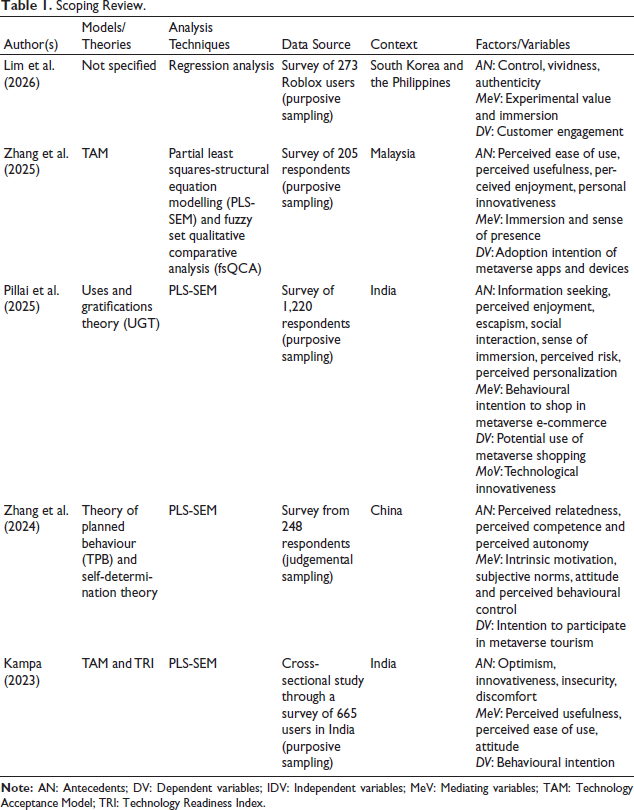
Scoping Review.
Theoretical Background
The study has taken factors from ‘TAM’ (Davis, 1989) along with ‘TRI’ (Parasuraman, 2000), collectively known as ‘Technology Readiness Acceptance Model (TRAM)’ (Larasati, 2017), and some critical factors from the literature, such as ‘social support, social presence and content quality’.
TAM is an extended version of the ‘Theory of Reasoned Action’ (TRA) (Fishbein & Ajzen, 1975), which focuses on the adoption of new technology (Davis, 1989). TAM explores the factors that influence an individual’s decision to either adopt or reject a new technology (Kampa, 2023). According to TAM, ‘perceived usefulness (PU) and perceived ease of use (PEOU)’ are two technology-related attitudinal factors that influence users’ adoption of information technology (Almarzouqi et al., 2022). TAM has been utilized in studying the users’ purchase intention using MBSCPs due to its commendable advantage for studying new technology and its related aspects (Dhingra et al., 2026).
‘Technology readiness’ (TR) refers to users’ willingness to use and accept new technologies to fulfil their daily needs and business objectives (Parasuraman, 2000). Parasuraman defines the TR construct as ‘people’s propensity to embrace new technologies for accomplishing goals in life and work’ (Parasuraman, 2000, p. 308). It is important to study user readiness for MBSCPs, as these platforms are new and related to innovative technologies. The construct predicts the behaviour of individuals in relation to technology with respect to four sub-dimensions: ‘optimism and innovativeness, which can increase TR, and discomfort and insecurity, which may decrease it’ (Parasuraman, 2000, p. 312).
The study combines TAM and TRI with social support, social presence and content quality to provide a holistic view of the concept by covering the technical, user personality and retail aspects of the MBSCPs. ‘The TAM employed for focuses on usage experiences and the technical benefits’ (Sinha et al., 2024, p. 4) offered by MBSCPs, TRI focuses on the personality traits of users that will help in framing positive purchase intention (Kuo et al., 2013) using these platforms, and ‘content quality, social support and social presence’ are specifically associated with studying social commerce aspects (Haikal & Kuswati, 2025) of the platforms. Therefore, it is theoretically suitable to combine TAM and TRI with content quality, social support and social presence to examine the purchasing intention related to MBSCPs.
Hypotheses Development
This study examined user behaviour in the adoption of the metaverse in social commerce using TAM (PU, PEOU and attitude), TRI (optimism, innovativeness, discomfort and insecurity), and the additional constructs: content quality, social support, social presence and trust, and the associations between variables are shown in Figure 1.
Research Model.
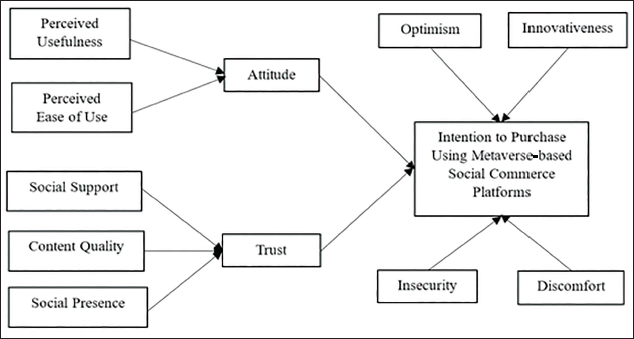
Research Model.
‘Perceived usefulness (PU) refers to the degree the user believes that the innovation has significant benefits’, (Akour et al., 2022, p. 5). Our study delineates it as the extent to which usage of MBSCPs will strengthen the user’s intention to purchase. Researchers determined that usefulness is a critical factor influencing the adoption or acceptance of metaverse technologies (Almarzouqi et al., 2022). The technology’s utility will cultivate a favourable disposition among users, establishing a basis for future preference and consumption (Dhingra et al., 2026). This study employed PU and its evidenced relationship with attitude and formulated the hypothesis (H) outlined below:
H1: PU positively impacts attitude towards MBSCPs.
PEOU
‘Perceived ease of use (PEOU) refers to the degree the user thinks that the innovation is effortless’ (Akour et al., 2022, p. 5). MBSCPs offer consumers a useful as well as effort-free option for purchasing products using the platforms. Our study considers how metaverse technology will provide users with ease while shopping using MBSCPs by offering the advantage of convenience and cost efficiency. Previous studies have demonstrated a significant relationship between PEOU and attitude (Kampa, 2023; Shen et al., 2022). The hypothesis was developed by specifically considering PEOU, which has a positive impact on attitudes towards MBSCPs.
H2: PEOU positively impacts attitude towards MBSCPs.
Content Quality
Content quality refers to the degree to which the provided information is sufficient and complete (Faisal et al., 2017). Content quality features include originality, ingenuity and the degree to which customers find the content credible (Perdana et al., 2023). In a social commerce community, consumers may form a continued commitment to the community after they gain useful and needed information through content (Wang & Huang, 2023). It appears that better content lowers risks and uncertainty, which raises user comfort levels on the platform. The literature depicts that there is a significant relationship between content quality and trust (Faisal et al., 2017; Handarkho, 2020) and develops the hypothesis mentioned below:
H3: Content quality positively impacts trust towards MBSCPs.
Social Support
Cobb (1976) defined social support as information that makes the subject feel cared for, loved, esteemed and part of a network of mutual obligations. Higher levels of social support encourage warmer, more intimate relationships (Rashid et al., 2020), which in turn lead to increased trust on the platforms. Building a strong social support system is the essence of MBSCPs, as it will offer more personalized and proximate social relationships that will build positive trust towards using these platforms. Several studies examined and supported this relationship (Cheng & Lin, 2023; Handarkho, 2020). Therefore, this hypothesis has been developed:
H4: Social support positively impacts trust towards MBSCPs.
Social Presence
According to the ‘Social Presence Theory’, social presence refers to the ‘sense of being with another’ and how interfaces shape and alter it. Text, images, movies and three-dimensional avatars that depict far-off people are just a few ways in which technology mediates representations of other people or intelligence that we come across (Biocca et al., 2003). When people feel a high level of social presence, it boosts their trust in platforms. Prior studies have shown a significant influence of social presence on the formation of trust (Amin et al., 2021). Thus, the following hypothesis has been developed:
H5: Social presence positively impacts trust towards MBSCPs.
Optimism
‘Optimism refers to a positive view of technology and a belief that, it offers people increased control, flexibility, and efficiency in their lives’ (Parasuraman, 2000, p. 311). ‘Individuals, who are optimistic and have an innovative attitude towards new technology, are generally likely to perceive new technology as easier to use and useful’ (Kampa, 2023, p. 5). In the case of MBSCPs, users have a positive outlook towards metaverse technology due to its usefulness and widespread usage across various domains, which in turn fosters a positive attitude towards its use. Previous studies explored the role of optimism in framing users’ intention (e.g., Kampa, 2023; Kim & Chiu, 2019). Thus, this hypothesis has been formulated to study the proposed relationship:
H6: Optimism positively impacts the intention to purchase using MBSCPs.
Innovativeness
‘Innovativeness refers to a tendency to be a technology pioneer and thought leader’ (Parasuraman & Colby, 2014, p. 18). People who exhibit innovativeness in TR are more likely to experiment with novel tools and techniques for problem-solving, as well as to be more open to new concepts and technology (Kampa, 2023). MBSCPs are highly innovative and technology-based platforms; thus, innovative users will try to adopt and use these platforms. Prior studies have examined the role of innovativeness in technology adoption (e.g., Abubakre et al., 2022; Gupta et al., 2023). Therefore, this hypothesis has been developed:
H7: Innovativeness positively impacts the intention to purchase using MBSCPs.
Insecurity
‘Insecurity refers to distrust of technology and scepticism about its ability to work properly’ (Parasuraman & Colby, 2014, p. 18). Researchers have identified risk perception as the most significant barrier to user adoption of innovative technologies, as privacy threats will increase user perceptions of risk and vulnerability (Piris, 2019). Ensuring user privacy and maintaining data security are crucial concerns in virtual realms like the metaverse (Lee et al., 2021). According to several studies, insecurity negatively affects an individual’s decision to adopt the technology (e.g., Wang & Shin, 2022). Users experiencing MBSCPs will find it insecure and privacy invasive, as it captures facial expressions, emotional data and other significant private data that could hinder its usage. Therefore, insecurity must be considered in the context of MBSCPs.
H8: Insecurity negatively impacts the intention to purchase using MBSCPs.
Discomfort
‘Discomfort refers to a perceived lack of control over technology and a feeling of being overwhelmed by it’ (Parasuraman, 2000, p. 311). This dimension generally measures the fear and concerns people experience when confronted with technology (Godoe & Johansen, 2012; Parasuraman & Colby, 2014). While experiencing MBSCPs, users will face discomfort due to inconvenience caused by devices and their associated impacts on mental and physical health. Prior studies have examined the negative effect of discomfort on adopting innovative technology (e.g., Blut & Wang, 2020; Kampa, 2023). Therefore, this hypothesis has been developed.
H9: Discomfort negatively impacts the intention to purchase using MBSCPs.
Attitude
The prediction of a person’s behavioural intention is the main tenet of TAM (Muk & Chung, 2015). People will embrace new technology once they have a positive attitude towards it. Literature has revealed that a positive attitude will have a significant impact on intention (Kampa, 2023; Shen et al., 2022). Previous research has also widely focused on the relationship between attitude and intention (Larasati, 2017; Shen et al., 2022). A positive attitude will lead to individuals’ favourable intentions to adopt the technology (Dhingra et al., 2026). Consequently, the hypothesis has been formulated.
H10: Attitude positively impacts the intention to purchase using MBSCPs.
Trust and Intention to Purchase Using MBSCPs
Trust means believing in someone and being ready to rely on them (Cheng & Lin, 2023). People trust platforms because they believe that using them for engagement has benefits (Handarkho, 2020), and these platforms will keep their private and financial data safe, which makes them more inclined to use MBSCPs. Prior literature has talked about the relevance of trust in the formation of intention (Amin et al., 2021; Cheng & Lin, 2023). Purchase intention refers to the readiness to act in a purchasing manner, which is fundamentally an indication of adoption (Mior Shariffuddin et al., 2023). If the technology improves the experience by satisfying the user, then it must have wider adoption (Ren et al., 2022; Yang et al., 2022). Prior literature has talked about the relevance of trust in the formation of intention (Amin et al., 2021; Cheng & Lin, 2023). Thus, this study examines the role of trust in framing purchase intention using MBSCPs. Therefore, the following hypothesis has been developed:
H11: Trust positively impacts the intention to purchase using MBSCPs.
Research Methodology
The purpose of the study is to examine users’ purchase intention using MBSCPs. The questionnaire was designed in English language. The study modifies the academically validated and well-established scales of TRI, TAM and three other literature-based factors to match the current research context, using a ‘five-point Likert scale’ to assess 12 variables comprising 48 items. Response options ranged from ‘1 for strongly disagree’ to ‘5 for strongly agree’. The face validity of the questionnaire was ensured by showing it to six professionals before it was distributed to collect data. In a subsequent phase, the instrument underwent pilot testing with a sample of 70 individuals to mitigate other potential concerns. The Cronbach’s alpha value was between .726 and .864, which is greater than the threshold value of 0.70 (Hair et al., 2022), which is acceptable for establishing the reliability of the questionnaire. After all pertinent remarks were incorporated, a survey was undertaken to gather the data using both online and offline modes.
The minimum recommended sample size for the study, using the formula in which the total item count is multiplied by 10 (Chuah & Cham, 2020), is 480. The typical response rate of participants in surveys is roughly 50% (Baruch & Holtom, 2008); therefore, we aimed to engage approximately 1,000 respondents, around double the minimum sample size, via both online and offline methods. The questionnaire is structured into two parts. The initial part collects demographic information, and the subsequent segment comprises 48 items that assess the users’ intention to purchase using MBSCPs. To ensure the study’s pertinence, participants were mandated to possess prior experience with both social commerce platforms and metaverse technology. Respondents’ comprehension was evaluated via inquiries about fundamental questions, that is, (a) Have you ever used social commerce platforms? (b) Have you ever interacted with any metaverse-based platforms? Data were collected only from those respondents who had marked yes in both the qualifying questions.
The study employed a two-stage sampling approach in which, first, systematic random sampling, a probability sampling method, was employed to select the cities and malls for data collection. Later, in the second stage, the purposive sampling method was employed to collect the data from the respondents available in those locations. Initially, 5 cities were randomly selected out of a total of 15 metropolitan cities in India, that is, Delhi, Hyderabad, Mumbai, Chennai and Gurugram, using the fishbowl method, in which the names of each city were first written on separate chits and mixed in a bowl for selecting 5 cities randomly. These five city chits came out of the bowl while picking randomly, and hence, these five cities were included in our study to collect data. Thereafter, a list of shopping malls was obtained for each city, and those having stores offering metaverse-related experiences were shortlisted to meet the objective of our research. The study included only those malls that had stores offering metaverse-related experiences; the rest of the malls were excluded from the list. Out of the malls included, five malls having metaverse-based stores were randomly selected from each city using the random number generation method in Excel and then approached physically to collect the data using the purposive sampling method. Subsequently, we asked the available respondents in the stores to fill out a questionnaire, but some of them agreed to participate online due to their time constraints, so their email addresses and contact numbers were collected to share the Google Form. The survey was conducted across India between November 2023 and October 2024 to collect the primary data.
A total of 640 respondents consented to participate in the study out of the 1,000 individuals approached for participation. Out of the 640 respondents, 360 filled out the questionnaire in offline mode and 280 filled out the questionnaire through online mode. The response rate of respondents for the study was 64%. However, due to incomplete information in 47 responses, those responses were eliminated from the analysis. As a result, 593 valid samples remained for additional scrutiny. The collected data were analyzed using ‘partial least squares structural equation modelling (PLS-SEM)’, a statistical technique for exploring complex relationships among identified variables (Hair et al., 2022; Lahiri et al., 2026). The study also employed ‘MICOM’ and ‘MGA’ for performing the moderation analysis.
Results
Common Method Bias (CMB)
The study employs marker variables and inner variance inflation factors (VIFs) to examine the CMB. Contextual performance is used as a ‘marker variable’, which is theoretically unrelated to the other variables examined in the research. The findings indicate that there is no CMB in the study since the change in R2 between the values before and after applying the marker variable is less than 1%, which is less than the threshold value of 10% (Chin et al., 2013). Additionally, the inner VIF values are within the range of 1.520–2.292, which is less than the threshold value of 3.33, indicating that the study is entirely free of research bias (Kock, 2015). The VIF values are shown in Table 2.
Structural Model Results.
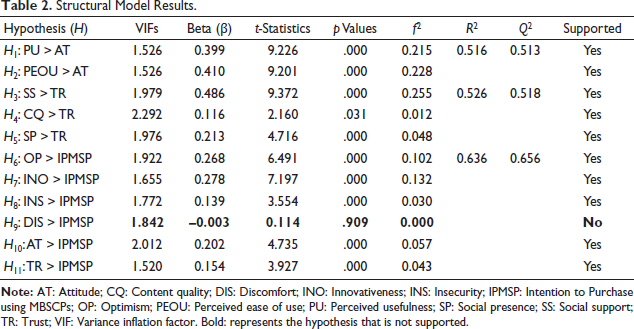
Structural Model Results.
The assessment of the measurement model is the first step in conducting ‘structural equation modelling (SEM)’, which is followed by the assessment of the structural model in the next step for testing the hypotheses (Anderson & Gerbing, 1988). The ‘factor loadings’ of all the items lie between 0.786 and 0.893, and the ‘composite reliability (rho_a and rho_c)’ of all the constructs lies between 0.857 and 0.930, which are above the threshold value of 0.70, showing internal consistency (Hair et al., 2019). The value of AVE of all the constructs lies between 0.682 and 0.768, which is above the threshold value of 0.50, depicting convergent validity (Hair et al., 2017). The discriminant validity of all the constructs is assessed using the ‘heterotrait–monotrait ratio (HTMT)’ criteria. The value of all the constructs is less than the threshold value of 0.85, establishing discriminant validity (Hair et al., 2022). Thus, the assessment of the measurement model establishes the reliability and validity of the items and constructs.
Structural Model Assessment
It has been analyzed using the bootstrapping procedure in SmartPLS 4 with 10,000 samples with a significance level of 0.05 (Hair et al., 2022). The structural model has been analyzed to test the proposed hypotheses using ‘beta value, t-statistics and path coefficients’, and the results are shown in Table 2. The results show the ‘coefficient of determination (R2)’ value between the independent and dependent variables. The model explains 51.6% of the variance in attitude, 52.6% in trust and, finally, 63.6% of the variance in IPMSP. The ‘effect size (f2)’ value is calculated to measure the contribution of independent variables in explaining the variance of the dependent variables (Hair et al., 2019), as shown in Table 2. The ‘predictive relevance of the model is assessed using the Q2 value’, which is 0.513 for attitude, 0.518 for trust and 0.656 for IPMSP, implying good predictive relevance of the suggested model, as the threshold value of Q2 is to be greater than 0 (Hair et al., 2017). Also, the ‘standardized root mean square residual (SRMR)’, indicating the overall model fit, is 0.062, which is less than the threshold value of 0.080 (Hair et al., 2017).
MICOM and MGA
Avatars are self-representations designed to make interactions easier in virtual environments (Ratan et al., 2020). They allow users to establish personal connections, reveal personal information and get online support from others. Avatars typically represent the essential components, such as identity and core values, that their creators use to construct a self-concept (Kang & Kim, 2020). Nowadays, many digital media interfaces let users make and customize their avatars and use them to communicate online for purposes including social media, education and commerce. The availability of avatar customization features enables MBSCPs to offer more interactive and communicative aspects that will help users engage and relate better with these platforms. This study aims to identify whether there is any difference between respondents’ perceptions regarding MBSCPs with respect to the availability of avatar customization features in these platforms. Previous studies have studied the role of avatar customization (Waddell et al., 2015).
The study performs MICOM analysis of avatar customization for establishing invariance, using a three-step approach, that is, configural invariance (first), compositional invariance (second), and equal mean values and variances (third) (Henseler et al., 2016). The MICOM analysis shows that configural and compositional invariance are achieved, so we can proceed with MGA. Also, the third step fulfils the criteria of full invariance by assessing equal mean values and variances, indicating that full MGA measurement can be performed (Henseler et al., 2016). The results of MICOM are shown in Table 3. After establishing full invariance, the study conducted the MGA and presented the pooled results in Table 4.
Measurement Invariance of Composite Models (MICOM).
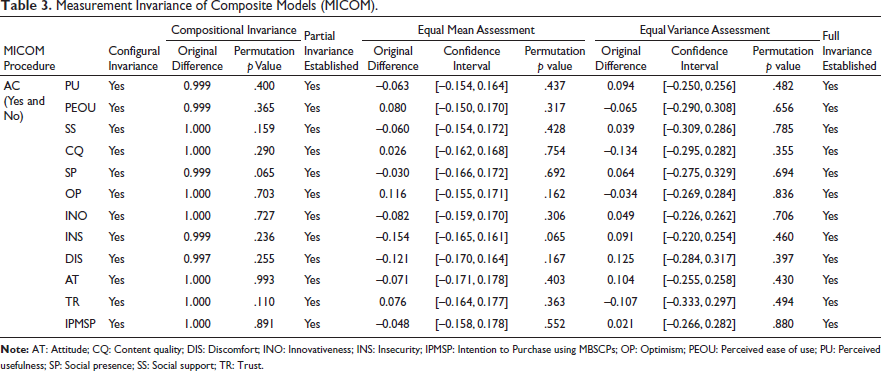
Measurement Invariance of Composite Models (MICOM).
Multi-Group Analysis (MGA).
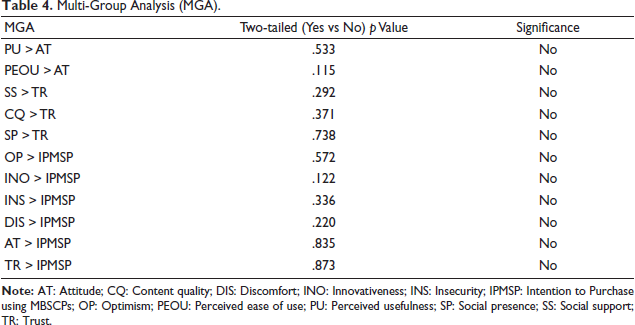
The ‘MGA’ has been performed to check the significance of avatar customization for the respondents. The study classifies the collected data into two groups and analyzes the difference among respondents’ perceptions regarding whether the avatar customization feature in MBSCPs makes any difference or not. The results show that all the relationship paths showing the interaction between avatar customization and variables in the study have insignificant p values. The findings indicate that none of the structural paths show statistically significant differences across groups, as all two-tailed p values exceed the recommended threshold of .05. The results depict that the respondents are indifferent regarding avatar customization, that is, their intention of using MBSCPs is the same whether they provide the feature of avatar customization or not, indicating that avatar customization does not moderate the examined relationships.
The present study builds the research model using a combination of TRI and TAM, known as TRAM (Larasati, 2017), with three other literature-based factors, to analyze consumers’ intentions to purchase using MBSCPs. By empirically integrating the conceptual framework, this study attempts to fill the gap of need for theory-driven research within immersive environments (Dwivedi et al., 2022). Our investigation supported all hypotheses except H9, which tested the relationship between discomfort and IPMSP. Since discomfort is an avoidance behaviour, or we can say it is negative, it may annoy anybody and induce the sense of not having enough control over the self to use technology (Parasuraman, 2000). This finding is consistent with Godoe and Johansen (2012), showing that technological strain reduces as users become habitual and more aware of visually rich and interactive digital platforms.
In the TAM model, PEOU and PU positively influence users’ attitudes (Davis, 1989) towards IPMSP. When users perceive MBSCPs as easy, convenient and effort-saving, their attitude becomes positive, leading to stronger behavioural intention to use them. This implies that if a user finds that MBSCPs are easy to use and do not require much effort in terms of searching for products and completing the transaction, then their attitude is positive. This means that the greater the ease of use and usefulness of MBSCPs, the stronger the behavioural intention towards using MBSCPs. The results align with prior research (Akour et al., 2022; Um, 2019).
Social support and social presence exhibited a positive relationship with trust in relation to the IPMSP. Confirming to the existing literature (Al-Tit et al., 2020; Liu et al., 2019), the results indicate that when users face any problem or get stuck while surfing MBSCPs, they get help and suggestions to overcome the issue. This way, users feel their concerns are heard and addressed appropriately. Further, when MBSCPs are more personalized, users tend to feel that the service provider focuses on emotional needs. This might make the experience of using MBSCPs engaging (Qu et al., 2023). Such relational cues play a significant role in metaverse environments where physical absence increases the users’ need for social commerce (Hennig et al., 2022). The results supported H4, which postulates a positive relationship between trust and content quality. The results of the study suggested that content quality constitutes a positive influential factor of social commerce users’ intention to use MBSCPs, confirming previous studies (Yuliana & Wahyudi, 2021).
In contrast to H9, H6, H7, H8, H10 and H11 are found to significantly impact IPMSP. Consumers’ attitude and trust play a crucial role in motivating them to make purchases using MBSCPs. The present study validated intention to use MBSCPs through TRI theory. The results show that optimism and innovativeness (Ismail & Wahid, 2020) positively influence users’ intention to use MBSCPs. Optimism, characterized by a positive outlook on technology’s potential benefits, encourages users to engage with and adopt new platforms. Innovativeness, reflecting a user’s tendency to embrace new technologies and ideas, further drives the intention to use MBSCPs by fostering a willingness to explore and utilize cutting-edge virtual environments. These findings align with existing literature (Kampa, 2023; Moussawi et al., 2021), underscoring the crucial role of psychological traits in MBSCPs.
Interestingly, the results show that insecurity negatively impacts intention to purchase using MBSCPs. A possible explanation for H8’s significance is that users fear their personal information and data being shared with third parties without consent. Also, MBSCPs would collect and share facial and other private data gathered while purchasing products. These findings align with existing literature (Moussawi et al., 2021). The study also examines the moderating role of avatar customization on all the existing relationships. The results confirm that avatar customization does not have any moderating influence on IPMSP, as depicted by the insignificant p values shown in Table 4. The users find that customization of avatars to resemble their own characteristics is not so important when forming IPMSP.
Theoretical and Practical Implications
The present study makes a valuable contribution from both theoretical and practical perspectives. The study makes a substantial academic contribution by studying the purchase intention in MBSCPs by integrating two popular theories, TRI theory (Parasuraman, 2000) and TAM theory (Davis, 1989), and three additional essential variables, that is, content quality, social support and social presence. This complete approach helps developers and businesses to create realistic and compelling metaverse platforms to boost adoption and shopping experience. While previous studies have primarily applied TRAM to traditional digital contexts (e.g., Kampa, 2023), this research investigates its applicability in the context of metaverse-based social commerce (Dwivedi et al., 2022). The research investigates the impact of avatar customization as a categorical moderator and concludes that it is not statistically significant. This finding paves the way for developing MBSCPs in a manner that will not hinder adoption and purchase intentions by incorporating this feature. The study results help in deriving conclusions that facilitate comprehension of the current constraints in the field of MBSCPs.
The study’s findings facilitate the derivation of numerous practical implications. The significance of PEOU and PU in influencing the intention to purchase using MBSCPs became apparent. Platform developers are advised to enhance the system’s acceptability by implementing intuitive and user-friendly features (Pillai et al., 2025). The results indicate that social support substantially affects the intention to purchase using MBSCPs (Liang et al., 2012). Thus, the development of MBSCPs by companies can further guarantee a more interactive, user-friendly and convenient environment. The results of MICOM–MGA imply that marketers and businesses need not focus on avatar customization features, as consumers are indifferent. Consumer adoption and utility of MBSCPs can be increased by ensuring that they are reasonably priced and well-designed. MBSCPs offer a multisensory experience and immersive encounters that revolutionize the conventional methods of purchasing and engagement; thus, marketers should focus on early adopters to grab the opportunities.
From a managerial perspective, the strong influence of PEOU and PU suggests that platform service providers should emphasize making platforms more seamless, with easy navigation, simplified transaction processes and a reliable system to increase adoption and keep users coming back as well. The important role of social support and presence further reveals that service firms should integrate interactive features such as peer-to-peer communication and customer support that are responsive and trustworthy and that would reduce uncertainty during the processes. Given the negative impact of insecurity on purchase intention, managers should invest more funds in data protection mechanisms. Lastly, the results showed avatar customization’s non-significant role. This implies that there is a need to focus on functional performance, improving context quality and building trust among platform users. The findings imply that the metaverse is evolving into a digital bazaar where retail success depends on immersive experiences, social interaction and trust rather than transactions alone. Retailers must therefore design MBSCPs as socially rich marketplaces that integrate technology, community engagement and experiential value to shape the future of retail.
Limitations and Future Research
The current study highlights various important factors impacting purchase intention in MBSCPs. Yet, the study has a few limitations that can be covered in future research. First, the research utilizes two primary theories, TAM and TRI theory, highlighting the moderating role of avatar customization. Studies in the future may consider other relevant theories and take other factors as moderators for comprehending their role in MBSCPs. Second, the research involves studying the adoption of MBSCPs; future research may study the challenges that marketers and consumers face while using this system. Third, the study employed quantitative studies to examine purchase intention using MBSCPs. Future studies may use both quantitative and qualitative studies for better analysis and interpretation. Lastly, the study is conducted in the Indian context. Future research can involve a target population from different regions or conduct cross-cultural studies to better capture cross-cultural variations in TR and metaverse adoption.
Conclusion
The article studied consumer attitudes and purchase intention using MBSCPs by employing TAM, TRI theory and three other variables. The results show that, out of the nine abovementioned variables, eight are significant, impacting attitude and trust towards intention to use MBSCPs. This research makes an important contribution to the literature by testing the moderating role of avatar customization, which is found to be insignificant. Future research in this domain will address the limitations of this study. The study will assist developers and businesses in the creation of platforms that are more immersive and engaging, which will result in the creation of a new method of shopping.
Footnotes
Acknowledgement
The authors thank Guru Gobind Singh Indraprastha University for giving them the resources and the chance to conduct this research.
Authors’ Contribution
All authors have significantly contributed to the development of this research article. Abhishek Gupta was responsible for writing the original draft, editing, proofreading and ensuring compliance with the journal’s formatting guidelines. Sanjay Dhingra contributed to the conceptualization of the study framework, development of the research model and supervised the overall project. Bhawika Batra was involved in data collection, initial data cleaning, and coding for SEM and MICOM-MGA analysis. Amit Sharma carried out the SEM analysis and interpreted the results. Sheela Narang conducted the literature review, formulated the hypotheses and designed the questionnaire. Abhijeet Jaiswal performed MICOM-MGA and validated the findings. All authors reviewed and approved the final version of the manuscript prior to submission.
Declaration of Conflicting Interests
The authors declared no potential conflicts of interest with respect to the research, authorship and/or publication of this article.
*Declaration of Generative AI
No generative artificial intelligence (AI) and AI-assisted technologies in the writing process have been used.
Ethical Declaration
The authors abide by all the ethics involved in this academic work and have not submitted it to any other journal.
Funding
The authors received no financial support for the research, authorship and/or publication of this article.
