







Abstract
Despite the growing adoption of digital transformation (DT) across industries, research on its impact on brand innovation (BI) in Nigeria’s fast-moving consumer goods (FMCG) sector remains limited. Intense competition and evolving consumer preferences make sustainable BI challenging. Prior studies have examined DT’s effects on customer loyalty and business models, but its specific influence on BI remains underexplored. This study addresses this gap by examining how DT affects BI in Nigeria’s FMCG sector, with customer experience (CX) as a mediator. Using a quantitative approach with data from 203 respondents, analysed via partial least squares-structural equation modelling (PLS-SEM), the results show that DT has no significant direct impact on BI. However, it enhances CX, which positively influences BI. CX partially mediates this relationship, accounting for about 68% of the total effect. This research contributes to the marketing and DT literature by highlighting the indirect pathway through which DT fosters BI. FMCG managers should invest in DT strategies that enhance CX, drive innovative marketing and maintain competitiveness in a dynamic market.
Keywords
Introduction
Brand innovation (BI) involves actively reshaping a brand’s identity, offerings and perceptions through new ideas, technologies and methods to meet evolving market demands, enhance perceived value, build equity and foster customer loyalty (Cuong et al., 2022; Dreßler & Paunović, 2022; Kraus et al., 2022; Maura et al., 2022; Shams et al., 2020; Yang & Wang, 2024). It encompasses product development, creative marketing, strategic positioning and technology integration to gain a competitive edge and deliver high-quality experiences. Digital transformation (DT) has disrupted traditional models, enabled innovative business strategies and supported creative growth through platforms, social media and advanced data analytics (Gartner, 2021; Kraus et al., 2022; Vaska et al., 2021). In tech-savvy markets, especially fast-moving consumer goods (FMCG), DT enables proactive trend detection, efficient co-creation and unique value propositions for differentiation, making active participation crucial for ongoing success. At the core of this process is customer experience (CX), which spans all touchpoints in the customer journey and aims to deliver perceived value, usefulness and emotional engagement (Becker & Jaakkola, 2020; Heinonen & Murto, 2023; Sianipar et al., 2023). DT significantly improves CX by enabling personalized, immersive and seamless multichannel interactions that satisfy the demand for instant gratification, boosting satisfaction, loyalty and financial results while requiring continuous updates to engagement strategies (Fernandes & Krolikowska, 2023; Shojaei, 2022; Singh, 2023; Yuen & Baskaran, 2024). Ultimately, DT accelerates BI by leveraging technology to enhance CX, strengthen brand connections and secure long-term competitive advantage.
The FMCG industry is highly dynamic, marked by rapid turnover, fast growth and frequent product changes. It aims to deliver products swiftly and at competitive prices through extensive supply chains, despite narrow profit margins, to meet customer needs. Pricing is crucial when targeting base-of-the-pyramid (BOP) markets with large consumer populations (Muller & Pelser, 2022). Global consumer spending in 2022 was expected to reach around $6.39 trillion. The value added in the consumer goods market is predicted to reach $4.54 trillion by 2025, with a compound annual growth rate (CAGR) of 1.47% from 2025 to 2029. Total output is projected to be $16.07 trillion in 2025 (Statista, 2023). FMCG includes single-use or frequently purchased items such as packaged foods, personal care products and consumer electronics (Muranko et al., 2021). It is divided into food and beverages, personal care, healthcare, home care and consumer electronics (Liu, 2022). High sales volumes create substantial opportunities. In Nigeria, the consumer goods market, valued at approximately $20 billion (Bizom, 2023), is one of Africa’s largest and most dynamic markets. It benefits from a population of over 220 million, significant foreign investment and strong growth potential, making it an ideal environment for BI.
Extensive research examines DT’s effects on customer loyalty, recruitment, retention and overall business innovation across sectors, including FMCGs (Huang et al., 2025; Li et al., 2022; Kraus et al., 2022; Rêgo et al., 2021; Vaska et al., 2021). With effective social media marketing strategies, these platforms not only promote products but also create immersive experiences that boost consumer loyalty and brand value (Alemsan & Fialho, 2024; Bari et al., 2025; Zahid et al., 2021). Despite this body of work, a notable theoretical gap remains in understanding how DT directly influences BI in the FMCG sector. The sector’s unique characteristics, such as intense competition, low entry barriers, rapidly evolving consumer needs and a sales-driven approach, render traditional marketing methods inadequate for sustaining long-term BI (Guerola-Navarro et al., 2021; Khan et al., 2022). Few studies investigate DT’s role in fostering BI specifically in this industry. Additionally, empirical research on how digital tools can be applied to engage customers and develop marketing strategies that enhance brand loyalty and competitiveness in FMCG remains limited. This practical gap highlights the need for further research on how digital engagement can be translated into actionable strategies for building durable brand strength in a rapidly changing market.
Objective
This article introduces a framework to examine how DT influences BI in the FMCG marketing sector, emphasizing the mediating role of CX. DT will be defined as a strategic tool for marketing FMCG products, with a focus on its impact on BI and overall business growth in the FMCG industry. Additionally, the study aims to lay a foundation for future research. The objectives of this study are:
RO1: Measure the impact of DT on BI.
RO2: Examine the impact of DT on CX.
RO3: Investigate the impact of CX on BI.
RO4: Examine the mediating role of CX in the relationship between DT and BI.
Significance of the Study
Nigeria’s FMCG sector faces complex challenges to sustainable BI, including technological gaps such as reluctance to adopt new technologies due to uncertain return on investment, management resistance and poor infrastructure. These issues lead to inefficient supply chains and increased waste (Nwaulune, 2024; Zego & Mohamad, 2023). Consumer price sensitivity, quality concerns and weak brand perceptions require significant investment in marketing, innovation and transparent communication (Timiyo, 2023). Regulatory inconsistencies complicate compliance with global standards, and fierce competition often prioritizes short-term profits over long-term sustainable practices, despite the potential advantages of green logistics (Nwaulune, 2024; Oyeyemi et al., 2024). To overcome these hurdles, the sector must develop innovative, consumer-focused strategies that enhance operational capacity, accelerate technology adoption and address regulatory issues to sustain long-term brand competitiveness.
This study examines how adopting digital tools and channels enhances consumer targeting, recruitment, retention and satisfaction, ultimately strengthening brand loyalty through an improved CX (Sharma & Ganguly, 2025). Second, it highlights the connections among DT, CX and BI in the FMCG sector. Third, using digital technologies to create brand experience can serve as a key differentiator for brands compared to competitors. It also helps develop a distinct brand identity that extends beyond the product to include the experience and the emotional bond it forms with customers. This unique brand identity, driven by DT and CX, can significantly influence BI. In conclusion, it impacts customer and stakeholder relationships across recruitment, retention, product development and business innovation, providing a vital advantage that sets the brand apart from the competition (Li et al., 2022; Rêgo et al., 2021; Vaska et al., 2021).
Literature Review
Brands invest heavily in establishing and differentiating themselves in the market. To build a strong brand presence, marketers create positive, memorable experiences that foster emotional connections, ultimately driving brand loyalty. Research indicates that brand loyalty develops when a brand delivers favourable, consistent experiences and positive associations (Aini & Ferdinand, 2022; Ye et al., 2022), underscoring the importance of emotional attachment in marketing. This is especially important in the FMCG industry, where consumers interact with brands more frequently than with other product categories (Muller & Pelser, 2022). By nurturing brand loyalty, companies can ensure business continuity, increase market share and promote industry innovation.
Brand Innovation
BI is crucial to modern marketing strategies as businesses strive to stand out in competitive markets. It encompasses creating new products, strengthening brand equity and leveraging technology to drive consumer engagement. It enhances offerings creatively while staying true to a brand’s core values (Goodwin, 2022). BI is vital for boosting customer satisfaction, which is essential for brand loyalty and overall business success. By meeting customer needs through innovation, brands can reduce the likelihood of customer switching to competitors, fostering loyalty. It also involves recognizing the value of new products in response to consumer needs (Khamwon & Pattanajak, 2021). In the FMCG sector, understanding diverse consumer profiles is key to tailoring products and services to meet specific segment demands (Muller & Pelser, 2022). Research shows a strong link between brands and consumer engagement, indicating that active involvement and emotional bonds with a brand can lead to increased loyalty (Yin et al., 2022; Saputra et al., 2021). BI goes beyond product features and includes the overall approach to innovation and the ability to adapt to constantly changing consumer demands. It reflects a brand’s alignment with evolving market needs and can significantly impact brand equity through consumer attitudes (Yang & Wang, 2024). Brand innovativeness plays a critical role in shaping consumers’ perceptions of new products. The relationship between brand innovativeness and consumer perceptions is key to how innovations, including new technologies, are received and valued in the marketplace (Shams et al., 2020), especially since experiential innovativeness strengthens consumer–brand relationships (Kim et al., 2021; Maura et al., 2022).
Digital Transformation
DT has become a major scholarly focus, prompting research on new business models (Choudhury et al., 2021; Kraus et al., 2022; Vaska et al., 2021), strategic leadership (Li et al., 2023; Rêgo et al., 2021; Srivastava et al., 2023) and innovative activities (Li et al., 2022; Yamin, 2023; Yuen & Baskaran, 2024). It motivates organizations to adopt emerging digital technologies and modify business models to achieve greater flexibility, data consistency and process autonomy, key elements for sustainability (Steiber et al., 2020), while accounting for customers’ varying willingness to engage in value co-creation, preferences for digital tools and broader societal impacts (Cakici, 2022; Kraus et al., 2022). Driven by technological innovations and industry growth (Gomez-Trujillo et al., 2021), DT leverages disruptive technologies, shared platforms and ecosystems to reshape value creation and delivery, fostering models such as innovation and the circular economy (Kraus et al., 2022; Vaska et al., 2021). It relies on dynamic digital capabilities to enhance organizational performance, CX and responsiveness to market demands (Chen, 2023). Essentially, DT entails integrating information, computing, communication and connectivity technologies to adapt to environmental changes, overhaul operations, restructure assets and transform how value is delivered (Li, 2020). Achieving success in the digital economy requires new strategic approaches, organizational changes and innovative implementation that embed digital technologies across all functions (Rêgo et al., 2021). In today’s digital era, it is unavoidable and serves as a key driver of economic growth and competitiveness (Kraus et al., 2022; Li et al., 2023; Tian et al., 2023).
Customer Experience
Enhancing CX is crucial to driving BI, as high-quality interactions with the brand’s marketing mix shape perceptions of authenticity, trust and credibility (Azhar, 2024; Li & Chung, 2025). Effective digital marketing fosters ongoing engagement, supporting sustainable brand growth (Azhar, 2024). CX is defined by the value delivered, including perceived benefits, usefulness and importance (Huang, 2020; Khan et al., 2022; Lemon & Verhoef, 2016), and extends beyond traditional marketing to encompass personnel, operations and emotional bonds. Emotions play a key role in shaping CX, fostering brand love, loyalty and satisfaction, especially in the FMCG sector, where interactions are frequent (Heinonen & Murto, 2023; Sianipar et al., 2023). Digital innovations have transformed CX, enabling personalized, immersive and omnichannel experiences that elevate customer expectations and demand quick, flexible service (Fernandes & Krolikowska, 2023; Singh, 2023; Shojaei, 2022). Perceived value, driven by product quality, price and emotional connections, directly influences purchase intent, satisfaction and loyalty (Vargo et al., 2020). To succeed, FMCG companies must leverage real-time data and digital tools to co-create value, deliver responsive feedback and create interactive experiences (Chawla & Goyal, 2021; Gummesson, 2021). This approach strengthens relationships, enhances commitment to sustainable practices and builds long-term brand attachment and loyalty (Hongsuchon et al., 2023; Sadighha et al., 2025; Secioria et al., 2025).
Underlying Theory
This study examines the relationship among DT, CX and BI in FMCG. BI has gained significant attention from scholars and practitioners, as literature emphasizes its importance for understanding customer behaviour and for tackling challenges in attracting and retaining customers who provide long-term value, which is essential for sustainable competitive advantage.
Customer Relationship Marketing Theory
Customer relationship marketing theory (CRMT) has evolved to focus on building long-term, mutually beneficial relationships between brands and customers. It emphasizes deep understanding of needs, tailored value and sustainable practices in a constantly changing global market (Huang, 2020; Tapaninaho & Heikkinen, 2022; Vargo et al., 2020). Fundamentally, CRMT aims to foster customer loyalty, retention, repeat business and positive word of mouth through high satisfaction and emotional connections, which are essential for long-term success, especially in the FMCG sector (Gummesson, 2021; Khan et al., 2022). In the digital age, CRMT provides a vital framework for strategic adaptation and BI (Chen, 2021; Choudhury et al., 2021; Kraus et al., 2022; Vaska et al., 2021). Digital technologies enable technology-driven customer–brand relationships, efficient channels and personalized marketing strategies that enhance trust, loyalty and overall business outcomes (Cahyadi, 2023; Guo et al., 2023; Guerola-Navarro et al., 2021). In this context, CX plays a key mediating role, as DT tools deliver improved, personalized and seamless CX, strengthening relationships outlined in CRMT and promoting BI through greater efficiency, competitive edge and sustainable growth (Li et al., 2022; Rêgo et al., 2021). By aligning digital strategies with CRMT principles, companies can foster lasting loyalty and innovate their brands to meet evolving consumer expectations in the digital era.
Digital Transformation, Customer Experience and Brand Innovation
In today’s fast-paced global business landscape, DT is crucial to BI, largely through its impact on CX. Advances in digital technologies enable the delivery of personalized content, engaging interactions and seamless omnichannel experiences, raising customer expectations and requiring innovative brand management strategies (Fernandes & Krolikowska, 2023; Shojaei, 2022). DT directly enhances CX by enabling interactions anytime, anywhere, across multiple channels, meeting modern demands for convenience and instant satisfaction (Fernandes & Krolikowska, 2023; Shojaei, 2022). This enhanced CX acts as a catalyst for BI, prompting organizations to rethink value-creation models, build deeper customer relationships through personalized marketing and align strategies with changing consumer behaviours. Consequently, brands that focus on CX-driven innovation achieve greater operational efficiency, increased loyalty, improved competitiveness and progress towards sustainable growth goals (Yuen & Baskaran, 2024). The interconnectedness of these elements, where DT empowers superior CX and outstanding CX fuels BI, is fundamental to effective business strategy. Companies that leverage digital tools to better understand and predict customer needs not only build lasting relationships but also distinguish their brands in a competitive market, ensuring long-term relevance and customer satisfaction.
Research Framework
This study offers a research framework for DT and its influence on CX and BI. This framework helps organizations adapt quickly to changes in the digital landscape while actively engaging customers and other stakeholders in creating value. It suggests that digitally agile organizations that involve customers’ experiences in co-creating value are more likely to achieve BI, as they are better equipped to meet their customers’ changing needs and expectations, especially in the FMCG industry Figure 1.
Research Framework.

Research Framework.
A hypothesis typically proposes a relationship between two or more variables, establishes connections among them through logical reasoning within the theoretical framework and tests whether these proposed relationships are valid. Hypothesis development focuses on creating a testable statement about a phenomenon or the connection between variables. It is a crucial step in guiding the design and execution of this study.
Digital Transformation Impact on Brand Innovation
DT significantly shapes BI by enabling social innovation, enhanced value creation, stronger business relationships, product enhancements and value-driven services through widely adopted digital technologies, tools and channels (Agrawal, 2020). It helps companies better understand customer behaviour, supports effective digital marketing through high-quality content and consistent engagement and leverages data-driven insights to personalize messages, ultimately boosting brand loyalty and sustainability (Azhar, 2024; Mariam, 2024). Consistent with CRMT, which emphasizes understanding consumers’ actions, motivations, perceptions and attitudes to inform strategy, DT enhances interactive marketing, customer engagement and relationship-building through social media and technology (Guerola-Navarro et al., 2021). Technology-driven CRMT fosters BI by creating customer-centric channels and systems that strengthen relationships and improve business outcomes. Overall, DT enables organizations to navigate uncertainty, adapt to new technologies and evolving customer preferences, stay relevant and gain a competitive edge, directly fuelling innovative and sustainable brand strategies (Kraus et al., 2022; Li et al., 2022; Vaska et al., 2021).
H1: DT significantly impacts BI.
Digital Transformation Impacts Customer Experience
DT significantly improves CX by enabling organizations to manage uncertainty, adopt new technologies and respond quickly to evolving customer needs, thereby maintaining relevance and a competitive edge in a fast-changing digital environment (Kraus et al., 2022). DT fundamentally reshapes operations, business models and customer interactions through integrated digital tools, fostering innovation, flexible processes, data consistency and the creation of new value (Choudhury et al., 2021; Li et al., 2022; Vaska et al., 2021; Yamin, 2023; Yuen & Baskaran, 2024). It empowers consumers as active participants in innovation and supports social entrepreneurship (De Silva et al., 2020; Li et al., 2022; Yamin, 2023; Yuen & Baskaran, 2024). Importantly, DT enhances CX by creating positive, memorable and emotionally engaging brand interactions that foster brand love and loyalty (Aini & Ferdinand, 2022; Wijekoon & Fernando, 2020). In the FMCG sector, real-time data collection and digital tools optimize customer engagement, build emotional bonds and deliver superior experiences (Chawla & Goyal, 2021; Li et al., 2022; Rêgo et al., 2021). H2: DT significantly impacts CX.
Customer Experience Impact on Brand Innovation
CX strongly shapes BI by shaping perceptions of authenticity, trust and innovativeness. It also drives loyalty, satisfaction and engagement in competitive markets (Chen, 2024; Maura et al., 2022; Sedighi et al., 2022). Positive CX, encompassing all brand interactions, fosters favourable perceptions of BI and encourages adaptable, responsive strategies informed by customer feedback (Sedighi et al., 2022). Active customer participation through personalization, co-creation or input into product development improves experience, builds ownership and attachment and directly fuels innovation aligned with customer preferences (Maura et al., 2022; Sembiring et al., 2024; Winarti et al., 2021). Innovative methods, such as digital brand extensions, further strengthen the link between satisfaction and loyalty (Chen, 2024). High-quality interactions with the brand’s marketing mix deepen customer understanding, enhance credibility and support sustainable innovation through ongoing digital engagement (Azhar, 2024; Li & Chung, 2025). Ultimately, delivering superior CX is crucial for guiding and accelerating BI. H3: CX significantly impacts BI.
Mediating Effect of Customer Experience on the Relationship Between Digital Transformation and Brand Innovation
DT leverages digital technologies to revolutionize operations, enhance real-time analysis of customer behaviour and promote collaborative value creation, ultimately driving BI through adaptive, customer-centric strategies (Adeola et al., 2022; Chawla & Goyal, 2021; Kraus et al., 2022; Tapaninaho & Heikkinen, 2022; Vargo et al., 2020). CX plays a crucial mediating role in this process. DT enables deeper customer engagement on digital platforms, personalized interactions and emotional bonds that exceed expectations, translating technological progress into improved CX (Aini & Ferdinand, 2022; Chawla & Goyal, 2021; Gaydarov & Ilieva, 2022; Heinonen & Murto, 2023; Sianipar et al., 2023). This enhanced CX, encompassing all touchpoints, perceived value, usefulness, emotional responses and contextual factors, increases loyalty, fosters feedback and co-creation and directly fuels BI by aligning offerings with evolving customer needs (Aslan, 2021; Heinonen & Murto, 2023; Sianipar et al., 2023; Vargo et al., 2020). Consequently, CX mediates the connection between DT and BI: digital tools improve experiences, which, in turn, inspire innovative brand strategies to maintain competitiveness and loyalty. H4: CX significantly mediates the relationship between DT and BI.
Materials and Methods
This quantitative study employs an explanatory research design to identify the causes and effects of the phenomenon under investigation. The philosophical approach is positivism, which aims to produce clear, objective, accurate and empirically verifiable knowledge. The survey strategy employs a cross-sectional time horizon for data collection and analysis, meaning data are gathered once within a specific period to address the research question using the mono-quantitative method (Saunders et al., 2016). This approach best aligns with the study’s purpose, as it seeks to explain how DT influences BI and the mediating role of CX.
Research Design
This study uses an explanatory research design grounded in positivist philosophy and employs a quantitative, cross-sectional survey. The sample size was determined using the inverse square root method (Hair et al., 2021). Of 250 questionnaires distributed, 238 were returned. Data were screened for missing values, outliers and straight-lining using standard deviation (SD) checks in Microsoft Excel (Hair et al., 2019, 2021); 35 responses with an SD less than 0.25 were excluded, leaving 203 valid responses suitable for partial least squares-structural equation modelling (PLS-SEM) analysis. The questionnaire used a seven-point Likert scale across four sections: demographics, BI (adapted from Huaman-Ramirez et al., 2019), DT (adapted from Kraus et al., 2022) and CX (adapted from Wijekoon & Fernando, 2020). Respondents were randomly selected from customers in Nigeria’s FMCG sector, with individual customers as the unit of analysis. Data analysis was performed using PLS-SEM in SmartPLS 4, chosen for its suitability with complex models, multiple latent variables and moderate sample sizes (Hair, 2019; Ringle et al., 2024).
Results and Discussions
Descriptive statistics summarize respondents’ demographics. The sample includes 203 respondents: 54% women and 46% men. The age distribution shows that 50% are between 20 and 30, 26% are 31–40, 17% are 41–50 and 7% are 51 and older. The data indicate that 51% of participants have a bachelor’s degree, 21% hold a master’s degree or higher and 28% have a diploma. Regarding employment, 51% of respondents own a business, while 49% are employees. The reliability and validity of the data collection were confirmed through partial least squares (PLS) analysis. All items from the DT and CX scales demonstrated high reliability, with Cronbach’s α exceeding .7. Four items were removed from the BI scale because Cronbach’s α was below .7.
Measurement Model
Construct validity is confirmed with each construct’s factor loading above the threshold of Cronbach’s α greater than .70 and average variance extracted (AVE) above 0.50, as shown in Table 1.
Construct Validity.
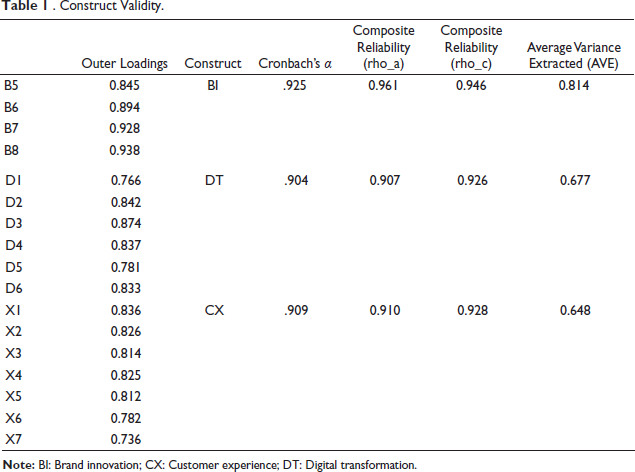
Construct Validity.
The assessment and establishment of discriminant validity are performed using the heterotrait–monotrait (HTMT) and Fornell–Larcker criterion. HTMT values are below 0.9 and considered acceptable, as demonstrated in Table 2.
Discriminant Validity.
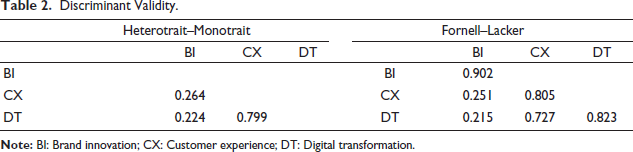
Discriminant Validity.
The confirmatory factor analysis (CFA) confirmed the measurement model for BI (four items), DT (sic items) and CX (seven items). The structural model shows a good overall fit with identical indices for the saturated and estimated models, indicating no structural misspecification. Key fit indices were as follows: standardized root mean square residual (SRMR) = 0.059 (<0.080, good fit) and normed fit index (NFI) = 0.817 (acceptable for complex models). These results support the adequacy of the proposed relationships among DT, CX and BI, as shown in Tables 3 and 4.
Model Fit Indices.
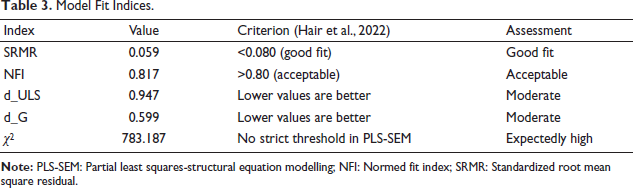
Model Fit Indices.
Explanatory and Predictive Power.

The model shows a good overall fit (SRMR = 0.059) and strong explanatory and predictive abilities for CX but has limited explanatory power for BI. The structural model is displayed in Figure 2.
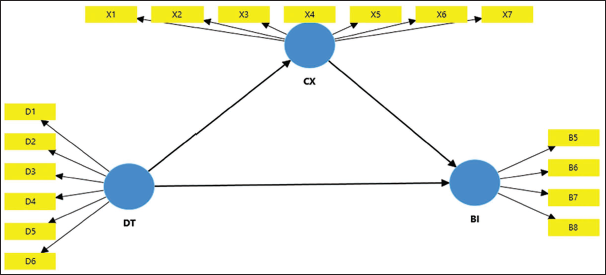
H1 found no statistically significant relationship between DT and BI. H1 was not supported, with a path coefficient (β = 0.70, t = 0.634, p = 0.263). H2 indicated a positive relationship between DT and CX, which was supported by a significant path coefficient (β = 0.730, t = 17.380, p < 0.01). H3 suggested a positive impact of CX on BI, and this was supported by a statistically significant result (β = 0.205, t = 1.669, p < 0.05). H4 examined the mediating effect of CX in the relationship between DT and BI; however, this hypothesis was not supported by a significant path coefficient (β = 0.151, t = 1.611, p = 0.05). CX has the strongest influence on the other two dimensions.
This finding aligns with the literature. Fernandes and Krolikowska (2023) note that advances in digital technologies enable content personalization and immersive experiences, raising customer expectations. Shojaei (2022) emphasizes the importance of DT in improving CX, as customers now expect to engage with businesses across multiple channels at any time. CX remains a key driver of BI. DT significantly enhances CX, which, in turn, positively influences BI. However, the direct link from DT to BI appears negligible, and CX does not significantly mediate this relationship. Future research could examine moderators or explore alternative model configurations to better capture indirect pathways. Table 5 presents the standardized path coefficients and relevant t-statistics for these relationships, obtained via PLS bootstrapping.
Main Effects.
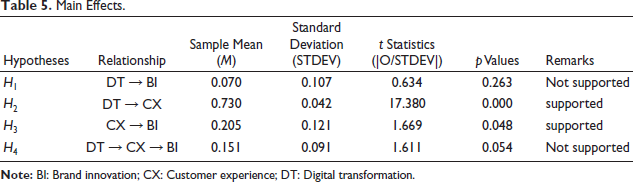
Main Effects.
Mediation was assessed using bootstrapping in SmartPLS 4, examining the indirect effect of DT on BI through CX. Table 6 presents the mediation analysis.
Mediation Analysis.
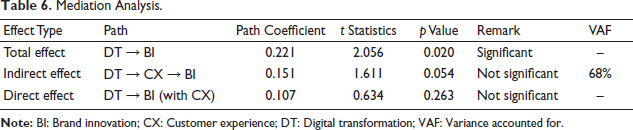
Mediation Analysis.
DT has a significant impact on BI (β = 0.221, p = 0.020). The indirect effect of DT on BI via CX is positive and substantial (β = 0.151, variance accounted for [VAF] = 68%), accounting for over two-thirds of the total effect. However, it falls just short of statistical significance (p = 0.054). This indicates marginal partial mediation by CX, warranting cautious interpretation. The direct effect becomes non-significant when CX is included. CX explains 68% of the total effect, indicating substantial but borderline statistically significant mediation. Therefore, CX partially mediates the relationship between DT and BI, though the borderline significance of the indirect effect suggests caution in interpretation.
Conclusion
The results show that DT does not directly impact BI (β = 0.070, t = 0.634, p > 0.05). However, DT most strongly influences CX, which, in turn, impacts BI (VIF = IE/TE = 68%). This finding aligns with the existing literature and underscores the importance of a technology-driven customer–brand relationship for fostering innovation and creating efficient channels to enhance customer-centric marketing and business outcomes (Guerola-Navarro et al., 2021). By leveraging digital technologies, organizations can improve efficiency, generate customer value, gain a competitive advantage and support sustainable growth in the digital era (Kraus et al., 2022; Li et al., 2022; Rêgo et al., 2021).
The second hypothesis indicates a positive effect of DT on CX. The study confirmed this positive impact, with strong empirical support (β = 0.730, t = 17.380, p < 0.01). Kraus et al. (2022) suggest that DT efforts help organizations navigate uncertainty and ambiguity effectively while maintaining relevance in a rapidly changing digital world. Technology-driven customer–brand relationships are crucial for encouraging innovation and creating efficient channels that enhance customer-focused marketing and business results.
CX encompasses the emotions a consumer feels when using a particular brand’s products. These emotions foster a deep, lasting and cherished connection to the brand (Gaydarov & Ilieva, 2022). The study demonstrates a positive relationship between CX and BI. The empirical findings support this hypothesis (β = 0.205, t = 1.667, p < 0.5). Based on the mediator analysis of PLS-SEM, the proposed mediating effect was confirmed, indicating that CX partially mediates the relationship between DT and BI (marginally). In summary, CX functions as a marginal mediator between DT and BI. It has a significant positive impact on BI, and this research confirms that CX has the most significant effect in fostering it.
Contributions and Implications
This study significantly enhances understanding of how DT impacts BI in Nigeria’s FMCG sector. Exploring the mediating role of CX offers a solid framework for strategic marketing that boosts BI, longevity, customer engagement and competitive advantage. The findings provide practical insights for practitioners, marketing professionals and business leaders in Nigeria’s dynamic FMCG industry, highlighting the importance of investing in DT to improve and deliver exceptional CXs that drive BI.
Theoretical Contributions
Methodological Contributions
This shows PLS-SEM’s effectiveness in testing complex mediated models with moderate samples (n = 203) in emerging markets (Nigeria’s FMCG sector), achieving good model fit (SRMR = 0.059) despite low explanatory power for BI, emphasizing the need for model extensions in similar studies.
Practical Implications
Overall, the findings affirm DT’s role in enhancing CX and relationships but underscore that BI requires broader factors beyond customer-centric efforts alone.
Limitations and Future Research Direction
While this study provides valuable insights, it has limitations that create opportunities for future research. First, the study focuses on Nigeria’s FMCG industry, which may limit the extent to which the findings generalize to other sectors or regions. Future research could replicate this study across different industries, such as technology or healthcare, or in other geographical settings to test the framework in diverse contexts.
Second, the absence of a direct, statistically significant link between DT and BI warrants further research. Future studies could examine contextual factors, such as consumer demographics, cultural influences and organizational capabilities, that may shape this relationship. Qualitative methods, such as case studies or focus groups, could offer deeper insights into the barriers and drivers of effective co-creation.
Third, while the study’s reliance on PLS-SEM is well-founded, it could be further strengthened by incorporating other methods, such as longitudinal studies or experimental designs, to establish causality and track changes over time. Longitudinal research might examine how DT and CX evolve as organizations advance along their DT journeys.
Finally, the mediating role of CX opens new avenues for research. Future studies could explore specific dimensions of CX, such as emotional, cognitive and sensory aspects, and their impact on digital and co-creation strategies. Other mediators, such as brand trust, brand loyalty and brand equity, could be examined alongside moderators, such as organizational culture. Additionally, the influence of emerging technologies, such as artificial intelligence, virtual reality or blockchain, on shaping CXs and BI could be examined.
In conclusion, this study thoroughly examines the relationships among DT, CX and BI in Nigeria’s FMCG industry. The findings highlight the crucial role of DT in fostering innovation and mediating CX. While DT does not directly drive BI, its impact on CX underscores its strategic importance. The study’s theoretical contributions advance the marketing literature by validating the customer relationship model and addressing emerging concepts. Its practical implications offer actionable strategies for FMCG organizations to leverage DT to improve customer engagement and drive sustainable growth. By acknowledging limitations and suggesting future research directions, scholars and practitioners can build on this framework to deepen understanding of BI in the digital age. The implications of this research extend beyond the FMCG sector, offering a framework for organizations across industries to navigate digitalization, foster customer-centred innovation and achieve long-term success. As markets continue to evolve, the ability to adapt quickly, collaborate with customers and deliver exceptional experiences will remain key drivers of BI.
Footnotes
Acknowledgment
This is to express profound gratitude to the co-authors at Putra Business School, Universiti Putra Malaysia for their support and contributions to this study. The authors are grateful to the anonymous referees of the Journal for their valuable suggestions to improve the quality of the article. Usual disclaimers apply.
Authors’ Contribution
Bello Yusuf: Conceived the research idea, designed the study, collected data, conducted data analysis, and drafted the manuscript. Ida Md Yasin: Contributed to manuscript writing, data analysis and provided critical revisions including supervision throughout the project. Wan Fadzilah Binti Wan Yusoff: Reviewed literature, contributed to manuscript drafting, and provided supervision throughout the project.
Declaration of Conflicting Interests
The authors declared no potential conflicts of interest with respect to the research, authorship and/or publication of this article.
Ethical Declaration
The authors abide by all the ethics involved in this academic work and have not submitted it to any other journal.
Funding
The authors received no financial support for the research, authorship and/or publication of this article.
