






Abstract

Case Analysis I
Basic Industries Limited is a good case of how organizations evolve from a small scale to a medium size company, and of the entrepreneurial zeal of a manager which can make a small company grow in its size and succeed. BIL was started in the early 1980s from ₹ 2 lacs loan taken from the state financial corporation, and in 2006 it was touching a turnover of ₹ 300 crores which is remarkable by any yardstick. The company has gone a long way in 20 years or so from manufacturing PVC pipes to special polyurethane pipes encasing the optic-fibre cables to refining soy oil, and entering into branded soy oil market. The company is having two plants dealing with plastic and soy products, and has earned a distinct name for its quality and fair business practices in the region. Mr Peter Rao who is the principal employer and the managing director has shown exemplary acumen and tact in expanding and maintaining its growth so far. But as it happens with the growth of a business, the company has started having in-breeding and is falling short of its stride which is the primary concern of Mr Rao, as discussed in this case.
The company is looking for a change, and Mr Rao is sceptical about the professional competencies of the managerial team. He does not want to miss the opportunity created by the economic growth and have an enthusiastic goal to touch ₹ 1000 crores turnover in coming three years, and to expand BIL at an all India basis. As for initiating any change, it is important that there must be a sense of urgency and need for a change felt by the organizational members which seems to be missing at BIL. For adopting the change at BIL which Mr Rao is striving for, it is important to develop and communicate the need for change. He must involve its key players, and establish a relationship of mutuality and collaboration at BIL. This may help in diagnosing problems and identifying solutions not quick-fixes. The consultant has done a good job in identifying priorities for actions and it must be pursued with conviction, and not to be seen as a mere expert advice.
As is evident from the case description and the consultant’s report, BIL is a poor pay master lagging behind the market and it has been difficult for BIL to retain good employees. As happens with many small and medium sized companies, there is no professional HR department dealing with the people management function. The plant is employing personnel officers but their job is more to do with the administrative work and establishing compliance with the labour laws. The corporate office does not have an HR manager at all. Other than firefighting and an ad hoc arrangement, BIL does not have a system in place for recruitment and selection of their employees (ending up hiring more than the requisite as mentioned in the case), for managing their performance, and rewarding and training them with a credible and coherent HR policy framework. This kind of policy is leading to the turnover of employees, and creating a work environment with persistent and nagging problems. Some of the HR issues raised in the case are: no distinction between high and low performers, lack of objectivity in the appraisal process, ad hoc-ism in promotion and transfer cases, poor job description and job classification, absence of an organized training and development system besides many other issues which need attention. There is a strong need to redefine HR strategy in line with the BIL strategies and objectives, and to put a HR department at corporate level to synergize the efforts.
BIL needs to redesign its organizational structure and decentralize and delegate its decision making process. Mr Rao himself is wearing too many hats, and he needs to delegate his role which may be difficult for him. It can be done by hiring and developing a professional and dedicated managerial team. The organization needs team working and collaboration of its stakeholders to survive in the competitive environment. If one looks at BIL from the perspectives of McKinsey & Co.’s ‘7 S framework’, it is quite evident that there is lack of coordination and integration between BIL’s strategy, structure, systems, style, staff, skills and superordinate goals.
Strategy: As evident in the BIL case, so far it has been able to develop products and expand its market but it needs to develop a collective think (not a one-man show, as also suggested by the consultant in the case) and synergizing the team effort for better strategizing, and mapping of the future course of action.
Structure: BIL needs to decentralize and delegate its decision-making. It needs to develop its managerial and core team who can shoulder the responsibilities in crises. The business units must have greater control and responsibility for the entire product process from development to the delivery.
System: Performance management system, training and development system and a robust reward system is strongly needed to reinforce right kind of workforce behaviour aligned with the new strategic imperatives.
Style: It refers to patterns in actions of managers and others in organization. As evident in BIL case, the inability/reluctance of managers to delegate, their insular behaviour and presence of fiefdom among them are indicative of the changes BIL needs in that regard.
Staff: Developing trust and creating an ambience of growth and learning with a right kind of reward strategy can help in institutionalizing a proactive work environment.
Skills: BIL needs to identify its training needs in terms of its organizational objectives, and long term plan. It is mandatory to put in place a training strategy in line with the HR strategy to ensure the skill upgradation and promoting learning and development of its employees.
Superordinate goals: It refers to the vision of the BIL which will help in building BIL what it ought to be. Mr Rao needs to delineate his dream of future BIL in paper and disseminate with his stakeholders to better connect and realize the goals.
The case provides the readers ample opportunity to look at an organization from various viewpoints. There are some limitations of information in this case such as size of the workforce, their skill and educational level, less vivid explanation of the organization structure, less information on employee recruitment and selection practices. Despite that, it provides ample food for thoughts to the student of business to dissect and diagnose the business and work practices of BIL. The students of business can have better understanding of how small and medium sized organization reaches to its ceiling where they need professionalism, and mere traditional managerial approach and hard work of individual cannot substitute the rubric of management and leadership. They can have a better understanding of the strategy which creates confusion at times if not streamlined properly; and how a structure facilitates or impedes the execution of the strategy. In this case, BIL needs a quick revisit to its structure. People management is at a loss at BIL, and I wonder how the company was able to sustain for 20 or more years with so poor HR policies which are non-existent at all. I cannot strongly recommend developing a HPWS (high performance work system) for BIL as it will be a too tough goal for BIL, and one has to be a market leader in paying his employees, and the recruitment and selection system must be rigorous for adopting HPWS. BIL is a poor pay master and Mr Rao has now realized that he has to pay a market salary to retain, if not, attract good employees. In all, this is a good learning case for the business students for understanding the dynamics of initiating a change in an Indian SME.
Associate Professor in HRM
Faculty of Economics and Administration
King Abdul Aziz University
Jeddah, Saudi Arabia
Case Analysis II
The case under review is a classic example of founder’s innate desire to script a success story for his organization. Organizations pass through various stages of life and the most crucial one is the consolidation phase. The organizations at this stage continue for a certain period without any noticeable hindrance and decline in the long run if they are not receptive to structural and contextual challenges. Complacency and sluggishness creep into the fabric of the entity and response remains static if a well thought out transformational strategy is not put in place. The possible challenges may or may not be external always, but internal issues like structural incompatibility, role ambiguity and lack of alignment with the top management’s vision act as deterrents in achieving the desired objectives. The strategic architecture for growth comes from within, which necessitates the revitalization of existing structures and systems.
BIL prepares to reposition itself as a national player with a turnover of ₹ 1000 crores for which it needs to grow at an unprecedented rate. Either it has to diversify or expand aggressively in terms of production and acquiring market space across the country. The company has to identify key deliverables, expand customer base and market spread over as well as enter into strategic alliances. BIL’s brand positioning is restricted to two states and its national aspiration requires aggressive brand building and strengthening marketing arm beyond the comfort zone. BIL is likely to face stiff competition from the existing players and needs to differentiate itself in terms of price, quality and service delivery. The market related challenges such as receptivity of new products in relatively unfamiliar markets, entry barriers, substitutions, supply dynamics, scale of operations and focused differentiation only single need to be dealt in a short span. There is also an imminent possibility of cartelization of few existing players to preempt the entry of a new player into their terrain. From the case it is apparent that the economy is growing at a faster pace and market may be able to absorb the supply in a larger scale considering the demand during the boom period. However, this period also witnesses rapid expansion of many players and entry of new entities in the respective sectors. This not only promotes unhealthy competition, but also there is a risk of losing out decisively in case economy and market conditions turn unfavourable. The other challenge is the profitability margins which are also affected in the familiar markets as a result of competition and uniform pricing across the domestic markets. The woes of attrition at the time of resurgent economy and escalating labour cost impinge on the bottom-line of the organizations decisively.
The MD of BIL seems to be treading a path of transformation rather than incremental changes considering the ambitious growth plan in place. Transformation not only requires a systemic shift but also altering the basic premises or character of the organization. The alternatives are either surgical mode or self-renewal route while retaining the values intact. The ambitious growth plans also bring pressures to a system that may not have geared up for increased production or services. Whatever may be the mode of transformation, the process generates fair degree of confusion and resistance, either overt or covert. The MD of BIL seems to be prepared to take risks which, however, require detailed analysis of external contextual factors including market forces while taking stock of internal dynamics and revitalizing existing structures and systems.
BIL has much strength to its credits besides obvious limitations. The organization has consistently achieved growth both in lateral and organic terms. The founder is visionary enough having out-of-box thinking with reasonably higher degree of professional conduct and commitment. The organization rests on strong foundations and has earned good will of customers for its quality products and service delivery. There exist regular interactional mechanisms among functions which work reasonably well. The organization’s value system is strongly grounded and the workforce is hardworking and disciplined. The limitations include restricted geographical presence, structural ambiguity, lack of high performance culture and collective decision making and more importantly, absence of second line of command in key positions. The appraisal and reward system is neither objectively defined nor measured. The diagnosis report also clearly pointed out the anomalies related to grades and responsibilities. The managers lack higher order managerial competencies to manage challenging situations. The training function is treated as a mere ritual or compliance tool for ISO requirements and no credible attempts have been made to assess the developmental needs of employees across different levels.
BIL lacks strategic HR architecture to steer transformation process. HR is often confused as an administrative tool by certain organizations which is evident in this case considering the absence of even a HR person. The first and foremost decision by the top management of BIL should be establishment of a strong HR department which may take care of people dimension of change process. Structural aspects like matrix arrangements to align and manage synergy among different functions need to be in place. The organization needs the right mix of experienced people and energetic young workforce. The hiring process should focus on right person-organization (P-O) fit and person-job (P-J) fit with an element of required diversity applying rigorous forecasting techniques. Inherent systems require to be strengthened through meaningful OD (organizational development) interventions on the basis of objective analysis of the strengths and bottlenecks. Functional and cross-functional competencies need to identified and effectively worked out to take care of strategic and implementation issues. Performance-based pay structures and variables need to be introduced to attract quality workforce. It is reassuring to note that the MD is inclined to introduce market related pay for deserving people. The other area which deserves attention is creation of an aggressive contingent of sales force to take care of emerging markets. The sales force need to be properly trained and compensated while retaining the core values intact. Key Result Areas (KRAs) and key deliverables for each function need to be defined and suitable appraisal and feedback process need to be introduced. The top management should take initiatives to reduce attrition level and exit interviews may be put in place. The training function need to be strengthened considerably as the transformation process requires a learning culture aligned with the strategic objectives of the organization. The developmental needs across levels should be objectively mapped and taken care of with utmost precision.
BIL lacks effective succession planning mechanism across the functions. Key positions require stand-in second lines on the basis of identifiable competencies. The company must also devise a career path model to send clear message to high performers that aspirations are duly cared for and rewarded. It may be noted that HR has a critical role to play both as generalist and specialist in building a responsive and agile performance culture to supplement the transformation process.
The transformation process is not free from hurdles. The sweeping changes may generate fair degree of resistance and half-hearted endorsements. There may be perceived fear of being redundant among sections of people. The employees across all levels need to be taken into confidence and involved in the process of transformation. The precursor to change process needs engagement at all levels and a well laid down roadmap reduces the negative consequences therein.
BIL needs to proactively understand market dynamics and act accordingly to realize the strategic objective of being a national player in three years. The framework of action plan must be based upon rigorous SWOT analysis in terms of resources, competencies, business opportunities and possible consequences. The organization should also make a conscious attempt to understand the external drivers and indicators of business and economy and act upon while revitalizing the internal structures and systems.
Associate Professor (HRM Area)
IBS, Hyderabad
Andhra Pradesh
India
Case Analysis III
Moving Beyond Two States 1
BIL does not need a management consultant alone. It needs a full-time HR person who can help Peter Rao fulfil his dream of making BIL a pan-India operating organization. The consultant-client engagement can work only in this phase of transitioning where BIL needs to focus on hiring an HR GM who will move the agenda 2 to fruition.
The consultant may like to begin by asking; if Peter is the principal owner of BIL, who are its other guardians––over its 30 years’ history? It may be out of the boundary of his role but without including his/her/their views it would not be wise to recommend any long term and sustainable suggestion. From 2 lacs to 1000 crores is the overall ‘change management’ 3 mantra that the consultant needs to begin chanting.
From the leadership perspective, it is important to take the top management team (TMT) into confidence and consider a series of three off sites/retreats to set the direction of growth for BIL. This retreat, is to be facilitated by the consultant; titled, ‘Vision––2015’ (envision your organization in the year 2015) can include two main agendas:
Vision setting and driving involvement, ownership and accountability within TMT. Drawing the blueprint of the future organization––the organization designing
4
phase.
When the HR head is hired at the level of GM––nothing below that ‘level’––then the next offsite; titled ‘1000 by 2015’ (₹ 1000 cr. turnover by year 2015) with the TMT must be designed with two other agendas other than to review the outcomes from the first offsite:
Mapping the philosophy of HR according to the 5P model.
5
(This exercise should be supported by the findings of a study which the HR GM has done prior to the retreat in which ‘HR audit’ is done involving a large proportion of the organization employees to explore satisfaction of the employees with current HR.) Phase-wise change management strategy for ramp up/scaling up presented by HR GM. (This exercise is backed by a study which the HR GM has done prior to the retreat in which Jobs and Salaries are mapped according to blueprint designed by TMT in previous retreat and industry compensation and benefits survey.)
Both soy and plastic have completely different market strategies, therefore, instead of one ‘chief marketing’, the immediate ‘talent hunt’ (after the GM-HR position) to be done is for two different heads of marketing for each product category, reporting to Peter Rao (temporarily reporting to current chief of marketing). For the plastics business, which is the flagship division and traditionally the ‘older’ business, check for tenured employees and power equations between works manager and only then suggest hiring of a head of the GM level. This will be the subsequent ‘talent hunt’; after heads of marketing are hired. As a philosophy since the hiring practices have been ‘home grown’ and ‘relationship-based’ (refer to hiring of chief marketing head as a friend of the MD) it will be important not to ‘revolutionarily’ change this practice, but rather do it only in ‘senior positions’ as a one-time activity before the change management process is transitioned to the HR-GM by the consultant. This interim hiring job can be outsourced to a ‘head hunting-executive search firm’ company and for the briefing both the current divisional heads of soy and plastic must be involved. After the three new ‘line’ people have joined, Peter, the Consultant and GM-HR must create an induction and performance review plan for the three together, strategically, and a performance review mechanism must kick in after a few days of their induction in a third retreat titled ‘From here where?’ (envisioning and chalking out the future roadmap of BIL). This retreat will discuss the six-pronged strategy 6 of getting the vision through to the change management intervention planned by the Consultant and GM-HR, that of: man power Planning, Talent management (including succession planning) and Job evaluation!
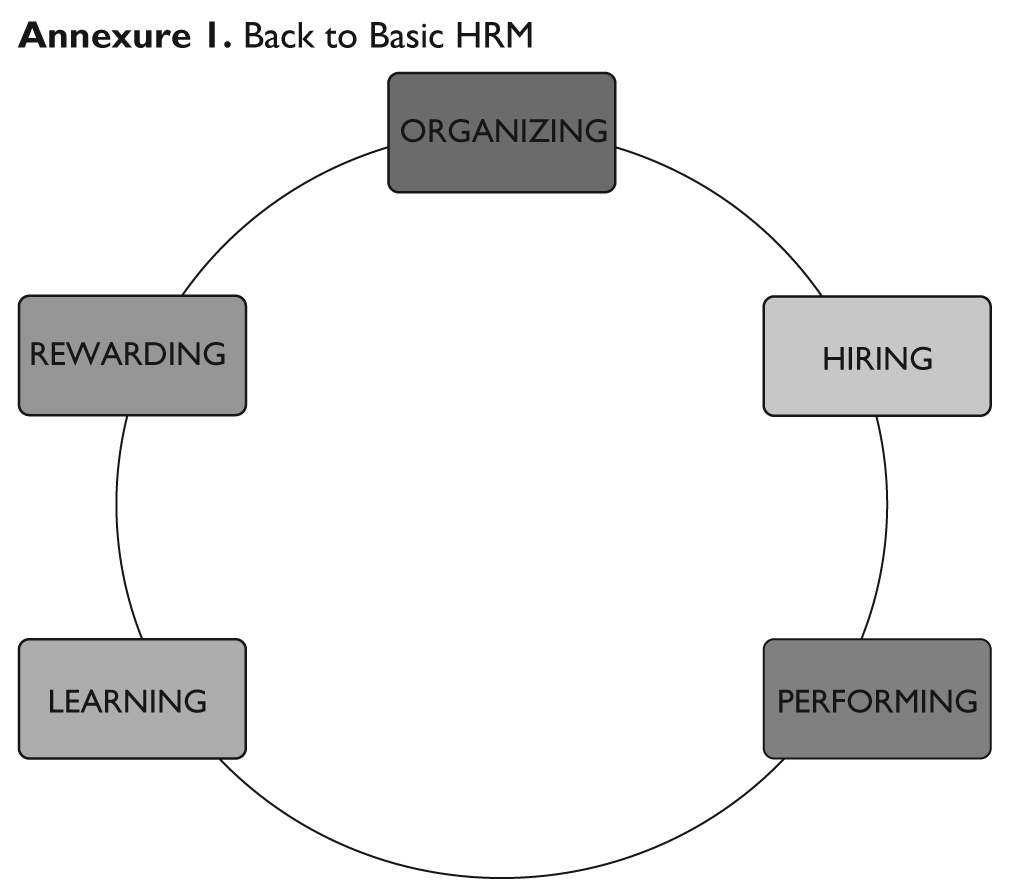
Back to Basic HRM
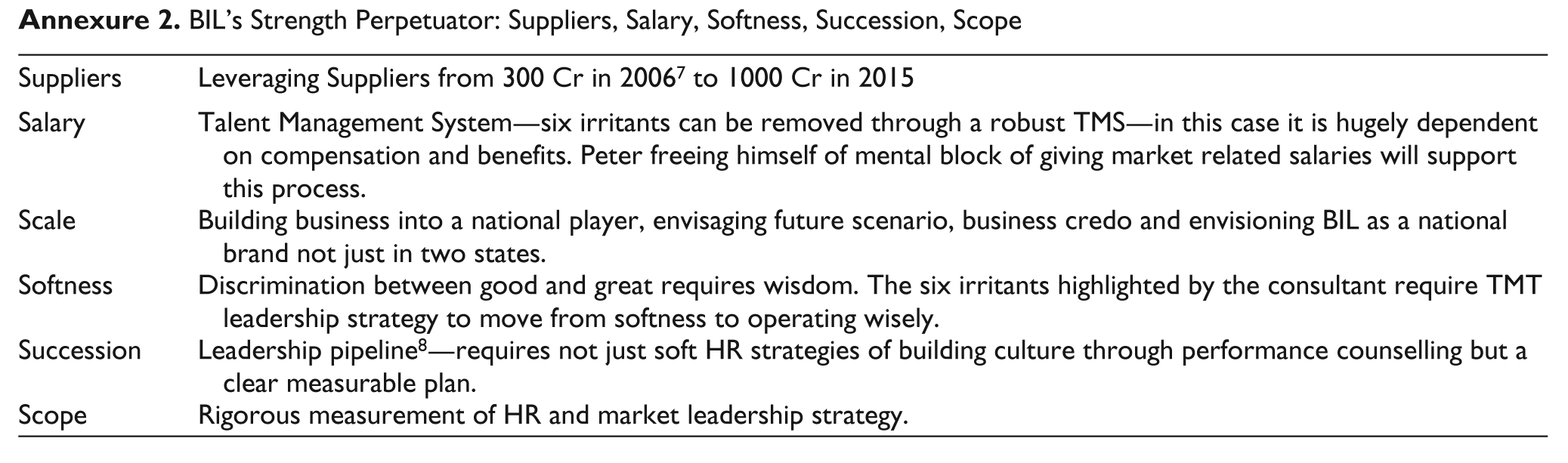
BIL’s Strength Perpetuator: Suppliers, Salary, Softness, Succession, Scope
Fellow of Management Development Institute
Gurgaon, Haryana
India
Notes
‘Two states’ is BIL’s current market size. It also happens to be Chetan Bhagat’s book title describing challenges in relationships across cultures. Further, it symbolizes spirituality––moving from two states (conditions of duality) to pan-India (oneness––singularity).
Referring to Annexure 1 HR GM gets BIL––back-to-basics of HRM.
Refer to Kotter’s eight-step process for leading change.
Gareth Jones for understanding the relationship between organization theory, structure, culture, design and change.
Pawan Budhwar’s 5P Model of mapping the strategy and HRM.
Refer Annexure 2 presented by consultant as BIL’s Strength Perpetuator-Suppliers, Salary, Softness, Softness, Succession, Scope, to enable the organization to focus on its core strengths in this change management process.
Will need business data, information, statistics to discuss this ‘S’. Even current 2012 turnover is missing. An annexure on the same would help SHRM case discussion.
Ram Charan’s beautiful conceptualization of this pipeline has been borrowed to suit this context––with talent and succession challenges.
Case Analysis IV
The woods are lovely, dark and deep. But I have promises to keep, and miles to go before I sleep.
The case of Basic Industries Limited (BIL) brings forth, in a fascinating way, the challenges encountered by Peter Rao, as he embarked upon his entrepreneurial journey to make BIL a national brand. Mr Rao was concerned about confronting the demands posed by the rising competition; in addition to the streamlining of BIL operations. Nevertheless, he strived to turnaround the existing state of affairs at BIL through an organization level diagnosis, aided by his friend, a veteran management consultant.
Organizational Inquiry
Through the consultant’s organizational diagnosis based on Marvin Weisbord’s framework, the case exemplifies six significant starting points for organizational improvement, as illustrated below.
Purpose
Set up in the 1980s, BIL was a medium-sized organization which started its business as a manufacturer of PVC pipes. However, by 2001 it had ventured into an array of agricultural, domestic and industrial products and had become an ISO 9000 certified producer of plastic and soya. In synchronization with its growth and expansion plans, it was required to sense the constraints inflicted by the external environment and respond proactively with an upgradation of its resources and skills.
Structure
BIL did not have a formal organizational structure in place. The hierarchies were not well defined. There were very few examples of job-person fit. Absence of cross-functional matrix structures to facilitate sharing of resources and pooling of business ideas acted as a deterrent in the way of designing of synergistic work systems. This called for strategic alignment of different functional units in order to achieve the organizational objective of reaching the ₹1000 crores turnover milestone by 2009.
Relationships
BIL had devoted and diligent employees, who were usually supportive of each other. However, lack of formal structural arrangements and overlaps in key result areas across different positions often led to ambiguity regarding the assigned responsibilities and accountabilities in superior–subordinate relationships. This at times resulted in strained work relationships, which had to be managed accordingly.
Rewards
BIL did not have a dedicated human resource management department. Consequently, there were neither well articulated job descriptions nor performance appraisal and reward mechanisms to differentiate high performers from low performers. Moreover, the employees (including the CEO) held the view that they were paid far less in comparison to industry standards. Pay dissatisfaction and demotivation had upshots in the form of high attrition rates and additional costs incurred on recruitment of two–three new persons as a replacement for a former skilled employee. This called into question the effectiveness of the entire talent management and retention scheme.
Helpful Mechanisms
Non-existence of satisfactory coordinating methods added to the woes. Though BIL was valued in the local market for its ethical business practices and quality products; the replication of its success stories in the future was contingent upon development of harmonizing mechanisms to modernize and align business processes, strategic planning and human resource management systems.
Leadership
Mr Rao, the owner and MD of BIL overlooked its entire operations. There was no exclusive strategic think-tank or advisory committee to counsel him. On the whole, it was a one-man show as all strategic decisions were taken by Mr Rao. Down the hierarchy, the functional heads were also reluctant towards delegation of decision-making power to their subordinates. As a result, there could be no leadership pipeline development in the times gone by and the senior functionaries remained engrossed in regular functioning of BIL, with hardly any time left for focusing on organizational development and change interventions. This resulted in an imbalance arising out of misalignment of organizational purpose, design, employment relationships and reward machinery.
The Path Ahead
The case clearly demonstrates the key factors behind BIL’s success so far. Besides a committed workforce and robust operational systems, the leadership and diligence of its owner Mr Rao had turned BIL in to a flourishing business enterprise. The case also brings forth the loopholes that might hinder its victory in the changing commercial landscape. However, it leaves the readers with some open-ended questions about how the existing management system at BIL could be tweaked to strengthen its viability?
The ownership structure at BIL could be fortified through a culture that promoted proxy-entrepreneurs as per the guidelines of ‘Entrepreneurial Theory of Organization’, suggested by Foss et al. (2007). Mr Rao was industrious and well-equipped with the nitty-gritty’s of the technical part of his business. However, what he had missed out on was the human resource management aspect of looking at the entire helm of affairs. His major worry was that his senior managers ‘lacked maturity about management processes….’.
But he was unable to figure out that it was his managers’ sole reliance on him with respect to strategic planning and implementation, which was responsible for their unpreparedness to meet up unforeseen challenges. This ‘spoon-feeding’ culture at BIL propagated down the hierarchy. It had become the root-cause for a lot of work-related issues. While the functional heads complained of work-overload, employees at the lower level did not feel empowered and motivated to exercise discretions concerning organizational development initiatives.
Thus, in order to increase firm’s value for its enduring sustainability in turbulent economic times, a significant facet to look into this case would be that Mr Rao considered delegating some decision-making power to lower levels of management hierarchy as well.
Another important feature that demanded attention was finding relations amongst apparently disconnected components of the organization. As evident from the case, the recent policy decisions by BIL management were not received by the employees in the intended spirit. What the management deemed to be a forward-looking approach was looked at as a conservative move by the staff. Lack of communication and transparency of processes between the strategic and implementation wings of the organization came in the way of employee motivation and involvement with BIL’s vision of making it big in coming times. With no formal systems primed for management of human resources, BIL had turned into a learning ground from where their competitors could pick up their prospective employees. Talent management and retention had turned into a grave issue that required immediate resolution. Hence, there was a colossal need for a systematic overhaul of the organization to get things in place. A major requirement was the setting up of a dyed-in-the-wool human resource management department to take care of the performance management and training needs of BIL employees. BIL had reached a stage where it required major restructuring for further development. For organizational effectiveness, people-related issues were now supposed to be given as much importance as core business-related issues.