






Abstract
Social networking sites (SNSs) emerged as one of the most powerful media for advertising across the globe. Globally, companies are shifting a larger pie of their advertising budgets towards social networking sites for better reach and interactive platform. The companies are also looking at it as a low-cost model, which could reap results in minimum time possible for the targeted ‘Facebook generation’. These very facts motivate researchers to study the value of advertisements on social networking sites like Facebook, LinkedIn, Twitter and others. The article is an empirical study to understand the implications of different variables in advertisements on the delivery of advertising value to the respondents. Confirmatory factor analysis (CFA) has been conducted to test the reliability of instrument being used for data collection. Further, a model has been proposed for measuring advertising value through structural equation modelling. The predicted results confirm the roles of different variables, namely, information, entertainment and irritation, in accessing value of advertisements displayed on social networking sites.
Introduction
Social networking websites (SNSs) have emerged as the ‘need of an hour’. Their journey started with the launch of
According to a report, the size of Internet advertising industry was INR 7.7 billion in 2010 registering a growth of 28.3 per cent over INR 6 billion in 2009 (PricewaterhouseCoopers Private Limited, 2011). The same report highlights that in India SNSs have shown a remarkable growth of 43 per cent in 2010 over 2009, with a 54 per cent growth in advertising on SNSs in 2010–2011 (PricewaterhouseCoopers Private Limited, 2011). Considering the fact that advertising on SNSs is on a new high, this research focus on studying the value of advertisements being displayed on SNSs.
Literature Review and Hypothesis
Web advertising continues to be a major area of advertising research from a long time. A number of studies have been done discussing advertisements on the Web and their effects. Berthon et al. (1996) have discussed the role of World Wide Web as an advertising medium in the marketing communication mix and proved that World Wide Web is a new medium for advertising characterized by ease-of-entry, relatively low set-up costs, globalness, time independence and interactivity. In spite of the acceptance of World Wide Web as an effective media for advertising, few studies have focused on the value of advertisements displayed on this medium. R.H. Ducoffe introduced the concept of advertisement value in 1995. According to Ducoffe (1995) advertising value is defined as the utility or worth of the advertisement. Ducoffe (1996), in his another study on World Wide Web, proved the significant impact (either +ve or –ve) of entertainment, information and irritation on advertisement value. Brackett and Carr (2001) in their study on cyberspace advertising reports that information, entertainment, irritation and credibility significantly affect advertisement value which in turn affects attitude towards advertisements. Discussion on different predictors of advertisement value with reference to SNSs advertisements is hereby illustrated:
Information: Information content is an important determinant of advertisement effectiveness. Companies advertise for one main reason—providing information about their product, services and brand to consumers. Consumers reported that supplying information is the primary reason why they approve advertising (Bauer et al., 1968). According to Norris (1984) information in advertisements enables the customers to evaluate the products more rationally leading to improved markets with low prices and high quality of the product. Information content on Internet can be delivered better in comparison to television medium, reason being short time span of television advertisements. Yoon and Kim (2001) mentioned that Internet advertising differs from traditional advertising as it delivers unlimited information beyond time and space and it gives unlimited amount and sources of information. Web advertisements provide information and generate awareness without interactive involvement (Berthon et al., 1996). On the contrary, information delivered through SNSs advertisements is different from traditional Web advertisements because SNSs provide a medium that is interactive in nature. A person could scan and share information with online friends and followers, thus making the advertisement information viral in nature. Large media companies have realized the potential of SNSs to reach and deepen relationships with the ‘subscribed’ audience (Jhih-Syuan and Pena, 2011). This specialty of SNSs advertisement makes it the most competitive platform for sharing information about products and services. As the delivery and importance of information for SNSs advertisements is different from other forms of advertisements, it is important to note its effect on advertisement value. Based on this rationale, the hypothesis tested is:
H1: There is a significant positive impact of information content of advertisements on the value of advertisements displayed on social networking websites. Entertainment: An advertisement that is full of information but nil in entertainment content is not worthy. According to McQuail (1994) an advertisement entertains when it fulfils the audience needs for escapism, diversion, aesthetic enjoyment or emotional release. The ability of advertising to entertain can enhance the experience of advertising. In addition, an advertisement could be information for one and entertainment for other person at the same time (Alwitt and Prabhaker, 1992). Consumers who found advertising to be entertaining also evaluate it as informative (Ducoffe, 1995). This shows that entertainment and information are interrelated concepts when talking about advertisements. SNSs platform is interactive in nature and display banner advertisements of different brands at the same platform and same time; they have the power to entertain the audience. Kim and Lee (2010) noted that college students use SNSs for six main reasons: entertainment, passing time, social interaction, information seeking, information providing, and professional advancement. According to Taylor et al. (2011) SNSs advertisements provide entertainment value to the audience. The same study reported that entertainment exhibits almost four times more strength of influence on favourable consumers’ attitude towards advertisements than information. With reference to the existing literature, it is important to find the impact of entertainment on advertisement value of SNSs advertisements. In the same vein, the hypothesis tested is:
H2: There is a significant positive impact of entertainment content of advertisements on the value of advertisements displayed on social networking websites. Irritation: Irritation from advertisements arises when we feel discomfort in watching advertisement due to any reason. The reason can be personal or social. A personal reason could be distraction while focusing on a particular task on World Wide Web. According to Wells et al. (1971) irritation is one amongst six dimensions of personal reactions towards advertising. It is the degree to which the viewer disliked the contents that he had seen. The words that came into the mind of the viewer at time of getting irritated from an advertisement are ‘terrible’, ‘stupid’, ‘ridiculous’, ‘irritating’ and ‘phony’. An advertisement can be rewarding for some viewers and yet be an irritant and unrewarding for others (Alwitt and Prabhaker, 1992). According to Aaker and Bruzzone (1985), increase in irritation can lead to general reduction in the effectiveness of advertisement. In case of Internet advertising, it also generates considerable irritation (Schlosser et al., 1999). As online behaviour including use of SNSs is highly goal oriented, advertisements on SNSs might irritate the user (Taylor et al., 2011). The literature suggested that irritation has a negative effect on the effectiveness of advertisement irrespective of the media. Based on this rationale the hypothesis tested is:
H3: There is a significant negative impact of irritation content of advertisements on the value of advertisements displayed on social networking websites.
A considerable amount of research on determinants of Web advertising effectiveness and value has been done (Berthon et al., 1996; Brown et al., 2007; Ducoffe, 1995; Lei, 2000; Schlosser et al., 1999; Yoon and Kim, 2001); however, these studies were more focused on traditional websites rather than SNSs. Advertising through SNSs is different from traditional websites due to several reasons. First, advertisements on SNSs are different not only in form and substance but also in delivery method. Some of the messages are ‘pushed’ upon consumers while others rely on consumers to ‘pull’ content; some generate revenue whereas some are non-paid content delivered through media content (Taylor et al., 2011). Second, SNSs have their own unique user-to-user interface (Safko and Brake, 2009). Third, SNSs users are increasing day by day all over the world, which makes this medium suitable for advertising. As SNSs advertising is different from traditional Web advertising and a little is known about value of SNSs advertisements, this study tries to fill this research gap by providing a model, which tests the interrelationships between different determinants of advertisement value.
Model Testing
The importance of advertisements displayed on SNSs is increasing day by day. According to Stelzner (2011) 88 per cent of the marketers have reported that their social media advertisements have generated more exposure for their businesses. This leads the authors to test a model for accessing the value of advertisements displayed on SNSs by employing structural equation modelling (SEM) approach. Use of SEM technique gives us the opportunity to examine multiple dependence techniques simultaneously. SEM approach is a statistical methodology that combines the strength of factor analysis and path analysis. According to Singh (2009) SEM is considered as a more advanced technique than other multivariate techniques because it can estimate a series of interrelated dependence relationship simultaneously. According to Byrne (1998) SEM technique is better because:
It accounts for measurement errors in course of model testing. It can incorporate observed (indicator) variables as well as latent (unobserved) variables at same time during model testing, It tests a priori relationships rather than allowing the technique or data to define the nature of relationship between the variables.
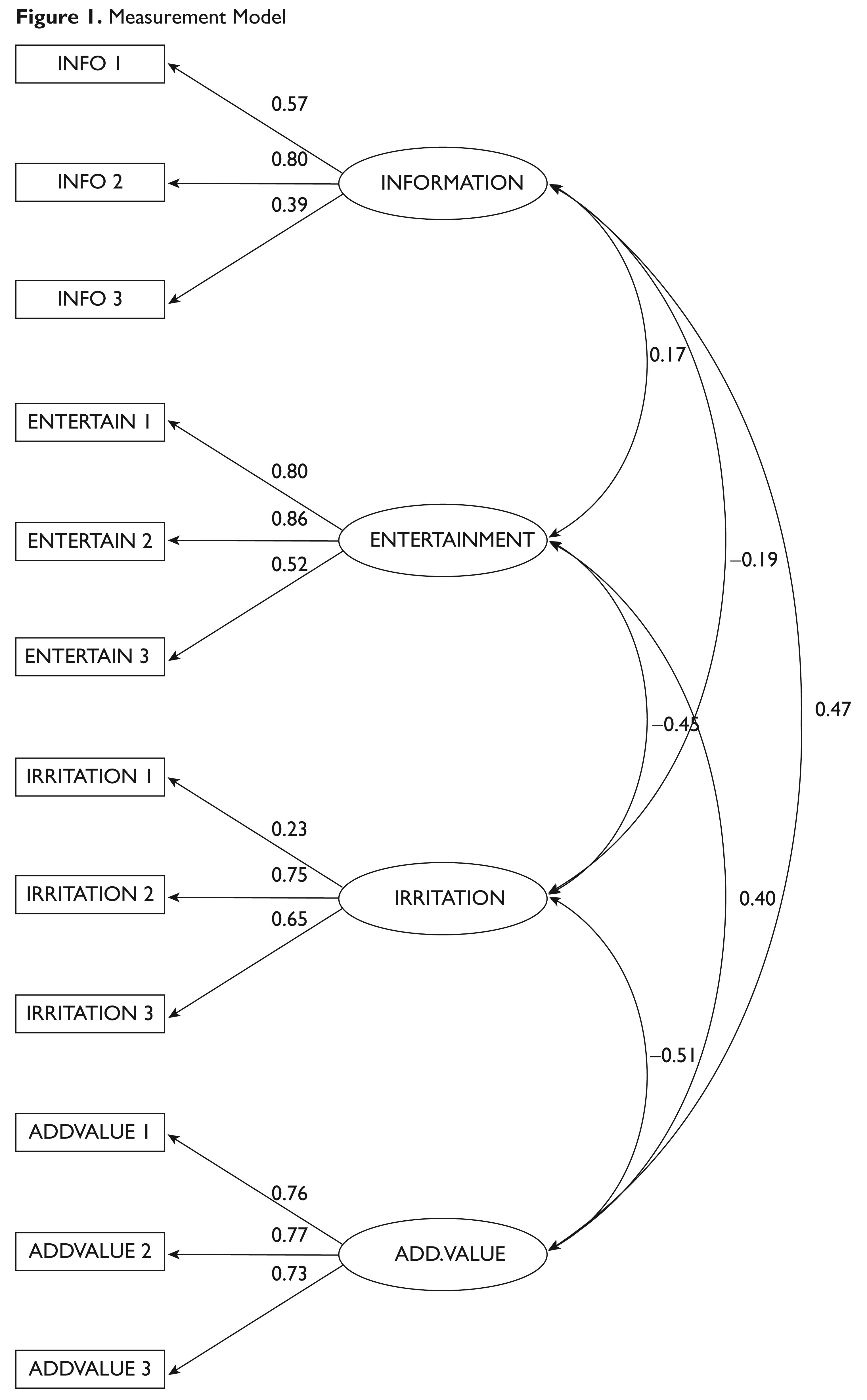
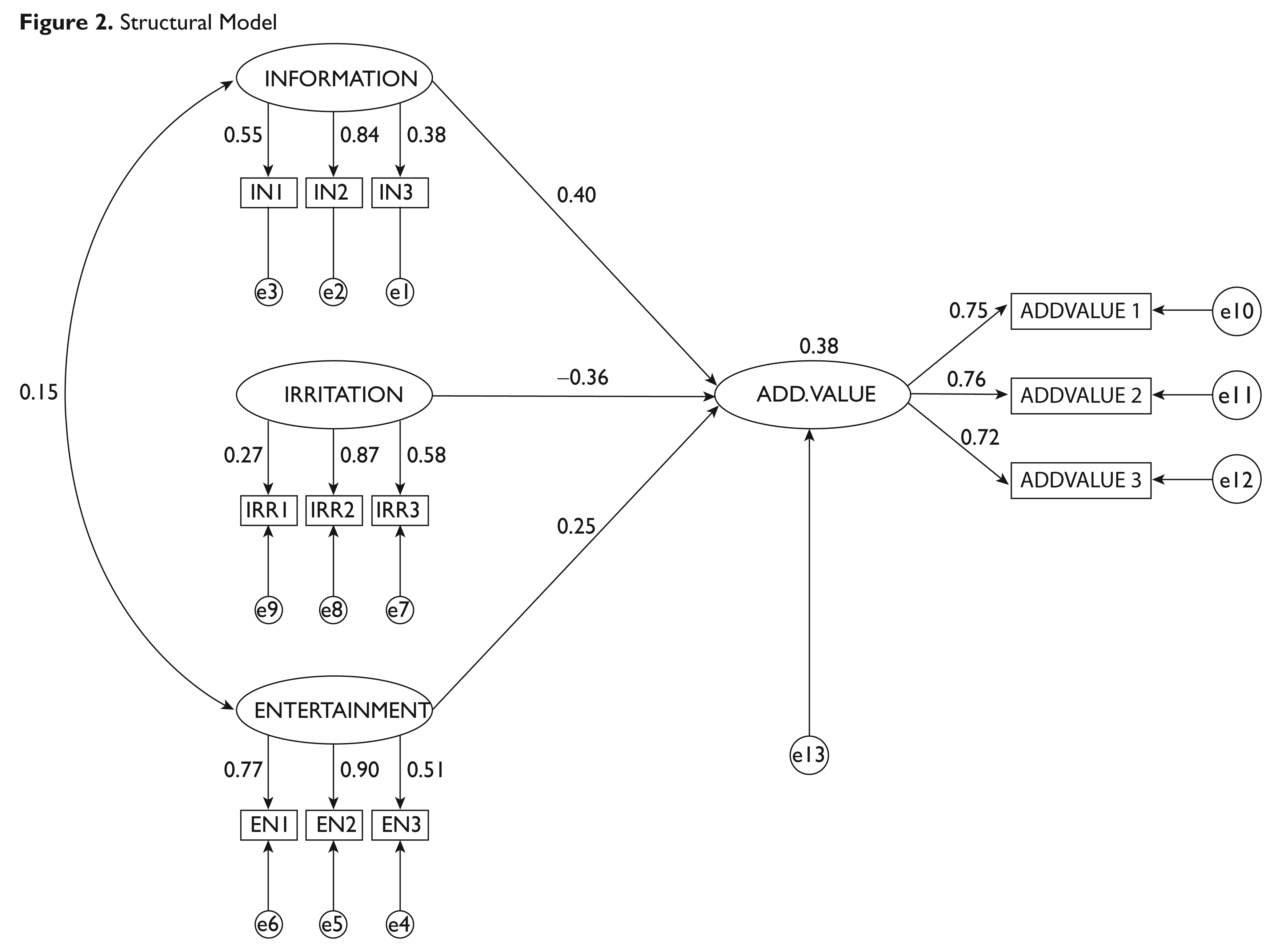
In the present study, SEM analysis is conducted in two major steps; first, to test the measurement model and second, a structural model. Measurement model provides the series of relationships that suggests how observed variables represent latent variables (Figure 1), tested by means of confirmatory factor analysis (CFA). Structural model tests the conceptual representation of the relationships between the latent variables. It tells whether the proposed model is eligible to represent a proposed concept and conceptual relationships between the variables or not (Figure 2).
Measurement Model
Structural Model
Method
Sample Design
The research focuses on social networking websites with college students as sample respondents. The college students were selected as sample for two basic reasons. First, student sample is more homogeneous (less variable) in terms of socio-economic background, demographics and education (Peterson, 2001). Second, a number of studies have reported that students are the main users of social networking websites (Dwyer et al., 2007; Pempek et al., 2009; Subrahmanyam et al., 2008). With this rationale, present study sample includes postgraduate management students of a reputed college based in India. 276 students have responded to an online questionnaire mailed to 300 students. The questionnaires were mailed with Google documents facility to form and mail online forms/questionnaires. After removing incomplete questionnaires, only 189 questionnaires were found to be useable for analysis and further study. Resulting sample consists of 71 per cent males and 29 per cent females. Subjects were asked to report their reactions to instrument statements by considering their perceptions of advertisements on SNSs in general, not a single advertisement or advertisement for any particular product. The objective of this generalization is to assess the value of advertisement on social networking websites across different advertisements of product and service categories.
Sample Size and SEM Analysis
Sample size is a key issue when performing SEM analysis. According to Bentler and Bonett (1980) and Hair et al. (2007) chi-square value is sensitive to increase in sample size, while it lacks power to discriminate between good fit and poor fit models with small sample size (Kenny and McCoach, 2003). Hair et al. (2007) mentioned that 15 responses per parameter is an appropriate ratio for sample size. Going on with this approach a sample size of 189 respondents for measuring 12 parameters was appropriate.
Research Instrument
For measuring the advertisement value of advertisements displayed on social media, a 12 item scale developed by Ducoffe (1995) was used. The instrument was modified as per the need of the study. A five-item Likert scale was used as a response scale, from strongly disagrees to strongly agree.
Measurement Model
Measurement model is a specification of the measurement theory that shows how constructs are operationalized by sets of measured items. Confirmatory factor analysis is used to test the reliability of a measurement model. Unlike exploratory factor analysis, CFA allows the researcher to tell the SEM programme which variable belongs to which factor before the analysis (Hair et al., 2007). According to Salisbury et al. (2001) CFA allows the researcher to specify the actual relationship between the items and factors as well as linkages between them.
Construct Validity
According to Hair et al. (2007) construct validity is the extent to which a set of measured items actually represents theoretical latent construct; those items are designed to measure. The reliability of advertisement value scale was examined by specifying a model in CFA using AMOS 19. Reliability of an instrument can also be calculated by Cronbach’s alpha, but use of SEM technique makes such a practice unnecessary and redundant (Bagozzi and Yi, 2012). The results (see Table 1) confirm the overall fit of a measurement model when employed to CFA.
Model Fit Indices for Measurement Model
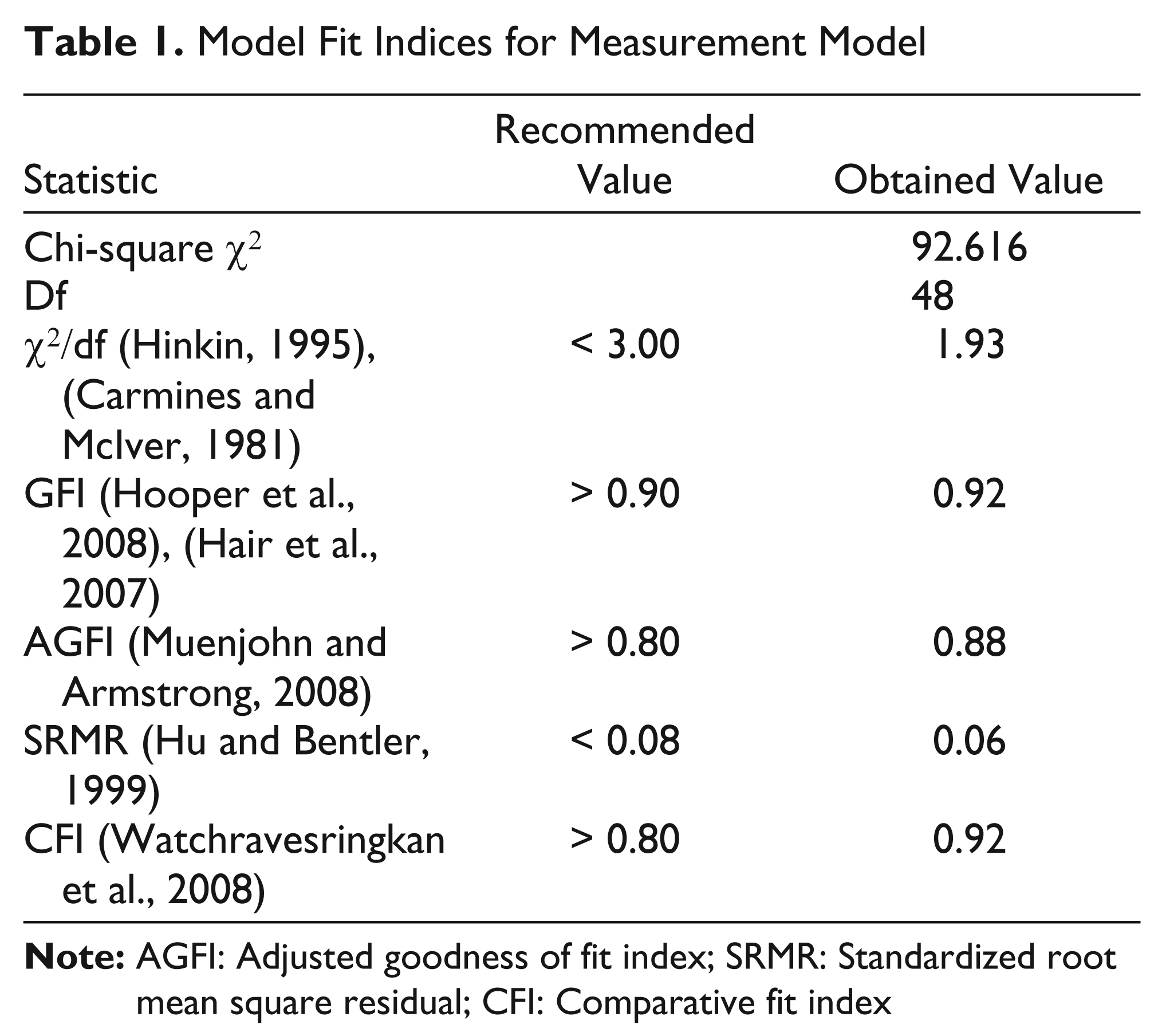
According to Hair et al. (2007) one incremental fit index (CFI), one goodness of fit index (GFI), one absolute fit index (GFI, SRMR) and one badness of fit index (SRMR), with chi-square statistic should be used to assess a model’s goodness of fit. Our study results show all the different types of indices in the acceptable range.
Convergent and Discriminant Validity
Convergent validity exists when the items that are indicators of a specific construct converge or share a high proportion of variance in common. In general, ‘factor loading’ and ‘variance extracted’ measures are used to measure convergent validity. We have used factor loading measure in our study to measure convergent validity (Hair et al., 2007; Salisbury et al., 2001). All the factor loadings are statistically significant, a minimum requirement for convergence (Hair et al., 2007). Furthermore, except items ‘Info 3’ and ‘Irritation 1’ all factor loadings are in the range of 0.50 to 0.80, which is more than acceptable value of 0.50 (Hair et al., 2007) (see Figure 1). According to Chin et al. (1997) discriminant validity exists if the correlation between the constructs is not equal to 1. Following the rule, our study shows the discriminant validity between the constructs (see Figure 1).
Structural Model
After assessing the eligibility of scale for measuring different variables in the study, the next step is to test the hypothesized relationships in a structural model. Ducoffe (1996) has proved the respective role of information, entertainment and irritation on advertisement value for the advertisements on the Web. In our study, we try to explore the impact of these respective variables on advertisement value vis-à-vis SNSs.
Performance of the Model
Hypothesized relationships are supported by the overall model fit indices obtained. All of the fit indices are above the recommended values. The χ2/df value 2.31 met the recommended value of less than 3 (Carmines and McIver, 1981). Hair et al. (2007) argues that chi-square value is sensitive to sample size and number of variables; therefore, χ2/df value is not taken as a sole indicator of model fit. Other model fit indicators taken are also within the recommended range (see Table 2). In sum, various model fit indices indicates that the proposed model fitted well with the present data set.
Model Fit Indices for Structural Model

Estimated Standardized Path Coefficients
Figure 2 shows the standardized path coefficients of the four constructs under investigation. All the path coefficients were significant at the level of 0.01 with the direction of influence as hypothesized (+ or −). Information and entertainment were positively associated with advertisement value whereas irritation is negatively associated with advertisement value; thus all the hypotheses framed are statistically supported. A significant correlation between information and entertainment also indicates that the consumers who find advertisement to be entertaining are more likely to evaluate it as informative. These results are consistent with another study (Ducoffe, 1995). Finally, the squared multiple correlations (R2) indicates that the present model explains 38 per cent of the variance in advertisement value.
Discussion and Implication
The study yielded important new insights about a topic that is important for both industry practitioners and academicians. The concept of advertisement value and factors affecting it had been widely tested for various types of advertisements in a number of studies but lack of work for advertisements displayed on social networking websites was the motivating factor to do research in the particular domain. The study tests the model to assess advertisement value by employing SEM approach. SEM combines the strength of factor analysis and path analysis. It enables us to test whether observed variables completely describes latent variables or not. In addition, SEM is a more successful technique than other multivariate techniques as it can estimate a series of interrelated dependence relationship simultaneously. It tells whether the proposed model is eligible to represent a proposed concept and conceptual relationships between the variables or not. The results of CFA suggest that the observed variables are suitable enough to represent different latent variables, that is, information, entertainment, irritation and advertisement value in the particular domain of social networking advertising.
The findings of structural model analysis suggest that the proposed model for accessing the value of advertisements displayed on SNSs fits well. In addition, the proposed hypotheses assessing the relationships between the variables are statistically supported. The findings suggest that when advertisements displayed on SNSs provide entertainment and information content or impressions, it increases the worth of the advertisement. On the one hand, as has been proved true for other types of media advertising, consumers derive utility from advertisements that provide some useful or functional information and increase hedonic value by entertaining them. On the other hand, irritation decreases the net worth of the advertisements displayed on SNSs. This suggests that the companies using SNSs media for advertising their products and services should reduce the contents, which irritate the viewers’ base.
It is worth noting that ‘information’ exhibited around 1.6 times more strength of influence on advertisement value than entertainment. This suggests that companies should firstly focus on providing information content in their advertisements to make their advertisements worth for consumers. In addition, it is interesting to note that findings of this study show a significant correlation between information and entertainment, which indicates that consumers who find advertisement to be entertaining are more likely to evaluate it as informative.
Limitations
Although the study has been done taking into account the methodological rigour, some limitations remain. First, the sampling used is convenience sampling. Second, exploration of other variables that affects the value of advertisement is needed.