Abstract

Case Synopsis
Balram Beverages Private Limited (BBPL) located at Bulandshahar was a bottling franchisee of Coca-Cola Company. In May 2016, the protagonist Shyam Sundar, General Manager (Sales and Marketing), had to select a Deputy General Manager (DGM)—Sales. He had three candidates under consideration and each of them had their strengths and weaknesses.
The market for BBPL was also changing since sales of aerated drinks had reduced from 82 per cent of total sales in 2009 to 65 per cent in 2015. The sales of water and juices had increased in this time and BBPL had significant expansion plans for new non-alcoholic ready to drink products (NARTD). The BBPL had traditionally relied on a channel where consumers were reached through retailers who, in turn, were served by distributors. This dynamic was also changing since automation and other developments were likely to shift focus from selling to intermediaries to selling directly to consumers. Shyam’s decision was further complicated since one of the candidates was from within the organization and whose departure might affect short-term business for BBPL.
Points to Consider
A sales force and by extension a sales management team consists of people and people are a ‘messy variable’ with different capabilities and motivators (Cespedes, 2014), and in this case different life experiences and circumstances. Good sales managers can bring their network, street smarts, experience, build relationships and work to marshal resources within the organization to achieve organizational goals. They also bring egos and other baggage which may be detrimental to the organization. And the consequences of hiring the wrong sales leader may be far reaching since a sales manager could cause grievous damage to the territories under his management. Also, it may take anywhere from 1 to 2 years to undo a wrong hiring decision. A DGM may take anywhere from 3 to 6 months to learn the ropes and start delivering (or not). It will take nearly a year for Shyam to discover and document bad performance. Subsequently, it may take another 6 months to a year to ease out the DGM and to hire a new one. In the meantime, untold damage may have been wreaked on the business. This underscores the importance of taking the right hiring decision for Shyam.
Decisions of this nature are usually left to the immediate manager by the organization. In this case, Shyam is making this decision all on his own with little oversight from anyone else from the organization. There are, thus, two possibly divergent perspectives that could emerge—one that is Shyam’s perspective and the other that of the organization. A decision which may make Shyam’s immediate life easy may not be suitable for the organization in the long term.
Another point to consider is that it is tempting for sales leaders to use their gut while taking hiring decisions. Certain candidates may seem intuitively right. This may be a function of past experiences with similar candidates or memories evoked. In situations like this, the Nobel laureate in Economics, Daniel Kahneman (2011), has advised the use of an equal weighting system. According to Kahneman, ‘Simple equally weighted formulas based on existing statistics or on common sense are often very good predictors of significant outcomes.’ Kahneman, building on the work carried out by others before him, advises managers to take intuition out of the decision and use simple formulae based on important criteria necessary for the job.
Suggested Framework
The above framework is adapted from a procedure provided by Zoltners et al. (2012). Zoltners et al. also mention that it is critical to screen for characteristics and train for competencies. They define characteristics (e.g., empathy, ambition and strategic thinking) as traits that are inherent in a candidate’s personality, character and aptitude. Competencies (e.g., coaching skills, product knowledge and technology usage) are defined as skills and knowledge that candidates can learn and develop, provided they have the right personal characteristics to enable their success. Thus, the absence of any important characteristic should be used to knockout a candidate. Competencies, on the other hand, are nice to have in a candidate at the time of hiring or can be nurtured through training and coaching.

Creating the Success Profile of the DGM
The DGM role itself was new and hence there was no past personnel data to fall back on to determine what type of person would succeed in the position. This is a particularly tough situation. Does Shyam look for someone who will be a substitute for him or someone who can complement him? Considering the changes in the market and the push towards NARTD, juices and water, perhaps Shyam needed to shake things up. The market for NARTD was quite different from the market that BBPL was selling to, which may entail tying up with new intermediaries. Also, the changing market dynamics (of direct-to-consumer) may require a DGM to complement Shyam’s skillsets which are all honed in the old ways of doing business.
The DGM would have three sales managers and four rural sales managers reporting to him. It can be assumed that the sales managers were handling the urban areas while the rural sales managers handled the rural areas. Thus, a DGM, ideally should have experience of both areas. The DGM also should be a person with experience of more than 10 years in sales since his subordinates are likely to be at least of that experience level (Exhibit 3). The sales managers and rural sales managers are not described. One can only assume that these were people who were not suitable for the role of DGM but their perspective is important since they need to accept the DGM in a senior position.
An organization is a system which needs to be understood by any employee in order to be able to function productively. However, being in an organization also ends up tunnelling the vision of the employees and there is an argument to be made for fresh blood and fresh eyes. Thus, the success profile in this specific case cannot have experience in the organization as a key facet since it has its positives and negatives in almost equal measure.
Comparison of the Three Applicants
Characteristics
From a perspective of characteristics, all three candidates seem to fit the bill for the job. All are keen, hardworking and seem to have an aptitude for the job. They are all motivated and have tasted significant success in their respective careers so far. This, thus, cannot be a reason to veto a candidate.
Competencies
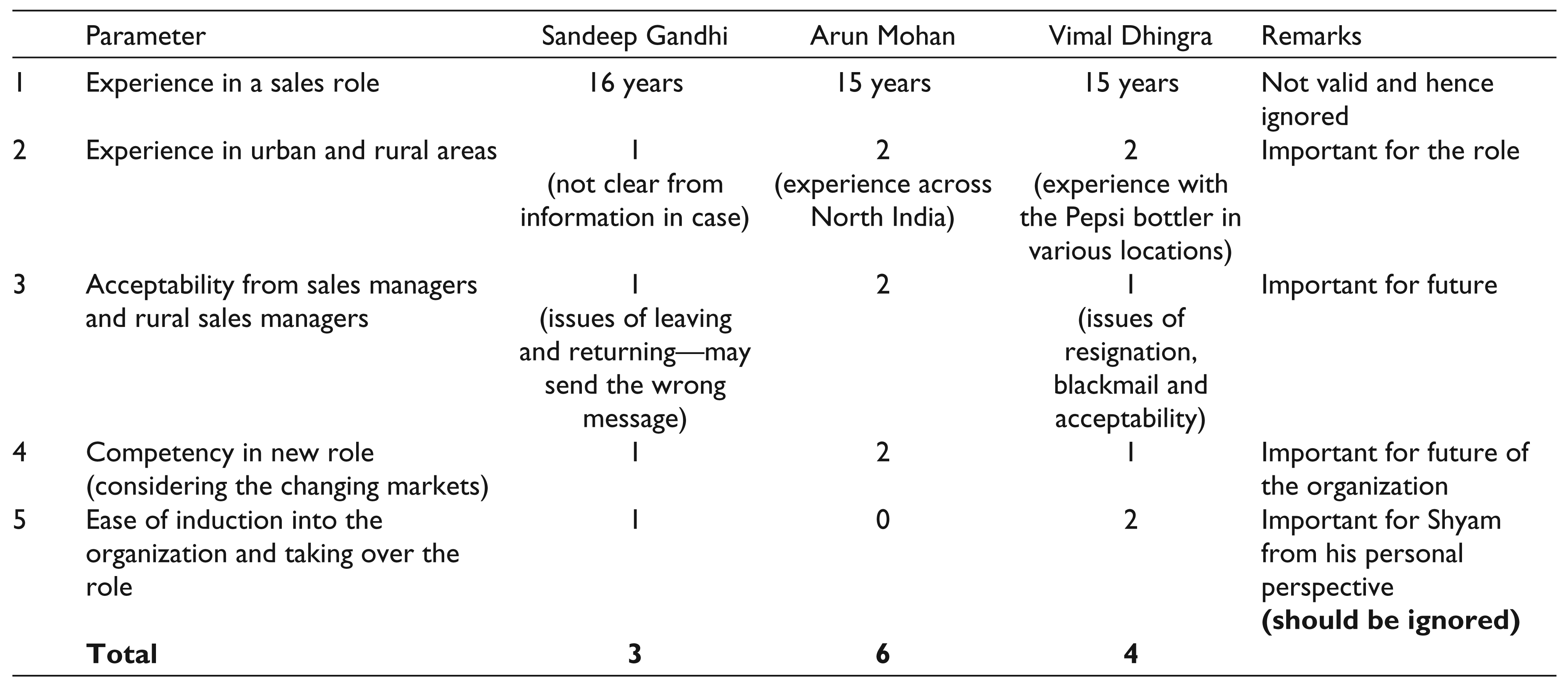
In case of competencies, the case does not provide information to do a comparison with the three candidates on parameters such as performance. The three candidates have diverse career arcs and different roles until the time of the case. Table 1 encapsulates some of the parameters that can be compared. However, not all the parameters are valid for deriving a formula. Row 1 pertaining to the total experience in a sales role is not a valid parameter for comparison since experience may not be indicative of excellence and also there is very little to choose between the three candidates in this regard. All are comfortably over the minimum required experience level of 10 years. Row 5 pertaining to Shyam’s personal perspective is controversial since what may be good for Shyam may not be in the best interest of the organization. Hence, the parameter in row 5 should be ignored. Thus, from the simple formula derived in Table 1, Arun Mohan should be the candidate to be chosen for the role of DGM.
Conclusion
Arun Mohan’s strong candidature can be intuitively reasoned as well. Sandeep and Vimal had experience in BBPL and thus were steeped in the culture of the organization and had a certain equity with their colleagues. However, their appointments to the position of DGM were likely to raise questions. Sandeep had left the organization and would be returning at a higher position. Vimal was essentially holding Shyam to ransom to extract a bigger role. These are serious issues and have ramifications for the long-term health and culture of the company. The question facing Shyam is whether he can sacrifice the short term (due to the negative impact on business due to Vimal’s loss) for the longer-term health of his business. Cespedes (2014) quotes a sales manager, ‘In this job, if you don’t survive the short term, you don’t need to worry about the long term.’ This may be applicable to the DGM’s subordinates but cannot be the driving motivation for Shyam or the organization. Shyam in his role as GM of sales for the organization has to worry more about the long term than the short term. In this case, he has to worry about the message he is sending his sales team and how he is investing for the future.
Comparison of the Three Candidates