







Abstract
This study identifies the barriers to sustainable consumption and measures the discriminating power of these barriers between groups having significant differences in their energy conservation behaviour. By analysing the response of 321 consumers to questionnaire survey in India, results reveal that belief in material growth is found to be the most important factor associated with the energy conservation behaviour across levels (grey, grey-green and green energy consumers). However, belief in technology is negatively associated with energy conservation efforts to all consumers. However, cynicism does not relate to energy conservation efforts. The results are significant to the agencies designing energy conservation campaigns aimed at modifying energy consumption behaviour of domestic consumers.
Introduction
Promoting sustainable consumption practices among domestic energy consumers is one of the biggest challenges facing India. Past research suggests that households are major contributors to increased emission of greenhouse gases and, consequently, global warming. Academic literature suggests that there is a huge potential for energy savings by modifying the behaviour of individuals through behaviour modification campaigns (Abrahamse, Steg, Vlek, & Rothengatter, 2005; Dwyer, Leeming, Cobern, Porter, & Jackson, 1993; Geller, 2002; McMakin, Malone, & Lundgren, 2002; Schipper, Bartlett, Hwak, & Vin, 1989). Behavioural interventions have largely focused on voluntary behaviour modification of individual’s attitudinal elements and have mainly focused on information, feedback, rewards and goal setting-based interventions (Abrahamse et al., 2005; Darby, 2006; Fischer, 2008; Mccalley & Midden, 2002). However, such behavioural interventions have attained compromised results worldwide, which can mainly be attributed to the limited and incomplete understanding of factors constituting behaviour as well as the barriers to sustainable behaviour. Recent literature has argued that in order to shape pro-environmental behaviour, there is a need to look beyond factors such as information, feedback and rewards (De Young, 2000; Leiserowitz, 2006; Osbaldiston & Sheldon, 2003; Steg & Vlek, 2009).
Research on sustainable consumption and pro- environmental behaviour had discussed the role of behavioural barriers in failure of interventions aimed at modifying energy consumption behaviour of individuals (Costanzo, Archer, Aronson, & Pettigrew, 1986; Gardner & Stern, 1996; Hirst & Brown, 1990; Kollmuss & Agyeman, 2002; McKenzie-Mohr, 2000; Young, 1989). Multiple constructs and categorization of behavioural barriers have been used by past researchers (Gardner & Stern, 1996; McKenzie-Mohr, Nemiroff, Beers, & Desmarais, 1995; Stokes, Mildenberger, Savan, & Kolenda, 2012). Broadly, these barriers have been classified into three main categories suggested in ‘Theory of Planned Behaviour’: the first category refers to barriers related to attitude such as discomfort, inconvenience, laziness and forgetfulness; the second category ₹Materialism' refers to subjective-norm-related barriers such as diffusion of responsibility and safety, and finally, the third category ‘Faith in Technology’ refers to barriers related to perceived behavioral control like futility and lack of knowledge (Guy, 2006).
The article attempts at serving a twofold purpose. First, the article empirically measures the barriers towards energy conservation and arrives at consistent findings with respect to the understanding of key barriers in behaviour modification towards sustainable energy consumption. Second, it is important to discriminate between the consumers who differ in their energy consumption behaviour based on the aforementioned three barriers. The study also aims at measuring the discriminating power of these barriers to understand how they affect the behaviour modification interventions and with what degree.
Literature Review
Consumption choices that we make directly or indirectly affect the environment by having an impact on the personal well-being of consumers as an individual or collective well-being of the society at large (Briceno & Stagl, 2006; Frey & Stutzer, 2010; Hume, 2010; Paavola, 2001). The aforementioned thought has ignited the interest of both academic world and policymakers to understand the subject of sustainable consumption. Over the last few decades, the debate of sustainable consumption has failed to generate an unequivocal definition of the construct ‘sustainable consumption’ (Hume, 2010; Mont & Plepys, 2008). The term has often been used as a generic and a blanket term for discussing issues related to resource utilization, waste reduction, quality of life, equitable distribution of resources, fulfilment of human needs, and so on (Mont & Plepys, 2008). One set of argument debates over technology development as a solution to consumption and related environmental problems.
Technocentric approach to sustainable consumption argues that the sustainable consumption is more of a production problem, and pro-environmental production process can solve these problems. Therefore, the techno-logy is the key to bring in eco-friendly, efficient and sustainable solutions (Easterbrook, 1995; Geyer & Jackson, 2004; Gladwin, Kennelly, & Krause, 1995; Graedel, Allenby, & Cοmrie, 1995; Guide & Van Wassenhove, 2009; Jackson, 2005). The technocentric solution is perceived beyond the control of individuals, and, therefore, ‘Faith in Technology’ has emerged as a barrier to sustainable consumption. However, in the last decade, the debate over sustainable has criticized technocentric approach and has increasingly developed a consensus on the fact that technocentric approach alone is not capable of delivering sustainable development (Jackson, 2005; Mont & Plepys, 2008).
There is evidence of growth in consumption alongside technological and efficiency improvements in the production process. It has been reported that ‘Faith in Technology’ leads to a bounce-back effect with technology improve- ment. It has been reported that the overall consumption has increased with the release of efficient products attrib- uted to increase in affluence of consumers and advocacy for inclusivity and consumerism (Brännlund, Ghalwash & Nordström, 2007; Greening, Greene, & Difiglio, 2000; Herring & Roy, 2007). Therefore, the debate about sus- tainable consumption recognized the need to understand consumption behaviour and promote conservation prac- tices by reducing consumption levels (Abela, 2006; Belk, 1985; Csikszentmihalyi, 2000; Daub & Ergenzinger, 2005; Jackson, 2005).
Although it is widely understood and accepted that there is an urgent need to understand and address levels of consumption, the topic has always been a sensitive subject for debate (Mont & Plepys, 2008). Material goods are important to consumers, not just for their functional uses, but because they play vital symbolic roles in their lives. This symbolic role of consumer goods facilitates a range of complex, deeply ingrained ‘social conversations’ about status, identity, social cohesion, group norms and the pursuit of personal and cultural meaning. According to Douglas and Craig (1997), ‘An individual’s main objective in consumption is to help create the social world and to find a credible place in it’. Happiness-seeking behaviour of consumers has attained an elevated and revered place in the modern society. This consumption-centric approach has been termed as materialism (Belk, 1985; Borgmann, 2000; Mont & Plepys, 2008). A number of studies have argued that excessive materialism is detrimental to sustainable living (Barnaby & Reizenstein, 1976; Belk, 1985; Borgmann, 2000; Mont & Plepys, 2008).
Therefore, the next direction of debate to address sustainable consumption moved from changing consumption patterns to reducing consumption levels or conservation. Studies on conservation provide evidence of a significant reduction in consumption levels (Csikszentmihalyi, 2000; Zinkhan, 1994). Therefore, the research started advocating for creating stimuli for motivating consumers to reduce consumption, and policymakers started actively supporting and promo- ting various conservation campaigns including energy conservation. These campaigns included awareness crea- ting, incentivizing conservation and also penalizing irresponsible consumption (Abrahamse et al., 2005; Daub & Ergenzinger, 2005).
Politicizing the issue and policy intervention sometimes got criticized by economic consumerists who advocated ‘freedom of choice’ and economic development (Firat & Venkatesh, 1995; Mujtaba & Jue, 2005). The criticism has been largely characterized by cynicism and distrust (Gordon & Richardson, 1989; Newman, Kenworthy, & Vintila, 1995). Studies on sustainable consumption reported that interventions targeting behaviour modification using information-driven campaigns often fail due to widespread cynicism among consumers (Bonino, Corno, & De Russis, 2012; Kangun, Carlson, & Grove, 1991; Marchand & Walker, 2008; McKenzie-Mohr, 2000). Similarly, studies have also reported evidence of notable cynicism among consumers towards hidden political agenda of such campaigns which in turn fail to deliver desired change in the consumption behaviour (Hobson, 2004; Newman et al., 1995). Therefore, the consumers often perceive such campaigns with scepticism and believe that energy conservation campaigns are driven with intentions of creating an artificial shortage of power and resources to benefit industrial houses. In India, some political parties had accused the incumbent government of creating energy crisis to benefit oil and power generation companies.
H3: Cynicism is a major barrier to energy conservation behaviour and has a negative association with energy conservation behaviour of household consumers.
The aforementioned three factors ‘Faith in Technology’, ‘Materialism’ and ‘Cynicism’ have remained as major barriers to sustainable consumption behaviour and a hindrance to conservation behaviour. Though several studies have been carried out to identify the underlying factors and antecedents to these constructs, hardly any study was found that measures the cumulative impact of these constructs on actual behaviour. The major purpose of this study is to examine the impact of ‘Faith in Technology’, ‘Materialism’ and ‘Cynicism’ on consumption behaviour of individuals and investigate that how consumers who behave sustain-ably score differently on the aforementioned constructs as compared to those who are non-conservationists.
Measuring Constructs
As described earlier, the objective is to identify the difference between grey consumers (those who do not believe in energy conservation at all), grey-green consumers (those who moderately believe and practise energy conservation behaviour) and green consumers (those who have a highly favourable attitude towards energy conservation) on the basis of three barriers towards energy conservation. The three barriers were related to attitude (i.e., cynicism), subjective norm (i.e. materialism) and perceived self-control (i.e., faith in technology). The following section explains scale development for measuring the constructs. A pool of 18 items was prepared to measure aforementioned three constructs.
Cynicism
Cynicism, in the context of the energy conservation, refers to the attitude that the energy crisis is faked by energy corporations and oil companies in order to make super profits. Crude oil which peaked at US$147 per barrel and subsequently fell below US$40 a barrel has reinforced the cynicism among consumers that energy problem is not a genuine problem, but a crisis forced by major oil and power syndicates. Cynical consumers, who often mistrust campaigns and advertisements run by the companies (Chylinski & Chu, 2010), feel that companies disparage and manipulate information for their own vested interest and fail to connect with the stated cause behind the campaign (Helm, 2004; Kanter, 1988; Webb & Mohr, 1998). In order to measure cynicism, past few studies have adopted two approaches. The first approach inferred cynicism by measuring the attitude of consumers towards motives of corporates (Helm, 2004; Milstein Jeffrey, 1979; Mohr, Eroǧlu, & Ellen, 1998; Tashchian, Slama, & Tashchian, 1984), whereas the second approach is to assess how consumers perceive the message in the advertisements and how the claims made in the advertisements affect consumers (Bennett & Moore 1981; Darley & Smith, 1993; Durand Richard, 1979; Ford, Smith, & Swasy, 1990; Seligman et al., 1979). In this study, we adopted five items from scales used in studies adopting the first approach. The scale items were customized to measure cynicism in the context of energy conservation. Few statements used in the scale were ‘The energy crisis is a situation contrived by major oil companies to increase their profits’, ‘Government serves the interest of private power companies and does not look for real ways to solve our energy problem’ and so on.
Materialism
Materialism is defined as a state of mind that focuses on worldly acquisitions that signify success and accomplishments. Since energy conservation not only implies changing consumption patterns but also suggests a reduction in asset accumulation pattern of households, consumers perceive this as an interference with their choice. Therefore, those who believe in materialism may see interventions towards conserving energy as an attempt to curtail their entitlements (Becker, Seligman, Fazio, & Darley, 1981; Seligman et al., 1979). Similar to measures of cynicism, materialism has also been measured in past using two approaches. In the first approach, materialism has been considered as a personality trait (Belk, 1984; Dawson & Bamossy, 1991; Ger & Belk, 1996; La Barbera & Gürhan, 1997). The second approach measured materialism adopting value as a construct to infer materialism with three major dimensions, namely ‘acquisitions centrality’, possession as a measure of success’ and ‘acquisition as a pursuit of happiness’ (Keng, Jung, Jiuan, & Wirtz, 2000; Richins & Dawson, 1992). In order to measure materialism, we adopted seven items from the value conceptualization approach. Sample items used in the scale were ‘Material growth makes for happier living’, Growth in material consumption helps raise the level of civilization’, ‘I have worked hard to get where I am and am entitled to the best things in life’, and so on.
Faith in Technology
Faith in technology, in this study, is used as a measure of perceived self-control, and it indicates consumer’s profound faith in technology as a solution to energy crisis. Therefore, conservation efforts by the individual are not considered to be sufficient, rather they are perceived that they are beyond individuals’ control to solve the energy problem. Consumers believe that technological innovations should be able to create innovative sources of energy and provide more capable ways of fuelling current supplies. In order to measure faith in technology, we adopted six items from studies conducted by Milstein Jeffrey (1979) and Tashchian et al. (1984). Sample items used in the scale were ‘I think energy conservation by individuals can’t help, new technology alone can solve the problem’, and so on.
Conservation Behaviour
Nine items were used to measure the efforts made by respondents in order to adopt energy conservation practices. The scale items measured three dimensions of energy conservation, namely conserving the energy at home by reducing the wastage, conserving the energy by purchasing only energy efficient or say star rating appliances and replacing the inefficient and old appliance with more efficient appliances.
On the basis of self-reported conservation behaviour, the efforts made by respondents were further classified into three categories, namely respondents making high efforts, medium efforts and low efforts. Respondents falling in low efforts to conserve energy were labelled as ‘Grey Consumers’; those who reported making medium efforts were labelled as ‘Grey-Green Consumers’ and respondents making high efforts to conserve energy were labelled as ‘Green Consumers’.
Methodology
The respondents in this study were selected using systematic sampling procedure (Frankfort-Nachmias & Nachmias, 2007). This technique was selected on the basis of its wide applicability and acceptability in the academic fraternity. Data collection was performed by a team of four field surveyors who were given in-depth training for conducting interviews and survey methods. Each surveyor was assigned different locations, and every fifth house was to be selected as a sample unit. Self-administered questionnaires were used to collect the data. The survey team visited the sample units personally and administered the form personally. A total of 390 questionnaires were distributed, and 321 questionnaires were found suitable for the analysis. In order to find sampling bias randomly, 10 questionnaires were selected from the set of questionnaires of each surveyor, that is, total 40 respondents were verified by calling at their numbers and talking to them.
Five-point Likert scale ranging from 1 (‘totally disagree’) to 5 (‘totally agree’) was used for 18 items measuring cynicism, materialism and faith in technology. Similarly, 5-point Likert scale ranging from 1 (‘no effort at all’) to 5 (equals ‘substantial efforts’) was used in 9-item scale to measure conservation behaviour.
Validity and Reliability
The convergent and discriminant validity of the aforementioned constructs was tested using CFA. It was decided to drop items with loadings less than 0.30 in order to eliminate poorly performing items and strengthen the convergent validity. It was observed that Cronbach’s α for all the aforementioned scales was above 0.60 (Nunnally, 1967), indicating an internal consistency of the scale items in measuring three constructs (see Table 1).
Validity and Reliability

The results of the confirmatory factor model show that all items load significantly on their corresponding latent construct, which indicates that convergent validity is obtained. The reliabilities and variance extracted for each variable also indicate that the measurements are reliable and valid. All composite reliabilities were > 0.70. Variance-extracted estimates were all above 0.45. The reliabilities and variance were computed using indicator standardized loadings and measurement errors (Hair, Black, Babin, Anderson, & Tatham, 1998). Discriminant validity of the applied constructs was tested by measuring the correlations between the constructs, and it was observed that the largest coefficient was 0.42 between cynicism and materialism (Table 2), which when squared was 0.18 and all of the average variance explained exceeded the squared value confirming discriminant validity.
Discriminant Validity

Analysis and Results
Model Fit
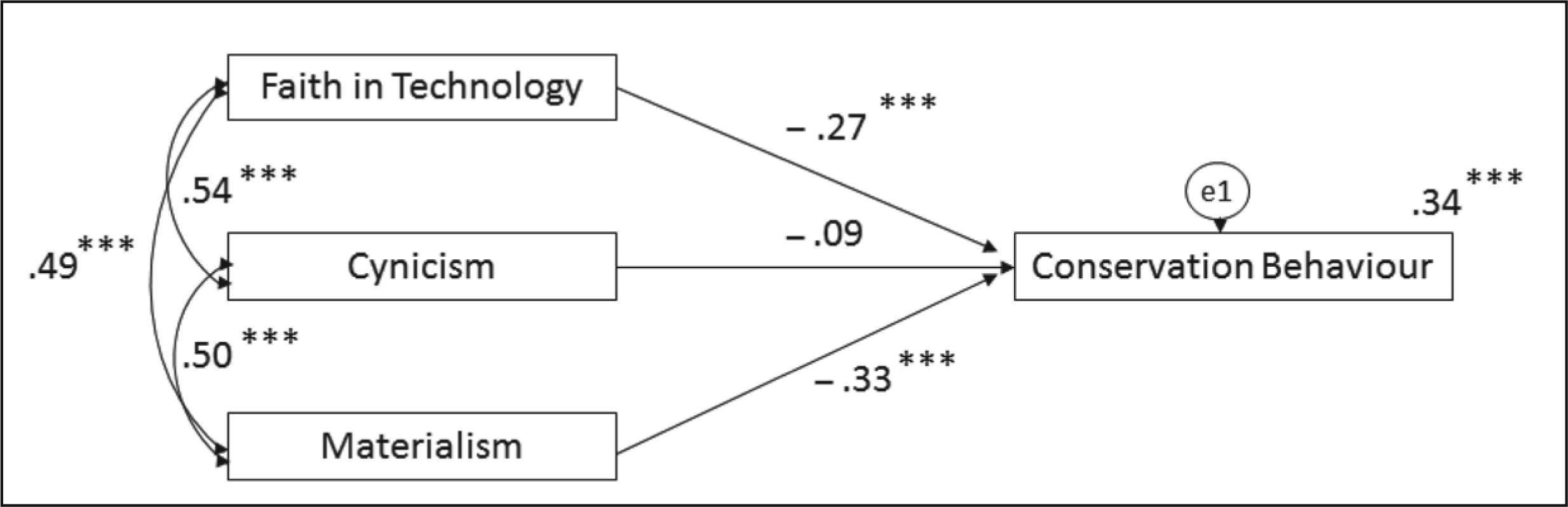
The relationships proposed in three hypotheses were examined using structural equation approach. The estimation of the structural model was done by means of AMOS version 18.0 using maximum likelihood estimate (MLE). The test of overall fit of the model produced a chi-square (χ2) to degree-of-freedom ratios 2.121 which is within the value of 3.00 suggested by Carmines and McIver. All the fit indices were within acceptable range. The value of GFI was 0.94, which was above the recommended value (Hair, Ringle, & Sarstedt, 2011). The value of the AGFI was 0.89, which was comfortable above recommended a cut-off level of 0.80 (Hair et al., 2011). The values of CFI and NFI were 0.914 and 0.927, respectively. Both of these indices were within the acceptable limit of 0.9 (Hair et al., 2011) and can be considered satisfactory. The value of the RMSEA, which is an absolute measure of the parameter of fit, was equal to 0.065. Thus, it was within the acceptable cut-off level of 0.08 (Hair et al., 1998).
Results indicated that Hypotheses 1 and 2 were true, and we may conclude that ‘Faith in Technology’ and ‘Materialism’ negatively impact conservation behaviour. However, it was observed that though there is a negative relationship between ‘Cynicism’ and conservation behaviour, it was not found to be significant (see Figure 1).
Discriminant Analysis
In order to achieve the second objective of the study, that is, whether it is possible to discriminate between the consumers who differ in their energy consumption behaviour based on the aforementioned three barriers, we categorized the respondents into three categories discussed previously, namely ‘Green Consumers’, ‘Grey-Green Consumers’ and ‘Grey Consumers’. The analysis was performed using discriminant analysis, and the results are discussed in the following paragraphs.
Construct means and standard deviations for each of the three segments indicated several significant differences across the three segments. In each of the three segments, two or more constructs showed univariate differences between considered segments and each of the other two segments. This suggests that multiple discriminant analysis would be appropriate for investigating the research question, and hence this analysis was used to explore the degree to which respondents’ attitude towards energy conservation can predict segment membership of consumers as a green, grey or grey-green consumer.
For the sample under study, only the first discriminant function (Wilks’ λ = 0.330, χ2 = 240.316; df = 6; p-value < 0.001) was significant and explained 77.3 per cent variance with an eigenvalue 1.225 and had a canonical correlation of 0.742. An analysis of variance was conducted for each factor, and significant differences were found between the group means at the 5 per cent level for the three factors: cynicism, belief in material growth and faith in technology. Since the second function is not significant, its associated statistics will not be used in the interpretation of the ability of the five constructs to discriminate among segments. The predictive accuracy of the model based on classification results was 76.92 per cent, whereas leave-one-out cross-validation correctly classified 76.02 per cent cases (refer to Table 3).
Results of Three Group Discriminant Analysis
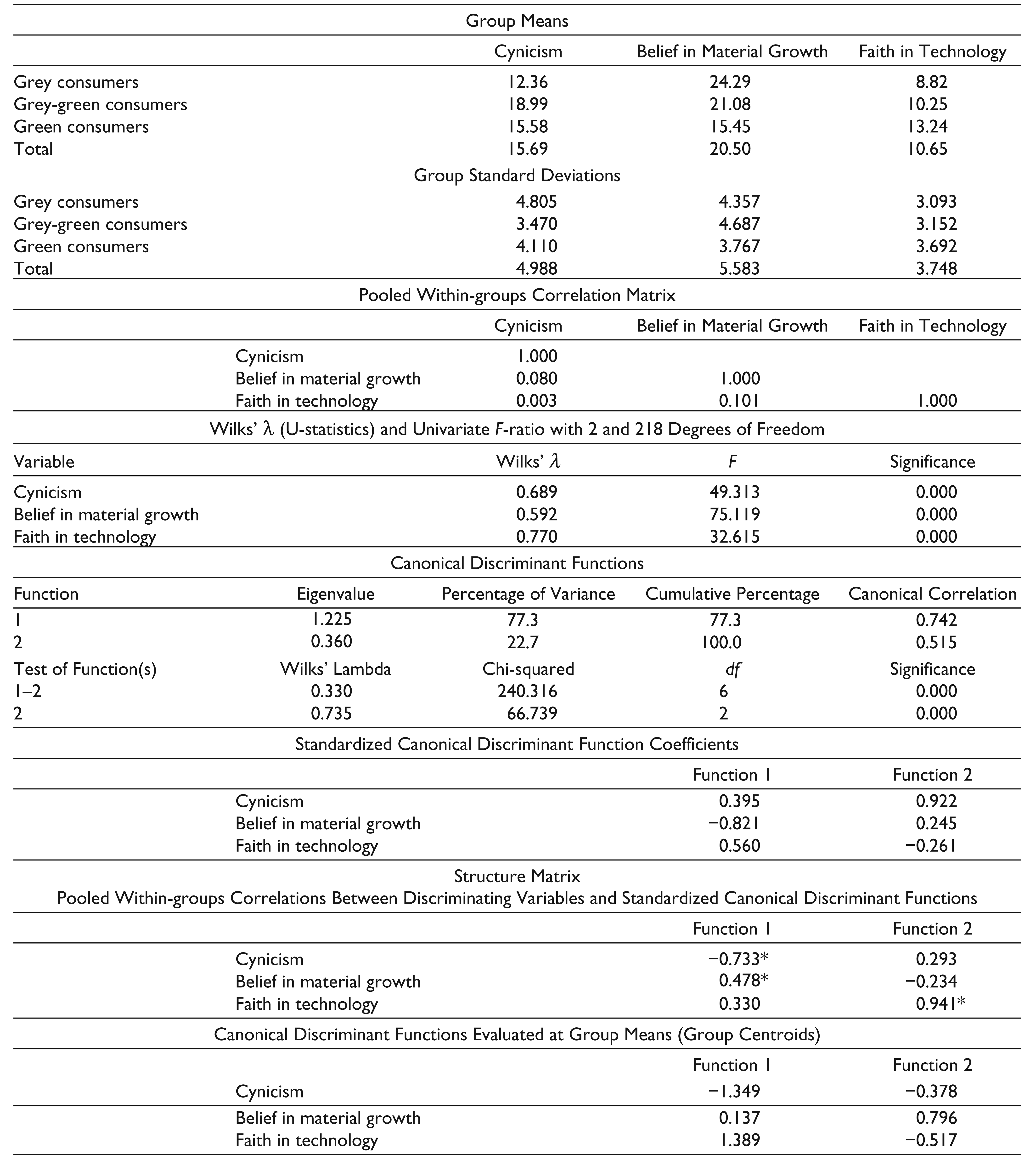
The results show that ‘Belief in Material Growth’ is the main contributing construct (discriminant loading = −0.821) in discriminating between energy conservers, that is, ‘green consumers’ from moderate conservers ‘grey-green consumers’ and non-conservers ‘grey consumers’. Substantive loading (> ± 0.3) was also obtained for other two constructs: faith in technology (0.560) and cynicism (0.395). The significance attached to univariate F ratios (all p-values < 0.05) indicates that when the predictors are considered individually, all three are significant in differentiating between the three groups. An examination of group centroids clearly suggests that function 1 discriminates between ‘grey consumers’ and ‘green consumers’/‘grey-green consumers’.
Discussion
In this study, the authors made a systematic attempt to first identify the barriers that hinder adoption of sustainable consumption practices among domestic energy consumers. Following a detailed review of literature pertaining to possible reasons for divergence between behavioural intentions of consumers to conserve energy and actual overt consumption behaviour, three barriers are identi- fied, namely ‘Faith in Technology’, ‘Materialism’ and ‘Cynicism’. We hypothesized that these barriers negatively influence the behavioural intention. The aforementioned hypotheses were tested, and it was observed that except ‘cynicism’, other two hypotheses were validated, and it was found that ‘materialism’ and ‘faith in technology’ were significant barriers towards the adoption of sustainable consumption practices. Materialism was observed as a practice of avoiding discomfort and inconvenience by consuming excessively, thereby weakening the attitude strength of consumers towards energy conservation and perceived self-control (Hume, 2010; Stokes et al., 2012). Alwitt and Berger (1993) also argued that attitude strength moderates the ability of attitude to predict environmentally sustainable behaviour. Similarly, ‘Faith in Technology’ was observed to be diffusing responsibility of energy conservation from individual efforts to scientific progress and technological developments. Therefore, ‘perceived self-control’, which is considered the third antecedent to behavioural intention, was found to be barred by consumer’s faith in technology. The results validate the propositions developed by Gladwin et al. (1995). The results of this study are in line with the existing studies that had demonstrated that attitudes are not the only barriers blocking consumers from engaging in conservation behaviour (Costanzo et al., 1986; Lehman & Geller, 2004; McKenzie-Mohr, 2000). Instead, other factors, like perceived self-control, play an important role in modifying consumption behaviour (Stokes et al., 2012).
Results reveal that though respondents were cynical about the energy crisis and were sceptical about the claims of government, energy companies and claims made through conservation campaigns, it had no significant relationship with behavioural intentions due to prevailing social norms. This is in conjunction with the previous studies which suggested that subjective norms are often significant in shaping conservation behaviour (Chan, Dolderman, Savan, & Wakefield, 2012; Perkins, 2002; Stokes et al., 2012).
The study further examined the ability of the aforementioned barriers in discriminating between the consumer groups displaying different conservation practices. The overall results of an intersegment comparison showed that ‘green consumers’ perceive energy conservation differently from ‘grey consumers’ and ‘grey-green consumers’. An examination of group means and individual discriminant loadings indicates that belief in material growth appears to be the primary discriminating construct and, therefore, separates the groups more widely followed by cynicism and faith in technology.
Thus, interventions related to motivating consumers for conserving energy should be compatible with existing energy consumption patterns. Agencies, like Bureau of Energy Efficiency (BEE) and Petroleum Conservation and Research Association (PCRA), should therefore not expect consumers to compromise their existing need for material growth in order to conserve energy. If consumers consider material growth and the comfort associated with it to be more important, then promotional campaigns might be developed which feature behaviours for conserving energy and saving money without sacrificing comfort. Those who believe in material growth may hence be motivated to replace their energy appliances with modern appliances which are more eco-friendly, comfortable and will fulfil their status needs. Similarly, those who do not believe in material growth and fall in third category ‘green consumers’ may be motivated to adopt behaviour which will conserve energy in their daily use. Faith in technology is the second most important factor; therefore, those who have faith in technology are likely to give little less emphasis on energy conservation. For this segment of consumers, demarketing and disincentives for consumption, rather marketing for conservation or say incentives for conservation, may also be helpful in reducing the usage of energy resources, especially in petroleum-related products.
Footnotes
Declaration of Conflicting Interests
The authors declared no potential conflicts of interest with respect to the research, authorship and/or publication of this article.
Funding
The authors received no financial support for the research, authorship and/or publication of this article.