







Abstract
The discussion of internationalization small and medium enterprises (SMEs) internationalization is salient in international business literature. In entering and performing in distant international markets, SMEs face more significant challenges than larger firms. This research aims to analyze the effects of psychic distance, international experience, and risk-taking ability among Indonesian SMEs internationalization in a distant market. This research was carried out with a survey involving 76 SMEs in Indonesia, and then the data were analyzed using multiple regression. The result shows that although the regression model is a good fit for the data, only international experience has a significant effect. This paper contributes by providing empirical evidence of (a) factors affecting the internationalization of SMEs of an emerging market in a distant market and (b) the role of psychic distance on internationalization in the context of SMEs.
Introduction
We live in an era where borders between countries are blurring, and trades across countries—even continents—happen daily. As international trades are growing, studies on international business are also expanding, covering a more comprehensive range of issues that need to be addressed. One of them is how firms go about internationalization or target countries in a distant market or outside of their region.
Rugman and Verbeke (2004) were part of earlier scholars who questioned multinational firms’ ‘globalness’. They stated that multinational firms are supposed to be able to operate in all of the three triads successfully. However, they found that only a few multinationals can operate simultaneously in all three triads. Most international businesses tend to undertake activities in their home region. In other words, they are less global than the commonly held belief; hence, they are less effective in entering markets located in a distant host region or in other triads (NAFTA, European UNION and ASEAN) regions. The report indicates that a firm in Thailand, for example, tends to operate ‘internationally’ only in the Asian region instead of the American and European regions.
What has been explained by Rugman and Verbeke (2004) is relevant in the Indonesian context. Based on the international trade data published by the Ministry of Trade of Indonesia, in 2014–2019, in the non-oil and gas sectors alone, there are 15 central target countries of trade for Indonesian firms. Of these 15 countries, 11 countries are in the Asia triad regions (South-East and East Asia), and the Asian markets account for 46.79% of Indonesian exports. The European region (Germany, Netherlands and Italy) account for only 10.45%, while 5.26% goes to other European countries. The United States (representing the American region/NAFTA) accounts for 10.85%. When combined, all 15 countries account for 62.84% of Indonesian exports, while the rest of other countries make up 37.16%. In other words, almost half of the total exports go to Asia.
Another note is that SMEs’ internationalization is likely to face more challenges than their larger counterparts as they generally have fewer resources (Sui & Baum, 2014). These resources include the limited capacity to search for new market opportunities (Vos et al., 1998) and to collect new information and network (Indarti & Langenberg, 2004) as well as the limited managerial capability (Abor & Quartey, 2010).
In a systematic review involving the literature of the past 20 years, Steinhäuser et al. (2021) noted that SMEs are less committed to internationalization than large firms. Still, there are SMEs that managed to internationalize rapidly and successfully to a culturally distant country, called fast internationalizes. Fast internationalizes appeared in the systematic research, but there were no specific findings and elaborative explanations about the antecedents.
When SMEs operate in a distant market, the assumption is that the SMEs must deal with foreign cultures, customs, regulations or lifestyles, which could be significant barriers. While large firms have resources and networks to remove such barriers (Rugman & Verbeke, 2004), this is not always the case for SMEs. Due to the limited sources of SMEs, studying what matters for SMEs to perform in a distant market is vital.
This study employs Uppsala internationalization framework (UIF) in analysing the phenomenon of internationalization to a distant market (Johanson & Wiedersheim-Paul, 1975). According to the framework, firms tend to enter markets with a low psychic distance (Johanson & Wiedersheim-Paul, 1975). When a firm perceives a low psychic distance with the target market, the target market is rather recognized as having or might possess similar characters with the home market, and vice versa (Johanson & Wiedersheim-Paul, 1975). Other variables considered are risk-taking ability and international experience. These three variables are viewed considering the UIF.
The UIF (Johanson & Wiedersheim-Paul, 1975) argues that firms incrementally build more significant commitment as the geographic scope expands. As a result, they tend to enter markets that are closer and have similar characteristics (Christensen, 1991). Hence, psychic distance hinders firms’ internationalization process (Arenius, 2005). Due to the difference in culture, custom or character between the home country and the distant market, psychic distance is predicted to be matter—even become a significant barrier—for SMEs internationalizing distant markets. SMEs that mostly choose a low commitment entry mode, such as export, are more prone to cost resulting from a high psychic distance (Dow, 2000).
This study also considers risk-taking as a vital factor. Risk-taking ability is an important attribute in internationalization since it enables firms to create opportunities, explore new arenas and processes or introduce new products to the target market (Zahra et al., 2001). Risk-taking ability also significantly affects internationalization performance (Javalgi & Todd, 2011). As stated in UIF (Johanson & Wiedersheim-Paul, 1975), firms faced with uncertainty tend to avoid risks and choose to internationalize in neighbouring countries or well-known countries—an argument supported by De Clercq (De Clercq et al., 2005).
In SMEs internationalization, the risk-taking ability can help SMEs exploit opportunities (Basile, 2012). However, small firms targeting distant countries with different cultures will face more significant risks (Dou et al., 2019). Perseverance, therefore, is a vital attribute for SMEs that target international markets (Gerschewski et al., 2015) to face and take risks. Considering this, we argue and predict that in a distant market, risk-taking ability is an even more prominent attribute for SMEs to succeed compared to when they try to enter a closer market.
Additionally, from a systematic literature review, Ofer et al. (2021) stated that SMEs in emerging countries tend to lack insight into the target market and rather are unable to obtain information about international markets (Ofer et al., 2021). This could be compensated by gaining more international experience. As experience itself is vital for SMEs, foreign experience is specifically needed to empower SMEs in their attempt to gain benefit from distant markets.
Firms are more likely to be committed to international establishment if they have experience from other foreign markets (Johanson & Wiedersheim-Paul, 1975). Hence, we predicted that Indonesian SMEs with international experience will have a higher success rate in distant markets.
Following the logic of UIF (Johanson & Wiedersheim-Paul, 1975), this article aims to examine the role of psychic distance, international experience and risk-taking ability in the Indonesian SMEs internationalization to a distant market. To our knowledge, our study is the first that examines psychic distance to internationalization in the context of Indonesian SMEs. The result of the study is expected to extend the body of knowledge on SMEs’ internationalization literature, especially in the context of developing countries.
Literature Review and Theoretical Background
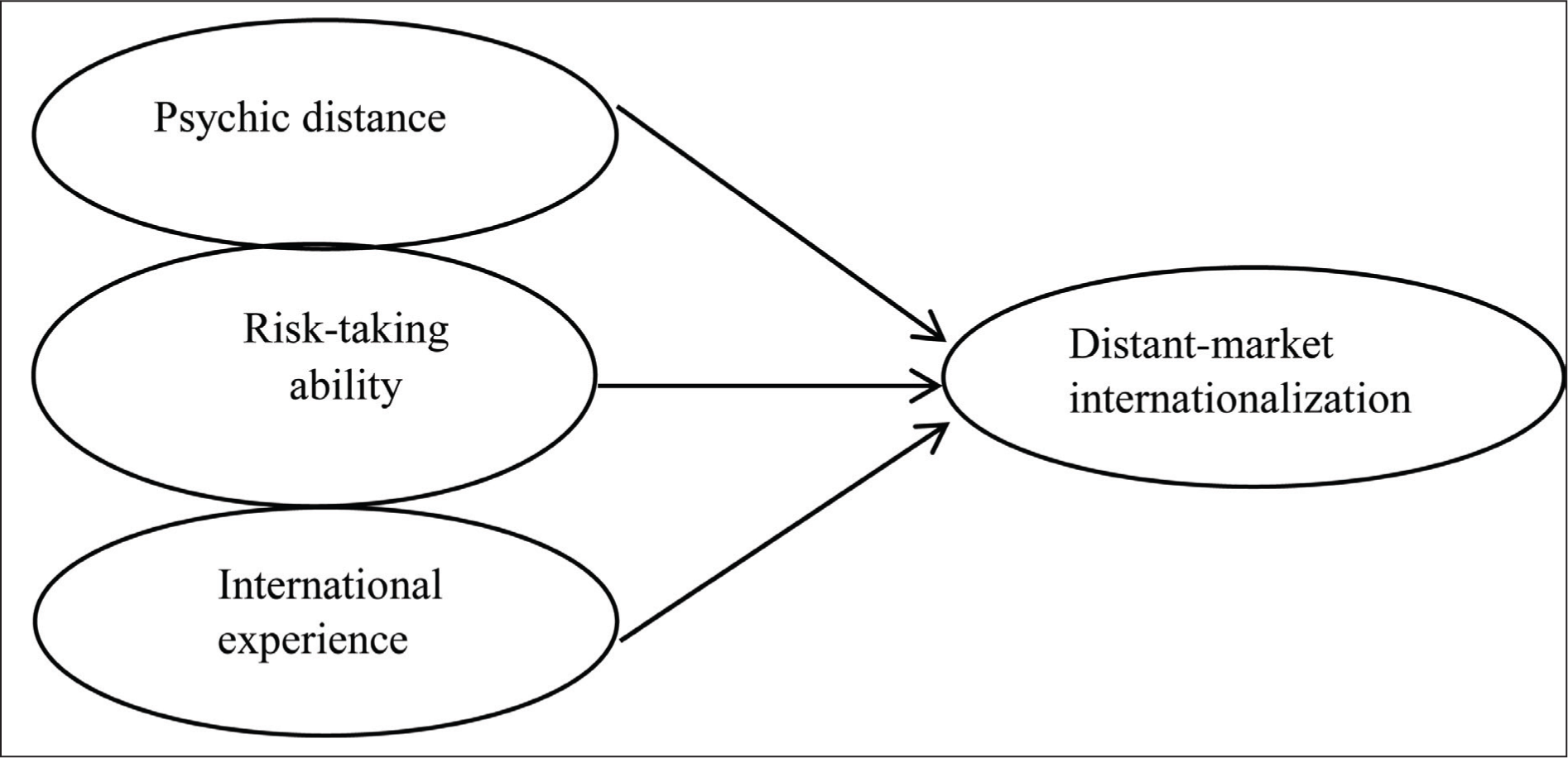
Figure 1 illustrates the hypotheses of this research. The UIF acknowledges the existence of differences between countries as being barriers faced by firms (Johanson & Wiedersheim-Paul, 1975). Besides different cultures and customs, it is also acknowledged that firms face higher uncertainty during the internationalization process. Consequently, internationalization tends to be incremental, starting from closer regions to further countries (Johanson & Wiedersheim-Paul, 1975).
The psychic distance can be understood as differences a business player perceives when they enter a foreign market (Nizielska, 2013). The concept of psychic distance was formulated as a potential solution for distance problems in internationalization research (Johanson & Vahlne, 2009). From a UIF perspective (Johanson & Wiedersheim-Paul, 1975), a high psychic distance will cause high liability of foreignness (Johanson & Vahlne, 2009). High liability of foreignness adds to the liability and potentially hampers the process of network building (Johanson & Vahlne, 2009).
Psychic distance also potentially hampers operational activity in a foreign country. Different characters lead to high uncertainty (O’Grady & Lane, 1996) and could also become an obstacle for SMEs to apply an operational mechanism (Evans et al., 2000). Psychic distance also complicates the ability of business players to get valid information (Arenius, 2005). Consequently, SMEs avoid that specific market (Johanson & Wiedersheim-Paul, 1975). As such, the proposed hypothesis is as follows:
H1: Psychic distance between the home country and target market negatively affects Indonesian SMEs distant-market internationalization.
Risk-taking ability as part of the entrepreneurial orientation of SMEs is defined as the willingness of SMEs to take a strategic decision, even when the decision is risky (Baird & Thomas, 1985). Humans are naturally wired to avoid risks. However, humans may dare to take more risks when the risk is not too significant (March & Shapira, 1987). In an organizational context, the risk-taking ability has an essential role as innovation is required for companies to remain relevant in a competitive market—it is inherently risk-taking (Naldi et al., 2007).
SMEs face uncertainty and risk daily, accept a loss and must be highly committed to remaining relevant in the market (Lumpkin & Dess, 1996). When SMEs target a distant market, the risk-taking ability is critical because there is increased uncertainty (De Clercq et al., 2005). SMEs with a low ability to take risks will have difficulty overcoming foreignness from the region. When SMEs face a distant target market, they also need to face much liability of foreignness, so they should apply strategies to reduce liability through adjustment and resource allocation (Brouthers et al., 2015). All of this requires the risk-taking ability (Luo, 2001). As such, the proposed hypothesis is as follows:
H2: Risk-taking ability of the firm positively affects Indonesian SMEs distant-marketinternationalization.
Organizations improve with experience. They can build up knowledge and use knowledge as capital (Murmann, 2003). Several papers have shown the positive role of experience in marketing and branding. In the marketing field, experience moderated the influence of involvement and satisfaction on attitudinal brand loyalty (Russell-Bennett et al., 2005). Experience also has a role in moderating the positive impact of sustainability orientation on entrepreneurial intention (Kuckertz & Wagner, 2010). The industry-specific experience could enhance performance (Bosma et al., 2004).
In terms of internationalization, experience can mitigate the impacts of uncertainty that resulted from a cultural distance in an international business setting (Cho & Padmanabhan, 2005). In the early stage of business development, experience is vital in export intensity (Majocchi et al., 2005). Experience is the beginning of learning (Argote & Miron-Spektor, 2011). When SMEs are exposed to a lot of business activity in a domestic and international settings, they will be able to formulate strategies needed in international business. The higher the experience, the better their distant-market performance. So, our proposed hypothesis is as follows:
H3: International experience of the firm positively affects Indonesian SMEs distant-market internationalization.
Methodology
Sampling and Procedures
Surveys were distributed to SMEs that met two criteria: First, whose number of employees is less than 300 (Subanar, 2001). Second, to get the context of the distant market, this study only asked those SMEs who have already conducted international business activities in the United States and/or Europe. Out of the 257 SMEs listed by the Ministry of Trade of Indonesia as a global business player, most are spread in nine provinces in Indonesia. This research prioritizes samples from Java and Bali because, based on data from the Ministry of Industry of Indonesia, 69.28% of Indonesian SMEs are on Java island, so the choice of sample is expected to be sufficient for generalization purposes.
From the 250 initial contacts, only about 76 surveys met the standard to be analysed. The authors specifically asked the survey to be filled by the owner or manager of the SMEs. Due to the small size of SMEs, the authors believe that the organizational capacity can be represented by the owners or managers.
On average, the SMEs have 52 employees, with the highest number of employees being 300 employees and the lowest being 3. Most of the owners (81.75%) hold an undergraduate degree. Most SMEs (93.42%) use an export/import market entry option, while only a small number of SMEs use a collaborative market entry strategy, such as joint venture.
Measurements
Dependent variable: Distant-market internationalization is defined as international business activities conducted outside a regional home market (Rugman & Verbeke, 2004). In this case, since the SMEs are from Indonesia, their regional home market is ASEAN. The measurement scale is adapted from Andersson et al. (2004). It needs to be noted that the referred measurement is expected to capture the degree of internationalization in distant market (outside Asian region; Europe or North America), consistent with the measurement of degree of internationalization by Sullivan (1994). There are three questions in the Likert-scale form, from a scale of 1 to 5. Scale 1 is labelled as strongly disagree, while scale 5 is labelled as strongly agree. One question sample of the indicator is ‘Generally, our income is dominated by business activities from countries outside Asia continent’.
Predictors:
Psychic distance is the perception of differences between the home country and the target country (Håkanson & Ambos, 2010). This research adapted the measurement developed by Sousa and Lages (2011). There are two dimensions of psychic distance in the measurement: the country-differences dimension and the citizen-differences dimension; these two dimensions measure the perception of psychic distance. There are 13 items to measure psychic distance adapted from Sousa and Lages (2011). The 13 items measure the psychic distance at a country-level and at a people-level. The respondents (in this context, the SMEs owners/managers) were asked about their perception of the similarity between the target market (nation) and the home country (Sousa and Lages, 2011). One sample of the country-level indicator is ‘Indonesia, and the target nation shows a similarity in economic level and industrial development’. Meanwhile, one sample of the people-level indicator is ‘The Indonesians, and the citizens of the target nation share a similarity in lifestyle’. Risk-taking ability is defined as the willingness of a company to take a strategic decision, even when the decision could be risky (Baird & Thomas, 1985). This research adapted the measurement developed by Boso et al. (2013) to measure risk-taking ability. Three items serve as proxies of risk-taking ability. The respondents were asked to rate statements by using the Likert scale (1 = strongly disagree; 5 = strongly agree). One sample of risk-taking ability proxy is ‘Our company tend to do a high-risk project’. To measure international experience, this study used duration of SMEs conducting business activities outside the region of Asia. The question is ‘How long have your company conduct business outside Asia region (in year)’. The number then was transformed to natural log (ln) to be analysed.
Results and Discussions
Validity and Reliability
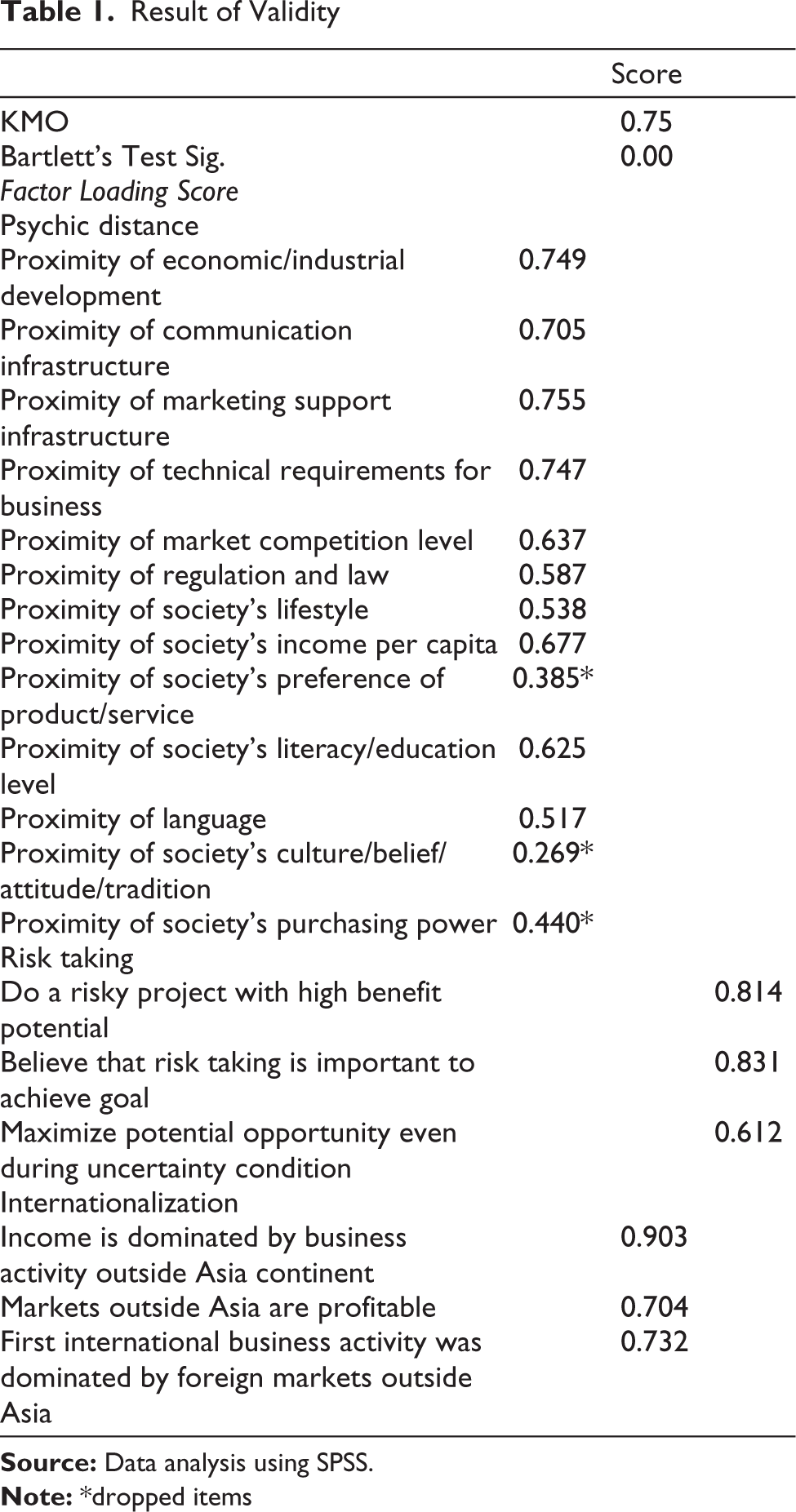
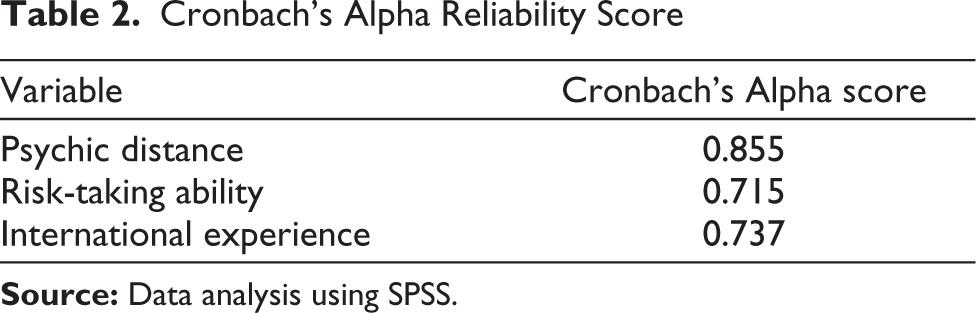
This research used face validity and construct validity. Face validity was done by asking relevant researchers to assess the operationalization for each variable. To test construct validity, researchers utilized confirmatory factor analysis (CFA) to evaluate the measurement of the variables. In the first attempt, three items (Table 1) in the psychic distance measurement did not fulfil the minimal factor loading requirement, 0.5 (Hair et al., 2014); as a result, we dropped the three items (deleted items are shown in Table 1). Table 1 shows that the measurement is valid, while Table 2 shows the reliability score. The valid and reliable results indicate that the operationalization can be used for further analysis.
Result of Validity
Cronbach’s Alpha Reliability Score
Descriptive Statistics and Correlations
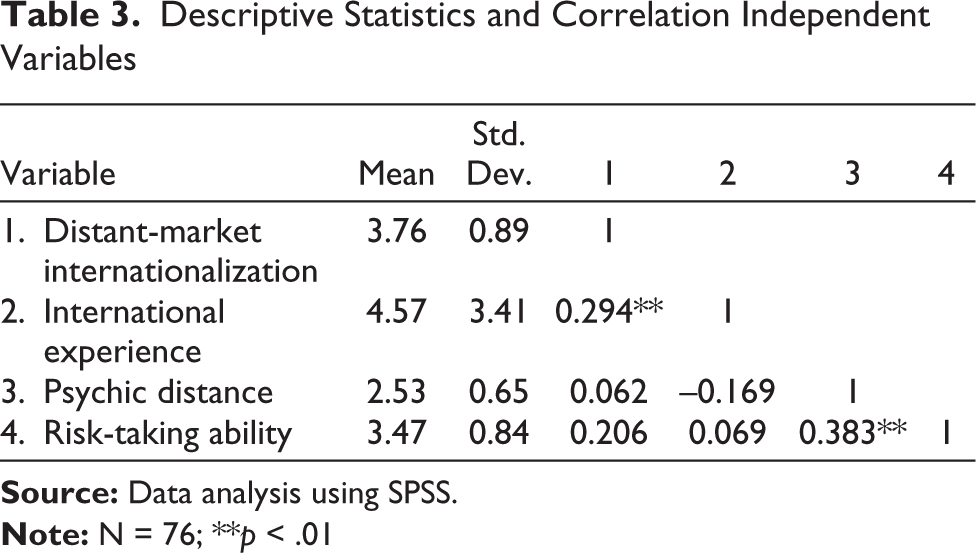
Table 3 shows the mean of the variables, standard deviation and Pearson’s correlations score. It is noted that psychic distance has the lowest mean score compared with other variables, which shows that most respondents have slightly low psychic distance towards the target market. It is also noted that some regressors correlate with each other. However, since the correlation coefficients between these variables are less than 0.5, it will not affect the estimation (Belsley et al., 1980).
Descriptive Statistics and Correlation Independent Variables
Hypothesis Testing
In testing the hypothesis, this research utilizes a multiple regression analysis. Table 4 reports the regression results, and the result shows that the regression model is a good fit of the data (F value = 3.368, p < .05). However, not all the predictors significantly influence internationalization when individual variables are examined.
Result of Regression
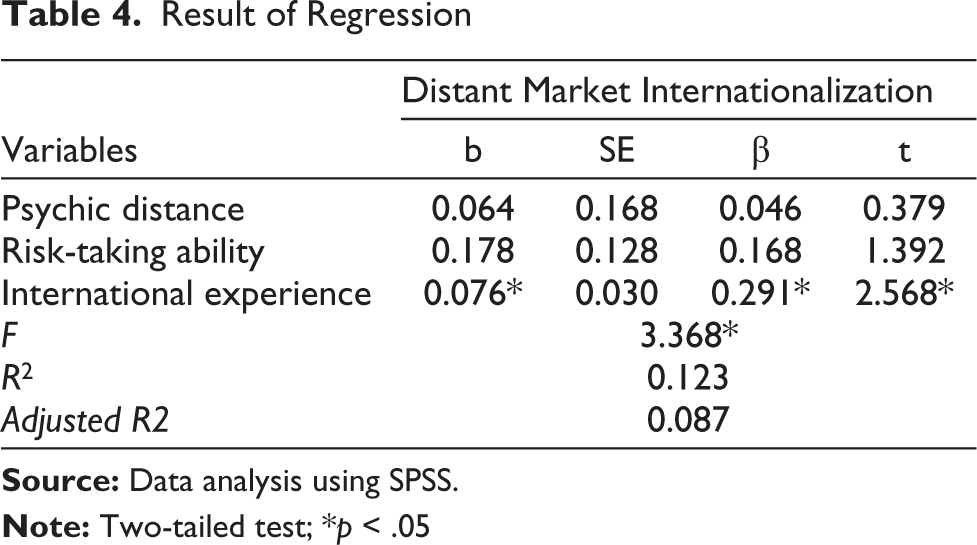
The result shows that only international experience positively affects internationalization (β = 0.291, p < .05); hence, this result supports H3. This result supports empirical support towards organizational learning theory and explicitly confirms the role of experience in transforming knowledge used by the company to perform its tasks (Argote & Miron-Spektor, 2011).
Psychic distance shows an insignificant effect (β = 0.046, p = .70), and so this result rejects H1. This result is in line with the research by Czinkota and Ursic (1987), Dikova (2009), and Stöttinger and Schlegelmilch (1998). Lastly, risk-taking also shows an insignificant effect (β = 0.168; p = .17), and so this result rejects H2. We elaborate on the unsupported hypotheses in the following paragraphs.
First, entry mode could be the underlying factor of the insignificant effect of psychic distance and risk-taking ability. Most SMEs in this research (97%) use export methods to enter the international market. From the non-systematic interview, many of them use intermediary services. The SMEs only produce goods, but intermediaries handle the market and search for prospective buyers. The intermediaries even take care of the distribution and provide transportation to carry goods to the closest port. Due to the export entry mode, both psychic distance and risk-taking ability may be unnecessary for SMEs. Since a more experienced third party carries many activities, the risk explosion, consciousness of risk and perception of distance are somewhat decreased or diverted.
Second, many SMEs in this study admitted they often engage with prospective buyers from exhibitions held by the government. The government’s supports through exhibitions and regulation could also nullify the effect of psychic distance. The notion is in line with Yan et al. (2020), who stated that institutional support (e.g., support from the government) could set aside psychic distance in SMEs in internationalization. Yan et al. (2020) also found that informal institutional support (e.g., business guanxi and political guanxi) are more relevant to help SMEs. Our findings support Yan et al. (2020) because Indonesian SMEs rely on a business network (third party intermediaries) to capture distant market opportunities.
Third, the globalized market (Stöttinger & Schlegelmilch, 1998) and the absence of moderating variables (Hang & Godley, 2009; Wu & Zumbo, 2008) could be the other factor of the insignificant effect of psychic distance. Through globalization, the cross-country and cross-culture unity (Al-Rodhan & Stoudmann, 2006) could connect societies from different countries, continents and cultures. Consequently, the distance (geographic and psychic) became less relevant (Keohane & Nye, 2000). Evans et al. (2000) were among several scholars who believed that psychic distance alone could not explain international performance. Hang and Godley (2009) also stated a similar conclusion, who admitted that it is possible for firms unable to interpret psychic distance to performance.
Fourth, the measurement and operationalization variable could be the other culprit of the insignificant result. In psychic distance topic, questions and doubts of the conceptual translation were not raised by one scholar only. Perhaps one example comes from Ojala and Tyrväinen (2009) who found that the indicators of macro-level psychic distance (country-level distance) somehow could not measure the psychic distance appropriately.
Conclusion
As most of the internationalization literature focuses on MNEs and big firms, this research facilitates the study of SMEs’ struggle in global markets. This research also gives empirical proof of inter-regional and inter-continental internationalization. As there was scepticism of firms ‘globalness’, we tested SMEs that successfully enter distant and cross-continent markets and the possible factors.
From this research, it is noted that psychic distance has no significant effect on the internationalization of Indonesian SMEs to a distant market. However, international experience as experiential learning is still vital for SMEs’ internationalization to distant markets. Therefore, it is worth for future studies to examine whether form and internationalization mode of entry could moderate or intervene insignificant variables in this study. Another variable worth checking is the network’s role in distant market internationalization.
Lastly, this research provides empirical contribution by serving insight into SMEs’ context from the developing market. Furthermore, this research extends to previous research claiming that the concept and measurement of psychic distance need to be revisited. This research also extends to research that stated the importance of intervening variables in understanding the effect of psychic distance on distant market internationalization. Finally, this research can hopefully give a theoretical contribution to UIF (Johanson & Wiedersheim-Paul, 1975).
Footnotes
Declaration of Conflicting Interests
The authors declared no potential conflicts of interest with respect to the research, authorship and/or publication of this article.
Funding
The authors received no financial support for the research, authorship and/or publication of this article.