







Abstract
In recent years, research on green purchase behaviour has made tremendous progress. But still, several significant elements in diverse contexts require additional investigation, and it is also crucial to address the effect of the global pandemic COVID-19 on green purchase behaviour. This study is the outcome of a thorough literature review and aims to fill the gap of an integrated model that spells out the current state of green purchase behaviour. Apart from the previous models, this framework strives to lay out a complete illustration of factors influencing green purchase behaviour by assimilating relevant constructs from various theories such as Theory of Planned Behaviour (TPB), Theory of Consumption Values (TCV), Innovation Resistance Theory (IRT), Theory of Green Purchase Behaviour (TGPB) and Health Belief Model (HBM). The article adds to the current research by proposing a conceptual framework that binds the value, threat, risk, habitual and psychological aspects of green purchase behaviour. Moreover, this suggested model can effectively offer several implications to policymakers and marketers for improving sustainable consumption.
Keywords
Introduction
Several environmental and societal problems have been caused by the unsustainable consumption of natural and energy resources in recent years. Individuals are considerably more conscious of the environmental impact of materials used in everyday items (Kumar et al., 2020). The green revolution of a country is mainly focused on the consumers (Sun & Wang, 2020). As a result, mainstream producers started promoting eco-friendly products that benefit both nature and mankind (Edinger-Schons et al., 2018). Environmental practices, such as waste management, are now being considered by businesses in their production plans and everyday operations (Wilmer et al., 2018). Sustainable behaviour has grown in popularity because of the long-term advantage it provides to individuals as well as the entire society (Singh & Pandey, 2018). The acceptance of Agenda 2030 also impacted the nation’s regulatory policy to ensure a proper living standard of living by 2030 (Barrantes Briceño & Almada Santos, 2019; George & Nair, 2020; Zinkernagel et al., 2018). The studies related to green purchase behaviour (GPB) and sustainable consumption gain relevance on the grounds of the 12th goal of Agenda 2030, that is, sustainable consumption and production. Nowadays, consumers are adopting a consumption culture that reduces environmental degradation (Kadic-Maglajlic et al., 2019). The environment-concerned customers are also willing to accept green products even for higher prices (Khan & Mohsin, 2017). Green products are eco-friendly products that reduce environmental degradation, and it is a vast concept that includes various categories of products and services such as organic food, eco-friendly apparel, green hotels, eco-friendly handicrafts, energy-efficient appliances and electronic vehicles. For instance, a study conducted among US residents found that beer consumers are ready to accept sustainable beers even for a higher price (Carley & Yahng, 2018).
Reviewing the current status, the need of implementing Agenda 2030 has been underlined by the COVID-19 pandemic (Coccia, 2021). Based on the evidence from Brazil and Portugal, Severo et al. (2021) highlighted the significant connection between COVID-19 and sustainable consumption. Ali et al. (2021) found that eco-friendly consumption, social responsibility and environmental awareness have been positively affected by COVID-19. A study conducted by Qi et al. (2020) in the Chinese context also divulged the impact of COVID-19 on green purchase intentions (GPI). As per the global survey conducted by IBM, about 93% of consumers agreed that COVID-19 impacted their sustainability ideas. Furthermore, about 78% of Indian consumers are willing to adopt purchase behaviour that reduces environmental degradation, 90% choose eco-friendly travel options and 57% are informed about the after-effects of climate change (IBM, 2021). In the wake of this, green behaviour is a hot button area in the contemporary plot.
Despite green advantages, consumers are also conscious and careful about greenwashing (GW), that is, giving misleading information related to a products’ green attributes. Green product development and positioning face several obstacles, as claiming to be ‘green’ is insufficient in today’s environment (Sharma & Sharma, 2017). The young population are more aware of GW and are said to have less trust (Urbański & Ul Haque, 2020). For instance, until 2015, Volkswagen was a benchmark in the automotive industry in terms of its quality and reliability; in 2009, green car journal awarded the Jetta TDI the green car of the year title. In 2015, Volkswagen was sued for the emission scandal, and it affected the stakeholders’ trust. After that, Volkswagen launched several campaigns to regain consumers’ trust, such as offering extended warranty and shifting to electronic vehicles (Jung & Sharon, 2019). Consequently, GW, trust and regaining trust have an indispensable role within the bounds of GPB.
Therefore, to tie up the aforementioned concerns and fill the gap of an integrated model, we employed Theory of Planned Behaviour (TPB) as a base and extended it with the support of other relevant theories. As per Bosnjak et al. (2020) in the field of social and behavioural science, more than 4,200 empirical studies were conducted using TPB as a base. Undoubtedly, the TPB model is well enough to predict the purchase behaviour of the consumer. We also implemented the latest research directions from the pertinent literature to modify TPB, apart from the theoretical explanations. Constructs from Theory of Consumption Values (TCV) have been inserted to cover the value dimensions of green products. The perceived threat (PT) of disease has been included as a construct with the academic support provided by the health belief model (HBM) to connect the GPB with the pandemic situation. For studying habitual behaviour, the construct of past behaviour (PB) is included by providing adequate theoretical explanations. The tradition barrier (TB) from the innovation resistance theory (IRT) has been inserted to assess the inhibitor effect. Additionally, GW and Green Trust (GT) are tailored based on the established logical connections from the previous literature to address the trust and risk norms in green purchasing. The objective of the study is to identify and conceptualize the relevant and latest drivers of GPB. Based on the earlier objective, the research question, which we want to answer through the proposed framework, is as follows:
What conceptual framework can explicate the latest drivers of GPB?
Literature Review and Model Development
Theory of Planned Behaviour
The preceding model of TPB, Theory of Reasoned Action (TRA) attempts to forecast human behaviour (Fishbein & Ajzen, 1975). In consumer behaviour and marketing, TRA has been used extensively in determining human behaviour (Lam & Hsu, 2004; Lee & Green, 1991; Netemeyer & Bearden, 1992; Sheppard et al., 1988). Ajzen and Fishbein (1980) believed that intentions are the drivers of human behaviour and that humans are logical in illustrating any given data (Zhikun & Fungfai, 2009). According to TRA, the key determinants of behavioural intention are attitude (AT) and subjective norm (SN). But, the applicability of TRA was questioned due to the absence of certain non-volitional elements in determining human behaviours (Han et al., 2010). Therefore, to rectify the drawback Ajzen (1991) formed TPB by including perceived behavioural control (PBC) as an additional variable.
However, this article follows the directions suggested by Barbera & Ajzen (2020) about including subcomponents of AT, SN, PBC and their interactions. Integrating the sub-components as the direct predictors of social behaviour, Montaño and Kasprzyk (2008) formed Integrated Behavioural Model (IBM) by using TPB/TRA constructs. Hence, based on theoretical background from the TPB and IBM, the sub-dimensions are included in the article as the direct activators of GPI.
TPB Constructs
Attitude, Subjective Norm, and Perceived Behavioural Control
While developing a framework for GPB, it is important to include the key theoretical variables that have an indispensable role in predicting consumers’ behavioural intentions. Hence, AT, SN and PBC are included as the strong predictors of consumers’ GPI. According to Fishbein and Ajzen (1975), AT is a vital variable that reveals one’s willingness to conduct a certain behaviour. ‘SN refers to the perceived social pressure to perform or not to perform the behaviour’ (Ajzen, 1991, p. 188). It is similar to the UTAUT 2 construct of social influence (George and Sunny, 2021). ‘PBC refers to the perceived ease or difficulty of performing the behaviour’ (Ajzen, 1991, p. 188). A plethora of studies used a combination of these three variables in various green contexts such as sustainability (Garay et al., 2018; Trail & McCullough, 2020; Zhang et al., 2019), green hotels and organic food (Chen & Peng, 2012; Chen & Tung, 2014; Dean et al., 2012; Han et al., 2010; Olya et al., 2019; Teng et al., 2014; Zhou et al., 2013), electronic vehicles (Kaplan et al., 2016; Shalender & Sharma, 2021) and GPB in general (Nguyen et al., 2018; Taufique & Vaithianathan, 2018; Verma & Chandra, 2018).
Apart from the unidimensional view, several scholars have distinguished the cognitive and affective nature of AT (Courneya et al., 1999; Wilson et al., 2003). Therefore, to address these aspects, it is neutralized into instrumental and experiential instead of cognitive and affective labels (Fishbein & Ajzen, 2011). Consequently, assessing AT should encompass both instrumental (benefits) and experiential (feelings) components (Ajzen, 2002a). Therefore, in this article, instrumental attitude (IA) and experiential attitude (EA) are included as two separate constructs to assess AT. EA is one’s emotional response to completing a green conduct, and it is similar to AT. In contrast, IA results from one’s views about the outcomes of engaging in eco-friendly behaviour (Montaño & Kasprzyk, 2008). Furthermore, several studies also stressed the necessity of disaggregating these variables while evaluating a person’s AT towards their actions (Ajzen & Driver, 1991; Davies et al., 2002). For instance, by assessing these factors separately, marketers can analyse both the affective and functional effectiveness of their marketing strategies.
The relatively poor link between SN and intentions is one of the most commonly highlighted flaws in the TPB. As per the TPB, SN is defined as an injunctive norm (IN) and it is not fully capable of capturing the normative effect (Fishbein, 2007). IN, which describe ideas about what constitutes socially acceptable or unacceptable behaviours. In addition, descriptive norms (DN) might potentially play a role in normative influence; it explains what the bulk of people do and suggests what would be an effective and adaptive norm (Fishbein & Ajzen, 2011). Furthermore, DN can encapsulate a strong sense of social identity in some cultures, and some theorists also highlighted DN as a good indicator of normative influence (Bagozzi & Lee, 2002; Triandis, 1980). The findings of Rivis and Sheeran (2003) also supported the inclusion of DN to the TPB as an additional predictor. In the light of the aforementioned discussions, IN and DN are included in the conceptual framework as two separate constructs to predict GPI.
Despite the effectiveness of TPB, several scholars have questioned the PBC construct’s conceptual clarity (Armitage & Conner, 1999; Manstead & van Eekelen, 1998). Several studies have been conducted by distinguishing the multidimensional nature of the construct PBC, that is, self-efficacy (SE) and perceived control (PC) (Povey et al., 2000; Terry & O’Leary, 1995; White et al., 1994). SE is the ‘people’s beliefs about their capabilities to exercise control over their level of functioning and over events that affect their lives’ (Bandura, 1991, p. 257), and PC is the perceived difficulty or ease with which an individual accomplishes a specific activity (Ajzen, 1991). In addition, a series of studies conducted by Trafimow et al. (2002) supported the dichotomy between SE and PC. The suggestions made by Ajzen (2002b) also highlighted that it is possible to consider PBC as a single component or to discriminate between SE and PC depending on the purpose of the study. The IBM also classified SE and PC as two separate constructs of personal agency (Montaño & Kasprzyk, 2008). In the wake of the aforementioned discussions and the theoretical base provided by IBM, SE and PC are included as two separate constructs.
Green Purchase Intention
Generally, intention is the desire to complete a given behaviour (Ajzen, 1985). GPI is the consumers’ readiness to consume sustainable products for preserving the environment (Dagher & Itani, 2014; Paul et al., 2016). GPI is influenced by two motivational factors: the desire to contribute to environmental improvement and the desire to avoid potential loss (Burhanudin & Ferguson, 2018). Based on the directions provided by Ajzen (2002a), GPI can be treated as the best predictor of GPB.
Relationship of AT, SN, and PBC with GPI
AT towards the environment is a crucial predictor of GPI. The positive impact of AT on GPI was already evident, and several empirical studies supported the predictive power of AT on GPI (Chaudhary, 2018; Khan et al., 2020; Liu et al., 2020; Matharu et al., 2021; Naalchi Kashi, 2020; Nguyen et al., 2017; Ricci et al., 2018; Shalender & Sharma, 2021; Troudi & Bouyoucef, 2020; Verma & Chandra, 2018; Wang et al., 2020b). In addition, the individuals’ recycling intentions are influenced by the interactions of EA and IA with other factors such as SN (Wan et al., 2017). Recently, Siddique et al. (2021) also found that EA and IA towards green products positively influenced GPI. Hence, the following propositions are presented:
H1: EA towards green products positively influence GPI. H2: IA towards green products positively influence GPI.
SN plays the part of social influence in predicting an individual’s behavioural intentions. There are enough empirical evidences that divulged the significant favourable connection between SN and eco-friendly consumption (Arli et al., 2018; Bhatt & Bhatt, 2015; Matharu et al., 2021; Mobrezi & Khoshtinat, 2016; Sreen et al., 2018; Sun & Wang, 2020). Multiple studies provided empirical evidence about the favourable connection between DN and GPI (Ham et al., 2015; Han & Stoel, 2016). However, few studies retrieved the negative effect of SN on GPI (Lee, 2011; Paul et al., 2016). Hence, this study posits the following:
H3: IN regarding green positively influences GPI. H4: DN regarding green positively influences GPI.
PBC is a vital variable that predicts the intention of the individuals. There are ample evidences in the literature that have identified a significant positive connection between PBC and GPI (Arli et al., 2018; Hosta & Zabkar, 2021; Jaini et al., 2020; Patel et al., 2020; Sun & Wang, 2020). Furthermore, few scholars retrieved the favourable connection between the sub-component SE and GPI (Gupta & Ogden, 2009; Siddique et al., 2021; Sreen et al., 2021). Consistent with the previous studies, the following is postulated:
H5: Green PC positively influence GPI. H6: Green SE positively influence GPI.
Theory of Consumption Values
In today’s marketing definitions, value-oriented approaches are highlighted (AMA, 2020; Kotler & Armstrong, 2021) in marketing task (Weinstein, 2020) and in strategies of competition (Sheth et al., 2020). According to Kotler and Armstrong (2021), consumers prefer products that have the most significant perceived value. Also, consumption values of a product have a crucial role in unfolding the behavioural intentions of consumers (Long & Schiffman, 2000). As a result, it is vital to assess the importance of perceived value in the green context. Interestingly, in the context of GPB, the significance of perceived value has not been adequately investigated. This article attempts to fill the void in the literature by integrating the role of perceived value in tandem with constructs from other relevant theoretical models in the proposed theoretical framework.
TCV was developed by Sheth et al. (1991), which mainly emphasises the consumption values that predict ‘why customers purchase or avoid a specific product and why they prefer to use one product over another’. TCV had been used extensively to predict consumer behaviour (Talwar et al., 2020; Voropai et al., 2019; Yeap et al., 2020) in over 200 cases, and it exhibited good predictive validity (Sheth et al., 1991). TCV is grounded on three axiomatic propositions. ‘Consumer choice is a function of multiple consumption values, the consumption values make a differential contribution in any given choice situation, and the consumption values are independent’ (Sheth et al., 1991, p. 160). According to TCV, consumers’ choice can effectively influence five different consumption values, namely, ‘functional value, social value, emotional value, epistemic value, and conditional value’ (Sheth et al., 1991, p. 160). Moreover, each value’s performance would vary according to the category of products (Gonçalves et al., 2016). Recently, Alagarsamy et al. (2021) revealed a favourable relationship between green consumption values and GPI. We exclude social value from the theoretical framework because it coincides with SN. As a result, we consider all consumption values, except social value, as direct predictors of GPI for predicting GPB.
TCV Constructs
Functional Value
Functional value (FV) is the consumer’s discernment regarding a product’s physical and functional utility (Sheth et al., 1991). Ecologically conscious customers will prefer sustainable and nature-friendly products (Suki, 2013). The two sub-components of FV of a green product includes price and quality (Kushwah et al., 2019a; Qasim et al., 2019). Several previous studies identified that consumers worldwide are value-focused and accept green products even for a higher price (Biswas & Roy, 2015b; Chaudhary, 2018; Xu et al., 2020). Therefore, reasonable prices and better quality might create a rise in the perceived value of eco-friendly products (Cuatoiu et al., 2010).
Relationship Between FV and GPI
FV is considered a strong driver of green consumption (Rahnama & Rajabpour, 2017; Rizkalla & Setiadi, 2020). Recently, Yue et al. (2021) retrieved the positive connection between FV and green consumption intention. Concerning the sub-dimensions, Prakash et al. (2018) found FV price as a crucial determinant of consumers’ buying behaviour. At the same time, Husic-Mehmedovic et al. (2017) identified FV quality as a crucial predictor of organic food purchase intentions. Conversely, a study conducted in the organic food context failed to retrieve the significant connection between price and buying behaviour (Sobhanifard & Balighi, 2018). In the light of the aforementioned discussions, the following is postulated:
H7: FV price of green products positively influence GPI. H8: FV quality of green products positively influence GPI.
Epistemic Value
‘The perceived utility acquired from an alternative’s capacity to arouse curiosity, provide novelty, and/or satisfy a desire for knowledge’ is referred to as epistemic value (EV) (Sheth et al., 1991, p. 162). When customers become tired of the features and qualities of old products, they try new things, resulting in EV (Solaiman et al., 2017). In contrast to conventional products, the notion of green products is pretty recent, which are seen to have EV (Rizkalla, 2017). The two significant aspects embedded in EV are novelty-seeking and knowledge-gaining. For instance, when a customer changes to a new energy-efficient appliance from the old one, they are stepping into a new product category folded with entirely new information regarding energy saving process, sustainability and benefits of energy-efficient appliances.
Relationship Between EV and GPI
EV is closely related to the self-interested concerns of the individuals such as novelty-seeking and knowledge-gathering. Pham et al. (2019) revealed self-interested concerns as a crucial predictor of green purchase. In addition, EV has a favourable influence on ethical behaviour (Kushwah et al., 2019a) and green choice behaviour (Khan & Mohsin, 2017). Recently, Majeed et al. (2021) found EV as the second most positive indicator of green choice behaviour. Therefore, it is imperative to examine the link between EV and GPI. Hence, the following is hypothesized:
H9: EV of green products positively influence GPI.
Emotional Value (EMV)
Emotional value (EMV) is ‘[t]he perceived utility acquired from an alternative’s capacity to arouse feelings or affective states’ (Sheth et al., 1991, p. 161). According to Mackay (1999), EMV is a blend of utilitarian and hedonic components, which have a vital role in every purchase decision. Lin and Huang (2012) identified EMV as a significant influencer of green product purchase. In green consumption, customers are well aware that their decision to purchase sustainable items is motivated by a sense of fulfilling the obligation to themselves and the environment. There are several more instances when a consumer opts for a green hotel for the holidays, the motivating factor being the feeling of having healthy holidays.
Relationship Between EMV and GPI
EMV has an essential role in consumer ethical and environmental behaviour. It was found to be one of the important predictors of GPB (Gonçalves et al., 2016; Joibi & Annuar, 2021; Kushwah et al., 2019a). Rizkalla and Setiadi (2020) found EMV as the most significant predictor of eco-labelled product purchase intentions. These positive results emphasise the significance of EMV as a prerequisite for green buying. Consistent with the previous literature, the following is postulated:
H10: EMV of green products positively influence GPI.
Conditional Value
‘The perceived utility acquired by an alternative as the result of the specific situation or set of circumstances facing the choice maker’ is referred to as conditional value (CV) (Sheth et al., 1991, p. 162). CV is created when the value of a product or service is tightly connected to its use in certain situations. Rahnama and Rajabpour (2017) and Lin and Huang (2012) identified that conditional factors such as personal situation, place and time have a crucial role in customers’ buying behaviour. Biswas and Roy (2015b) recognized CV as a pertinent factor in spelling out eco-friendly purchase behaviour. For instance, in consumption of organic food during pregnancy, the situational factor of pregnancy impacted the consumption value of organic food.
Relationship Between CV and GPI
Qasim et al. (2019) retrieved the favourable relationship of CV with organic food purchase intentions. Numerous previous studies retrieved positive and significant effects of CV in different green contexts (Biswas & Roy, 2015a, 2015b; Khan & Mohsin, 2017; Majeed et al., 2021). Conversely, Suki (2016) commented on the insignificance of CV with environmental concern. Therefore, it is vital to investigate the connection between CV and green buying intention. Hence, the following is hypothesized:
H11: CV of green products positively influence GPI.
Innovation Resistance Theory
Focusing on the resistance of consumers towards innovation, Ram (1987) developed a model for innovation resistance. Later, Ram and Sheth (1989) modified the theory and formed IRT by addressing two separate sets of innovation barriers. IRT primarily deals with the functional and psychological barriers (Kushwah et al., 2019b). Functional barriers include value, risk and usage, and psychological barriers include tradition and image. In the green context, apart from the other barriers, the TB and image barrier (IB) were identified as the potent inhibitors of customer buying intentions (Sadiq et al., 2021). IBs are related to the ease or difficulty of accepting an innovation, which contradicts with PBC already incorporated in the proposed framework, and therefore we propose to include TB as the direct inhibitor of GPI.
IRT Construct
Tradition Barrier
TB is the factor that inhibits consumer buying intentions, and it explains the conflict between the prevailing belief system and the acceptance of the new innovative product (Laukkanen, 2016). It arises as a result of the shifts connected with the adaptation of innovative products, which impact current and existing social conventions and consumer value (Ram & Sheth, 1989). Most green products are innovative in nature because of their eco-friendly attributes. For example, an individual using a petrol or diesel car may resist accepting a new electronic vehicle because it will transform the prevailing belief system.
Relationship Between TB and GPI
According to Kushwah et al. (2019b), the psychological states of customers impact the TB since green items have a short shelf-life and low satisfaction in contrast to conventional goods. In the ambit of green purchase, Chen et al. (2018a) identified TB as a major reason for innovation resistance. Recently, Sadiq et al. (2021) also revealed the strong inhibitory force of TB on eco-friendly cosmetic purchase intention. Therefore, the following is proposed:
H12: TB significantly inhibits GPI.
Health Belief Model
The HBM was developed by Rosenstock (1990), to determine factors that motivate or demotivate individuals to take part in health prevention and detection programmes. In the pro-environmental behavioural context, Lindsay and Strathman (1997) applied HBM. Perceived susceptibility and severity are the two primary dimensions that form PT. Therefore, it is possible to combine these two dimensions to form the construct of PT (Aucote et al., 2010; Jeong & Ham, 2018). Several recent research related to COVID-19 integrated PT as a predictor of self-protection behaviour and typical product preference (Mehrolia et al., 2021; Septianto & Chiew, 2021). In the light of the aforementioned discussion, it is assumed that the construct of PT can play the part of the COVID-19 pandemic in predicting GPI.
HBM Construct
Perceived Threat of Disease
The COVID-19 outbreak has destroyed the standard rules of consumption. Like the disease itself, the dread of illness also spreads at a higher rate (Wen et al., 2021), and this fear has the capability to shift behavioural intentions (Addo et al., 2020). It is found from the literature that fear appeal and respondents consumption behaviours are closely related (Wise et al., 2020). PT is the perception of individuals regarding the seriousness of the illness and their susceptibility to it (Berg & Lin, 2020; Cho et al., 2020). Daily reporting of COVID-19 infection numbers, its media coverage and data about people who were infected with or died due to COVID-19 may have heightened the PT of disease nowadays.
Relationship Between PT and GPI
Recent studies conducted in the bounds of sustainable consumption also underlined the impact of COVID-19 (Ali et al., 2021; Qi et al., 2020; Severo et al., 2021). The ecological concerns of the consumers are also impacted by the fear and uncertainty of the pandemic (Jian et al., 2020), and the threat is a powerful motivator of behavioural change towards pro-environmental behaviours (Tchetchik et al., 2021). Some other scholars identified that the pandemic cues had decreased the typical product consumption (Huang & Sengupta, 2020; Laato et al., 2020) and that PT has heightened the variety-seeking AT of consumers (Kim, 2020). In light of the aforementioned discussions, the following is hypothesized:
H13: PT positively influence GPI.
Reciprocal Determinism and Theory of Green Purchase Behaviour
The reciprocal determinism framework of sustainable consumption was coined by Phipps et al. (2013). According to Bandura (1986), internal factors can predict potential outcomes but not finished behaviour. Therefore, the behaviours result from PBs and environmental factors, and this dynamic nature of behaviour can be considered reciprocal determinism (Bandura, 2001). According to Bandura (1986), the central aspect of the reciprocal determinism concept of social cognitive theory (SCT) is how both tangible outcomes and feelings provide feedback to the customers that stem from PB. Later, Phipps et al. (2013) connected the reciprocal determinism of SCT with sustainable consumption, and revealed PB as a good indicator of future sustainable behaviour. Studies linking PBs and sustainable consumption are limited; however, Thøgersen and Crompton (2009) demonstrated the spillover effect, which shows how sustainable behaviour in one area may spread to another.
Later, Han (2020) introduced the theory of green purchase behaviour (TGPB), focusing on green hotel and restaurant product consumption. The theory included PB as the direct antecedent of GPB. Through his qualitative study, PB in everyday life is identified as one of the fundamental aspects of GPB. Further empirical validation also revealed the strong effect of PB on GPB.
TGPB Construct
Past Behaviour
PB is an integral part of consumer behaviour. While developing a model for GPB, it can be used as a direct activator that predicts consumer behaviour (Han, 2020). PB is similar to a habit from UTAUT 2 by Venkatesh et al. (2012). An individual’s behaviour may be driven by past experiences rather than careful considerations about the advantages of engaging in a specific sort of activity (Koklic et al., 2019). Fishbein and Ajzen (2011) also summarized that the PB has a significant effect on later behaviour. When an experienced activity becomes a habit, according to Triandis (1980), the intention to execute it becomes less important. Based on the aforesaid discussions, PB is integrated into the framework as a direct activator of GPB.
Relationship Between PB and GPB
Prior studies conducted in different green contexts revealed PB as a strong indicator of GPB (Khare, 2015; Khare & Sadachar, 2017; Robinot et al., 2017; Yeon Kim & Chung, 2011). Han (2020) also provided empirical evidence for the influence of PB on GPB. Recently, Testa et al. (2021) also identified PB as a crucial behavioural factor influencing GPB. Therefore, the following proposition has been presented:
H14: PB has a positive impact on GPB.
Additional Constructs
Greenwashing and Green Trust
GPB is an integral part of green marketing. Because of several causes such as legal requirements and stakeholder pressure, companies are turning green. In order to maintain public confidence and competitiveness, they are focusing on establishing a green image. To achieve a significant position and win the competition, many firms are initiating green marketing campaigns (Al-Majali & Tarabieh, 2020; Chen et al., 2017; Tarabieh, 2017). Hence the terms ‘green’, ‘nature friendly’ and ‘eco’ gained popularity; about the same time, another term also emerged as a side effect—‘greenwash’.
GW is the process of giving misleading claims regarding a company’s sustainable and eco-friendly practice or the eco-friendliness of its product (Parguel et al., 2011). To follow the trend of greening, companies included keywords such as ‘sustainability, ‘eco-friendly’ and ‘green’ as misleading claims in their promotional strategies. The problem of GW occurs when a firm fails to live up to its claims of being environment-friendly (Akturan, 2018). Because once customers experience the effect of GW, it will develop distrust in the entire green claims (De Jong et al., 2018). Multiple studies revealed the negative effect of GW on consumers’ buying intentions (Chen et al., 2018; Zhang et al., 2018). But rather than the direct connection between GW and purchase intention, it has an interrelation with GT—the inclination to believe in another party’s green claim based on their reliability. GW and GT are the two primary constructs of the trust and behaviour intention model developed by Chen et al. (2019) in green hotel consumption. The model highlights the negative impact of GW on GT and the positive impact of GT on behavioural intentions such as the intention to participate and intention to revisit. Appertaining to the earlier discussions, GW and GT are included in the study as additional constructs that predict GPI.
Relationship Between GW and GT
Numerous research have found that GW has a deleterious influence on GPB (Chen et al., 2018b; Hameed et al., 2021; Zhang et al., 2018). Moreover, Wang et al. (2020a) confirmed the spillover effect of GW. The frequent usage of the term ‘distrust’ was found in the GW literature. As per the findings of Zhang et al. (2018), green word of mouth has been negatively influenced by GW. Later, Seo et al. (2020) confirmed the significant connection between word of mouth and trust. Recently, Chen et al. (2019) and Thu et al. (2021) retrieved the adverse effect of GW on GT. Hence, the following is postulated:
H15: GW negatively influence GT.
Relationship Between GT and GPI
Recent studies have illustrated the vital role of trust in unfolding consumers’ buying intents (Harrigan et al., 2021; Meng et al., 2021; Qalati et al., 2021; Yu et al., 2021). Consumers will surely rank green items better and have a solid favourable AT if they have strong confidence in firms professing the product’s eco-friendliness (Lee et al., 2011). Later, Wei et al. (2017) provided evidence for the significant positive relation between GT and AT towards green products. A thematic study conducted by Krishna (2021) identified lack of trust as a barrier to adopt electronic vehicles. Specifically, some studies also supported the positive association of GT and GPI (Ahmad & Zhang, 2020; Chen et al., 2019; Thu et al., 2021; Wasaya et al., 2021). Therefore, this study posits the following:
H16: GT positively influence GPI.
Relationship Between GPI and GPB
Numerous studies correlated GPI and GPB (Akehurst et al., 2012; Kanchanapibul et al., 2014; Mostafa, 2007; Rahbar & Abdul Wahid, 2011; Ramayah et al., 2010; Sheppard et al., 1988; Tarkiainen & Sundqvist, 2005), and a positive relationship between GPI and GPB was established (Chaudhary & Bisai, 2018; Hojnik et al., 2020; Jain et al., 2021; Jaiswal & Kant, 2018; Taufique & Vaithianathan, 2018; Yadav & Pathak, 2017). Conversely, Chan (2001) and Crane (2000) failed to draw a favourable connection between GPI and GPB. Based on the prior results, the following proposition is formulated:
H17: GPI positively influence GPB.
Conceptual Model
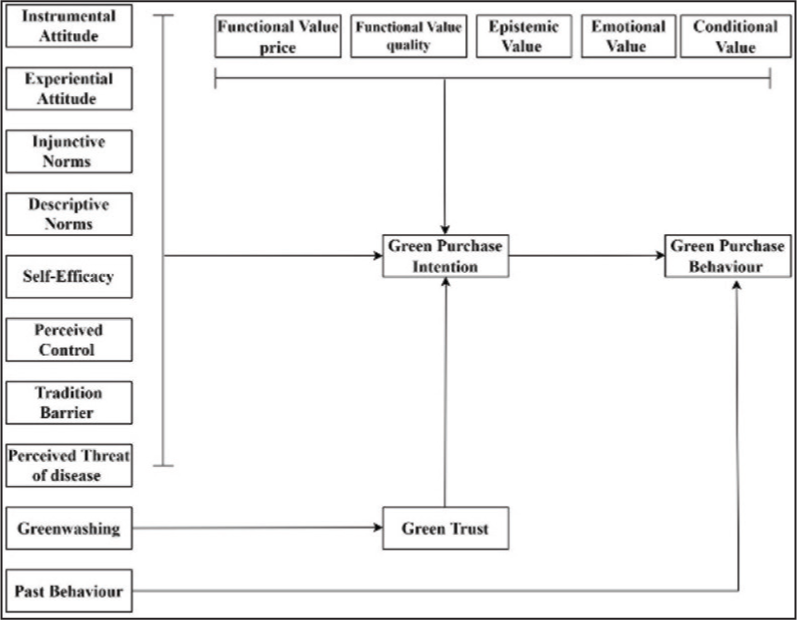
The conceptual model is presented in Figure 1.
Theoretical Contributions
This article has proposed an integrated conceptual model to examine various factors influencing GPB by integrating most relevant constructs from various theories. The sub-dimensions of AT, SN and PBC that are included in the proposed framework enrich the current literature and provide new insights into this research area. The conceptualization of PT adds to the current body of knowledge about consumer responsiveness to an external threat. Moreover, this conceptualization extends the literature on consumer behaviour by connecting COVID-19 and GPB. In this era of the pandemic, the construct of PT gains more relevance and, therefore, it will enhance the scope of HBM in consumer studies. In addition, PT can be employed in sustainability studies to link an external threat. Therefore, the construct of PT that explains the part of COVID-19 in GPB will encourage further in-depth research in consumer studies.
Furthermore, the mediation of GT and the connection between GW and GT in the proposed framework envelops the risk associated with green buying and gains a significant position in future research. This conceptual framework also considered the value and habitual dimensions to fill the gap of an integrated model to predict GPI and thereby GPB. In this sense, the unique combination of variables provides new cognisance to the existing literature. This framework has tailored the latest pieces of information, so, indeed, the proposed research model will act as a guide for analysing the drivers of GPB.
Practical Implications
The developing countries around the world are actively working to achieve the sustainable development goals of Agenda 2030. In this scenario, this article can offer several practical implications to the government and marketers. This proposed framework will aid green marketers in formulating new strategies to attract consumers to green products. The practical implication of integrating PT in the proposed model is that the manufacturers and marketers can understand the change in consumer preference and responsiveness to an external threat, and accordingly, they can modify their products with green attributes to spur demand. In addition, it will help the government to devise incentives in the form of tax concessions and subsidies for manufacturers to produce eco-friendly products in line with the sustainable development goals of Agenda 2030.
Furthermore, in India, the electric vehicle segment is in a nascent stage; Hyundai, MG, TATA, Hero Eco and Ather are the major players in the electric vehicle market. The theoretical insights provided by this article will help them to frame a new set of strategies to take the electric vehicle segment to the next stage of maturity. The framework also enables policymakers to reduce the risk of green buying by implementing strict guidelines. The policymakers can introduce environmental corporate social responsibility policies to enhance sustainable consumption. Finally, the article aids to frame new regulations to improve the sustainability rank of the country by encouraging sustainable consumption.
Future Research Directions
Future researchers can widen the idea outlined using the model by studying the interactions between the identified variables. Further empirical analysis of the proposed model by adding demographic variables will gain essential insights into this research area. Future researchers can adopt the validated scales from the previous studies, the construct of EA (Paul et al., 2016), IA (Do Valle et al., 2005; Wang et al., 2020c), IN (Han & Stoel, 2016; Paul et al., 2016), DN (Han & Stoel, 2016; Lapinski et al., 2014), SE (Armitage & Conner, 2001), PC (Paul et al., 2016; Shalender & Sharma, 2021), FV price (Rahnama & Rajabpour, 2017), FV quality (Rahnama & Rajabpour, 2017), EV (Lin & Huang, 2012), EMV (Rahnama & Rajabpour, 2017), CV (Lin & Huang, 2012), TB (Kaur et al., 2021), PT (Chua et al., 2021; Jeong & Ham, 2018), PB (Han, 2020), GW (Chen & Chang, 2013), GT (Chen & Chang, 2013), GPI (Paul et al., 2016) and GPB (Chaudhary & Bisai, 2018). The green product segment comprises a wide variety of products, and scholars can also use the proposed framework to investigate the drivers of purchase behaviour of a specific green product. Therefore, we suggest modifications in the measurement items from past studies so that it suits the requirements of different contexts of investigation. Future researchers can perform a confirmatory factor analysis (CFA) for testing the construct reliability and validity. In addition, we suggest performing structural equation modelling (SEM) to test the hypotheses.
Footnotes
Declaration of Conflicting Interests
The authors declared no potential conflicts of interest with respect to the research, authorship and/or publication of this article.
Funding
The authors received no financial support for the research, authorship and/or publication of this article.