







Abstract
In recent times, both developing and developed countries have witnessed the existence of the informal economy along with its formal counterpart, and India is not an exception. The informal sector is significant to the Indian economy in terms of its contribution to GDP and employment generation. Therefore, evaluating the performance of this sector is important in terms of the growth of the Indian economy for further policy formulation.
This study is purported to examine the performance of the informal enterprises in the Indian economy. The performance of informal enterprises is examined across a variety of factors, including ownership type, location, sector, enterprise type, and so on, to get a more complete picture. In addition, it is also analysing the determining factors of informal firm performance, paying particular attention to the outsourcing or subcontracting of the informal firms in all the subsegments. The study has used ordinary least squares (OLS) regression to examine the determining factors. For the empirical analysis, it has used National Sample Survey 73rd Round (2015–2016) microdata on unincorporated non-agricultural enterprises. The results show that urban informal enterprises are performing well compared to their rural counterparts, though inter and intra-sectoral heterogeneity has been observed across ownership type, location, sector, and enterprise type. It is also noticed that formal–informal interlinkage in terms of subcontracting is mostly exploitative in nature, with only a tiny portion of the informal enterprises benefiting from it. Subcontracting has a negative impact on the performance of rural enterprises, but it has a mixed effect on the performance of urban informal firms.
Introduction
In the last few decades, almost all countries have witnessed the coexistence of the informal sector with its formal counterpart, and the informal sector is growing rapidly in both developing and developed countries (Paul & Muniyoor, 2021; Paul et al., 2017). India is not exceptional here as around 90% of the total labour force in India is surviving through various informal activities (Hammer, 2019; Sengupta & Jha, 2020). Informal sector emerges as the primary source of employment in the countries as the modern ‘formal’ sector is unable to provide livelihoods to a large proportion of the labour force (Chakrabarti, 2009; Kundu & Chakrabarti, 2008; Mukherjee et al., 2019; Paul et al., 2017; Sanyal & Bhattacharya, 2009). Primarily, the informal sector has become the ‘reservoir of the surplus labour force’ (Sanyal, 2007). Sometimes these activities are termed as ‘informal’ or ‘unincorporated’ or ‘unorganized’ or ‘shadow’ and so on.
The informal sector belongs to the ‘periphery’ of the economy (Breman, 2016; Chakrabarti et al., 2016; Sanyal, 2007) and is mainly involved in low-value activities but plays a crucial role in eradicating poverty and inequality (Marjit & Kar, 2012). In addition, this sector contributes a significant proportion (approximately half of the GDP) of national output as well (Paul et al., 2017). Over the last few decades, both policymakers and researchers have been trying to comprehend the definition and characteristics of the informal sector. After several decades since the emergence of this concept, the question remains the same. Despite a sizeable literature, there is still substantial disagreement among researchers about the characteristics of this sector. Informal sector is conceptualized and portrayed in different ways by the researchers. Informal sector is portrayed in a positive light by the proponents of the ‘dualistic approach’. They assert that the informal sector is expanding alongside the formal sector through subcontracting (Marjit & Kar, 2012). On the other hand, researchers who adhere to the ‘legalist’ viewpoint consider that firms prefer to operate informally to reduce or bypass the cost of a lengthy registration process (Raj & Sen, 2016; De Soto, 1989). They stated that the informal sector is less productive compared to the formal sector (Raj & Sen, 2016). According to structuralists, the informal sector is an appendage to its formal counterpart in the process of surplus accumulation by providing cheap production factors and raw materials, which will help the formal sector maximize its profit (Moser, 1978). The formal and informal sectors were interconnected for mutual advantage, and the formal sector often encouraged the informal counterpart to reduce their cost of production (Breman, 2016). Even the postcolonial perspective is sceptical about this sector (Sanyal, 2007; Sanyal & Bhattacharya, 2009). They followed Harvey’s ‘accumulation by dispossession’ and stated that modern capitalism accumulates resources enormously from the non-capital sphere (Chatterjee, 2008; Sanyal, 2007). Therefore, it is clear that the characteristics of the informal sector and the link between the formal and informal sectors are still ambiguous. Furthermore, a broader and deeper understanding of the characteristics of the informal sector and the linkages between the formal and informal sectors is crucial in a country like India, where the informal sector predominates.
In this context, this study aims to understand the performance of the informal enterprises across ownership type, location, sector, enterprise type, and so on, in order to comprehend the traits of the informal sector and the consequences of formal–informal linkages. In addition, this study also focuses on the role of subcontracting in the operation of the informal enterprises in all of their subsegments. Although the existing literature has discussed the interlinkages between the formal and informal sectors, this study has segregated the informal sector into several subsegments for a deeper understanding. In a very concrete way, this study aims to compare the performance of informal enterprises across all their subsegments in the Indian context. In addition, we analyse the role of subcontracting in an enterprise’s performance. So, we are trying to get the answers to the following research questions: (i) Is there any heterogeneity in the performance of informal enterprises across all the subsegments? (ii) Does the subcontracting process boost these informal enterprises’ performance or does it push them towards an uncertain future?
For the empirical analysis, this study has used the latest (73rd) round of NSSO microdata (2015–2016) for unincorporated enterprises in India. To examine the performance of the informal enterprises, we have divided them according to their location in the rural and urban sectors. And within each sector, enterprises are divided according to the types of ownership, social group of the owner, location of the enterprise and type of enterprise. This study has used ordinary least squares (OLS) regression to analyse the determining factors of informal enterprises, which include variables like gross value added by the firm, net surplus of the firm, number of workers, capital employed, age of the firm, the firm’s waste management practices, Information and Communication Technology (ICT) usage, growth tendency, registration status and subcontracting status.
This article contributes to the existing literature in the following ways: first, it provides a comprehensive picture of firm-level performance in the Indian informal sector across all its subsegments; and second, it estimates the impact of subcontracting on the performance of informal firms across all the subsegments. Whereas the earlier studies dichotomized this sector into rural and urban, we have segregated it into more subsegments. So, this study will help to understand the informal sector in more concrete ways, allowing the researchers to create effective policies so that each segment of this sector can perform well.
The study is arranged as follows: The performance debate that is currently raging in the informal sector across the various disciplines is discussed in the second section. Here we have introduced the conceptual framework by presenting an extensive theoretical debate and introduced the role of subcontracting in the informal sector, followed by the next section with the data and methodology of the present study. The performance and role of subcontracting in the enterprises are discussed in the fourth and fifth sections, respectively. The last section concludes the study.
The Performance Debate: Informal Sector
In the early 70s, the International Labour Organization (ILO) promoted the notion of the informal sector (Bangasser, 2000; Chakrabarti, 2016). After a couple of years, Keith Hart coined the term ‘informal sector’ for the first time (Hart, 1973). In the initial stage, a group of scholars from Latin America initiated to start the discussion on the informal sector (Moser, 1978; Portes, 1978). For the time being, academics from many other fields have stepped forward to comprehend the characteristics of this particular sector. Due to its tremendous potential to employ a sizeable portion of the total workforce, this domain has gained attention in the context of research. In addition to developing countries, the informal sector exists in developed economies as well. Given this background, defining this sector is crucial for a useful policy instrument. An extensive discussion of the informal sector from various disciplines is presented in this section.
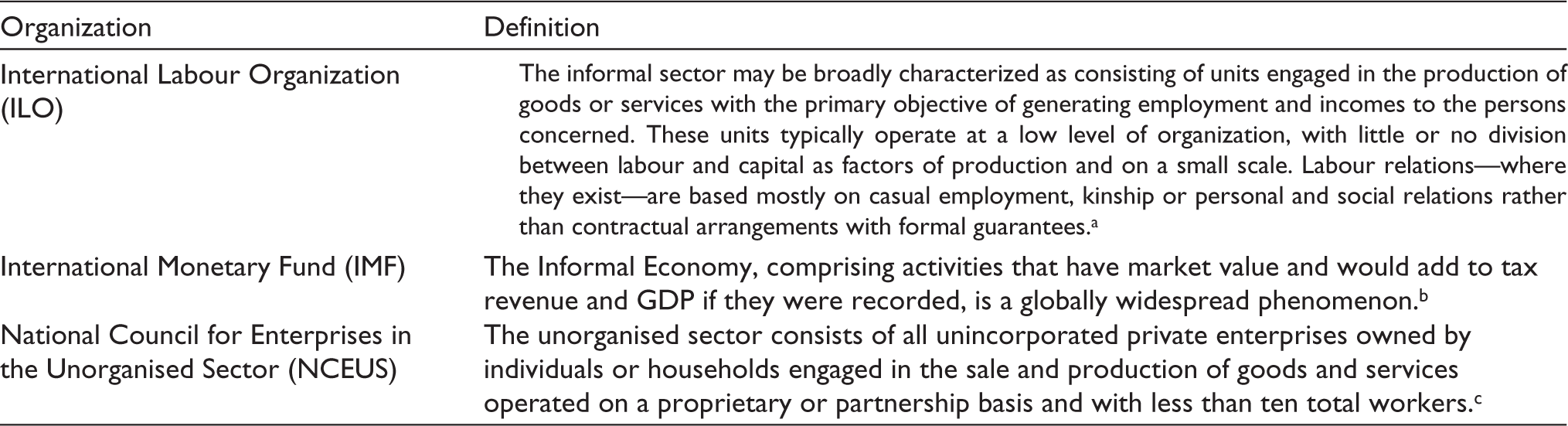
Various national and international organizations are described in Table 1. Despite the numerous definitions given to informal sector, we broadly follow the NCEUS definition. In this study, informal sector is conceptualized as ‘all unincorporated’ private enterprises owned by individuals or households engaged in the sale and production of goods and services operated on a proprietary or partnership basis and with less than ten total workers’ (NCEUS, 2007).
Definition of the Informal Sector.
b
c
In the early 1960s, the Lewisian framework of ‘Unlimited Supply of Labour’ failed miserably. On one hand, the modern sector was unable to absorb the unutilized labour force from the pool of the surplus population. And on the other hand, those who cannot find a job in the modern sector often survived through petty informal activities without any social safety nets, often exposed by market forces. The employment is mainly on a ‘hire and fire’ basis without any social or employment benefits (Breman, 2016). The nature and characteristics of the new segment are different from those of the modern formal sector and the traditional agricultural sector. Initially, the people engaged in this sector are often invisible to national statistics. Despite the sizeable literature, the proper characterization and identification of this sector is still an open question. We present a comprehensive debate on the informal sector from different perspectives. The neoclassical economists advocated the concept of the ‘dual economy’, where the informal sector is considered to be composed of marginal activities that are distinct from the formal sector. It often help to eradicate the incidence of poverty and act as a safety net for the poor in terms of income generation (Hart, 1973; ILO, 1972, 1992; Tokman, 1978). According to them, the informal sector is the most dynamic, innovative and effective segment of the economy and is often associated with subcontracting with its formal counterpart. These interlinkages ultimately help these informal units grow along with the formal sector’s growth (Marjit & Kar, 2012; Ranis & Stewart, 1993).
Contrarily, the proponents of the legalist approach believe that some ‘plucky’ micro-enterprises who desperately operate their enterprises to avoid the cost, time and effort of the formal registration process and need to convert their assets into private ownership (De Soto, 1989, 2001). They believe that these firms intend to avoid the legal cost of registration and choose to be informal, thereby deliberately avoiding the regulatory and taxation processes.
The structuralist approach is more sceptical about the informal sector. According to this approach, the informal sector operates as subordinate units of capitalist firms to reduce input and labour costs and increase the competitiveness of the formal firm. The famous anthropologist Jan Breman has also agreed with this view and delineated the informal enterprises as the residual part of the formal sector (Breman, 2016). The formal sector even encourages the informal sector to avoid regulation and increase profit through exploitation. In a similar vein, postcolonial scholars largely supported Harvey’s notion of ‘Accumulation by Dispossession’. They distinguished two types of economic activity: (1) a capitalist economy whose purpose is to make a profit, and (2) a need economy whose goal is to fulfil its basic needs. The capitalist sector often encroaches on the resources of the non-capitalist space in the pursuit of capital accumulation (Sanyal, 2007; Chakrabarti 2016). During the interaction between the formal and informal sectors, postcolonial capital excludes and marginalizes the informal counterpart, and this sector is exploited in terms of surplus extraction and appropriation (Sanyal, 2007).
The Indian perspective has a mixed reaction on this very issue. While a few firms are performing exceptionally well and progressing along with the formal sector, a large number of firms are becoming stagnant (Chakrabarti, 2014, 2016; Chakrabarti & Kundu, 2009). These firms are frequently unable to cope with market fluctuations and eventually fail. (Paul & Muniyoor, 2021; Paul et al., 2017; Papola, 1980; Raj & Sen, 2016).
Many scholars have stated that formal–informal interlinkage frequently benefits both the segments. Enterprises are linked with formal firms through subcontracting, offshoring or outsourcing, and these ties are advantageous to both the segments (Marjit & Kar, 2012; Ranis & Stewart, 1993). The formal–informal linkages formed through subcontracting, offshoring or outsourcing are often beneficial for small and micro-informal units in various ways: it includes technical advancement, employment and income generation, market access, capital accumulation and more (Singh, 2020). Contrarily, this subcontracting also restrains the informal firms from further growth. Sometimes, the firms that are engaged with the formal sector through subcontracting grow in slower pace than the firms that do not have such linkages (Shekar & Nataraj, 2022; Singh, 2020).
Data and Methodology
For the empirical analysis, this study has used the 73rd round (2015–2016) of NSSO microdata for unincorporated enterprises (excluding construction). Here, informal enterprises are defined as those that employ no more than 20 people in accordance with the Factories Act of 1948. We are considering an expected 66.1 million enterprises for our study from the 0.291 million samples. In this study, our major concern is to examine the performance of informal enterprises. We have considered net surplus (SURPLUS) and gross value added (GVA) as a measurement of firms’ performance following Paul & Colleagues (2017). In this study, we have divided the informal enterprises into two different sectors: rural and urban. Within each sector, enterprises are divided across ownership types (male-owned, female-owned, partnership and others), social group of the owner (socially deprived and others), location of the enterprise (within household premises, outside household premises) and type of enterprise (owned account enterprises and establishments). To understand the impact of subcontracting on the firms’ performances, we have used ‘incremental income earned by users over non-users’. In addition, this study analyses the determinants of performance of the informal enterprises. Here, we have used Ordinary Least Square (OLS) regression and the model is as follows:
Framework of NSSO (73rd round) Data Used in this Study.
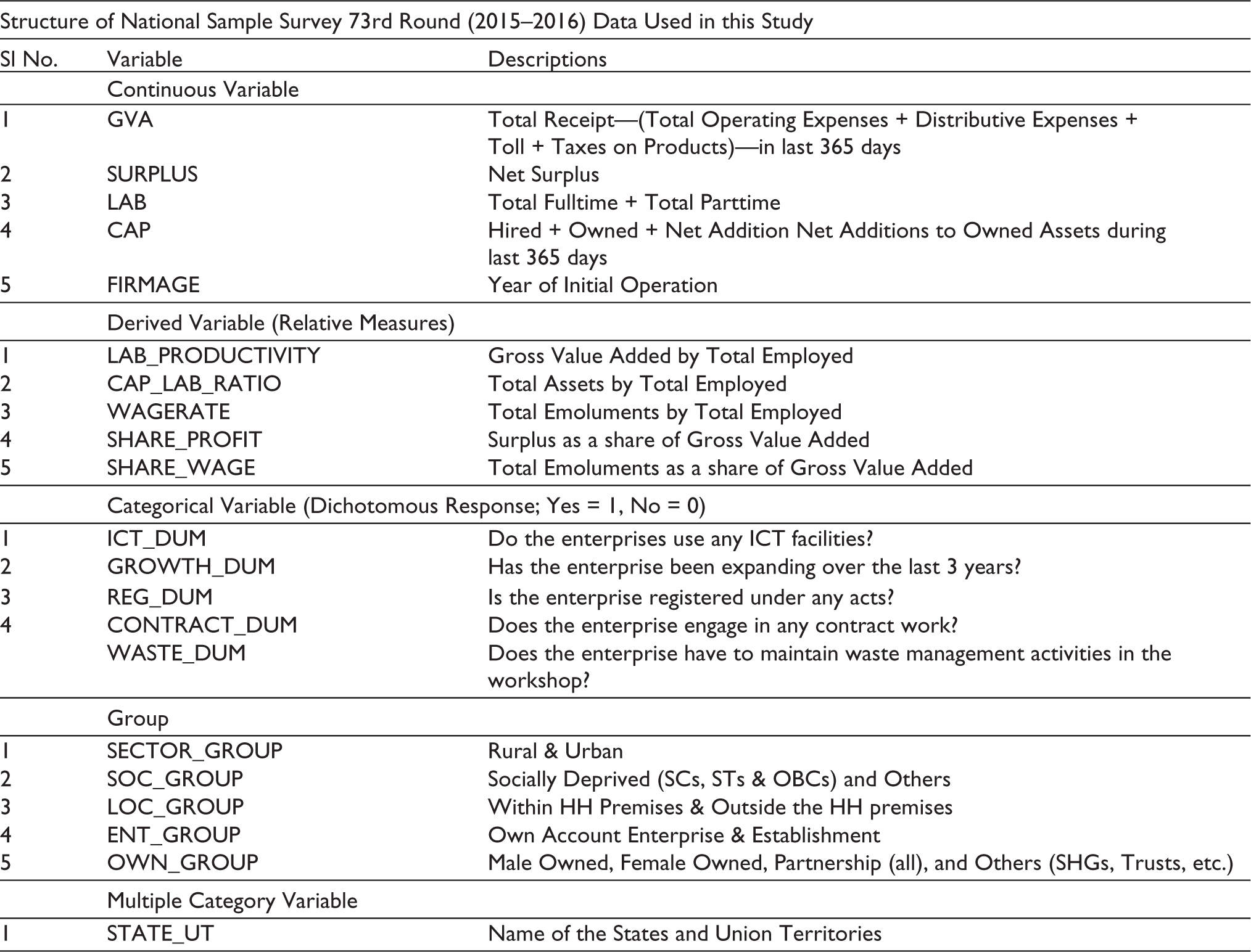

Where, Y, Dependent Variable; X, Independent Variables; C, Control Variables; α, β, γ, Co-efficients; m, number of Independent Variables; n, number of Control Variables; ε, Error Terms
In this model, the dependent variables are the performance variables: GVA and SURPLUS. The independent variables are the number of workers, capital employed in the enterprises and firm age. And the control variables are as follows: the firm’s waste management practices, ICT usage, growth tendency, registration status and subcontracting status. Table 2 provides the description of all variables.
Performance Measures
Paul and Colleagues (2017) used SURPLUS and GVA as measures of a firm’s performance in their study. In order to evaluate the effectiveness of the informal firms, we also took into account GVA and SURPLUS. The details of the other variables are discussed below.
Descriptions of Group Categories
Sector (SECTOR_GROUP): Rural Sector and Urban Sector
Social group of the owner (SOC_GROUP): Socially Deprived (Scheduled Caste, Scheduled Tribes and Other Backward Caste) and Others
Ownership Type (OWN_GROUP): Male Owned, Female Owned, Partnership (partnership with members of the same household and partnership between members not all from the same household) and Others (Transgender Owned, Self-help groups, trusts and other ownerships)
Location of the Enterprise (LOC_GROUP): Within household premises and Outside household premises (with fixed premises and with permanent structure, with fixed premises and with temporary structure/kiosk/stall, with fixed premises but without any structure, Mobile Market, without fixed premises—street vendors)
Enterprise type (ENT_GROUP): Own-Account Enterprise and Establishment
The Performance of the Informal Sector: An Overview
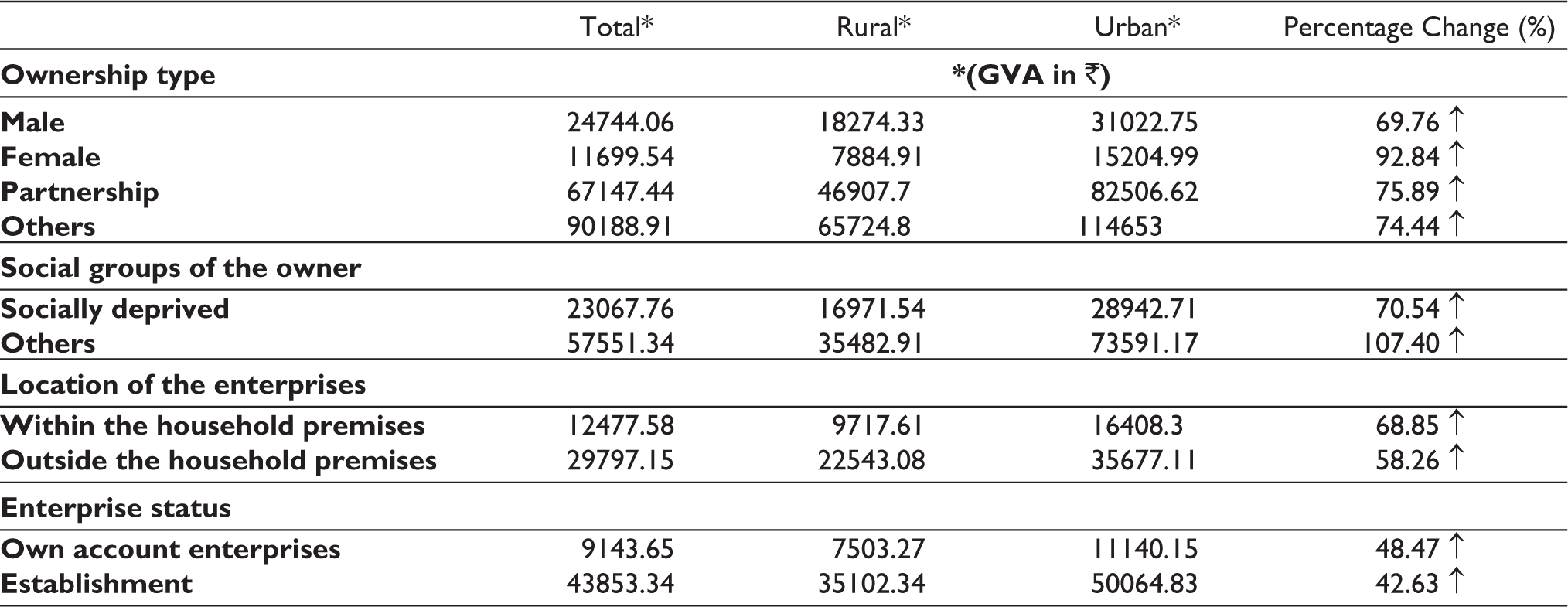
The performance of the informal sector has been the subject of extensive debate, yet the situation is still murky. Thus, there is a need for examining the performances of informal enterprises, and this section focuses on observing the group-wise means of GVA and SURPLUS for these informal enterprises. Table 3 delineates the average GVA of the enterprises across all segments in India.
From Table 3, it can be observed that the urban sector is performing well compared to its rural counterpart, and this is similar to the results of Marjit and Kar (2012), Chakrabarti (2016) and Mukherjee and Colleagues (2019). According to these scholars, one of the reasons for the better perfor- mance of the urban informal sector is the interlinkage with the formal sector through subcontracting or offshoring. However, the performance of the enterprises within each sector exhibits heterogeneity. A considerable disparity can be observed across the different ownership types of the enterprises, irrespective of the facts that in which sector the enterprise is located. All types of partnership-operated enterprises are performing relatively well on this list, and women-owned enterprises are at the bottom. Heterogeneity in firm performances is also noticed according to the social category of owners, and socially deprived-owned enterprises are not performing well. It is noticed that the male-owned enterprises are performing well compared to the female-owned enterprises. Location of the enterprise also matters in the case of informal enterprises’ performance. The enterprises that are located outside household premises are performing well than the enterprises which are located within household premises. The enterprises that are hiring labourers (the establishment) are performing better than the enterprises with unpaid family labourers (the own-account enterprises). It can be said that rural own-account enterprises, rural female-headed enterprises and rural enterprises within household premises are performing extremely poor. Contrarily, urban enterprises owned by the Self-Help Groups (SHG), trusts, etc., urban partner- ships and urban informal enterprises owned by other category owners (apart from the socially deprived), urban establishments and the urban enterprises that are located outside the household are the best performing segments. So, it can be said that not all the informal enterprises in urban areas are performing well compared to their rural counterparts. But, micro-segments like own-account and female-owned informal enterprises are not performing well, irrespective of the fact that they are located in the urban or rural sector. So, it can be concluded that the performance of the informal enterprises is very heterogeneous, as both inter- and intra-sector disparities are noticeable due to its diverse nature.
The Average GVA of the Informal Enterprises.
How does Subcontracting Impact the Dynamism of Informal Sectors?
The last section presents the heterogeneous performance scenario of the informal enterprises across all subsegments. One of the main factors behind this heterogeneous performances is the subcontracting/offshoring of formal firms. The dualist approach believes that outsourcing or offshoring helps the informal sector flourish along with the formal sector’s growth (Burchielli et al., 2014; Marjit & Kar, 2012; Ranis & Stewart, 1993). Contrarily, some researchers are critical of this dynamism and state that both complementary and conflicting relations exist between these two sectors (Chakrabarti, 2016; Mukherjee et al., 2019). Thus, there is a need to understand the role of subcontracting in the performance of informal enterprises. This particular section illustrates the performance of the enterprises considering the contract work of the firms across all segments.
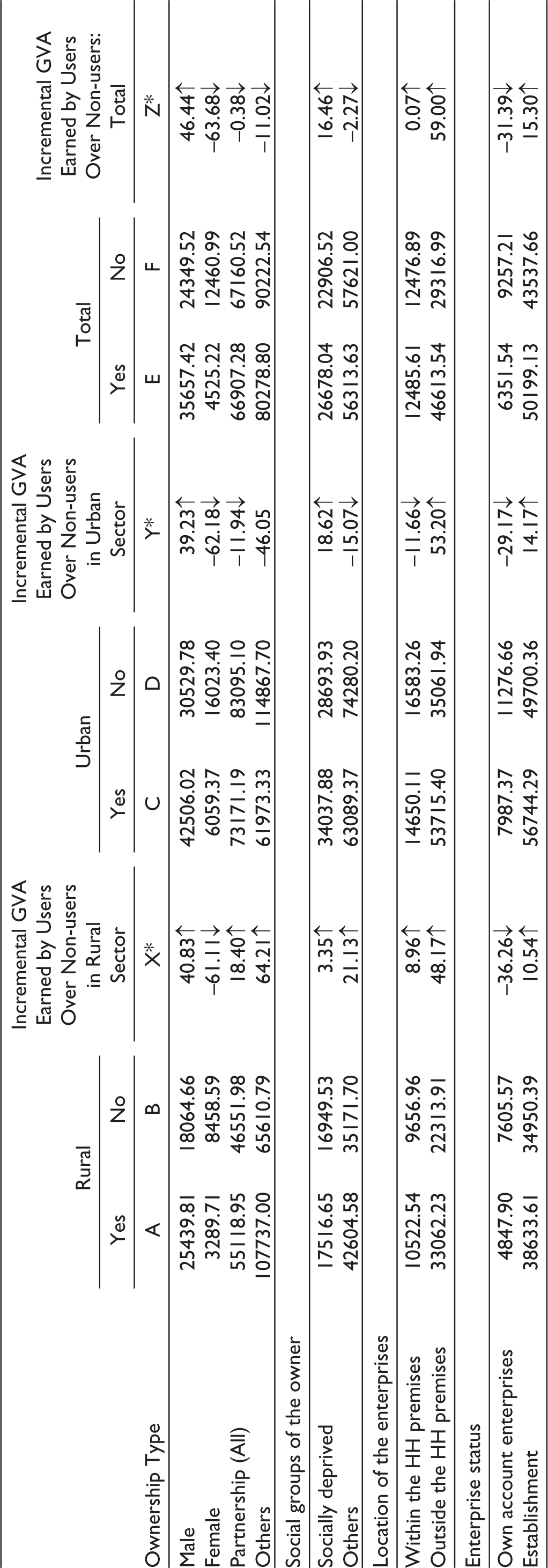
In each subsegment, we have two types of enterprises: those that are engaged in some kind of contract work and those that are not engaged in any type of contract work. Therefore, types of firms in terms of GVA across all the subsegments.
It can be observed that even in urban areas, firms engaged in contractual work are not performing well compared to their rural counterparts, except when they are male-owned, socially deprived, enterprises with outside operations and establishments. On the other hand, in the rural sector, apart from women-headed firms and own-account enterprises, the rest of the segments are performing better when they are involved in contract work. The main reason for such an adverse result is the presence of a few big firms and a large number of tiny informal enterprises. These big firms often dominate the bargaining process. Conversely, due to their small production capacity, these tiny units cannot negotiate with the big firms and get less prices for their products.
In the informal sector, social norms play a crucial role, as it can be observed that the owners who belong to socially deprived sections are not performing well, irrespective of the status of contract work. In both the rural and urban sectors, those firms that are engaged in contract work are performing well compared to those that are not engaged in any type of contract work, as is the case with socially disadvantaged owners. Strikingly, in urban areas, the firms that are not socially deprived-owned perform better when they do not take part in any kind of contract work.
In both rural and urban areas, own-account enterprises are performing well without any contract work, whereas it is the opposite in the case of establishments. Formal firms, which are capital intensive in nature, frequently engage in a subcontracting relationship with micro and small informal firms in order to reduce production costs and maintain market leadership. In the Indian economy, informal firms are huge in number, and these are labour-intensive in nature and characterized by low productive capacity. They face both intra and inter-sectoral competition and act as price takers. As a result, these small, informal enterprises are unable to negotiate with the formal firms in a collective way, which resulted in the poor performance of the firms while some of them managed hard to survive. This unequal negotiation or absence of negotiation makes this interlinkage weaker, and the relationship becomes exploitative rather than complimentary.
The Average GVA of the Enterprises in Terms of Contract Work.
From the previous discussion, we have noticed that the performance of the informal firms is heterogeneous in nature. Thus, there is a need for examining the determinants of informal firms’ performance. The previous literature has mentioned that subcontracting is a driving force for the performance of informal enterprises’ dynamism. It has also been mentioned that the urban informal sector is progressing along with the formal sector’s growth via subcontracting, whereas the rural sector is being isolated. Hence, we are going to analyse the determinants of the informal firms’ performance with consideration to subcontracting. In other words, here we will examine whether it is acting as a stimulator for the firm’s performance or not. To determine the impact of contract work on a firm’s performance, we carried out a comprehensive econometric analysis. Here we are using the simple linear regression model, and the variables are listed in Table 5.
Structure of Econometric Models Applied to NSSO (73rd round) Data.
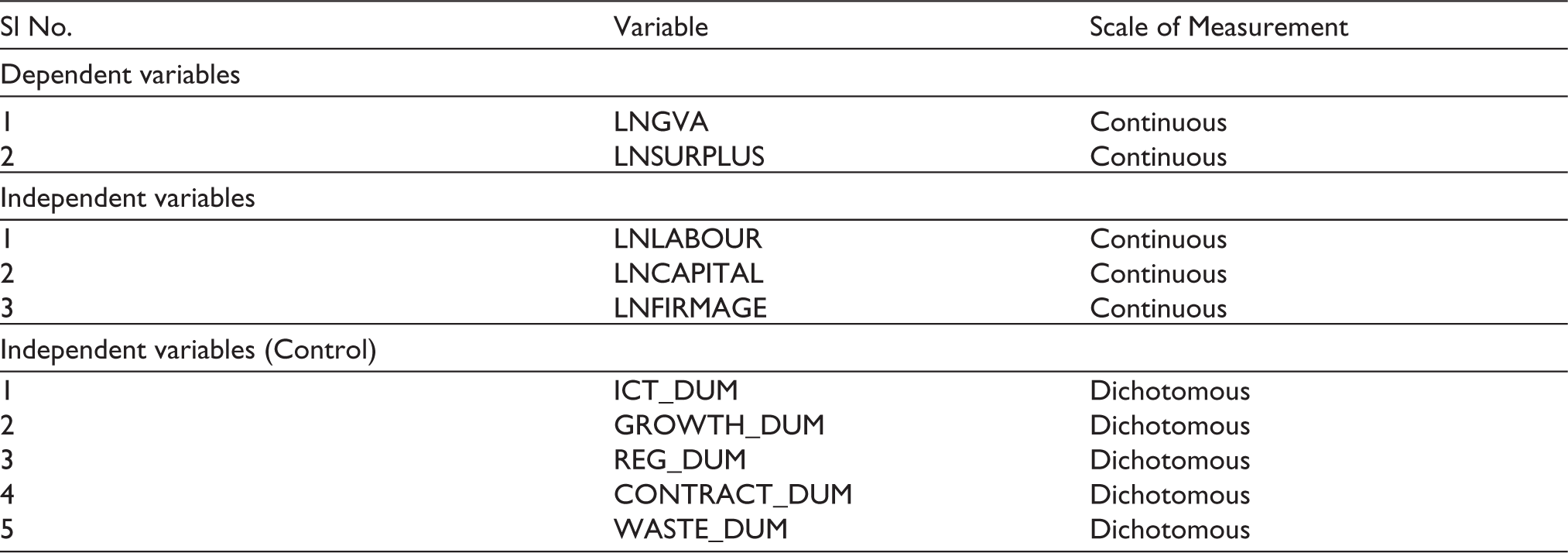
The regression has been performed for each of the subsegments, like ownership type, social group, location of the enterprise and enterprise type, for both rural and urban sectors. GVA and SURPLUS of the enterprise are considered as dependent variables, whereas independent variables are the number of labourers, capital intensity of the firm, age of the firm, the firm’s waste management practices, ICT usage, growth tendency, registration status and subcontracting status.
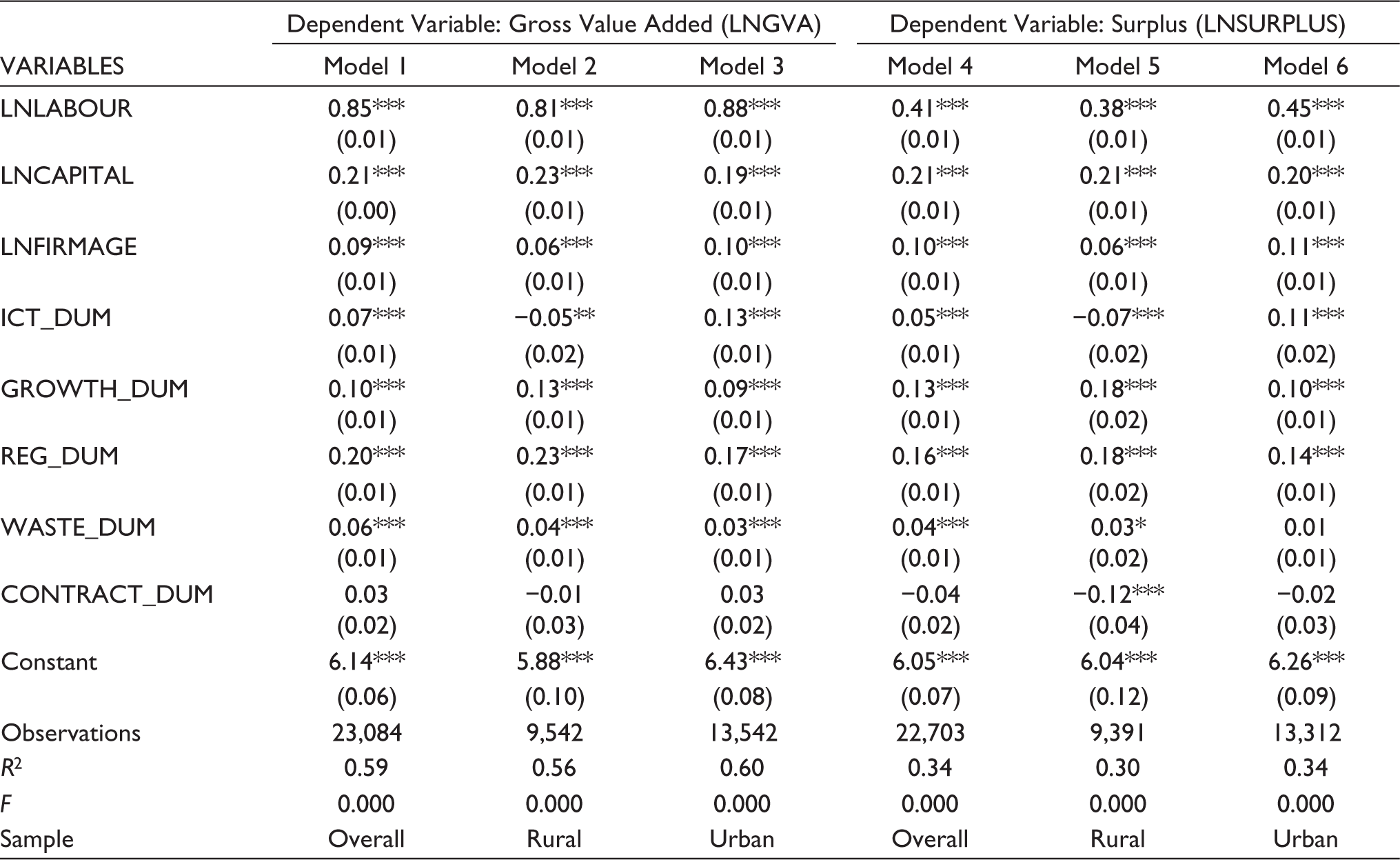
The overall regression result is shown in Table 6 along with the results for the scenario where enterprises are separated into rural and urban categories (Models 1–6).
From Table 6, it can be said that the number of workers, capital intensity of the firm, age of the firm, the firm’s waste management practices, ICT usage, growth tendency and registration status are the significant determinants of the performance of informal firms. In the case of urban informal firms, subcontracting is not a determining factor of performance, whereas it is a significant factor for rural informal firms. Although contract work is statistically significant for the firm's performance, it is adversely affecting the net surplus of the rural informal firms. So, the exploitative nature of the subcontracting system in rural areas is very evident from the empirical analysis.
Determinants of GVA and SURPLUS.
Robust standard errors in parentheses.
***p < .01, **p < .05, *p < .1.
Now, we have performed a similar regression model for each subsegment. From the empirical analysis, it is evident that contract work is largely exploitative in nature in rural areas. Because it is observed that contract works are negatively related to the performance of rural informal firms owned by socially deprived individuals as well as other ownership categories (Models 8, 11 and 12; see appendix). Similar kinds of scenarios are noticed in the cases of rural non-farm with an outside workplace (Model 20), rural own-account enterprises, as well as rural establishments (Models 23, 25, 28 and 29; see appendix). In addition to these rural informal enterprises owned by males, females (Models 32, 35, 37, 38 and 41; see appendix) are not also benefiting from the contract works.
However, the impact of subcontracting or outsourcing is mixed in the case of urban informal firms. Because those urban informal enterprises that are male-owned, located outside the household and hire labourers (Models 18, 22, 26 and 34) have a significant positive relationship with contract work. Whereas the relationship is negative in the case of urban female-owned enterprises and urban own-account enterprises (Models 25, 29, 35 and 41).
Given the discussion above, it can be said that the impact of contract work on a firm’s performance is very heterogeneous. We cannot assert that the growth of the informal sector is fuelled by contract work. In terms of formal–informal interlinkages, subcontracting works as both exploitative and complementing. To minimize production costs, the formal sector takes advantage of these tiny informal firms, eventually increasing their own market share. Only a few firms are benefiting from contract work and moving up the performance spectrum as a part of the urban informal sector.
Conclusion
This study presents a comprehensive picture of the Indian informal economy across its subsegments. It is known to us that the informal sector is very diverse in the context of India, and this leads to a heterogeneous performance of each segment of it. From the empirical analysis, it has been observed that urban informal firms are outperforming their rural counterparts in terms of GVA. The performances of the informal enterprises vary within and between sectors. Rural own-account enterprises, rural female-headed enterprises and rural informal enterprises that are located within household premises are not performing well. On the other hand, urban enterprises that are socially deprived-owned, enterprise located within households and own-account enterprises are underperforming. Furthermore, it can be said that these subsegments of the informal sector are vulnerable in both the rural and urban sectors.
Existing literature has shown that interlinkage between the formal sector and the informal sector through subcontracting enables the latter to flourish alongside the former. However, our empirical analysis yields different findings. It shows that the enterprises that are engaged in contract work are not always performing well. In rural areas, contract work is largely exploitative in nature. However, the impact is mixed in the case of the urban informal sector. So, it can be concluded that formal–informal tie-ups through subcontracting are mostly exploitative in nature, and only a tiny portion of the informal sector is benefiting from them.
The performance of the informal sector has been significantly impacted by a number of policy changes during the past few years. For instance, demonetization had an adverse impact on the informal sector since it is cash-driven, and only a tiny portion of the sector connected to the formal sector could be protected from shocks. Similarly, the imposition of Goods and Services Tax led to an uncomfortable situation for the many enterprises in the informal sector, which have been driven to the brink by efforts to make them tax compliant. Eventually, this tax compliance decreased their margins and volumes. The COVID-19 outbreak triggered an extraordinary economic lockdown that had an impact on the whole supply chain, particularly in developing countries like India. During a lockdown, the formal sector and its connected sectors might have some surplus, while the other segments might not. Therefore, individuals who had some kind of surplus may have made it through such a crisis by enduring such an unprecedented lockdown. For the other sections of the informal sector, it might be highly troublesome. Moreover, it is beyond the scope of this study to provide empirical evidence of the impact of these economic events on the performance of the informal enterprises, due to scarcity of recent data as well.
Footnotes
Acknowledgements
The authors would like to thank Bino Paul G D and Unmesh Patnaik for their support. The authors are grateful to Manojit Bhattacharjee and Radha Lekshmi M for their valuable inputs. The authors are grateful to Saumya Chakrabarti, Anirban Kundu, and Indrajit Bairagya. The authors also acknowledge the insightful comments made by the anonymous referees. The authors acknowledge the Indian Council for Social Science Research (ICSSR). However, the usual disclaimer that the author accepts full responsibility for errors and omissions applies.
Declaration of Conflicting Interests
The authors declared no potential conflicts of interest with respect to the research, authorship and/or publication of this article.
Funding
The authors received no financial support for the research, authorship and/or publication of this article.