







Abstract
This study attempts to assess the variations in households’ confidence levels in various sociopolitical institutions with varying socioeconomic and cultural characteristics across major Indian states based on two rounds of the India Human Development Survey (IHDS-I, 2004–2005; IHDS-II, 2011–2012). It traces the presence of a lower confidence level of households in governance institutions compared with other institutions, implying a deficit of households’ confidence in this component against the overall confidence score, which marginally improves over time. The states of Jammu and Kashmir and Mizoram have a lower level of confidence score in governance and justice compared to other states. On analysing the socioeconomic determinants of households’ confidence in two rounds of the IHDS separately, this study observes that regional and economic factors are more significant in shaping the confidence levels of households than any other socioeconomic attributes.
Introduction
With the evolution of ideas and changing perspectives on the role of institutions, a significant amount of literature has emerged asserting the role of confidence in social, local and public institutions, including the government, in shaping the levels of economic development across the world (Acemoglu & Robinson, 2008; Besley & Ghatak, 2010; North, 1990; North, 1991; Rodrik et al., 2004). The recognition of the role of institutions in the development of society is not of recent origin; it dates back to Adam Smith’s ‘Wealth of Nations’ (1776). The emphasis was on the minimal role of the government, limited to upholding the law-and-order situation and leaving the rest to the invisible hand (market institutions) to automatically ensure optimal resource allocations. Traditionally, it was believed that the market economy played the most fundamental role in efficiency of an economic system. However, ensuring efficiency in economic performance largely hinges on the public’s perception of the government’s performance and institutional structures. Otherwise, it is assumed that any degree of imperfection in the market or the absence of a market can cause serious detrimental effects on resource allocation, incentive structure and growth, resulting in economies attaining sub-optimal equilibrium outcomes. Therefore, it is argued that differences in market outcomes can largely be ascribed to different systems of property rights and political institutions (various governance and regulatory institutions) across economies. 1 Such an institutional architecture is historically credited to colonial establishments for setting up administrative institutions to regulate economic activities across the colonies. Rodrik (2000) highlighted that democracy helps build better institutions. On account of the role of institutions in shaping economic performance, numerous studies have attributed differences in economic performance to differences in institutional quality (Acemoglu & Robinson, 2008; Besley & Ghatak, 2010; Christensen & Lægreid, 2005; Commander & Nikolski, 2010; North, 1990; North, 1991) Osman et al. (2012) examined the relationship between institutional quality and economic performance in 27 sub-Saharan African countries and concluded that improving the institutional infrastructure plays a key role in delivering long-run economic development and social prosperity.
Such engagement primarily focuses on analysing the role of governance institutions in safeguarding private property rights and enforcing contractual laws, which leads to the primacy of societal trust in public institutions and the governance system of economies. With a similar premise, Arrow (1972) ascribed much of economic backwardness in various regions of the world to a lack of mutual confidence, as an attitude towards trust among individuals is a prerequisite for the progressiveness of nations. In the 1970s, Mckinnon’s (1973) and Shaw’s (1973) financial liberalisation hypothesis was in the larger public domain, which argued that liberalisation of financial institutions from government control or without public monopoly can serve people’s and economy’s interests better than if it is not left to the market. This is also based on Smith’s invisible hand principle.
Trust and confidence serve as the elementary dimensions of social capital, which are outcomes of specific institutional arrangements that have a bearing on economic outcomes under varying governance regimes. In particular, social trust, through its various interactions, influences the political and economic features of countries (Beugelsdijk et al., 2004; Bjørnskov, 2006; Knack, 2002; Whiteley, 2000). In addition, being an essential ingredient of social capital, social trust has helped many countries to perform better in terms of their economic standards than other countries with comparable economic development. Studies have also postulated that the higher the social trust, the better the functioning of bureaucracy in the delivery of governance and public provisioning 2 (Dollar & Kraay, 2003; Rodrik et al., 2004). There is a mutual relationship between institutions and individual trust. If institutions work perfectly, then people will have higher confidence in those institutions, and if people expect the institutions to serve efficiently, that would get reflected in strong institutions, as weak institutions cannot survive against people’s interests or by dissatisfying a majority of people’s interests in a democracy. Arrow (1972) recognised trust as an important determinant of economic development. Putnam (1993) claimed that social capital in terms of community association explained the long-run growth differences across regions in Italy during the post-World War II period. 3 A similar finding was also confirmed in a cross-country study conducted by Knack and Keefer (1997) in their seminal work on economic growth. Studies by Whiteley (2000), Zak and Knack (2001) and Beugelsdijk et al. (2004) established that countries with high levels of social trust but not necessarily other elements of social capital such as high human capital (measured in schooling) and rule of law or governance have not experienced faster growth than other comparable countries in recent decades. In addition, an environment of positive trust is assumed to be helpful in the functioning of a welfare state towards ensuring better economic growth (Kumlin & Rothstein, 2005; Rothstein, 2003). Knack and Keefer (1997) reported that trust could, in principle, be created by formal institutions, such as a strong rule of law. Trust can also play a key role in an institution in explaining the inequality of development across countries, whereby institutions define the formal rules in shaping human interactions (Acemoglu & Robinson, 2008). Algan & Cahuc (2014) described various theoretical mechanisms through which trust will have a significant influence on the economic development of countries. In the absence of trust, economies cannot attain efficiency and would remain away from the first-best allocation of resources. The literature points out that higher social trust leads to a higher supply of quality decisions in the bureaucracy and political process and hence better governance, which is an important determinant of growth (Dollar & Kraay, 2003; Rodrik et al., 2004). Rodrik et al. (2004) highlighted that the quality of institutions ‘trumps’ everything else. Nannestad (2008) postulated that countries with higher trust levels are successful in maintaining extensive welfare states. Such an association between trust and an efficient welfare state is largely attributable to the absence of anti-state sentiments and moral hazards. To generate public trust, there may be a need for higher government expenditures that may have greater welfare implications and a stifling effect on growth rates. Nevertheless, this needs to be verified in developing country contexts. This is particularly motivated by the premise of state patronage in welfare provisioning.
Several studies observed that Nordic countries have both highly trusting populations and extensive welfare states, suggesting that the universal welfare state may be associated with faster growth (Kumlin & Rothstein, 2005; Rothstein, 2003). Turning to potential transmission channels, education or human capital has proven to be difficult, and therefore, the theoretically strong association in economics often finds surprisingly weak empirical support (Temple, 2001). In addition, though primary education could arguably be of paramount importance to developing countries, many developed countries have mandatory primary schooling requirements, and the endogenous models based on technological changes are found to be more relevant to developed countries, suggesting the influence of higher education rather than basic skills (Nelson & Phelps, 1966).
People’s trust is a dynamic outcome of the performance of various types of institutions in producing different welfare- and efficiency-enhancing outcomes, and it also hinges on people’s prevailing perceptions of the functioning of these institutions in achieving these outcomes. It can be hypothesised that differences in the quality of these institutions depending on the geographical specificity in consonance with various socioeconomic and cultural characteristics can influence the levels of generalised trust in the working of institutions even within the same nation from geography to geography. 4 This is examined by accounting for a host of factors based on various cultural and institutional theories. Generalised trust, which is broader than particularised trust within a smaller society, is quite conducive to individuals’ meaningful living in a larger society, where individuals may need to interact and exchange with many people beyond the society’s smaller known networks. The society is endowed with generalised trust, and the trustees or individuals in the society are likely to establish a mutually cooperative relationship, which is essential for a healthy social environment. Following Banfield (1958) and Coleman (1990), social scientists make a distinction between limited and generalised morality. Coleman (1990) maintained a similar distinction between strong ties, defined as the quality of the relationship between family members, and weak ties, defined as the strength of social relationships outside the family circle.
Recognising the relevance of confidence and governance in economic development, the governments of developing and least-developed regions have been putting sustained efforts in encouraging private ownership and market-oriented reforms towards attaining higher economic efficiency, along with pressures and incentives maintained from time to time by multilateral international development organisations such as the IMF and the World Bank. However, it is also observed that, while ensuring efficiency in market-oriented economies, the market has been constantly replacing the traditional government provisioning. In some instances, market intervention is partially in force to encourage competition, whereas, in others, it has fully replaced government provisioning. With the introduction of such changes around the world, for a holistic analysis and evaluation of public trust in public institutions or government institutions, some authors have suggested accounting for the degree of improvement in public trust in the efficiency of market institutions. Otherwise, the degree of public trust in institutions of governance is probably under-evaluated (Edlund & Lindha, 2013).
Widespread economic reforms intended to ensure greater benefits to the poor can be possible if new reformed institutions reflect the local beliefs of a broad cross-section of the population rather than imposing something by a political class from the top-level bureaucracy in an administrative hierarchy. In the literature, there is a lack of identifying factors that shape the levels of confidence in public institutions in general and in developing countries like India in particular. Discussion on people’s confidence is pertinent in view of its bearing on their behaviour and shaping the institutions. Therefore, it becomes all the more necessary to examine the degree of confidence of citizens in various public institutions representing different social and political dimensions and to suggest policies to recover the deficit of confidence or strengthen the public confidence, if any, by mitigating and remedying institutional loopholes through reforms and achieving sustainable developmental outcomes faster. With this perspective in mind, this study attempts to contribute to the literature on households’ confidence in different institutions in three principal ways:
First, an incisive review of debates in the literature is comprehensively made with the aim of clarifying what may constitute the sources of social capital and recognising their relevance in the economic development of a developing nation facing any deficiencies in the roles of its social institutions. Second, the subcomponents of overall confidence in a developing economy like India are examined to assess their relative contributions to the overall/general confidence across different regions/states within India. Finally, an attempt to explore the broad determinants of public confidence is made by considering various socioeconomic, cultural and regional characteristics of regions across the states of India.
Empirical Assessment on Confidence— Trust and Institutions
A few studies have indicated the decline in public confidence in a wide range of central institutions (Dalton, 1996; Dogan, 1994; Listhaug, 1998), whereas others have focused on the loss of social trust among citizens as a significant indicator of social and political malaise (Putnam, 1995). Using cultural and institutional theories, Landmark (2016), in a related work for Botswana and Tanzania, investigated whether sociodemographic factors against the social capital factors determine trust in public institutions. He observed that institutional theories rather than cultural theories explain public trust in both countries. Yosuf and Nauman (2015) examined citizens’ trust in the government and other institutions of Pakistan, such as the federal government, provincial government, political parties, the army, the judiciary, the police and the medical departments. They observed distrust of respondents in the performance of all major institutions in Pakistan, except the army. A series of influential studies has demonstrated a positive contribution of trust and confidence in public institutions to developmental goals (Beugelsdijk, 2006; Knack & Keefer, 1997; Rothstein & Stolle, 2007; Zak & Knack, 2001). These studies observed that socioeconomic resources are emerging as significant factors in fostering public trust.
Interpersonal trust and confidence positively contribute to the smooth functioning of a society of any kind (irrespective of the organisation of the government: the democratic form of government, autocracy and economic system: socialist, capitalist and mixed), as both of them are essential elements of social capital. It is argued that the better the trust levels, the stronger the social capital. Generalised trust, which is broader than interpersonal trust, is exceptionally conducive to individuals’ meaningful living in society. In a society endowed with generalised trust, individuals’ confidence is likely to establish a mutually cooperative relationship, which is essential for a healthy and sustainable social environment. However, the emergence of generalised trust and confidence from particularised confidence is quite complex, especially in a developing country context, mainly because people tend to mistrust others who are outside their own ethnic group or local community. This results in a lack of social trust. In contrast, some argue that a low score on trust in poor countries does not necessarily imply a deficit in interpersonal trust, but an absence of well-functioning institutions.
Knack (2002) reported that government social capital represents government regulations and institutions, whereas civil social capital consists of common values, norms and trust-based networks. The close proximity is likely to enhance the partnership between the government and civil society, which can foster democratic practices and facilitate better provisioning of public services (Evans, 1996; Fukuyama, 1995). In a developing country context, it is hard to find a higher degree of trust by citizens in public institutions as institutions fail to serve more effectively on account of the scarcity of resources on the one hand and inefficiency in the service of the people and inefficient monitoring in the working of these organisations on the other. In addition, citizens with distrust are less inclined to comply with the laws in general and are less tax compliant in particular (Levi & Stoker, 2000). Furthermore, trust serves as an economic lubricant for the wheel of economy, reducing the cost of transactions, enabling new forms of cooperation and furthering business activities, employment and prosperity (La Porta et al., 1997).
As reported by Beugelsdijk (2006), although macro trust is closely related to the functioning of institutions at the aggregate level, macro trust and micro trust are complementary to each other. He argued that measuring trust in institutions is the same as measuring well-functioning institutions with regard to contract enforceability, transparency, international corruption index, black market premium, revolutionary coups, rule of law, capitalism and social infrastructure. Trust is highly valued as it is an efficient channel for coping with uncertainty. Because of a lack of trust, countries tie up their economies with strict regulations and strong institutional order. Trusting societies also enforce strong legal systems that gain citizens’ confidence. However, strong institutions may not always contribute to a higher level of trust as the relationship between them is responsive to the actual stage of development of an economy and other social factors such as a sense of belongingness to community. For instance, higher educated people may have a higher level of trust towards similarly educated people with whom they daily transact and associate, but not with others.
Vanneman et al. (2006), using the IHDS datasets, examined the associations between various dimensions of social capital. They focused on three measures of social capital, namely a positional generator of social networks, a count of memberships in formal organisations, and a subjective index of confidence in institutions. Although all three measures showed good internal reliability, the association between them was found to be low, suggesting that no generalisation can be established from one type of social capital to another in India. Kumar et al. (2021) analysed public confidence in state governments in India using the IHDS datasets. They observed that a lower socioeconomic status is more likely to generate a higher level of confidence in the state government and that the households that have received benefits from government programmes show higher confidence levels. However, they did not explore regional and other perspectives that are being analysed here.
Based on a comprehensive survey of the literature, it is observed that empirical verification of the role of social capital is limited to individual country contexts, and this study attempts to verify this in the Indian context. This is a maiden attempt in this respect in terms of measuring households’ confidence in a range of institutions representing public provisioning and protection of citizens’ interests in various states of India. This provides an exposition of the differential level of confidence prevalent across various regions and its temporal change in relation to a range of pertinent sociocultural and economic attributes.
Data and Methodology
Data
This study uses the IHDS-I (2004–2005) and IHDS-II (2011–2012) datasets to analyse the confidence level in different institutions among Indian households. The IHDS is a nationally representative household survey carried out by the National Council of Applied Economic Research (NCAER) and the University of Maryland, with a specific focus on issues related to human development. This database also contains important information regarding the characteristics of households and individuals, similar to that of the National Sample Survey Office (NSSO) database. It measures different dimensions of human development besides measuring the changes in the socioeconomic characteristics of households in different states of India. 5 Subject to the information available from the survey, an index of confidence for the two-time points of the IHDS (2004–2005 and 2011–2012) is computed in this study. The confidence levels of households are qualitatively measured in three levels: great confidence, some confidence and hardly any confidence in various institutions, viz., politics, the military, the police, state governments, newspapers, panchayats, schools, medical departments, courts and banks. 6 Here, instead of the IHDS panel datasets, independent cross-sectional datasets are used for the analysis. Aggregate confidence scores are computed by adding up these disaggregated indices. Using these sub-indices, different kinds of broad indices on social, governance, justice and other confidence scores are also computed.
Methodology
To compute confidence index scores, modified normalisation methods were used, as explained in the Human Development Report Team (2013), by using two rounds of IHDS-I (2004–2005) and IHDS-II (2011–2012). This can be represented as follows:

In this study, an aggregate index of confidence is computed eloquently, wherein the least/worst value of 36 and the best value of 12 are chosen for IHDS-II, whereas the worst value of 30 and the best value of 10 are chosen for IHDS-I. These values are imputed based on the confidence scores reported by households as 1, 2 and 3 in a hierarchy from high to low confidence levels. 7
Hence, a minimum possible confidence score of a household is 12 (10 for IHDS-I), whereas the maximum score is 36 (30 for IHDS-I). Against this backdrop, every individual household’s independent confidence score is evaluated against the worst value so that it reflects the extent of improvement in confidence. To further simplify our indexing process, the indexed values are reversed so as to range between 0 and 1 (with 1 representing the best and 0 the worst). Hence, a higher index value would represent a higher level of confidence compared with a lower index value. It is crucial to note that the segregation of social confidence (in health and education sectors) in IHDS-II into public and private did not affect our aggregate confidence score estimates, because relevant adjustments were taken into account separately while calculating the aggregate confidence score, that is, an aggregate total high value of 10 and a lower value of 30 for IHDS-I (2004–2005) and a high value of 12 and a low value of 36 for IHDS-II (2011–2012).
Then, the distribution of confidence scores is divided into two categories around its median value to locate the determinants of higher confidence vis-à-vis lower confidence considering the overall confidence score and the governance confidence score. This exercise is carried out based on the data of both rounds of IHDS-I (2004–2005) and IHDS-II (2011–2012), wherein a period dummy is introduced to measure the possible influence of differences in the period on confidence scores. The logit model is used to estimate and understand various correlates related to households’ confidence levels with other households’ attributes. It is used to investigate the relationship between binary or ordinal response probability and explanatory variables. This study adopts the approach followed by Trueck and Rachev (2009), which can be presented as follows:
Let yi denote the response of the binary dependent variable i with respect to the independent variables x1i,…, xki. For example, let Y = 1 denote the household’s low confidence in aggregate governance institutions, and Y = 0 denote high confidence (from the median value). Then, using the logistic regression, the following equation can be derived:

The function f denotes the logistic distribution function such that we get the following equation:

The logistic distribution function transforms the regression into an interval (0, 1). Further defining the logit(x) results in the following equation:
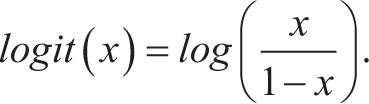
The model can be represented with real constants β0, β1, ..., βn:

Each of the explanatory variables represents various households’ characteristics, and their estimation relies on the maximum likelihood estimation procedure using numerical methods. The advantage of using this approach is that it does not assume multivariate normality and equal covariance matrices as the discriminant analysis does (James Press & Wilson, 1978). Further, the odds ratio is computed from the logit model to understand the likelihood of various socioeconomic factors influencing aggregate confidence in governance institutions.
The dependent dummy variable includes households’ confidence at the median at the aggregate level as well as the governance score (0 = above the median, 1 = below the median). The independent variables representing various household attributes used in this study include IHDS-I (2004–2005) as the base, social group identity dummy (ST reference category), religion identity group dummy (Hindu reference category), income group dummy (lower quintile as the base category), sector dummy (rural as the base category) and regional dummy (east region as the reference category). An interaction dummy is included in the model, which includes interacting the IHDS base with social groups, religious groups and sectors. The estimates of the ‘odds ratio’ for all the regressors are derived from the pooled logit model estimates for both the survey periods (IHDS-I, 2004–2005; IHDS-II, 2011–2012). While analysing the aggregate confidence score and state confidence percentage shares, household multipliers/weights are used (to calculate the total population parameter).
Changing Level of Confidence in Different Institutions among Indian Households
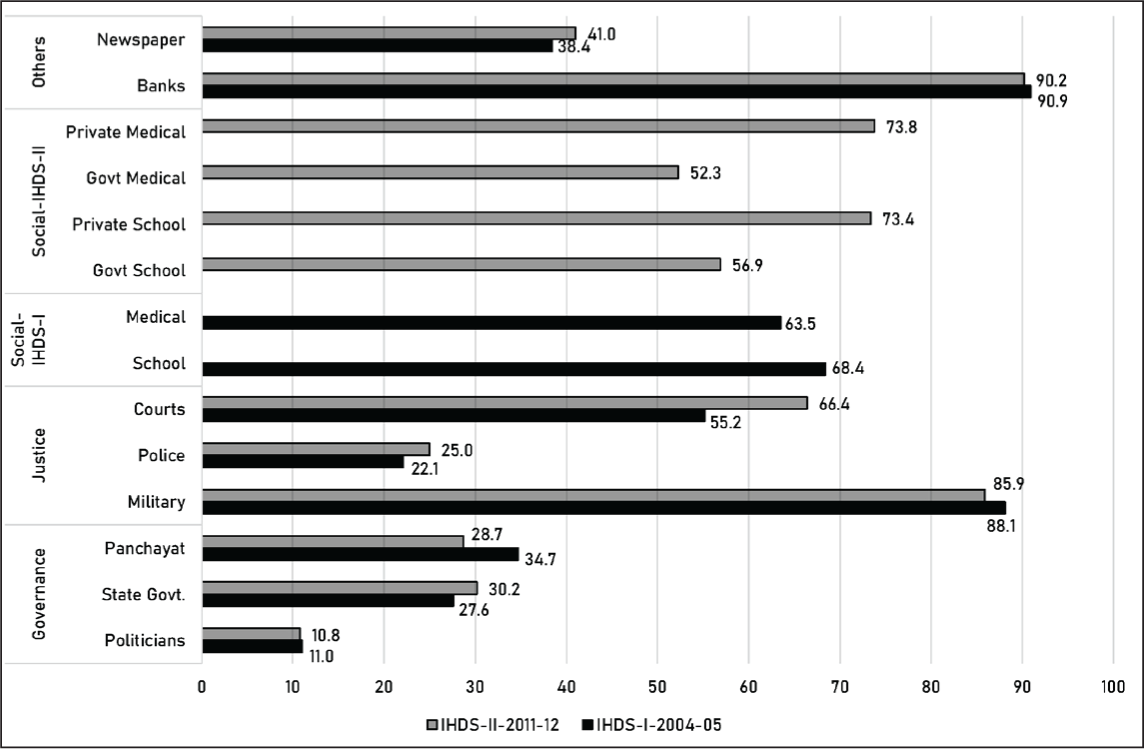
While evaluating the extent of confidence in terms of a score derived based on the reported opinion of households on a given scale, a visible improvement is observed in confidence in a few areas of government machinery, such as the police, state governments and courts. However, a mixed pattern of improvement and deterioration in confidence scores is also observed over time across regions.
In summary, the statistics in Figure 1 indicate that although an increase in households’ confidence levels in some institutions is observed, a decline in confidence is also observed in a few others over time (such as politicians). In addition, such an assessment offers evidence of a great deal of disparity as regards confidence across institutions. For instance, higher levels of confidence are observed for institutions such as banks, the military, courts, private schools and government medical institutions compared with governance institutions such as politicians, the police and state governments, including newspaper agencies like media, government schools, and so on. Some modest improvements are observed in households’ confidence levels in institutions such as the police, newspapers and state governments, which remain minimal. The confidence in social sectors such as health and education is further disaggregated in IHDS-II in terms of public and private to reflect upon the differential level of confidence between them. However, the most disquieting feature relates to the deterioration of public confidence in institutions such as panchayats, government medical institutions, government schools, banks, the military and politicians over seven years. This undoubtedly hints at a confidence deficit in public institutions, which could be due to either a lack of efficiency compared with private provisioning or the quality of services delivered by public institutions. Given this trend, it is rather rewarding to investigate confidence levels across sectors and among households in terms of their socioeconomic attributes to uncover additional insights as to whether reliance/confidence in certain institutions is merely guided by frequent engagements with them or their ways of functioning below the public expectation.
Pattern of Confidence in Institutions across Socioeconomic Attributes
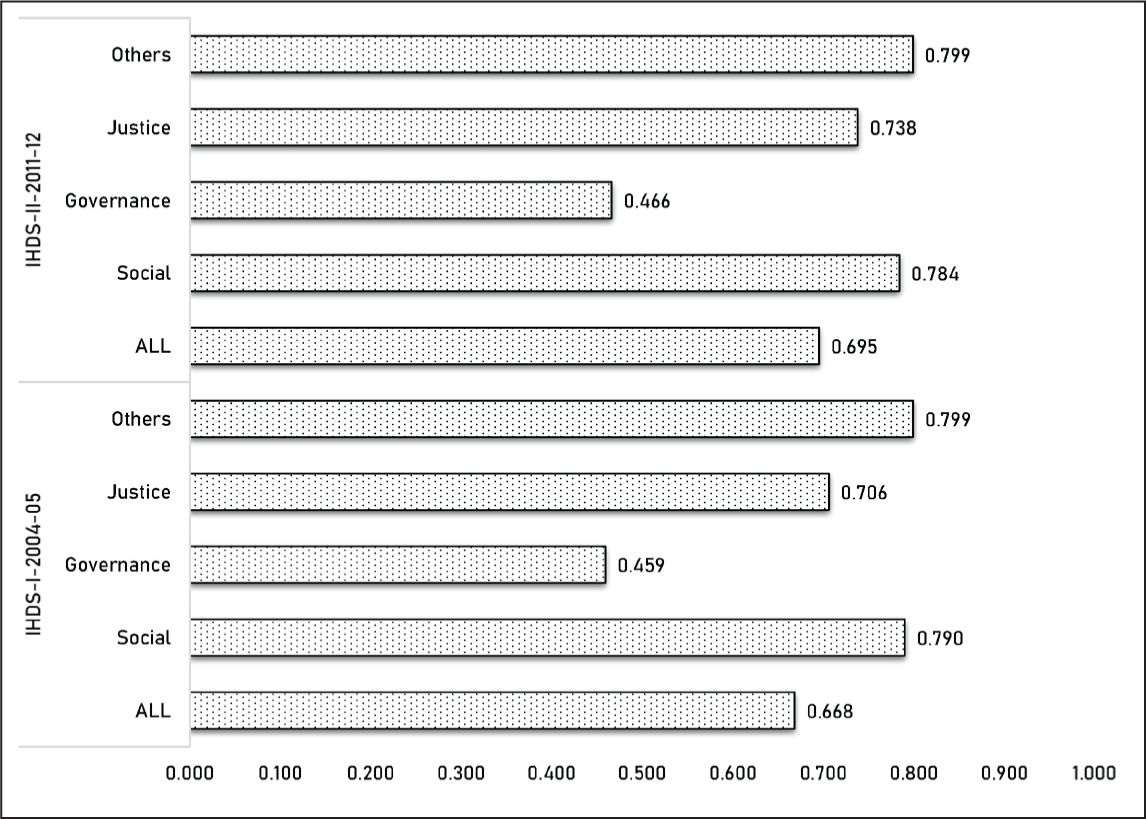
As confidence levels are measured in three categories, an analysis of the share of households with the highest confidence level across institutions and over time displays a pattern that unfolds the differential confidence on the one hand and improvement/deterioration on the other. The institution where households pose higher confidence levels is banking, which is gaining confidence over time, followed by the military, which has shown a marginal decline over time. Among other institutions, two-thirds of the households depose confidence in the medical and schooling domain in the period 2004–2005. However, when these components were split into public and private in the later period, it is evident that though half of the households seem to have full confidence in public institutions of education and health, nearly two-thirds of the households have confidence in private education and health institutions. Besides education, health and banks, there is a visible sign of confidence in legal institutions (courts) and the police although only a quarter of the households have the highest confidence in the police. Coming to pure governance institutions such as government, politicians and decentralised institutions like panchayat raj, a marginal improvement is observed in complete confidence in the government. This description is mostly in terms of the share of households deposing extreme confidence, and therefore, to compare the differential confidence level across institutions and over time, the aggregation of their distribution of confidence levels has been calculated in terms of confidence scores. Figure 2 shows the aggregate average confidence score and average confidence score for governance, justice, social and others. Based on these scores ranging between 0 and 1, the overall confidence score among Indian households has shown a marginal improvement over time, and the score level remains midway between 0.6 and 0.7. While observing these scores along with the broad components of governance, justice, social and other confidence, there seems to be a scale difference with justice, social and other confidence, which is well ahead of the governance component. A marginal improvement is observed in three of the four domains, except for the social domain, where a slight decline is observed. Altogether, the aggregated scores reflect the differential level of confidence in varying institutions, with a clear deficit of confidence in governance institutions, with a score level of around 0.466 during 2011–2012.
Given the differential confidence scores across components and their degree of improvement over time, an attempt is made to understand the responsive dynamics of these scores over time, as well as across components in terms of their distribution across Indian states. Analysis of the confidence scores and their characterisation over time is presented in Table 1. This analysis is intended to reflect upon the kind of variation in these confidence scores across characteristics and changes over time.
From the overall average confidence score, a marginal improvement in confidence levels is apparent over time with the narrowing down of characteristic differences. In period I (2004–2005), the widest difference in this confidence score was between 0.635 and 0.733, which declined to a range between 0.665 and 0.711 in period II (2011–2012). However, this range of variation in average confidence score is different for specific domains such as social, governance, justice and others. Considering the overall average confidence score inclusive of all domains, the widest variation is observed across regions, followed by religion and caste characteristics, indicating that other attributes such as residence, economic hierarchy, poor and non-poor, as well as the educational level of the head of the households, make a very little difference to these confidence scores (see Table 1). Table 1 indicates that the rural–urban divide is quite marginal, but over 7 years, the improvement in the confidence score is more in favour of urban households than rural households. Following the characteristic inspection of the average levels of confidence scores, it is proposed to examine the same over two-time points across the states. Such an inspection has been done, in the next section, in terms of placing the states in a four-quadrant scape divided by the median level of the confidence score.
Mean Confidence Scores for Various Categories of Households in India.
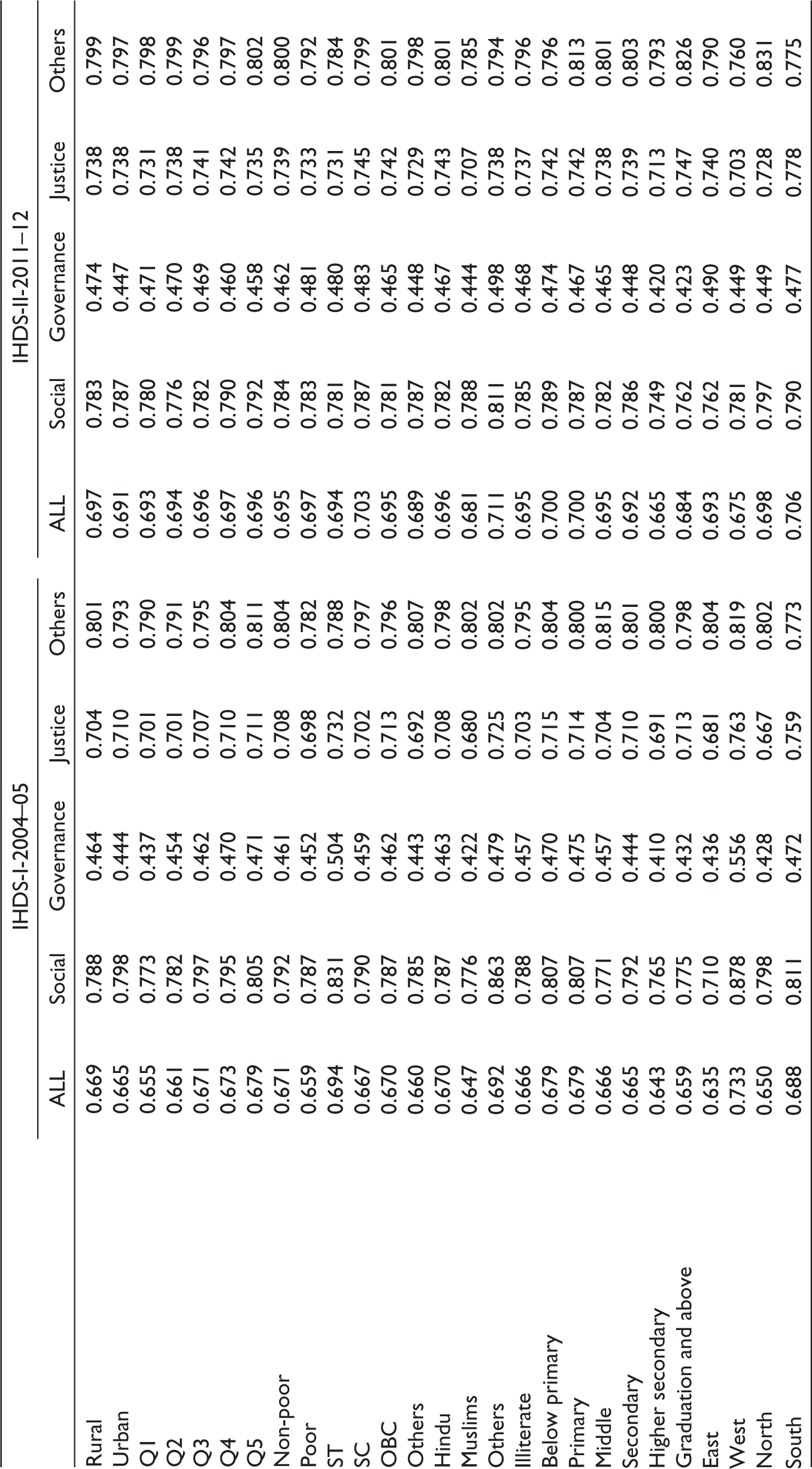
The mean index confidence score reflects the persistence of fewer differences across the regions, except for the fact that a higher confidence score was observed in the western region in the earlier survey, which has favoured the southern region in the later period. In terms of caste and religion, these confidence scores do not show drastic variations at both time points, except that Muslims (a minority) have lesser confidence compared with others and Hindus. In terms of caste groups, it is the backward social groups (households from either SC or ST communities) that seem to have a higher level of aggregate confidence than others. Further, when it comes to improvement in these confidence scores, except for the ST community, all other social groups show a visible improvement in the overall confidence score. With respect to confidence in institutions on different attributes, caste group differentials are almost in keeping with the overall pattern. The mean governance confidence score is quite lower compared with other institutions.
As per the educational level of the household head, estimates reflect that less educated heads have a moderately higher confidence level than educated ones, and this difference persists over time despite a marginal improvement in the confidence levels of the better educated. Estimates also reflect that Muslims have less aggregate confidence in institutions and governance compared to Hindus. This can be due to the discrimination meted out to the population based on religion. This observed pattern of the overall confidence score against that of the social confidence score gets strengthened further over time, and the emerging pattern indicates an agreement at either of the extremes of the overall confidence score.
Across quintile groups, results reflect that poor confidence levels are largely conditioned by poor confidence in governance and that better confidence, on the whole, goes along with a higher confidence level in the system of governance. It is important to note that since services provided in the market remain out of reach for the poor, they might have a higher confidence level only in government-provided services. On the other hand, middle- and high-income groups may well afford the services available in the market. This observation of improvement from the base period gets weakened over time as—despite the improvement in overall confidence—a significant deficit is observed with regard to the confidence in governance.
Changing Level of Confidence among the States of India
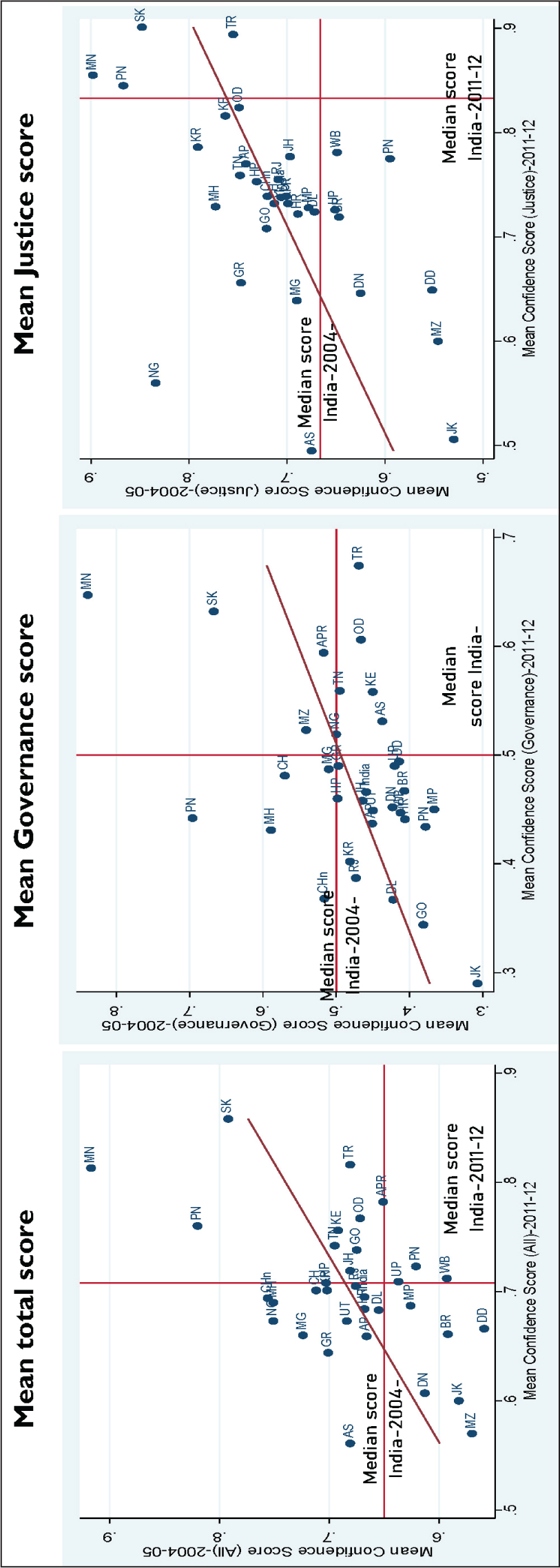
The state-level analysis reflects an interesting pattern in differences in the confidence score at the overall mean confidence level, as well as across governance and justice confidence scores. Figure 3 shows that the overall confidence index in institutions undoubtedly improves over time across a majority of the states at the aggregate level, as well as for the governance and justice category combined. This is also reflected in terms of the average index for all the states and union territories, which show only a marginal improvement from 0.668 in the first survey (IHDS-I, 2004–2005) to 0.695 in the second survey (IHDS-II, 2011–2012) at the aggregate level. Based on the change in the overall confidence score between the two-time points across the states, it is observed that 12 out of 29 states have improved their overall confidence score. The remaining states experienced a declining confidence score over time, among which Bihar, Madhya Pradesh, Uttar Pradesh and West Bengal are notable with a reasonable decline in the levels of confidence scores. A similar comparison made for the governance and justice component reflects a similar regional divide, with 12 states improving their score but others declining over time. Figure 3 reflects that, at the aggregate level as well as in the governance and justice category, Jammu and Kashmir has a very low level of governance and justice confidence score compared with other Indian states.
In terms of the overall confidence score compared over time, it is apparent from Figure 3 that many of the most populated states such as Madhya Pradesh, Uttar Pradesh, Bihar and West Bengal have remained in the lower spectrum of this score compared with a few smaller states belonging to the high–high quadrant, intimating an improvement in their confidence, which already showed relatively better confidence scores in period I. Except for the states of Manipur and Sikkim, other states such as Tripura, Bihar, Uttar Pradesh, Madhya Pradesh, Chhattisgarh, Rajasthan, Odisha, Assam and West Bengal fare poorly in terms of the overall confidence levels of households compared with those in richer states such as Gujarat, Maharashtra and Haryana. This reflects the different levels of household confidence at the aggregate level, as well as across the governance and justice score for major Indian states.
Understanding the Factors Influencing Overall Confidence in Indian Institutions
With an understanding of characteristic variations and temporal changes in confidence scores, it becomes pertinent to trace out the determinants of overall confidence levels in Indian states. Such an attempt will help figure out the relative significance of a range of socioeconomic characteristics in shaping the confidence levels in specific domains, which might translate into building up the overall general confidence in the working of public institutions in India. This is compared between two survey periods to observe the possible changes in the influence of dimensional characteristics.
Logit Odds Estimates—Aggregate and Governance Confidence Scores.
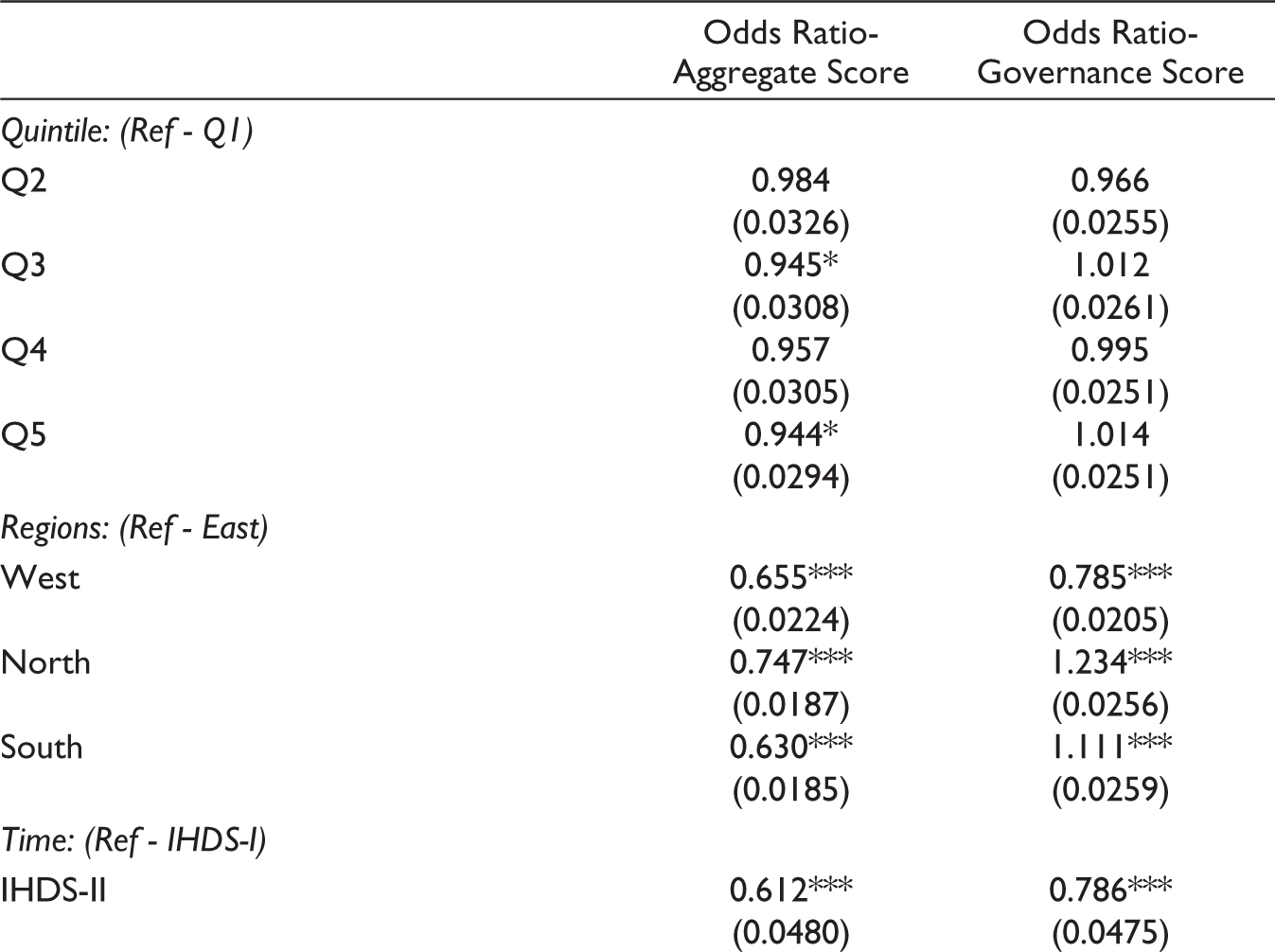
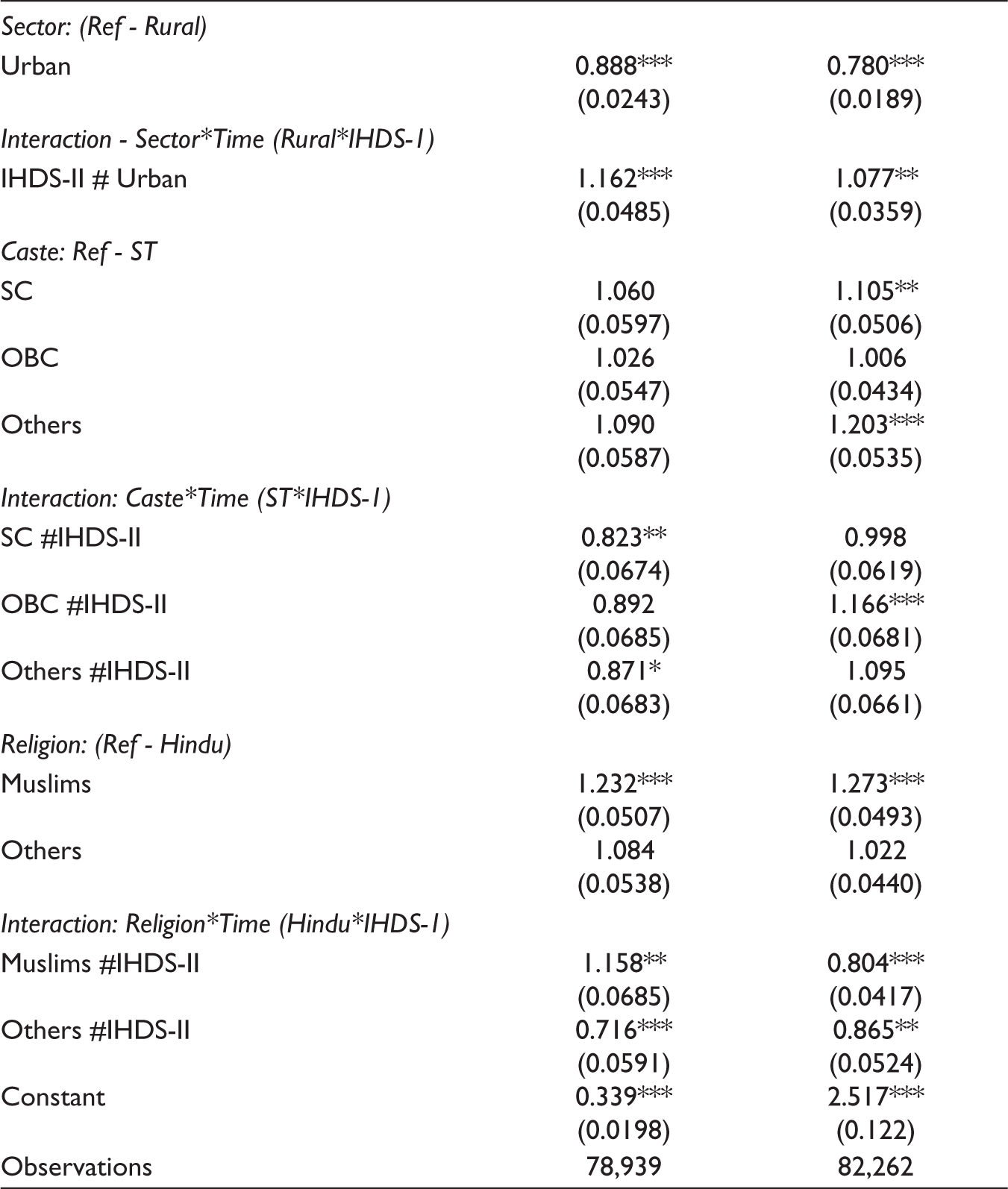
The resultant binomial logit model estimates related to various determinants of overall confidence and governance based on the pooled datasets of the two survey periods (2004–2005 and 2011–2012) are reported in Table 2. In executing such a validation exercise following the inspection of characteristics, the confidence score is categorised in terms of its median cut-off as higher than the median and below the median in both the components, that is, the overall confidence score and the governance confidence score. This will depict whether a characteristic influences the confidence score to be above the median level disproportionately compared with other characteristics. The set of attributes discussed earlier has been considered along with the period, that is, the two rounds of surveys. Considering the region and residential location, it is evident that rural residents are less likely to have a confidence score above the median level, which is further strengthened exclusively in the governance confidence score.
However, the same account of the governance confidence score indicates that the northern region is more likely to have a higher confidence score, and the western and southern regions have a marginally lower confidence score in the governance component. These results reiterate that the overall confidence score is responsive to the regional development divide, whereas confidence in governance is determined by reliance on governance institutions on the one hand and dependence on them on the other. Response to these confidence scores based on the economic hierarchy of households strictly follows a pattern of the rich being less and less responsive; however, a similar systematic pattern gets distorted when it comes to the governance confidence score, suggesting that governance’s interface with public institutions is not greatly conditioned by the economic status of households per se.
Considering the influence of caste identity, the marginalised are likely to have a higher confidence score in general, and it is even stronger when it comes to confidence in governance. This is a mere reflection of the caste divide as regards the dependence on public institutions entrusted with providing different services. A similar intensity of the influence of religion does not appear because public provisioning is more caste-conditioned in terms of its targeting than religion. However, religious minorities, as well as regional geography, contribute largely to differential confidence levels. All the regions in general significantly contribute to higher confidence although the southern region contributes to a medium level of confidence along with the eastern region, excluding the western region. On the whole, this exercise offers us valuable insights into the complexities of associations between confidence in various institutions and characteristic differences therein, along with the mutual responses across the components of confidence in institutions.
Conclusions and Policy Implications
This study examines the pattern of households’ confidence levels in different institutions across socioeconomic attributes in India. In summary, this study observed that the pattern of aggregate confidence score is responsive to various socioeconomic attributes in India. However, the average confidence score in governance institutions remains lower than in other institutions. Such a discrepancy, in the expressed confidence, points to the fact that there is a higher level of reliance on private or market-led institutions. The lack of confidence in public institutions could also be influenced by the reduced level of interaction with such institutions by relatively well-off households, whose opinions would be at best prescriptive rather than reflective of the functioning of such institutions. Therefore, self-reported confidence has the potential bias on account of the respondent reporting confidence levels as a passive observer being exclusive to the working of the institutions, without having necessarily a chance to interact with those institutions. Hence, altogether, confidence levels may get skewed towards the worse, which is to some extent revealed by the economic gradient of the reported confidence scores in various domains. This analysis shows that the improved quality of institutions with a higher confidence level goes hand in hand with the state of development. Such an observation reiterates the theoretical premise of the importance of well-functioning public institutions with adequate confidence in them, which serves as a prerequisite for the state of development. In conclusion, although there is a need to regain the confidence of people in public institutions in India, the complementarity between public–private provisioning needs to be fostered to bridge the gap in access to service provisioning between the rich and the poor. A detailed analysis of the self-reported household perceptions of confidence in different institutions by evading all the possible biases can go a long way in evaluating the performance of institutions in developing economies like India.
Footnotes
Declaration of Conflicting Interests
The authors declared no potential conflicts of interest with respect to the research, authorship and/or publication of this article.
Funding
The authors received no financial support for the research, authorship and/or publication of this article.