







Abstract
Abstract
The most explicit representation of gendering of space is the division between public and private space. Public space—the space of transcendence, production, politics, and power—is the sphere of men, whereas private productive space—the sphere of reproduction—is the women’s space. The spatial perspective developed here recognizes the complexities of a patriarchal society and how these define gender roles, which further help in sustaining gender stratification on the physical space. Whatever mobility women accrue is due to the nature of their work; thus, the nature of work and the gender roles a woman performs define her space of access. Age and caste are two major factors that affect mobility. The study also attempts to explore how “patriarchal bargain” takes place. They are a bargain, in that the “rules” which regulate gender relations in a region are constantly contested and renegotiated in daily life. Forms and expressions of patriarchy are undergoing changes; moreover, it can be said that the village is moving toward a kind of patriarchal bargain that allows women more mobility.
Introduction
Edward T. Hall was one of the first social scientists to address space as “the silent language” and the “hidden dimension” shaping human action (Spain, 1992). Gender is a complex word to define, as its meaning has changed over the period of time and is now highly contested. “Gender” is used in contrast to the term sex and is described as socially constructed characteristics (masculinity and femininity). Scholars from different theoretical backgrounds and disciplinary learnings have studied how gender comes to matter in the way spaces and places are constructed. Feminist geographers have long argued that gender varies both historically and geographically and is a product of specific practices, places, spaces, and discourses (Massey, 1984) “Gendered characteristics vary not only between countries and over historical time but also in everyday spaces and interactions.” The idea is that space itself is gendered rather than neutral and both implicate each other in the spatial underpinnings of gender roles, performances, and portrayals. Space tends to be divided as masculine and feminine spaces, and this categorization has led to the gendering of space. It is the stratification at the social level, which gets transformed in the form of social rigid constructions on geographic space. And this holds true with regard to any society and space irrespective of their location. While a woman’s accessibility to various spaces is defined by the nature of her work, her mobility is restricted only to those spheres where her labor is required (Datta, 2011). A United Nations report in the 1980s came to the conclusion that women perform nearly two-thirds of the work hours in the world. (Women’s working day is much longer than men.) Despite having longer working hours, the spaces to which women have access to are minimalistic. The aim of the research undertaken is to identify the gendered spaces in the village, that is, all exclusive male spaces and all exclusive female spaces and the intermediate spaces between the two. In a patriarchal society like India, the honor and dignity of the family and the community lie on the shoulders of women, which is regulated through restricted mobility and gendered access to space. For a woman to step outside the confines of her household for any work not approved by the head of the family is to endanger whatever tenuous security and status she has accrued (Phadke et al., 2011). Mobility and gender roles are, thus, intertwined; it is gender roles which define the mobility of a woman and, at times, its mobility or her access to particular space would define the gender roles which she can perform.
The area of study is a typical example of classic patriarchy (classic patriarchy is one in which all the facets of patriarchy, namely property, residence and descent are through the male lineage), which is commonly found in agrarian societies. “Patriarchy is defined as a system of social structures, and practices in which men dominate, oppress and exploit women” (Walby, 1989). Men, who are the patriarchs, control society. The spatial perspective developed here recognizes the complexities of a patriarchal society, how they define gender roles, and that further helps in sustaining gender stratification on the physical space.
Research Methodology and Data Sources
The study is based on primary data collected through observation, focus group discussions, and in-depth interviews. The observations were carried out from general life experiences and during the field visits. Observation of the routes, paths, and the behavior demonstrated by the women was followed while accessing the public spaces. In-depth interviews and focused group discussions were carried out during the same period. Using Gatekeeper and key informants, participants for the study were recruited from households which had three generations of women. These were grandmothers, mothers, and daughters and daughters-in-law. Thus, four women in each of the household used for the study were interviewed at length to gain insights into the question of access to space in the village. The households for the study were chosen based on social indicators such as class, caste, religion, education of the head, landownership, migrant, and nonmigrant. This is on the assumption that these would influence women’s access to space to a large degree. For the purpose of focused group discussion, young women have been chosen across the age group of 15–23 years. The people chosen for the interviews were selected, in order to cover different opinions and experiences related to gendering of space and various factors affecting the access to these gendered spaces.
Socioeconomic Profile of the Study Area
The study area chosen is the patriarchal heartland—the state of Haryana. The region reports the lowest sex ratio, together with low female literacy and work participation rate. The population of Haryana, as per the census of 2011, stands at 25 million out of which 13.5 million are females, that is, 53 percent of the total population (Census of Haryana, 2011). The sex ratio as of 2011 is 879 females per 1000 males against the national average of 940.However, it has increased by 18 points over the past decade. Mitathal village, which is 7 km away from the district headquarters is surrounded by Dhanana village in the north and Badesara village in the northeast, Chang in the east, Gujrani in the south, and Ghuskani in the southwest. The total area of the village is 2,377 ha and has a total population of 7,076 of which women account for 45.77 percent of the population (Census of India, 2011). The economy of the area thrives on agriculture, and of the total area in the village, 2,000 ha is under cultivation. No major industry is found in the village; the village thrives on cottage industries such as flour mills, pot making, tailoring, goldsmith, repair of automobiles, sale of agricultural implements, carpentry, etc.
Ethnically, the village is dominated by the Jat community; however, 19 percent of the population belongs to the Scheduled Caste. Being a conservative society, restrictions are usually imposed on women, and their gender roles are defined in accordance to the need of the household. Specifically, women are engaged in agricultural activities or are homemakers, and a few are engaged in jobs involving teaching. The gendered division of labor is the most common phenomena, which vis-à-vis defines their scope of access to the surrounding space; their mobility is defined with reference to the kind of work they are engaged in, which becomes the legitimate means to access any space.
The village has been chosen as the study area due to the following reasons:
It is a typical Haryanvi village of the patriarchal heartland where the concept of gender and space is explicitly manifested.
It is located near the district headquarters, which is witnessing rapid developmental processes that have a trickle-down effect on the nearby villages, changing the socioeconomic scenario of the village, thus altering the space construct. The following figure 1 shows the location map of the study area.

Gendered Geography: Public and Private Sphere
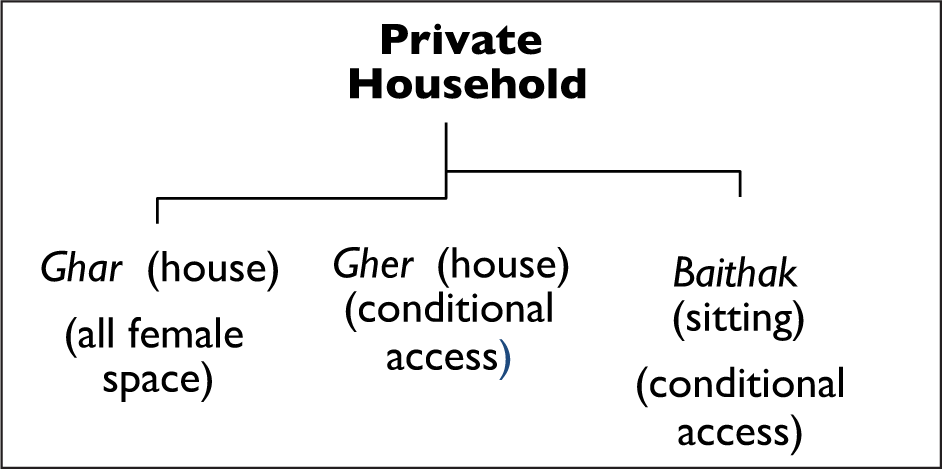
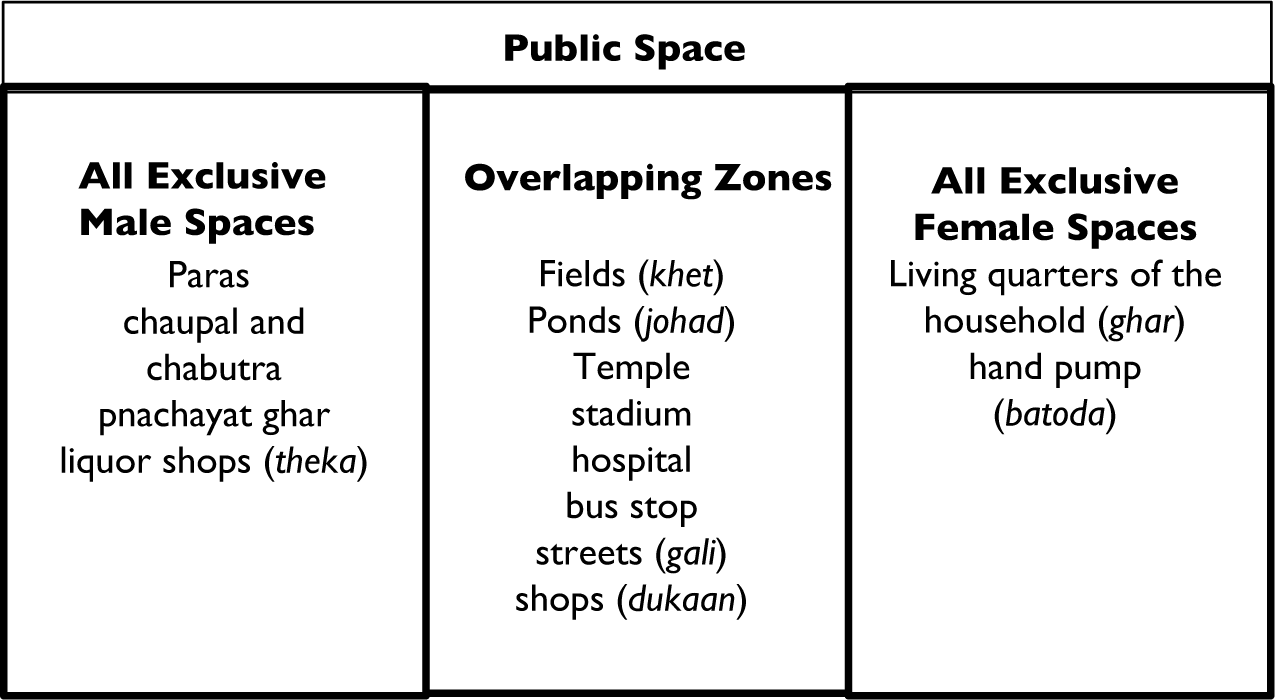
The best representation of gendering of space is the division between public and private space. The gendering of space is not restricted to the public space only, but it extends into the very private sphere of the household, the so-called female space. The two aspects covered in the following study are gendered spaces in the public realm (as shown by figure 3) and gendered spaces in the private realm (as shown by figure 2).
Gendered Spaces in the Private Realm
Baithak is an outer apartment reserved for men corresponding to a sitting room for visitors
Waisetoh hum nahinjaate, lekinsaafsaffaikarnekeiyetohjaate hi hain. (As such we do not go, we only go to give food or water when some visitor is there or for cleaning and maintenance we do go).
Gher is an open place for cattle often used like an outhouse and is located nearby to the main household so that the cattle can be easily maintained. Basically, a male-dominated place, but women of the house also have access to it as and when their assistance is required. Men usually sleep in gher at night to guard the cattle. Gher, although a male dominated space; but women could use it as a spot to take a break from their household chores, even if it meant a simple walk till that destination. It was a common thread running across all the narratives of old ladies that when they got married the male
Ghar comprises of the living quarters of the household, kitchen and usually an open verandah. This is the innermost part of the household and is the “all-female exclusive space” as men of the household are restricted to baithak; however, they are not debarred from this area. It corresponds to what baithak is for men. Women spend maximum time indoors, and the fact is substantiated by the architecture of the region where open courtyards are built within the household for women to enjoy the open sun.
Gendered Spaces in the Public Realm
All male exclusive spaces highlight not only the dominance of men but exclusion of females, whereas the “So-called all exclusive female spaces highlight only the dominance of women but not exclusion of males.” “All-male exclusive spaces” play an important role in constructing gender identities. “Ranging from home to the public domain these are reserved and used exclusively by the male population, these are spaces where the power and legitimacy of masculinity are displayed and cemented and where men are at distinct advantage in terms of deployment of power” (Chowdhry, 2014). Power, which is manifested in the form of controlling these public spaces and resources, is exercised by keeping women away from these places. The spaces which emerge as a result of the study show the sociocultural and political ideologies of the men behind constructing gender roles. And it is these very ideas which make the absence of females from these public domains very “natural.” This masculinization of spaces goes totally unacknowledged and unchallenged even by the most affected. Women have to accept it as the tradition and norm and religiously follow this division as part of the gender roles assigned to them. An attempt has been made to show the gendered division of the village into; all exclusive male spaces, all exclusive female spaces and overlapping zones. (as shown in figure 6).
Chaupal and Paras are the public extensions of the baithak. (Chaupal is a less formal extension of panchayat (raised sitting platform) and is more in number unlike paras. The non-important discussions and decisions are made here. Apart from them on a day-to-day basis, men can be seen sitting and playing cards, sipping hookahs, and discussing various topics of local importance and politics. Chaupal and paras are usually located in the centre of the village and are its lifelines. In other words, it is a space where men indulge in leisure activities. In the evenings, it is a common scene in any village to see men gather at the chaupals (it is a way of socializing). Women are strictly instructed not to cross or pass these chaupals, especially when men are sitting, as it invites unwanted gaze and is considered being “out of place.”
Panchayat ghar (It is the formal community building meant for the developmental works of the village, dispute settlement, and for panchayats to be held). Women are completely excluded from these premises, although decisions taken inside revolve around their lives. Women are the mere
Humaare badon ki yeh riwaaz thi ki aurat kabhi para aur panchayat ghar mein nahin jaati, aur wo aurat hi kya hui jo in jagahon pe chali gayi. (Our elders had this tradition that women never went inside panchayatghar and paras, questions were raised on her essence of being women if she accessed these places).
Women since time immemorial have come to accept this exclusion as part of the lineage of the societal norms of the village and mostly “a construction of the gender role and identity.”
These are places which “women have access to (but conditional) and their mobility is largely restricted by the nature of their work.” Women’s presence in these spaces is not uninvited, but her presence should be “legitimized,” for example, agricultural fields, ponds, temple, stadium, hospital, bus stop, shops, and streets. When we call them as spaces of contest, we mean women literally have to fight their case for their presence in these public spaces. If a woman is found at any of these places without a sense of purpose, then it is termed as “loitering”; this has a negative connotation attached to it. In these public spaces, men and women are usually seen at a distance from each other following the invisible boundaries of separation. For example, a pond is a site which is accessed by both men and women, but they can be seen as sitting separately—men are usually seated on one side at an elevated platform under the shade of a big banyan tree and playing cards, while women are seated on the other side in small groups with a “veil” on their face under a relatively smaller tree. Such a pattern of division is symbolic of the strength of the male power in the village. Similarly, during the daytime, women perform labor work on the agricultural fields, but the same place “gets out of bounds for her” or is the “illegitimate user” of that place after it gets dark. Thus, nature of women’s work defines her spheres of access. Another important factor which comes to the forefront is, if your presence can be substituted by someone, then you need not access that place. Thus, the mobility and access to public space by a woman is based on the “dire needs”; any job involving the movement of women outside the private sphere of the household is minimized by opting out for substitutes. The mobility or access to a place is not only gender specific but within it, the compartmentalization of age also exists.
(My mother in-law always took the kids to the hospital and only if she was not there then I had to take them to the hospital.)
The term “all-exclusive female spaces” does not have the same connotation as the term all-exclusive male spaces. These spaces highlight the presence and dominance of women but “not exclusion of men.” This sphere comprises the inner household or the ghar, Hand Pumps or Wells for fetching drinking water, and batoda (It is a place where women bake the cow-dung cakes and dispose of the animal waste of their households).The ghar is the most prominent of these spaces that men also do not access out of respect for women and due to the strong patriarchal traditions where intermingling of men and women is considered against the common prevalent social norms. Activities performed in these spaces are exclusive to females, and thus, she continuously engages with these spaces in her day-to-day life. Thus, it not by the virtue of her gender that the dominance of women in these areas can be seen but again due to the “gender-specific role of these activities.”
Table 1 shows the everyday activities performed by women and the corresponding spaces used by them. It should be highlighted that if mapped, the mobility of women is largely restricted to the private space and whatever little mobility she has in public space is due to the nature of activity she is involved with. Thus, it is the “Gender roles” assigned to women that determines her course of mobility. Her life shuttles between the private sphere of the household and the public spaces which require her assistance. The labor performed by women often goes unrecognized as it is usually considered as her moral duty to perform those functions.
Everyday Activities Performed by Women and the Corresponding Spaces Used by Them

Restricted Mobility: A Conditional Access
Space has been shown to be gendered, and its importance in constructing gender identities and mobility in different cultural settings is well recognized (Hoven & Horschelman, 2005). Mobility as a term is used in relation to people’s physical movement and the social mobility in relation to the changes in the social status. In fact, in a patriarchal society, the concept of physical mobility stands redundant and is overridden by the social mobility in case of women. Social mobility is of utmost importance when we talk about gender and space. Often, the public space is used by women as a “transit” (Phadke et al., 2011) between one space to another space. When a woman’s assistance is required, even the non-legitimate spaces turn into legitimate spaces, thus highlighting the gender role which changes as per the requirement. A narrative of a woman whose husband was in the army performed all the roles by herself and nobody ever questioned her presence as she had no male members in the family to perform those roles. Access to these spaces apart from a legitimate reason demands a behavioral code of conduct. A definite physical look, proper decorum, non-verbal communication, proper attire, etc., are some markers stipulated for women while accessing public spaces. “Their presence in public space is conjectured to entail dishonour and shame as well as questions of sexual virtues.” Access to any public space by women is “conditional.”
Kabhi kuch kaam hota hai tabhi bahaar jaate hain, warna koi matlab hi nahin
(Only if we have work then we go out otherwise it makes no sense).
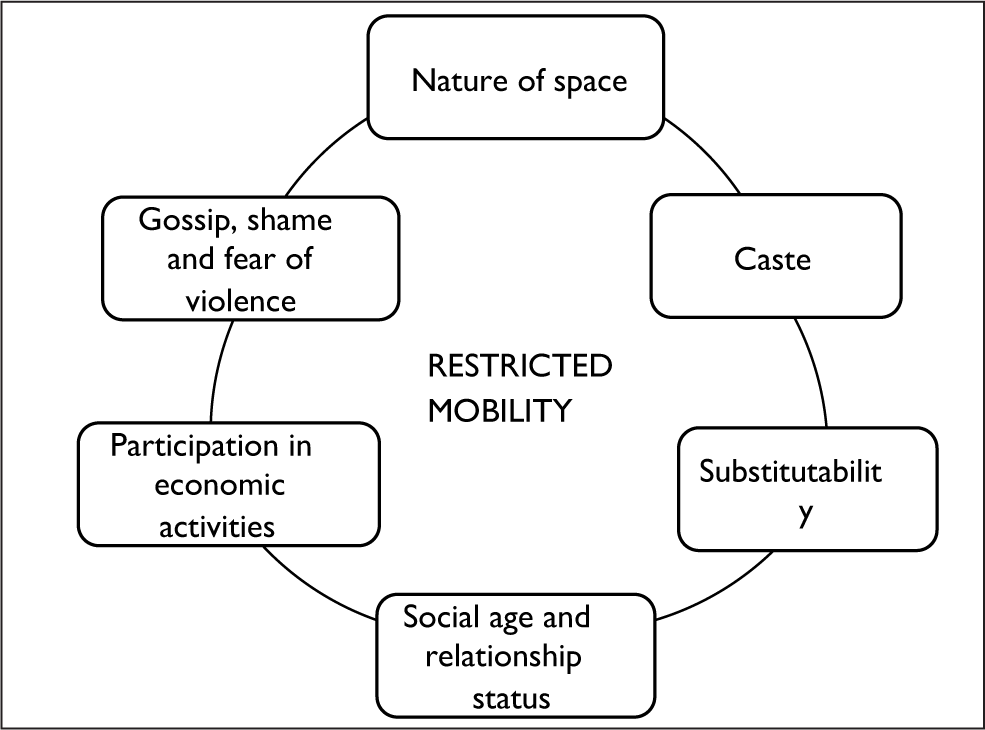
Other than the space and time dimension of mobility, there is another very important dimension, which is the brainchild of patriarchy, that is, “caste and age”. Figure 4 shows the various attributing factors affecting mobility.
The class or caste impact on classic patriarchy creates additional complications. Among the wealthier strata, the withdrawal of women from non-domestic work is frequently a mark of status institutionalized in various seclusion and exclusion practices like purdah system or “veiling” (Kandiyoti, 1988).
jaat zamindar logon ke ghar mein toh sab cheezon ki mauj hai unhe kissi cheez ke liye kahin jaane ki zarurat nahin hai, lekin humme toh kaam ke liye jaana hi padega, agar nahin jaayenge toh khaayenge kya.
(The landed class enjoys all the privileges, they don’t have to go anywhere for anything but we have to go out in search of work and if we don’t go then what will we eat).
Since earlier times, the economic activities of the people have been determined by the caste to which they belong and so has been the case in this village. Scheduled Castes, such as chamaar, dhaanak, dom, and telli, have been working on the fields of the zamindars (landed class). Women of the subordinate class work as helpers in the upper-class households such as knitting their cots, cleaning their cattle, and filling water for them, for which they are bound to access spaces which the upper-caste women cannot. Also the shops in the village which are not accessed by the higher caste women because of their caste status are easily accessed by them as they have to collect subsidized items from these shops only.
Even in the private space, difference in the economic backgrounds alters the course of social settings and norms.
Accheaurrunchegharonkiaurateinaisegaaonmeinnahinghoomti.
(Women from good and upper-class households do not loiter in the village).
The word good is used in conjunction with the word “unche” (high class) which signifies the typical stereotype regarding the good woman exists in the patriarchal society.
In classic patriarchy, subordination to men is offset by the control older women attain over younger women. The deprivation and hardships she faced as a young bride is eventually superseded by the control and authority she will have over her own daughter-in-law.
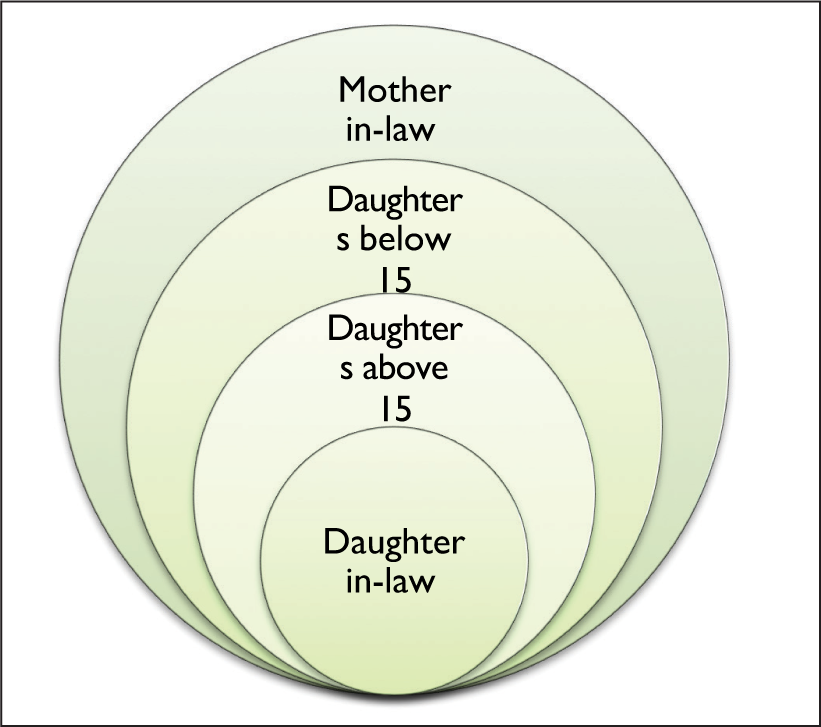
An important dimension in the mobility is the age, that is, age-specific mobility. The sphere of access to public space increases with the age of a woman. When we talk in the context of the “age-specific” mobility, it should be noted that we do not take into consideration the literal meaning of age, that is, the biological age but the “social age,” that is, the age in context of the social relationships. When we talk about the hierarchy within a generation of women in one family like daughter, daughter-in-law, and mother-in-law, the sphere of access increases, mother in-law enjoys the maximum freedom in terms of her mobility, and the daughter in-law of the family the least.
Figure 5 shows the various factors affecting mobility of women and the figure shows the sphere of access that each woman enjoys, thus placing the daughter in-law having the least sphere of access followed by daughter and mother-in-law. However, I would like to point out that it is not that the daughter of a family enjoys more freedom in terms of her access to public spaces, but her presence is more legitimized in a particular place. For example, street is a much contested public space where social norms are clearly manifested and displayed; daughter of the family still enjoys the privilege to go to the neighbors and talk or stand in the street to catch up with someone, but being the bahu of the family, a daughter in-law has to think about it. Their presence in the streets is uninvited and is considered as immoral; questions are raised on her integrity and are devoid of the tag of a “good bahu”. For the daughters-in-law of the family, streets act only as zone of transit, but for an elderly woman, it is a zone where she communicates with others. It is a very common scene in the village where the cots of elderly men and women are laid right outside their house during the afternoon in the winters and during evenings in the summers, where they are free to interact whoever passes by across the street. Another factor that comes with mobility is the proper attire; a daughter-in-law of the family cannot walk around without a veil, whereas a daughter can (although even she covers her head).
Bahu hone ke naate humme hamesha ghoonghat karna padta hai, kapde soch samjh ke pehene padte hain aur main aise har jagah jaa bhi nahin sakti jaise mein apne maayke mein jaati hun. Agar gayi toh sab bolenge; Abhi toh nayi nayyi bahu aayi aur abhi se ghar ghar ghoomne lagi, badi dadi ban gayihai.
(Being the daughter in law of the family I always have to take out veil, dress up appropriately, think before going out and if I will go out then people will say that I just got married and already I have started roaming out in the village like a grandmother).
Thus, for women, factors legitimizing access to space/mobility are as follows:
Social age
Child birth
Participation in economic activities
The narrative of a 75-year-old woman when asked about the changes which she feels has come in her mobility?
Ab toh gaaon mein kahin bhi, kabhi bhi, kaise bhi chale jaao. Poore gaaon ki dadi ho gayi hun”.
(Now I can go anywhere, anytime and anyhow in the village as I have become the grandmother of the whole village now).
Also, the verandah as mentioned earlier corresponds to female baithak is usually a site where women from the neighboring households would come and chitchat, but it needs to be mentioned that the daughter-in-law of the family does not enjoy the privilege of organizing such get-together.
Another important dimension is the mobility of young girls. The transformation from being a carefree kid to a cautious young girl is not as smooth as it seems; it comes with perceptible changes. The degree of freedom a girl enjoys varies with her age. This narrative of a 14-year-old girl explains the level of freedom she enjoys in terms of her access to public spaces and mobility within the village; no stigmas are attached to her movement. She enjoys the freedom to play after-school hours, though only in the vicinity of her household. On the other hand, her elder sister living in the same household has restrictions on her mobility due to the limitations posed by her age. She goes out only when she has to go to college, or she has some work like to fetch water or throw rubbish, but she enjoyed the same level of freedom till she was in school. This change is due to the societal norms and traditions that prevail in the village, which restricts the movement of young girls due to questions of sexual virtues which are raised.
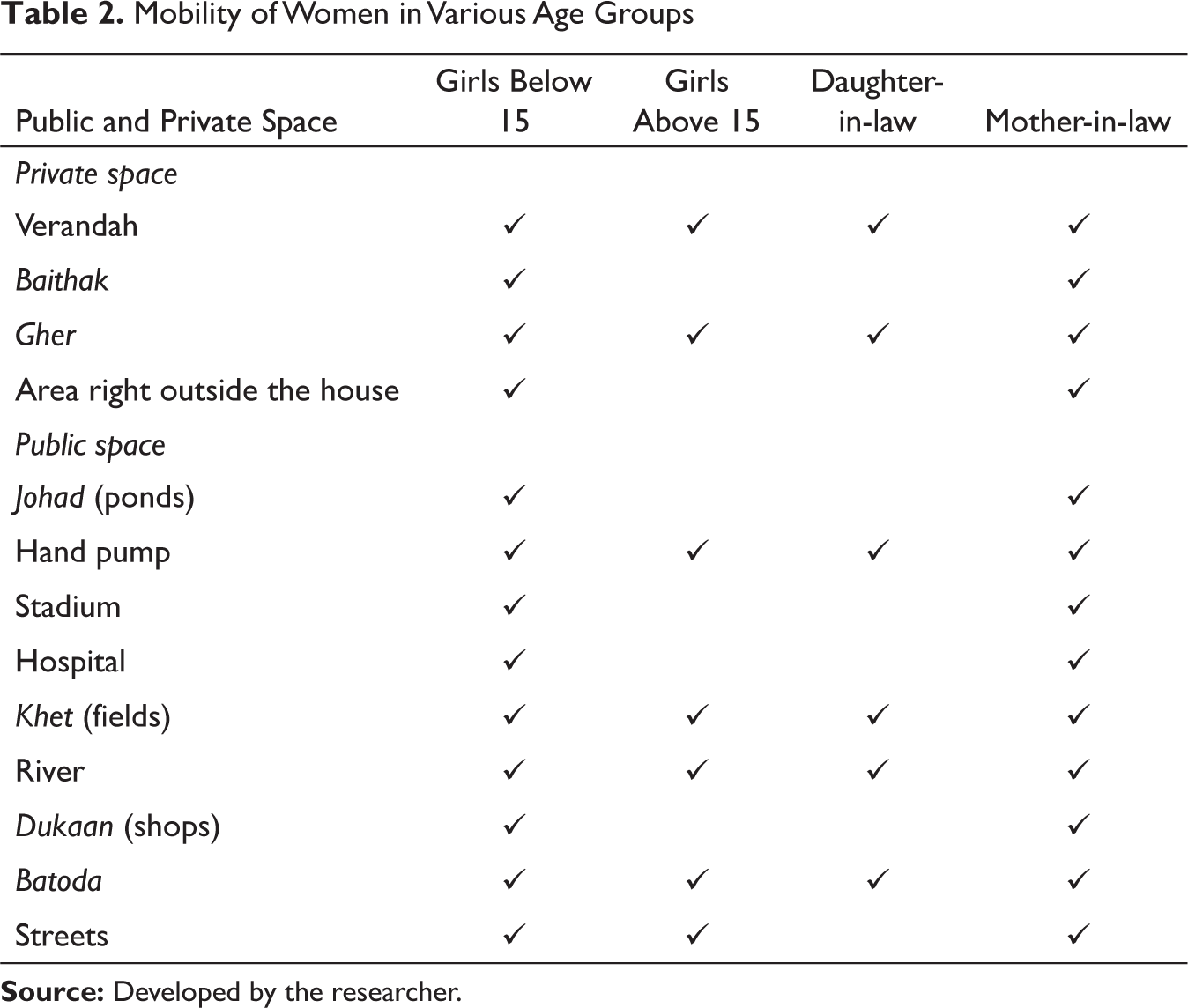
Table 2 shows not just the access to public space by various age groups, but the level of freedom of movement enjoyed by the females of different age groups. As Table 2 shows, children and elderly women enjoy greater level of freedom as compared to young girls and daughters-in-law of the family who are restricted to certain spaces. In other words, you can say that certain areas become more legitimate with age. If graphed, then one can certainly say that the age and access to public space by a woman shows positive co-relation, that is, with the advancement of age, the women gain a step further in the level of freedom.
Mobility of Women in Various Age Groups

Conclusion
The findings in this article document how gender and space implicate each other and how the space is socially and culturally produced. Gender roles defined by the society define the mobility of women; wherever her assistance is required, she is allowed to access that space, and public spaces being the most contested of all the spaces always require women to have legitimate reason for thier presence. Subjugation of women by men is the basic characteristic of patriarchy, and through this, the gender roles are produced and reproduced vis-à-vis defining the boundaries of gendered spaces.
Be it the baithak, chaupal, or any other public masculine space, they demonstrate the male strength exercised over women by controlling their access to public spaces and restricting their mobility, maintain their power by controlling the resources of production.
These masculine spaces reflect the very nature of the society, which produces them and also legitimizes them. When men and women do not have equal claim to the geographical space and the movement of latter is largely controlled by gender roles constructed by the patriarchal system, then the word equality in itself stands meaningless. Ideas of a just and equitable society are sincerely lacking in patriarchal rural areas, and the exclusive and restricted male spaces underline basic inequality between the two genders. Gender inequality is undoubtedly one of the country’s most shameful social realities. It is not just that it is inequitable and unfair, quite simply, any society where half the population suffers from social bias has already hobbled itself and its future.
Footnotes
Declaration of Conflicting Interests
The author declared no potential conflicts of interest with respect to the research, authorship and/or publication of this article.
Funding
The author received no financial support for the research, authorship and/or publication of this article.