







Abstract
Kashipur block in Rayagada district of Odisha has witnessed displacement of tribal and Dalit people because of the establishment of Utkal Alumina International Limited (UAIL). During the process of establishing UAIL, the local communities were promised adequate compensation and a fair resettlement and rehabilitation policy by the state government as well as the company. However, there has been a lack of equitable distribution of resettlement and rehabilitation facilities, widespread gender bias and caste-based discrimination against Dalits and tribals while the company offered semi-skilled jobs. Moreover, the Dalit and tribal women have been subjected to gender-based discrimination on top of the caste-based discrimination faced generally by these communities. The present study is an attempt to examine such discriminations and the effect that this has had on the traditional livelihood practices of Dalit and tribal women. The study also explores how upper-caste people are controlling the legal and informal power in the region.
Introduction
The Utkal Alumina International Limited (UAIL) in Rayagada district of South Odisha in India comprises of an alumina refinery plant and bauxite mines in Baphlimali hill range located in the Eastern Ghats. The Alumina Refinery Plant of UAIL is located in Doraguda village, which comes under the jurisdiction of the Tikiri police station of Kashipur block. Between 1995 and 1997, the company acquired 2673.71 acres of land from 26 villages through the Industrial Development Corporation (IDCO) of Odisha, in which the share of government land was 518.25 acres, and private land was 2155.46 acres (Naik, 2013). Most of this land has been acquired from the ethnic communities, such as Jhodia Porja, Penga Porja, Khond and Lohara, 1 and Dom (Kumar, 2014). Since the start of construction work in 2004, many tribal and Dalit people have been displaced from their villages (Bandyopadhyay, 2004; Debasree, 2015; Naik, 2013; Sahoo, 2007).
Even though the UAIL was approved by the state government as a development project, it has actually led to the displacement of local communities without fair compensation. While the target of the company is to capture the international market, the state government expects more revenue to the government. However, both of them do not bother about the social and economic security of the displaced Dalit and tribal communities, who have lost their livelihood due to the construction of refinery plant and bauxite mines in the region. Apart from displacement caused by setting up of company, the local people (who are not displaced but have seen their traditional forms of livelihood disappear), especially the Dalit and the tribal have been facing multiple problems since the initial land acquisition process and extraction of bauxite.
This article explores the impact of the gender and caste biased resettlement and rehabilitation (R&R) policies of the UAIL along with its unfulfilled job promises and the life and livelihood struggle of Dalit and tribal communities in the project-affected areas. It also finds the implementation of inadequate and unequal R&R facilities, by violating various Acts of the Indian Constitution. It also examines how the traditional food patterns of the local people have been changed by the implementation policies of R&R.
Background of the Study
The current study was carried out in the Rayagada district of Odisha. Out of a total population of 967,911 persons in the district, Scheduled Castes or SCs (also called Dalits) constitute about 14.4% (139,514 persons) and Scheduled Tribes constitute about 56% (541,905 persons). Thus, Dalits and tribal people comprise around 70% of the total population of Rayagada. Within the Kashipur block of Rayagada district, where the UAIL is located, this proportion increases to 60% tribal and 21% Dalit population (Census of India, 2011). However, in spite of being an overwhelming majority in the study area, Dalits and tribals constantly face the issue of casteism. The upper-caste people have maintained a strong control over all levels of local government like panchayat/block/district-level administrations. Because of such strong connections, all government-level activities in the region are carried out only after consultation with upper-caste people. Before the entry of UAIL, upper-caste people used to run both formal and informal institutions of the villages and therefore gave priority to their own caste group. Thus, most of them had achieved high status socially and politically.
According to the Panchayats (Extension to the Scheduled Areas) Act, 1996 or PESA, the state government is required to ensure self-governance through “Gram Sabhas” (village-level administration) and allows local communities to make different rules to improve social and economic conditions of the region (Behura & Panigrahi, 2006). However, while establishing UAIL, the state government bypassed Gram Sabhas and instead collaborated with the socially and politically active upper-caste community while providing R&R facilities.
Moreover, before the displacement, Dalit and tribal women in the affected villages earned income by either working as agricultural wage laborers or by collecting non-timber forest products (NTFPs) from forest. The forest, therefore, served as a common property resource (CPR) 2 and provided the people with products such as different fruits (especially mahua), edible roots Siali leaves, castor and others (Bulliyya, 2010). As collection of NTFPs was done mostly by women, tribal and Dalit women used to bring an income for their household purposes which helped them enjoy an equality with their men in their households. Both of them used to take decisions in the household matters. After displacement, the women could not carry on their lifestyle at the newly resettled area. However, during R&R process, the women were paid no compensation, and only men were recognized as having been affected by displacement. Thus, the problem caused by the setting up of UAIL is two folds. First, Dalits and tribals have been marginalized in favor of upper-caste people. Second, the tribal and Dalit women have faced further discrimination during compensation process. The present article aims to examines both these issues in Kashipur block of Rayagada district.
Caste Dynamics in Study Area
The political and economic spaces of the region are dominated by Brahmins and Khandayats. As per the Indian caste system or traditional varna framework, they are considered as upper castes and, therefore, at the top of the caste system. The Other Backward Castes (OBCs) in the region mainly comprise of the Sundi and Paika castes. The OBCs have a close interaction with the upper castes and actively coordinate with them to dominate the social, cultural, economic, and political space of the region. Thus, even though demographically these communities are a minority, they dominate the political and economic space in the study region and play a crucial role in the decision-making process. They also hold important government posts such as block officers, Panchayat officers, and in district administration. The majority Dalits and tribals on the other hand are mostly landless and marginal farmers, so their livelihood depends on CPRs, sharecrop, dongar chas (shifting cultivation), and agriculture wages. They practice a subsistence economy with limited external trade (Misra, 2013) and also face seasonal migration to seek job opportunities in other states. Due to less literacy and crunch in economics, they are often exploited and mistreated by the upper-caste people.
Rationale of the Study
Historically, the region is one of the most backward regions of the country (Sarangi, 2002). Its social backwardness is highly reflected even now also in terms of health, education, and economy (Borooah & Dubey, 2007). With the permission granted to the company to do bauxite mining, the region is facing acute deforestation and pollution. By approving UAIL, the government expects that the company would help in economic development of the region by creating various jobs opportunities. The government handed over agricultural and forestland to the company and ignored the primary livelihood means of thousands of people living in the foot of hills and forests region. This study exposes how a corporate company works out on caste and gender bias and reinforces the gaps of social and economic conditions between upper-caste people and the disadvantaged people like Dalits and tribals. Apart from these issues, it also explores how the Constitutional Acts of India have been violated by the company and how the voice of the local communities has been suppressed. It finds how the affected people measure the changes in their lives after entry of the corporate company in their locality in terms of compensation, job offers and the R&R facilities.
Development-Induced Displacement
There is a huge gender gap between the health, education, and political status enjoyed by men and women in India, and this is especially so for tribal and Dalit women (Sabharwal & Sonkar, 2015). In the case of Kashipur region, people from Dalit and tribal communities have been displaced by UAIL, and they have faced caste and gender bias during the implementation of R&R policies. On the one hand, their sources of income were snatched away from them, and they faced gender bias and caste discrimination at resettlement area on the other, while the company created jobs opportunities. This issue is not a new one in India, we have come across displacement of thousands of families have lost their way of life in the name of development-induced projects which aim so-called betterment of the society. But in reality, we can see most of the people would be project-affected and the project-benefitted would be very less especially, women and children who would be the real victims of these mass projects.
Since 1950, 70 million people have been displaced through the development-induced displacement and resettlement (DIDR) (Wet, 2019), and around 40% of displaced persons (DPs) belong to tribal communities, while a majority of the rest belong to other lower caste communities. In the case of the study area, most adversely affected people (tribal and Dalit) did not get proper R&R facilities, neither from the state nor from the corporate company. Their access to the CPRs has been denied by the establishment of UAIL. As per the Land Acquisition Act 1894, CPRs are considered as state’s properties, so the state government believes that there is no need to give cash compensation and proper R&R facilities to the DPs and other project affected persons (PAPs) (Ramanathan, 2009).
Caste-Based Discrimination and Social Segregation
In Kashipur block, even before the arrival of UAIL, the upper-caste people used to discriminate Dalits and tribals. Caste system still exists in these affected areas. Dalits are considered as untouchables and the upper-caste people have not yet recognized them equally (Kanmony, 2010). Dalits and tribals also have been denied their basic rights to own land and they have not given proper education, and are restricted in using public places, such as temples, religious places, and other common places (Ramachandran & Naorem, 2013). The reason for such discriminations are based on their caste-based occupations and food habits (Chigateri, 2008). Apart from these issues, they have been physically and socially segregated by the upper-caste people. Thus, isolation and segregation have suppressed their freedom and resulted in the denial of equal status in various spheres of the society.
With the establishment of UAIL, Dalit and tribal communities actually had expected an end to discriminations and hoped to get job opportunities without any caste bias. But, when the corporate company started functioning, Dalits and tribals have to face same sort of discriminations on the basis of caste and gender. Moreover, they have lost their traditional livelihood means too.
Article 341 of the Constitution of India recognizes the socially and economically backward communities of India and the Fundamental Rights (Articles 12–35) and Directive Principles of State Policies (Articles 36–51) guarantee that the state shall protect those who have been socially marginalized and discriminated based on their caste identity. Subsequently, the Constitution of India has also been amended to introduce a series of Acts to remove the caste-based discrimination in order to make an equitable social sphere among all human beings. Apart from the above Articles, there are other Acts like the Untouchability Offence Act, 1955 (renamed as the Protection of Civil Rights [PCR] Act in 1996) and the Scheduled Caste and Scheduled Tribes Prevention of Atrocity (POA) Act, 1989. These two Acts aim to prevent crimes and atrocities stemming from discrimination and hatred towards Dalits. But the discriminatory practices have been associated in different forms, such as attitude towards Dalit women. For an example, Dalit women are rarely employed as cooks in upper-caste homes and are mostly employed in cleaning works like sweeping, mopping, and dusting (Sabharwal & Sonalkar, 2015). The present study focuses on the Dalit and tribal people, who have been displaced by large-scale development project and have lost their income, traditional livelihoods, and the way of life.
Gender-Based Discrimination
In the study area many Dalit women have got employment opportunities in the informal sectors, such as cleaning works in and outside of the UAIL. After the acquisition of CPRs and ownership of the land, the DPs and PAPs have become dependent on wage labor with limited social security. In the working place their political participation is lower than the upper-caste men and women. In the areas, Dalits are still living in separate locations with poor services and are facing discrimination when they try to access public services. Also, they receive low wages at working places when it is compared to the wages of upper-caste men and women (Sabharwal & Sonalkar, 2015). This is a manifestation of caste and gender bias. Therefore, they are living at the bottom of the economic and social structures without any dignity. Conversations with Dalit women during our focused group discussions (FGDs) reflect that they are more vulnerable than their men. Based on their caste and gender, Dalit women have narrated that they are experiencing discriminations more than men due to their caste and gender identities. They also have to face economic deprivation from private and public sector companies. Initially, they have faced displacement; then they lost income and their traditional food. When they sought semi-skilled works, they had to face gender bias. When they had to move away from their native villages, they lost all types of traditional livelihood means. Before the displacement, women contributed income for the betterment of family. But after their displacement, they have to face different issues at the R&R area not only because of gender bias and economic deprivation but also because of the problems connected with their religion, language, food, and culture. The health of the Dalit women has deteriorated more than the health of Dalit men. Their problems are distinct and unique in many ways, and they suffer from the “triple burden” of gender bias, caste discrimination, and economic deprivation (Sabharwal & Sonalkar, 2015).
The study area is under the Fifth Schedule which is mentioned in the Article 244 (i) of the Indian Constitution. As per the Article 244 (i), people have rights to continue their religious practices and traditions, traditional livelihoods, and they can control and manage the existing CPRs through the help of Gram Sabha. But during the acquisition of private land and CPRs from the local communities, the district administration and the company have violated the Act. Also, as per the PESA, the state should not make laws which lead to conflicts with the traditional norms and customary laws of the local communities. Apart from PESA, under the provisions of the Forests Rights Act (FRA) 2006 (Dalapati, 2009), the scheduled tribe community has the right to access and ownership of forest resources and forestland. But due to the failure of proper implementation of FRA in the region, most people have not received ownership over the forest land. Thus, in the study area, during the acquisition of CPRs, people’s rights have been violated by the district administration.
The study area is one of the most backward regions in the country in terms of education, health, employment opportunities, inequality in land distribution, and also poor execution of welfare schemes of the state (Sarangi, 2002). Therefore, under the provision of Article 244 (1), the state should create equal job opportunities and protect the civil rights of the marginalized people so that people could improve their socio-economic status. But empirical evidence of the field shows that their civil rights have been violated, and the company has failed to provide enough job opportunities as it promised before the acquisition of land. In addition, opportunities for work have been given on the basis of caste and gender. The displaced women have been treated as “illiterate” and “uncivilized” by the company and also by the bureaucratic machinery of district- and block-level offices. Due to gender bias, women have been kept away from semi-skilled and skilled jobs, and only a few women have been assigned for housekeeping and other sanitation works, both inside and on the periphery of the company.
While the state and other key actors, such as politicians, contractors, and landlords, pushed project-affected women out of their ancestral land on the one hand, they had snatched away their livelihood means from the communities, on the other. During the acquisition of land and displacement of people their fundamental rights have been violated, such as the following:
Right to Equality (Articles 1, 15, 16, 17, and 18).
Right to Freedom (Article 19 and 21).
Right against Exploitation (Articles 23 and 24).
Right to Freedom of Conscience and Free Profession, Practice and Propagation of Religion (Articles 25–28).
Right to Minorities to Conserve their Culture (Articles 29 and 30).
Right to Constitutional Remedies for the Enforcement of all these Fundamental Rights (Article 32) (Kumar & Mehta, 2003).
Methodology and the Study Area
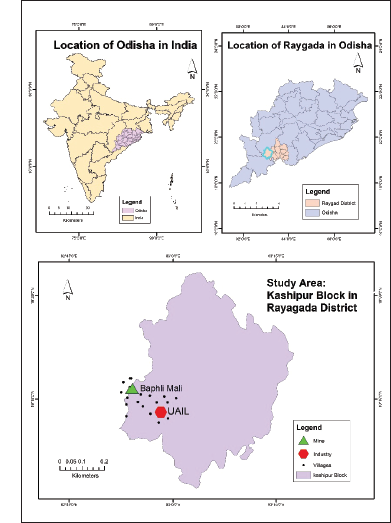
As this research is an ethnographic study, I have followed a qualitative method to collect the primary data, by using a few techniques such as FGDs, structured and unstructured individual interviews, and participatory observations. This study was conducted in Kashipur block of Rayagada district, which is situated in south Odisha. Figure 1 shows details of the study area.
Discussions
In Odisha, there are 93 sub-castes which come under the SC category, and 62 sub-castes that come under the Scheduled Tribe category. Dom is one such sub-caste, which is the third largest SC community in the state, based on population. In the study area Khond, it is a sub-caste of ST which is the highest in the state based on population. As per the Agency Tract Interests and Land Transfer Act, 1917, Dom was considered as a “hill tribe”. But after January 13, 1943, they were omitted from the hill tribes and considered as SC. This study block is a part of KBK 3 region where health is a major concern. The region has seen many instances of deaths caused by diseases such as diarrhea and malaria (Debajyoti & Panza, 2013; Sharma et al., 2004). Apart from these, people live without proper sanitation and basic civic amenities (Nayak & Patri, 2017). Unavailability of employment is widespread in this region and also most of the people do not possess agriculture land. Most of Dalit and tribal people are landless and depend on CPRs like water and forest for their livelihood. Since their livelihood means are considered as “informal” and the state controls such resources without any consent of the local communities. In addition, inadequate state policies 4 regarding land allocation have made Dalits and tribals poorer than the upper-caste “Hindu people.” This unequal landholdings, and unavailability of basic requirements, have forced them to often depend on CPRs, agricultural labor and sharecropping. Due to lack of ownership of land and unavailability of opportunities in the region, people face migration within the state and out of the state. But the study area is rich in mineral resources, such as bauxite, chrome, coal, and iron, and is also blessed with perennial water resources, land, and cheap labor. Therefore, the state has chosen this region as the best available place for mining.
By allotting agricultural land for a corporate company and forests for mining, the state believes that it would be a solution to remove backwardness and out-migration and thus can reduce caste and gender bias from the region. To reduce the people’s migration and develop the socio-economic condition of the region, the Government of Odisha and UAIL had signed a memorandum of understanding (MoU) in 1992 to establish a mining company. After signing of MoU, the local communities came to know about the establishment of the mining company and the decision to acquire land and displace local communities. As these issues threatened the traditional way of life in the area, the locals started protests against the company and the MoU of the state.
The Government of Odisha, which was influenced by the neoliberal economy, had aired its view that a mining company would create employment opportunities, irrespective of caste and gender, and would fulfil basic necessities of the people. But the neoliberal economic reforms continue to displace people from their land through the legislation and extra-economic coercion, by actively working on behalf of global capital (Anand, 2019, pp. 25–26). In Odisha, due to economic coercion, most of the mining companies have dispossessed marginalized groups from their land (private and common) and their habitat. This has typically been overlooked by the state, which has failed to give better facilities to the adversely affected people.
Families Displaced due to Establishment of Alumina Refinery Plant of UAIL (2004–2006)
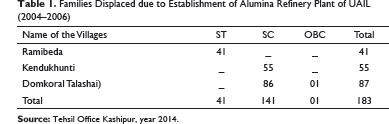
As per the revenue record of the tehsil office of Kashipur, the Alumina refinery plant of UAIL has acquired land from 26 villages, but only 183 families of three villages (Kendukhunti, Ramibeda and Domkoral Talashai) have received R&R facilities. Another instance of unequal distribution of R&R facilities is in the Domkoral Talashai village, where only 87 families out 300 have received the promised compensation. This is despite the fact that before land acquisition and establishment of UAIL, the district administration and company staff promised that all families would be provided R&R facilities. But even before the land acquisition process, neither there was a proper social impact assessment (SIA) nor any economic impact assessment (EIA).
The state has framed the guidelines of the R&R policy, and the policy was implemented by the RPDC of UAIL. While the affected families have lost their livelihood, traditional way of life, and green environment, most have not been provided the promised R&R facilities. Moreover, a lack of comprehensive R&R policy and unequal implementation of the current policy have ensured that women have been more adversely affected than men. The unequal allocation of the R&R facilities has emerged due to the absence of SIA and EIA. Therefore, numerous families in the region have been excluded from the facilities that they are entitled. One of the greatly affected villages is Dimundi. The villagers of Dimundi have been demanding R&R facilities, but neither the company nor the state government has paid any attention to it. Apart from the unequal distribution of the facilities, the RPDC of UAIL has given less importance to proper rehabilitation of women based on caste identity, and ignoring their traditional livelihood of the community and their relationship with natural resources.
From 1992 to 2004, and even in 2019, a series of people’s movements have emerged both inside and outside this region. But these protests did not work out in favor of Dalit and tribal communities. During these movements, many people died by police firing, many of them had been injured, and many environmental activists and local protestors have been stamped as anti-social and anti-development people (Das, 2003). During the field visit, some activists claimed that throughout such mass protests, the district administration had also booked some local people in false cases under the National Security Act (NSA). The local communities tried their best to protect their sources of livelihood through a series of people’s movements. But they could not succeed against the power of state government and capitalist ideology. Also, due to inadequate political means to have their voice heard, and due to lack of financial resources, they have been unable to seek redress from judicial systems.
During the land acquisition (both private and common), the state government followed the “eminent domain principles,” 5 which are mentioned in the Land Acquisition Act, 1894 (Sampat, 2013). The Act is more than 117-years old, and was made by the colonial government, but it is still applicable in India in land acquisition process (Ramanathan, 2011). Under this act, only those who have ownership or patta of land, are eligible to receive cash compensations from the company. Those who depend on CPRs have been deprived of any compensation. Even for those who have received cash compensation, the amount paid was unjust and inadequate (Jayewardene, 2008). The reason is that the Act does not have provisions to assess its “replacement value” 6 or to set adequate compensation. Apart from these issues, the Act does not correct the gender bias in cash compensation process on the basis of landownership. In spite of the legal system in India, most land is owned legally by male, so the compensation directly goes to the male member of the family. In the development-induced projects, cash compensation is common; so, the cash dispersed by the company is controlled and managed by the male member of the family, and women are unable to be a part of the decision-making process of how the money should be spent. But before land acquisition, women were playing an important role in land management before and after cultivation. Based on their relationship with the land, women deserve a share of the cash compensation from the company, but that aspect has been overlooked by the state and the company. Even the paid cash compensation process has been violated by the company. As per the Land Acquisition Act, 1894 (Section 1), the compensation has to be paid within 2 years of land acquisition (Fernandes, 2008), but during the field survey, it was observed that the process has taken more than 2 years.
In this region, the upper-caste Hindus and other backward communities (OBCs) exercise their informal power on public institutions, such as panchayats, block offices, and also in the district administration, and they play an important role in decision-making process. As per the 73rd Amendment of the Indian Constitution, people from the Dalit and tribal communities have been contesting in Panchayati Raj systems and have also been elected, but they are often manipulated by the upper-caste people (Naik, 2009). The government has implemented many public welfare schemes 7 in the region, but these schemes are controlled and managed by the upper-caste people (Naik, 2009).
In this region, Doms are also known as Harijans 8 and the settlement area is known as Harijan Sahi 9 or Dom Sahi. This area signifies their identity, and is considered as a “polluted place.” Therefore, this area is isolated from the main village. Traditionally they used to remove dead animals (cows) and engaged in selling of cows’ leather, and drum-beating, and eating beef was part of their food habit. Because of their traditional works as well as food habits, the upper-caste as well as other backward-caste Hindus consider them as polluted. Thus, they were not allowed to enter into the house of caste Hindus who maintained a social distance from Doms. In case if they have to enter into their residing areas, they would purify themselves by taking bath, and also inter-caste marriages are not allowed. Doms were not allowed in community spaces, such as temples, water bodies, and other religious places. Sometimes, they were often publicly humiliated based on their food practices and occupations (Mohanty et al., 2020; Pfeffer, 2014). Due to such humiliations from the upper-caste people, many of them are forced to adopt the Hindu culture by leaving meat-eating habits. Even the immigrant teachers from costal and central Odisha would always force tribal students to avoid beef and to drink cow milk (Pfeffer, 2014). Nowadays they worship the Hindu gods, goddess, and basil plant and also read Hindu holy books. During the field survey, we have observed that most of the Doms have left the habit of eating beef and other traditional food which are rich in protein. Many of them do not want to continue their traditional occupations, such as shifting of dead animals (cows), selling of cows’ leather, and drum beating. Apart from the traditional occupations and food practices, people have changed their surname from Dom to Naik and Nayak. 10 The reason is that the surname of Dom is directly linked with their caste identity, and food practices, therefore, to overcome public humiliation they have changed their surname. Along with Doms, tribals have been living as a poor section of the society. The state government has implemented many national 11 and international 12 schemes to reduce poverty among them. But even after the execution of these schemes, holistic development for these communities remain distant (Sarangi, 2002). During FGD, people responded that the areas is under the Fifth Scheduled so the state cannot snatch their livelihood resources, which have been traditionally owned and managed by them for generations (Sisodia, 2009). However, the company took away their land and created very little jobs for the local communities with a strong gender- and caste-based discrimination.
Before the establishment of UAIL, the civil society organizations (CSOs) had estimated that the company would directly affect more than 30,000 indigenous people from 66 villages. 13 A voluntary organization known as IDEA from Andhra Pradesh, which was working in collaboration with NORAD of Norway, has suggested that 43 villages are going to be displaced directly and indirectly by the Alumina refinery plant of UAIL. At the same time, a Delhi-based organization, Taru, submitted a report which says that around 87 villages are likely to be displaced (Naik, 2013, pp. 219–238).
Apart from displacement caused by acquisition of land and habitat, women have been forced to bear the brunt of loss of forest land. The CPRs like forests were important source of livelihood for especially tribal and Dalit women. They practiced shifting cultivation or pudu in forest lands and the green forests used to give them NTFPs like roots, mangoes, mahua, sal leaves, wild mushroom, flowers and, seeds, cheri-muli (indigenous medicines), fruits, hill brooms, and firewood (Naik, 2012). In the words of a tribal woman,
Baphli Budhai
14
is our goddess forever. She protects us and gives us everything in our lives that includes water, tress, millet, rice, and fruits. Therefore, we cannot allow any company to mine on Baphlimali hill, but what can we do? We are living at a poor section of society. The government, police, local political leaders, contractors and upper-caste people have supported to establish the mining company in the region. Now, these security guards and other staff of the company even threaten us while entering Baphlimali hill to collet our daily needs. On the basis of caste identity, they tease us, calling us illiterate and poor.
The loss of the resource of livelihood as discussed above has affected women more than men. On the one hand, women have lost their identity, culture, dignity, and their livelihood security, and on the other hand, they have to face caste and gender discriminations at the plant area while UAIL announced semi-skilled jobs for the DPs and PAPs. Moreover, this gender bias has emerged not only in the company but also in their homes. The reason is that after the acquisition of their source of income, the women are no longer financially independent, and this has led to them becoming inferior in their household.
Anthropological studies (Agarwal, 1998; Fernandes, 2009; Naik, 2009) have suggested that through CPRs and daily wages (off- and on-farm), Dalit and tribal women have enjoyed “economic freedom” more than the upper-caste women. Whatever amount they get after selling NTFPs, the amount would be owned and controlled by women. Apart from that, they play an important role in the decision-making process in their home. Therefore, they are relatively high in social status than other caste women. When they work with nature, they enjoy their social life through songs, local dialogues, and jokes, and also, they share stories of their married life with their friends. So, after the acquisition of the resources, they not only lost their traditional social life but also their economic well-being. These issues could be understood as another form of exploitation by the company. It has been proven that women are not a homogeneous group in India. They are different in health status, educational attainments, and economic performance which are measured by the Human Development Index (HDI). In the case of Dalit women, they are at the bottom of social hierarchy (Sabharwal & Sonalkar, 2015). In the study area, most of the Dalit women have been more adversely affected than the tribal women, due to lower caste, gender bias, and untouchability.
To restore their source of income and way of life, the company executed the R&R policy in 2006. But due to inadequate facilities in the R&R policy, women have been victimized at the resettlement area. During the field survey, some of the company staff called them as uncivilized and unintellectual people. But before the acquisition of land, they were having good skill in indigenous agricultural practices and regeneration process of forest. When they were displaced from their habitat, they lost their traditional skill and knowledge. Apart from these issues, women have lost their traditional food practices, such as beef-eating, meat, milk, millet foods, various edible fruits, and roots from forest. During the FGD, women said that they had never faced caste and gender discrimination when they were working on agricultural land and forest. They also added that because of the economic independence that they enjoyed earlier, there was an equitable power relationship between men and women. However, when they lost their sources of income, their power relation has become imbalanced.
The inadequate facilities as well as poor execution of policies created many problems in the resettlement area. Some of them are (a) gender and caste discriminations while the company offered the affected people semi-skilled jobs, (b) inadequate and gender-biased cash compensation, (c) company’s failure to implement its promises such as land for land, and sustainable livelihood for all families who have been adversely affected, and (d) poor infrastructures at the resettlement area, such as houses, washing rooms, Balabadikendra 15 schools, community hall, drinking water supply, and water tanks, playgrounds, drainages, and boundaries for the resettlement colony.
The company has made pucca houses for the DPs in the resettlement area, but they are not happy with their new houses. The reason is that all houses are uniformly designed and have limited number of rooms. Those who have a big family size live uncomfortably inside this restricted space and cannot maintain privacy or offer an accommodation to their guests. Also, their houses are constructed with low quality of raw materials. Before the displacement of the people, they had their semi-pucca houses, and the houses were constructed as per their choice and need. But the houses at the resettlement area were designed by the RPDC, and the DPs were not a part of the decision-making process. Moreover, the resettlement colony is constructed very close to the Alumina refinery plant of the UAIL, and this causes a lot of air, water, and noise pollution. Therefore, the DPs have pointed out that they are unhappy with the settlement colony.
Conclusion
Even though the reservation policy of India as well as various policies and acts aim to give Dalits and tribals more political and economic power, it is found that in the study area, power is centralized and is still in the hands of the upper-caste people, including informal power. Rayagada district has a majority of tribal and Dalit communities, but due to the lack of political voice and illiteracy, they have not got opportunities to participate in the decision-making process. Further, as Dalits and tribals are economically backward, they should have been given an opportunity to share their demands on acquisition of land, CPRs, displacement, and should be given a provision to participate in the decision-making process. Moreover, before the process of displacement, the state government should have conducted the SIA and environmental impact assessment. Another important point is that tribal identity and culture are unique and significant, and they are more attached to nature than non-tribals. Therefore, any state government which approves development-induced projects should think about the way of life of tribal people lead before their displacement occurs and acquisition of their land and habitat takes place. If the displacement is inevitable, the state or the company should allow them to choose their alternative source of livelihoods and should provide them appropriate R&R facilities, and the facilities should not be gender and/or caste biased.
Footnotes
Acknowledgements
This is a revised version of the paper which was first presented at the Fifth International Conference on the Unfinished Legacy of Dr. B.R. Ambedkar, hosted at the New School in New York City, October 24–26, 2019. The author would like to thank Sarmistha Pattanaik, Ashok Gurung, Juliana Beecher, and Sunaina Arya for their valuable comments to improve this paper and to Devendraraj M. for his support in developing the field map.
Declaration of Conflicting Interests
Funding
The author received no financial support for the research, authorship, and/or publication of this article.