







Abstract
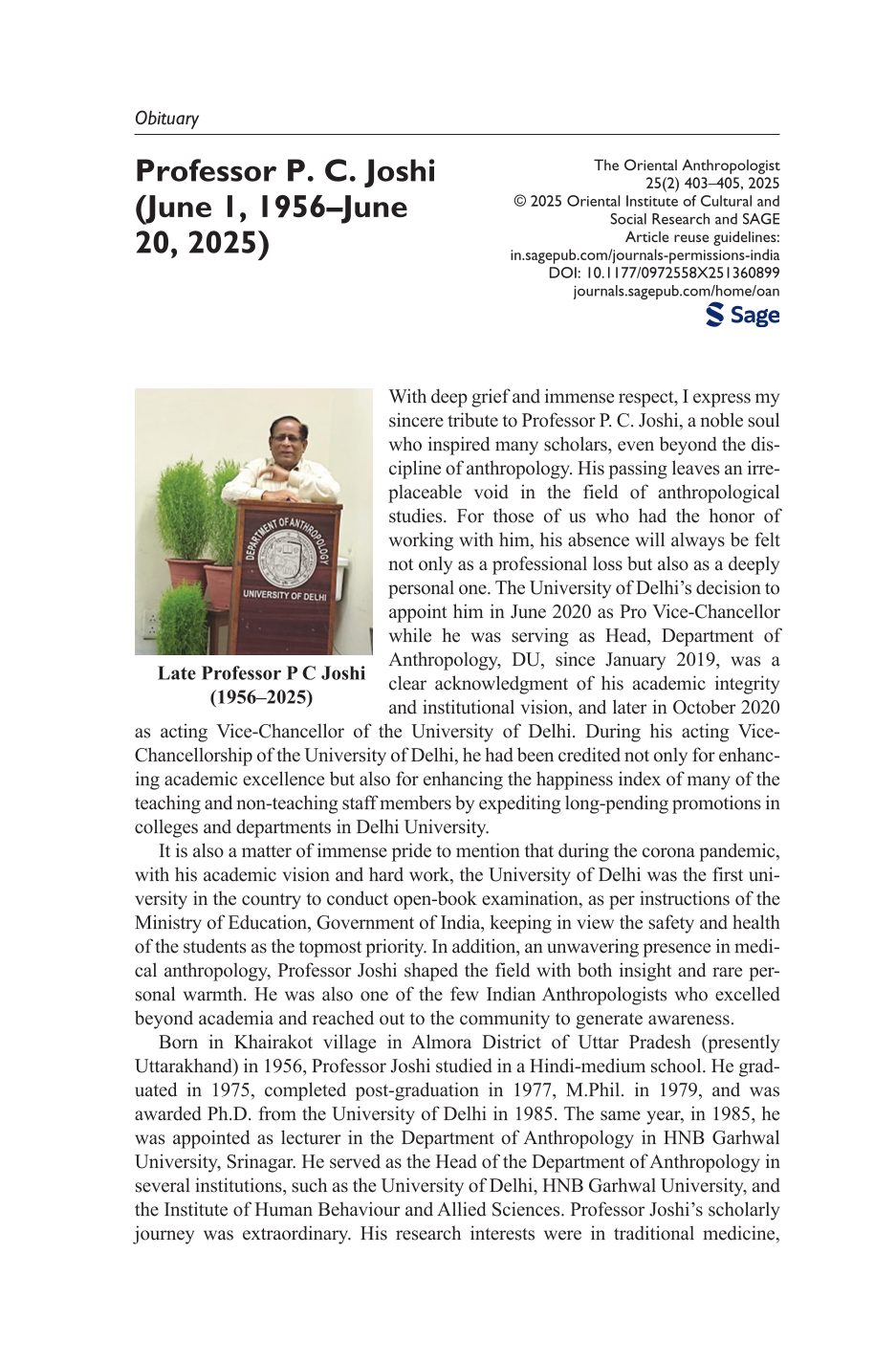
Late Professor P C Joshi (1956–2025)
With deep grief and immense respect, I express my sincere tribute to Professor P. C. Joshi, a noble soul who inspired many scholars, even beyond the discipline of anthropology. His passing leaves an irreplaceable void in the field of anthropological studies. For those of us who had the honor of working with him, his absence will always be felt not only as a professional loss but also as a deeply personal one. The University of Delhi’s decision to appoint him in June 2020 as Pro Vice-Chancellor while he was serving as Head, Department of Anthropology, DU, since January 2019, was a clear acknowledgment of his academic integrity and institutional vision, and later in October 2020 as acting Vice-Chancellor of the University of Delhi. During his acting Vice-Chancellorship of the University of Delhi, he had been credited not only for enhancing academic excellence but also for enhancing the happiness index of many of the teaching and non-teaching staff members by expediting long-pending promotions in colleges and departments in Delhi University.
It is also a matter of immense pride to mention that during the corona pandemic, with his academic vision and hard work, the University of Delhi was the first university in the country to conduct open-book examination, as per instructions of the Ministry of Education, Government of India, keeping in view the safety and health of the students as the topmost priority. In addition, an unwavering presence in medical anthropology, Professor Joshi shaped the field with both insight and rare personal warmth. He was also one of the few Indian Anthropologists who excelled beyond academia and reached out to the community to generate awareness.
Born in Khairakot village in Almora District of Uttar Pradesh (presently Uttarakhand) in 1956, Professor Joshi studied in a Hindi-medium school. He graduated in 1975, completed post-graduation in 1977, M.Phil. in 1979, and was awarded Ph.D. from the University of Delhi in 1985. The same year, in 1985, he was appointed as lecturer in the Department of Anthropology in HNB Garhwal University, Srinagar. He served as the Head of the Department of Anthropology in several institutions, such as the University of Delhi, HNB Garhwal University, and the Institute of Human Behaviour and Allied Sciences. Professor Joshi’s scholarly journey was extraordinary. His research interests were in traditional medicine, shamanism, disaster impact, lifestyle diseases, antibiotic resistance, health, culture, policy, and so on.
I first met Professor Joshi during my postgraduate years at the University of Hyderabad. Even in those early interactions, I was struck by the clarity of his thoughts and the humility in his behavior that he possessed. Years later, I had the good fortune of joining the Department of Anthropology at the University of Delhi, where I came to know him more closely as a guide, a senior colleague, and, most significantly, as a mentor.
It was he who first encouraged me to take up the responsibility of teaching research methodology. This proved to be a significant milestone at the very start of my academic journey in teaching. It was a challenging assignment, but under his mentorship, it became a formative experience. His support continued as my career progressed. In fact, it was a memorable experience during the fieldwork trip with Professor Joshi, when all newly joined faculty members who had attended the workshop organized by the Department of Anthropology, University of Delhi, visited Rani Khera, where Oscar Lewis had conducted his fieldwork. Professor Joshi’s mesmerizing personality, experiences in the field of anthropology, and simplicity as a person were truly visible.
Besides, he also organized over 15 national and international conferences, collaborated with institutions globally, and served in leadership roles at the Indira Gandhi National Centre for the Arts, Indira Gandhi Rashtriya Manav Sangrahalaya, the United Indian Anthropology Forum, Society for Indian Medical Anthropology, Mysore, Indian Association of Social Psychiatry, Himalayan Environmental Society and Conservation Organisation, Dehradun and various academic bodies across India. Among his numerous honors were the Indira Priyadarshini Vriksha Mitra National Award (1987), the Inter-University Centre Associateship in Humanities and Social Sciences, and commendations from academic institutions in France, Indonesia, and the Philippines. Under his academic guidance and supervision, more than 25 Ph.D. scholars and 12 M.Phil. scholars have been awarded degrees.
However, despite all his academic distinction and institutional leadership, what truly set Professor Joshi apart was his human touch, simplicity, and hard work. He had a rare ability to make people feel at ease, often breaking the tension in a room with a perfectly timed, well-intended anecdote. He connected effortlessly with people of all ages alike: children, students, colleagues, senior scholars, and non-academic staff. His quality of making everyone feel seen and heard is something that I learned from him. He exemplified a style of leadership built on trust, patience, and deep institutional ethics. In an era where administrative roles often create distance, Professor Joshi remained remarkably accessible and grounded.
His passing away leaves a void that will be difficult to fill. For me, it is the loss of a mentor who shaped my early years in academia with quiet confidence and unspoken generosity. I remain deeply grateful for his trust in me, his humor, and the countless lessons, both academic and personal, that came from simply observing how he conducted himself.
Professor Joshi has left behind his legacy not just in his published books and research articles, institutional developments, or the awards that were bestowed upon him, but also as a revered teacher and academic leader.
Thank you, Sir, for everything. Your “intangible source of energy” will always guide and inspire me.