







Abstract
Economic growth, urbanization and higher disposable incomes have helped to propel growth of luxury fashion in India. Indian customers attach luxury fashion with their social status. Therefore, a need was felt to understand the drivers of purchase intention for luxury fashion goods. The purpose of study is to explain the role of factors which have influence on purchase intention for luxury fashion brands. The research tries to identify the mediating effect of brand perception and social status on interrelationship between country of origin (COO) and purchase intention. The data were collected by means of structured questionnaires from a total of 400 Indian customers residing in the Delhi NCR. Structural equation modelling has been used to find the outcomes. COO, brand perception and social status were found to significantly influence customer purchase intention. However, mediation effect of brand perception was found in relation between COO and purchase intention. Mediation effect of social status also exists in relation between COO and purchase intention. Brand perception and social status sequentially mediate the relationship between COO and purchase intention.
Introduction
The size of the global luxury market is estimated to be around $2 trillion. As per, ASSOCHAM Report, 2018, India’s luxury market is set to grow to $30 billion from $23.8 billion by the year end at 30% growth rate. 1 This amounts to approximately 1.5% of the total global market size. The Indian luxury market comprises of products (wear or carry, such as clothing footwear and accessories), services (experience and enjoy such as travel and hospitality), and assets (houses, cars, planes, etc.). The most visible part of luxury market is the luxury products market which is around 30% of the total market.
In India, luxury fashion is on nascent stage, with a slow but constant growth and creating opportunities for the foreign companies dealing in luxury products. Although there will be some obstacle including high import duty on luxury goods, the demand for luxury products will increase in the upcoming years. If we talk of demographic profile, Delhi NCR accounts 40% of spending on luxury products, followed by Punjab and Haryana. South and western India approximately account 25% each of spending on luxury products, and the remaining 10% sale on luxury products is with the eastern part of India. 2 The rapidly growing middle class with its increasing purchasing power is the key driver for the growth of luxury market in India. Apart from this, increased penetration of Internet and frequent travel to foreign countries lead customer interest towards luxury fashion.
The country of origin (COO) image is the overall perception consumers form of products from a particular country, based on their prior perceptions.3–4 The origin was specified not only for identification but also to signal quality because since ancient times countries have been famous for their products such as India for spices, French for wines and perfumes, Italy for fashion, Switzerland for watches, Egypt for textiles industry, Australia for pearls, etc.
Consumers usually evaluate a product on the basis of intrinsic cues which is inherited in the product itself (such as taste, design, and other product features) and extrinsic cues (such as price, brand, place of purchase, or COO) which are externally attributed to goods.4–5 In the absence of information of tangible attributes, consumers use COO as an extrinsic attribute. Brand name may be a dominant cue in consumer evaluations of products; COO may be another very important, perhaps, more important than brand name, cue that consumers use during evaluations of foreign products and domestic products vs. foreign products. 6
The COO cue prompts a global evaluation of quality, performance, specific product, and service attributes. 7 Consumers infer attributes to the brand based on country stereotypes and experiences with the brand. 8 Products originated in a developed country such as Germany or the USA have a greater chance of positive brand image perceptions in comparison with products made in developing countries. 9 COO effect comes in picture when a customer makes a product evaluation and makes decision to buy any product. The COO effect can be driven by various factors including country image/national stereotypes, consumer ethnocentrism, involvement, consumers’ product familiarity, experience, and cultural difference.
As per Takhor and Lavack,
10
COO plays an important role in determining the brand perception. Consumers have knowledge of brand origins, and it has significant influence that drives perception of product quality.
11
COO have influence on overall perception of brands, and it may vary with high and less reputed brands.
12
The effect of COO is very strong with reference to brand perception, because it has the power in shaping brand image in the customer’s mind. However, Laroche et al.
13
suggest that COO has a significant influence on consumers’ choice. Apart from this, the elite consumer give weightage to made in label when purchasing a luxury product, since it reflects their social status. Elite consumers buy luxury products for themselves and to impress their friends and family member.
14
The fundamental objective of this study is to explain the role of factors which have influence on purchase intention for Italian luxury fashion brands of Indian customers. As well as to measure the mediating effect of brand perception and social status on interrelationship between COO and purchase intention. Hence, the following objectives have been set for the study:
To investigate the interrelationship among COO, brand perception, social status, and purchase intention. To examine the mediation effect of brand perception and social status on the interrelationship between COO and purchase intention.
Literature Review
Country of Origin
COO refers to the country with which a product or brand is associated, such as SONY is a Japanese brand and Apple is an American brand. 15 COO research started with the study of COO effect in the American market and found that respondents are biased that product made in less developed nations will be of inferior quality. Somehow, they associate quality with the level of development. 16 Bilkey and Nes 17 found that during the process of product evaluation, customers use only COO information to make their buying decision. Further researches showed that COO is not the only factor that affects consumer product evaluation. Product cues such as quality and price may have a stronger effect on consumer decision-making than COO information. 18 The COO image is based on previous experience from the country. 19 In addition, Tse and Gorn’s 20 findings reveal that a well-known global brand will override the COO effect, which further found that the COO is an important factor in consumer product evaluation. Elliot and Cameron 21 found that quality and price are more significant than COO as well as locally manufactured products are preferred by the customers. As per Ahmed et al., 22 in the presence of other extrinsic cues, consumer’s purchase decision is more influenced by brand rather than COO. COO has a significant impact on brand perception. Both less and high reputed brands are affected differently if the production is shifted to another country. 12
Brand Perception
Brand perception is the reality as how a customer views the brand; in other words, brand perception is the current image that exists in the minds of the customers. Brand is perceived on the following parameters: quality, value, visual, senses, personality, legacy, and status. Research has shown evidence that customers of developing countries prefer to purchase brands originated in developed countries. 23 Customer associate brands with countries where the brands were initially developed rather than with the countries in which the products are currently produced. 24 The COO image of a brand contributes to the positive or negative perception towards the brand and brand image.25–27 The impact of COO on the brand perception varies from product categories. Products with technical features are more likely to be evaluated on the basis of COO. 4
Social Status
Status is used as a synonym for honour or prestige, while social status denotes the relative position of a person on hierarchy of social worth. Earlier status consumption was confined to the Western countries, but later on in major countries status consumption became prominent and got reflected in the usage of luxury products with demonstration of modern status symbols.28–29 Researchers found that consumers perceived that the consumption of foreign products and brands may confer higher social status.30–31 Consumers of developing countries are highly influenced by glamorous Western consumption practices and lifestyles. Studies conducted in several developing nations such as India, China, and Vietnam have shown that foreign brands from developed nations are preferred for the reason of status.32–35,9 Indian customers perceive that consumption of foreign brands enhances their social status and foreign brands have a distinct edge over Indian brands, so far as the status attribute is concerned. 9 Consumers prefer to purchase products made in a certain country to show off their wealth and enhance their status amongst their peers. 14
Purchase Intention
It is defined as a measure of the strength of one’s intention to perform a specific behaviour or make the decision to buy a product or service. COO has an effect on purchase intention.36–38,23 Findings indicate that brand image and quality of products create significant positive influence on purchase intention of foreign products. 39 COO will positively influence product evaluation and purchase intention, when there is strong match between product image and country. 40 As per Khan, et al., 14 Elite consumers look for made in label especially when purchasing luxury goods and perceive that it will reflect their social status. They also interpret that consumption of these products will make an impression among their family and friends; they, hence, have an intent to purchase foreign brands.
Hypotheses Development
Country of Origin and Brand Perception
The quality of foreign brand was perceived to be generally higher and superior to domestic brands among Indian customers. Customers, in light of individual experience or information from other sources, seem to have knowledge with respect to the quality of products made in various nations and might utilize COO as a summary construct rather than as an inferential signal to make decisions about the quality of brands.
41
Rosenbloom and Haefner’s
42
study reveals that global brands are indicators of quality, and they reduce the uncertainty and risk associated with high involvement products. The brand originating from developed countries have ability to create trust in consumer’s mind. Studies have found a significant positive relationship between COO and brand perception.12,56 Hence, on the basis of existing literature, it can be hypothesized:
H1 COO has significant and positive impact on brand perception towards Italian luxury fashion brands.
Country of Origin and Social Status
Indian customers are inclined towards consumption of foreign luxury goods for enhancement of social status. They believe that purchase of foreign goods may display their wealth and enhance social status. Batra et al.
31
carried out a study on Indian consumers’ perceptions of foreign brands and found that they are primarily motivated for the purpose of status enhancement. The product/brand originating from developed countries are not only perceived on quality aspect but also on social status. Schultz et al.
33
surveyed Vietnamese consumers and found that COO not only acts as an indicator of quality but also as a symbolic representation and status enhancement. Hence, on the basis of existing literature, it can be hypothesized:
H2: COO has significant and positive impact on social status towards Italian luxury fashion brands.
Country of Origin and Purchase Intention
From last many decades, Indian consumers have developed a taste for foreign goods because of perceived quality, reliability and exclusiveness, and particularly for Italy-based luxury fashion. As it is perceived as the fashion capital of the world and most of the global fashion brands originate from there. So it becomes imperative for Indian consumers to purchase these global fashion brands. Findings further indicate that COO is a very important factor in the purchase intention of luxury products.
43
Studies have found that COO has positive and significant effect on purchase intention.36,23 Further studies have shown that COO has significant effect on purchase intention.36,44 Hence, on the basis of existing literature, it can be hypothesized:
H3: COO has significant and positive impact on purchase intention towards Italian luxury fashion brands.
Brand Perception and Social Status
Consumers attach themselves to specific brands to affirm their desired identity. They consume the brands to signify the wealth, success, and social status. Customers are emotionally attached to the luxury brands and do not bother in paying high premium for the brand. Batra et al.
31
studied perception of consumer for local and non-local brands in a developing country like India and found that the non-local brand possesses high quality and enhance social status. Wong and Ahuvia
45
found that preference for luxury goods among East Asians is often viewed as a sign of materialism. Youth customers attach themselves to certain brands to proclaim their desired identity and prefer the brands originating from Western countries, because these brands are associated with status and pride in the construction of social identity. Hence, on the basis of existing literature, it can be hypothesized:
H4: Brand perception has significant and positive impact on social status towards Italian luxury fashion brands.
Brand Perception and Purchase Intention
Consumers’ intention to purchase a specific brand is in harmony with their impression about the COO of the brand. Due to this, the brands originating from developed countries are preferred over domestic brands in emerging countries. Wang and Yang’s
46
study was based on the relationship between brand perception and purchase intention with reference to Chinese automobile industry. They found that brand perception has positive significant impact on purchase intention. Brand image creates significant positive influence on purchase intention for foreign products.47,39 Hence, on the basis of existing literature, it can be hypothesized:
H5: Brand perception has significant and positive impact on purchase intention towards Italian luxury fashion brands.
Social Status and Purchase Intention
Customers, in particular, tend to buy luxury goods for display of their social status and wealth. Elite customers associate global brands with their social status and perceive that these brands differentiate them from others; hence, they have an intent to purchase these brands.
48
The enhancement of social status is increasingly one of the first and most important reasons for consumers to purchase Western products.
45
Hence, on the basis of existing literature, it can be hypothesized:
H6: Social status has significant and positive impact on purchase intention towards Italian luxury fashion brands.
Country of Origin and Purchase Intention: Mediation of Brand Perception and Social Status
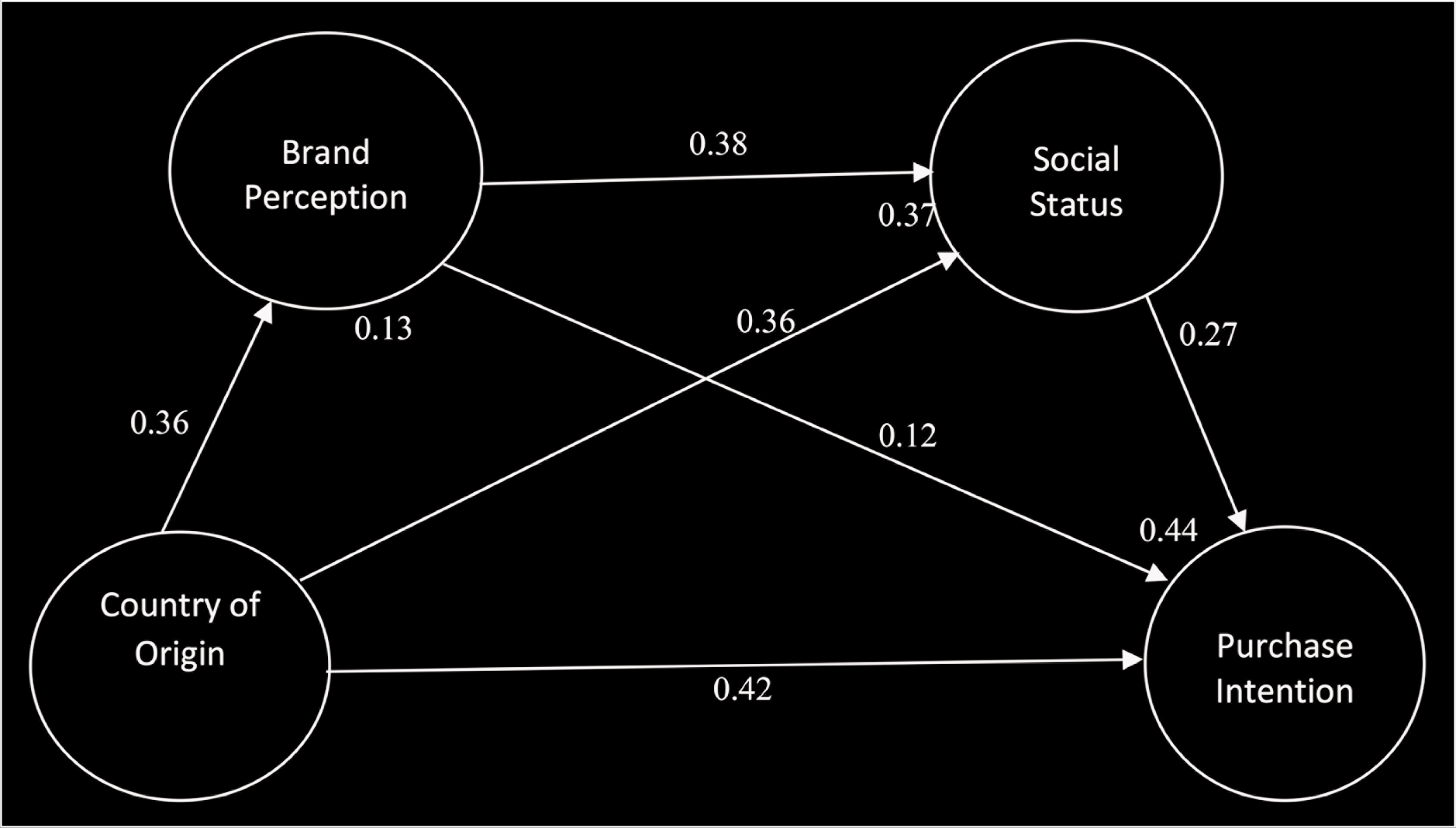
A country with its positive COO image helps in the reinforcement of brand image. Customers perceive that conspicuous consumption may confer higher social status. Consequently, the customers have an intent to buy these luxury fashion brands. Prior studies have indicated that there exists an established link between COO, brand perception, social status, and purchase intention.9,46,48,49 It has been broadly acknowledged that COO directly influences brand perception, and brand perception is an antecedent of social status. These three variables have direct and indirect effect on purchase intention. Based on the literature review, the study conceptualized the model as shown in Figure 1 and the following hypotheses are proposed:
H7: Brand perception mediates the relationship between COO and purchase intention towards Italian luxury fashion brands. H8: Social status mediates the relationship between COO and purchase intention towards Italian luxury fashion brands. H9: Brand perception and social status has mediation effect on the relationship between COO and purchase intention towards Italian luxury fashion brands.
Operational Definition
In this study, researcher define elite customers as those belonging to the high social stratum and living an affluent lifestyle; since they have a high disposable income and purchasing capacity and a willingness to buy comparatively expensive foreign goods and services.
Research Methodology
The insights from the literature review and discussion with experts were used to design the questionnaire. The drafted questionnaire was validated from industry experts, and modifications were made as per their advice. Respondents were asked to rate the statements on a 5-point Likert scale where 1 indicates ‘strongly disagree’ and 5 indicates ‘strongly agree’. The scale items were tested for reliability measures and resulted with a Cronbach’s alpha of 0.940 which indicates internal consistency reliability. To check the reliability and validity of the questionnaire, CFA analysis was performed. Factor loading range between 0.591 and 0.926, meeting the minimum required value. The composite reliability (CR) of the constructs is more than 0.858, average variance extracted (AVE) is more than 0.551, which confirms convergent validity. Each construct had a minimum of 5 to 7 items.
Descriptive study was conducted for the research with a cross-sectional review; response was collected through a structured questionnaire from the customers visiting Italian luxury fashion brands stores in Delhi NCR. A total of 417 respondents were approached to collect the data. However, 17 questionnaires were found not suitable for further analysis due to incomplete information. The majority of respondents were married (81%) and the percentage of businessman was 49. Above 10 lakh monthly income respondents were 35%. Delhi NCR accounts 40% of spending on luxury products in India, hence considered as target population. This study was conducted in the month of May to June 2019. Convenience sampling technique has been used to collect the responses from respondents. Further to examine the hypothesized conceptual research model, structural equation modelling was performed.
Data Analysis and Interpretation
Scale Assessment
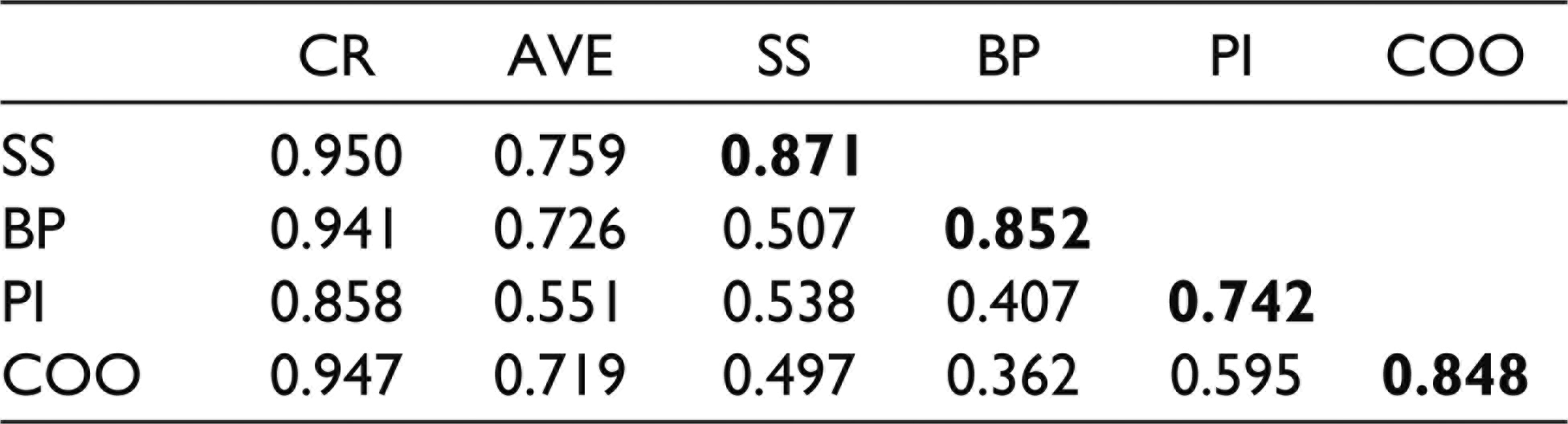
Standard factor loading (standardized estimate) of items should be above 0.50, the AVE should meet the cut-off value of 0.50, CR value should be equal or higher than 0.70 and CR should be greater than AVE. Standardized estimate of all items range between 0.591 and 0.926, meeting the minimum required value. CR of the constructs vary between 0.858 and 0.950, and AVE ranges between 0.551 and 0.759. Further CR for each construct exceeds the respective AVE, thus establishing convergent validity. Discriminant validity expresses the degree to which a construct is truly different from other constructs. 50 It was examined through Fornell and Larcker’s 51 AVE test and correlations criterion. From Table 1, it can be seen that the square root of average variance extracted is greater than the component correlation coefficients. Therefore, the construct discriminant validity is confirmed.
Convergent Validity, Discriminant Validity and Intercorrelations Among Variables
Summary of Fit Indices for Measurement Model

The fit indices of the measurement model are Chi-square (χ2) = 601.515, CMIN/df = 2.44, p = .000, root mean square of approximation (RMSEA) = 0.05, root mean square residual (RMR), comparative fit index (CFI) = 0.96, normalized fit index (NFI) = 0.93, goodness of fit index (GFI) = 0.90, and Tucker–Lewis index (TLI) = 0.95. This indicates that the proposed scale fits for measurement.
Path Analysis
After establishing validity and reliability of measurement model, structural equation modelling (SEM) analysis is conducted to test the hypothesis. From Table 3, it can be seen that COO, brand perception, and social status have significant and positive impact on purchase intention. Figure 1 shows the standardized path coefficients, illustrating the significant relationships. Among the three constructs, COO (0.418) has more impact on purchase intention. H6: Social status has significant and positive impact on purchase intention (β = 0.270; p < .05). Hence, H6 is supported. H5: Brand perception is having significant and positive impact on purchase intention (β = 0.119; p < .05) is also supported. Further, it was also found that COO is having significant and positive impact on brand perception and social status (β = 0.362; p < .05 and β = 0.361; p < .05). Therefore, H1 and H2 have been supported. In addition, brand perception positively impacts social status (β = 0.376; p < .05). Thus, H4 has been supported. Meanwhile, the coefficient of determination (R2) value for purchase intention is 44.3%, social status is 37%, and brand perception is 13.1%. Minimum threshold value of R2 should be 10%. 52 Results met the criteria of R2 which indicate that SEM is valid.
Summary of Testing of Hypothesis for Structural Model

Mediation Analysis
The research model (Figure 1) represents mediation hypotheses, indicating how an independent variable (COO) effects dependent variable (purchase intention) through mediating variables (brand perception and social status). SEM analysis is being applied to evaluate mediation model and test mediation hypotheses (H7, H8 and H9). To determine the different effects and test mediation, the four-step procedure suggested by Baron and Kenny 53 has been applied.
Initially, the mediator effect of brand perception on the relationship between COO and purchase intention has been tested through the four-step procedure. First, the model showed that the antecedent variable COO had a significant effect on brand perception. At the second step, it was found that brand perception had a significant effect on purchase intention. Third, when the mediating path through brand perception to purchase intention was constrained (i.e., brand perception was not linked to purchase intention), the direct effect of COO (β = 0.60; p < .05) on purchase intention was significant. Fourth, the previously direct effect of COO (β = 0.52; p < .05) was significantly reduced when the mediating path from brand perception to purchase intention was linked (see Table 4). Hence, it can be concluded that brand perception partially mediates the relationship between COO and purchase intention. Therefore, H7 is supported.
The Mediating Effect of Brand Perception and Social Status Between Country of Origin and Purchase Intention
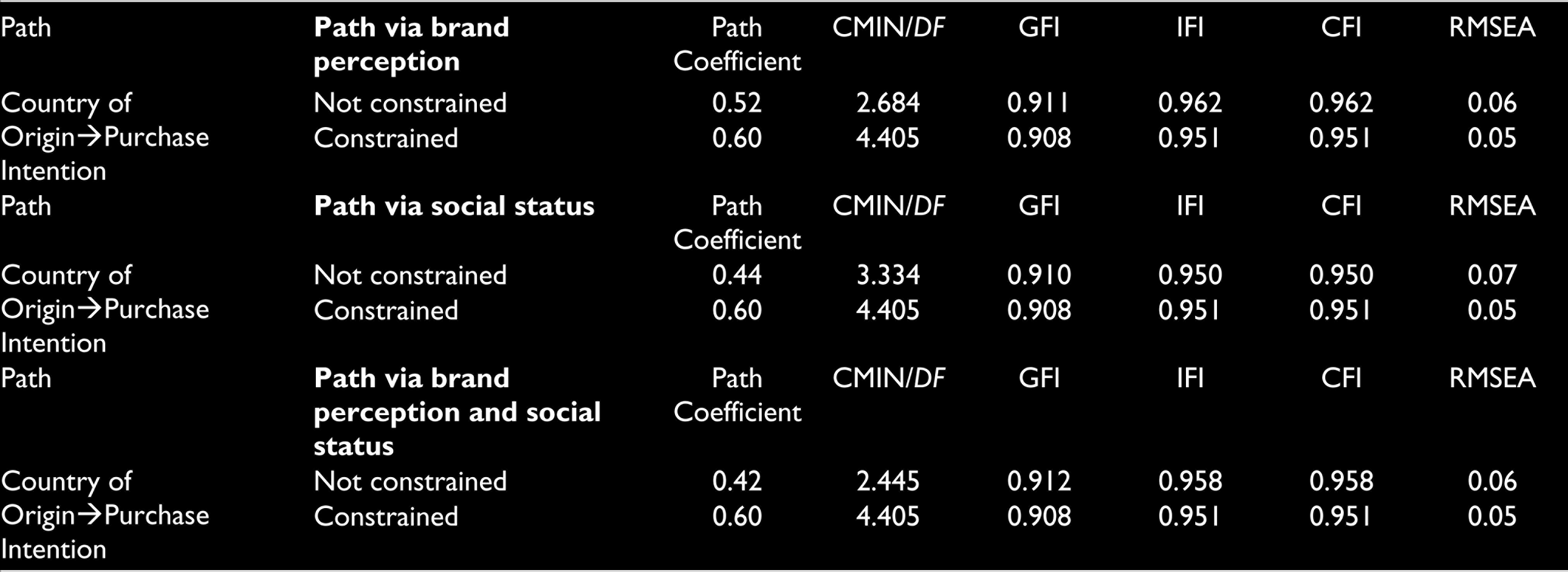
Further to test H8, which predicted that social status mediates the relationship between COO and purchase intention, the same procedure is followed as discussed above. First, the model showed that COO had a significant effect on social status. At the second step, it was found that social status had a significant effect on purchase intention. Third, when the mediating path through social status to purchase intention was constrained (i.e., social status was not linked to purchase intention), the direct effect of COO (β = 0.60; p < .05) on purchase intention was significant. Fourth, the previously direct effect of COO (β = 0.44; p < .05) was significantly reduced when the mediating path from social status to purchase intention was linked (see Table 4). Hence, it can be concluded that social status partially mediates the relationship between COO and purchase intention. Therefore, H8 is supported.
Lastly, H9 which predicted that brand perception and social status mediates the relationship between COO and purchase intention has been tested through the same procedure as mentioned earlier. First, the model showed that COO had a significant effect on brand perception and social status. At second step it has been found that these mediating variables had a significant effect on purchase intention. Third, when the mediating path, through brand perception and social status to purchase intention was constrained (i.e., brand perception and social status was not linked to purchase intention) the direct effect of COO (β = 0.60; p < .05) on purchase intention was significant. Fourth, the previously direct effect of COO (β = 0.42; p < .05) was significantly reduced when the mediating path from brand perception and social status to purchase intention was linked (see Table 4). Hence, it can be concluded that brand perception and social status partially mediate the relationship between COO and purchase intention. Therefore, H9 is supported.
Discussion and Implication
It can be inferred from the analysis that COO has significant and positive impact on purchase intention. This is in line with several other research works.41,43,54 Therefore, marketers should emphasize more on COO information while advertising, promoting, or educating customers about product offerings. Results reveal that social status is having significant and positive impact on purchase intention. This is in line with the findings of Kinra 9 and Khan et al. 14 Indian customer purchase luxury fashion brands to get noticed by others in the society and perceive that the consumption of it will enhance their social status. This study empirically proved the positive relationship between brand perception and purchase intention, and this result is consistent with empirical studies of Wang et al. 46 and Bhakar et al. 47
The findings of the study also highlight that COO is having significant and positive impact on brand perception and social status. The result supports the findings of Khan and Bamber, 55 Pandaa and Misra, 56 Pham and Richards, 57 Batra et al. 31 and Koubaa. 12 Elite consumers rely on COO information in order to determine the quality of luxury fashion brands. They perceive that luxury brands originated in developed country such as Italy will be of superior quality and the consumption of it will enhance their social status. Most of the MNC’s are shifting their manufacturing units to low labour cost countries such as India, Vietnam, Philippines, and China to reduce the cost. From financial aspect, it is an effective decision, but it affects the customers perception about the brands. Hence, the marketers should appraise this issue before restructuring their supply chain including the relocation of production units.
In addition, brand perception positively impacts social status, and the results are in line with the findings of Batra et al. 31 The luxury fashion brands originating from developed countries have considered status signalling and prestige as their key factors. It is also found that brand perception mediated the path between COO and purchase intention, as well as the mediation effect of social status also exists on interrelation between COO and purchase intention. The countries with its positive COO image help in strengthening the brand image originating from these countries such as SONY, a Japanese brand, and GUCCI, an Italian brand. Customers perceive that the consumption of luxury fashion brands originating from developed countries may confer higher social status. Hence, customers have an intent to purchase these luxury fashion brands. It is also worth mentioning here that COO is not the only one factor which influences customer purchase intention but brand perception and social status are also factors that have significant role in explaining the purchase intention for Italian luxury fashion brands.
Managerial Implication
COO is identified as an important variable that has significant influence on purchase intention for luxury fashion brands. Hence, foreign companies entering in the Indian market should associate with their respective country name in the segment of luxury fashion goods. It is also revealed that Indian customers have favourable attitude towards luxury brands that are made in developed countries. Hence, these brands may achieve a competitive advantage in the Indian market over competitors by positioning themselves using COO as a unique selling preposition. In the 21st century, luxury goods trade is rapidly increasing and the international marketplace has become more competitive. It is essential for marketing managers to understand the fact that consumer attitudes towards a specific COO or brand can be significantly changed, either positively or negatively, and it may influence the preference of the customers. Hence, taking into consideration the dynamic nature of customers, marketing strategies should be developed in tune with their changing requirement. It is also the case of Indian cinema which exerts significant influence on youth as luxury fashion is promoted by cinema, which is prompting youth towards luxury consumption. 58 Indian youth firmly believe that if they consume the brand which is being used by the celebrities, it will enhance their social status. Celebrities extend their personality and popularity to the brand and give consumers a reason to trust on a brand. Hence, marketers should have close association with celebrities to capture elite customers.
Marketers should also take a clue from the consumer preferences identified earlier on, which have significant influence on purchase of luxury brands. It further assists in identifying the factors which affect customer purchase intention. The perception of the luxury brand is totally different in comparison to an economical product. It is also found that social status and COO information are an essential factor which influence elite consumers’ buying decisions. Overall, an understanding has been developed for the purchase intention of luxury fashion goods among elite consumers of India, which could assist marketers to design appropriate marketing mix strategies that will facilitate in targeting the existing and future purchasers and position the brand in the Indian market suitably.
Theoretical Implication
The current study seeks to expand the existing literature on purchase intention by understanding the relationship between COO, brand perception, social status, and their impact on purchase intention towards Italian luxury fashion brands in an emerging economy. The past literature presented not exactly ambiguous but a not-so-rich coverage of the purchase intention of Italian luxury fashion brands. A lot of research has been reported related to COO effect on purchase intention in automobile industry, electronic durables, and FMCG sector. However, limited attention has been given in the context of luxury fashion brands with reference to elite consumers of India. It is focused on the purchase intention for Italian luxury fashion brands sold in Indian market with reference to brand perception and social status, an area that has primarily remained unexplored. The research study contributes majorly and directly to the literature pool of luxury purchase intention that exists in India. In addition to it, mediation effect of brand perception and social status was not examined earlier with reference to COO and purchase intention. The comprehensive framework developed here propagates the clarity of each factor that leads to purchase intention, thereby making a major contribution to the field of consumer behaviour research.
Limitation and Future Research
This study deals with cross-sectional data, and a longitudinal study covering pre-purchase and post-purchase behaviour would have added more in-depth view on the factors affecting purchase intention. Future studies can be undertaken concerning the post-purchase behaviour which is largely unexplored and can be taken up. Similar studies can be conducted for other brands and product categories such as watches from Switzerland and perfumes from France.
Footnotes
Declaration of Conflicting Interests
The authors declared no potential conflicts of interest with respect to the research, authorship, and/or publication of this article.
Funding
The authors received no financial support for the research, authorship, and/or publication of this article.