






Abstract
This article aimed to examine the serial mediation effect of workplace inclusion and employee engagement in the relationship of authentic leadership and employee creativity. This study makes a contribution towards the literature of management by studying the relationship between authentic leadership, workplace inclusion, employee engagement and employee creativity which is limited so far. By providing empirical research on the psychological process that creates a link between authentic leadership and employee creativity, this study fills the gap in the literature. This research was conducted among employees who were working in top 10 IT sector companies that are located in Northern India. Data were collected from the employees who were having at least 3 years of experience in the current organization. The serial mediation in this study was tested using regression analysis (SPSS process macro model six). Findings of this study found the sequential mediation effect of workplace inclusion and employee engagement in the relationship of authentic leadership and employee creativity. Thus, organizations can get the benefit of the creative workforce at the workplace by selecting, developing, fostering and nurturing authentic leaders who can create inclusive environment at the workplace.
Introduction
One of the industries with the fastest global growth is the Indian IT industry. India is referred to as the global hub for digital capabilities because it is home to 75% of the world’s talent. Today, world economy is mainly driven by IT industry as almost every business, organizations, and even government is dependent on the IT sector. In the environment of fierce competition worldwide in IT sector, it becomes important to find out the critical success factors for IT organizations such as organizational, cultural, and managerial issues. Leadership is one such critical success factor where companies can invest more to get success.1–3 It is therefore crucial to understand the leadership behaviours that will ensure successful organizational outcomes. But there is limited research that are studying the type of leadership behaviours which can benefit the organization the most.2, 4–6 Authentic leadership has gained momentum in the recent years due to its contribution towards positive organizational outcomes. In today’s times, authentic leaders in IT industry are playing a very important role, not just in India but in the whole world as requirement of authentic and accurate information sharing within the organization is upsurging due to globalization and diverse workforce than ever before. Walumbwa et al. define authentic leadership as
[A] pattern of leader behavior that draws upon and promotes both positive psychological capacities and a positive ethical climate, to foster greater self-awareness, an internalized moral perspective, balanced processing of information and relational transparency on the part of leaders working with followers, fostering positive self-development.
7
Thus, authentic leadership is a specific type of leadership behaviour which fosters leaders to be aware of their own self, to take decisions after considering all available information, to share reliable information with the followers and to regulate own their behaviour by following internal moral standards and values. Practitioners and researchers from all around the world have been interested in the concept of authentic leadership, which derives from earlier theories of multiple intelligence8, 9 and social intelligence. 10 Growing societal costs globally and the need for authenticity have increased the demand for authentic leadership.11, 12 There are some studies claiming that authentic leadership can lead to various positive outcomes such as high OCB, identification with supervisor, work engagement, 13 organization-based self-esteem, 14 psychological meaningfulness, and safety. 15 Protagonists of the concept “authentic leadership” also posited that authentic leaders enhance the level of optimism, trust, self-efficacy, resilience, hope, and confidence among stakeholders at the workplace. 16 But studies on the construction of authentic leadership are in its nascent stage, that is, not explored yet to its full extent. Many theoretical studies posited that authentic leadership plays a very important role in affecting employee’s behaviour and attitude positively but there is a dearth of empirical proof of the same assertion.11, 15 Also, the psychological process by which authentic leadership encourages employee’s positive behaviour and attitude has not been explored yet.11, 15,17–19 In this context, Rego et al. conducted a study to examine the relationship between authentic leadership and employee creativity through positive affect and hope in which they claimed that other mechanisms also operate in the association of authentic leadership and employee creativity instead of just positive affect and hope. 18 So, this study aims to find out various other positive organizational outcomes of authentic leadership by examining its relationship with employee creativity and to study the mechanism that links authentic leadership with employee creativity. This study looked at two sequential mediators, namely workplace inclusion and employee engagement, between the link of authentic leadership and employee creativity.
Many studies revealed the importance of knowledge and creativity of the employees in IT sector. 20 IT sector always focus on promoting knowledge sharing among the employees across the industry which is very important for enhancing creativity of the employees at the workplace. 20 Creativity has significantly influenced the success and expansion of IT firms as creative employees provide various new and innovative ideas in the organization, and implementation of those can be an important factor for the success of the IT companies. Previous studies also posited that employee creativity has a significant contribution towards competitive advantage to the organizations.21–26 Also, leadership is one of the important contextual predictors of employee creativity and innovation at the workplace. 27 Different leadership styles such as empowering leadership, 28 transformational leadership,29, 30 and servant leadership 31 have been studied in the past. But only a few studies exist that examine the role of authentic leadership in enhancing employee creativity.
The concept of workplace inclusion was first systematically reviewed by Mor Barak and Cherin in the year 1998 who defined “the continuum of inclusion–exclusion as the degree to which individuals feel a part of critical organizational processes such as access to information and resources, involvement in work groups, and ability to influence the decision-making process.” 32 After the year 2010, it began to gain traction in the literature of management. The number of articles on workplace inclusion is growing annually, and roughly 65% of all articles and research papers on the topic were published after 2017. Therefore, workplace inclusion is a new topic whose advantages for organizations need to be further investigated. 33 Workplace inclusion has been linked to increased employee engagement and creativity at the workplace.34, 35
Kahn had introduced the concept of employee engagement who defined it as “the harnessing of organizational members to their work roles, in engagement, people employ and express themselves physically, emotionally, and cognitively during role performance.” 36 Schaufeli et al. define employee engagement as “a positive, satisfying, job-related state of mind that is characterized by vigour, dedication, and absorption.” 37 A study by Khan et al. argued that highly engaged employees are more creative as they share new ideas and thoughts with their co-workers. 38 Employee creativity can be defined as the “production of high quality, original and elegant solutions to complex, novel, ill-defined, or poorly structured, problems.” 39
So, this article attempts to provide a conceptual framework which determines the psychological path through which authentic leadership enhances employee creativity in the IT companies and then empirically test it.
Review of Literature and Hypothesis Formulation
Authentic Leadership, Workplace Inclusion, Employee Engagement and Employee Creativity
Previous research emphasizes on the role of leadership in enhancing perception of inclusion among employees.40, 41 In a study on leadership challenges to develop a feeling of inclusion, it was claimed that leaders of inclusive and diverse organizations must create opportunities for discussions across individuals and groups in the organization, model ease with diversity, be authentic about their own behaviour, and encourage authenticity among followers. 42 Some researchers argue that there is a dearth of research that studied the role of different leaders’ quality in enhancing perception of inclusion among employees. 33 Authentic leaders are characterized by moral reasoning and positive psychological capacities, which seem to be closely related to multicultural competencies that are accentuated by diversity experts. 16 All these capacities of authentic leadership including open communication, perspective taking, and self-awareness support an inclusive climate.43, 44 In line with this, other researcher identifies leadership as an important antecedent in influencing employee’s perception towards inclusion. 45 Another researcher also asserted the importance of leaders’ philosophy, strategies, practices, values and decisions in determining employee’s perception towards inclusion. 33 In another study, the author posited that commitment of leaders is must to make inclusive workplace. 46 To create inclusive culture at the workplace, leaders must engage their employees in genuine communications, treat and view others as different as well as unique, 33 and model appropriate behaviour at the workplace. 42 This is in line with optimal distinctiveness theory given by Brewer who argued that every individual wants to get a validation in the organization of being similar to others as well as they also want to be accepted for their uniqueness. 47 On the basis of this theory, Shore et al. proposed inclusion framework in which they argued that employees who feel that their uniqueness is valued at the workplace and feel belongingness towards their work-group results in the enhanced feeling of inclusion of the employees in the organization as well as they tend to be more creative. 33 Leaders play a very important role in enhancing the perception of uniqueness and belongingness among employees.33, 46
Authentic leaders are also open to encourage creative behaviour among their followers. Various past studies found that employees who see their leaders as authentic, feel more engaged at work. 48 In line with this, another researcher also asserted that authentic leadership has direct as well as indirect effect (through psychological well-being) on employee engagement. 49 Another study examined the relationship between authentic leadership and work engagement among nurses working in three major corporations of South Korea. They found that under the effect of authentic leadership, nurses show high level of work engagement. 50 Furthermore, it was found that leader inclusiveness have a crucial impact on engagement through psychological safety. 51 It means that leaders who create inclusive climate at the workplace play a very important role in enhancing psychological safety and engagement level of the employees at the workplace. Several other authors also asserted that employees feel more engaged at the workplace when they are provided with reliable and sufficient information as this may create a feeling of inclusion among employees, thereby making the work more interesting for the employees and increase their contribution towards organization’s performance.52–55 Leaders also help in developing the creativity level of the employees by providing them support for breakthrough ideas and enhancing their critical thinking skills. 56 The association of authentic leadership and employee creativity has been explored by other researchers as well who assert that followers who believe their leaders to be authentic are more creative through affective commitment and job resourcefulness. 57 Many studies recommended that it is important for the organizations to engage their employees, as engagement level of the employees has been found to coincide with their level of creativity at the workplace. 58
Authentic leadership enhances employee creativity through the mediating effect of psychological capital directly as well as indirectly. 59 They recommended that in future, researchers can include other mediating variables to learn how authentic leadership tends to promote employee creativity at the workplace. So, more studies are needed to validate the relationship of authentic leadership and employee creativity and the mechanism through which authentic leadership enhances employee creativity at the workplace. 60 Different researchers studied different mediating variables in the relation of authentic leadership and employee creativity such as positive affect and hope, 18 trust in leaders, 61 affective commitment, 60 happiness, 62 work engagement,15, 63 psychological meaningfulness, 15 psychological empowerment, 64 psychological capital, 59 and psychological contract. 65
Figure 1 depicts the indirect effect of an independent variable (Authentic Leadership) on a dependent variable (Employee Creativity) through serial-mediating variables (Workplace Inclusion and Employee Engagement).

Hypothesized Research Model.
Taking all these into consideration, it was worthwhile to study the mediating role of workplace inclusion and employee engagement in the relationship of authentic leadership and employee creativity. So, the following hypothesis was formulated:
H1: Workplace inclusion and employee engagement sequentially mediates the relationship between authentic leadership and employee creativity.
Research Methodology
Sampling Technique and Procedure
Descriptive research design was used for the purpose of this study. Questionnaires were sent to about 400 employees (who were having experience of at least 3 years in the current organization) working in top 10 global IT companies (namely Microsoft, Oracle, Cisco, SAP, Accenture, L&T, Capgemini, Cognizant, Infosys, and TCS). List of top 10 companies was taken from Global 2000 magazine published by Forbes in the year 2021. For the purpose of collecting data from employees, google form was created and shared with the potential respondents through LinkedIn and e-mail using snowball sampling. Out of total 400 questionnaires that were sent to the employees, a total of 329 employees responded to the questionnaire. So, the sample of 329 employees was considered for data analysis. To get unbiased and realistic data, respondents were asked to give genuine and realistic responses as much as possible regarding the questionnaire. Also, it was assured to the respondents that their information would be used only for research purpose.
Adequacy of sample size was measured by applying KMO (Kaiser–Meyer–Olkin) measure of sample adequacy in SPSS 24. KMO value was 0.944 which indicated the adequacy of sample.
Sample Profile
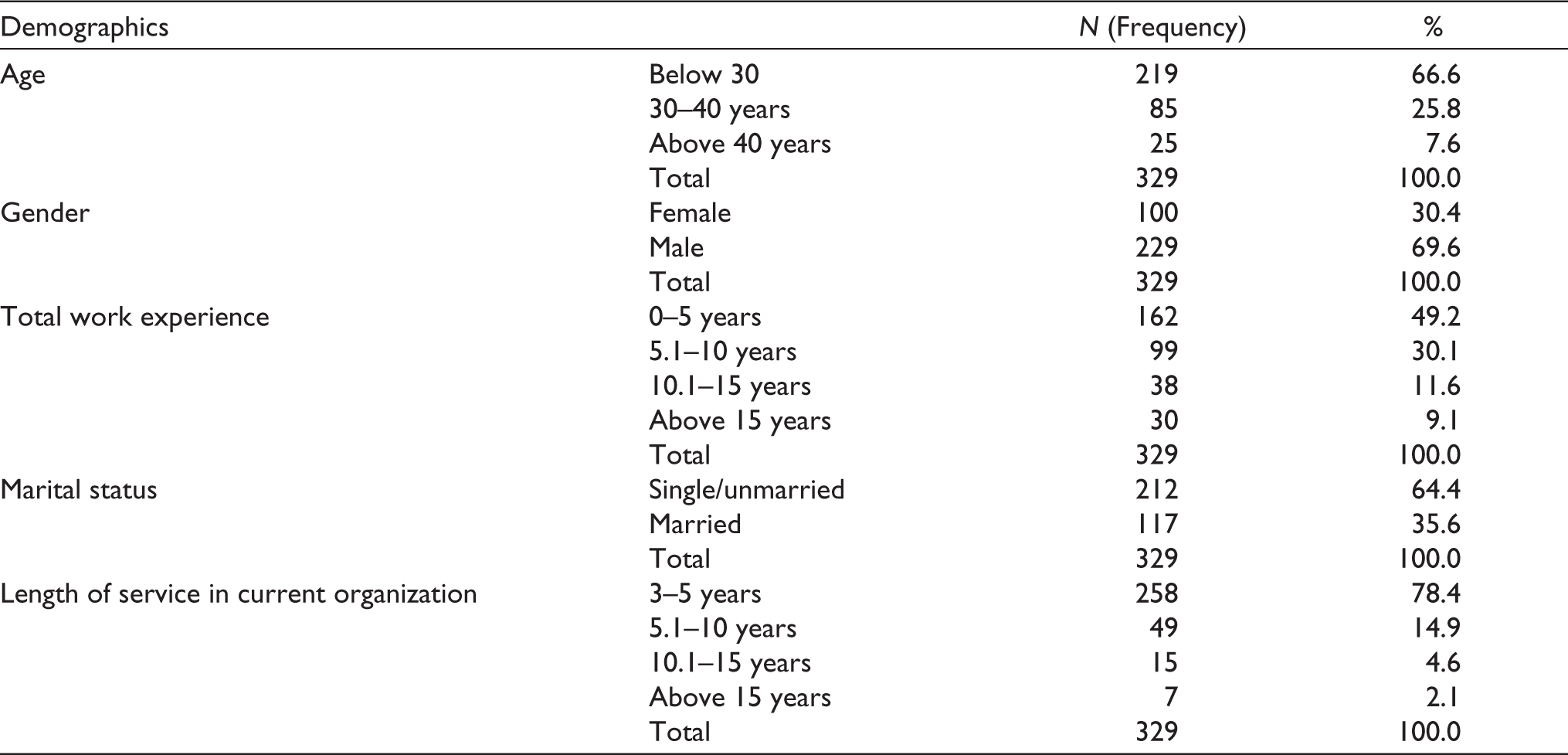
Table 1 shows the distribution of employees based on their marital status, age, gender, total experience and length of service in current organization. Out of the total respondents, most of the employees were of age 30 or less, that is, 219 (66.6%), 85 (25.8%) were in the age group between 30 and 40 years, and 25 (7.6%) were of age above 40 years. Male respondents were 69.6% and the rest were female. Also, about two-thirds of the respondents were single/unmarried, rest were married. Furthermore, out of total respondents, 162 (49.2%) were having a total experience of less than 5 years, 99 (30.1%) were having experience of 5.1–10 years, 38 (11.6%) were having experience of 10.1–15 years and remaining 30 (9.1%) were having experience of more than 15 years. Also, about 258 (78.4%) of the respondents were having experience of 3–5 years in the current organization, 49 (14.9%) were having experience of 5.1–10 years in the current organization, 15 (4.6%) were having experience of 10.1–15 years in the current organization and only 7 (2.1%) were having experience of more than 15 years.
Sample Profile.
Measures
All variables were measured through standardized scales that were provided by different authors. Descriptions of these are as below:
Authentic leadership: Employee’s perception towards authenticity of their leaders was measured by using authentic leadership questionnaire (ALQ) in which authenticity was measured using four dimensions, that is, self-awareness, relational transparency, internalized moral perspective and balanced processing.7 Authentic leadership was measured using 5-point Likert scale ranging from not at all as 1 to always as 5. Sample item in relational transparency includes “Tells us the hard truth,” self-awareness includes “Seeks feedback to improve interactions with others,” internalized moral perspective includes “Asks us to take positions that support our core values,” balanced processing includes “Analysis relevant data before arriving at a decision.” Many authors used this scale to measure authentic leadership in which they found very high internal consistency of ALQ ranging from 0.90 to 0.95.2, 4,14,66
Workplace inclusion: Workplace inclusion was measured through 15-items scale which has three dimensions, namely work-group involvement, decision-making, and access to information. 67 Five-items scale was developed to measure each of three dimensions. Sample item to measure decision-making includes “I have influence in decisions taken by my work-group regarding our tasks,” sample item to measure access to information includes “I frequently receive communication from management higher than my immediate supervisor,” and sample item to measure work-group involvement includes “I am invited to actively participate in review and evaluation meetings with my supervisor.” Workplace inclusion was measured using 5-point Likert scale ranging from strongly disagree as 1 to strongly agree as 5. Three items of this scale were reversely coded to prevent the respondents from systematically answering the questions. This scale was found to be highly consistent in previous studies.14, 68
Employee engagement: Employee engagement was measured using Utretch Work Engagement Scale (UWES), 2006 (short version). 68 UWES-9 consists of nine items which has three dimensions, namely dedication, vigour, and absorption. Sample items to measure employee engagement includes “At work I am bursting with energy,” and “I am immersed in my work.” 5-point Likert scale was used to measure employee engagement ranging from never as 1 to always as 5. Many studies have supported the one-factor structure instead of three factors as factors show very high correlation ranging from 0.65 to 0.90 and this scale shows high internal consistency across samples of different countries.69–73 So, this study also adopted one-factor structure of employee engagement as consistent with previous studies.
Employee creativity: Employee creativity was measured using four-item scale developed by Zhou and George in 2001 74 and revised by Baer and Oldham in 2006. 75 As consistent with many past studies, creativity was self-reported by employees.76, 77 Each employee rate themselves on a 5-point scale ranging from never as 1 to always as 5. Sample item includes “Suggests new ways to achieve goals and objectives.” This scale was also found internally consistent in previous studies. 15
Data Analysis and Interpretation
Common Method Bias
The method given by Podsakoff et al. in 2003 is used in this study to account for common method variance. 78 So, Harman’s one-factor test was applied to assess the presence of common method bias in the current study, if any. 79 To perform this test, all items of four variables under this study were loaded on a single factor by fixing the number of factors to be extracted as one using principle component analysis. The results of this unrotated factor solution represent that a single factor leads to 36.364% of the total variance. Thus, the variance explained by single factor is less than 50% (minimum threshold limit for the presence of common method variance) 80 , thereby indicating the absence of common method bias in the current study.
Results
Hypothesis of the study was tested using SPSS 24 by applying regression analysis. Serial mediation effect was tested using bootstrapping method with the help of SPSS Process Macro Model six. 81 Bootstrapping method is a non-parametric method for estimating effect size and testing hypothesis. This method does not make any assumption regarding the distribution of the data or statistics. Process Macro method estimates the indirect as well as the direct effects using ordinary least square procedures. Bootstrap confidence intervals were used to estimate the indirect effect size estimates.
Before testing hypothesis, mean, standard deviation and correlation were calculated to test the level of authentic leadership, workplace inclusion, employee engagement and employee creativity among IT sector employees and to study the relationship among the mentioned variables. Cronbach’s alpha value was used to test the reliability of the scale (refer Table 1).
Inferential Analysis.

**Correlation is significant at 0.01 level.
Mean of authentic leadership, employee engagement, workplace inclusion and employee creativity ranged from 3.80 and 3.93 which indicated high level of authentic leadership, employee engagement, workplace inclusion and employee creativity among IT sector employees. Cronbach’s alpha value in Table 2 found in this study indicates the high internal consistency of the instruments as Cronbach’s alpha value of more than 0.7 indicates that the scale have high internal consistency and reliablity. 82
Mediation Analysis.

Bivariate Correlations
Results of the bivariate correlations claimed that all the four variables under study shared a positive and significant relationship with each other. Authentic leadership was found to be significantly related with workplace inclusion (r = 0.658), employee engagement (r = 0.664), and employee creativity (r = 0.467) at the significance level of p < .001. Also, workplace inclusion was found to be significantly related with employee engagement (r = 0.716) and employee creativity (r = 0.607) at the significance level of p < .001. Furthermore, employee engagement was found to be significantly related with employee creativity (r = 0.615) at the significance level of p < .001. Out of all these relationships, workplace inclusion and employee engagement were found to have highest correlation (Table 1).
Hypothesis Testing
Regression analysis results using Process Macro model six are shown in Table 3. H1 tested the sequential mediating effect of workplace inclusion and employee engagement in the relationship of authentic leadership and employee creativity. The results of this study revealed that authentic leadership leads to 21.79% variation in employee creativity through workplace inclusion and employee engagement. Also, positive and significant total effect of authentic leadership was found on employee creativity (β = 0.4586, p = .000, t = 9.554). T-value of more than 1.96 and p value of less than 0.05 indicate significant impact of one variable on another. Proposed hypothesis received empirical support as indirect effect of authentic leadership on employee creativity was found to be significant through mediating variables such as workplace inclusion and employee engagement (β = 0.1186, p = .000, t = 3.478). Furthermore, direct effect of authentic leadership on employee creativity in the presence of workplace inclusion and employee engagement was not significant (β = –0.0079, p = .892, t = –0.135) which indicates the full mediation effect of workplace inclusion and employee engagement in the relationship of authentic leadership and employee creativity. Thus, proposed hypothesis received empirical support.
Discussion
The current study’s findings support the proposed research model’s hypotheses, which are shown in Figure 1. According to this study’s findings, it can be claimed that authentic leaders, who are true to self and to others, share unbiased and relevant information with everyone, aware of his/her own self, and take decision on the basis of moral standards, create an environment of inclusion in the organization where employees feel involved in their work group, perceive that they have decision-making power and access to information in the organization. Furthermore, employees who feel included at the workplace tend to engage more with their work, feel enthusiastic, energetic and immersed. These findings are also supported by previous studies.34, 83–85 Furthermore, engaged employees tend to be more creative, they give new and innovative ideas, suggest various new ways to achieve the objectives and goals of the organization. Previous studies have also supported this finding.86–89 One more important and noteworthy finding that has resulted from this study is that authentic leadership does not have direct effect on employee creativity. There is some process through which authentic leadership effects employee creativity. A study by Chaudhary and Panda also supported this finding who studied two different paths through which authentic leadership links with employee creativity, one is achieved by psychological meaning and job engagement in that order, and the other is achieved through psychological safety and work engagement in that order. 15 This study found the workplace inclusion and employee engagement as a sequential mediator in the relationship of authentic leadership and employee creativity. Results of this study proved that there is a full mediation of workplace inclusion and employee engagement in the association of authentic leadership and employee creativity among IT sector employees as indirect effect of authentic leadership on employee creativity was found significant (β = 0.1186, p = .000, t = 3.478) while direct effect became insignificant in the presence of mediating variables (β = –0.0079, p = .892, t = –0.135).
Managerial Implications
The present research can have many implications for the managers of IT sector organizations. This research can help managers by providing a framework on how one can develop creative workforce. Creativity is the need of today’s time as creative workforce works as a competitive edge21,–26 for the organization and helps them in achieving their goals and objectives. Creative workforce also enhances organization’s performance as well as profitability. This research paper developed a theoretical framework and tested it empirically and resulted how one can enhance creativity at the workplace. Findings of this study revealed that authentic leadership helps in developing creative workforce through a psychological process and this process tested sequential mediating effect of workplace inclusion and employee engagement in the relationship of authentic leadership and employee creativity.
As high engagement and creativity level of the employees work as a competitive edge to the organizations and leads to organizational excellence, managers should focus on increasing engagement and creativity level of the employees at the workplace. For enhancing engagement and creativity level of the employees, managers should put efforts to select, develop and nurture authentic leaders at the workplace, as authentic leadership enhances the level of workplace inclusion, engagement, and creativity among employees. Managers should select employees on the basis of their self-monitoring, self-esteem, integrity and emotional intelligence as all these are the important determinants of authentic leadership. 90 Furthermore, managers may also use different techniques to develop authentic leaders such as coaches and mentors that provide feedback to improve self-awareness level. 91
Conclusion
In this study, a model was developed and tested that creates the link between authentic leadership and employee creativity through the sequential-mediating impact of workplace inclusion and employee engagement. Results of this study accepted this model and revealed that there was a full sequential mediation of workplace inclusion and employee engagement in the association of authentic leadership and employee creativity. It means that managers should hire, develop and nurture authentic leaders, as these leaders enhance the feeling of inclusion among employees which further enhance the level of engagement and creativity of the employees.
Limitations and Future Scope
Every research has its own limitations associated with it. This research article had too. Although, this article aimed to be as exact as it could be, there were some limitations associated with it due to the nature and techniques used in this study. First, this study was based on cross-sectional research design which limits our ability to generate causal inferences. In future, longitudinal and experimental research design could be used to establish casual relationships. Second, the findings of this study cannot be generalized as data were collected from a specific sector (IT sector). In future, same study can be replicated to other sectors such as automobile, manufacturing, banking, and consultancy. Also, this study collected data through structured questionnaire which limits the ability of respondents to provide their view and thoughts on variables under the study. So, in future, interview or observation method could be used to identify various other views on the psychological processes that can link authentic leadership with creative work behaviour. Also, future researchers are also encouraged to study different intervening variables in the relation of authentic leadership and employee creativity. Future researchers are also encouraged to study various other determinants of authentic leadership and workplace inclusion.
Footnotes
Declaration of Conflicting Interests
The authors declared no potential conflicts of interest with respect to the research, authorship, and/or publication of this article.
Funding
The authors received no financial support for the research, authorship, and/or publication of this article.