







Abstract
Background
Alteration in synaptic plasticity and oxidative stress is involved in the pathogenesis of bipolar disorder (BD).
Purpose
The objectives of the study were to analyse neurexin-3 and 4-hydroxynonenal (4-HNE) levels in BD and their relation with cognitive scores and severity of the disease.
Methods
Eighty-four BD patients and 84 healthy volunteers were enrolled. Neurexin-3 and 4-HNE were analysed by enzyme-linked immunosorbent assay (ELISA). Cognitive scores were determined using Addenbrooke’s Cognitive Examination III (ACE-III) scores.
Results
4-HNE (p < .001) and neurexin-3 (p < .001) were higher in BD cases in comparison with controls. 4-HNE was positively related to neurexin-3 (p = .048). Neurexin-3 was related to the total ACE-III score (p = .029), attention (p = .040) and fluency (p = .026) scores in BD cases. When multivariate analysis was done, neurexin-3 was related to ACE-III score in BD (p = .005).
Conclusion
We conclude that neurexin-3 is increased and associated with 4-HNE and cognitive dysfunction in BD.
Introduction
Bipolar disorder (BD) is one of the common neuropsychiatric disorders with increasing worldwide prevalence. 1 Individuals who are in the acute phase or remission phase of BD are known to be associated with cognitive dysfunction. 2 Earlier researchers have attributed the cumulative effect of oxidative stress and altered synaptic plasticity to the deficit in cognition in BD. 3
Neurexins (NRXN) are presynaptic cell adhesion proteins that connect neurons at the synapse. 4 They are located mostly on the presynaptic membrane and mediate signalling across the synapses. 5 Genes encoding NRXN are reported to be altered in cognitive disorders like autism, indicating an association between NRXN and cognition. 5 NRXN are implicated in neuropsychiatric disorders like schizophrenia. 6 Previous investigators have documented a reduction in cerebrospinal fluid (CSF) NRXN-3 levels in major depressive disorders. 7
Oxidative stress is known to be involved in the pathogenesis of several psychiatric disorders. 8 Elevated lipid peroxidation and reduction in antioxidant enzymes have been reported in BD. 9 4-Hydroxynonenal (4-HNE) is a marker of oxidative stress and a by-product of lipid peroxidation. Increased 4-HNE levels in CSF have been reported in Parkinson’s disease. 10 Experimental studies have demonstrated higher 4-HNE levels in the cortical region of schizophrenia and BD patients. 10
Even though markers of oxidative stress and synaptic plasticity are known to be altered in psychiatric disorders, the data related to the association between 4-HNE, NRXN-3 and cognitive status in BD are limited. Hence, this study was undertaken to analyse the association between 4-HNE, NRXN-3 and cognitive domains in BD.
Methods
This study was conducted at a tertiary care hospital in India. Eighty-four BD patients in the age group of 20-50 years, diagnosed based on the SCID-I interview, and 84 controls were included. Participants with a significant head trauma history, active substance use and any medical disorders were excluded. Institute Ethics Committee (Human Studies) (IEC/2021/021) approval was obtained. All the participants were informed about the study and gave written consent before the study.
Clinical Workup
BD was diagnosed based on a structured clinical interview for DSM-5 (SCID-5). A senior psychiatrist made the diagnosis using a standard protocol. The severity of BD was analysed by the Young Mania Rating Scale (YMRS) for mania and the Hamilton Depression Rating Scale (HDRS) for depression.
For the cognitive examination—Addenbrooke’s Cognitive Examination III (ACE-III)—was used to analyse the cognitive domains, such as attention, memory, fluency, language and visuospatial in BD patients.
Assessment of Biochemical Parameters
Five mL of peripheral venous blood was collected, centrifuged, and the serum was used for the estimation of NRXN-3 and 4-HNE. NRXN-3 (Fine test, Wuhan, China) and 4-HNE (Fine test, Wuhan, China) were analysed using enzyme-linked immunosorbent assay (ELISA).
Statistical Analysis
The categorical data, like clinical characteristics, disease severity, suicidal ideation and others, were represented as frequencies and percentages. The continuous data, such as age, NRXN-3, 4-HNE, duration of disease and so on, were represented either as mean with standard deviation (SD) or as median (interquartile range). The statistical analysis for the differences in NRXN, 4-HNE, and duration of disease between two groups (control and BD) was analysed using the Mann–Whitney U test or independent t-test. The association between NRXN-3 and 4-HNE levels with the disease severity, cognitive scores, and duration of disease was carried out using Spearman’s correlation analysis. ACE-III score was predicted using multivariate analysis with 4-HNE, NRXN-3, educational years and age as independent variables. p < .05 was considered statistically significant.
Results
The clinical parameters, disease severity scores, 4-HNE, NRXN-3 levels and ACE-III scores in BD and controls are shown in Table 1. Educational years (p = .041), 4-HNE (p < .001) and NRXN-3 (p < .001) were increased in BD cases compared to the control group.
Demographic Details, Clinical Characteristics, Biochemical Parameters, Disease Severity Scores and Cognitive Scores in Controls and Bipolar Disorder Cases.
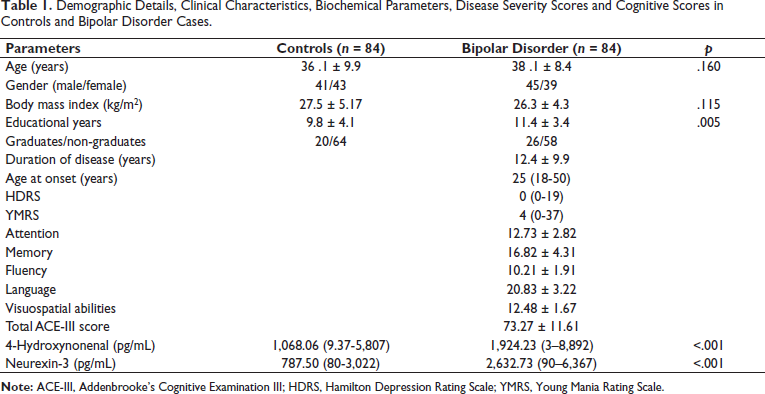
Table 2 shows the correlation of 4-HNE and NRXN-3 with ACE-III scores, YMRS and HDRS scores in BD. 4-HNE was positively correlated with NRXN-3 (p = .048). NRXN-3 was related to total ACE-III score (p = .029), attention (p = .040) and fluency (p = .026) scores in BD cases.
Correlation of 4-Hydroxynonenal and Neurexin-3 with Disease Severity Score and Cognitive Scores in Bipolar Disorder (n = 84).
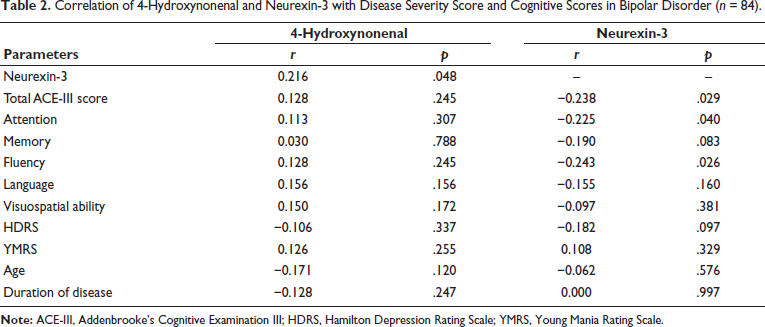
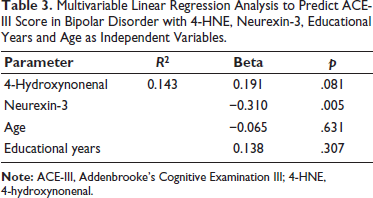
Table 3 shows a multivariate analysis to predict ACE-III score in BD with 4-HNE, NRXN-3, educational years and age as independent variables. Linear regression analysis showed that NRXN-3 was related to ACE-III score in BD (p = .005).
Multivariable Linear Regression Analysis to Predict ACE-III Score in Bipolar Disorder with 4-HNE, Neurexin-3, Educational Years and Age as Independent Variables.
Discussion
The role of NRXN in the pathophysiology of neuropsychiatric disorders like schizophrenia is well established. 6 An earlier study has sequenced the NRXN gene in BD patients with and without a suicide attempt, and no difference was observed. 11 Alteration in NRXN1 gene expression has been demonstrated in the prefrontal cortex of BD patients. 12 The data related to plasma NRXN levels and their association with cognitive scores in BD are limited. In this study, NRXN-3 levels were increased in BD (p < .001) and negatively associated with HDRS, but it was not significant (p = .097). Cognitive dysfunction is one of the common complications of BD. Among BD cases, 70% (n = 59) had cognition impairment (total ACE-III score < 82). NRXN-3 was related to total ACE-III score (p = .029), attention (p = .040) and fluency (p = .026). Based on these results, we presume that increased NRXN-3 levels may alter synaptic plasticity, leading to cognitive dysfunction.
Oxidative stress is involved in the pathophysiology of BD. 9 Elevation in lipid peroxidation and its reduction following treatment with anti-psychotics was reported in BD.13, 14 4-HNE, a lipid peroxidation by-product, is reported to be elevated in psychiatric disorders like schizophrenia.10, 15 Experimental studies have demonstrated elevated 4-HNE levels in the anterior cingulate cortex in BD. 13 Andreazza et al. observed that 4-HNE levels were not significantly different between controls and BD. 9 Scola et al. found elevated 4-HNE levels in high risk and first episode BD patients, but it was not significant when compared with controls. 16 In the present study, 4-HNE was increased in BD (p < .001), but it was not related to YMRS, HDRS or cognitive scores.
Synaptic plasticity is known to be altered by oxidative stress and inflammation. In the present study, 4-HNE was positively correlated with NRXN-3 levels (p = .048), suggesting that lipid peroxidation may increase the markers of synaptic plasticity. When multivariate analysis was done to identify the predictors of the total ACE-III score with educational years, NRXN-3, 4-HNE, and age as covariates, we found that NRXN-3 was related to the ACE-III score in patients with BD (p = .005). These results suggest that oxidative stress increases NRXN-3 levels, which in turn may lead to cognitive dysfunction in BD.
In the current study, only a smaller number of BD patients had normal cognitive function. We did not recruit any drug-naïve patients, since all BD patients were on treatment. The other markers of oxidative stress and synaptic plasticity were not analysed due to financial and ethical constraints.
Conclusion
We conclude that 4-HNE and NRXN-3 are elevated in BD compared to controls. NRXN-3 is negatively associated with cognitive scores and positively associated with 4-HNE, suggesting oxidative stress increases NRXN-3 levels, which in turn leads to cognitive dysfunction in patients with BD.
Footnotes
Abbreviations
BD: Bipolar disorder.
DSM-5: Diagnostic and statistical manual of mental disorders, edition—5.
HDRS: Hamilton Depression Rating Scale.
4-HNE: 4-Hydroxynonenal.
SCID: Structured clinical interview for DSM IV.
YMRS: Young Mania Rating Scale.
Acknowledgement
The authors acknowledge the intramural grant from JIPMER for conducting this study.
Authors Contribution
Guguloth Sudhakar: Methodology, investigation, data curation.
Hanumanthappa Nandeesha: Conceptualisation, methodology, investigation, validation, data analysis, visualisation, original writing, funding acquisition, resources, supervision, project administration.
Vikas Menon: Conceptualisation, investigation, recruitment of cases, supervision, writing–review and editing.
Kothandan Saravanan: Methodology, investigation, validation.
Statement of Ethics
The study was approved by the Institute Ethics Committee for Human Studies (JIP/IEC/2021/021).
Declaration of Conflicting Interests
The authors declared no potential conflicts of interest with respect to the research, authorship and/or publication of this article.
Funding
The authors disclosed receipt of the following financial support for the research, authorship and/or publication of this article: The intramural grant from JIPMER for conducting this study.
Patient Consent
All the participants gave written consent prior to the study.
