







Abstract
Background
The rising female labour force participation in India brings social isolation and stress into focus. The unique social challenges of maintaining contacts while juggling multiple roles highlight the significance of this research for understanding the psychological impacts of social isolation and stress in women. The study further emphasis the necessity of providing specific intervention strategies that help alleviate stress and improve techniques of adjustment; if successful, this indeed mitigates loneliness in women.
Purpose
The study analyses the association among loneliness, stress and the level of adjustment among working and homemaker women aged 25–45 years living in Delhi NCR, considering their possible interrelations and effects on women’s psychological well-being.
Methods
This was a cross-sectional design with 130 participants, involving the UCLA Loneliness Questionnaire, the Perceived Stress Scale and the Bell Adjustment Inventory as study measures.
Results
The findings indicate a moderate positive correlation between adjustment difficulties and loneliness, along with a correlation between stress and loneliness. Regression analysis shows that stress and adjustment together account for 75.4% of the variance in loneliness, suggesting that higher stress and adjustment challenges significantly contribute to loneliness among women.
Conclusion
This raises a critical concern aboutmitigating these aspects related to the mental health of women who navigate professional and domestic roles.
Introduction
The status of women can be broadly defined as the degree to which women enjoy socio-economic equality and freedom. In recent decades, women’s position in society has undergone a complete transformation. Modern women nowadays perceive themselves as nurturing homemakers for their family members while yet maintaining a strong connection to the outside world and remaining constantly occupied. The interaction of economic, social and cultural factors reinforces gender differences in land ownership, control and access through inheritance, marriage and informal networks. 1
Women make up roughly 48% of the Indian population. 2 The most recent Periodic Labour Force Survey for 2021–2022, conducted by Employment Statistics in Focus-April 2023, indicates that the female labour force participation rate for the prime working age group (15 years and above) has significantly increased, currently standing at 32.8% in India. 3
A significant indicator of a nation’s overall development is a higher status for women in terms of employment and labour provided by them. Women in contemporary society have successfully penetrated several sectors of the workforce. However, women’s progress in several domains is still significantly hindered, and they frequently encounter substantial discrimination and patriarchal attitudes both in the workplace and in domestic and social environments. The inequality in property control and ownership between genders is the primary factor contributing to the gender disparity regarding women’s economic welfare, social status and empowerment. 4 The economy fails to recognise the unpaid labour that women perform in the home and as they care for their families. 5 This may reveal a significant correlation between the maladjustment of women and the elevated amounts of stress that they experience in their day-to-day lives. A correlation of distress and lack of social support has also been observed in Indian women. ‘National research conducted in 2004 indicated that around 1.23 million men and 3.68 million women lived alone in India. 6 Despite the prevalence of loneliness throughout the nation, there is a scarcity of empirical evidence about its magnitude or other quantitative measures of severity in India’.
Loneliness is most prevalent in early and late adulthood, as well as among women. 7 A number of studies have been conducted all over the world which provide significant evidence of women experiencing depression, anxiety, low self-esteem, postpartum depression, loneliness in older women and social, emotional and educational adjustment issues in young females at university level, as well as stress. The impact of these problems often manifests in their emotional well-being and ineffective coping strategies. Research has shown that individuals of all genders experience anguish, loneliness and adjustment difficulties throughout their lives. However, women are biologically more susceptible to experiencing psychological distress.
The recent COVID-19 outbreak brought more attention to the problem of loneliness, as it forced individuals to stay inside for long periods of time and prevented them from engaging in their social lives as they normally would have. In 2004, the National Sample Survey Office of India reported that 1.23 million men and 3.68 million women lived alone and experienced loneliness. 6 The Longitudinal Ageing Study in India conducted a comprehensive examination of over 72,000 adults throughout India during the period of 2017–2018. The results indicated that 20.5% of those who were 45 years old or older experienced a moderate level of loneliness, while 13.3% reported a severe level of loneliness. 8 Numerous studies are conducted in India regarding loneliness, but it is safe to say, to my understanding that this study will be the first on the given age group and gender
According to the American Psychological Association, behavioural or attitudinal modifications in an individual occur when they acknowledge a need or desire for change, particularly in response to their surroundings or unexpected situations. A well-adjusted individual is someone who effectively meets their needs in a positive and constructive manner, while also displaying acceptable social and psychological responses to various situations and demands. In contemporary times, stress has become an exceedingly prevalent aspect of our daily existence. Nearly all of us experience occasional stress. Recent research conducted by Laustsen et al. as part of the Danish National Health Survey found a reciprocal relationship between stress and loneliness in adults aged 16–80 years. 9
Akdeniz and Gültekin Ahçı found that loneliness had a notable and favourable predictive impact on psychological adjustment issues among Turkish students and young people. 10 In their 2024 study, Kang et al. examined 255 participants (aged 25–65 years) and found that persons with elevated degrees of loneliness are prone to encountering daily stresses and have extended emotional reactions to these stressors. The study concluded that stress and loneliness might predict each other over time. 11
This study will aid to understand the said variables in targeted population and effective measures can we be taken to manage them for the betterment of the targeted gender.
Social isolation was correlated with increased mortality risk, poorer health and impaired cognitive function among older individuals residing in community environments. 12 Physical separation during COVID-19 intensified social isolation and contributed to the decline in mental health associated with social isolation in older individuals. 13 Furthermore, an individual’s impression of social isolation influenced their mental and physical well-being. 14 Studies indicated that felt isolation or loneliness correlated with reduced physical and mental health, manifesting as increased depressive symptoms, psychological discomfort and impaired cognitive performance among older persons residing in community settings.15, 16
A study of Finnish elderly individuals in assisted living revealed that perceived social loneliness was associated with both external and internal contacts within the institution. 17 Residents’ views of social isolation differed based on the quality of relationships with co-residents and staff members, daily routines inside the institution, their own life narratives and the avoidance of visits from older friends at their facility. 18 Gender influenced loneliness and social estrangement. 19 Although male gender correlated with social isolation, many investigations showed that loneliness was more prevalent among elderly women than men. 20 Elderly women who were unmarried, widowed or divorced and experienced emotions of loneliness exhibited higher levels of sadness and anxiety compared to their elderly counterparts. 21
Methods
Data Collection
The study collected data using three scales: (a) The UCLA Loneliness Questionnaire by T. Russell, Peplau and Ferguson was used to assess the loneliness variable. The scale consists of 20 items —10 positively worded and 10 negatively worded. (b) Stress was assessed by the Perceived Stress Scale (PSS), developed by Sheldon Cohen in 1983. The scale contains a total of 10 items. (c) Adjustment was assessed by the Bell Adjustment Inventory by Hugh Bell, which comprises 160 questions.
Study Design
The study used a cross-sectional design involving women in the age group of 25–45 years living in Delhi NCR, India. The initial sample size was 200; however, the analyses presented in this study were restricted to respondents who completed all the items on the administered tools. The participants were selected as per some selection criteria. The inclusion criteria for participants were as follows: (a) 25–45 years of age, (b) working as well as non-working professional women, (c) proficiency in the English language and (d) no chronic mental illness.
Assessment Tools
A semi-structured socio-demographic proforma was developed, and participant information was recorded, including name, sex, age, highest educational qualification, employment and designation. The UCLA Loneliness Scale by Russell et al. 22 was used to assess the loneliness variable. The scale comprises 20 items—10 direct and 10 reverse-scored.
Items invite respondents to rate how often they experience a circumstance on a four-point Likert scale. The test exhibits good internal consistency (α = 0.89–0.94) and year-long test–retest reliability (r = 0.73).
Stress was assessed using the PSS developed by Sheldon Cohen 23 in 1983. It quantifies the degree of stress induced by life circumstances, with a total of 10 items. The items assess respondents’ perceptions of unpredictability, uncontrollability and overload. The scale poses a plethora of direct questions regarding stress levels. The internal consistency reliability of the PSS-10 is 0.78.
Adjustment was assessed by using the Bell Adjustment Inventory by Hugh Bell. 24 It contains 160 questions to assess home adjustment, health adjustment, social adjustment, emotional adjustment and occupational adjustment. This reliability of this scale ranges from 0.75 to 0.89, with a validity of 0.58.
Results and Interpretations
Table 1 presents the socio-demographic characteristics of middle-aged women living in Delhi (N = 130). Seventy respondents provided incomplete information, so the effective sample size was 130. The findings show that the average age of women participants was 34 years. The table reveals that out of 130 women, 62 were married, 52 were unmarried, 12 were living separately from their partners and 4 were divorced. The number of female participants who were employed professionals was 79, while the remaining 51 were unemployed. Their socio-economic standing was quite homogeneous, with 66 women belonging to the medium socio-economic class and 64 falling into the high socio-economic status category.
Socio-demographic Characteristics of Middle-aged Women (N = 130).
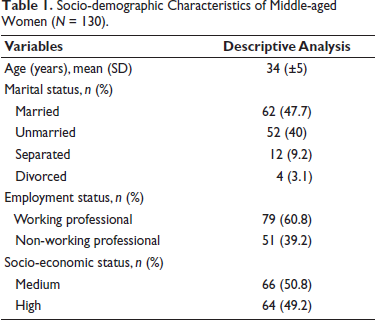
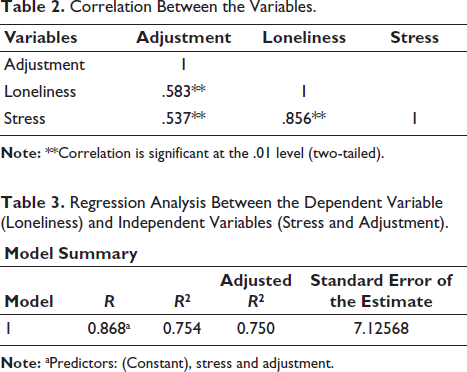
Table 2 depicts the correlation between adjustment, loneliness and stress variables among the women (n = 130). The correlation between the variables of adjustment and loneliness shows a statistically significant moderate positive relationship with a p value of .01 and a correlation coefficient of r = 0.583**. The difference between the two variables, the variable of adjustment and stress, is also positive, with a p value of .01 (r = 0.537**). This implies that adjustment and stress are statistically significantly related to one another at the level of significance (p = .01). Furthermore, the table represents a strong positive association between stress and loneliness (r = 0.856**). This suggests that increased levels of stress are associated with higher levels of loneliness, while lower stress levels correspond to lower levels of loneliness, and so on.
Correlation Between the Variables.
R may serve as an indicator of the predictive quality of the dependent variable (loneliness). A result of 0.868 in this instance indicates a strong predictive capability, suggesting that heightened stress and adjustment difficulties may forecast an increase in loneliness. R 2 represents the coefficient of determination. R 2 indicates the percentage of variation in the dependent variable that can be explained by the independent variables. In Table 3, the R 2 value is 0.754, indicating that 75% of the variance in the dependent variable, loneliness, is attributable to variations in the independent variables, stress and adjustment.
Regression Analysis Between the Dependent Variable (Loneliness) and Independent Variables (Stress and Adjustment).
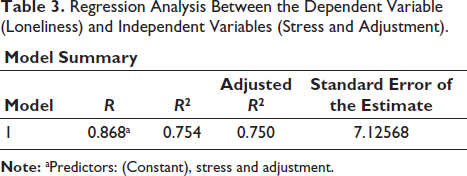
Table 4 presents the overall significance of the regression model in predicting loneliness based on the independent variables of stress and adjustment. Under the Regression row, it has been found that the model explains a substantial proportion of the variation in loneliness, with a large F value of 194.254 and a p value (Sig.) of .000, which is less than the conventionally accepted value of .05. As the p value is much smaller than the typical significance level of .05, this indicates that the overall regression model is statistically significant. In other words, the predictors (stress and adjustment) are likely to have a meaningful impact on predicting loneliness. The sum of squares represents the variance explained by the predictors (stress and adjustment) in relation to the dependent variable (loneliness). This implies that stress and adjustment, as independent variables, collectively and significantly explain loneliness. The sum of squares for the regression equation is 19,726.646. These are the variances explained by the model, and the residual sum of squares is 6,448.462, which actually reflects the variation that has not been explained by the predictors. The mean square values are obtained by dividing the sum of squares by their corresponding degrees of freedom (df). In this analysis, the regression has 2 df and the residuals have 127. The total sum of squares, 26,175.108, represents the overall variance in loneliness within the sample, combining both the explained and unexplained variance. The regression model, with stress and adjustment as predictors, significantly explains the variance in loneliness and both predictors are statistically significant.
Regression Analysis Showing Predictors of Loneliness (Dependent Variable).

bDependent variable: Loneliness.
Discussion
A substantial association between adjustment, stress and loneliness was found to exist among middle-aged women in Delhi, according to the findings of the study. The results of the correlation study indicate that adjustment has a somewhat positive association with loneliness and that it also has a moderately positive correlation with stress. The fact that issues associated with adjustment are tied to high levels of stress and loneliness is thus attributed to the fact that these factors are related. In their research conducted on adolescents, Hussain et al. proved that academic stress not only inhibits academic performance but also substantially impacts adjustment. 25 This was proven through the studies that they conducted. They also stated that there were inverse associations between the connection between academic stress and adjustment, which was another thing that they proposed.
Furthermore, there is a substantial positive correlation between stress and loneliness, which indicates that high levels of stress reflect high levels of loneliness. It was said in the research conducted by Singh and Kiran that older women report higher degrees of loneliness in comparison to their male counterparts. According to them, loneliness is a serious problem that has a negative impact on the well-being of older women. It is because loneliness is a contributor to emotional discomfort and is associated with a variety of health problems in this population. 26
The results suggest that, for this sample, the combined effects of stress and adjustment are highly significant in influencing loneliness. Similarly, a study conducted by Morrish and Medina-Lara explains the association between loneliness and unemployment, demonstrating a consistent positive association relationship in which unemployment increases the likelihood of loneliness. 27
The present study is, therefore, a quantitative investigation into the conjoint relationship between adjustment, stress and loneliness among middle-aged women in Delhi that was addressed through the proper application of statistical analysis-correlation, regression and analysis of variance—to further establish the fact that stress and adjustment problems highly predict loneliness. On the other hand, the study by Woods is a phenomenological qualitative design, where loneliness experiences and how they impact mental health are investigated, particularly during the time of the COVID-19 pandemic, among middle-aged women in Los Angeles. This specific study used semi-structured interviews that collect personal experiences of isolation owing to social distancing. 28
The current study, as well as Bulog et al. have always focused on the fact that stress has a profound impact on women. 29 For this reason, both studies include factors that lead to emotional well-being amongst women. Both studies explain the relationship between external pressures in adjustment difficulties within Delhi and increased stresses among women in unpaid care work during the COVID-19 pandemic within Croatia.
The associations between adjustment, stress and loneliness among middle-aged women in Delhi are investigated in this study, using correlation and regression analyses to measure and highlight these associations, but mostly to predict the predictive effects of stress and adjustment concerns on loneliness.
Conclusion
In this study of middle-aged women, stress and adjustment problems were significant predictors of loneliness. The study links loneliness, stress and adjustment for Delhi’s middle-aged women. Adjustment troubles are linked to stress and loneliness. The findings highlighted the need for specific treatments in women’s mental health and well-being, including stress and adjustment-related therapies that tackle loneliness. This study examines loneliness, stress and adjustment among middle-aged women in Delhi, affecting mental health and support networks. The scope of the study is constrained. It starts with cross-sectional research. This method lowers causal inferences by gathering data simultaneously. The 130-person sample may not reflect Indian middle-aged women as a whole. Bias may limit the scope of the results. Social preferences or personal assessments may underreport or overreport loneliness and stress. Second, the study only included 25–45-year-olds, ignoring regional and age disparities in India.
Longitudinal studies should evaluate how loneliness impacts stress and adjustment in more than just middle-aged women. Research on loneliness and stress reduction may yield remedies. Studying rural India and other cultures may reveal how society influences women’s mental health.
Footnotes
Acknowledgements
I would like to thank Dr Mehfooz Ahmad and Dr Geeta Singh for their valuable guidance and support throughout this study, as well as for their assistance with data analysis and critical review of the manuscript. I am also grateful to AIBAS, Haryana for providing access to their research facilities.
Authors’ Contribution
All authors mentioned provided substantial contributions to the conception of the work, data acquisition, analysis or interpretation, and to drafting or revising the article.
Statement of Ethics
I confirm that this work is original and has not been previously published, nor is it currently under consideration elsewhere. I further confirm that the data presented are accurate, and that no data have been fabricated, falsified or manipulated. All sources used are properly cited, and plagiarism has been avoided.
Declaration of Conflicting Interests
The authors declared no potential conflicts of interest with respect to the research, authorship and/or publication of this article.
Funding
The authors received no financial support for the research, authorship and/or publication of this article.
ICMJE Statement
We declare that this article has been prepared in accordance with the ICMJE guidelines.
Patient Consent
Informed consent was obtained from all participants, and the study was conducted in accordance with ethical guidelines. The confidentiality and privacy of participants were maintained throughout the study.
