







Abstract
Background
Adolescence is a sensitive developmental stage marked by rapid physical, cognitive, and socio-emotional changes. School transitions during this period often heighten vulnerability by disrupting established routines, academic familiarity, and peer relationships. New curricula, unfamiliar teaching styles, and the challenge of building new social connections can increase academic anxiety and make emotional regulation (ER) more difficult. These stressors, compounded by pubertal changes, heightened family expectations, and the influence of social media, may amplify emotional volatility and negatively affect students’ overall well-being. Understanding how adolescents adapt emotionally and academically during school changes is critical for designing supportive interventions.
Purpose
This study aimed to assess the levels of academic anxiety and ER among adolescents who had recently changed schools and to explore possible gender differences and relationships between ER components and academic anxiety.
Methods
A cross-sectional, quantitative design was employed with a purposive sample of 120 adolescents (60 boys and 60 girls) aged 14–16 from the National Capital Region (NCR) of Delhi, India. Participants had changed schools in either the 9th or 11th grade. Standardised self-report measures were administered to assess academic anxiety and ER, including its sub-domains of cognitive reappraisal (CR) and expressive suppression (ES). Data were analysed using the Statistical Package for the Social Sciences (SPSS, version 16.0). Independent-sample t-tests were conducted to examine gender differences, and Pearson’s correlation coefficients were calculated to evaluate relationships between study variables.
Results
Findings indicated low but statistically significant gender differences and low significant correlations between boys and girls in overall ER, CR, ES, and academic anxiety. A strong positive correlation emerged between ER and ES.
Conclusion
Adolescents of both genders face similar ER and academic anxiety challenges following school transitions. These results highlight the importance of early, targeted interventions to support emotional well-being and academic adjustment during this vulnerable period.
Introduction
Academic Anxiety
Changing schools often heightens academic anxiety, as students must adapt to unfamiliar environments while facing performance pressures. Alongside academic concerns, many experience stress, social isolation, and emotional regulation (ER) difficulties, underscoring the need for strong coping strategies and academic support. Academic anxiety is a broad construct encompassing fears related to typical school demands such as peer comparison, classroom participation, and workload management. 1 Unlike test anxiety, it extends beyond evaluation events to general school-related stressors. Its theoretical roots trace to 2 who distinguished facilitative anxiety, which can motivate achievement, from debilitative anxiety, which overwhelms coping resources, aligning with the Yerkes Dodson principle. 3
Academic anxiety acts as a barrier during transitions such as school changes. Low self-concept and self-efficacy strongly predict test and academic anxiety, undermining ER and performance. 4 Anxious students often experience peer rejection, aggression, or social withdrawal, further limiting academic and social growth. 5 High anxiety has also been associated with school dropout and reduced achievement. 6 Secondary school students are especially vulnerable, with peer pressure, self-concept, and parental expectations intensifying distress. Anxiety impairs learning by triggering fight-or-flight responses and reducing cognitive flexibility. Collectively, these findings indicate that academic anxiety during school transitions strongly predicts ER difficulties and challenges in overall adjustment.
ER and Adolescence
ER is the ability to monitor, manage, and respond to emotions in ways that are socially appropriate and flexible. It involves modulating the intensity, duration, and quality of both positive and negative emotions and may occur consciously or automatically. 7 ER is fundamental to emotional development, enabling students to remain calm under pressure, manage stress, and navigate social interactions effectively. As a core self-regulatory process, ER includes strategies such as cognitive reappraisal (CR), which reframes situations to reduce emotional impact and is linked to resilience and positive outcomes and expressive suppression (ES), the inhibition of outward emotional display, which is often maladaptive and associated with psychological distress and poorer social functioning. 8
Effective ER underpins emotional intelligence, stress management, and overall well-being. During adolescence, regulation increasingly depends on self-perception and peer relationships rather than parental support, 9 with peer pressure fostering both adaptive and maladaptive emotional responses. 10 ER also predicts academic resilience, found ER shaped stress responses and academic self-efficacy, while emphasising the school’s role in supporting identity and adaptive coping.
Adolescence is a peak period for the onset of mood and anxiety disorders. 11 ER plays a transdiagnostic role in the development and maintenance of psychopathology. Poor ER is linked to impulsivity, behavioural adjustment problems, and risky behaviours such as early sexual activity. 12 Academic settings can intensify these vulnerabilities reported high academic anxiety among Delhi adolescents, with 56% of girls and 49% of boys affected, stress, anxiety, and depression rose sharply by Grade 12, particularly among girls. These findings align with evidence that adolescence combines rapid physical maturation and advancing abstract thinking. 13
ER is also culturally shaped. Western norms encourage open expression, while Asian cultures often emphasise harmony and emotional suppression. Suppression may not always indicate maladaptation; it can reflect cultural expectations, and findings of mental health links with ER strategies vary across cultures. 14 Emotion regulation strategies are associated with mental health outcomes in adolescence: more adaptive strategies tend to relate to lower depression and anxiety, whereas maladaptive strategies predict greater psychological distress. Difficulties in emotion regulation are also broadly linked to poorer psychosocial functioning and elevated risk for internalising and externalising problems. Because emotion regulation continues to mature across adolescence alongside improving cognitive control, this period is important for strengthening adaptive regulation within developmental contexts. 15
Academic Anxiety, ER and School Transitions
Classroom emotions strongly influence students’ cognitive, motivational, and academic development, with evidence suggesting a bidirectional relationship. Positive emotions such as pride and enthusiasm enhance engagement and performance, whereas poor achievement reinforces negative emotions like anger and sadness, reducing motivation and participation. Highly activated negative emotions may also disrupt classroom processes, underscoring the importance of assessing their impact within a single academic year.
A positive school climate, defined as the overall quality of school life, including shared values, ethos, and relationships among students, teachers, and staff, is consistently linked to improved attendance, academic achievement, retention, and psychological well-being. 16 Supportive school climates can strengthen students’ sense of safety and belonging and are consistently linked to better academic and psychosocial outcomes. 17 School mobility can disrupt these protective factors, and transferring schools is associated with a higher risk of disengagement and dropout, even after accounting for prior achievement and family background. 18
Gender differences in academic anxiety are well-documented. Girls often show higher internal distress even when they achieve strongly, consistent with evidence of gender-linked patterns in academic performance and emotional distress. 19 Individual traits also shape adaptation. Coping strategies are consistently linked to adjustment in academic contexts: more adaptive, problem-focused coping relates to better functioning, while maladaptive coping relates to poorer adjustment outcomes. 20
Adolescence is a vulnerable period when school changes amplify academic anxiety and strain the ER. Disrupted routines, unfamiliar teaching styles, peer loss, and increased external pressures can hinder well-being. These findings highlight the need for targeted, school-based interventions to support emotional resilience and academic adjustment during transitions.
Rationale of the Study
The current study aims to investigate the intricate relationships between academic anxiety and ER in students aged 14–16 who have experienced a school change. This research is designed to identify how academic anxiety, often heightened by school transitions, directly disturbs ER, consequently affecting students’ overall adaptation and well-being in their new educational environments. Recognising that boys and girls may exhibit differing adaptive responses to new settings, which could influence their academic anxiety levels, we also anticipate that academic anxiety following a school change will provide significant additional explained variance in predicting symptoms of low ER among these students.
Methods
Study Design
A purposive, cross-sectional sampling strategy was used to recruit 120 students (60 boys and 60 girls) aged 14–16 from schools in Delhi National Capital Region (NCR) who had recently changed schools in either the 9th or 11th grade. The study followed a quantitative, descriptive comparative design, with correlational analyses to examine relationships among the measured variables.
Assessment Tools
Demographic Information form students also completed a short demographic questionnaire that included gender, enrolment for the class, parents’ education, profession, family status and information about siblings.
Academic Anxiety Scale (Cassady) 21
The scale was developed to represent a cross-section of worries and fears in academic environments and situations. It typically consists of 11 items that prompt users to rate themselves on a Likert-type scale (e.g., from 1 = ‘Not at all typical of me’ to 4 = ‘Very typical of me’). The underlying goal of this scale was to generate a simplified, broad contextual representation for anxieties experienced within academic settings (see Cassady, 2010). Psychometric properties of the Academic Anxiety Scale were not established prior to this study, and are addressed in the forthcoming analyses.
Emotion Regulation Questionnaire (ERQ; Gross & John) 22
The ERQ is a 10‐item questionnaire developed to measure the habitual use of two emotion regulation strategies: CR and ES. Both subscales are measured against a Likert-type scale from 1 (Strongly Disagree) to 7 (Strongly Agree), with an example item for CR being ‘I control my emotions by changing the way I think about the situation I am in’ and for ES ‘I control my emotions my emotions by not expressing them’. The internal consistency for the CR items was excellent (α = 0.92), and the ES items was good (α = 0.81)
Procedures
The study was conducted on school students aged 14–16 who had recently changed schools. Ethical approval was obtained from the relevant committee, and written informed consent and permission were secured from both parents and students. All participants were provided with detailed information about the research in both verbal and written form. Prior to test administration, rapport was established with each participant, and they were encouraged to answer all questions openly. Participant confidentiality was strictly maintained throughout the study. Data analysis was performed using the Statistical Package for the Social Sciences (SPSS, version 16.0), with t-tests and correlation analyses conducted.
Results
Descriptive Analysis
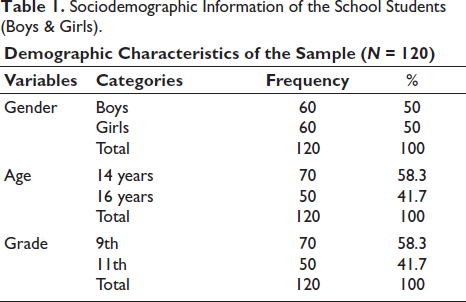
The sociodemographic characteristics of the study sample were 120 school students (60 boys, 60 girls) from the 9th (58.3%) and 11th (41.7%) grades. Their ages ranged from 14 (58.3%) to 16 (41.7%) years (Table 1).
Sociodemographic Information of the School Students (Boys & Girls).
The sociodemographic characteristics of the study sample, which consisted of 120 school students, were analysed based on their parents’ education, occupation, and family income. Among the parents, 44.2% of fathers were graduates, while 55.8% were postgraduates. For mothers, 41.7% were graduates, and 58.3% were postgraduates. Regarding occupation, 66.7% of the fathers had jobs, and 33.3% were in business. Among mothers, 41.7% were working, and 58.3% were homemakers. In terms of family income, 66.7% of the students came from middle-class families, and 33.3% were from high-class families (Table 2).
Sociodemographic Information of the School Students’ Parents, Including Their Education, Occupation, and Family Income.
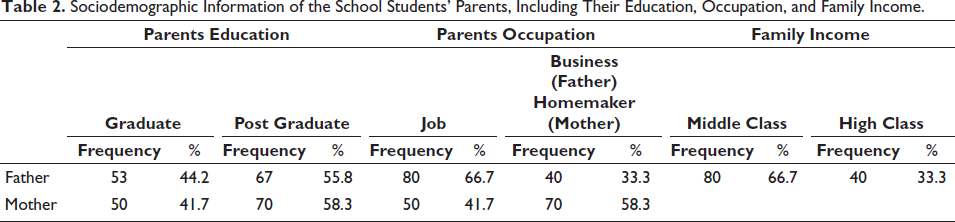
Table 3 presents the demographic information of the students’ siblings. A majority of the students (61.7%) have siblings, while 38.3% are only children. Of those with siblings, 70% attend the same school as the student in the study, and 30% attend different schools. The data also indicates that 39.2% of the students live with a single parent, while 60.8% live with both parents.
Sociodemographic Information of the School Students’ Siblings.

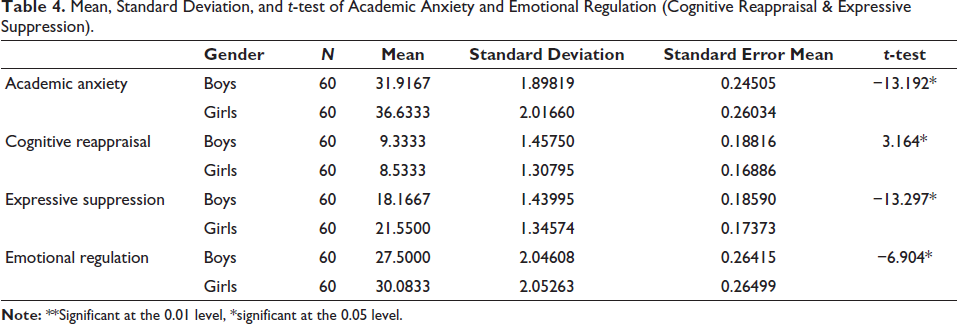
A statistically significant difference was observed between boys and girls who experienced a school change regarding academic anxiety and ER. The mean score of academic anxiety for boys was 31.92 (SD = 1.89), while the mean score for girls was 36.63 (SD = 2.02). The girls’ mean score was significantly higher than the boys’ mean score, with a t-value of −13.192* at the 0.05 significance level and a 95% confidence interval (CI = −5.42 to −4.008) (Table 4 and Figure 1).
Mean, Standard Deviation, and t-test of Academic Anxiety and Emotional Regulation (Cognitive Reappraisal & Expressive Suppression).
Gender Differences in Academic Anxiety Scale and Emotion Regulation Scale Scores.
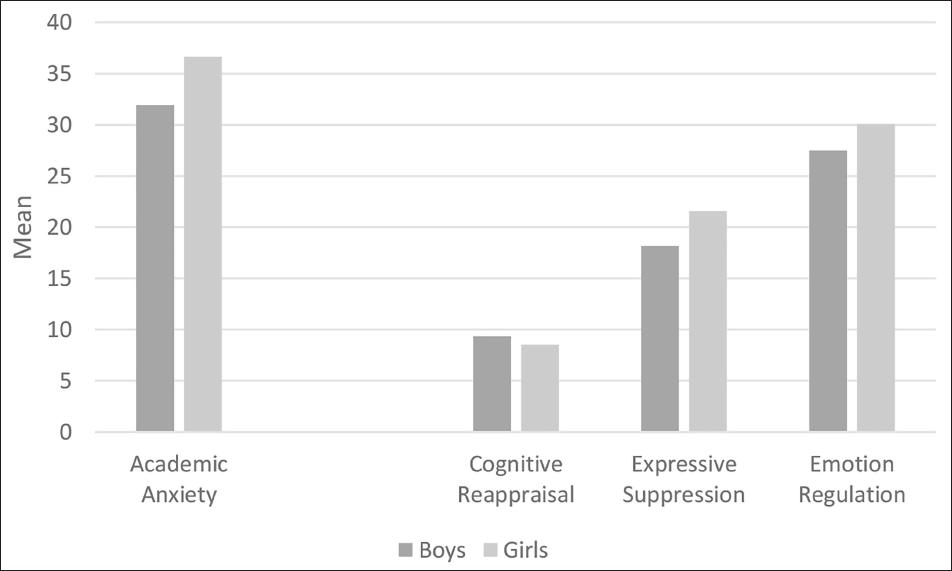
There was a statistically significant difference in the two subscales of ER between boys and girls who experienced a school change. For the CR subscale, boys reported a mean score of 9.33 (SD = 1.46), which was significantly higher than the girls’ mean score of 8.53 (SD = 1.31), with a t-value of 3.164* at the 0.05 significance level and a 95% confidence interval (CI 0.29 −1.30). Conversely, on the ES subscale, boys had a mean score of 18.17 (SD = 1.44), which was significantly lower than the girls’ mean score of 21.55 (SD = 1.35), with a t-value of −13.297* at the 0.05 significance level and a 95% confidence interval (CI = −3.89 to −2.88). Overall, the mean ER score for boys was 27.50 (SD = 2.04), which was significantly lower than the girls’ mean score of 30.08 (SD = 2.05), with a t-value of −6.904* at the 0.05 significance level and a 95% confidence interval (CI = −3.32 to −1.84).
There is a statistically significant, low negative correlation between academic anxiety and CR (r = −0.299**, p < .01). This indicates that among students who experienced a school change, the use of CR tends to decrease as academic anxiety increases. There is a statistically significant, moderate positive correlation between academic anxiety and ES (r = 0.604**, p < .01). This indicates that among students who experienced a school change, there is a tendency for ES to also increase as academic anxiety increases. There is a statistically significant, low positive correlation between academic anxiety and emotion regulation (r = 0.370**, p < .01). This indicates that as academic anxiety increases, there is a tendency for ER to also increase in the students who experience school change (Table 5).There is a statistically insignificant, negligible correlation between ES and CR (r = 0.163, p > .01). This indicates that there is no statistically significant relationship between the two variables, so we cannot conclude that an increase in one variable is associated with a change in the other. There is a statistically significant, low positive correlation between ER and CR (r = 0.446**, p < .01). This indicates that as ER increases, there is a tendency for CR to also increase.There is a statistically significant, strong positive correlation between ER and ES (r = 0.810**, p < .01). This indicates that among students who experienced a school change, there is a strong tendency for ES to increase as ER also increases.
Correlations of Academic Anxiety and Emotional Regulation (Cognitive Reappraisal & Expressive Suppression).

Discussion
The current study aimed to investigate the complex relationship between academic anxiety and ER in students aged 14–16 who had recently changed schools. It examined how academic anxiety, particularly during school transitions, disrupts ER and affects students’ adaptation and overall well-being. The study further predicts that post-transition anxiety would significantly contribute to lower ER, with boys and girls demonstrating different adaptive responses. In a study of 120 school students who experienced a school change, a statistically significant difference was observed between boys and girls regarding academic anxiety and ER. The sociodemographic characteristics of the sample were analysed based on parents’ education, occupation, family income, and number of siblings. Academic pressures from high expectations, competitive environments, and an uncertain future can lead to low ER. Family expectations and social dynamics, including peer pressure, bullying, and feelings of social inadequacy, also play a crucial role in triggering academic anxiety and low ER among teenagers due to a school change. Rehman specifically highlighted that secondary school students are highly susceptible to anxiety during transitions, with predictors such as peer pressure, self-concept, and parental expectations intensifying emotional distress. These factors undermine adaptation, making school changes especially challenging. 23
Academic anxiety has been found to be higher in girls than in boys who experience school changes. High levels of anxiety are linked to reduced academic achievement. 2 Female students often report higher academic/test anxiety than males, and this anxiety is meaningfully linked to poorer academic outcomes. 6 Evidence also suggests that academic anxiety is shaped by students’ self-beliefs: lower perceived ability and weaker performance expectancies are associated with greater anxiety, while expectancies predict later grades, and value beliefs influence course enrolment intentions. 24 Together, these findings imply that gender differences in academic anxiety may reflect differences in confidence and perceived academic pressure, particularly during demanding school years.
Among boys who experienced a school change, the CR subscale was higher, ES was low, and overall ER was low compared to girls. It identified difficulties in responding to emotions as a major functional concern in help-seeking youth, which had impacted various domains of their lives. This indicates that as academic anxiety increases due to a school change, there is a tendency for ES to also increase. Research has found that more mobile adolescents tend to be more socially isolated and less involved in extracurricular activities than non-mobile adolescents. 25 This may lead to weak academic performance, lowered educational aspirations, and less commitment to and satisfaction with school.
A correlation was found indicating that when students who experienced a school change had increased academic anxiety, the use of CR tended to decrease in both boys and girls. The basic components of academic anxiety include fear of lower performance compared to peers, worry about handling responsibilities, and experiencing stress in classrooms. 1
There is a statistically significant, strong positive correlation between ER and ES. As ER increases, there is a strong tendency for ES to also increase among students who experience a school change. This relationship may be understood considering the broader social stressors of transferring schools, where students enter environments with established friendship networks and cliques. For many transfer students, being ‘unknown’ can restrict their access to the school’s existing social hierarchy, making social integration more difficult and increasing the need to manage emotional expression in public settings.26, 27
As a result, more mobile adolescents tend to be more socially isolated and less involved in extracurricular activities than non-mobile adolescents, 28 which can lead to weak academic performance, lowered educational aspirations, and less commitment to and satisfaction with school. The girls in higher grades demonstrated weaker confidence and stronger anxiety than boys. 29 Such gender differences reflect not only academic pressures but also ER challenges during critical educational transitions.
Conclusion
Academic anxiety and related emotional issues due to school change involve focusing on the factors and their potential correlations with cognitive functions. ER difficulties are distinctive in students; they learned what emotions are and how to regulate themselves to reduce anxiety due to school change. The students aged 14–16, school change created a complex interplay of increased academic demands and social uncertainties exacerbate existing developmental vulnerabilities. Academic anxiety, which in turn challenges their capacity for effective ER, ultimately impacts their overall well-being and adaptation to the new educational environment.
Implications of the Study
This study will help students balance academic anxiety and learn to regulate their emotions. It will equip them to accept challenges in a new school environment by rationalising their thoughts, enabling them to focus on future studies. Emotion regulation can boost positive feelings and emotional engagement to improve learning, and it can calm overwhelming emotions that might be preventing you from successfully taking in new information as a student.
Footnotes
Abbreviation
ER = Emotional regulation
Acknowledgements
The authors extend their sincere appreciation to Dr Mehfooz Ahmad for his valuable guidance, support, and critical insights throughout the course of this research. His assistance with data analysis and constructive review of the manuscript significantly enhanced the quality of this work. The authors also acknowledge AIBAS, Haryana, for providing research facilities and institutional support.
Authors’ Contribution
Binni Singla designed the study, collected and analysed the data, and drafted the manuscript. Dr Mehfooz Ahmad provided supervision, critical feedback, and guidance throughout the research process and manuscript development.
Statement of Ethics
This manuscript is an original work that has not been published previously and is not under consideration for publication elsewhere. All data presented are accurate and have not been fabricated, falsified, or manipulated. All sources have been appropriately acknowledged, and the study was conducted in accordance with ethical research standards and academic integrity guidelines.
Declaration of Conflicting Interests
The authors declared no potential conflicts of interest with respect to the research, authorship and/or publication of this article.
Funding
The authors received no financial support for the research, authorship and/or publication of this article.
Participant Consent
Written informed consent was obtained from all participants prior to their inclusion in the study. The research adhered to institutional and international ethical principles, ensuring the confidentiality and privacy of participants throughout the study.
