






Abstract
Background
Synaptic plasticity markers are known to be altered in schizophrenia.
Purpose
The objectives of the study were to analyse neurexin-3 levels and their relation with severity in schizophrenia.
Methods
A total of 216 schizophrenia patients and 216 healthy volunteers were enrolled. Neurexin-3 was analysed by enzyme-linked immunosorbent assay. The severity of schizophrenia was determined using the Positive and Negative Syndrome Scale (PANSS) scores.
Results
Neurexin-3 levels were significantly reduced (p < .001) and positively associated with negative symptom score (p = .037), general psychopathological score (p = .025) and total PANSS score (p = .019) in schizophrenia cases. Neurexin-3 was significantly increased (p < .05), and disease duration (p < .05) was significantly reduced in schizophrenia patients with marked illness compared to those with mild illness.
Conclusion
We conclude that neurexin-3 is reduced and is associated with the severity of schizophrenia.
Introduction
Schizophrenia is a chronic mental illness accompanied by a disturbance in the thought process and emotional responsiveness. 1 Schizophrenia is associated with complications such as cognitive dysfunction, suicide and an increased risk of premature mortality.2, 3
Synaptic dysfunction is known to play a key role in the development of neuropsychiatric disorders, including schizophrenia and bipolar disorder. 4 Previous studies have documented altered plasma levels and single-nucleotide polymorphisms of markers of synaptic plasticity and their relation to the severity of schizophrenia.5, 6
Neurexins are transmembrane proteins that bind to neuroligins and mediate the formation and maturation of synapses. 7 Neurexin signaling is known to be altered in several psychiatric disorders, including schizophrenia. 8 Deletion of neurexin-1 is reported to increase the risk of schizophrenia by reducing neuronal activity and neurotransmitter release.9, 10 Earlier studies have documented altered neurexin-3 levels in psychiatric disorders. Cerebrospinal fluid (CSF) neurexin-3 levels were found to be reduced in major depressive disorders. 11 Plasma neurexin-3 levels were reported to increase and to be associated with cognitive scores in patients with bipolar disorders. 12 Neurexin-3 gene polymorphism has been investigated in schizophrenia and was found to be associated with the risk of schizophrenia. 13 Since data about plasma neurexin-3 levels are lacking in schizophrenia, the present study was undertaken to investigate plasma neurexin-3 levels and their relation to the severity of schizophrenia.
Methods
This case-control study comprised 216 schizophrenia patients (age—20–50 years), diagnosed based on DSM-5 (Diagnostic and Statistical Manual of Mental Disorders, edition-5) criteria and 216 controls. Participants with medical disorders, inflammatory disorders and active substance use were excluded. Institute Ethics Committee (IEC/2018/523) approval was obtained. Written consent was obtained from all the participants of the study. The Positive and Negative Syndrome Scale (PANSS) 14 was used to analyse schizophrenia severity. Based on the PANSS score, schizophrenia patients were divided into mild illness (PANSS = 30–58), moderate illness (PANSS = 59–74) and marked illness (PANSS = >75).
Sample Size Calculation
Since there was no previous study in the literature on neurexin-3 levels in schizophrenia, we performed an interim analysis and calculated the sample size based on the mean difference in neurexin-3 levels between cases and controls. The sample size was estimated at a 5% level of significance and 80% power.
Sample Collection and Neurexin-3 Estimation
5 mL of blood sample was collected in an EDTA tube and centrifuged. Plasma was used for estimating neurexin-3 by enzyme-linked immunosorbent assay (ELISA) (Krishgen, India). The normal range of neurexin-3 was 400–1,000 pg/mL.
Statistical Analysis
The normality of the data was analysed with the Kolmogorov–Smirnov test. Mann–Whitney U test/Student’s t test was used to compare the data between controls and schizophrenia. The relation between neurexin-3 and age, disease duration and the PANSS score in schizophrenia was analysed using the Spearman correlation test. One-way analysis of variance (ANOVA), followed by post hoc Tukey’s test, was used to analyse neurexin-3 and disease duration in schizophrenia patients with different stages of illness.
Results
The clinical characteristics and neurexin-3 levels in schizophrenia cases and controls are shown in Table 1. Neurexin-3 levels were significantly reduced in schizophrenia cases compared to controls (p < .001).
Clinical Characteristics and Neurexin-3 Levels in Schizophrenia Cases and Controls.

Table 2 shows the correlation of neurexin-3 with PANSS scores and the duration of the disease. Neurexin-3 was positively associated with negative symptom score (p = .037), general psychopathological score (p = .025) and total PANSS score (p = .019) in schizophrenia cases. There was no significant association between neurexin-3 and disease duration.
Correlation of Neurexin-3 with Disease Severity Score in Schizophrenia.
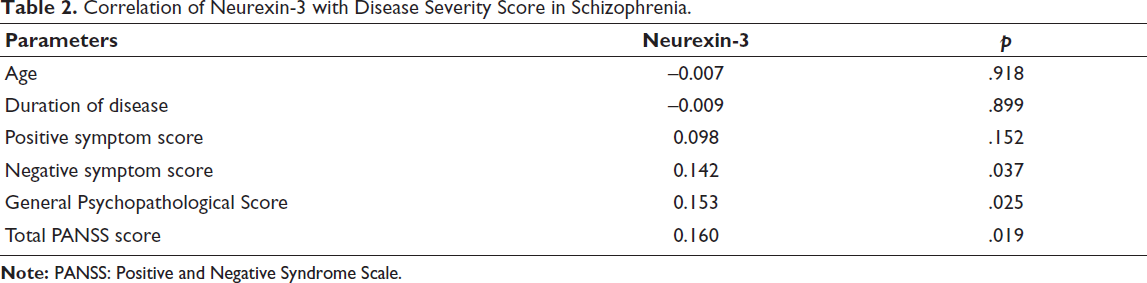
Table 3 shows the neurexin-3 levels and disease duration in schizophrenia subgroups based on PANSS scores. Neurexin-3 was significantly increased (p < .05), and disease duration (p < .05) was significantly reduced in schizophrenia patients with marked illness compared to those with mild illness.
Plasma Neurexin-3 and Duration of Disease in Schizophrenia with Mild, Moderate, Marked and Severe Illness.

Discussion
Neurexin-3 is a marker of synaptic plasticity and is known to play a role in the pathophysiology of schizophrenia. 15 An earlier study from the Chinese Han population has documented an association between single-nucleotide polymorphisms of the neurexin-3 gene and weight gain in schizophrenia patients treated with risperidone. 13 Altered plasma neurexin-3 levels were reported in bipolar disorder, 12 but there are no data regarding neurexin-3 levels in schizophrenia.
In the current study, neurexin-3 levels were significantly reduced in schizophrenia cases compared to controls (p < .001). When subgroup analysis was performed on schizophrenia patients based on PANSS scores, we found that around 50% (n = 107) had mild illness (PANSS = 30–58), 25% (n = 54) had moderate illness (PANSS = 59–74), and 25% had marked illness (PANSS = >75). Neurexin-3 was significantly increased (p < .05) in schizophrenia patients with marked illness compared to those with mild illness. It was positively associated with negative symptom score (p = .037), general psychopathological score (p = .025) and total PANSS score (p = .019) in schizophrenia cases. There was no significant association between neurexin-3 and disease duration. Even though the mechanism through which neurexin-3 is related to the severity of schizophrenia is not known, it can be speculated that altered neurexin-3 levels may affect the formation, maturation and functioning of synapses, 7 resulting in synaptic dysfunction, which may increase the severity of schizophrenia.
The main limitation of the study is that the effect of anti-psychotics on neurexin-3 levels was not analysed. Other types of neurexins were not analysed due to financial constraints.
Conclusion
We conclude that neurexin-3 is reduced in schizophrenia and positively associated with PANSS scores, suggesting that reduced neurexin-3 levels lead to the severity of schizophrenia. Further studies are needed to analyse neurexin-3 gene expression in schizophrenia and its association with disease severity.
Footnotes
Abbreviations
DSM-5: Diagnostic and Statistical Manual of Mental Disorders, edition-5; PANSS: Positive and Negative Syndrome Scale.
Author’s Contribution
Neha Keshri: Methodology, investigation, data curation. Hanumanthappa Nandeesha: Conceptualisation, methodology, investigation, validation, data analysis, visualisation, original writing, funding acquisition, resources, supervision, project administration. Vikas Menon: Conceptualisation, investigation, recruitment of cases, supervision, writing—review and editing.
Declaration of Conflicting Interests
The authors declared no potential conflicts of interest with respect to the research, authorship and/or publication of this article.
Funding
The authors disclosed receipt of the following financial support for the research, authorship and/or publication of this article: The present study was funded by the Indian Council of Medical Research, New Delhi, India (No:5/4-4/161/M/2020–NCD-II) for the corresponding author.
Patient Consent
All the participants gave written consent prior to the study.
Statement of Ethics
The study was approved by the Institute Ethics Committee for Human studies (JIP/IEC/2018/523, date 18/1/2019).
