






Abstract
Background
Speech perception in noise varies widely even among normal-hearing individuals and is strongly influenced by cognitive factors such as attention, working memory and linguistic abilities. Yoga is known to enhance these domains, yet its potential impact on speech-in-noise perception remains insufficiently explored.
Purpose
This study investigated whether yoga practitioners (YP) demonstrate superior speech-perception-in-noise (SPIN) performance compared to non-practitioners and whether differences could be attributed to enhanced selective attention, working memory and linguistic processing capabilities.
Methods
Sixty young adults (18–30 years) with normal hearing were recruited: 30 YP with a mean practice duration of 4.79 years and 30 non-yoga practitioners (NYP). Speech identification in noise was assessed using Kannada low-predictive sentences presented with speech babble and speech-shaped noise at varying signal-to-noise ratios. Cognitive measures included Stroop tasks (selective attention), digit span and N-back tests (working memory) and moving-average type-token ratio and generative naming (linguistic abilities). Scores were converted to rationalised arcsine units and group differences were analysed using independent t-tests and Mann–Whitney U tests. Stepwise linear regression identified predictors of SPIN performance.
Results
YP demonstrated significantly superior performance in speech babble at 0 dBSNR (p = .009) but not in speech-shaped noise conditions. Regression analyses revealed distinct predictive patterns: vocabulary (generative naming) predicted 26% of variance in NYP (β = 0.534, p = .002), while working memory (backward digit span) predicted 11.6% of variance in YP (β = 0.383, p = .037). Cognitive and linguistic measures showed no significant group differences.
Conclusion
YP exhibited superior speech identification under informational masking conditions, mediated by working memory capacity. Our findings suggest that yoga practice is associated with a shift from vocabulary-based to working memory-based strategies for speech-in-noise perception.
Introduction
Understanding speech in noisy environments remains one of the most challenging tasks, even for individuals with normal hearing sensitivity. Wilson 1 has demonstrated substantial variability in speech-in-noise perception, particularly in the elderly and in individuals with hearing loss, indicating that successful speech perception in noise depends on factors beyond peripheral hearing sensitivity. This difference demonstrates the complexity of auditory processing in noisy listening conditions, and it is possible to conclude that other factors other than auditory sensitivity play an important role.2, 3 Speech perception in noise is a complex cognitive-perceptual process that involves higher-order processes such as selective attention, working memory and lexical knowledge.4, 5 Recent studies have shown that individual differences in cognitive abilities contribute a large proportion of the variance in speech-in-noise performance. 6 These findings have created interest in developing interventions that may help to boost these underlying cognitive processes to maximise speech perception skills.7, 8
Theoretical Framework of Speech-in-Noise Perception
The ease of language understanding (ELU) model proposes that in cases where speech perception is impaired by the distortion of the signal or competing sounds, the working memory is more active to counter the inferior acoustic signal. 9 This theoretical model is based on the assumption that effective perception in speech-in-noise is not only the fidelity of sensory input but also the efficiency of the cognitive processing mechanisms to facilitate access to speech cues and lexical access.4, 10
In addition, selective attention helps the listener focus on acoustic information, reducing the distraction from competing acoustic signals. 11 It is also evidenced that individual differences in selective attention capacity explain a large amount of variance in speech-in-noise, and high attentional control leads to the successful segregation of target speech. 12
Working memory provides cognitive space for storing and processing both acoustic and linguistic information during speech perception. Noise that impairs acoustic input requires more working memory processing to incorporate fragmented acoustic information, retrieve lexical information and rebuild targeted messages. 13 There is a positive correlation between working memory and speech-in-noise performance, 14 even after controlling for audiometric thresholds. 15
Linguistic abilities contribute to speech-in-noise perception through top-down processing mechanisms that allow listeners to use semantic, syntactic and lexical knowledge to compensate for degraded acoustic information. 9 Vocabulary knowledge is a robust predictor of speech perception in adverse listening conditions, enabling listeners to leverage linguistic context to resolve acoustic ambiguities. 16 Additionally, measures of lexical diversity and lexical retrieval (generative naming) ability reflect the efficiency of lexical access mechanisms during challenging listening conditions.17, 18
Neuroplasticity and Cognitive Enhancement Through Yoga
As understanding of cognitive contributions to speech perception has grown, studies on the nature of interventions that could increase such underlying mechanisms have also increased. The practice of yoga has been associated with better performance in attention, working memory and other cognitive abilities pertaining to auditory processing.19–22
Yoga practice has also been associated with neurobiological differences related to cognition. 20 The cognitive benefits have been given a biological explanation through neuroimaging studies of yoga practitioners (YP). The structural and functional changes in brain areas involved in attention and memory include increased grey matter volume in frontal, temporal and cerebellar regions, improved functional connectivity within attention networks and increased neural efficiency in working memory networks. 23
Voss et al., 20 reported moderate effect sizes for yoga on cognitive functioning, with the most significant effects in attention and processing speed, followed by executive functioning and memory. More importantly, these cognitive domains are very much similar to those cognitive domains involved in the perception of speech in noise, which suggests a potential association between yoga practice and auditory-cognitive processing abilities.
Studies specifically examining yoga’s effects on auditory cognitive skills have yielded particularly encouraging results. 19 Research with meditation practitioners demonstrates enhanced P300 amplitudes and reduced latencies during auditory attention tasks, indicating superior attentive processing of auditory stimuli. 24 Furthermore, practised meditators demonstrate superior temporal resolution skills, better gap detection thresholds and superior speech-in-noise perception than non-practitioners. 25 The results of these studies suggest a possible association between yoga practice and auditory cognitive processes of speech perception in adverse listening conditions.
Although there is increasing evidence of cognitive contributions on speech-in-noise perception and some current evidence on the cognitive benefits of yoga, there is little direct investigation on the effects of yoga practice on speech-perception-in-noise (SPIN). The current research fills this gap by examining whether YP have better SPIN than non-practitioners and whether any observed differences are associated with selective attention, working memory and linguistic ability.
Methods
Participants
The determined effect size from the previous studies26, 27 was 0.75. To detect such a difference between the groups with an α of 5% and a power of 80%, the sample size determined was 26 in each group. Sixty participants were recruited in two groups of 30 each, based on whether they practised yoga asanas. All participants were between 18 and 30 years of age, with the YP having practised hatha yoga for an average of 4.79 years (SD = 3.47). In addition, participants reported performing breathing exercises at least 5 days per week for 1 h or more per session during the past year. Meditation practices were comparatively less consistent, typically performed 2–3 days per week.
The non-yoga practitioners (NYP) did not engage in any structured physical exercise regularly. A few mentioned playing indoor sports, like table tennis or carrom, a couple of times a week for less than an hour, mainly as a way to unwind rather than as part of a fitness regimen. None of them had a prior or current history of practising yoga, which helped maintain a clear distinction between the groups.
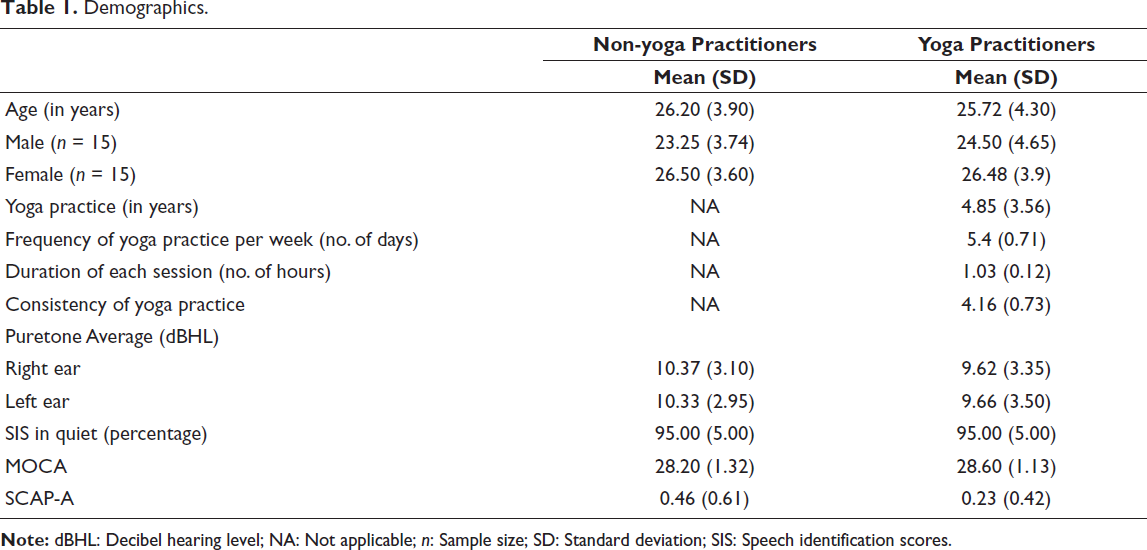
All participants were native Kannada speakers with normal hearing abilities (<15 dBHL), good speech identification scores in quiet (>90%) and no self-reported history of otological, neurological or psychological conditions, nor were they exposed to chronic noise at work or home. Additionally, all participants had MoCA scores of 26 or above, indicating normal cognitive health and scores below six on the SCAP-A. 28 Demographic data of all the study participants are given in Table 1.
Demographics.
Materials and Procedure
All tests were conducted in a random order within a single 90-min session, with sufficient breaks between tests. All hearing-related tests were conducted in sound-treated audiometric rooms, and the remaining tests were conducted in a quiet office.
Speech Identification in Noise
Stimulus
Kannada low predictive sentence lists 29 were used for measuring speech identification in noise (SIN) scores. The sentences had semantically neutral content and were recorded by a female native speaker with a flat intonation using Praat software (version 6.3), following ANSI S3.1 (R2013) guidelines.
Two types of noise were used to study SIN: speech-shaped noise and four-talker speech babble. The speech-shaped noise had the long-term power spectrum of the selected sentences, and each sentence list was mixed with the speech-shaped noise at –6, –4, –2 and 0 dBSNR. A four-talker babble of the same language was used. This was developed by the simultaneous reading of different materials, which was subsequently filtered to approximate the long-term average spectrum of the target sentences and mixed to produce –2, 0 and +2 dBSNR. Both types of noise and sentences were normalised to ensure they had identical amplitudes, creating stimuli of desirable amplitude. The selected SNR ranges were determined based on pilot observations and previous literature to avoid floor and ceiling effects and to ensure measurable variability in performance across conditions. During preliminary testing, speech-shaped noise at higher SNRs (0 and −2 dBSNR) and babble noise at +2 dBSNR resulted in ceiling-level performance in many participants. Therefore, more challenging SNRs were selected for speech-shaped noise (−6 and −4 dBSNR), while relatively easier SNRs (−2 and 0 dBSNR) were retained for the four-talker babble condition to achieve comparable levels of task difficulty across masker types.
Procedure
The stimulus for SIN was presented via a calibrated audiometer with Sennheiser HDA 200 supra-aural headphones at a fixed intensity of 50 dBHL. The order of presentation of the lists with different types of noise was randomised. The participants were instructed to listen carefully to the stimulus and repeat the sentences they heard, and were encouraged to guess words if they were uncertain. Keyword scoring 30 was employed for each response, and the percentage of words correctly identified was tabulated.
Cognitive Measures
Selective Attention–Stroop Task
The Stroop colour and word test (SCWT) 31 was used to assess visual inhibition with two tasks: word naming (baseline) and colour naming (interference). In the word naming task, participants identified the correct colour from three choices when colour words (RED, GREEN, BLUE) appeared in black ink. In the colour naming task, the ink colour conflicted with the word’s meaning. During the Auditory Stroop Task, participants heard ‘male’, ‘female’ and ‘child’ spoken in Kannada by male, female and child voices, respectively. Each word was presented in either auditory or visual mode in three conditions (one congruent, two incongruent), with three congruent and six incongruent stimuli, plus three additional congruent trials to balance conditions, resulting in 48 randomised trials. The results from both tasks were evaluated for accuracy and reaction times. Stroop interference was calculated for participants with ≥85% accuracy by subtracting congruent from incongruent reaction times. 32
Working Memory–Digit Span Test and N-Back Test
The digit span test 33 involved both forward and backward versions. A series of digits were presented to the participants, who were then instructed to type back the digits in the same order or in the reverse order. The test was administered using Smrithi Shravan software 26 and the longest sequence correctly identified in both conditions was accomplished by identifying the midpoint of the performance graph. For each participant, the percentage of correctly recalled digit sequences was plotted against span length. The midpoint of the performance graph was determined as the span length corresponding to 50% correct performance (interpolated when necessary), and this value was considered as the digit span score.
Numeric N-back task 34 was used to assess the non-auditory working memory using the N-back evolution mobile application. Numbers were presented in sequence, and the task was to determine whether the current stimulus matched the stimulus presented 1 step earlier. Participants were asked to tap the phone screen when the target numbers were repeated. The maximum score was 10, and the number of correct responses of each individual was recorded.
Linguistic Abilities–Lexical Diversity and Generative Naming
Moving-average type-token ratio (MATTR) 35 was used to assess the lexical diversity. The participants were asked to speak for 3 min in Kannada about ‘Mysuru’ (the place where they had lived since childhood). MATTR used a moving window to estimate the type token ratio (TTR) for each subsequent window of fixed length to determine the linguistic diversity of a sample. The speech samples obtained for the MATTR analysis were manually transcribed verbatim from the audio recordings into text format. The transcriptions included all meaningful lexical items produced by the participants. However, disfluencies such as fillers (e.g., ‘um’, ‘uh’), repetitions, false starts and incomplete words were excluded prior to analysis to ensure that the MATTR reflected lexical diversity rather than speech fluency characteristics. The cleaned transcripts were then uploaded to the MATTR analysis software to compute the MATTR scores. The estimated TTRs were averaged to determine the final score. 36
The generative naming subtest of the cognitive linguistic quick test (CLQT) 37 was used to assess the semantic and phonemic verbal fluency. Participants were instructed to name as many animals as they could and words starting with the phoneme /m/ in the Kannada language. The samples were recorded separately and analysed for the correct number of animals named and words spoken by each individual within a span of 1 min. A score of 1 was given for each response. The total score was calculated by combining the scores of both tasks.
Statistical Analysis
To stabilise the error variance in the SIN scores, the percentile score was converted into rationalised arcsine units (RAU) using the method described by Hoen et al. 38 Further, the SIN scores were excluded from further analysis for speech-shaped noise at 0 and –2 dBSNRs and for speech babble at +2 dBSNR, as the scores reached the ceiling. The distribution of data, assessed using the Shapiro–Wilk test, revealed non-normality for the N-back and interference measures (auditory and visual). Hence, the differences between the groups for these measures were analysed using the Mann–Whitney U test. A parametric independent-samples t-test with Bonferroni correction (wherever applicable) was used to assess group differences for the remaining tests. Stepwise linear regression analyses were conducted to determine predictors of SIN in the YP and NYP groups separately, with all cognitive and linguistic measures as potential predictors. Prior to regression analysis, assumptions of linearity, normality of residuals, homoscedasticity, independence of errors and multicollinearity were evaluated, and all assumptions were found to be adequately satisfied.
Results
Speech Perception Performance
Speech Babble Masker Condition
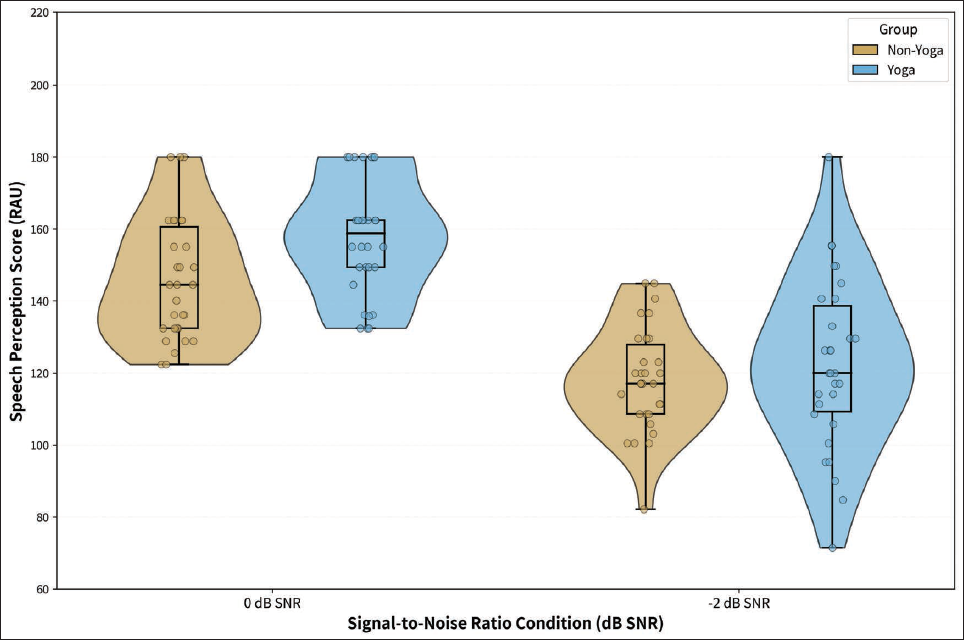
A superior speech identification performance was observed in YP as compared to NYP (Figure 1). At –2 dBSNR, YP achieved a mean score of 168.42 RAU (SD = 10.38) compared to 162.04 RAU (SD = 13.58) for NYP, though this difference did not reach statistical significance (t = –2.05, p = .169 after Bonferroni correction). At 0 dBSNR, YP obtained a mean score of 157.57 RAU (SD = 9.69) while NYP scored 145.97 RAU (SD = 17.78), yielding a significant group difference (t = –2.71, p = .009 after Bonferroni correction, Cohen’s d = 0.81).
Speech Perception Scores (in RAU) with Speech Babble for Both Groups at 0 and –2 dBSNRs.
Speech-shaped Noise Masker Condition
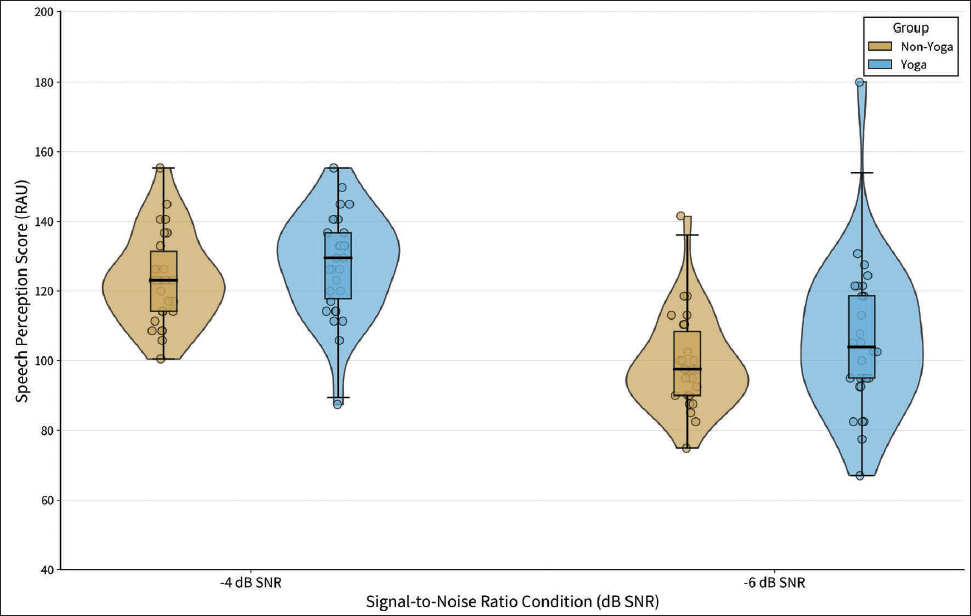
For speech perception with speech noise masker, YP showed modest advantages at both -4 dBSNR (M = 127.70 vs 123.61) and –6 dBSNR (M = 106.31 vs 99.11) (Figure 2). However, the differences did not achieve statistical significance at –6 dBSNR (t = –1.31, p = .585 after Bonferroni correction) as well as at –4 dBSNR (t = –1.40, p = .503 after Bonferroni correction).
Speech Perception Scores (in RAU) with Speech-shaped Noise for Both Groups at –4 and –6 dBSNRs.
Cognitive Measures
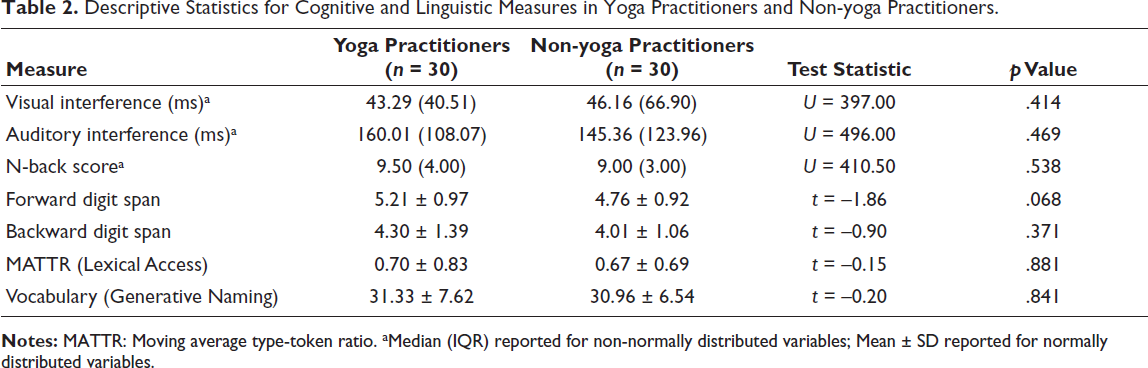
Descriptive statistics revealed that the YP showed numerically higher mean scores on most cognitive and linguistic measures compared to the NYP (Table 2). Specifically, the yoga group demonstrated better scores in forward digit span (M = 5.21 vs 4.76), backward digit span (M = 4.30 vs 4.01), vocabulary (M = 0.70 vs 0.67) and naming (M = 31.33 vs 30.97). The yoga group also showed lower visual interference scores (median = 43.39 vs 46.16 ms), higher auditory interference scores (median = 160.01 vs 145.36 ms) and higher N-back scores (median = 9.50 vs 9.00). The linguistic measures revealed minimal between-group differences. The MATTR, indexing lexical access, yielded means of 0.70 for YP and 0.67 for NYP. The naming performance depicting vocabulary averaged 31.33 for YP compared to 30.96 for NYP. However, none of these differences were statistically significant (p > .05).
Descriptive Statistics for Cognitive and Linguistic Measures in Yoga Practitioners and Non-yoga Practitioners.
Predictors of Speech Perception in Noise Performance
To elucidate the cognitive mechanisms underlying speech-in-noise perception in each group, stepwise linear regression analyses were conducted using speech identification scores in babble noise at 0 dBSNR as the dependent variable and all cognitive and linguistic measures were entered as potential predictors.
Non-yoga Practitioners
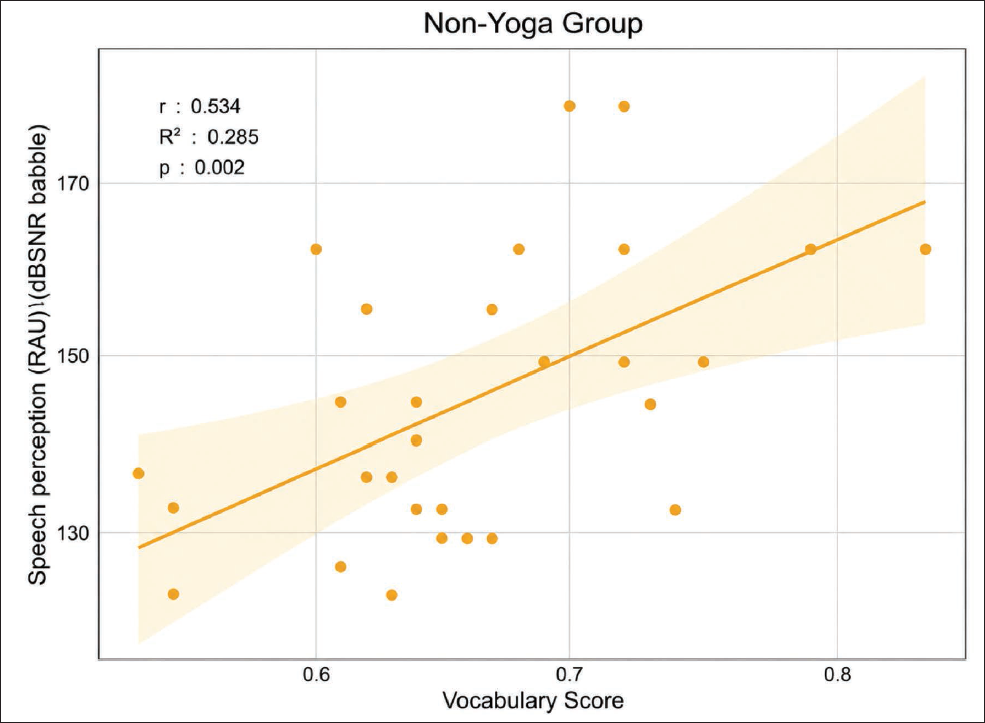
For the NYP group, the stepwise algorithm selected vocabulary (generative naming) as the sole significant predictor of speech-in-noise performance (β = 0.534, t = 3.343, p = .002) (Figure 3). The final model explained 26% of the variance in speech identification scores (R2 = 0.285, adjusted R2 = 0.260), with the overall model achieving statistical significance (F(1,28) = 11.174, p = .002).
Regression Plots Showing the Relationship Between Vocabulary Score and Speech Perception Scores (in RAU) at 0 dBSNR in the Non-yoga Group.
Yoga Practitioners
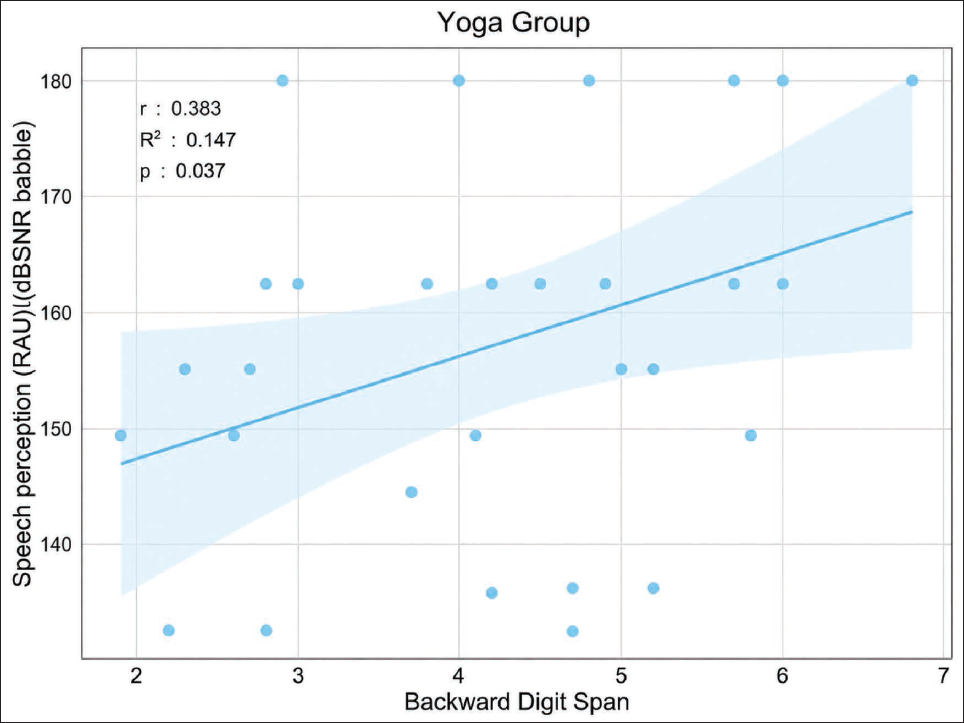
In contrast, for the YP group, backward digit span, a measure of auditory working memory capacity, emerged as the only significant predictor (β = 0.383, t = 2.193, p = .037) (Figure 4). This model accounted for 11.6% of the variance in speech-in-noise scores (R2 = 0.147, adjusted R2 = 0.116), with the overall model reaching statistical significance (F(1,28) = 4.811, p = .037).
Regression Plots Showing the Relationship Between Backward Digit Span and Speech Perception Scores (in RAU) at 0 dBSNR in the Yoga Group.
Discussion
Informational Versus Energetic Masking: Differential Effects
The findings of the present study indicate specific interesting trends that can be used to indicate the relationship between yoga practice and speech perception under difficult listening conditions. The YP scored much higher with 0 dBSNR speech babble, and the effect size was significant (Cohen’s d = 0.81). Speech babble causes both energetic and informational masking, which requires significant cognitive resources to extract speech successfully.39, 40 Speech babble produces informational masking because it contains linguistic information that vies for cognitive resources. 40 Listeners must allocate attention to segregate the target voice from interfering voices, maintain the target in working memory while suppressing masker information and resolve ambiguities when target and masker share similar acoustic-phonetic features. Selective attention serves a gatekeeping function, determining which acoustic information receives further processing and which gets filtered out. 41 Reconstruction of fragmented messages is then performed using working memory, which provides cognitive space to combine incomplete messages and access linguistic knowledge. 13 YP may perform well under informational masking conditions, as yoga practice enhances attention and working memory.24, 25
Speech-shaped noise performance is more reliant on non-cognitive aspects of peripheral auditory features, such as frequency selectivity and temporal resolution, than on cognitive resources. 42 The difference between groups was not significant, as all participants had normal hearing and similar audiometric thresholds.
Mechanisms Underlying Speech Perception Differences
The regression analyses suggest that YP and non-practitioners may rely on different cognitive correlates during speech perception in noise. In the case of NYP, vocabulary (measured by generative naming ability) was the only predictor of speech-in-noise performance, accounting for about 26% of the variance. This dependence on lexical knowledge is consistent with the ELU model’s focus on semantic long-term memory as a compensatory source when acoustic input is impaired.9, 43 When the input phonology does not match the stored representations, listeners are compelled to use their vocabulary knowledge to resolve ambiguities and fill in missing information. 16 Individuals with larger vocabularies can employ top-down linguistic processing to a greater extent and apply the context-based and semantic clues in the reconstruction of degraded messages. 44
However, in the YP group, backward digit span was the only significant predictor, explaining approximately 12% of the variance in speech-in-noise scores. Backward digit span not only presupposes storage of auditory data but also their manipulation in working memory, which demands executive control and the mental transformation of the input.45, 46 This change in predictive factors suggests that yoga practice may be associated with differences in cognitive processes underlying speech perception, with greater reliance on working memory-related processes.
Although the regression models were statistically significant, they explained only a modest proportion of variance in speech-in-noise performance, particularly in the yoga practitioner group. This suggests that speech-in-noise perception is influenced by multiple additional factors not assessed in the present study, including auditory temporal processing, inhibitory control, processing speed, listening effort and individual perceptual strategies. Therefore, the identified predictors should be interpreted as contributing factors rather than exhaustive determinants of performance.
The ELU model provides guidelines for interpreting this shift. 9 This model states that when there is incompatibility between incoming phonological information and stored representations in long-term memory, the working memory is explicitly involved to resolve the ambiguity. 43 Fragmented acoustic information can be better maintained and manipulated by listeners who have a higher working memory capacity, who then combine partially received cues and rebuild the intended message. 47 This association suggests that the working memory may play a relatively greater role in speech-in-noise performance among YP.
Association of Working Memory with Speech-in-Noise Performance
The observation that backward digit span is a specific predictor of performance among YP is worth further investigation, as this task involves sustaining and reversing sequences mentally, which engages executive processes of control. 45 In the case of degraded acoustic input, working memory can assist a listener in retaining partially recognised phonological units during access to lexical information to narrow down interpretations 9 and in maintaining more than one candidate word at a given time. 48 The ELU model assumes that the working memory capacity is what is important to explain the variation in the speech-in-noise performance9, 47 and the positive association between the digit span and speech recognition in the degraded conditions is always observed. 14 The reason why the working memory forecasted performance in the yoga group is doubtful.
One possible interpretation is that YP demonstrated relatively greater reliance on working memory processes to the extent of making it the rate-limiting test in speech perception. When the working memory capacity of non-practitioners is relatively low, they can enter a cognitive bottleneck, leading them to rely more on other strategies, such as lexical prediction. YP may rely more strongly on working memory-related processing during speech-in-noise tasks, retaining acoustic-phonetic information sufficiently to succeed in recognition without much top-down facilitation.
Lexical Knowledge in Non-practitioners
The use of vocabulary by non-yoga subjects is consistent with the extensive amount of literature concerning the top-down effects in speech perception. Even when the information available to the listener is obtained through bottom-up acoustic means, it is still inadequate; listeners use linguistic knowledge to bridge gaps and resolve ambiguities. 49 Vocabulary size is a potent predictor of speech-in-noise performance across diverse age groups, including children and older adults.16, 17
Lexical knowledge plays a role in speech perception in several ways. To begin with, the larger the vocabulary, the larger the semantic networks, which help predict subsequent words based on context. 44 Second, vocabulary lends credibility to the quality and specificity of phonological representations in long-term memory. 16 Listeners with good vocabularies might have more elaborate phonological templates, enabling them to match better even when the anacoustic signal is distorted.
The difference in vocabulary performance between non-practitioners and YP suggests that the groups may have used different processing strategies. Non-practitioners seem to use a compensatory strategy based on top-down linguistic knowledge during speech perception in noise. The given strategy might be effective, but it might be cognitively challenging to sustain prediction generation and utilise during real-time speech perception in noise.
In contrast, the speech-in-noise performance in YP appears to be more strongly associated with working memory measures. Instead of directly recruiting lexical knowledge, they could retain ambiguous acoustic information in working memory long enough to access sufficient phonological detail for identification. This pattern may indicate relatively greater reliance on working memory processes compared to lexical strategies.
Limitations and Future Directions
There are several limitations that should be mentioned. The cross-sectional nature of the study does not allow for inferring causal mechanisms between yoga and speech perception in noise; causal evidence can be better demonstrated by longitudinal studies that follow novices through their practices. Therefore, the observed associations among yoga practice, cognitive measures and speech-in-noise performance should be interpreted with caution and not as evidence of direct causal or neural mechanisms. The chosen sample size may be sufficient for primary comparisons. However, it may not be large enough to detect minor effects in cognitive tests that showed numerical patterns in favour of YP (forward digit span, MATTR, visual interference). Unstable frequency of meditation practice (2–3 days per week) compared to breathing practice (5 or more days per week) complicates the separation of practical elements. The participants were all young adults; thus, the findings may differ among older adults or in cases of hearing impairment, where cognitive variables play a larger role in speech perception in noise. Further, there is a need for larger sample sizes, and confirmatory regression approaches are required in future studies to validate the observed predictor responses. In addition, yoga adherence was based on self-reported information, which may have led to reporting bias. The absence of assessor blinding could have also caused observer-related bias.
The results of the present research show that yoga may alter a cognitive structure underlying auditory processing, in which speech-in-noise performance is not based on vocabulary but on working memory. Yoga can provide a pharmacology-free method for improving auditory-cognitive functions, supplementing technological interventions such as hearing aids. Future studies need to focus on dose-response correlation, compare various yoga elements since breathing practice is less inconsistent than meditation, investigate neural processes and expand studies to clinical groups with auditory processing disorders, age-related hearing loss or cognitive decline to develop therapeutic possibilities.
Conclusion
The present research results reveal that YP identify speech more effectively in informational masking situations than their non-practitioner counterparts, and this difference is mediated by various cognitive processes in both groups. Whereas non-practitioners use vocabulary knowledge as the primary source of speech-in-noise perception, YP use working memory capacity as the primary source. These findings suggest that yoga practice may be associated with differences in the cognitive correlates underlying speech-in-noise processing. Their specificity to informational, but not energetic, masking conditions suggests that associations related to yoga practice were most apparent in environments with high cognitive processing requirements. These results expand on current knowledge of the effects of contemplative practices on auditory cognition and indicate that yoga could be a complementary approach to addressing speech perception issues, especially in a complex multi-talker setting.
Footnotes
Acknowledgements
The authors are grateful to the participants of this study for their time and cooperation, and to JSS Institute of Speech & Hearing, Mysuru, for permitting us to conduct this study.
Authors’ Contribution
SDM – Conceptualization and data collection. SV – Conceptualization, methodology, writing: original draft, review and editing, analysis. VK – Methodology, writing: original draft, review and editing, analysis and supervision.
Declaration of Conflicting Interests
The authors declared no potential conflicts of interest with respect to the research, authorship and/or publication of this article.
Funding
The authors received no financial support for the research, authorship and/or publication of this article.
Patient Consent
Written informed consent was obtained from all the participants of the study.
Statement of Ethics
Institutional Ethics Committee (JSSMC/IEC/130624/13NCT/PY/2024-25) of JSS Medical College approved the study.
