






Abstract
Background
Human behaviour and personality are a unique psychosomatic constitution of every individual, and they may have diverse applications in the field of medicine. Conventional methods used to conduct behavioral and personality examination in medical research and clinical practice are found to have limitations, which make their validity questionable.
Purpose
To date, no study has explored the objective quantification of human behaviour and personality among Indian healthcare professionals. Also, being an important component of evidence-based decision-making in research and clinical domains, this analysis will scan human behaviour non-invasively to study the cognitive neuroscience functions among health care professionals.
Methods
The present research was a cross-sectional study; out of forty-five (n = 45), thirty-eight (n = 38) participants completed the study. The participants were attendees of a workshop during a National Conference of Physiology in October, 2025. All the participants completed evidence-based advanced Prakriti Analysis Instrument (PAI) objectively through provided link.
Results
The present study showed the balanced prakriti tri-doshas- vata, pitta and kapha among health care professionals, as no single doshas was overwhelming dominant. On further analysis, the physical features were found to be more variant than physiological and psychological features, as prakriti is not a static category; rather, it is characterized by continuous evolution and transformation. On the other hand, the physiological and psychological features were found to be balanced in association with their behavioral pattern signatures among healthcare professionals.
Conclusion
PAI could be a valuable non-invasive tool for future behaviour and personality biomarkers which will help to understand and describe individual health status and cognitive attributes.
Keywords
Introduction
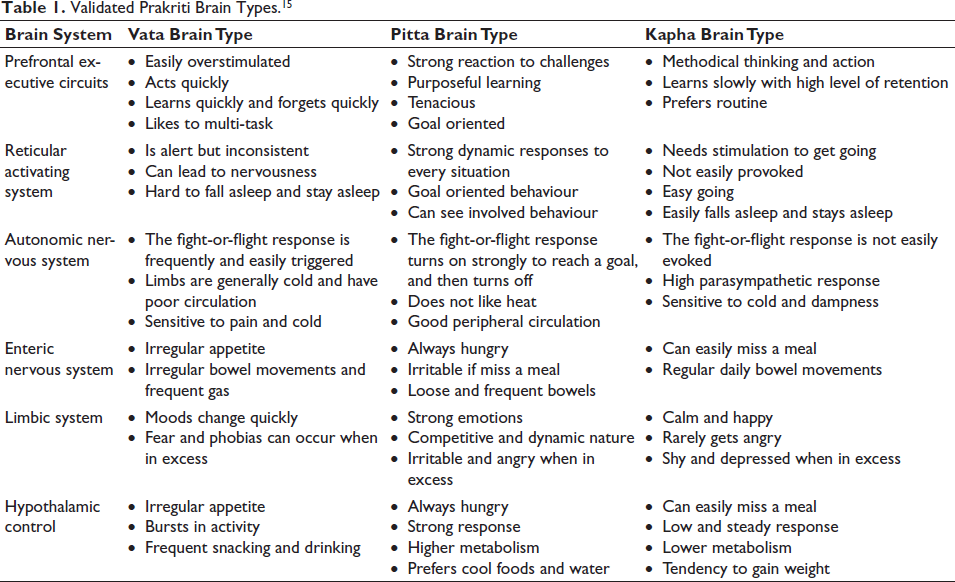
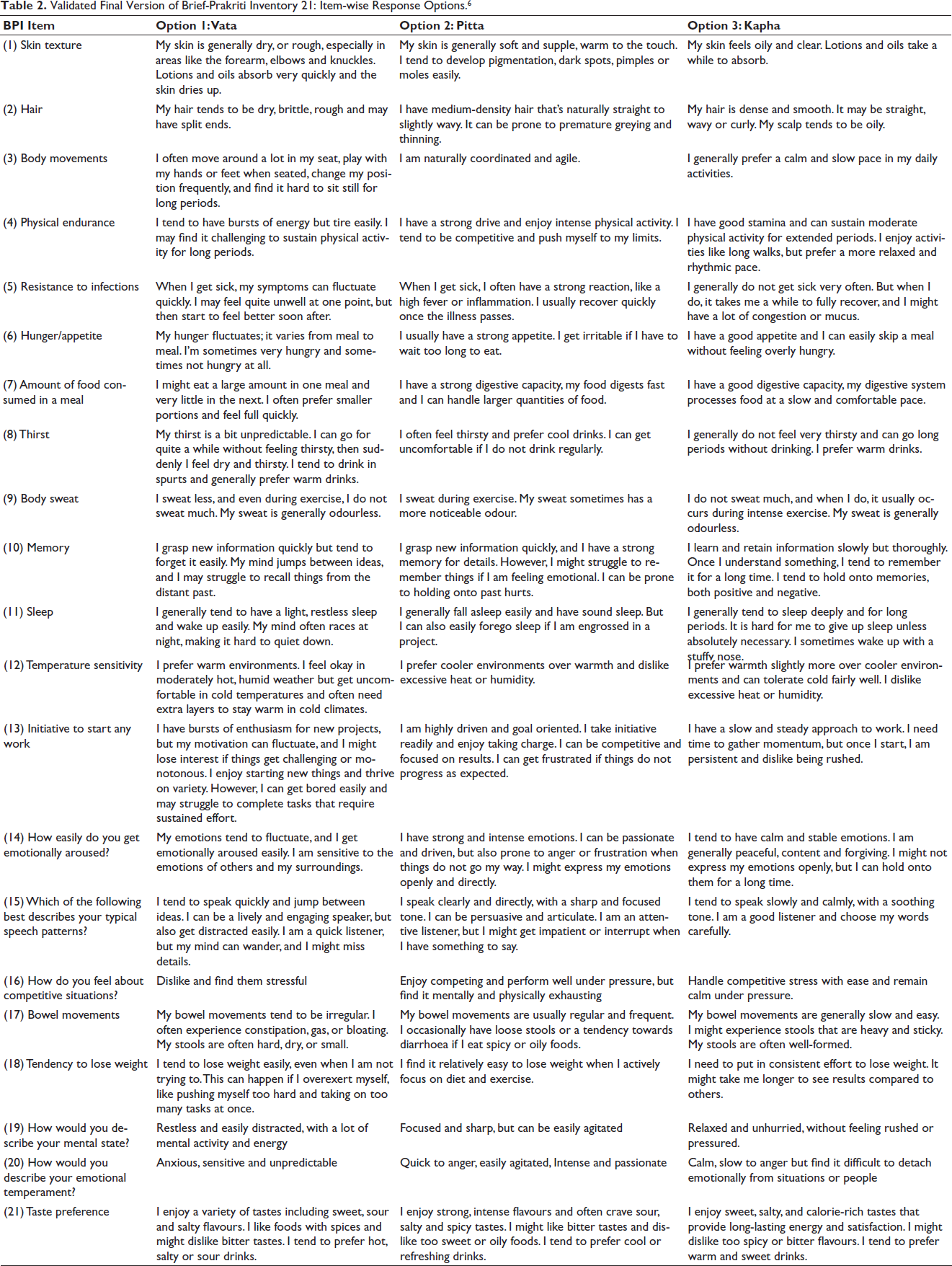
Human behaviour and personality or constitutional typology, which includes body-constitution (Sharirik Prakriti), psychological constitution (Mansik Prakriti) and role of doshas (vata, pitta and kapha). 1 It has a diverse application in the field of medicine. Being an important component of evidence-based decision-making in research and clinical settings, behaviour and personality examination method require serious concern.1–4 Conventional methods used for this examination in medical research and clinical practice have limitations, making them questionable.1, 3 Behaviour and personality are linked to specific psychosomatic, genetic and metabolic signatures, including distinct neurophysiological and brain activity patterns. 5 These signatures represent how different constitutions process information, manage emotions and react to stimuli. 5 Research indicates that different prakriti types exhibit distinct cognitive and affective patterns that correlate with neural activity that include vata-type is associated with high-speed, flexible, but sometimes unstable neuronal firing, often linked to a ‘fight-or-flight’ tendency, quick grasping but poor retention; pitta-type is associated with high activity in areas related to focused attention, logic, decisive action and moderate grasping and retention; kapha-type is associated with slower, steadier neuronal processing, slow grasping but good retention (Tables 1 and 2).5–11
Validated Prakriti Brain Types. 15
Validated Final Version of Brief-Prakriti Inventory 21: Item-wise Response Options. 6
On the other hand, numerous studies have been conducted to assess personality using different questionnaires to assess human behaviour subjectively.5, 8, 12, 13 The studies have also shown that brain mapping and neural decoding are advanced fields in neuroscience that use modern technology to understand brain function without surgery, including functional magnetic resonance imaging, electroencephalography, magnetoencephalography, near-infrared spectroscopy and positron emission tomography, in association with personality correlation. 14 There is currently no scientific evidence to quantify the human prakriti-tri-doshas objectively in an integrated approach to obtain the human behaviour signatures non-invasively in order to decode the neural activity among Indian healthcare professionals.6, 10 The decoding of human behaviour non-invasively will help in studying cognitive neuroscience functions, and it is related to specific disease susceptibilities (e.g., Kapha in cardiovascular disease) and metabolic responses among healthcare professionals.
Methods
Study Design and Participants
The present cross-sectional study was planned as collaborative research at AIIMS-New Delhi, AIIMS, Bathinda and AIIMS, Bibinagar with NIMHANS, Bangalore. For the present study, a total of 45 (n = 45) participants were enrolled and out of 45, 38 (n = 38) completed the study. The participants were attendees of a workshop, ‘Brain Mapping of Human Consciousness: An Integrative Approach of Yogic Signature’ during a National Conference of Physiology in October 2025 (Ref No.APPI/4/Oct/2025). The study was approved by the Institutional Ethics Committee (Ref. No. IEC/AIIMS/BTI/2026/04/13). All the participants completed the advanced prakriti analysis instrument (PAI) objectively through provided RED-Cap (Research Electronic Data Capture) software link (
Statistical Analysis
The data were analysed using SPSS software Version 29.0 (IBM, Chicago, IL, USA, October 2020). The normality of the data was analysed using the Kolmogorov–Smirnov test. The data are presented as the mean (standard deviation) for parametric variables and interquartile range for non-parametric variables. The gender differences for different prakriti tri-doshas were analysed using the Mann–Whitney test for non-parametric variables. The statistical differences between different types of prakriti tri-doshas were analysed by using one-way analysis of variance (ANOVA). The sub-domains features of tri-doshic prakriti profile were analysed using the Kruskal–Wallis H test. Stacked-bar graphs were used to illustrate the relative percentage distribution of the subdomains. Sociodemographic variables were summarised as frequency and percentages. The p-value < 0.05 was considered statistical significance.
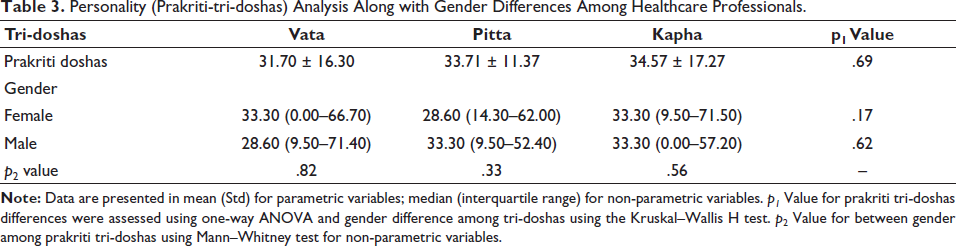
Personality (Prakriti-tri-doshas) Analysis Along with Gender Differences Among Healthcare Professionals.
Results
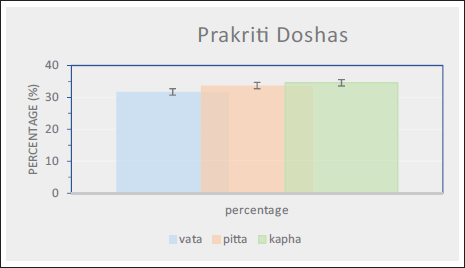
The age range of 38 (n = 38) healthcare professionals was 32.29 ± 11.53 years [female, n = 21; age, 26.0 (21.0–57) years; male, n = 17; age, 32.0 (18.0–52.0) years]. The education levels of the participants include undergraduate MBBS [n = 5; 13.15%] and postgraduate MD and above [n = 20; 86.84%]. The present study found that the percentage of all tri-doshas, which include vata, 31.70% ± 16.30%; pitta, 33.71% ± 11.37%; and kapha, 34.57% ± 17.37%, among the participants was not statistically significant (p = .86) and indicates a nearly equal distribution of the prakriti tri-doshic constitution (prakriti) (Table 3 and Figure 1).
Total Prakriti-tri-doshas Relative Frequency (%) Among All the Healthcare Professionals.
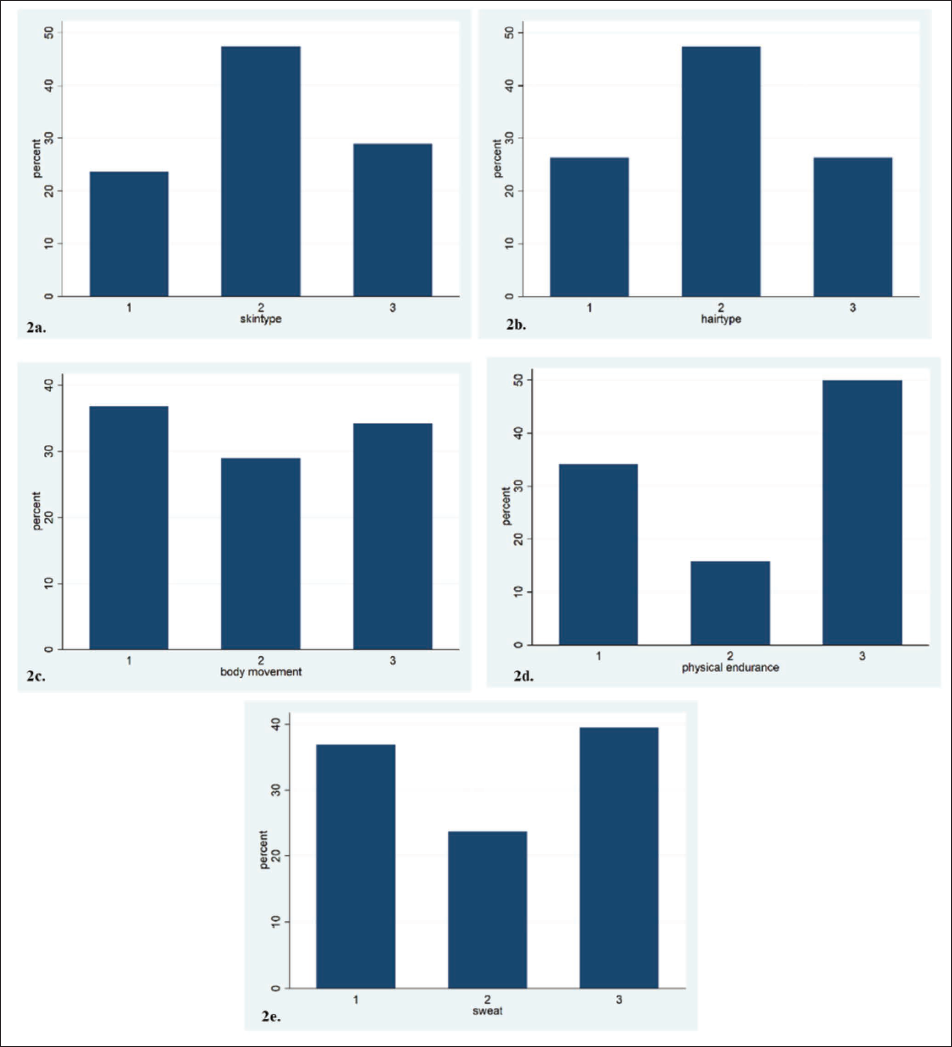
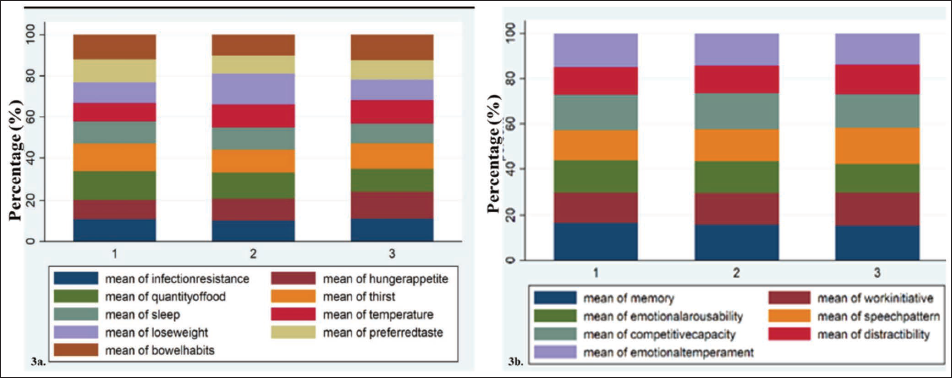
Further, in-depth analysis, for the sub-domains analysis that include physical, physiological and psychological features, the authors observed the variation in the physical features—for skin and hair type, pitta (48%) was found to be dominant; for body movement, vata (47%) was found to be dominant; for physical endurance and sweat, kapha (49%) was found to be dominant (Figure 2a–2e). For physiological and psychological features, all the sub-domains (relative percentage, %) were found to be balanced among healthcare practitioners (Figure 3a and 3b).
Prakriti-sub-physical Features (a–e) of Tri-doshas Relative Frequency (%) Among All the Healthcare Participants.
Prakriti-sub-physiological (a) and Psychological (b) Features of Tri-doshas Cumulative Frequency (%) Among All the Healthcare Participants.
Further, the authors have correlated the above findings with the prakriti brain types (Tables 1 and 2). From the present findings, the balanced prakriti tri-doshas can now be correlated with the balanced psychosomatic regulations of brain and behavioural functions among healthcare professionals, as shown in Tables 1 and 2. The physical features are more variant because of the heterogeneity of human constitution, which is influenced by environmental, hereditary and lifestyle factors. Personality (prakriti) is not a static category; rather, it is characterised by continuous evolution and transformation.
Interestingly, the authors highlighted that the brain behavioural signatures involved in balanced prakriti tri-doshas among healthcare practitioners signify that there are balanced prakriti brain types that include prefrontal executive circuits, reticular activating system, autonomic nervous system, enteric nervous system, limbic system and hypothalamic control among healthcare participants (Table 2).
Discussion
The present pilot study is being conducted from India for the first time and has observed a predominance of balanced prakriti (tri-doshic constitution) among healthcare professionals. In Ayurvedic concept-based theory, balanced tri-doshas reflect harmony in physiological movement, metabolism and structural integrity, respectively. Such tri-doshic balance has traditionally been associated with optimal health, high stability and a strong, resilient mind–body constitution, concepts that may parallel emerging understandings of neuroplasticity and adaptive stress regulation.15, 9 The balanced prakriti requires a consistent mindful approach to diet and lifestyle practices that support equilibrium across all three doshas. 9 The present findings are in line with previous research studies suggesting that human prakriti significantly impacts positive health by dictating an individual’s physical, mental and emotional predispositions 7 and support evolving integrative frameworks linking Ayurvedic constitutional types with contemporary models of brain function and cognition.4, 8, 9, 11
Further sub-features analysis showed the physical features of prakriti tri-doshas were found to be variant in terms of skin type, hair type, body movements, physical endurance and sweat pattern. This variation in physical features may be due to the heterogeneity of human constitution, which is influenced by environmental, hereditary and lifestyle factors, because human behaviour and personality (prakriti) are not to be considered in a static category and every participant has their different phenotype and genotype-representation. 9 The authors did not find any statistically significant gender differences for different doshas in understanding prakriti in detail, which may be due to the small sample size.
On the other hand, the authors have elaborated the integration of prakriti assessment with validated prakriti brain types framework 15 shown in Table 1. The predominance of balanced tri-doshas scores among healthcare professionals may signify an optimal prakriti-brain profile characterised by psychological resilience, adaptive capacity and cognitive clarity. 9 This observation may support an integrative framework of combined Ayurvedic-based theory with contemporary neuroscientific perspectives to better understand cognitive and behavioural health. Further, present findings will assist clinicians to know an individual’s prakriti profile as a complementary health assessment tool to understand behavioural status in day-to-day lives.6, 7, 16 Furthermore, education may contribute to increased awareness about lifestyle choices, including the type and intensity of physical movement, to align with Ayurvedic principles and maintain a healthy, balanced constitution. In the present study, all the healthcare professionals’ education levels were undergraduate, postgraduate and above and demonstrated generally calm and coordinated behavioural patterns in their daily activities.
Although the present study was conducted with conceptual analysis, it has a few limitations. First, the findings of this study, based on gender for different prakriti doshas, were not statistically significant due to the small data sets and need to be corroborated with larger data sets. Second, the present study did not evaluate the prakriti brain types for gender-based analysis due to the small sample size. In spite of these limitations, the present findings have provided technical indications among healthcare participants to be vigilant of their psychosomatic status; this will provide direction to undergo lifestyle amendment programmes. However, the present study results provide appreciable perceptions into the elaborate prakriti analysis, along with its prakriti brain types among healthcare professionals. Further, prakriti sub-domain analysis with respect to different gender- and education-based was not analysed in the present study and will be enclosed in a future research article.
Conclusion
The present study supports the feasibility of measurable prakriti assessment using PAI among healthcare professionals. This simple, cost-effective PAI provides a non-invasive objective evaluation of the constitutional profile, which may have possible utility in the future development of prakriti-based biomarkers for considerate individual health characteristics, behavioural tendencies and cognitive attributes.
Footnotes
Acknowledgements
The authors thank the participants for cooperating to make this research possible. Thanks to the committed research team, collaborators and institutions (All India Institute of Medical Sciences, Bathinda, Punjab; All India Institute of Medical Sciences, Bibinagar, Telangana; All India Institute of Medical Sciences, New Delhi and National Institute of Mental Health and Neuro Sciences, Bangalore) for their invaluable support.
Author’s Contribution
Prafull Kumar: Study design, data acquiring and interpreting the data; Dipti Magan: Study conceptualisation, study design, acquiring and interpreting the data, manuscript writing and manuscript review; Vandana S. Daulatabad: Study design, data acquiring and interpreting the data; Raj Kumar Yadav: Interpretation of data sets and manuscript review and approving the final content of the manuscript; Hemant Bhargav: Data interpretation; providing Prakriti Assessment Instrument software, drafting and revision to the manuscript; Shivam Pandey: Data analysis and data interpretation.
Declaration of Conflicting Interests
The authors declared no potential conflicts of interest with respect to the research, authorship and/or publication of this article.
Funding
The authors received no financial support for the research, authorship and/or publication of this article.
Patient Consent
Informed consent was obtained from all participants included in the study.
Statement of Ethics
This manuscript is based on a national physiology workshop-based research study (Workshop Ref No. APPI/4/OCT/2025). All study procedures and protocols involving human participants adhered to the principles of the Declaration of Helsinki, and the study was approved by the Institutional Ethics Committee (Ref No. IEC/AIIMS/BTI/2026/04/13).
