







Abstract
Firms are under constant pressure to minimize negative externalities and increase positive externalities. These pressures are translating into the corporate social responsibility (CSR) activities by firms. CSR is emerging as a widespread business activity, and firms are undertaking CSR voluntarily. This case provides a brief discussion of the scenario of CSR in India. It goes on to discuss the educational activities undertaken by firms under their CSR programmes.
Brillio Technologies is one such company that has adopted CSR voluntarily, from the very first year of operations, in 2015. CSR actions of Brillio go beyond the legal requirements as it achieved remarkable results in community engagement and employee engagement. CSR activities of companies are internal to the organization, such as reducing and recycling waste, or external to the organization, such as reducing its carbon footprint. While Brillio undertook numerous internal activities, its focus was on external activities through its flagship programme ‘Bringing Smiles’. The programme successfully reached 100,000 underserved students through STEM education by 2020—the company partnered with NGOs and schools to achieve its social goals. Participants need to evaluate the existing programme and strategize for achieving the goals. They are posed with three choices: (a) increase employee volunteering hours, (b) partner with more NGOs and (c) recommend a foundation for taking up CSR activities. These strategies could be a huge drain on the resources, hence there is need for a cost-benefit analysis of the alternatives.
Discussion Questions
What is CSR, and what are the dimensions of strategic CSR? What are the drivers for the successful implementation of CSR? What is the role of top management involvement in the successful implementation of CSR? Who are the primary stakeholders in this case? Discuss these with reference to Brillio Technologies.
What approaches do firms adopt for their CSR? What should a company consider when implementing CSR practices in the local markets?
Brillio has chosen ‘Education based on digital technology’ as the core area for its CSR programmes. Why do you think the company chose this area? How does this choice fit in the company’s overall strategy? Discuss how firms design and implement CSR successfully.
What should a company consider when implementing CSR practices in the local markets? What are the performance indicators for CSR implementation? How should the company measure the impact of its programmes?
How did Brillio benefit from employee engagement and volunteerism in CSR activities?
Given that Brillio started its operations in 2014 and presents ambitious plans for increasing the number of beneficiaries to 100,000 by 2020, what challenges would the company face? Design a roadmap for achieving this target.
It was an early Monday morning, in December 2018, when Mr Abhishek Ranjan and his team were discussing the future of their flagship CSR programme ‘Bringing Smiles’. The programme should reach 100,000 underserved students in India through STEM (science, technology, engineering and mathematics) education by the year 2020. It had only two more years to achieve the target. The team was working on finalizing one of the three alternatives identified for achieving this goal. First, increasing the number of employees’ volunteering hours; second, partnering with more NGOs and third, creating a foundation to work exclusively on the firm’s CSR activities. For a firm that was just a few years into its operations, the decision could have a major impact on its resources and profits.
Company Background
Brillio is a leader in global digital business transformation, applying technology with a human touch. It helps businesses define internal and external transformation objectives and translates those objectives into actionable market strategies using proprietary technologies. Brillio is an ideal partner for enterprises that want to increase their core business productivity quickly and achieve a competitive edge, with the latest digital solutions, capabilities, and ecosystems out there.
—Brillio Technologies Pvt. Ltd.
Brillio Technologies Pvt. Ltd., founded in 2014, was a leader in global digital business transformation, applying technology with a human touch. Headquartered in Santa Clara, California, US, it had its presence in the United States (US), United Kingdom (UK), Norway and India (see Exhibit 1). The company was formed when Collabera spun off its Information Technology (IT) services division into a subsidiary named Brillio. Mr Raj Mamodia, the then Chief Executive Officer (CEO) of Collabera, became the CEO of Brillio Technologies. The company focused on digital technologies and big data analytics for clients from banking and finance, utilities, technology, media, retail and entertainment sectors. Brillio invested in several proprietary tools that could speed up digital implementation for its customers. It maintained its innovation by investing in advanced technologies like machine learning, blockchain, NLP, cloud, analytics and deep learning/AI. It was supported by a best-in-class partner ecosystem through alliances with Microsoft, Amazon Web Services and Salesforce and recognized by customers and industry analysts like Forrester and Gartner for their work. In January 2019, Brillio received major funding from Bain Capital Private Equity, which helped Brillio scale its digital transformation offerings.
Initiating CSR Activities at Brillio
From the inception of Brillio, Mr Raj knew he wanted to create a company beyond customer stories and technology services. He wanted to build a company that embraced sustainability and social responsibility alongside revenues and the bottom line. He did not want to wait for years into Brillio’s operation to give back to the community. So, implementing a corporate social responsibility (CSR) programme needed to start from the beginning. The senior management leadership strongly supported corporate social responsibility and started related activities in the first year of its operations. Its sustainability strategies focused on the principle of ‘act responsible, think sustainable’. Mr Abhishek, who was engaged in various community projects in the past, was appointed as the Global Head of CSR in 2015. With his vast experience, he was assigned the task of developing a global CSR strategy that would, in the future, integrate societal welfare with the company’s business operations.
There are plenty of issues at hand, ranging from hunger, health, education, women empowerment, and so forth, but how can we adopt a focused approach to social responsibility? I decided that we needed to narrow our focus to something most of our team felt passionate about. We all agreed upon a recurring theme supporting education for underprivileged children as it is one fantastic and impactful way of creating a better world. Saying ‘no’ to social causes is not something that comes naturally to me, but I realized that staying focused will create a better impact in the long run. 1
About CSR
According to the United Nations Industrial Development Organization (UNIDO) 2 CSR was a management concept whereby companies integrate social and environmental concerns in their business operations and interactions with their stakeholders. Corporate social responsibility was generally understood as being the way through which a company achieves a balance of economic, environmental and social imperatives (triple-bottom-line approach) while at the same time addressing the expectations of shareholders and stakeholders. In this sense, it was important to distinguish CSR, a strategic business management concept, charity, sponsorships or philanthropy. Even though the latter made a valuable contribution to poverty reduction, while directly enhancing the reputation of a company and strengthen its brand, the concept of CSR went beyond that.
Based on the above definition, CSR was viewed as a holistic approach to address all the stakeholders’ well-being, while philanthropy was only a part of CSR. 3 United Nations Global Compact 4 (UNGC), the world’s largest corporate citizenship initiative, derived 10 principles relating to businesses’ sustainability into four broad areas: human rights, labour rights, environment and governance. UNGC guidelines and regulations guided the CSR activities of firms in most countries across the globe. While the community benefited from companies’ genuine CSR activities on one end, companies also gained because CSR activities could enhance the company’s reputation among employees, motivate and engage employees and retain and attract employees.
CSR in India
Though India was among the fastest growing economies globally, it faced challenges in health, hygiene, sanitation, water, education, unemployment and the environment, to name a few. These voids offered ample opportunities for Indian companies to focus their CSR activities on. Corporate social responsibility was long viewed as a philanthropic activity in India but was gaining strategic importance with increasing globalization. India was among the first few countries to bring in mandatory spending by companies for corporate social responsibility (CSR). Compliance to the Companies Act, 2013, and the CSR Rules (The Act) in India came into effect from April 2014. According to the Act, companies with a net worth of US$5 billion or more, or a turnover of US$10 billion, or a net profit of US$50 million or more, in a given financial year needed to spend 2% of their earnings on CSR programmes. Companies were required to disclose their CSR policy and the CSR committee’s composition; post the passage of this Act. It was anticipated that more and more companies would contribute to the community. Companies were cautiously identifying opportunities for CSR interventions. In the year 2016, more than 90% of the companies spent the funds for CSR activities on health, education, environment and rural development 5 (see Exhibit 2). According to the Ministry of Corporate Affairs, the maximum number of projects in India were reported in the states of Maharashtra, Karnataka, Andhra Pradesh, Gujarat and Uttar Pradesh 2015–2016. Energy and power, manufacturing, banking financial services and insurance sector (BFSI), information technology (IT), consulting and software sectors were the major sectors spending on the CSR activities (see Exhibit 3). Public sector companies were only 4% of the companies listed on the stock exchanges (NSE and BSE). Yet, they contributed to almost a quarter of the entire CSR spends 6 by industry.
Education and CSR Interventions in India
According to 2011 data, India had a literacy rate of 74.4% but with the largest illiterate population. The Indian government had taken initiatives to improve the situation. Year on year, the Indian government increased the outlay for education. The National Policy on Education (NPE) articulated the role of education in nation building. The Ministry of Human Resource Management (MHRD) under the Sarva Shiksha Abhiyan (SSA) programme provided a variety of interventions (at the elementary school level) such as constructing new schools, adding teachers, improving resource support for books and uniforms and improving learning outcomes. 7 Sarva Shiksha Abhiyan was India’s key programme for enhancing the education and improve learning outcomes of children. The Department of School Education and Literacy under the MHRD aimed to increase education quality, which included the disadvantaged groups in the education system, ensured quality of education, and brought about systematic reforms in secondary education.
Given the scenario for education in India, companies came forward to contribute their bit. Nine companies reportedly spend more than US$500 billion on education and skill development in 2016. 8 Exhibit 4 shows different initiatives undertaken by companies over the last few years. Anushree Parekh and Poorvaja Prakash, in their report on Mapping Education Initiatives of 100 companies with the largest CSR budgets, 9 stated that issues related to the quality of education, such as lack of learning, poor teacher quality, lack of accountability, irrelevant curriculum and pedagogy, explained low educational standards of students attending schools. Structured CSR programmes helped address most of these issues. Various CSR interventions focused on education were broadly classified, as seen in Exhibit 5. There were four different ways through which companies implemented CSR programmes in India. They were direct implementation, implementation through agencies, own foundations or a combination. Few companies reported exclusive implementation of CSR activities through their own foundations in 2016. 10
CSR at Brillio
The Brillio Solution: ‘Bringing Smiles’
‘While most companies wait to make profits to initiate CSR activities, at Brillio, it was part of their plan from the first year of operations. CSR is not an afterthought; it is built into its culture and ethos. Building a great company is not enough to develop great products and solutions and contribute to society. Bringing Smiles is the soul of our organization,’ said Mr Raj Mamodia, CEO of Brillio Technologies.
The CSR policy of Brillio lists several activities for (see Exhibits 6a and 6b) India and the US. Corporate social responsibility was build into the corporate strategy, and it identified three focus areas: technology intervention and education, digital literacy and skill development with technology. 11
Brillio recognized that the gap in education quality between government and private schools led to the students’ lack of motivation in the underserved schools. Brillio’s employees focused on their CSR activities as technology intervention and education, digital literacy and skill development with technology. They named this global CSR programme ‘Bringing Smiles’ (see Exhibit 7), launched in 2015. The activity aimed to help the underprivileged children acquire skills related to technology so that they were future-ready. The programme primarily targeted children in the US, Costa Rica, Europe and India. It provided digital solutions for their literacy and education. Being a technology company, it believed that, along with growth in its business, it could also impact society by providing technologies for education, digital literacy and skill development. Brillio spelled-out this mission on their website:
Brillio impacts the communities by helping underprivileged children develop conceptual understanding of and acquire skills related to technology, which will increase their future opportunities. It aims at enabling over 100,000 young minds globally to thrive in a new digital economy through e-learning projects, innovation workshops, science experiments, interactive self-learning initiatives, and productive skill-sharing. (Source:
Hence, the ‘Bringing Smiles’ programme was perfectly aligned to its core offering. The programme took many forms, from fostering career development and STEM skills with underserved young minds in India and the United States. Using Skype and Google Hangout, 50 teachers worldwide taught Science, Mathematics, and English to students in rural India. A structured syllabus was created based on the inputs and feedback from the schools and through the students’ internal assessment. Digital supplements that the students got through Brillio’s programmes helped students improve their grades. End-to-end project management of all programmes was taken care of in-house by the CSR team, and employees provided physical or digital support. In 2016, Brillio expanded the CSR agenda to include environmental impact. Their strategies, risk management practices, and internal policies were transformed to reflect this thinking.
Beneficiaries of Bringing Smiles
Brillio began with just one school in 2015 in India and scaled up to 70 government schools by 2018. 30,000 students have benefited through digital learning, interactive self-learning initiative, and active skill sharing. Over 100 teachers were trained to impart digital know-how by the volunteers of Brillio. Under the peer-to-peer programme, around 224 instructors were trained to train the rest of the students. Brillio iMobile labs provided a hands-on learning experience in digital technology and science in 12–15 schools in Bangalore. Brillio digital libraries with more than 1,250 talking books made education accessible to more than 500 visually impaired students. Brillio initiated ‘reverse learning’, where students tutored the parents in English communication and digital technologies (see Exhibits 7 and 11).
CSR Policy
Brillio’s CSR policy established the CSR scope, vision, company activities and funding approval process. The policy laid down the guiding principles and mechanisms for undertaking socially useful programmes for welfare, sustainable development and technological advancements for the society at large. Corporate social responsibility committee’s responsibilities were CSR reporting and monitoring (see Exhibits 8 and 9).
Organization Structure for CSR Programme Implementation
Mr Raj personally drove and guided CSR initiatives, with the support of a CSR team at Brillio. The company did not have a foundation. The CSR committee adhered to the country-specific laws and regulations both in India and the United States. Brillio’s CSR programme and the project management were handled internally by the CSR team, right from identifying the beneficiaries to the measurement of impact. The company focused on a programme-based approach for supporting and investing in long-term programmes that were highly impactful. It developed an innovative model for co-governing the projects with its non-profit partners.
Mr Abhishek was the Global CSR Head with over 12 years of experience in the corporate development sector. He was an alumnus of IMT Ghaziabad and completed an Executive Management Programme in Digital and Social Media from Indian School of Business (ISB), Hyderabad; he also completed Strategic CSR from IIM Bangalore. He started his career with IBM as a Business Analyst. He later worked for Oracle Financial Services, where he was credited with setting up the Customer Centres and Industry Relations function in India. As part of the global leadership team, he was instrumental in starting the CSR programmes in India and the Americas. He was a pro-bono advisor for several non-profit and industry bodies such as TC4A, FKCCI, UNGC India and Rotary. He received the CSR Professional of the Year Award at India CSR Award 2016; India’s top 10 CSR Thought Leaders in 2018 by CauseBecause.
Communication
All communication between the stakeholders of the programme was routed through traditional and digital media. Emails, conference calls, email groups, social media, and mobile communication were used extensively for sharing information among the stakeholders. WhatsApp platform was also used extensively for instantaneous sharing of notifications and stakeholders’ quick participation, and was a preferred medium for communication by most volunteers. WhatsApp was used for product and programme ideation as participants vote for finalizing the projects. The logo of ‘Bringing Smiles’ was finalized using WhatsApp. There were around 15 groups, one for each location, to localize and effectively communicate within the groups. Microsoft Teams was also used to showcase the work done. Contests were conducted by sharing selfies of the products designed along with the beneficiaries. Posters, T-shirts, caps, hoodies and banners were used as outdoor communication.
Approach for CSR Programmes at Brillio
Brillio’s CSR programmes rested on four strong pillars. The first pillar was the financial resources from Brillio, the second pillar was employee engagement, where employees pledged working hours towards the initiative, the third was technology-based product offerings for CSR, and lastly, their partnerships with schools and NGOs.
Financial Resource Support by Brillio
As per the CSR policy, the company spends at least 2% of its average net profits made during the immediately preceding three financial years. 12 Surpluses arising out of the CSR programmes were not a part of the business profits.
Technology-based Product Offerings for CSR
iMobile Programme
In the pilot stage in 2016, this programme was aimed at addressing the lack of scientific infrastructure and computer labs in public schools in India with a focus on providing integrated learning. The programme was co-created by the beneficiaries and the employees. Brillio partnered with Agastya International Foundation to create the iMobile programme, where Agastya Foundation provided the operational support and Brillio provided the funds. Twenty hours of digital learning and 20-hour science practical classes were offered in tandem to 12 public schools across Bengaluru. The programme used face-to-face classroom methods, enhanced student-teacher interaction models, and computer-mediated activities that blend traditional and non-traditional formats of imparting knowledge. The beneficiaries of this programme were students in the age group of 10–14 years. Digital Days were initiated to help children from public schools who would spend half a day at Brillio offices exploring concepts such as IoT, wearables, UX, mobile technology, artificial intelligence and virtual reality. If employees could not tutor children at schools, the children were invited to the office for digital field visits. ‘I truly believe that by exposing underprivileged children to disruptive technologies early in life fuels their imagination and in turn democratizes the innovation and entrepreneurship process,’ said Mr Raj Mamodia.
Operational Support by NGOs
Execution of the CSR programmes of the company were through (a) registered trust or society, (b) associate companies in India and (c) collaborations with other companies. Operational support for Brillio’s CSR activities was provided by non-governmental organizations (NGOs) such as SRF Foundation, Citizen Schools, Sunrise Middle School, Dreams for kids, Jersey Cares, Agastya Foundation, eVidyaloka, Samarthanam Trust for Disabled, Junior Achievement USA (see Exhibit 10). Support provided to the beneficiaries depended on integrating inputs provided by the volunteers, NGO and the beneficiaries. All NGO partners were tied-up for a minimum period of 3 years. Brillio co-governed the projects along with its non-profit partners.
Employee Engagement
Involving employees in the company’s CSR activities could be an important strategy for companies to engage and inspire their employees. Their involvement could also be a reason for attracting and retaining employees or even increasing employee productivity. CSR activities emotionally bonded employees with the organization. Monetary incentives might not be sufficient to motivate employees (Bhattacharya et al., 2008). The above statements were reinforced by an increasing number of studies conducted by companies and academicians. It was believed that though employees were unable to participate in the CSR activities of the company; they might still want to be associated with companies that created a positive social impact on society.
An article in the HR magazine mentioned:
CSR needs to be embedded at the heart of a company’s ethos, rather than viewed as a mere add-on. Instead, it should dictate how the company operates across the board, and employees should truly feel empowered to get involved in relevant initiatives. This might often involve giving staff time off work, on top of their usual holiday allowance, so that they can support a chosen charity or good cause.
13
The company had more than 2,600 employees. It encouraged corporate volunteers 14 for its CSR programmes. According to the company’s CSR policy, ‘employees of Brillio would volunteer to impart technical and non-technical knowledge to children, which would help the children build confidence to face the corporate world in the future’. Brillio had been able to integrate its employee engagement programme with its CSR programme. Volunteering by employees was a structured process that encouraged involvement at all levels. It encouraged corporate citizenship among employees and fostered a sense of ownership and individual social responsibility (ISR) through its CSR initiatives. The company had been able to sustain and grow the number of motivated volunteers by (a) surveying and asking the employees about their interest and reasons for volunteering, (b) customizing the programmes according to the interests of the employees and (c) communicating with them as to what is expected from them, taking their suggestions and feedbacks.
Thank God It’s Friday was a programme initiated by the company under the Bringing Smiles initiative. Under this programme, the employees visited the beneficiaries every Friday from 2 to 3:30 p.m. to teach and spend time with the students making a meaningful impact. Earlier to this programme, Fridays were associated with long lunch, fun and leisure. By 2018, employees had put in over 17,335 hours of volunteering to impact over 30,000 children. The company had been recognizing and rewarding employee efforts towards CSR through (a) Brillio Hike and Smile Programme, where employees who clocked maximum volunteering hours in a year were taken on an all-expense-paid hiking trip; (b) Bringing Smiles Champions, where employees who had contributed to the programme were featured on the company’s social media handle and were awarded as the ‘Bringing Smiles Champions’ every month; and Precious You Programme, where employees who clocked a minimum of 10 hours of volunteering referred at least one of his/her peer to the programme were featured on the company’s social media, posters in the office were put up and they won goodies like T-shirts.
Within a year, the company saw a 200% increase in the volunteer strength with 200 regular committed volunteers (i.e., 10% of Brillio’s workforce) and more than 600 people (i.e., 30% of Brillio’s workforce) had been a part of the CSR activities at least once since the inception. (Mr Abhishek Ranjan). (Source:
A survey conducted on millennial employees on what inspired them to be a part of Brillio revealed that CSR was amongst the top three reasons. Brillio attributed this to the inclusion of the employees in their initiatives and challenging employees to strive better. To summarize, Brillio employed some of the best practices that companies most effectively used to harness the power of CSR (Christopher & Jennifer, 2014), which treated employees as ‘internal stakeholders’; working on specific CSR initiatives; considering Gen Y’s preference for and influence on CSR; communicating with the volunteers on the CSR programmes; encouraging learning and fostering development through CSR initiatives; encouraging participants at all levels.
Results of the CSR Programmes
The journey of ‘Bringing Smiles’ had been impressive, with all the key impact measures showing year-on-year growth (see Exhibit 11). Return on Investment (ROI) for the Bringing Smiles programme was calculated on a pilot basis for four schools. ROI was 1:4, indicating very positive results. A 12% increase in student enrolment at 20 schools where digital learning was offered was reported.
Conclusion
The CSR initiatives at Brillio were effective, innovative, and sustainable that yielded social and business values. The company had been recognized for its CSR activities on various platforms (see Exhibit 12). Brillio worked hard to make it a part of their culture by engaging and involving employees and making other necessary investments to give back to society. Rather than working on multiple societal issues, the company wisely planned to educate the underprivileged through technology. In the process, it aligned its core strengths with societal needs. Agastya Foundation reported that iMobile improved student performance and increased the number of students scoring above 60% in their exams from 2% to 85%.
The Task Ahead
Given that already 10% of the employees were committed volunteers, and almost 30% of the workforce volunteered their time, adding more volunteering hours might be questioned. This was a huge demand for the resources in terms of employee time and finances, amongst other resources. A foundation or more tie-ups with NGOs, on the other hand, would reduce the benefits of employee engagement, which the company reaped through CSR. Should Mr Abhishek and his team go forward and achieve this humungous task of increasing the number of underserved young minds to 100,000 through STEM education by 2020. Which could be the best way forward for the firm? How should Mr Abhishek and his team help Brillio achieve this target without compromising its core business activities and business profits? Would a changing business environment impact Brillio’s ambitious CSR goals?
Footnotes
Acknowledgements
We sincerely thank Mr Abhishek Ranjan and his team from Brillio Technologies for providing all the relevant information required for this case study. We also thank Dr Aasha Sharma for supporting and guiding us on this case study and our students for gathering information for the initial draft of this case.
Declaration of Conflicting Interests
The authors declared no potential conflicts of interest with respect to the research, authorship and/or publication of this article.
Funding
The authors received no financial support for the research, authorship and/or publication of this article.
Appendix
Awards and Recognition for ‘Bringing Smiles’
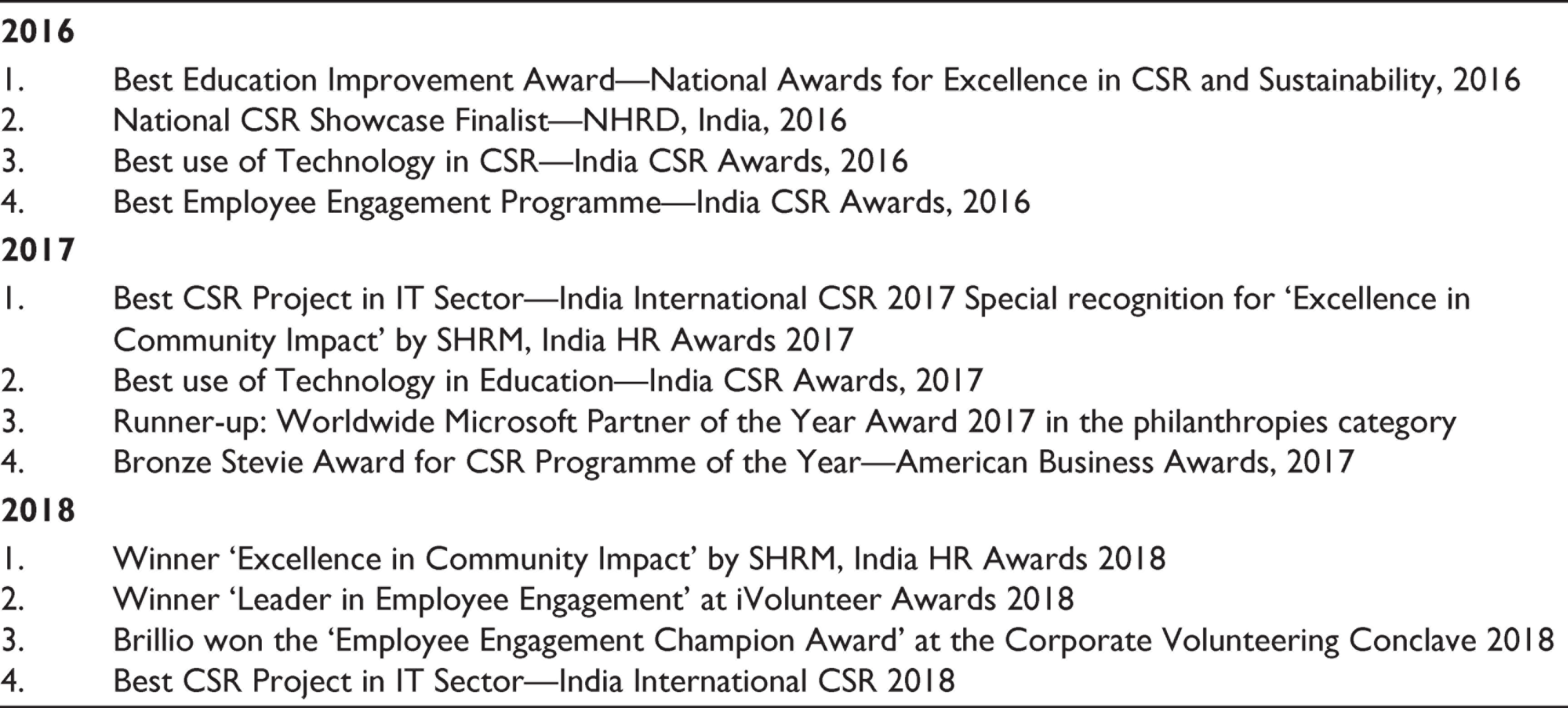
| 2016 | |
| 1. | Best Education Improvement Award—National Awards for Excellence in CSR and Sustainability, 2016 |
| 2. | National CSR Showcase Finalist—NHRD, India, 2016 |
| 3. | Best use of Technology in CSR—India CSR Awards, 2016 |
| 4. | Best Employee Engagement Programme—India CSR Awards, 2016 |
|
|
|
| 1. | Best CSR Project in IT Sector—India International CSR 2017 Special recognition for ‘Excellence in Community Impact’ by SHRM, India HR Awards 2017 |
| 2. | Best use of Technology in Education—India CSR Awards, 2017 |
| 3. | Runner-up: Worldwide Microsoft Partner of the Year Award 2017 in the philanthropies category |
| 4. | Bronze Stevie Award for CSR Programme of the Year—American Business Awards, 2017 |
|
|
|
| 1. | Winner ‘Excellence in Community Impact’ by SHRM, India HR Awards 2018 |
| 2. | Winner ‘Leader in Employee Engagement’ at iVolunteer Awards 2018 |
| 3. | Brillio won the ‘Employee Engagement Champion Award’ at the Corporate Volunteering Conclave 2018 |
| 4. | Best CSR Project in IT Sector—India International CSR 2018 |