






Abstract
This article explores conflicts, confrontations and conduits for sustainable development in rural environments. Fragility and degradation with a slight resilience manifest heavily in Gokwe South Rural District (GSRD), Zimbabwe. The article notes rural development as a double-edged sword, bringing tremendous opportunities for innovation but also causing increased ecological degradation. As such, it often results in conflicts and confrontations among stakeholders. Like many Zimbabwean rural settlements, GSRD is experiencing serious land disputes. conflicts arise from the proposed changes, like extension of infrastructure, perceived by some stakeholders as contrary to their interests and wishes. Using focus group discussions and thematic analysis, a trend of how conflicts and confrontations emerged was established in GSRD. The findings show that land transition from rural to urban status without consultations instigates conflict between different development agencies and communities.
Introduction
Settlement expansion induces conflict with other land-use practices, especially land cultivation and grazing. Fast urbanisation is the chief driver of rural land encroachment and competition (Xu et al. 2009; Lombard 2015). Urban land development compromises rural livelihoods, most of which are hooked to natural resources like forests and fisheries. The present article is built on a study that explored land-related conflicts and confrontations induced by settlement development and expansion in Gokwe South Rural District (GSRD) with local communities citing exclusion and their interests and wishes of development side-lined. Gokwe is located in the Midlands Province of Zimbabwe. In the 1960s, Gokwe District was one entity comprising both the present day Gokwe North and South Districts. The area used to be sparsely populated and a jungle in which people later settled from places, like Bikita (Chief Jiri and Kraalhead Masuka) and Chirumanzu (Headmen Muyambi and Huchu), Chivi, Mberengwa and Zvishavane areas to pave way for the white farming minority. Currently, GSRDC business centres are expanding; land within gazetted boundaries is running out. Development expansion is seeing encroaching into communal land, inhabited by local communities and now triggering compensation and rights debates. This article is organised as follows: introduction, theoretical perspectives underpinning the study, research methodology presentation and analysis of the research findings and a summary of the study, conclusions and recommendations.
The Socio-Ecological Dynamics and Characteristics of Gokwe South
Socio-ecologically, Gokwe is divided into Gokwe South and Gokwe North districts. Divergent ethnic groups, coming from many parts of Zimbabwe, have settled in the districts. Two dominant ethnic groups are the Tonga (who traditionally lived in the Zambezi Valley, an enclave between Zimbabwe and Zambia) and migrants from Masvingo province (Nyota 2015). Migration into the district began in the 1950s (Ncube 2017); it was both environmental migration and institutionally engineered migration (Charewa 2017; Sachingoma 2016). Migrants perceived advantages, like podzolic soils that supported cotton production and the removal of tsetse flies in the area (Masvaya et al. 2010). Pressure on land resources in other districts saw the colonial and post-colonial governments opening up the district, as an institutional decision (Nyambara 2001). In recent times, climate change and variability are putting pressure on the district and affecting agricultural productivity even further (Gwimbi and Mundoga 2010; Sachingoma 2016).
Ecologically, Gokwe South situated between the agro-ecological Regions 3 and 4 with an average rainfall of 600 to 650mm per year, principally from November to February. Soils are predominantly sandy soils. Livestock production in the district is supported by savannah grasslands (Maburutse et al. 2012). Contract farming is major activity in the district (Hove 2014). Dryland crop production and the recently promoted conservation farming are key in the district (Hanyani-Mlambo, Sibanda and Rukuni 2000; Mashango 2015; Nhodo, Dube and Mafongoya 2012). For a long period, cotton was a major commodity of production and sale from the district (Gwimbi 2009; Jingura, Sibanda and Hamudikuwanda 2001; Mtetwa and Nlanga 2018).
The Zion Christian Church (ZCC), founded by Samuel Mutendi, who died in 1976, started in Gokwe South in area of Chief Sahai in the 1960s (Chimininge 2014; Mberengwa 2016; Robert 2018). Before that, Mutendi established his first Zion city or centre of worship at Mbungo in Masvingo. Having experienced tension with colonial administrators, the Dutch Reformed and Roman Catholic Church members, Mutendi established a shrine at Defe Dopota in Gokwe. The religious influence of the ZCC has expanded territorially and spiritually in Gokwe and beyond (Chimininge 2014).
Theoretical Framework
Conflict theory and the principal-agent theories underpin the study. The conflict theory explains how conflict starts, varies and affects individuals and communities. unequal distribution of scarce resources and power, differences in interests and goal variation are the main sources of conflicts. However, different paths open up opportunities for negotiation (Castelfranchi 2000; Maslow 1943; Thangarajah et al. 2002). Order, change and conflict are linked by often reciprocal interactions. New values can arise within the society being incompatible with the old. Hostilities are possible ethnically and culturally (Schweitze 2016; Scott and Storper 2015). Unequally distributed natural resources induce the bulk of conflicts experienced in rural areas (Grimble 1998; Teferra and Beyene 2014). Traditionally, the principal-agent problem is viewed as a product of the principal inducing incentives that the agent has to harness from them (Grossman and Hart 1992). The incentives set may not be once-off, but continuous creating a dynamic relationship between the agent and the principal, defining life contracts (Sannikov 2008; Sobel 1993; Toelstede 2020). Overall, the principal-agent problem is a hierarchised game-theoretic problem; all strata of society will not get the same information at the same time with the same understanding (Turner 2017). The conclusion by Turner (2017: 22) is important to the debate of the principal-agent relationship:
With the commercialisation of civil society on the one hand and the financialisation of capitalism on the other, a new figure is emerging, namely, the citizen who, from the safety of his or her own private space, observes society as a spectacle, rather than acting upon or with society.
Literature Review
Types and Sub-Types of Land Conflict.

Contests over power arise from the disjuncture between political elites and the masses during state building (CCMT 2015; Mlambo 2009; Thomas 2015). Studies have shown how the countryside as a ‘purified space’ have been used to exclude undesirable, ‘incongruous’, or essentially ‘urban’ types of development. Discussion of rural planning policy is often couched in the politically acceptable, neutral and scientific language of environmental sustainability, opposition to rural development is as fervent and sensational as ever (Lombard 2016). For example, diverse claims, overlapping frameworks and power relations were experienced in Mexico. The complexity and intractability of the land conflict in Santa Lucia reflects the diverse interests of the actors involved in land transactions.
In most sub-Saharan African countries, land-related conflicts are increasingly becoming a threat to rural economic activities, such as agriculture (Deininger and Castagnini 2006; Yamano and Deininger 2005). Many studies have, thus, linked land conflicts to weak or non-existent formal land institutions and the failure of current customary land tenure systems to resolve conflicts (Donge and Pherani 1999; Fred-Mensah 1999). Often, original inhabitants oppose the transfer of traditionally owned family and community land to ‘strangers’ by committing acts of sabotage, looting, burning and theft of property and crops of new landholders (Fred-Mensah 1999; Donge and Pherani 1999; Platteau 1996). The issue of control over agricultural land and even pastoral resources is a major concern (Alawode 2013; Maiga and Diallo 1998). Generally, access to arable productive land in Africa is declining due to the growing population. This has exacerbated land degradation brought about by climate change (FAO 2006; in Onoja and Achike 2011). Government and political officeholders have been accused of getting involved in land grabbing as well (Adebayo and Oriola 2016; Manzetti and Wilson 2007; Van Leeuwen et al. 2014).
Driven by economic activities and increased population, urbanisation is rapidly developing in urban hinterlands and a series of land resource and environmental conflicts (Li 2017; Xu et al. 2016). Loss of farmland is the most socially undesirable outcome of urbanisation, especially in a developing economy, even though these farmers are properly compensated for their land (Li 2017). Farmers may not have other skill sets to survive in urban settings. Some may not be amenable to living in crowded city environments. Leaving the village implies of loss of social and personal networks.
Governments in the majority of African countries use various means to dispossess locals of their land in the name of promoting agricultural investment, provision of housing estates and industrial revolution (Abdulatif 2009). For instance, most land grabbed in Nigeria were profit-driven under the guise of using the land acquired for agricultural investments, especially for cassava, sugarcane and sweet sorghum, that ultimately would become raw materials for bio-fuel production. In Ethiopia, national parks came into being in the late 1960s and early 1970s (Sawada and Koike 2016; Teklehaimanot and Balakrishnan 2017). The establishment of national parks has overlooked the livelihood bases of local people hence a conflict-inducer (Teferra and Beyene 2014). In Zimbabwe, in 2012, for example, there was a conflict between Vungu Rural District Council and Kushinga resettlement areas (CCMT 2013). The conflict emanated from a disputed site for a secondary school in that particular area. This did not sit well with the settlers and conflict arose. In natural resource management, conflicts indicate the outcome of competition and potential disagreement between two or more groups (Teferra and Beyene 2014).
Research Methodology
The study used primary and secondary methods to gather data. Document review included literature, reports and newspaper articles on conflicts and confrontations across the globe and in Zimbabwe. The data collection methods followed a series of steps including focus group discussions in April 2019, historical narratives, interviews with respondents and key informant interviews. Five villages in GSRDC were purposively selected that share a boundary with Gokwe town and have frequent conflicts between the local authority and local communities. Five focus group discussions were conducted with 10 to 15 individuals in each. In selecting participants for the group discussion, different age groups and social statuses were included to capture as diverse opinion as possible. The checklist used for focus group discussions were on an electronic tablet. Four teams were constituted, each headed by a technical expert. Four key informants, selected for the study, included community elders (the chief and the kraalhead) and the technical team of the local authority who were knowledgeable with the process and events in the area. Data analysis was done using thematic analysis. Issues that came out of the study were clustered around themes of community lived realities, land shortage, water scarcity, council development programmes, tenure insecurity, land-use planning, and roles and responsibilities of government departments and institutions.
Results and Interpretation
This section presents an analysis and discussion of the research findings. Key issues that were raised included community lived realities, land shortage, water scarcity, council development programmes, tenure insecurity, land-use planning and roles and responsibilities amongst institutions.
Conflict Around Resources
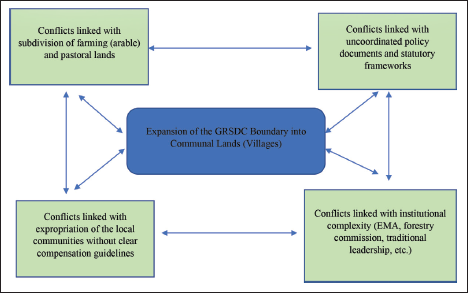
Noted is that land in the villages is distributed by the kraalhead (sabhuku) who receives a token of appreciation called maburamunzwa from the beneficiary. Maburamunzwa is a custom inherited from the forefathers’ traditions. The corollary effects of institutional conflict emanate from some village heads selling other households’ plots to outsiders, for some to as much as US$ 3000,00 /hectare. It emerged that some pieces of land sold had already been subdivided by the GSRDC. Households involved said were applying a concept of garawadya ‘eat first then be questioned later’. They were not interested in the urban plots’, through planning ‘introduced on their traditional land by the GSRDC.
Villagers also complained about the ad hoc nature of the process of land acquisition by the GSRDC. They said that the local authority did not follow proper consultative procedures to engage them. they accused it of forcibly pegging on their land with the assistance of heavily armed police and police dogs. On the contrary, the GSRDC cited that it has the powers to displace and evict the villagers in evocation of the Regional and Town Country Planning Act of 1976 (revised in 1996). Yet, the villagers were concerned about the long-term investments they had done on their homesteads orchards and houses). They also cited that they were attached, by cultural reference to the graves of their departed relatives. They cited also that the GSRDC had not communicated any clear framework or guideline regarding compensation.
Overall, the expansion of the growth point entailed encroachment into communal land, inhabited by local communities. The GSRDC designed a layout that was approved by the Department of Physical Planning, and these naturally would displace the villagers and their activities—cultivation and grazing. Specifically, Villagers also indicated that plantations, orchards and gardens (mushandirapamwe) formed the backbone of their livelihoods also income generation. They depended on the wild fruits, such as mazhanje, matamba and shumha from the nearby forests. The GSRDC barred villagers from practising farming from the pegged areas and this stirred hostility
The villagers also indicated that cattle formed part of their economic activity. The subdivision of communal lands to accommodate the growth point expansion resulted in the paddocks being depleted, endangering their livestock. In the two plates, there is increased socio-ecological conflict. Livestock owners also increasingly quarrel over the grazing resources. Particularly, Plate 2 shows a household that was built in the middle of a pastureland Tension, between the villagers and migrant, increased. The villagers base their arguments on ancestry; migrants base their claims on the money they have used to buy ‘land’. Yet council policies and statutes argue that land is never sold, only improvements are done on land.
Conflicts around Religion and Territoriality
The development of areas in Gokwe caused a number of conflicts, including evictions and threatening non-ZCC members, unplanned expansion of the area into village lands, uncoordinated and inharmonious land-use (graveyards in the vicinity of Defe), banning of other economic activities that are believed to be unholy and forced rest on Sundays despite being a non-believer. The expansion of the Defe area brought with it changes that affected the lives of the villagers. Defe has some developed residential areas, which are high, medium and low-density suburbs with some hotels meant to accommodate church congregants. By virtue of being ZCC church members, professionals from GSRD are used to seek approval for developments, which are rarely approved by the rural district council. Though the spatial area of Defe is increasing, it is unknown what the service to population ratio is like. The settlement lacks coordinated service delivery, such as water and sewage networks. It is not clear whether the area has septic or soak-away sewage systems and, if so, how they are discharged and managed, which becomes a health concern in the long run.
The area had no proper shopping centre and relied on small tuckshops that could not provide a sufficient variety of services and products. An absence of a clinic was noted as ZCC members believed in spiritual healing. This is a cause for concern in the event of disease outbreak. Unfortunately, the residential set up near Defe is mixed with a graveyard site close to residents’ accommodation. The developments are not harmonious as required by planning regulations. The village heads who are of the Mutendi clan are continuously denouncing the rearing of pigs in the area and this has affected the livelihoods and practices of non-believers. Every village member is not supposed to work on a Sunday despite going to a different church. The village heads allocate communal land to members of the ZCC from across the country in the area and nearby game reserve, depriving the privileges of the original villagers who are non-believers. The effect of religion on conflict has generated much attention around the area.
Conflict Between the Institutions as a By-Product
Various pieces of legislation have a bearing on access, control, ownership and utilisation of communal land in Zimbabwe. These pieces of legislation include the Communal Land Act (Chapter 20: 04), Constitution of Zimbabwe (Amendment No. 20 of 2013), Environmental Management Act (Chapter 20: 27), Forest Act (Chapter 19: 05), Land Survey Act, Regional, Town and Country Planning Act (Chapter 29: 12), Rural District Councils Act (Chapter 29: 13), Sustainable Development Goals—Agenda 2030, Traditional Leaders Act (Chapter 29: 17), Water Act (Chapter 20: 24), Mines and Minerals Act (Chapter 21: 05) and Parks and Wildlife Act. These pieces of legislation form the crux of the matter for rural development in areas, such as GSRDC, and neglecting one of these legislations could result in land-use conflicts. Additionally, the Constitution of Zimbabwe (Amendment Act 20) of 2013 is the supreme law of the country and all laws, practices, norms and values are subject to it (Chatiza et al. 2014; Government of Zimbabwe 2013). Within the field of spatial planning, most allied acts are not aligned to the provisions of the Constitution of Zimbabwe (Amendment Act 20) of 2013. Local authorities seem to conceptualise the constitution as only binding on national government, as they have not implemented constitutional provisions that do not require legislation to operationalise (Chatiza et al. 2014).
There is lack of proper understanding of the Traditional Leaders Act on land allocation by the traditional leaders themselves, as the Government sought to democratise land allocation by setting up elected Village Development Committees (VIDCOs). When the statute was enacted, it corrected the exclusion of traditional leaders by making the village heads and headmen, chairpersons of Village Development Committees and Assembles. In this light, the village head became the land authority; in fact, he had power to allocate land contrary to council resolution. At independence, the enactment of the Traditional Leaders’ Act, corrected the exclusion of traditional leaders by making the village heads and headmen, chairpersons of Village Development Committees and Assembles, and Ward Assemblies, respectively. Thus, the perspective of political ecology, the outcome of the conflicts has been the recurrence of grievances by the indigenous claimants distinguished as customary right-holders. Various sources of conflict in the event of an expansion of boundaries exist in GSRDC (Figure 1).
The Institutional Framework: Roles and Responsibilities of Various Implementing Institutions in Rural Development.

Discussion
A plethora of diverging claims about the nature and kind of development compete for attention and often result in conflicts. An intensification of conflict in the development of urban areas, peri-urban areas and rural communities is noted in GSRDC. A realistic conflict may end when the social actors find another more satisfactory way of reaching their goals (Bressers 2004; Coser 1957; Himes 1966). Different perceptions of a conflict situation require joint conflict analysis with all relevant parties in order to resolve confrontations and conflicts in Gokwe. The analysis must switch between the overall system and a micro-analysis of the relevant sub-systems (Mitchell 2005). It must be noted that processes of social change within societies do not follow linear principles, hence, according to Diamond (1997), ‘conflict habituated systems’ apply. Ethnic, religious or territorial tensions must be understood for effective reconstruction of the post-conflict environment (Bowd and Chikwanha 2010). The governance factor speaks to how power struggles over authoritative, allocative and framing are conducted, restructured or changed. Less fragmented governance frameworks and collaboration in any development, be it in rural or urban regions, can contribute to economic growth by harnessing the potential and diversity of various institutional roles and responsibilities (Ahrend et al. 2015). The absence of a clear policy to provide a framework for the creation and sustenance of a Gokwe rural settlement and its land-use planning and management, demonstrates institutional complexity. promotion of fairness, accountability, transparency and trust in land-use management induce an unclear monitoring and evaluation system on human, wildlife and livestock resources. In the GSRDC proper land-use planning could be organised through first establishing the adequacy levels of land for cropping and grazing towards sustainable development practices in the district. Lack of funds, lack of a clear policy to guide the desired practices and corrupt tendencies by some leaders who arbitrarily continued to admit people from other places in the district are the excuses by the GSRDC to implement this. As supported by Robinson (2015: 833), ‘policy-makers compose their ideas in the midst of a myriad influences from elsewhere’, resulting in an ‘often messy and unmappable complexity’. Various non-state actors, including cultural institutions, cultural intermediaries and independent cultural producers are not respected (Temenos et al. 2019).
Conclusion, Policy Options and Recommendations
This article provided an indication on how settlement development and expansion could be done in an inclusive way to reduce conflicts and confrontation amongst various stakeholders in Zimbabwe. There are diverse and varied rights to a given piece of land, which becomes a contentious issue given competitive claims from various institutions and ministerial objectives. Policies promoting sustainable human settlement for all needs need to be encouraged and supported. Lack of a policy on settlement and land-use in GSRDC has resulted in an ad hoc way of acquiring land in Gokwe. Thus, there is need for a policy that deals with settlement and land-use.
The policy would provide a framework that supports the creation and sustenance of a Gokwe rural settlement whose land-use planning and management are sustainable, harmonious, inclusive and responsive. Villagers’ participation in the acquisition of land was done in a fragmented and piecemeal manner, which led to tension and confrontations in Gokwe. Imperative, therefore, was community inclusion in decision-making processes—appreciating all forms of social, economic and political differences (age, religion, disability, culture, education, language, economic, geographical and any form of differences) in Gokwe. The uncoordinated development happening in GSRDC calls for the development of detailed land-use plans for all communal land in the district. The GSRDC lacks a clear compensation strategy. In this regard there is need for the GSRDC to introduce a compensation for development by induced displacements offering guidelines and recommendations. Development projects should be in place for the purposes of public notice of intent, negotiations, consultations, valuations, community impact assessments, alternative land and determining financial compensation. There are no timeframes for compensating communities affected by development induced developments in GSRDC. Measures should be in place to ensure that all the affected households, upon receiving payment schedule, be relocated within a minimum possible time.
Footnotes
Declaration of Conflicting Interests
The authors declared no potential conflicts of interest with respect to the research, authorship and/or publication of this article.
Funding
The authors received no financial support for the research, authorship and/or publication of this article.
