






Abstract
The agriculture sector in India is beset with twin limitations of shrinking cultivable area and absence of major technological breakthroughs in the recent past. In such a situation, a judicious management of the farm in the form of adjustment in a crop portfolio can be quite useful to maximise output and minimise wastage of resources. This article seeks to examine whether a diversified crop portfolio makes the farmers more efficient using farm-level survey data collected from geographically diverse areas of Assam, a state in northeast India. The results of a stochastic production frontier analysis show that adoption of a diversified crop portfolio across crops and seasons makes the farmers more efficient in cultivation by helping them reduce weather-induced damages to crops and reap better returns from farming. This efficiency-enhancing effect of crop diversification is found to be heterogeneous among the regions. However, too much diversification reduces the efficiency of farmers. The results have important implications for Assam where floods cause extensive damage to crops every year. Moreover, access to extension services and government support are found to make the farmers more efficient. On the other hand, fixed-rent form of tenancy reduces efficiency of the farmers while household size has a positive impact on the same.
Introduction
Agriculture plays a vital role in the Indian economy where over 58% of the rural households depend primarily on it for their livelihood. Area expansion and productivity growth—the two major sources of growth in agriculture which served well in the past—are now beset with some limitations. While the scope of area expansion is limited by inelastic supply of land and conversion of cultivable land for non-farming activities, it is argued that any significant technological breakthrough cannot be expected in the near future and, hence, one has to depend on the exploitation of the potential of the existing technology (Government of India 2006). Hence, the growing demand for food has to be met by increasing productivity through raising efficiency of the farms (Manjunatha et al. 2013) with proper utilisation of the existing inputs including technology and targeting the factors that cause inefficiency. In this regard, a useful strategy could be to move towards a diversified crop portfolio, particularly into high-value crops, that can enhance the efficiency of the farmers in a number of ways. First, a diversified crop portfolio can help avoid the disadvantages of emphasis on one or two crop varieties such as deceleration in productivity growth, overexploitation of ground water resources and deterioration of soil health. Second, it can offer a number of agronomic benefits, such as improvement in soil fertility, and protection of crops from diseases, weeds and insects (Ogundari 2013). Third, the farmers are often the victims of production risk arising out of vagaries of weather that is often responsible for loss in output and wastage of resources. While the occurrence of such risk is beyond the control of the farmers a judicious management in their farming can be a decisive factor in minimising the damage and maximising output. Adoption of a diversified crop portfolio across crops and seasons helps the farmers minimise weather-induced damage by compensating for a loss in one or two crops by others that do not suffer such damage, and thus reap better returns from farming. Previous research shows that farmers often make adjustments in their cropping patterns across crops as well as seasons to cope with exogenous production risk (Kumar et al. 2002; Mandal 2010; Shiyani & Pandya 1998), especially when they do not have any other ex ante coping mechanisms like crop insurance and they often become successful with this (Mandal 2014).
Assam, a state in the north-eastern region of India, has remained more agrarian than most parts of the country in terms of a higher share of agricultural domestic product and a larger proportion of workforce being engaged in agriculture. This is evident from the facts that despite undergoing a sectoral transformation, agriculture continues to support more than 75% of the population and provides employment to more than 53% of the workforce in Assam (Government of Assam 2011). The conducive agronomic conditions along with abundance of monsoon precipitations in the state and the mountains surrounding it have enabled the majority of its population to depend on cultivation as the principal source of livelihood. However, excessive precipitations in the wider region often result in damaging floods, especially for those who inhabit close to the rivers (Mandal 2014). The plains of Assam, covering 81% of the total geographical area and accommodating 97% of the total population of the state, are highly prone to floods (Mandal 2017). The regular floods in the state characterised by varying timing, intensity and frequency cause a huge damage to the crop-growing sector by destroying standing crops, creating water logging, soil erosion (Mandal 2010) and siltation. In fact, frequent floods (sometimes three to four times a year) are accountable to a great extent for low yield and low growth of agriculture sector of the state (Mandal 2010).
As the agriculture sector in the plains of Assam is beset with a great amount of production risk, mainly arising out of flood, the farmers can yet try to minimise the damage and wastage, and maximise output through judicious coordination and management of inputs at their disposal (Bhattacharyya & Mandal 2016). There is extensive literature highlighting the fact that a change in the crop portfolio by relocating the resources at the disposal of the farmers is often adopted as a risk-averse strategy. For example, using district-level aggregated data, Goyari (2005) and Mandal (2010) find that recurring flood and damages thereof have led many farmers in Assam to make changes in the cropping pattern away from Kharif to Rabi crops. 1 Likewise, Mandal (2014) using farm-level data from Assam shows that farmers who have diversified their crop portfolio across crops and seasons have been able to reap a higher farm income. All this suggests that a judicious management of the farm in the form of a diversified crop portfolio can be quite useful to maximise output and minimise wastage of resources.
With this background, the present article seeks to examine whether the adoption of a diversified crop portfolio makes the farmers more efficient. For this, we apply stochastic production frontier analysis using farm-level survey data collected from geographically diverse areas of Assam through face-to-face interviews with the head of the farm households. The study is quite relevant from policy point of view because of the fact that agriculture is the principal source of livelihood for the majority of population in Assam. But there has been limited investigation on the productive efficiency of farming in the state. To the best of our knowledge, there are only two studies (Bhattacharyya & Mandal 2016; Mazumder & Gupta 2013) that investigate productive efficiency of only one type of crop, namely rice. 2 But to improve productivity of the crop-growing sector and make cultivation a remunerative profession, it will be of utmost importance to examine productive efficiency of this sector taking into account all the crops grown by the farmers and identify the factors that reduce output below the maximum possible level. Policies aimed at targeting such factors can also help improve productive efficiency. The novelty of this article lies in the fact that it is the first one to investigate the productive efficiency of the crop-growing sector of Assam and identify the factors that affect such efficiency with a special focus on the role of a diversified crop portfolio. The results of a stochastic production frontier analysis show that a diversified crop portfolio enhances efficiency of the farmers but within a particular range beyond which further increase in diversification reduces their productive efficiency. Moreover, the efficiency-enhancing impact of crop diversification among the sample districts is different from one another. Access to extension services and government support are found to make the farmers more efficient. On the other hand, fixed-rent form of tenancy reduces efficiency of the farmers while household size has a positive impact on the same.
The rest of the article is organised as follows. The next section gives a brief description of the study area, the sample and data. The methodology and model used in the study are discussed in the third section. The empirical results and their discussion are covered in the next section followed by conclusion and policy implications.
Study Area and Materials
Assam—the core of the north-eastern region of India—is located between the latitudes of 24008′ N and 27009′ N and the longitudes of 89042′ E and 96010′ E. The state covers a geographical area of 78,523 sq km and accommodates a population of over 30 million. It has two broad natural divisions—plains and hills. The plains division, comprising the Brahmaputra valley and the Barak valley, constitutes 81% of the total geographical area and accounts for 97% of the total population of the state. The state has been divided into six agro-climatic zones based on rainfall patterns, terrain, soil type and climatic conditions. They are Lower Brahmaputra Valley Zone (LBVZ), Central Brahmaputra Valley Zone (CBVZ), North Bank Plains Zone (NBPZ), Upper Brahmaputra Valley Zone (UBVZ), Barak Valley Zone (BVZ) and Hills Zone (HZ). Figure 1 presents a map of Assam along with these ago-climatic zones where the constituting districts are demarcated.
This study is based on farm-level primary data collected from four non-contiguous districts of the Brahmaputra and Barak valleys of Assam with the help of multi-stage sampling during November 2009–March 2010. They are Dhubri, Morigaon, Dibrugarh and Cachar, which belong to four different agro-climatic zones of the state, namely LBVZ, CBVZ, UBVZ and BVZ, respectively. This is to capture as much variations in the agro-climatic conditions of the farms as possible. The broad field study locations (i.e. districts) are shown by arrows in Figure 1. From each district, three Agricultural Development Officer’s (ADO) circles have been selected first. In the next stage, two villages have been selected from each ADO circle. In the final stage, we have randomly selected a representative number of farm (cultivator) households from each village. Thus, our sample comprises a total of 360 farm households who have been interviewed using a pre-tested question schedule. The information collected from the sample farm households pertains to a number of variables such as acreage, output and prices of different crops grown at the farms along with quantities and prices of inputs used in their cultivation, and the background and other characteristics of the selected farmers.
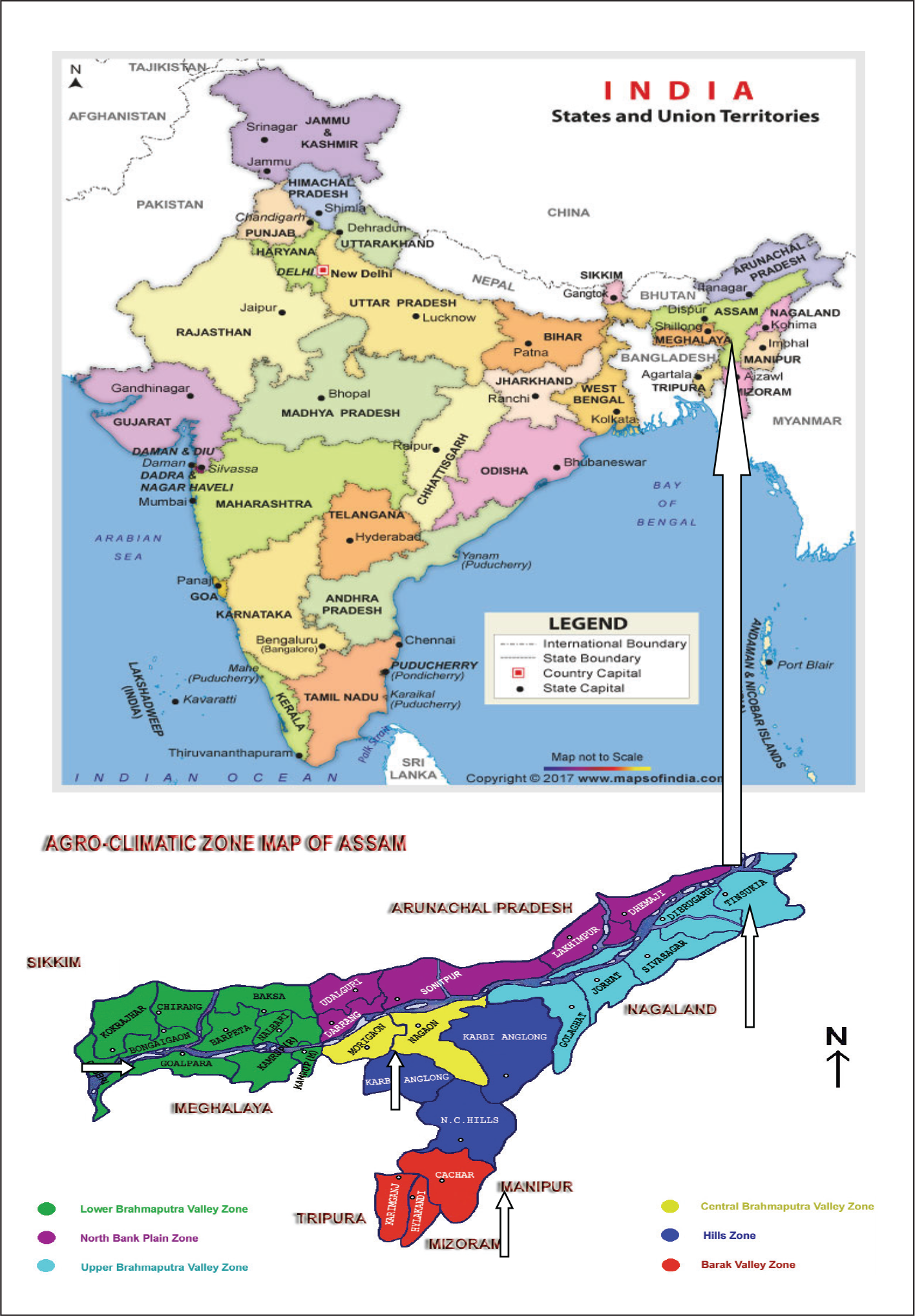
Map of India and Assam.
Description of the Variables.
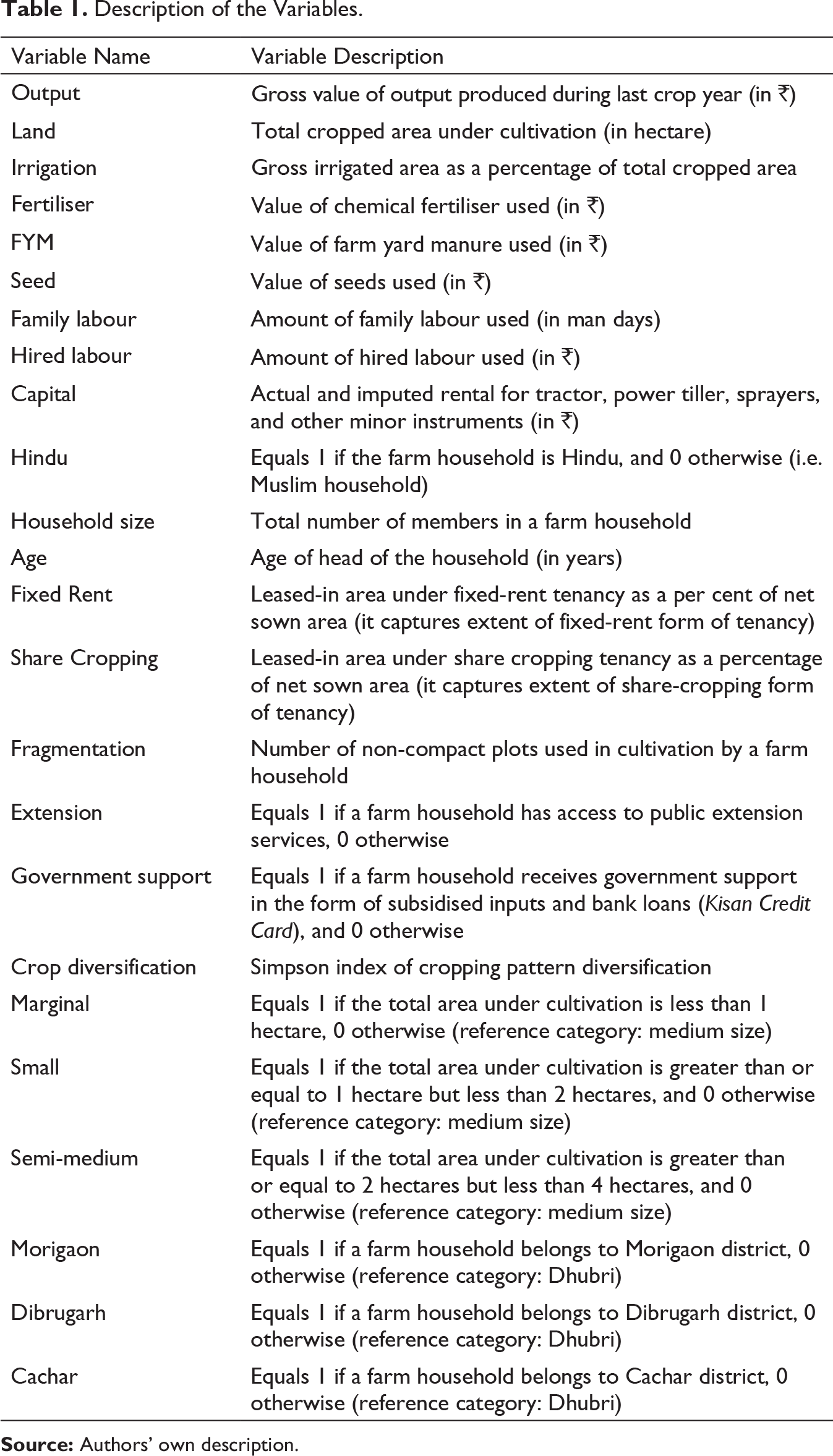
Source: Authors’ own description.
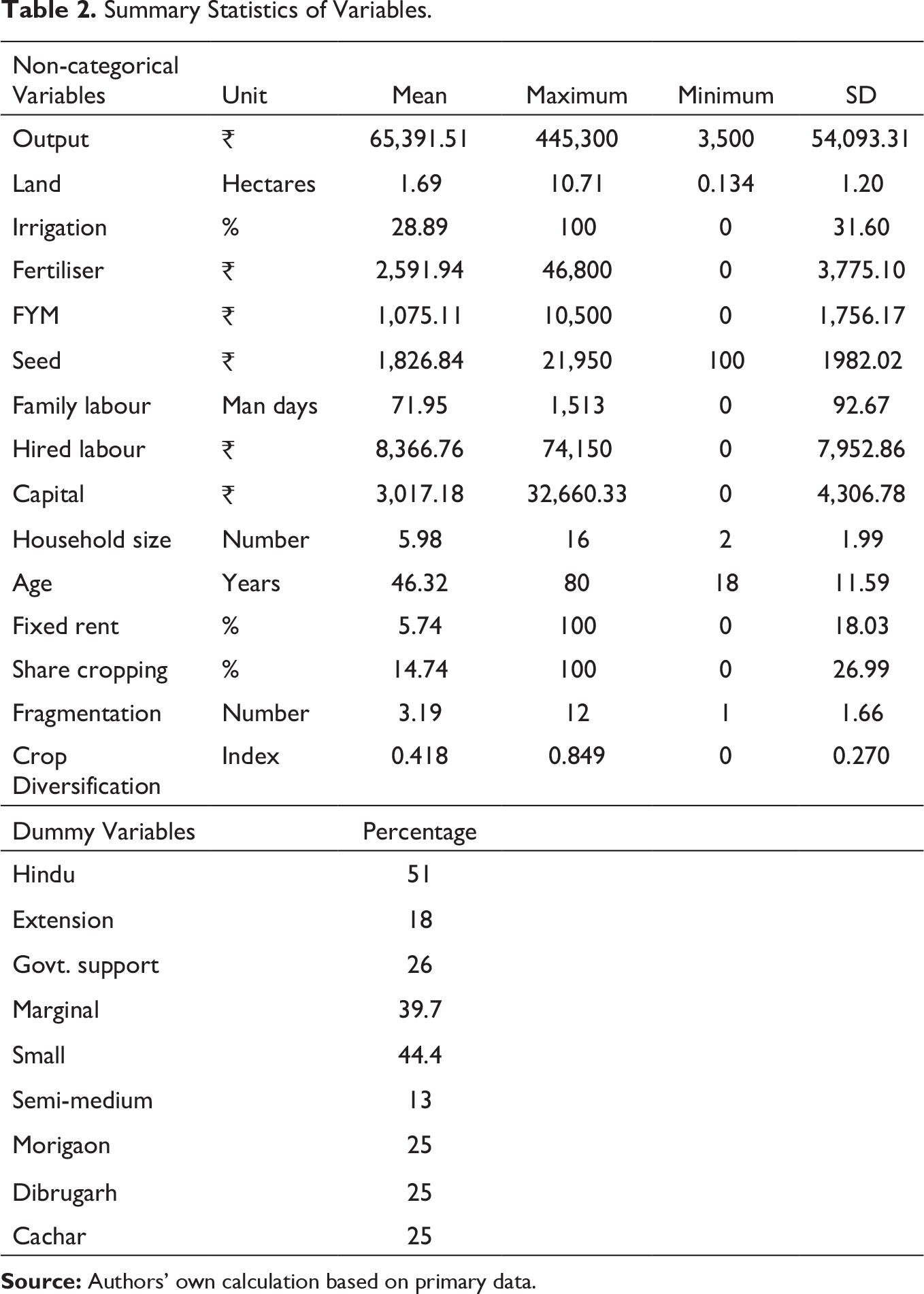
Summary Statistics of Variables.
Methodology and Model
Theoretical Formulation
The empirical studies on technical efficiency have used mainly two approaches, viz. the non-parametric data envelopment analysis (DEA) and parametric stochastic frontier analysis (SFA). Both have their own merits and limitations. The main advantage of DEA is that it is free of the assumptions for functional form of frontier technology and for the distribution of the technical inefficiency term (Coelli 1995; Wadud & White 2000). However, the limitation of DEA is that it does not explicitly accommodate the effects of measurement error and other noise in data, and attributes all the deviations from the frontier to inefficiencies (Coelli 1995; Theodoridis & Anwar 2011). Another limitation of DEA is the potential sensitivity of efficiency scores to the number of observations as well as to the dimensionality of the frontier (Ramanathan 2003). Such limitations in estimation are better handled by SFA. The SFA was independently proposed by Aigner et al. (1977) and Meeusen and Van den Broeck (1977), which specifies a production function with two error terms that account for the existence of technical inefficiency of production, and also for factors such as measurement error in the output variable and the combined effects of unobserved inputs on production (Coelli & Battese 1996). But the main limitation of SFA is that it depends on explicit specifications of the functional form of the production function and the distributional assumptions of the two error terms (Coelli & Battese 1996). Thus, neither of DEA and SFA is perfect, and their use depends on the application being considered (Coelli 1995; Wadud & White 2000). The SFA is generally preferred or recommended for use in agricultural applications because of the reasons as noted by Coelli and Battese (1996), which are as follows. First, the assumption of DEA that all deviations from the frontier are associated with inefficiency is wrong given the inherent variability of agricultural production resulting from weather, pests, diseases etc. Second, many farms are small family-owned operations and do not keep accurate records because of which much available data on production are likely to be subject to measurement errors.
From the above discussion, it is clear that SFA is better suited in case of agricultural economics and hence this article uses a stochastic frontier approach to measure technical efficiency of crop production of Assam. Abbreviating the production function, we can write our model to be estimated as
where y is the output, x and
Following Battese and Coelli (1995) we make the specifications as shown below:
where the random variable,
Empirical Application
For the present empirical context of measuring technical efficiency and the determinants of farm-specific efficiency, the following empirical models are used. The stochastic production function used is shown by equation (5).
Here the dependent variable measures the gross value of the output of various crops cultivated by a farm household in the last crop year (in ₹). The vector of inputs of the production function includes total cropped area under cultivation (Land); proportion of irrigated land (Irrigation); expenditures (in ₹) on chemical fertilisers (Fertiliser), farm yard manure (FYM), seeds (Seeds), use of farm capital goods (Capital); wage paid on hired labour (Hired labour); and also the amount of family labour in man days (Family labour).
The focus of this article is not only to measure technical efficiency of crop growing sector of Assam but also to analyse the determinants of such technical efficiency. More specifically, it seeks to examine whether a diversified crop portfolio makes the farmers more efficient in cultivation. For this, farm-specific technical inefficiency scores are regressed on the crop portfolio diversification index, measured by the Simpson index of diversification, along with other relevant exogenous factors. The inefficiency models used in the present study are shown by equations (6) and (7). Equation (6) helps to find the main (or average) impact of crop diversification on efficiency of the farmers, while equation (7) captures the heterogeneous impacts of crop diversification on efficiency of the farmers among the sample districts.
4
The explanatory variables used in the inefficiency models include extent of diversification of crop portfolio (Crop diversification), proportion of net sown area under fixed-rent tenancy (Fixed rent), proportion of net sown area under share-cropping tenancy (Share cropping), extent of land fragmentation (Fragmentation), access to extension services (Extension), access to government supports (Govt support), religion of the farm households (Hindu), age of the head of the farm households (Age), size of the farm households (Household size), size of the farms measured with dummy variables (Marginal, Small and Semi-medium, taking medium-sized farms as the reference category) and district dummies (Morigaon, Dibrugarh and Cachar, taking Dhubri district as the reference category). 5 To investigate the non-linear impact of crop diversification on the technical efficiency of the farmers, a square term of it (Crop diversification) is also included in the model. Moreover, to see whether crop diversification has heterogeneous effects on technical efficiency of the farmers located in the sample districts three interactive terms (between district dummy and crop diversification index) have been included.
The descriptions of the variables mentioned above are shown in Table 1. We estimate stochastic production frontier and inefficiency models specified above using the maximum-likelihood method with the help of FRONTIER-4.1 (Coelli 1996). This simultaneous estimation method is an improvement over the two-step method (Kalirajan & Shand 1985), as this method allows consistent estimation of the technical inefficiency terms (and parameters) even if they are correlated with the inputs and incorporates the non-positive nature of the inefficiency values (Bhattacharyya & Mandal 2016).
Empirical Results and Discussion
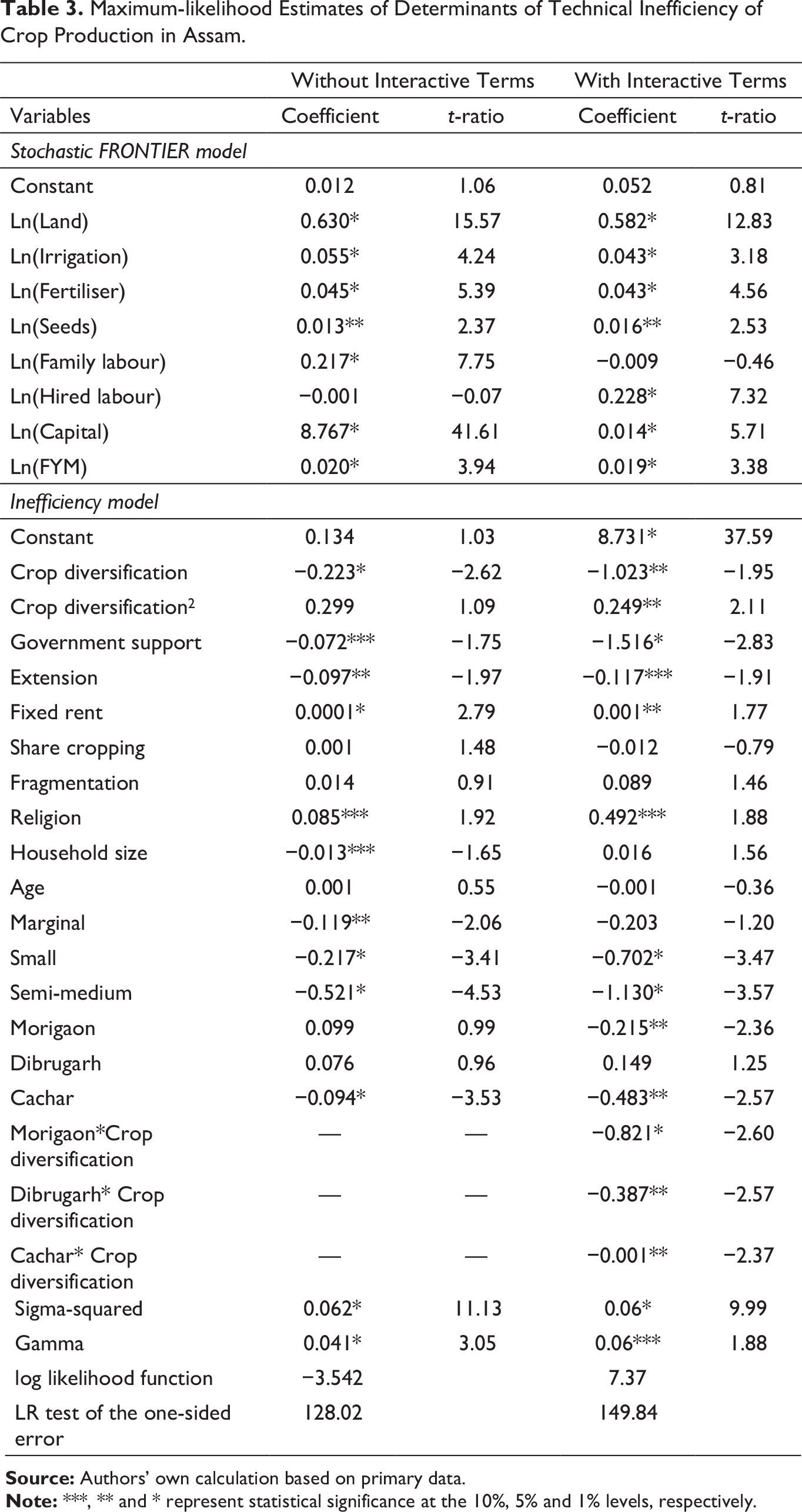
As mentioned earlier, the production function and inefficiency model are estimated simultaneously. The estimated results are shown in Table 3. The positive and statistically significant coefficients of the production function model imply positive marginal productivity of the inputs which is quite expected.
Maximum-likelihood Estimates of Determinants of Technical Inefficiency of Crop Production in Assam.
Source: Authors’ own calculation based on primary data.
Note: ***, ** and * represent statistical significance at the 10%, 5% and 1% levels, respectively.
Table 3 also shows the regression results of the inefficiency models. The focus of the article is to examine whether adoption of a diversified crop portfolio makes the farmers more efficient. It is to be noted that the coefficient of Crop diversification is found to be negative and statistically significant. This means a diversified crop portfolio makes the farmers more efficient in crop cultivation. A similar result has also been found by Manjunatha et al. (2013), Ogundari (2013), Rahman (2009) and Coelli and Fleming (2004). This beneficial impact of crop diversification on efficiency of farmers in the present context is due to the following. First, the farmers in the plains of Assam are susceptible to flood-induced production risk which is a regular and chronic problem in the state causing extensive damage to its crop-growing sector every year (Mandal 2014). 6 Therefore, adoption of a diversified crop portfolio across crops and seasons helps the farmers minimise weather-induced damage by compensating for a loss in one or two crops by others that do not suffer such damage, and thus reap better returns from farming. Second, crop diversification has a number of agronomic benefits such as improvement in soil fertility, and protection of crops from diseases, weeds and insects (Ogundari 2013). Third, it can further help avoid the disadvantages of emphasis on one or two crop varieties in the form of serious ecological problems such as deceleration in productivity growth, overexploitation of ground water resources and deterioration of soil health. 7
The coefficient of Crop diversification 2 has turned out to be statistically significant and positive when interactive terms are used (equation (7). This, along with a negative and significant coefficient of Crop diversification, has interesting implications which are grossly ignored in the existing literature, and they are as follows. The farmers can enjoy higher technical efficiency in cultivation as they increase the level of crop diversification but up to a limit beyond which further increase in it reduces their efficiency. This is quite intuitive because as a farmer keeps on diversifying his crop portfolio by adding more crops, the excessive diversification can create problems of supervision and proper management of the resources and their use in the farm. Cultivating too many crops in a crop year could entail problems such as switching between tasks, allocation of labour and management issues of resources caused by their simultaneous requirement in different activities during peak period of the production cycle (Coelli & Fleming 2004). This adverse type of impact of crop diversification on farm efficiency is also reported in some previous literature (Haji 2007; Llewelyn & Williams 1996).
The coefficient of Government support is also found to be negative and statistically significant. This means the farmers having access to government support in the form of subsidised inputs and bank loans are more efficient than others. Most of the farmers in Assam are poor and hence cannot afford to buy the necessary inputs in time to maximise output. On many occasions, they have no other option but to depend on informal sources of credit such as moneylenders and traders who charge an exorbitant rate of interest in the form of cash and kind apart from dictating the crops to be produced that serves their interest. 8 Government assistance in the form of subsidised inputs and banks loan (Kisan Credit Card) may reduce the liquidity constraints of the farmers and help them have a timely access to agricultural inputs and thereby increase their efficiency. Akram et al. (2013), Bozoglu and Ceyhan (2007) and Binam et al. (2004) also find a similar kind of efficiency-enhancing role of bank credit.
Access to extension services from government sources is found to increase efficiency in farming. This result is consistent with the findings of Ogundari (2013). Extension services have a crucial role in diffusing new innovations among the farmers, which has been emphasised in several studies (Bezbaruah & Roy, 2002). With increase in the level of access to extension services, farmers become more aware of the recent techniques and practices of cultivation along with latest policies of government for agricultural development. Thus, it helps the farmers to be more efficient in cultivation. It may be noted that in the absence of such services from the government agencies, the farmers are forced to depend on advice from the private dealers and input traders who may induce the farmers to use excessive doses of such inputs like chemical fertilisers and pesticides (Goswami & Bezbaruah 2017) that not only increases the cost of cultivation but also adversely affects soil health and production.
As regards the impact of tenurial arrangements, it is found that as the extent of fixed-rent tenancy increases, technical efficiency on the part of the farmers decreases. The reason for this is as follows. A fixed-rent tenant farmer, in the context of the present study, has to pay a fixed amount of rent either in cash or in kind, and hence is rationally motivated to maximise the return from the land by exploiting it too intensively. Thus, the fixed-rent tenants may overexploit the land and thereby leading to suboptimal output (Goswami & Bezbaruah 2018). Similar results in the context of Assam have also been reported by Goswami and Bezbaruah (2018), where they have shown that the fixed-rent tenants are inclined to exploit land productivity excessively without consideration for soil health.
The coefficient of the religion dummy (Hindu) is found to be positive and significant. Thus our results suggest that the Muslim farmers are more efficient than their Hindu counterparts. A similar result is also obtained by Bhattacharyya and Mandal (2016). Most of the Muslim farmers of Assam have their origin in Bangladesh (erstwhile East Bengal) who migrated to the state at different points of time. This community is well known for their better farming practices, which are well documented in the available literature (Madhab 2006; Nath & Nath 2010). These differences in the farming practices make the Muslim farmer more efficient than the Hindus.
The estimated coefficient of Household size has turned out negative and statistically significant. This means the farm households with a larger number of members are more efficient than others. The reason is as follows. Larger farm households have more manpower to assist in management and supervision of farming. Moreover, they have to support and feed more people with a given cultivable land. Hence, they are consequently induced to utilise the available resources more effectively.
The coefficients of farm size–specific dummies (Marginal, Small and Semi-medium) have turned out to be negative and statistically significant. This means the marginal, small and semi-medium farms are technically more efficient than comparatively the bigger-sized reference category of medium size farms. This may be because it is easier for the relatively smaller farms to supervise and manage farm operations in a better way compared to the large farms (Mandal 2011). Moreover, the households operating relatively smaller-sized farms are usually poor and thus have greater economic pressure of fulfilling family and social obligations. As a consequence, they have no other option but to extract the most out of the cultivated piece of land. As noted by Coelli and Fleming (2004), family and social obligations have a negative impact on technical efficiency of farmers. Previous researchers such as Khataza et al. (2019) and Zyl et al. (1995) also found that relatively larger farms are less efficient than the smaller ones.
As far as the district dummies are concerned, the negative and statistically significant coefficients of Morigaon and Cachar imply that the farms located in these districts are more efficient than those of the reference district Dhubri.
To capture the differential impacts of crop diversification on the technical efficiency of the farmers across the regions, interactive terms between district dummies and crop diversification index have been included in the inefficiency model. It is interesting to note that the coefficients of all these interactive terms are statistically significant. Their relative sign and magnitude have the following implications. The marginal impact of crop diversification in the reference category of Dhubri district is −0.814. On the other hand, the same in Morigaon, Dibrugarh and Cachar is −1.635, −1.20 and −0.816, respectively. 9 Thus, there are regional differences in the impact of crop diversification on technical efficiency of the farmers. This is not unexpected because the districts included in this study belong to distinct agro-climatic regions. The variations in agro-climatic conditions could lead to differences in farming systems across the regions (Geffersa et al. 2019), which have a direct bearing on agricultural production of the farms. Thus, because of the differences in the agro-climatic conditions such as soil type, rainfall patterns, topography etc., crop diversification may have differential impacts on technical efficiency of farmers across the regions.
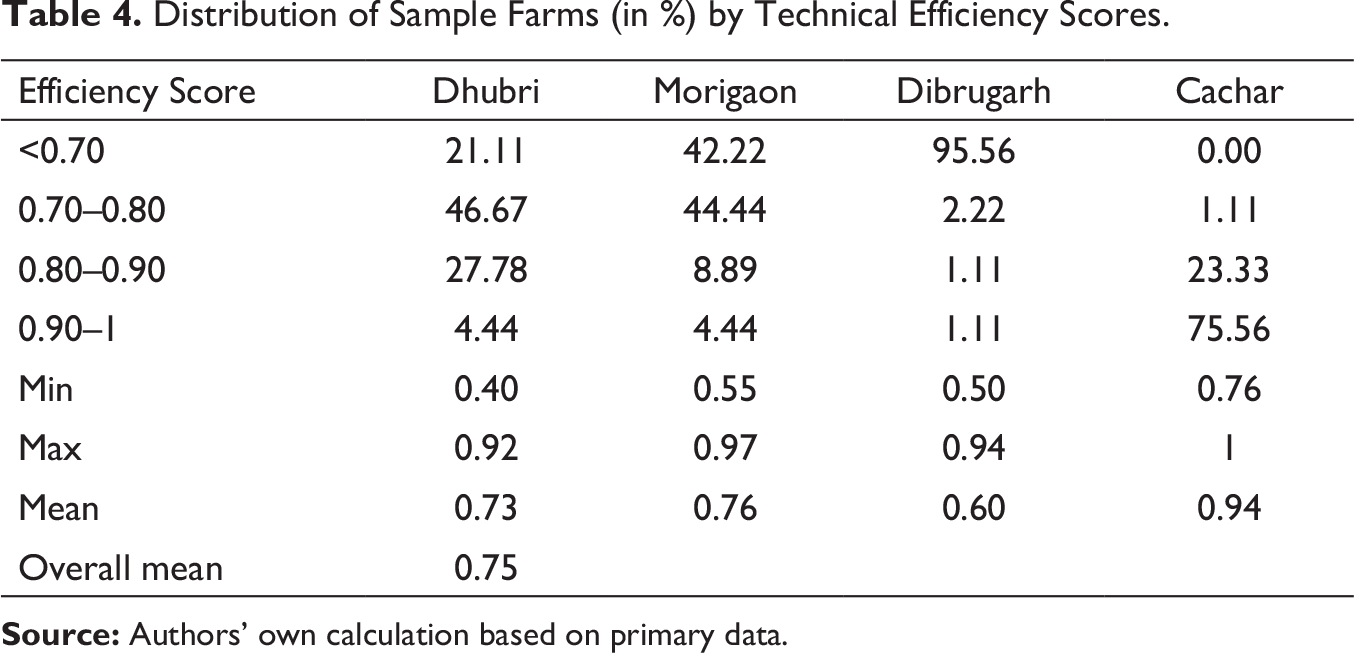
Table 4 summarises the technical efficiency of the farms and its distribution across the sample districts. As seen from the table, it is clear that the overall mean technical efficiency is 75% with large-scale variations among the four districts. The mean efficiency score is the highest in Cachar (94%) and lowest in Dibrugarh (60%), followed by Dhubri (73%) and Morigaon (76%). Thus, there is scope of improving technical efficiency in farming in the study area.
Distribution of Sample Farms (in %) by Technical Efficiency Scores.
Conclusion and Policy Implications
The article studies technical efficiency and its determinants of the crop-growing sector of Assam. More specifically, it examines whether a diversified crop portfolio makes the farmers more efficient. We simultaneously estimate the stochastic frontier model and inefficiency model using farm-level survey data collected from geographically diverse areas of Assam. We find that mean technical efficiency score is 75%, which implies that there is still scope to enhance crop production in the study area with the given inputs by improving managerial practices and making deliberate changes in the exogenous factors that adversely affect efficiency of the farmers.
The maximum-likelihood estimates of the inefficiency model reveal that there is a significant positive association between a diversified crop portfolio and efficiency of the farmers. More specifically, those who practice a higher diversified crop portfolio are more efficient in farming compared to others. The results have important implications for the state of Assam. The farmers in the plains of Assam are susceptible to flood-induced production risk which is a regular and chronic problem responsible for low yield and low growth of the agricultural sector of the state (Mandal 2014, 2010). Therefore, adoption of a diversified crop portfolio across crops and seasons help the farmers avoid weather-induced damage to the crops and reap better returns from farming, and thus making them more efficient in cultivation.
Our analysis also shows that access to extension services and government support in the form of subsidised inputs and bank loans enhances efficiency of the farmers in crop cultivation. However, fixed-rent tenancy makes the farmers more inefficient. On the other hand, the Muslim farm households, a majority of which migrated to Assam from Bangladesh at different points of time, are found to be more efficient than others due to their better farming practices.
The analysis of our results leads us to conclude that since a diversified crop portfolio helps the farmers to be more efficient in cultivation, such a strategy is to be encouraged. Since most of the farmers in the state are poor provision, effective delivery and expansion of government supports is expected to benefit the farmers by making them more efficient in farming. Moreover, given the beneficial impact of access to extension services, such services need to be expanded and the connection between farmers and extension workers is to be strengthened.
Footnotes
Declaration of Conflicting Interests
The authors declared no potential conflicts of interest with respect to the research, authorship and/or publication of this article.
Funding
The authors received no financial support for the research, authorship and/or publication of this article.
