







Abstract
The objective of this article is to describe the dynamics of fair trade in organisations that adhered to the Fair Trade International system, based on the principles of fair trade and the dimensions of social innovation, and to identify why there was a disruption in commercial transactions. Four organisations from the state of Rio Grande do Norte, Brazil, which won the fair trade seal, were analysed. Primary data collection occurred through semi-structured interviews and simultaneous annotations and, later, secondary data were collected from official documents, articles, academic works and websites. The results show that the experiences of organisations with Fair Trade International have numerous properties of the dimensions of social innovation. There was the emergence of an emerging development model with the opportunity to work collaboratively and collectively. These changes required adaptation and new practices, as producers underwent a period of changes in their working and production. The formation of cooperatives and fair trade certification had the mobilisation and participation of various actors, who also provided collective learning, both in technical terms and in terms of civic and interpersonal management, especially for rural producers.
Keywords
Introduction
In the face of exploration and uncertainty, where large organisations dominate regional/national and international trade and, in this context, small rural producers are left out of this process, the search for development, better working conditions and respect in commercial relation activities became inevitable for essentially agricultural communities with a predominance of small producers, especially those who suffer from socio-economic and environmental problems and who envisioned a promising future as they were guided by the promises of better working conditions and quality of life, from Europe and the United States (Schneider 2012).
Social innovation arises in a context of crisis and population dissatisfaction with the lack of action by the government and the private sector, which, in turn, causes serious socioeconomic and environmental problems. In this way, the main objective of social innovation is to develop and promote solutions to structural problems of the poorest classes of the population based on the participation, interaction, and empowerment of social actors, either individually or collectively (groups of friends, neighborhood associations, non-governmental organisations, government agencies, etc.).
The development of strategies and new forms of social integration is essentially delineated from proposals and new actions to solve social problems and promote well-being. Among these proposals is fair trade (FT), which first became an opportunity to promote socio-economic development and improve the production methods of small family-based producers, marginalised by the voracity imposed by the market.
FT is not only a new model of socio-economic development based on partnerships between producers and consumers but also the implementation of a set of factors that, combined, allow the creation of social and environmental value through sustainable agricultural techniques, international certification and labelling, prevention of slave and child labour, gender equality and fair prices. FT is an alternative based on environmental conservation and the emancipation of small producers by paying ‘fair prices’ for products in an ethical relationship between consumer and producer, as well as by creating sustainable networks, that is, the formation of production chains that seek to promote socio-economic development in an environmentally correct way.
However, when doing several searches in the databases of national and international journals focusing on works that addressed the FT theme, relating it to social innovation, there was a gap in empirical studies with a more holistic and systematic focus that dealt with this association (Carrillo 2020; Caviedes Rubio and Amaya 2020; Dufays 2013; Gurviez and Sirieix 2013).
From this perspective, the absence of a sustained and systematic analysis can lead to delays in the practice of social innovation. In this context, the literature is unanimous in stating that FT is a social innovation (Howaldt and Schwarz 2010; Maurer 2011; Mulgan et al. 2007; Murray, Mulgan, and Caulier-Grice 2008; Simon et al. 2014). However, it was not possible to find, in reliable sources, empirical studies that highlight the theory. Given the above, the question is: ‘what characterises, in practice, FT as a social innovation?’ Moreover, as a complementary question: what motivated the break in commercial relations between the organisations studied and Fair Trade International (FTI), considering that the interrelations are essential for the emergence and continuity of social innovation?
Thus, the general objective of this study is to describe the dynamics of FT in organisations that adhered to the FTI system, based on FTI principles and the dimensions of social innovation, and to identify why there was a disruption in commercial transactions. To achieve the proposed objective, the present study used as data collection interviews, document analysis and on-site visits as a way to better understand the phenomenon studied. Data analysis was performed through content analysis (Bardin 2016), but specifically semantic analysis as it is the most suitable for achieving the objectives (Gerhardt et al. 2009).
Therefore, the theme developed refers to the analysis of FT as a social innovation, based on the experiences of organisations in the agricultural sector in the state of Rio Grande do Norte, Brazil, evaluating its results, aiming to contribute to the discussion of the need to pay special attention to the implementation, maintenance and expansion of projects and practical actions by the government, companies, civil society organisations and their actors and collaborators.
Fundamentally, the theme reveals its importance due to the historical moment in which the transformations that have taken place in the economy and society impose the renewal of existing paradigms, based on the current production and consumption model and its unwanted consequences for a large portion of the world population. That is, the current situation requires and, at the same time, provides the emergence of new, more sustainable production models and new forms of social inclusion, through some alternatives, such as fair trade, incorporated into new attempts to understand reality and intervene in it and, in this way, opposes the current capitalist development model based on the exploitation of the working class and accumulation of wealth by a small minority (Brito et al. 2019; Caviedes Rubio and Amaya 2020; Salvagni, Nodari, and Valduga 2020).
This work also seeks to promote social innovations as a theoretical–practical research field in administration. Moreover, it intends to contribute to the development of studies in the agricultural sector in the state of Rio Grande do Norte, mainly aimed at small family-based producers, due to the numerous incentives given to the sector in recent years, especially for the formation of either associations or cooperatives production, processing and marketing of production encouraged and promoted by the Brazilian Micro and Small Business Support Service (SEBRAE), other state agencies and programmes at either federal, state or municipal levels, and Non-Governmental Organisations (NGOs) as a strategy for strengthening the supply chain and add value to production (Huybrechts and Defourny 2008; Serviço Brasileiro De Apoio A Micro E Pequena Empresa [SEBRAE] 2005).
Social Innovation
At the beginning of the 21st century, social innovations marked innovation. This type of innovation has as its primary purpose the development and dissemination of either technologies, products, processes or other forms of action to promote social change by meeting the needs of either socially vulnerable groups or communities and those marginalised.
The emergence of social innovation depends on the historical, socio-political, economic, or cultural context (Bureau of European Policy Advisers [BEPA] 2010; Butkevičienė 2009; Farfus and Rocha 2007). Another critical point is that the environment for social innovation is a chaotic, turbulent environment with great widespread dissatisfaction, whether with the negligence of the state or with the omission of the market (Cajaiba-Santana 2014; Caulier-Grice et al. 2012). Thus, Tardif and Harrisson’s (2005) first concern is to analyse the (macro and micro) context in which social innovations arise and develop.
In this sense, the ‘macro’ analysis, especially aspects related to market competitiveness (globalisation, current modes and systems of production, technological innovation and development, competition and free trade areas, among others), implies changes in the macroeconomic socio-economic structure. When faced with a new scenario of uncertainties, people are forced to take a more participatory stance within society, whether at a local, regional or national level, to solve the problems arising from macro-structural transformations. In terms of investigation, Tardif and Harrisson (2005) see that these changes should be the second element to be analysed since they consider that this unstable environment causes changes in the economy that are not always so radical. However, a vulnerable economic scenario generates changes in habits, work, production and consumption (Maurer 2011).
Furthermore, it is essential to understand where the initiatives come from, how they occur, the actors involved and how to institutionalise these practices further. Therefore, at this level, three aspects of social innovation are analysed: the type of model in which it is inserted; the type of economy to which the innovation belongs; how actions are conducted before (generation of the innovative idea), during (implementation process) and after (replication to other contexts) social innovation (Tardif and Harrisson 2005).
According to Tardif and Harrisson (2005) and Maurer (2011), social innovation can create three new types of economy: the Knowledge Economy, the Mixed Economy and the Social Economy. It should be mentioned that since the analytical framework of Tardif and Harrisson (2005) is the result of studies carried out by the CRISES researchers, this level of analysis is focused on innovations inserted in the Social Economy. This type of economy has the resolution of socio-economic and environmental problems as its primary objective. However, the authors seek to evaluate initiatives related to general and collective interests, both an innovation in obtaining economic returns and solving structural problems (Maurer 2011).
Tardif and Harrisson (2005) point out that social innovations mainly arise from ordinary people’s ideas, not large companies. On the other hand, socio-technical innovations can occur in organisations (Maurer 2011) through a debate of interests between the actors, which explains innovation’s technical and social elements. Another type of innovation analysed by the model is organisational innovation which, as the name suggests, is innovation directly related to organisations and aims to provide better working and living conditions for employees.
Social actors represent a critical dimension in the analysis of social innovation. According to Dagnino, Brandão, and Novaes (2004) and Nodari et al. (2020), there are numerous feasible ways and solutions to social problems. However, the social actors decide among a set of technically possible options that should be put into practice. For Tardif and Harrisson (2005), social actors can have a social, organisational, institutional or intermediary character. Social actors are seen as citizens, neighbourhood associations, non-governmental organisations, social movements, cooperatives, unions and other civil society institutions.
Concomitantly, Tardif and Harrisson (2005) argue that the main restrictions to the development and implementation of innovation permeate the complexity of the phenomenon, (individual and collective) uncertainties, resistance to change, the tension that surrounds the environment where innovation is implemented, the commitment of actors and institutional rigidity. We noticed that, for the authors, the great adversities for the consolidation of innovation reside explicitly in the actions of those involved and new actors who wish to participate in the project.
Fairtrade
The emergence of this business model was recurrent in the 1940s and 1950s when European missionaries took craft items from needy communities in Central American and Caribbean countries to Europe to help these people. In Brazil, the FT movement only started in the mid-2000s. However, there had been a trend from some farmers since 1970 when they started to organise into work cooperatives, seen as the principle of FT and which grew more substantially in the international market from this period. Initially, rural and urban producers saw fair trade as the solution to the most significant problem they faced: the lack of alternative channels for marketing their products, both locally/regionally and nationally/internationally.
Although FTI focuses on reducing poverty and on sustainable development through the generation of opportunities for economically-disadvantaged producers and workers through the conventional trading system (Kuhlmann 2006), it is still seen and addressed by some current scholars and economists as a natural evolution of the capitalist system that culminates in sustainable development, supporting its relationships in ethics, engaging profit and social responsibility.
In this sense, the commercial relations established by FT differ from the conventional system in a specific point: the prices of the products commercialised in this commercial system must correspond to (a) production costs, as well as (b) guarantee an income capable of meeting basic needs of producers and workers (Kuhlmann 2006; Moore 2004; Schneider 2012). Another vital aspect of FT is that it is possible to guarantee access to the market without competing with large companies and paying a fair price above that practiced in the market.
The FTI system comprises several interest groups with different functions and roles. The criteria describe the FT objectives and set out in detail the requirements that must be met by producers and traders who wish to join and remain within the network (Kuhlmann 2006). According to Moore (2004), the formulation of the constituent elements for certification results from a comprehensive debate between the different interest groups of the FT system and the practical and shared experience of these actors throughout history, reflecting their diversity.
In 2009, the World Fairtrade Organisation (WFTO), in partnership with Fairtrade Labelling Organisations International (FLO), released a booklet entitled ‘The Charter of Fair Trade Principles’ in which they set out the five basic principles: market access for producers and workers that are marginalised; sustainable and equitable business relationships; the empowerment/training and empowerment of actors, especially producers; awareness and protection of consumers against fraud and products of questionable quality; FT as a social contract in order to guarantee the producer the payment and the buyer the delivery of marketed products (Fairtrade Labelling Organisations International [FLO] 2010).
In October 2013, WFTO revised and updated the booklet and instituted ten FT principles: create opportunities for economically-disadvantaged producers; encourage fair trade practices; payment of a fair price; fight off child labour and forced labour; commit to non-discrimination, gender equity and women’s economic empowerment; freedom of association for producers; ensure good working conditions; provide training for producers and workers; promote fair trade; and respect the environment (World Fair Trade Organization [WFTO] 2013).
When the FT principles are compared with the literature on social innovation, we can see even more similarities. The principle of creating opportunities for vulnerable producers and workers is embedded in the FT definition itself. In addition, actors are called to take ownership and participate in decisions inherent to the organisation they are a part of and the entire international network. According to Kuhlmann (2006) and Carrillo (2020), all members of the FT system, from the producer to the manager of international entities, can have representations in the FLO board. Seen from the perspective of social innovation, this fact can be considered the empowerment of actors in the social transformation they are part of.
Many approaches developed by the international system are directly investigated in social innovation. However, some of these theorists (Bignetti 2011; Butkevičienė 2009; Dufays 2013; Maurer 2011; Mulgan 2006) emphasise the need for frameworks that allow capturing and understanding the process of social innovations and, in this way, deepen the studies and, consequently, knowledge about social innovation practices to strengthen the area as a more solid and robust field of research and action.
Method
This is qualitative and descriptive research. As for its design, the research is characterised as a multi-case study. According to Yin (2009) and Eisenhardt and Graebner (2007), this type of approach is recommended to either test, expand or analytically generalise theories. For a case study, multiple and varied sources of evidence are needed, as explained above. According to Eisenhardt (1989) and Yin (2009), the most used techniques in these cases are document research, interviews and direct observation.
Interviews were semi-structured and had a pre-established script. Therefore, they were comprised of open- and closed-ended questions to allow the interviewees complete freedom of speech when answering questions and, in this way, to provide a better understanding of their worldviews, beliefs and opinions (Brandão 1999).
The main form of data collection was through interviews with 24 producers/managers of the analysed cooperatives and the SEBRAE consultant (Table 1), who coordinated the process of adaptation, training, consulting and marketing of rural producers to FTI.
Interviewee Data

The surveys were carried out in the four organisations that obtained the certificate of adequacy and compliance with the FTI criteria and principles. These organisations are all under the legal form of cooperatives. These cooperatives are located in the state of Rio Grande do Norte and are listed below:
Potiguar Agroindustrial Development Cooperative (COODAP), located in Sítio Pau Branco in the municipality of Mossoró-RN. In January 2017, the organisation consisted of 34 cooperative members in its membership and its main activity is irrigated agriculture, with emphasis on melon; Novo Pingos Producers Cooperative (COOPINGOS), located in the Novos Pingos Land Reform Settlement Project in the municipality of Assú-RN. In December 2016, the cooperative consisted of 56 people, and its main activity was the production of almonds from cashew nuts. However, due to the lack of rain in recent years, currently COOPINGOS has stopped its productive activities; Serra do Mel Beekeepers Cooperative (COOAPISMEL), operating in the town of Serra do Mel and covering beekeepers from all agricultural villages in the municipality. In December 2016, the organisation consisted of 80 members who produced beekeeping honey as the organisation’s main productive activity; and Frutos da Paz Farmers Cooperative (COOAPAZ), registered in the community of Dom Marculino in the municipality of Maxaranguape-RN. In 2011, the organisation stopped performing productive activities due to internal problems, and its members chose to leave the cooperative.
Among the various forms of content analysis, thematic (semantic) analysis was used as it is considered the most straightforward and most suitable for qualitative research (Gerhardt et al. 2009) based on the framework proposed by Tardif and Harrisson (2005). By analysing the 46 works developed by researchers at the Center De Recherche Sur Les Innovations Sociales (CRISES), they identified that five essential elements permeated all definitions of social innovation related to social change presented in these works: (a) novelty and innovative character of innovation; (b) goal of innovation; (c) innovation development process; (d) relationships between actors and structures; and (e) restrictions on the development of innovation. Thus, the authors developed the social innovation analytical framework with five dimensions of investigation.
The Fair Trade Certification Process in Organisations Surveyed
From the experiences of the cases studied, this topic seeks to present the criteria that govern the FT certification process that producer organisations interested in working in this modality of trade must follow to obtain the seal and, thus, be able to trade within the international chain.
The FT certification process consists of confirming that all the requirements are met by the organisations so that, in the case of non-regulation, the company will be subject to losing the right to trade within the international chain. Thus, it is essential to emphasise that the certification process implies granting the use of the seal. After certification, the products receive the seal that authorises the sale through the FTI system.
As for producers, one of the requirements is that they legally formalise a company due to the following aspects: (a) bureaucratic procedures such as issuing invoices and customs documentation and (b) producing in quantity and quality under the international standards required for the export.
It is essential to emphasise that the producers were already organised in an association among the cases studied. However, according to the interviewees, the guidelines by SEBRAE was that they should choose the legal form of cooperative since there are restrictions in Brazilian legislation that prevent associations from selling large volumes and that the most viable way for these undertakings was cooperative, as highlighted by the president of COOPINGOS: ‘An association already existed, right? And so, in 2009, [...] we were having much difficulty in marketing, right? The association did not issue invoices, right? That’s when we looked for SEBRAE, and SEBRAE advised us to create a cooperative’. This fact was also reported by the president of COOAPISMEL. According to him, ‘at the time we created the cooperative that they were… they guided people so that the association would not trade within fair trade’.
In this sense, there are specific requirements to be met by each interest group in the international system (producers, traders, merchants and others), and for this reason, they undergo some changes during the certification process. In this way, it is possible to guarantee to all actors in the chain better working conditions and quality of life, as established by the International Declaration of Human Rights and the international conventions of the International Labour Organisation. Only producer organisations were investigated on compliance with these requirements in the cases studied.
Therefore, these norms are based on the principles that guide fair trade, which intrinsically encompass the values preached by a cooperative and are shaped from the sustainability pyramid that governs the guiding principles: social, economic and environmental factors. Organisations adapt to these regulations after the rules are established and broken down, periodically audited by the FTI certification bodies. In the cases surveyed, we should mention that several internal audits were carried out in organisations during the certification process.
From the intention of working with FT to granting the seal, it is a long way to go. This is partly due to the need for training and education of producers, requires significant effort from producers and requires time, and demands a vast team of consultants and instructors from SEBRAE. As the organisations surveyed are all producers, the criteria required are the same.
The SEBRAE consultant reinforces the rigour with which these audits are carried out in organisations: ‘And then, the whole process of legalisation, of an instrument of cooperative, was all evaluated and passed. Because the auditor goes deep: she talks with the board of the cooperative and also goes with the partners’. The audit can take weeks and even months. ‘The English spent a month here within the community. Every day they were here watching the entire process. From the beginning of production to packaging’ (COODAP secretary). The president of COOAPAZ stresses that ‘with each passing year, FT starts to be a little more rigid in order to keep that farmer in the process’.
Producers achieved other essential certifications for exporting production and the fair trade seal. These certifications are the GLOBALGAP, Integrated Fruit Production (IFP), and Organic Production. In this sense, the organic production of three of the four organisations surveyed stands out. It should be noted that about 52% of all producer organisations linked to the FT network are producing in this cultivation model (Fairtrade Labelling Organisations International [FLO] 2021).
Dimensions of Social Innovation in the Cases Surveyed
The analysis of the dimensions of social innovation based on the experiences of the researched cooperatives with FTI showed converging and divergent characteristics between organisations, compared to the framework of Tardif and Harrisson (2005). Table 2 presents the elements and characteristics of the analytical model used, where the characteristics highlighted are described in black, while the characteristics highlighted in red were not identified in the cases studied.
Elements and Characteristics of the Model by Tardif and Harrisson (2005) Identified and Not Identified in this Study
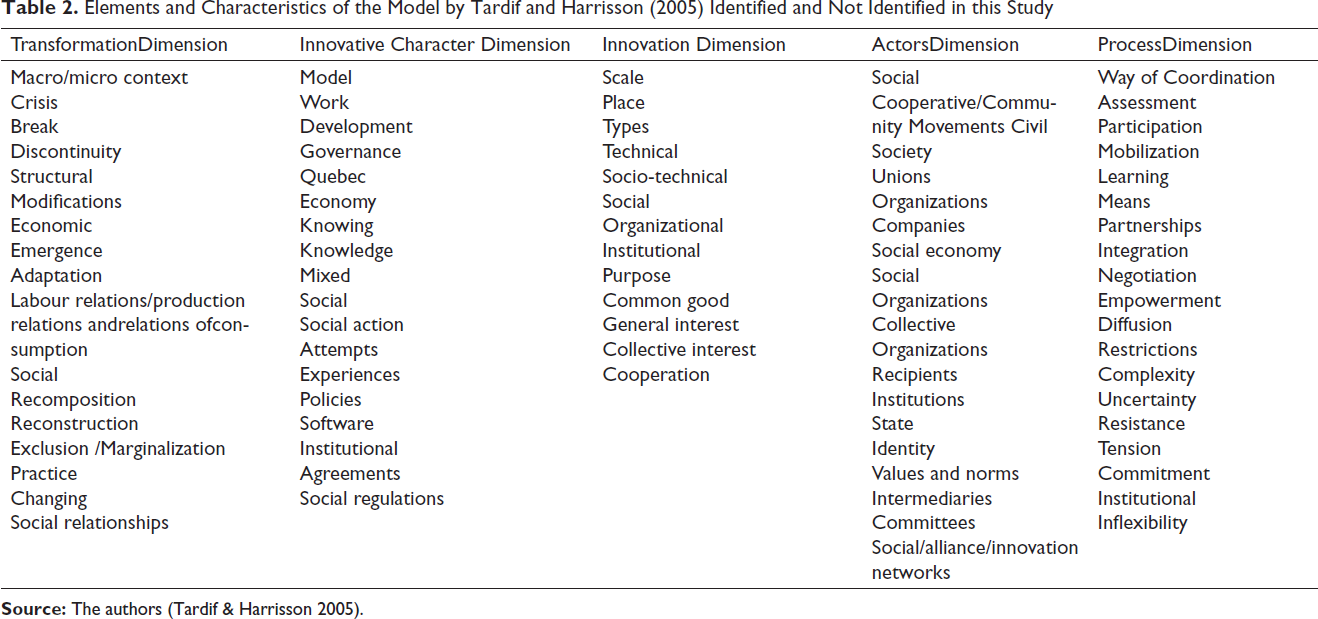
According to this model, the first category is the Transformation dimension, composed of three analytical elements: ‘macro/micro’ context, economic structures, and social structures. In the Transformation dimension, all analysed cases presented difficulties in satisfactorily commercialising the production, which motivated organisations to work with FT (Farfus and Rocha 2007; Lévesque 2002; Murray, Caulier-Grice, and Mulgan 2010). In the COODAP, COOAPAZ and COOAPISMEL cases, marketing was done with ‘middlemen’ who paid as and when they wanted for the farmers’ products. COOPINGOS, on the other hand, sold fresh nuts to a large company that benefited and kept most of the profits. With the adherence to fair trade, all researched cooperatives had a discontinuity in the sale of their products, which led to changes in the way of marketing and adaptation with the adoption of new production practices and the strengthening of social relations between the actors involved (Butkevičienė 2009; Cloutier 2003). According to the president of COOPINGOS
So from 2002 to 2007 the only thing we knew how to do was harvest the production of chestnut and sell to the middleman. The only thing we did. It didn’t benefit. [...] Just to get an idea when we received the certification, we received several emails from various countries wanting to buy the production of chestnut from us, chestnut almond
The results of the Transformation dimension did not find the characteristics concerning ‘rupture’ and ‘structural modifications’ of the context element. In ‘economic structures’, there were no changes in the ‘consumption relationship’. Concerning ‘social structures’, the characteristics concerning ‘recomposition’, ‘reconstruction’, and ‘exclusion/marginalisation’ were not identified. However, it is noteworthy that the Transformation dimension deals with the adverse context in which the actors are inserted and refers to changes in socio-economic structures (Maurer 2011). However, in the cases studied, organisations again faced the same instability and vulnerability with product commercialisation after breaking the relationship with FT.
The elements analysed in the Innovative Character dimension are model, economy and social action. How social innovation develops to solve the problems identified in the Transformation dimension is evaluated (André and Abreu 2006; Pol and Ville 2009). The solution found, with the idealisation of SEBRAE, was to work with fair trade, from the organisation and formalisation of a group of people, in this case, rural producers, willing to work collectively. In all cases, the chosen form of work was cooperative, where the primary beneficiaries, both social and economic, were the actors who developed the innovative solution (Cajaiba-Santana 2014; Caulier-Grice et al. 2012). According to the current president of COODAP ‘So that’s what made us make this decision to form the cooperative. First it was the association and then we thought about exporting and made the cooperative, formed the cooperative’.
According to Tardif and Harrisson (2005), establishing institutional arrangements becomes essential for the implementation and success of innovative solutions. In the case of COODAP, the actors involved in the agreement were SEBRAE, the Ministry of Communications and the Municipality of Mossoró. In the case of COOPINGOS, the cooperation was between SEBRAE and Banco do Brasil Foundation. In the case of COOAPISMEL, the arrangement involved several actors, the main ones being SEBRAE, COOPERCAJU, Cooperative Without Borders and World Vision. In the words of a partner of COOAPISMEL: ‘SEBRAE was a partner because thus, these other partnerships with Cooperativa Sem Fronteira, with Cooperativa Chico Mendes, tudim, with APISMEL and COOPERCAJU arose through contacts with SEBRAE, partnerships with SEBRAE.’ Finally, in the COOAPAZ case, the agreement had the participation of SEBRAE, EMBRAPA, EMPARN, UFRN, MDA, Rural Workers Union, World Bank and Banco do Nordeste.
The development of social innovation went through the trial phase, where meetings were held with producers interested in forming cooperatives and the experiment stage, with the groups deciding to go through the fair trade certification process. In the cases studied, public policies to encourage family farming and rural development and land reform were essential in forming and developing COOAPAZ, COOPINGOS, COOAPISMEL and, indirectly, COODAP. In this way, the experiences of these organisations with FT became emerging development models, complying with Tardif and Harrisson (2005), in which the form of collective self-management was also identified.
However, some elements of the Innovative Character dimension were not identified in the cases studied. Concerning the type of ‘model’, considering that SEBRAE is a State Institution and that the experiences analysed were only possible due to the unique performance of the Brazilian Micro and Small Business Support Service, which is characterised as a development model, it should be mentioned that only the ‘governance’ model was not found. As for the element concerning ‘type of economy’, Knowing/Knowledge and Mixed Economy were not highlighted. As already described, organisations based their actions on Solidarity Economy (Maurer 2011). Finally, although in the COODAP case, there was the intention to punish the members that did not justify their absence at the meetings and assemblies, that is, to regulate the participation of members in a coercive manner, a fact that was not confirmed; no evidence of the characteristic concerning ‘social regulation’ in the cases researched was found.
The analysis of the Innovation dimension sought to assess the innovative solution’s scope, that is, the ‘scale’, the ‘types of innovation’, and the purpose. Among the cases, only the experience of COOAPISMEL went from local scale to regional scale, with an indication for an organisation in the state of Piauí to work with FTI. Regarding the element ‘types of innovation’, the type of social innovation was highlighted (Moulaert et al. 2007; Mulgan et al. 2007). Although the initial idea came from SEBRAE, the process itself was developed by the beneficiaries of the solution and was not intended to be commercial exploitation (Phills, Deigmeier, and Miller 2008) and organisational innovation. In the COODAP, COOPINGOS, and COOAPAZ cases, there was also a process innovation (Howaldt and Schwarz 2010; Organisation for Economic Co-operation and Development [OECD] 2010) considered by Tardif and Harrisson (2005) as technical and socio-technical innovations.
In this sense, the formation of organisations sought to work out the cooperation between actors to meet the general and collective interests of those involved in developing the innovative solution (Butkevičienė 2009). Another objective was to meet the requirements of Brazilian legislation and FTI to achieve the common good of the group, that is, the development of a solution to end the difficulty of commercialisation (Bignetti 2011; Caulier-Grice et al. 2012).
The ‘institutional’ type was not identified in any analysed cases in the Innovation dimension. The experiences of the organisations studied with FT as a social innovation can be considered distinct from other types of innovation described by Tardif and Harrisson (2005) as they were developed by the beneficiaries themselves and limited to the local context. In the COOAPISMEL case, although FT sought beekeepers in the state of Piauí, they are not affiliated with the cooperative in Rio Grande do Norte.
In the Actors dimension, participants in the cooperative formation process and in the certification and negotiation process with FTI were analysed (Tardif and Harrisson 2005). The analytical elements are ‘social’ actors, ‘organizations’, ‘institutions,’ and ‘intermediaries’. In all the cases researched, SEBRAE (organisations and institutions element) participated, from the idea of working with FT to the delivery of products abroad, as in the COODAP case. In this sense, as the objective was to end the difficulties in commercialising farmers’ production (social actors), local actors were involved in each case (Bignetti 2011; Cloutier 2003; Mulgan et al. 2007).
As previously mentioned in the case of COODAP, the organisation had the support of COEX (intermediate actor), the Ministry of Communications and the Municipality of Mossoró. COOPINGOS, on the other hand, had the state’s contribution through MDA and INCRA, as well as the Banco do Brasil Foundation (social organisation). In COOAPISMEL, there was the collaboration of several actors. The main ones were: the State through SENAR, MTCI and SEBRAE; from social and collective organisations such as COOPERCAJU, Cooperative Without Borders, the Visão Mundial NGO and the World Bank. In the COOAPAZ case, the members received help from the Rural Workers Union (social actor); the federal government through MDA, Banco do Nordeste, SEBRAE, SENAR and EMBRAPA; the state government through SEARA and EMPARN; and social organisations such as UFRN and the World Bank.
However, in the Actors dimension, the elements concerning ‘organisational actors’, ‘companies’, and ‘recipients’ were not identified. In ‘institutional actors’, the actors’ values/norms were not crucial for forming cooperatives and experiences with FTI. Finally, for ‘intermediate’ actors, the elements ‘social networks’, ‘alliance networks,’ and ‘innovation networks’ were not highlighted.
In the Process dimension, the elements concerning ‘coordination mode’, ‘means’ and ‘restrictions’ faced by the actors involved were analysed. The management model of actions developed in the social innovation implementation process refers to the involvement of actors (Maurer 2011). In the cases studied, mobilisation and participation were carried out by local actors in partnership with SEBRAE (Centre De Recherche Sur Les Innovations Sociales [CRISES] 2015). The organisations’ experiences with FT provided collective learning, especially for the producers. However, only in the case of COODAP was there an assessment by the farmers to decide between continuing or giving up on fair trade trading.
In the cases analysed, the empowerment and integration of local actors and the partnerships signed with SEBRAE and other organisations and institutions were the means to implement and develop the innovative solution (Tardif and Harrisson 2005; Maurer 2011). Moreover, we found that all organisations surveyed faced restrictions before, during and after the experience with fair trade. The complexity of the certification process and adaptation to the requirements regarding quality and production capacity generated resistance from some producers in COODAP, COOPINGOS and COOAPAZ. Uncertainties and tension were also reported by respondents from all organisations as a constraint during the inception phase.
In the COODAP and COOAPAZ cases, the interviewees considered the lack of commitment by the cooperative members as the main reason for the break in commercial relations with FT. Other restrictions such as the lack of adequate structure (COODAP, COOAPAZ and COOPINGOS), problems with the climate and production (COOAPISMEL, COODAP and COOPINGOS), pests and indirect competition with large companies (COODAP) and animal health requirements of the importing country (COOAPISMEL) complete the list of restrictions faced by organisations and are pointed out as motivations for organisations to give up on marketing through FTI.
Finally, it should be mentioned that, in the Process dimension, only in the element concerning ‘means’ the characteristic ‘diffusion’ and in the element concerning ‘restrictions,’ the characteristic ‘institutional inflexibility’ was not identified in any of the researched cases. The other elements were present in all cases.
Conclusion
Fairtrade has provided thousands of small producers into the labour market previously excluded by conventional trade. The innovative proposal is the continuous development of entire communities from space reorganisation. It works through cooperation and interaction between local actors to generate employment and income for people, especially women, contributing to improved quality of life. In this sense, this study sought to analyse the experiences of organisations in the state of Rio Grande do Norte that were certified to market their products through the FTI network, considering the dimensions of social innovation contained in the analytical framework of Tardif and Harrisson (2005).
The results show that the experiences of rural organisations with FTI brought significant achievements and improvements both in the internal and external environment with the dissemination of the brands. Significant advances were found concerning awareness, education and empowerment of actors, improvement of the production structure, concern and respect for the environment, the social responsibility of organisations towards the communities where they operate, the health of workers and cooperative members, and the importance of recycling and reusing materials.
However, in the cases studied, the organisations’ experiences with FTI had a short duration, which may justify (a) significant socio-environmental and economic advances in the short term on the part of the actors and organisations involved, especially regarding the learning and empowerment of those involved; and (b) lack of socio-economic and cultural advances by the population of the communities in which these organisations are located, except in the case of COOPINGOS, in the long run. In the case of Novos Pingos producers, the benefits provided by the prize money have so far contributed to improving the quality of life of the entire community. Thus, the short time was the main reason for not having large-scale social development, as postulated by the literature on FT, which indisputably involves using the bonus to which the producers are periodically entitled to comply with the contract.
Although the FT principles comprise good intentions and socially-acceptable motivations for social responsibility, there are inconsistencies between the discourse and organisational practices. A large part of the social actions has been based on philanthropy and welfare, without concern for the actual impacts of these actions on improving the lives of the communities in which they are carried out. The lack of inspection regarding the organisations’ social actions casts doubt on the real intentions of FT to promote an improvement in the quality of life, as well as its proposal for sustainable rural development. FLO lacked the commitment to oversee the use of the ‘fair trade award’, and in the case of COODAP, the organisation was not pressured by any of the actors (FTI, customers, consumers and community) to carry out social projects within the community and, therefore, did not fulfil what was initially promised, which reinforces the findings of Dammert and Mohan (2014) and Gurviez and Sirieix (2013).
We noticed that the environmental issue and generating new business opportunities, such as organic certification of production and respect for the environment, can enable critical technological innovations. Innovating to comply with regulations can pay off, enable better use of inputs, create better products or improve product results, and add value to the brand. The COOAPISMEL and COODAP cases showed that work in this area could bring numerous benefits both in production technology and socio-economic terms for producers and society in general.
As the international system grows, the debate on food sovereignty, sustainable development at the local and regional level, and sustainable consumption and access to FT products by the poorest populations in emerging countries will deepen. However, with the end of negotiations, a significant part of these producers’ production continues to be sold on the local conventional market. This is due to several factors: lack of government support, lack of capital for production and logistics, and infrastructure.
None of the organisations surveyed sought insertion in the fair and solidary national chain as an alternative way to commercialise their products. Some of the reasons are lack of knowledge about the national fair trade proposal by the producers themselves; the prices are not as attractive as in fair trade, and the non-payment of the extra premium for fulfilling the contract; local demand less than production capacity; difficulties with the logistics for supplying large urban centres where there is a greater demand for these products; among others.
In this sense, the study points out several managerial implications to be worked on to achieve the expected success. Among the managerial implications, we can highlight the strategies to be adopted by companies and small rural producers for the expansion of the sector, such as the integration and articulation of all those involved (producers, traders, importers and organisations); sensitisation of producers to work in cooperation, whether through associations or cooperatives; raise society’s awareness of the principles of the social and solidarity economy as an engine for the sustainable development of rural communities; targeted institutional sales; targeted prospecting of licensees; regular websites and electronic newsletters. In this way, the managerial implications will result in the development of new products; greater distribution and availability; consistency in quality; increased consumer awareness; increasing the relationship with the organic food sector and trying not to confuse the two concepts among others.
Among the political implications, Brazil’s delay, compared to other countries, stands out in promoting and developing actions aimed at the solidarity economy and fair trade, since it was only at the beginning of the 21st century that the actions had a more significant effect, both because of the government and sector organisations. Another political implication is that the attempt to strengthen the national chain is, on the one hand, something fundamental, as producers cannot be held hostage to the international market as is the case with the conventional market. On the other hand, it hampers access to experiences and communication with organisations in other countries that already have strategies focused mainly on sustainable development, with a focus on fair and solidary production and marketing, such as Peru, Bolivia and Ecuador in South America.
This study showed that only two organisations could carry out commercial transactions in this business model. Thus, as a suggestion for future research, we suggest carrying out studies with many organisations for more robust results. Still, concerning obtaining more powerful results, interviews with more actors involved in the process are suggested, especially those who had the opportunity to learn about other FT experiences in Brazil and abroad.
Another suggestion for future research is quantitative studies of changes resulting from social innovations. We should mention that the focus of this study was linked to the dimensions of social innovation promoted by the experience of organisations with FTI that were adopted for its analysis and, for this reason, little numerical information was presented. It should be noted that the present study had numerous limitations related to the research methodology, which did not allow us to generalise the results found. On the other hand, data analysis contemplated the points of convergence and divergence between the analysed cases.
Finally, we suggest researching with other analytical models since the results of the evaluated cases did not include all the elements of the social innovation dimensions of the framework used in this study. For new articles, the local culture of the actors involved in the process must be considered a research limitation.
Footnotes
Declaration of Conflicting Interests
The authors declared no potential conflicts of interest with respect to the research, authorship and/or publication of this article.
Funding
The authors received no financial support for the research, authorship and/or publication of this article.
