







Abstract
Background
Epilepsy becomes a prevalent drug-resistant neurological condition, often regarding cognitive impairment. As a traditional Chinese patent medicine, Songling Xuemaikang capsules (SXC) mainly contain Pueraria lobata and pine needles, clinically used to treat epilepsy and alleviate cognitive impairment.
Objectives
Our research served to explore the suppressive effect of SXC, alone or combined with carbamazepine (CBZ), on lithium chloride–pilocarpine-inducing epileptic seizures among rats, as well as its potential to alleviate cognitive impairment.
Materials and Methods
A rat model of epilepsy was formulated by injecting 3 mmol/kg lithium chloride, 1 mg/kg atropine, and 30 mg/kg pilocarpine hydrochloride. The rats were separated stochastically into five groups (n = 14): saline (sham), model, CBZ, SXC, and CBZ–SXC combination groups. The experimental groups took oral CBZ (80 mg/kg/day), SXC (600 mg/kg/day), or a combination of CBZ (80 mg/kg/day), and SXC (600 mg/kg/day) orally for 60 days. Epileptic seizures, neuronal loss, cognitive disorder, and the level of phosphatidylinositol 3-kinase (PI3K), protein kinase B (Akt), nuclear factor kappa-B (NF-κB) p65, and P-glycoprotein (P-gp) were evaluated among the rats.
Results
The combination treatment with SXC and CBZ remarkably lessened the severity and frequency of seizures (p < .01) while mitigating cognitive impairment (p < .05). In the model group, neuronal damage observed was apparently improved (p < .05). The expressions of PI3K and Akt were upregulated (p < .01), whereas the levels of NF-κB p65 and P-gp were prominently suppressed (p < .01) in the combination therapy group.
Conclusion
SXC is an effective adjunct therapy for treating drug-resistant epilepsy. The mechanism of action might involve upregulating PI3K and Akt, and suppressing NF-κB p65 and P-gp.
Keywords
Introduction
The exact pathogenesis of epilepsy remains unclear (Asadi-Pooya et al., 2023; Pong et al., 2023). Research has illustrated that the phosphatidylinositol 3-kinase (PI3K)/protein kinase B (Akt) and nuclear factor kappa-B (NF-κB) signaling pathways are significantly linked to various neurological diseases (Löscher & Friedman, 2020). PI3K plays a crucial role in signal transduction related to cell metabolism, proliferation, and apoptosis, particularly via activating Akt-dependent signaling pathways (Ghafouri et al., 2022). Akt, in turn, can activate the suppressor of nuclear factor kappa B kinase (IκB), which detaches from NF-κB and becomes ubiquitinated, thus activating NF-κB (Shankar et al., 2019). Once activated, NF-κB enters the nucleus, triggering target gene expression and inflammatory mediator secretion, ultimately inducing inflammation (He et al., 2021). Some traditional Chinese medicinal compounds have been found to inhibit the expression of inflammatory factors via this pathway, thereby offering neuroprotective effects (Long et al., 2021).
Another important pathophysiological mechanism in epilepsy is drug resistance. Many anti-epileptic drugs (AEDs) promote the protein expression of multidrug resistance, like P-glycoprotein (P-gp), during epilepsy treatment (Galgani et al., 2018; Garg et al., 2020). Cognitive impairment, another common complication of epilepsy, is primarily characterized by declines in memory and learning abilities (Sen et al., 2020; Roliz & Kothare, 2023). It has been confirmed that the PI3K/Akt signaling pathway regulates the protein expression of drug resistance, such as P-gp. Activating the PI3K/Akt/NF-κB pathway can enhance P-gp expression, whereas inhibition of this pathway may reverse this phenomenon (Liu et al., 2020).
Natural compounds and traditional Chinese medicine are significant components of clinical treatment (Açar et al., 2023; Alcorta et al., 2024). Songling Xuemaikang capsules (SXC), a traditional Chinese patent medicine, are primarily composed of ingredients like Pueraria lobata and pine needles (Fan et al., 2021). Clinically, it is utilized to treat conditions, encompassing insomnia, headaches, palpitations, and dizziness. Recently, it has demonstrated synergistic anti-epileptic effects in clinical applications, although its potential mechanisms are still unknown. Our study was aimed at assessing the combined effects of SXC and carbamazepine (CBZ) in inhibiting epileptic seizures and improving cognitive impairment via the PI3K/Akt/NF-κB signaling pathway.
Materials and Methods
Animals
The experimental animals used were male Sprague–Dawley (SD) rats, reaching 240 ± 20 g in weight. Such rats were preserved in natural light at 22°C ± 3°C and 40% humidity. Rats obtained food and water freely. The whole experimental process followed the moral code of the People’s Republic of China and received approvals from the Ethics Committee of Lanzhou University Second Hospital (Reference D2021-051).
Animal Studies
The rats were segregated randomly into five groups: control, model, CBZ, SXC, and combined treatment groups. Except for the control group, epilepsy models were induced in all groups by intraperitoneally injecting lithium chloride and pilocarpine. Initially, rats were injected with 3 mmol/kg lithium chloride, followed 18–24 h later by 1 mg/kg atropine, and then 30 mg/kg pilocarpine hydrochloride 30 min afterward. If no seizures occurred within 30 min, a further 10 mg/kg pilocarpine injection was administered until seizures were observed. Sixty minutes after the outbreak of seizures, rats got an injection of 10 mg/kg diazepam to alleviate spasms. Additional diazepam injections were allowed if necessary to fully relieve the seizures. Rats reaching a seizure stage of 4 or above (based on the Racine scale) were considered successful models.
After successful modeling, the rats received their respective treatments. Based on the Meeh–Rubner dose equation, the maximum daily doses for adult rats were 80 mg/kg for CBZ and 600 mg/kg for SXC. CBZ tablets were obtained from Jiangsu Pengyao Pharmaceutical Co., Ltd., and SXC capsules from Kanghong Pharmaceutical Co., Ltd. Both drugs were pulverized into fine powders and then dissolved in 0.9% saline. The control and model groups received 2.5 mL/kg of 0.9% saline, while the CBZ group received 32 mg CBZ in 1 mL saline, the SXC group received 240 mg of SXC in 1 mL saline, and the combination group received both CBZ and SXC at the same doses. The total therapies were orally administered at 9
Behavioral Assessment
The seizure severity in rats was evaluated using the Racine scale (Joshi et al., 2019):
Level 0: Normal behavior. Level 1: Facial convulsions. Level 2: Regular nodding. Level 3: Unilateral forelimb clonus. Level 4: Bilateral forelimb clonus and hind limb standing. Level 5: Falling and rolling.
Seizure status was recorded by the same observer when rats reached Level 3 or above. When epileptic seizures attained Level 4 or higher and these rats experienced two or more seizures, the model was considered successful.
Evaluation of Cognitive Function
Cognitive ability in rats was assessed through the Morris water maze (MWM) assay (Othman & Hassan, 2022). The MWM consists of a circular tank and a hidden platform. The tank was separated into four quadrants: Northwest (NW), Northeast (NE), Southeast (SE), and Southwest (SW). The escape platform was placed in the SW quadrant, submerged 1 cm under the water surface. Titanium dioxide powder was supplemented to make the water non-transparent, concealing the platform. Clues around the pool were kept constant to help the rats navigate.
The MWM test was divided into two parts:
Positioning navigation test: Conducted from days 1 to 4, the rats were tested twice per day, once per morning, and once per afternoon. The entry points alternated between the NW, NE, and SE quadrants, with the rats facing the pool wall to avoid sighting the platform. The time spent by the rats in locating the platform was documented as the “escape latency.” On conditions that a rat reached no platform within 120 s, the escape latency was documented as 120 s, with the rat leading to the platform.
Spatial probe test: On day 5, the platform was eliminated, and the rats were put in the NE quadrant to explore freely. The time spent in the NE quadrant and the frequency of crossing the previous platform location were recorded as measures of spatial memory.
Histopathological and Biochemical Analysis
When the 60-day therapy ended, the rats underwent anesthesia, and brain tissue samples were gathered for histopathological and biochemical analysis. Brain sections were coated with hematoxylin and eosin (H&E) to appraise neuronal loss. Western blot analysis was used for determining the level of key proteins, including p-PI3K, p-Akt, PI3K, Akt, NF-κB p65, and P-gp.
Histological Staining
After a 60-day administration, five rats were stochastically chosen from each group and underwent anesthesia by intraperitoneally injecting 0.35 g/kg of chloral hydrate. The rat hearts were rinsed with 0.9% physiological saline and then immobilized with 4% paraformaldehyde after opening the rats’ chests. The complete brain tissues of the rats were quickly removed after decapitation and fixed at 4°C for 24 h with 4% paraformaldehyde. The fixed brain tissues were washed with 0.1 mol/L phosphate buffer, dehydrated with different concentrations of alcohol, and then processed for transparency before being placed in paraffin wax. Subsequently, the paraffin wax was cut into coronal sections. Such sections were dewaxed using water, rinsed using distilled water, then soaked in 1% toluidine blue staining solution (#89640; Sigma, St. Louis, USA) at room temperature (RT) for 6 min and rinsed with distilled water again. Ultimately, these sections were treated with 70% and 95% ethanol for color separation, each time for 3–5 min, and processed with 100% ethanol thrice for color separation, every time for 1 min. After transparent treatment with xylene, the slices were sealed with neutral gum. Each section was observed under an optical microscope to evaluate neuron loss in the CA3 area of the rat hippocampus.
Western Blot
After the behavioral experiment, four rats were stochastically chosen from each group and underwent anesthesia using 0.35 g/kg of chloral hydrate. After decapitation, the brain tissue was eliminated, with the hippocampus isolated. Then, the hippocampus tissue was lysed, and then the total proteins were obtained. All proteins were calculated using the BCA kit. Subsequently, sample loading and electrophoresis were performed. Subsequently, the samples were delivered to polyvinylidene fluoride membranes (Solarbio Science & Technology Co., Ltd., China). The membranes were sealed with 5% skim milk for 120 min in a tris-buffered saline solution containing 0.05% Tween-20 (TBST) at RT. Afterward, they were incubated overnight at 4°C with anti-PI3K, anti-p-PI3K, anti-Akt, anti-p-Akt, anti-NF-κB p65, anti-P-gp, and anti-glyceraldehyde-3-phosphate dehydrogenase (GAPDH) (#BM3874; Boster Biological Tech Co., Ltd., USA), each diluted 1:1,000. The following day, these membranes were brooded using the second antibody (#BA1054; Boster Biological Tech Co., Ltd., USA) at RT in darkness for 2 h and subsequently rinsed four times. An enhanced chemiluminescence (ECL) solution was added dropwise. Image J software was utilized to construe the density ratios of protein bands. The percentage of the target protein grayscale values to the internal reference GAPDH was utilized to represent the level of target proteins.
Statistical Analysis
Data were denoted as mean ± standard deviation (SD). Statistical comparisons between groups were made through one-way analysis of variance (ANOVA) before the post hoc Tukey’s test. Importantly, p < .05 held statistical significance.
Results
Effects of SXC Along and Combined with CBZ on Seizure Severity
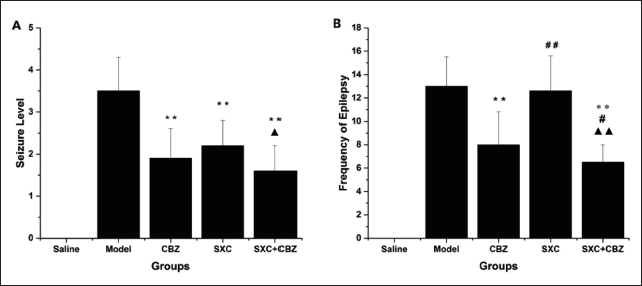
In each group, the degree and frequency of seizures were investigated following administration to evaluate the increased effect of SXC alone and integrated with CBZ upon seizures among rats. The controls experienced no seizures. Relative to the model group, the seizure level and frequency of each medication group were reduced, a notable difference emerged in the combination group (p < .01). No remarkable disparity occurred between the CBZ and SXC groups (p > .05). Relative to the CBZ group and the SXC group, the frequency of seizures was reduced in the combination group, with a remarkable disparity (p < .05) (Figure 1A and B). And no observable adverse reactions, such as weight loss, changes in mobility, or grooming behaviors, were noted in any treatment group during the 60-day study period.
Effect of SXC and Its Combined Application with CBZ on Cognition
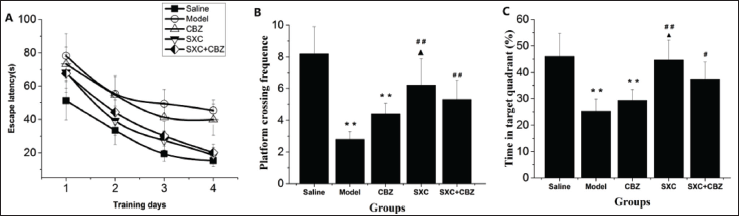
Rats in each group exhibited a gradual decline in escape latency as the training days of the MWM navigation assay increased. In the CBZ group, the escape latency came short of that of the model group. However, there existed no remarkable disparity (p > .05). Except for the first day, the escape latency of the model group prominently exceeded that of the SXC group during the other 3 days (p < .05, p < .01). The escape latency of the model group remarkably surpassed that of the combined group on the third and fourth days (p < .05) (Figure 2A and Table 1). In the spatial probe test, the platform crossing frequency of three medication groups increased relative to the model group. A remarkable disparity (p < .01) emerged between the SXC, combination group, and the model group, while no difference (p > .05) occurred in the CBZ group. In marked contrast with the CBZ group, the platform crossing frequency of the SXC group was apparently raised (p < .05), but no obvious difference occurred in the combination group (p > .05) (Figure 2B). Moreover, the time taken in the target quadrant of the SXC group (p < .01) and the combination group (p < .05) markedly exceeded that of the model group (Figure 2C). The results suggest that CBZ alone cannot efficiently enhance cognitive disorder among rats, and the use of SXC alone might even have better effects on cognitive ability than the combination of CBZ.
Escape Latency on Assay Days [Mean ± Standard Error of the Mean (SEM)].
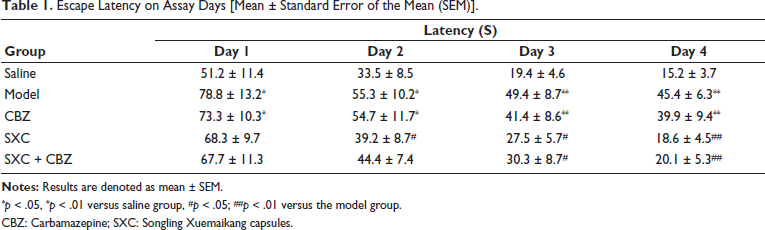
*p < .05, *p < .01 versus saline group, #p < .05; ##p < .01 versus the model group.
CBZ: Carbamazepine; SXC: Songling Xuemaikang capsules.
Effect of SXC and Its Combined Application with CBZ on Histopathological Damage
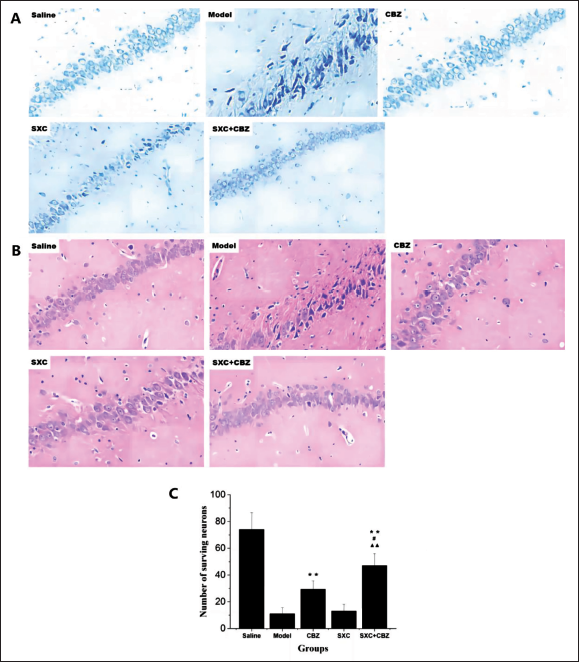
In the CA3 area of controls, neuron morphology and structure were normal, showing clear contours and distinct nucleoli. Neuronal cells in the CA3 area of the model group were disorganized, with increased cell spacing, nucleolus pyknosis, and blurred cell contour, indicating a large number of neuronal deletions (Figure 3A and B). In contrast to the model group, cells in the CA3 area of the CBZ group and the combination group were relatively tight, with fewer lost neurons (p < .01) and clearer nucleoli. Neuron damage in the SXC group was slightly alleviated in contrast with the model group (p > .05). This was not as obvious as the combined group (p < .01). Relative to the single administration group, the combined administration group exhibited a remarkable rise in the quantity of viable neurons among rats (p < .05) (Figure 3C).
Effect of SXC Alone and Combined with CBZ on Hippocampal Levels of p-PI3K, PI3K, p-Akt, Akt, NF-κB p65, and P-gp
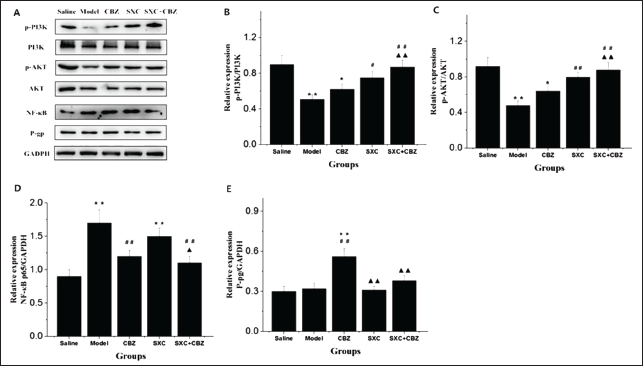
The levels of p-PI3K, PI3K, p-Akt, Akt, NF-κB p65, and P-gp in the hippocampus were determined through Western blotting (Figure 4A). The p-PI3K and p-Akt expressions in the model and CBZ groups were much lower than those in controls (p < .05) (Figure 4B and C), while the NF-κB p65 levels in the model group and SXC group prominently surpassed those in controls (p < .05) (Figure 4D). In addition, the levels of p-PI3K and p-Akt in the combination group remarkably exceeded those in the model group (p < .01), while the situation of NF-κB p65 in the combined group was exactly the opposite (p < .01). Findings indicated that the combination of CBZ and SXC could improve the expressions of p-PI3K and p-Akt while decreasing the expression of NF-κB. In the CBZ group, the P-gp expression was obviously upregulated relative to the controls and model group (p < .1). In contrast to the CBZ group, the expressions of P-gp in the combination group were markedly reduced (p < .01) (Figure 4E). Findings illustrate that P-gp-resistant protein expression may be elevated by CBZ alone. P-gp expression can be reversed by combining SXC and CBZ.
Discussion
Human status epilepticus (SE), also known as temporal lobe epilepsy, shares similar mechanisms with the epilepsy model caused by lithium chloride–pilocarpine (Lu et al., 2021). Similar to the pathological process of human temporal lobe epilepsy, pertinent pathological studies have demonstrated that epilepsy induced by lithium chloride–pilocarpine can result in neuronal death in the hippocampus (Koohfar et al., 2022). For the study of anti-epileptic medications, this model provides a perfect representation of temporal lobe epilepsy. Neurological disorders are commonly treated in China with traditional Chinese patent medications and natural compounds (Açar et al., 2023). Combining traditional Chinese patent medicines with conventional anti-epileptic medications can effectively prevent side responses and exhibit clear combined effects when treating epilepsy (Lin et al., 2021). The primary ingredients of SXC are P. lobata and pine needles, which can promote blood circulation and relax the mind (Fan et al., 2021). This medication is frequently used to treat migraines, vertigo, palpitations, sleeplessness, and so forth. Although its exact mode of action is still unknown, it has been observed in recent years to exhibit a certain synergistic effect when coupled with anti-epileptic medications. As a result, our research team investigated how SXC and CBZ worked together to affect the intensity of rats’ epileptic convulsions. The amount and frequency of epileptic seizures were significantly reduced in this study by CBZ alone and in combination with SXC. A notable distinction occurred in the seizure state between the SXC group and the model group. While CBZ reduced seizures in the model, the partial efficacy reflects resistance, underscoring the need for adjunct therapies like SXC. According to the findings mentioned above, SXC may be utilized as an adjuvant medication to treat epilepsy.
Arslan and Demir (2022) have demonstrated that nerve cell injury and prolonged epilepsy may cause cognitive impairment. Furthermore, a strong correlation has been shown between the structure of the hippocampus and cognitive function (Sekeres et al., 2021). The learning and memory capacities of experimental animals would sharply decline following hippocampus injury, and humans following hippocampal excision likewise showed cognitive impairment (Takayama et al., 2022).
Cognitive impairment can result from long-term AED therapy and repeated seizures in epilepsy patients (Novak et al., 2022). The outcomes of our trial suggested a strong correlation between seizures and cognitive decline. Rats’ learning and memory capacities declined as the length of their epileptic convulsions grew; CBZ treatment alone, administered for 60 days, was unable to reverse this trend. On the other hand, using SXC or in combination with CBZ markedly raised the target quadrant time and crossing-platform frequency while reducing the average escape latency. This finding suggested that SXC considerably enhanced the rats’ memory and learning capacities. Consequently, SXC may help epileptic rats’ brains perform better cognitively, perhaps by repairing hippocampus neuron damage.
One of the pathophysiological processes of epilepsy is that all epileptic cases are accompanied by neuronal damage (Trinka & Leitinger, 2022). Thus, safeguarding neuronal cells is a crucial path in the development of anti-epileptic medications, which may involve anti-oxidant, anti-inflammatory, anti-apoptotic, and neurotrophic factor release promotion (Madireddy & Madireddy, 2023). Frequent seizures may cause oxidative stress, inflammatory responses, and cell apoptosis, which can result in brain tissue deterioration or necrosis, particularly in the hippocampus (El Nashar et al., 2022). In this experiment, SXC and CBZ together were able to restore neuronal damage successfully. This finding suggested that rats with chronic epilepsy brought on by lithium chloride–pilocarpine may have neuronal injury and subsequent cognitive decline. On the other hand, SXC and CBZ can reverse neuronal damage together.
Anti-epileptic medications have the potential to cause the level of multidrug-resistant proteins, like P-gp, which can develop refractory epilepsy and resistance to AEDs (Galgani et al., 2018). One of the primary ingredients in SXC, Pueraria, can block the Ca2+ channel, preventing the entry of Ca2+ and opposing the expression of transporters that are resistant to drugs, such as P-gp. It is a common inhibitor found in traditional Chinese medicine that works against drug-resistant transporters like P-gp. It can be used to control the production of proteins resistant to drugs and help treat refractory epilepsy (Garg et al., 2020). In this investigation, the rats processed with CBZ exhibited a considerable rise in P-gp expression in their hippocampal regions when compared to the SXC. On the other hand, the combination therapy group had an important decline in P-pg expression relative to the CBZ group, suggesting that P-gp overexpression was induced by CBZ alone and was a major contributing factor to epilepsy resistance. P-gp was not highly expressed when SXC was used alone, but when paired with CBZ, P-gp was reversed from its induction effect. This suggests that SXC can increase the effectiveness of AEDs and have a major regulatory impact on P-gp expression.
Neuron damage is a key pathophysiological mechanism in epilepsy. The PI3K/Akt/NF-κB signaling pathway tightly relates to various neurological diseases, including epilepsy. PI3K is a key player in cell metabolism, progress, and apoptosis and is able to activate Akt (Löscher et al., 2020). Upon activation, Akt phosphorylates and triggers the ubiquitination of IκB (inhibitor of nuclear factor kappa-B kinase), thereby triggering to activate NF-κB. Indeed, NF-κB increases proinflammatory cytokines, like IL-6 and IL-1β, leading to inflammatory responses (Ghafouri-Fard et al., 2022; Shankar et al., 2019). Studies, including one by Liu et al. (2020), have indicated that activating the PI3K/Akt/NF-κB signaling pathway can increase the level of P-gp, whereas inhibiting this pathway can reverse this effect.
To appraise the inhibitory effects of the combination of SXC and CBZ on epilepsy in lithium chloride–pilocarpine-induced epileptic rats, we measured the levels of p-PI3K/PI3K, p-Akt/Akt, and NF-κB p65 in the hippocampus. In contrast with the model group, the combined group had heightened levels of p-PI3K/PI3K and p-Akt/Akt, whereas NF-κB p65 expression was notably decreased. This suggests that the neuroprotective effect of SXC integrated with CBZ against neuron damage significantly relates to protein modulation in the hippocampus. However, this needs some long-term safety proof to back it up, so safety research is the next step.
Conclusion
Our findings suggest that SXC, as an adjunct to CBZ, can reduce seizure level and frequency, mitigate cognitive impairment, and reverse P-gp overexpression and neuronal damage. These effects may hold significant clinical value, particularly for drug-resistant epilepsy and cognitive impairment, where conventional therapies often fail to achieve sustained efficacy. This highlights the promise of SXC as an adjuvant therapy for drug-resistant epilepsy. These beneficial effects appear to be mediated through the regulation of p-PI3K/PI3K, p-Akt/Akt, and NF-κB p65 expression, suggesting modulation of the PI3K/Akt/NF-κB signaling pathway as the underlying mechanism. Therefore, the combination of SXC with AEDs presents a prospective clinical approach to treating refractory epilepsy.
Footnotes
Abbreviations
Akt: Protein kinase B; BCA: Bicinchoninic acid; CBZ: Carbamazepine; GAPDH: Glyceraldehyde-3-phosphate dehydrogenase; MWM: Morris water maze; NE: Northeast; NF-κB: Nuclear factor kappa-B; NW: Northwest; P-gp: P-glycoprotein; PI3K: Phosphatidylinositol 3-kinase; SE: Southeast; SW: Southwest; SXC: Songling Xuemaikang capsules; TBST: Tris-borate-sodium Tween-20.
Acknowledgments
The authors thank Lu Zhang, from Xi’an International Studies University, for his participation in editing the English draft of this manuscript.
Authors’ Contributions
Liming Wei and Chen Jia contributed equally to the project and are considered co-first authors.
J.H.S. devised the research.
Z.S.Q. overseen the program.
W.L.M. implemented the research and construed the data.
J.C. compiled the manuscript.
Z.L. and Y.J.G. advised on experimental processes and data analytics.
All authors contributed to the manuscript. They read and approved the final version. Significantly, they have engaged adequately in the research and agreed to undertake responsibility for every aspect of the work.
Declaration of Conflicting Interests
The authors declared no potential conflicts of interest with respect to the research, authorship, and/or publication of this article.
Ethical Approval and Informed Consent
The Institutional Animal Care and Animal Ethics Committee of Lanzhou University Second Hospital authorized all animal operations and specimen collection (approval No.: D2021-051).
Funding
The authors disclosed receipt of the following financial support for the research, authorship, and/or publication of this article: Our study was backed by grants from the Gansu Province Science Foundation for Youths (No. 23JRRA1007), the National Natural Science Foundation of China (No. 82160840), Gansu Provincial Department of Education: Innovation Fund Program for College Teachers (No. 2024B-030), and Cuiying Scientific and Technological Innovation Program of Lanzhou University Second Hospital (No. CY2023-QN-B11).
