






Abstract
Introduction:
Peers impact the decision-making ability of adolescents. Thus, individuals can become susceptible to peer pressure, which leads to depression, self-injurious behavior, substance use, and risky behavior, among others. Further, since parents are influential in an individual’s life, their parenting styles can determine one’s choice of peers and, in turn, the extent of peer impact. Moreover, an individual’s peer attachment styles can determine their susceptibility to peer pressure. Conversely, assertiveness can help resist negative influences. Hence, using a correlational design, the present research aimed to study the role of parenting styles, peer attachment, and assertiveness on peer pressure among adolescents.
Materials and Methods:
A total of 315 senior secondary school students aged 15–17 years belonging to public and private schools in Delhi-NCR, employed through convenience sampling, filled the Peer Pressure Scale-Revised, Perceived Parenting Styles Scale, Adolescent Friendship Attachment Scale, and Rathus Assertiveness Schedule.
Results:
Peer pressure had a positive relationship with authoritarian (r = 0.320, P < .001) and permissive parenting styles (r = 0.341, P < .001), as well as anxious/ambivalent attachment (r = 0.305, P < .001), and had a negative relationship with authoritative parenting style (r = –0.210, P < .001) and assertiveness (r = 0.112, P = .047). Further, parenting styles, peer attachment, and assertiveness predicted a 23.8% variance in peer pressure, and authoritarian and permissive parenting styles and anxious/ambivalent and avoidant attachment styles were independent significant predictors.
Discussion:
Parenting styles, peer attachment, and assertiveness are significantly related to peer pressure, and parenting styles and peer attachment predict peer pressure among adolescents. The findings can help create tailored programs to reduce peer pressure, like parenting workshops and assertiveness training, to empower adolescents to make informed decisions.
Introduction
Adolescence is a period of significant bio-psycho-social changes. The parents become less influential while the peers gain importance in their lives. Many times, the peers become so powerful that they impact every choice the individual makes. While some can resist this influence and make decisions independently, others become susceptible to peer pressure. 1
Peer pressure is defined as being influenced by others to act in specific ways and fit in with or conform to the norms and expectations of the group. 2 Social identity theory states that to maintain a positive social identity, people identify with and conform to the norms of their ingroup. This is relevant in the context of peer pressure as well. Peers influence adolescents to engage in antisocial behavior and unhealthy practices like substance use, addiction to drugs, smoking, and alcohol abuse, and risky behavior, which results in alcohol dependence, poor psychological well-being (depression), peer victimization, self-injurious behavior, unhealthy eating habits, and decreased academic achievements.
Laursen and Faur 3 divided the characteristics of individuals susceptible to peer pressure into two categories, namely trait-like attributes that the individual possesses and state-like attributes, which change according to time and place. Studies have identified several individual traits that make individuals do things out of peer pressure. These include parental behavior, relationships with friends, self-monitoring, personality, self-esteem, and demographic factors like age and gender. Meanwhile, high self-esteem, good social skills, and strong family connections protect individuals from peer pressure.
Parents are a significant part of their children’s lives, and Bowlby (1969) and Ainsworth (1978) showed that parents influence the formation of other relationships, including peers, through the internal working model. Secure parenting creates affective peer and friend relationships based on communication, support, intimacy, trust, and quality, 4 which leads to secure attachment with peers. Authoritative parenting, as proposed in Baumrind’s theory of parenting, determined that adolescents tended to associate themselves with peers who valued both adult and peer-supported norms. On the other hand, those who perceived their parents as uninvolved were more inclined to join peer groups that did not prioritize adult values. 5 Parents, along with shaping peer relationships, have a role in determining the level of peer influence on their children. Parental monitoring, control, and family climate shield adolescents from peer pressure, while harmful parenting styles can make adolescents more susceptible to peer pressure. 6
However, during middle adolescence, the quality of the parent-child relationship decreases as compared to early adolescence, 7 while the relationship with peers deepens. 4 Though not all individuals become targets of peer pressure, peer attachment influences individuals to behave contrary to personal preferences to maintain relational harmony. Those with anxious attachment, according to Shaver’s attachment theory, have increased susceptibility to peer pressure. 6 Dykas et al. 8 found that adolescents with secure attachment had a positive relationship with peers, while those with insecure/dismissing styles were neglected and victimized. Moreover, parental overcontrol and adolescent risk-taking are mediated by peer conformity. 9 Hence, how closely an individual is related to their friends determines their susceptibility to peer pressure.
On the other hand, an individual can resist peer pressure by “Being able to say No.” Bandura, in his social cognitive theory, stated that self-efficacy beliefs influence behavior, impacting an individual’s ability to resist negative influences and assert their autonomy. Thus, assertiveness is expressing one’s feelings and needs directly while maintaining respect for others. 2 It determines the capacity to exert autonomy over one’s choices or give in to the external influences of peers, 10 thereby determining their susceptibility to peer pressure. Authoritative and permissive parenting styles influence assertiveness in adolescents and help them resist peer pressure. 11 Assertiveness and self-esteem are closely related to each other, 10 and self-esteem is negatively related to peer pressure, 12 but the relationship between assertiveness and peer pressure remains unclear.
The above sections show that familial, social and individual factors play a role in determining the susceptibility to peer pressure. Specifically, parenting styles, which form the basis for future relationships, determine how adolescents form attachment to their peers.4,5 An individual with an authoritative style develops secure attachment to peers, which protects them from peer pressure. On the other hand, authoritarian and permissive styles can lead to insecure attachment to peers and make them susceptible to peer pressure.6,8,9 Further, those with an authoritative style and secure attachment have the confidence to develop assertiveness that promotes resistance to peer pressure. 11 Moreover, the Indian collectivistic culture, with emphasis on interdependence and harmony, also influences the individuals, making them more likely to conform to group norms and more sensitive and responsive to peer influence. 13 The Indian culture also influences parenting styles, attachment, and assertiveness levels.
Further, these factors are critical during adolescence. Although resistance to peer influence is generally high between 14 and 18 years, 14 peer pressure continues in middle adolescence (14–17 years) regarding misconduct and risky and unacceptable behaviors.15,16 At the same time, the quality of the parent-child relationship declines, 7 but parental overcontrol still contributes to risk-taking. 9
Hence, these familial, social and individual factors collectively contribute to adolescents’ susceptibility to peer pressure during middle adolescence, as shown in Figure 1.
Conceptual Model for Factors Influencing Peer Pressure Among Indian Adolescents.
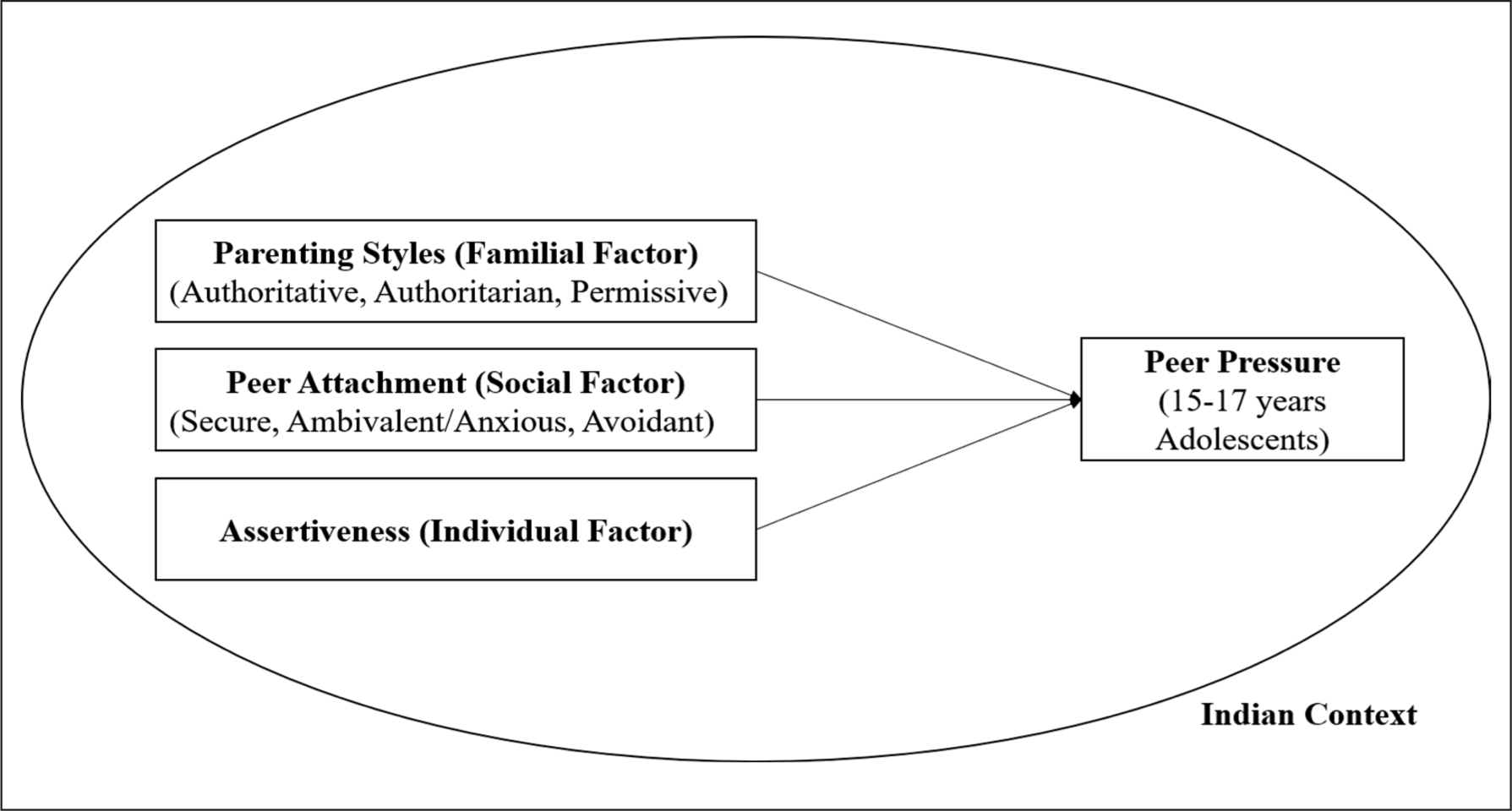
Therefore, this study aims to investigate the role of parenting styles, peer attachment, and assertiveness in peer pressure among Indian adolescents aged 15–17 years.
Objectives
To examine the associations between peer pressure, parenting styles, peer attachment, and assertiveness.
To investigate the predictive roles of parenting styles, peer attachment, and assertiveness in explaining variations in adolescents’ peer pressure.
Hypotheses
H1: There is no significant relationship between parenting styles and peer pressure, peer attachment and peer pressure, and assertiveness and peer pressure at α = 0.05.
H2: Parenting styles, peer attachment, and assertiveness do not significantly predict peer pressure.
Materials and Methods
Sample
About 500 questionnaires were distributed among high school students of public and private schools in Delhi-NCR using convenience sampling. The response rate was around 70% since 361 students returned the filled forms. Those aged 15–17 years, studying in senior secondary school, enrolled in the Central Board of Secondary Education (CBSE) schools, and with English proficiency were included in the research. Students with self-reported psychiatric disabilities and those who had switched schools in the past year were excluded to maintain a homogenous sample and to reduce confounding effects, as both can lead to different experiences and adaptation with new peers.
The final sample size was 315 participants. 46 were removed owing to incomplete forms and the exclusion criteria. There were 177 males and 138 females, and 172 were enrolled in private schools, while 143 were in public schools.
The current sample size meets the minimum required sample for regression analysis with seven predictors. 17
Procedure
After approval from the Institutional Review Board, the data were collected in person by visiting various public and private schools, coaching institutions, and tuition centers in Delhi-NCR. Permission from the authorized person of the institution was obtained before collecting data from the students at that place; they were adequately informed about the research. The participants were adequately informed about the research’s procedure, benefits and risks, confidentiality, participation, and withdrawal without repercussions. Once the forms were distributed to those participating voluntarily in the classroom, the students were given detailed instructions on how to fill out the form. The questionnaire consisted of a consent form for parents, an assent form for students, and a demographic data sheet, followed by questions from the measures used in the study. Written informed consent from parents and assent from students were obtained to ensure that the study meets the ethical requirements for adolescent research. Hence, the questionnaire was given to the students to take back home and bring back the next day with a signature from the parent/guardian, along with the filled form. The researcher collected the forms from them the following day in the classroom and clarified doubts to reduce misunderstandings. To diminish the potential bias of demand characteristics, participants were not informed about the research’s objective. Only after they completed the form were they debriefed about the aim of the research. Then, the data were coded in Excel. Data were transformed, and a rigorous data cleaning process was performed to ensure the accuracy and reliability of the data.
Tools/Measures
Sociodemographic Sheet
A demographic questionnaire was developed by the researcher to gather information about the participants’ age, sex, school name, class, whether they had switched schools in the past year, and whether they were being diagnosed with any psychiatric-related issues.
Peer Pressure Questionnaire-revised (PPQ-R)
PPQ-R, developed by Saini, 18 has 25 items rated on a 5-point Likert scale and measures the level of peer pressure experienced by adolescents. It has a reliability of Cronbach’s alpha = 0.79, internal consistency (á = 0.77), and has a good face and content validity. Further, the scale has concurrent validity as it was correlated (r = 0.38, P < .01) with the peer pressure subscale of the peer pressure and Conformity scale.
Perceived Parenting Style Scale (PPSS)
PPSS, developed by Divya and Manikandan, 19 has 30 items rated on a 5-point Likert scale and measures three parenting styles: authoritative, authoritarian, and permissive, of adolescents. It has good face validity and has a reliability of Cronbach’s alpha = 0.79 for the authoritative style, 0.841 for the authoritarian, and 0.86 for the permissive style.
Adolescent Friendship Attachment Scale (AFAS)
AFAS, developed by Wilkinson, 20 has 30 items rated on a 5-point Likert scale and measures the three attachment types: secure, anxious/ambivalent, and avoidant, and adolescents’ single friendship attachment factor. It has an overall reliability of Cronbach’s alpha = 0.916 and 0.914 for secure, 0.810 for anxious/ambivalent, and 0.788 for avoidant. Further, it has convergent and discriminant validity as it was correlated with the Relationship Questionnaire and the Inventory of Parent and Peer Attachment.
Rathus Assertiveness Schedule (RAS)
RAS, developed by Rathus, 21 has 30 items rated on a 6-point Likert scale and measures the level of assertiveness in 17–27-year-olds. It has test-retest reliability (r = 0.78, P < .01) and split-half reliability (r = 0.77, P < .01). It has a congruent validity, as it was significantly related to the California Psychological Inventory (CPI) (six Class I scales).
Statistical Analysis
All statistical analyses were performed using Excel and Jamovi software. Before analysis, the data were cleaned and coded. Parametric tests were employed since the sample was large. 22 Pearson’s correlation coefficient was calculated between parenting styles and peer pressure, peer attachment and peer pressure, and assertiveness and peer pressure. A multiple regression analysis was conducted to determine how parenting styles, peer attachment, and assertiveness predict peer pressure in adolescents.
Results
Descriptives
Preliminary data analysis was conducted. The mean age of females was M = 16.4 years (SD = 0.656), and males was M = 16.2 years (SD = 0.679). The reliability of scales using Cronbach’s α in the current population was as follows: for PPQ-R, α = 0.848; for subscales of PPSS, authoritative was α = 0.749, authoritarian was α = 0.756, and permissive was α = 0.748; for subscales of AFAS, secure was α = 0.891, anxious/ambivalent was α = 0.653, and avoidant was α = 0.652; and for RAS was α = 0.637. Hence, the tools used in this study had high to moderate reliability within the current sample.
Correlation Analysis
Table 1 reports the correlation between peer pressure and parenting styles (authoritative, authoritarian, and permissive), peer pressure and peer attachment (secure, anxious/ambivalent, and avoidant), and peer pressure and assertiveness.
Correlation Between Peer Pressure and Parenting Styles, Peer Attachment, and Assertiveness.
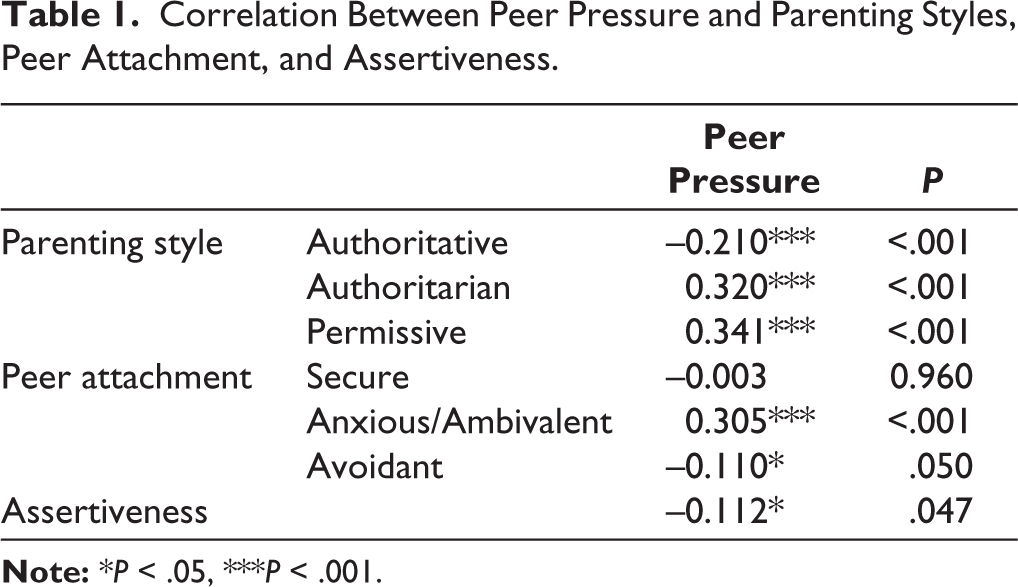
Results indicated a moderate positive and statistically significant correlation between peer pressure and authoritarian parenting style r(315) = 0.320, P < .001, peer pressure and permissive parenting style r(315) = 0.341, P < .001, peer pressure and anxious/ambivalent attachment r(315) = 0.305, P < .001; and a weak negative but statistically significant correlation between peer pressure and authoritative parenting style r(315) = –0.210, P < .001, peer pressure and assertiveness r(315) = 0.112, P = .047, and peer pressure and avoidant attachment r(315) = –0.110, P = .050; and a weak negative and not statistically significant correlation between peer pressure and secure attachment r(315) = –0.003, P = .960. Hence, H1 was rejected.
Multiple Regression
Before analysis, the assumptions required for multiple regression were checked. There was no multicollinearity (Variance Inflation Factor ranging from 1.03 to 1.44), presence of homoscedasticity (visual inspection of residual scatterplots), normal distribution of residuals (Shapiro-Wilk = 0.997, P = .767), and independence of residuals, assessed using the autocorrelation test (Durbin-Watson statistic = 1.87, P = .262). Although the box plot inspection revealed 21 outliers, the maximum Cook’s distance was 0.036, which is below the common threshold of 1.0. Hence, these were included in the analysis as they exerted no undue influence on the result.
Further, secure peer attachment was removed from the regression analysis due to a non-significant correlation with peer pressure. This aligns with modern attachment research, which favors a dimensional rather than a categorical approach wherein secure attachment is defined as the absence of anxiety and avoidance. 23
Table 2 shows the regression coefficient, R 2 = 0.238 and F = 16.0 (P <.001). Hence, the predictors in the model explain approximately 23.8% of the variance in peer pressure. In other words, parenting styles, peer attachment, and assertiveness account for about a quarter of the influence on peer pressure.
Regression: Model Fit Measures.

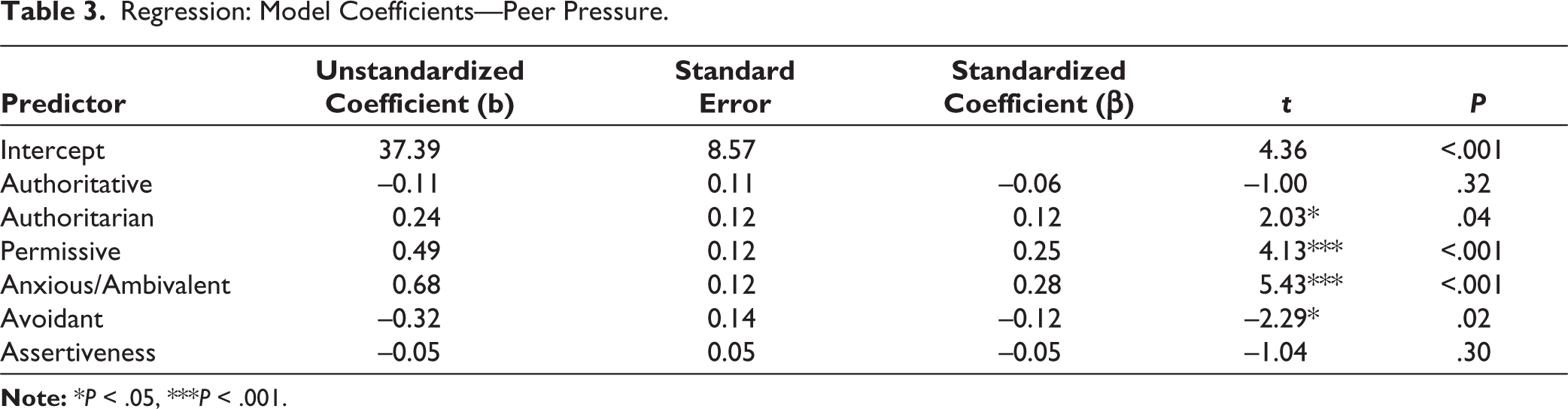
Table 3 shows the contribution of each predictor to peer pressure. Authoritarian parenting style (β = 0.12, P = .04), permissive parenting style (β = 0.25, P <.001), and anxious/ambivalent attachment style (β = 0.28, P <.001) were independent and significant positive predictors of peer pressure, and avoidant attachment style (β = –0.12, P = .02) was an independent and significant negative predictor. Hence, H2 was rejected.
Regression: Model Coefficients—Peer Pressure.
Discussion
The research investigated the role of parenting styles, peer attachment, and assertiveness in peer pressure among adolescents. The results indicate that peer pressure is significantly related to parenting styles, peer attachment, and assertiveness. Further, parenting styles and attachment styles significantly predict peer pressure among adolescents.
An authoritarian parenting style is positively associated with peer pressure, that is, those raised with low warmth, low autonomy, and high control are more likely to experience higher peer pressure. This might stem from excessive parental power leading to rebellious and problematic behavior in children. 24 In the Indian context, parents who emphasize collectivistic values like obedience and compliance might instill in their children that conformity brings acceptance from others. This might lead them to seek peer approval through risky behaviors, potentially increasing their vulnerability to peer pressure. Bansal and Bansal 25 found similar results, suggesting that when adolescents conceal their true feelings and experiences from their controlling parents, they may create distance from their parents, making their peers more influential in their lives. Further, those raised with an authoritarian style generally have low self-esteem, which might lead to increased peer pressure.12,26
A permissive parenting style is positively associated with peer pressure, that is, those raised with high warmth, high autonomy, and low control are more likely to experience higher peer pressure. These adolescents tend to replace parents with peers for guidance and support, likely increasing their influence from peers. 27 In the Indian collectivistic societies, when conformity is emphasized, the absence of parental guidance can make peers more influential, thereby increasing their susceptibility to peer pressure. Lebedina-Manzoni and Ricijas 6 also suggested that lower psychological control and higher permissiveness in both mother and father predict higher susceptibility to peer pressure. Also, without consistent rules or monitoring, adolescents may not develop strong self-control, which might increase their susceptibility to peer influence and lead to more delinquency. 28 However, Bansal and Bansal 25 found contradictory results that adolescents with responsive parents experience lower levels of peer pressure. This can be attributed to overprotective parenting, which can lead adolescents to become introverted and overly dependent on their parents.
An authoritative parenting style is negatively related to peer pressure, consistent with previous literature.25,29 Adolescents raised with high warmth, high autonomy, and high control are less likely to experience higher peer pressure. This parenting tends to allow adolescents to build self-reliance and develop coping strategies against life stress, including peer pressure. 27 Tomé et al. 30 discovered that parental communication, a characteristic of authoritative parenting, might act as a mediating factor in protecting adolescents against risky behaviors.
Hence, regarding parenting styles, according to Bowlby’s attachment theory (1969), those with secure attachment with parents tend to develop higher self-esteem, emotional regulation, and independence and are more likely to resist peer pressure as they feel confident in their sense of self. On the other hand, those with insecure attachment may feel more anxious or dependent on external approval, potentially making them more susceptible to peer pressure as they seek validation and acceptance from their peers. Further, there may be self-selection bias in the present study, since the questionnaires were completed at home, potentially resulting in an overrepresentation of higher-engagement families. Consequently, the presence of authoritative parenting may represent those raised with open communication and autonomy, which likely serve as protective factors potentially reducing susceptibility to peer pressure.27,30 Conversely, the relative underrepresentation of adolescents with authoritarian and permissive parenting styles could suggest lower involvement of parents in this group. This may lead adolescents to prioritize peers over parents, potentially increasing susceptibility to peer pressure.25,27
Anxious/ambivalent attachment is positively associated with peer pressure, that is, those with emotional reactivity, fear of abandonment, and intensive reassurance seeking are more likely to experience higher peer pressure. Rihtarić and Kamenov 31 suggested that high anxious attachment in adolescent girls predicted susceptibility to peer pressure. This could be driven by an increased fear of rejection and abandonment, fostering a strong need to belong, possibly making them conform to peer pressure as a self-regulatory response to maintain peer relationships.6,32 In India, when interdependence and harmony are valued, the heightened fear of rejection and peer validation might increase adolescents’ susceptibility to peer pressure to maintain peer acceptance.
Avoidant attachment is negatively associated with peer pressure. Adolescent boys with high avoidant attachment might be less susceptible to peer pressure as they tend to avoid close relationships and have a strong sense of self-reliance, which might act as a protective factor against peer pressure. 31 However, this result appears to diverge from the Indian collectivistic culture, where interdependence is valued. As proposed by Bowlby (1969), those with avoidant attachment show defensive exclusion, thereby emotionally detaching from peers, which might lead to reduced sensitivity to social rewards and threats, including peer pressure. Additionally, avoidant individuals tend to show less distress when excluded socially across individualistic and collectivistic cultures by suppressing their need to belong. 33 Moreover, in urban settings, with increasing individualistic ideas and autonomy, adolescents might find their avoidant attachment style being reinforced, consequently perceiving conformity as a threat to their independence.
Hence, with respect to Shaver’s peer attachment styles, adolescents’ susceptibility to peer pressure for risky behaviors or socially unacceptable behaviors could be significantly predicted by their attachment to friends. 31 Lotar 32 observed that adolescents with insecure attachment might be more vulnerable to peer pressure, possibly driven by their strong inclination to comply with peers, who might function as primary attachment figures during adolescence. Further, according to social identity theory, those with a strong identification with their peer group might experience heightened peer pressure, as conforming to group norms might enhance their social identity and self-esteem, while those with insecure attachment styles might experience more pressure to conform to avoid being perceived as different or excluded from the group. Finally, those from a collectivistic society are likely to be interdependent on others, making them more likely to conform to group norms to maintain harmony and more sensitive to peer pressure. 14
Assertiveness has a weak negative relationship with peer pressure, meaning that assertive adolescents are likely to experience lower levels of peer pressure. Oghounu 34 found that adolescents with high self-confidence and assertiveness tend to resist peer pressure to engage in harmful and risky behavior. These adolescents typically exhibit an internal locus of control, which may function as a protective factor against peer pressure, and when peer pressure increases, their locus of control becomes more external. Hence, assertiveness may serve as an anchor for adolescents’ sense of agency. 35 In the Indian collectivistic society, when conformity is valued, adolescents might deviate from the cultural expectations by being assertive. Especially those with authoritative parenting tend to learn to express their feelings and needs directly, and possess the necessary coping skills to resist peer pressure and deal with it effectively. 11 However, the weak relationship might suggest that the collectivistic culture might still influence assertive adolescents to engage in risky behaviors to maintain harmony.
In summary, the present study highlights the role of familial, social, and individual factors in determining peer pressure among adolescents. While these factors are important, sociodemographic factors, which were beyond the scope of the study, might also have affected the results. Factors such as gender, socioeconomic status and family structure may shape parenting styles, peer attachment, and assertiveness, while institution type and academic stream may influence peer norms and exposure to peer pressure. This could potentially lead to confounding effects in determining peer pressure beyond the predictors studied in the current model.
Limitations and Future Direction
While the current study offers many insights into the relationship between parenting styles, peer attachment, and assertiveness and peer pressure, it is limited to English-speaking, educated male and female students living in urban areas. Moreover, the collected data were self-reported; hence, the responses could have been biased. Similarly, although the 70% response rate is moderate to high due to ethical requirements in adolescents’ research, this might have resulted in self-selection bias, leading to overrepresentation of adolescents with higher parental engagement, and hence skewed sample representation. Further, since the population was limited to students from Delhi-NCR schools collected through convenience sampling, the study might lack generalizability due to regional variations and bias in sample representation. Also, the moderate reliability of the two scales may be attributed to cultural differences in how peer attachment (anxious/ambivalent and avoidant) and assertiveness are assessed, as these scales were originally developed in Western contexts. This might have weakened the validity of the findings, leading to measurement errors in correlation and regression analysis, and hence, underestimating the true relationships with peer pressure. Finally, unmeasured factors, like socioeconomic status, family structure, and academic stream, may have confounded the results, limiting generalizability to the broader population.
Future researchers are suggested to identify the causal relationship of peer pressure. Moreover, the mediating/moderating model using parenting styles, peer attachment, and assertiveness in peer pressure could be analyzed. The differences in the parenting styles of the mother and father could be taken into consideration. Further, peer pressure could be assessed using other methods, like observations, laboratory simulations, and interviews. Using culturally appropriate tools for better reliability and generalizability. Probability sampling and passive parental consent could be used to ensure appropriate representation of the population. Finally, students speaking other Indian languages, from both urban and rural milieus and those with disabilities and other sociodemographic backgrounds can be included in future studies on peer pressure.
Conclusion
The research investigated the role of parenting styles, peer attachment, and assertiveness in peer pressure among Indian adolescents aged 15–17 years. Findings revealed that authoritarian and permissive parenting styles and anxious/ambivalent and avoidant peer attachment significantly predicted peer pressure. Hence, the Indian collectivistic culture might shape how family and peers play a significant role in determining adolescents’ susceptibility to peer pressure. These findings suggest that developing parenting programs and mental health interventions for adolescents with low confidence or insecure attachments would be beneficial to reduce peer pressure. Peer support groups would help adolescents to build self-reliance, assertiveness, and coping skills to resist negative peer influences and make informed decisions.
Footnotes
Acknowledgements
The authors would like to express their gratitude to all the participants, parents, and the institution’s management in Delhi-NCR for their generous approval to obtain data from the students. Further, the authors wishes to thank her supervisors for their guidance throughout the research process and her family and friends for their support.
Data Availability Statement
Data will be made available if requested, after consent and assent from adolescent participants and their parents.
Declaration of Conflicting Interests
The authors declared no potential conflicts of interest with respect to the research, authorship, and/or publication of this article.
Ethical Approval
The research was approved by the Institutional Review Board (IRB) of Christ (Deemed to Be University) (CU: RCEC/00191/08/24) on August 27, 2024.
Funding
The authors received no financial support for the research, authorship, and/or publication of this article.
Informed Consent
Written informed consent from parents and assent from students were obtained. The participants were adequately informed about the research’s procedure, benefits and risks, confidentiality, participation, and withdrawal without repercussions. Their participation was voluntary.