







Abstract
This article contributes to the study of globalization and social change in rural Kerala by examining the historical trajectories of educational, occupational and spatial mobility among three communities—Syrian Christians, Ezhavas and Pulayas—in the village of Kavakad, Kerala. It addresses the involvement of each community in transnational migration and related mobilities away from the village. The article is based on quantitative data collected through an intergenerational family survey and semi-structured interviews conducted in Kavakad. The research reveals that while the dominant Syrian Christian community gained most from transnational migration, all three communities benefited from forms of upward mobility. However, our findings also confirm that, despite various forms of mobility, longstanding social inequalities between Syrian Christians, Ezhavas and Pulayas in the village persist. The article highlights the ways in which spatial mobility is a key factor in shaping the relative social mobility of each community. As such, it contributes to our understanding of the reproduction of inequality in contemporary Kerala and, in particular, of the ways in which historically accumulated resources and community networks enabled Syrian Christians to turn transnational migration into lasting forms of upward mobility. It also suggests a need for alternative development interventions at the local level to support the spatial mobility of marginalized rural communities.
Introduction
The different dimensions of economic development in India have been widely discussed and debated with contradicting narratives. Many scholars argue that the macro forces of globalization and rapid urbanization of rural areas have expanded access to opportunities across communities, leading to economic development. Alongside this, there is a widely discussed phenomenon of rising socio-economic inequality across different regions in India (Sarkar & Mehta, 2010; Kapur et al., 2010; Sen & Himanshu, 2004). On the other hand, researchers argue that rural areas are less researched in the context of accelerating urbanization in contemporary India (Jodhka, 2014). Scholarship has paid relatively little attention to the implications of the articulations of globalization within local communities (Deshpande, 2003, p. 88; Gardner & Osella, 2003, p. 3). Globally, studies on globalization have minimal reference to rural communities, and they have tended to choose the urban over the rural as the unit of analysis (Woods, 2007, p. 6). This lacuna raises a whole new set of concerns and questions about what happens to the ‘rural’ in contemporary India and about how different communities respond to processes of globalization?
In this context, the high rate of international migration makes the social change in Kerala a peculiar one. Questions on social change for any rural area in Kerala cannot be answered without considering processes of migration and mobility. It is acknowledged that transnational migration from the 1970s onwards has brought about vital changes in the mobility of rural communities in Kerala (Zachariah & Rajan, 2015). Also, it has been found that international migration is a crucial factor behind many of the positive outcomes of the ‘Kerala Model’ development (Harilal & Akhil, 2016; Harilal & Joseph, 2003;Zachariah & Rajan, 2012, 2015; Zachariah et al., 2001). Therefore, contemporary globalization in Kerala is overwhelmingly represented by transnational migration, which raises questions about the nature of globalization and ongoing social transformation in rural Kerala. The article offers a step towards understanding the complex dynamics of rural transformation. The attempt here is limited to understanding the intensity and extent of transnational migration and related mobilities that are taking place in rural Kerala.
Against this backdrop, the article advances existing scholarship by enquiring into the mobility aspects of various communities in rural Kerala, focusing on a hitherto neglected part of inequality. The article draws on research on one rural locality called Kavakad. It connects upward social mobility to spatial mobility, reflecting on how globalization enables dominant communities to access opportunities and reproduce historically inherited inequalities. Also, it attempts to contribute to the emerging scholarship on the implication of the wider process of transnational migration on villages, with the village as the unit of analysis.
The key concepts employed for the analysis in the article are social mobility, spatial mobility and inequality. The concepts explain various aspects of transnational migration and related mobility and inequality in rural areas of Kerala. The article conceives social mobility as intergenerational mobility where a change occurs through individuals or families in communities over generations (Sorokin, 1959), which is crucial for the present study since it covers over 100 years of life in Kavakad. The article analyses the absolute 1 and upward social mobility of communities and compares the mobility patterns between communities. Absolute and upward social mobility is understood through two components: intergenerational educational mobility and intergenerational occupational mobility. Here, educational mobility is defined as the changes in the attainment of educational status compared to the previous generation, and occupational mobility is a change in the occupational status with the same skills or differing skills of the members compared to the previous generation. The second part of the analysis discusses how these mobilities (educational and occupational) are related to intergenerational spatial mobility. The article borrows the term geography of social life (spatial mobility) to denote the difference in distance for major life events across communities (Deshpande, 2003, p. 84). Thus, spatial mobility is defined as intergenerational changes in the geographical location of life events 2 of individuals. Drawing from the findings of the first and second part of the analysis, the article then reflects on relative social mobility as crucial in determining persisting social and economic inequality in Kavakad.
The article argues that dominant communities are spatially mobile and seize the opportunities of globalization through transnational migration, which eases other forms of mobility. In contrast, the opportunities for geographical mobility of contemporary globalization remain inaccessible to marginalized communities, which has adverse implications for their mobility. The analysis shows that the attainment of higher educational status is a mediator for attaining occupational mobility. The difference in spatial mobility is a crucial determinant of relative social mobility: the chance of gaining social mobility compared to previous generations.
The article is organized as follows: the first section briefly reviews the literature on migration, social mobility and rural change in India. The second section presents a picture of intergenerational mobility in terms of education and occupation and compares mobility patterns across the communities of Kavakad. The third section discusses the geography of social life (spatial mobility) across the communities and reflects on relative social mobility. Subsequently, the article sheds light on how different communities conceive transnational migration and the extent of their transnational relations. Finally, in the concluding observation, the article points out that inequality persists irrespective of mobility across the communities.
Migration, Social Mobility and Rural Change
In general, this article builds on the sociology of rural development in India. The plethora of village studies by Indian academics has opened up different inquiries and methodologies from the colonial period. However, the article is informed by the critique of the unchanging nature of village in India, and accordingly, a discussion of relevant literature is introduced here. The idea of social mobility and rural inequalities has received much scholarly attention in India. It has been argued that the central elements in rural transformation are an active state, class relations and agents appropriating the agricultural surpluses and external linkages (Breman & Mundle, 1991), which consequently lead to the mobility of rural communities. Therefore, how traditional caste-based economic power constitutes hurdles for mobility and shapes the axis of inequality was a major concern for researchers.
However, there have been contrasting findings regarding the disappearance of caste-based inequality in rural areas in the post-Independence era. For instance, Gough (1955) observed the signs of a changing traditional village structure in Tanjore of Tamil Nadu as internal migration and integration with urban markets increased. Similarly, Bailey (1964) observed that the village he studied in Odisha witnessed a breakdown of the traditional division of labour based on caste due to outside influences from the market economy. Alongside this, Beteille (1965) pointed out the changing village power structures in Tamil Nadu from caste affiliation to class attributes as land resources became increasingly marketized. Consequently, the traditional social system became caste-free in some areas and led to the creation of new institutions. Guhan and Mencher (1983) and Jeyaranjan et al. (2010) tell the story of the re-survey of the Slater village of Iruvalpettu in Tamil Nadu and point out the persisting power of landlords. Also, it is argued that the agrarian structure changes when people leave agriculture and find non-farm employment both inside and outside the village in Tamil Nadu (Djurfeldt et al., 2008). It is interesting to note the dependency of most households on agriculture despite the growing diversification of employment.
On the other hand, longitudinal research in the post-Independence era confirms that access to new opportunities on offer in a market economy is still shaped by caste structure in rural India (Epstein et al., 1998; Lanjouw & Stern, 1998). In recent times, Carswell and De Neve (2014) studied two economically diversifying villages in Tamil Nadu around the major textile cluster of Tiruppur and pointed out the opposite effects in the two villages. In one village, they observed reduced caste interdependencies as new demand-driven labour markets emerged, while in the other village, rural power-loom industrialization within the village entrenched caste power and inequality. The longitudinal study of Palantpur village in Uttar Pradesh is similarly relevant to understand development in India through the perspective of a village (Himanshu et al., 2018). This study, too, has thrown light on the complexity of changing aspects of inequality. For instance, access to outside job markets and migration have become more important in explaining inequality in Palantpur rather than land ownership.
Moreover, it was observed that the question of change in the village life with globalization and increased mobility of the rural population along with migration and related issues had for long been ignored in village studies (Breman, 2007). Jodhka (2014) points out that a revival of village studies have been attempted at many levels. Various projects have been initiated in the social sciences to regain village ethnography and understand different social realities under the dynamic processes of urbanization and migration. Therefore, this new focus on village ethnographies indicates the need to situate village life in the context of globalization (Mines & Yazgi, 2010). Besides, it is observed in the literature that Kerala villages can be a mirror for explaining the possible realities of South Asian villages (Gallo, 2015).
On the other hand, issues pertaining to migration and rural change have been differently dealt with in the literature on South Asia. For instance, studies from a sending community perspective have focused on how transnational mobility converts new wealth into cultural capital and produces growing power disparities between those who have access to migration opportunities and those who do not (see Gardner, 1995, on Bangladesh). Earlier studies have pointed out that the traditional caste hierarchy is weakened by migration but that many aspects of other aspects of social life remain the same in rural India (Desai, 1964; Kessinger, 1974). Later, studies emphasized the transformation of the local through circular migration and rural cosmopolitanism in Tamil Nadu (Gidwani & Sivaramakrishnan, 2003). Also, it was observed that transnational experiences had brought cosmopolitanism to the rural hinterland of Pakistan (Ballard, 2003).
Interestingly, migration has been recognized as a critical aspect of Kerala’s development trajectory since early modernity, and it has been linked to discussions of the social mobility of various communities. Later on, scholarship focused on migration and development from the 1970s onwards in the region and was based on statistical data and survey work. For instance, Zachariah et al. (2003) addressed different facets of migration in Kerala based on a large-scale survey among 10,000 households in the state, which produced a macro picture of the intensity of migration from Kerala. They tried to measure the quantum and impact of remittances on the Kerala economy through various studies. 3 Zachariah and Rajan (2004) compared the socio-economic consequences of migration between 1999 and 2004, and they found emerging adverse effects of migration along with its positive effects on employment. The remittances played an essential role in increasing the number of highly educated people in Kerala and almost converted Kerala into a part of the ‘Gulf’.
Further, the Kerala Migration Survey of different years (1998–2016) has contributed to understanding migration from the state. This scholarship also highlighted the role of remittances in transforming the rural economy in Kerala. Significantly, remittances were identified as the critical factor in sustaining the fruits of the Kerala model of development. 4 Alongside these observations, Joseph (2006) traced the history of the migration of Malayalees and concluded that the global presence of Malayalees is a century-old phenomenon. However, Zachariah and Rajan (2015) analysed the impact of remittances on the Kerala economy and found a more mixed outcome. Though the study points out the positive factors, it also observes that migrants are from the richer strata, which could have increased income inequality in Kerala. Rajan and Zachariah’s (2019) findings reaffirm the observation that migration helped reduce socio-economic inequalities in Kerala in the earlier days. It also levelled class structures, social hierarchies, and differences in religion and caste. However, today, there is an increasing feeling in Kerala that migration is widening these differences once again (Rajan & Zachariah, 2019, p. 65). More so, this tradition of migration research was not enormously extended later, and studies on migration from Kerala have mainly concentrated on the number of migrants and the extent of remittances.
Nonetheless, one of the first academic studies of how rural change is happening in response to foreign remittances was that of Mathew and Gopinathan Nair (1978). They studied the socio-economic characteristics of migrants and their impact in the two villages of Kerala. The implications of international migration were shown as the transformation from financial returns became visible in housing and other infrastructural facilities. Their study also found that migration facilitated social mobility among migrants. Prakash (1978) also examined the impact of Gulf migration on the socio-economic life of the family of migrants, based on primary data in Chavakkad village of Thrissur district. The migration from Chavakkad was chain migration prompted by the encouragement and help received from relatives and friends in the Middle East.
In recent years, many studies have been carried out on different aspects of migration in specific rural contexts of Kerala. For instance, Osella and Osella (2000) pointed out how spatial mobility converts into social mobility in various spheres. They discussed how the Ezhava community were able to enhance their social position in rural society by accumulating economic, symbolic and cultural capital through migration. However, Kurien (2002) was quite distinct from earlier analyses of migration and reached beyond a demographic and quantitative depiction of the phenomena. She analysed how migrants from three different communities in Kerala dealt with the opportunities and challenges of working in the Gulf. She showed how the diverse cultures of these three villages were shaped by their historical experience of migration and she pointed out some unexplored areas of international migration in Kerala, stating how ethnicity varies across communities and villages. Moreover, Lukose (2009), in her ethnographic exploration of globalization as a discourse and practice in Kerala, argued that there are always more attributes to globalization than the one that tends to be dominant in global and national discourses.
To summarize, the mixed evidence on social mobility in rural India suggests the ambiguous nature of transformations. Also, Kerala is a site to examine non-dominant experiences of globalization, which are inflected in particular ways in local communities through migration. The present article tries to envisage a reading of relative social mobility in contemporary Kerala through connecting the chances of mobility to access to transnational migration opportunities. Also, the article attempts for a new understanding of rural inequalities in India under contemporary globalization.
The Study Site and Methodology
The article is based on four months of fieldwork carried out from September through December 2015 in Kavakad, Kerala. 5 The village is located in the Muvattupuzha Taluk of Ernakulam district and is around 237 km north of Trivandrum, the state capital, and 60 km east of Cochin, the district headquarters. According to Panchayat-level statistics, the village has 380 households and a population of 1,460. The social composition of the village has remained mostly stable over the last decades. The main communities include the Syrian Catholics, Ezhavas and the SC/ST (mostly Pulaya) households. There are 232 households of Syrian Catholics, and the people who belong to the Hindu religion are from the Ezhava and the SC/ST communities (mostly Pulaya), which comprise 22 households and 102 households, respectively. The residential areas of Syrian Christians and Ezhavas are on the sides of the main road, while the Pulaya community resides in a settlement on the hillock.
The article explains the intergenerational changes in the backdrop of a changing rural economy. The dominant Syrian Christian community accumulated land and other productive resources in the village, while the Ezhava community possessed scanty land and engaged in agricultural and other casual jobs. In contrast, the Pulaya community constituted the working class of the village and was landless (Luke, 2018). Significantly, there were shifts in the economic base from paddy cultivation to commercial production, such as rubber plantations and pineapple plantations. Also, a transition took place to casual jobs by agricultural labour and to reliance on remittances by the dominant communities over the decades.
The article combines qualitative and quantitative information, which involved two stages of research: an intergenerational family survey and semi-structured interviews across the communities. 6 A triangulation of methods was carried out for the analysis. The survey was conducted to capture the spatial movement of people, which maps the geography of social life for different communities (Deshpande, 2003, p. 161). The data on the life events of the individual members of families belonging to three different communities in Kavakad was collected using the following three variables, taking the definition of the village as a cultural region: place of education, place of employment and place of residence of spouse immediately before marriage. Along with that, the survey incorporated information on intergenerational educational and occupational changes to map mobility. The family was considered a unit to generate intergenerational data on education, occupation and spatial mobility.
In each family, information was collected on three generations in relation to the respondent: Generation 1—grandparents of respondents below 55 years (or else their parents); Generation 2—all the children of Generation 1; and Generation 3—all the children of those in Generation 2. Notably, the first generation spans from 1920 to 1950, the second generation spans from 1950 to 1980 and the third generation spans from 1985 until 2015. 7 Purposive sampling was used as the sampling technique for selecting families for the survey. The identification of families was based on the following sources: parish directory, SNDP yogam register, voters list and personal reference/introduction from someone known to the family.
Occupational and Educational Mobility
In this section, the article tries to trace occupational and educational mobility and identify how education has played a catalytic role in changing rural lives over generations and shaping rural inequalities in Kavakad. Mobility in education and occupation is examined by mapping educational attainment and occupational levels across communities. The village economy and occupational structure of Kavakad were formed based on caste practices. The initial occupational choices were limited to the productive sectors of the village, that is, paddy cultivation and related activities. In the first generation, 47% of the Syrian Catholics depended on agriculture (paddy cultivation) for their survival. There is a significant change in the occupational pattern among Syrian Catholic families in the second generation. Although 94% of people’s prime income sources shifted away from agriculture, they did not stop cultivating their lands in the second generation. The second-generation members from the 1960s primarily aimed to get formal sector employment with the help of their newly gained education.
Consequently, many educated people in the second generation chose agriculture as their primary occupation along with other jobs. There are also many notable intergenerational changes in the work of women belonging to this community. Though women were educated in Syrian Catholic and Ezhava communities, only Syrian Catholic women took up formal employment in the second generation. Many educated Syrian Catholic women from the second generation entered the teaching profession as it offered respectability because of the modern values of self-discipline and caring. Their parents and husbands often approved of the teaching profession.
Only 2% depend on agriculture in the third generation since education became more widespread in this community. Presently, the most demanded occupations for 43% of the third generation in the Syrian Catholic community are engineering for men and nursing for women. Such education is considered as a passport for migration to distant places, both across India and abroad. Some small landholders from the Syrian Catholic community are still dependent on agriculture, but they too benefited from education and began moving away from agriculture. The number of households surviving on remittances from abroad is a remarkable 25% of the second generation.
The occupational pattern of the Ezhava community is different from the other two communities. Around 65% of the people in the third generation of the Ezhava community hold non-agricultural occupations. The international migrants from this community mainly concentrate on technical jobs. Women’s occupational mobility in the third generation is less pronounced in this community compared to the Syrian Catholics. Nevertheless, there is a shift from being dependent on agriculture to service sector jobs in the Ezhava community.
The first generation of the Pulaya community was employed as agricultural labour in the village and also used to work in several caste-specific occupations. Agrarian labour in the wetlands was the only potential work available to members of the Pulaya community. Agriculture shifted to commercial cultivation in the village, which led Pulaya labourers from the second and third generations to start travelling to distant places for work. Interestingly, third generation youngsters also formed a team of painters. The shift from paddy cultivation to plantation-based agricultural activities marks the change in occupations. For example, around 50% from the combined second and third generations of Pulaya families who withdrew from agricultural labour took up casual jobs in pineapple and other plantations similar to their earlier occupations. Around 70% of the third generation of the Pulaya community presently work in informal sector jobs that are disconnected from agriculture-based occupations. The only international migrant from the community is employed as a lift technician in the Gulf.
Intergenerational Occupational Mobility.
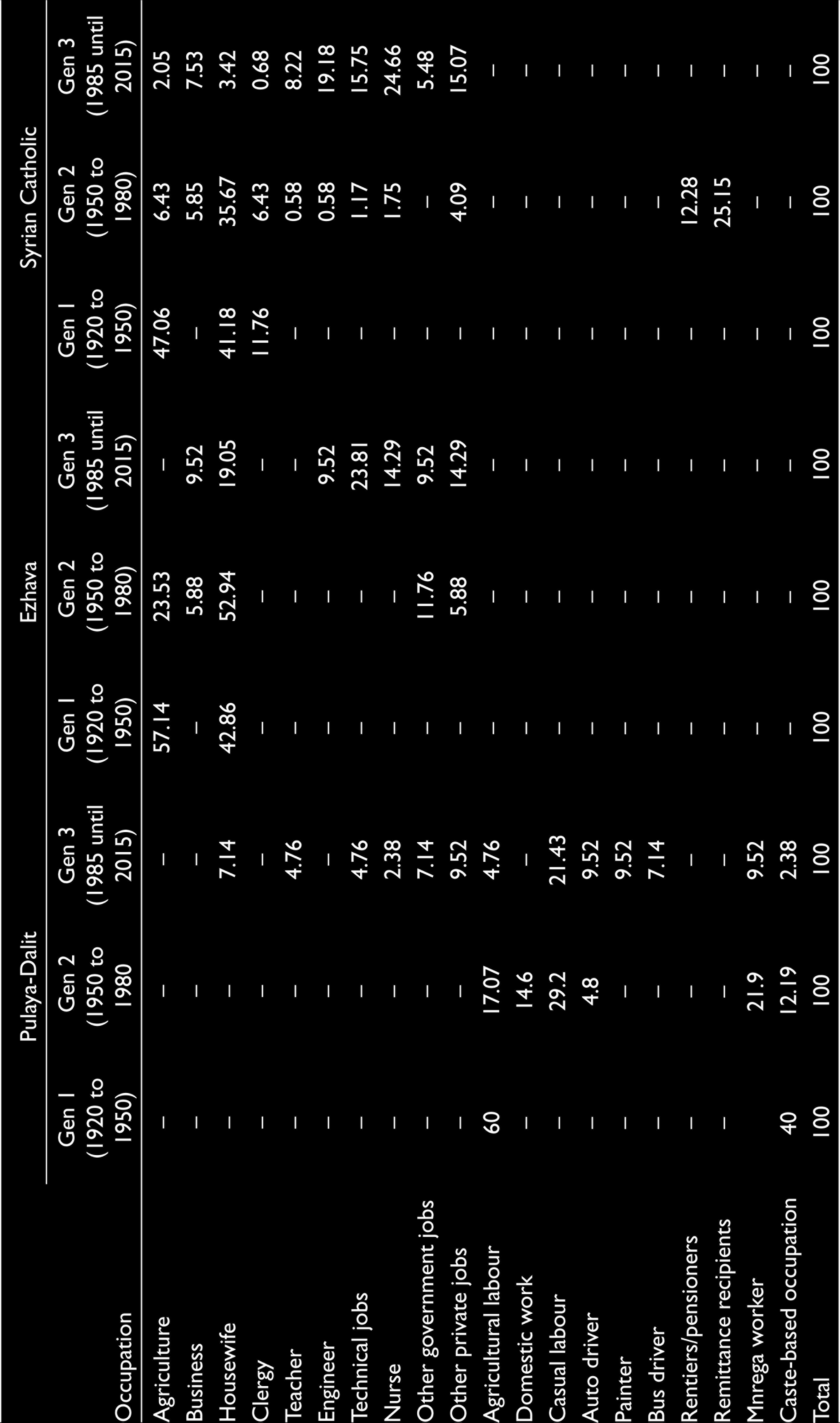
The data shows that the focus of the village economy moved away from agriculture, and the diversification of occupations is towards non-farm employment in Kavakad. Today, employment opportunities are mainly shaped by global and internal migration movements. As is visible from Table 1, the occupations of the Syrian Catholic community are presently concentrated on higher-wage jobs in the third generation. The Ezhava community is focusing on higher-wage jobs and medium-wage jobs. In contrast, the Pulaya community’s occupational activity has transformed from low-wage agricultural work to more income-generating modern sector jobs.
To conclude, there is upward occupational mobility in all three communities across generations. However, inequalities in occupational levels between communities persist in new forms. The occupational inequalities that developed based on land relations in the 1920s have transformed into disparities in occupational diversification. The data reveals that access to formal occupations is minimal among historically marginalized communities, despite affirmative actions. However, the occupational diversification among Pulayas needs more rigorous analysis since they now engage in multiple casual occupations. The following discussion attempts to explore the extent to which disparities in occupational levels can be explained by educational attainment.
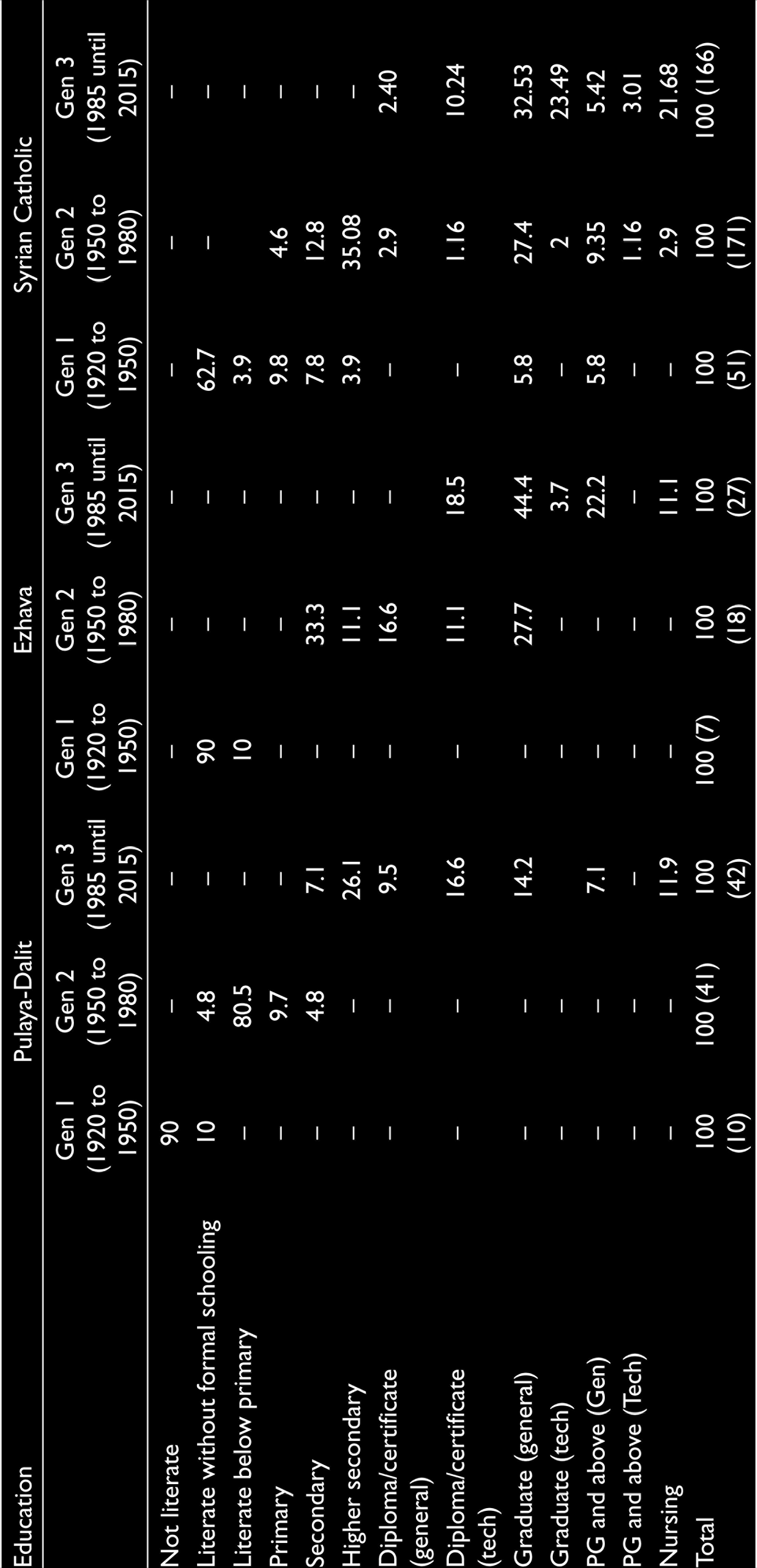
Although the success of the Abstention Movement 8 was instrumental in bringing educational mobility to the Syrian Catholic community in the early decades of the twentieth century, affirmative action on the educational and occupational front has played a significant role in providing social mobility to marginalized communities in Kerala. 9 In the Syrian Catholic community of the first generation, 62% were literate without formal education. The informal school—the Kalari run by a teacher, the Asan—was where most Syrian Christians of the first generation acquired basic literacy and numeracy skills. Those who gained formal and higher education in the first generation were mostly those who entered the Catholic clergy. About 37% of other members (non-clergy) of the surveyed families also availed themselves of various educational opportunities due to their connection with the Catholic Church.
Another interesting observation from the interviews regards women’s educational attainment in the Syrian Christian community. Women who became nuns were able to achieve higher education even in the first generation. The second generation women were much more educated, but the aim of educating them was not to prepare them for entry into the job market but to teach them the values necessary for a modern married and domestic life. The idea of the ‘modern’ was linked to rationalized domestic life imbued with modern self-discipline, cleanliness and care, all perceived to be vital to nurturing a family successfully.
However, the educational preferences of the third generation of the Syrian Catholic community focused on professional courses such as nursing and engineering. Approximately 73% of the third generation are attaining professional education, enabling them to access different employment opportunities in the international labour market. The increasing number of engineering colleges and nursing schools started by the Catholic Church further underpinned these rising levels of education within this community. There are eight engineering colleges in the micro-region of the village created by religious minority groups during the boom of self-financed engineering colleges in Kerala during the 2000s. Eighteen students from Kavakad’s Syrian Catholic community and two students from the Ezhava community study in these colleges.
We get a similar picture when observing the Ezhava community. Though they are fewer in number in the village, their educational attainment is at par with the Syrian Catholic community. Around 90% of the first generation had learned letters. Moreover, all people from the third generation of the Ezhava community reached higher and professional levels of education, while the third generation of the Pulaya community concentrates on vocational education. It seems Ezhavas were also able to attain education through affirmative actions. The educational attainment of the Ezhava community contrasts with the Syrian Catholic community in the second generation, especially the period between 1950 and 1990. Around 80% of the Ezhava community attained vocational education in the second generation, while 40% of the Syrian Catholic community moved to higher education. The women from the Ezhava community acquired only minimal education in the second generation.
It is evident from Table 2 that the younger generation from the late 1980s in the Pulaya community attained upward mobility in education as almost 90% were illiterate in the first generation. In the first two generations, they were unable to go to distant places for education. Their educational attainment was limited to the primary schools in the nearby areas until the 1990s. Although there was an Asan Kalari 10 in the village where people learned letters without formal education, this was not accessible to the Pulayas. The perception of the upper-caste families in the village used to be that letters were of no use to the Pulayas, who were expected to continue their physical labour in agriculture. About 80% of people in the second generation of Pulayas had below primary-level schooling. This suggests that they only began to be more mobile on the education ladder from the second generation onwards. The destinations of vocational courses vary from self-financing institutions to government institutions. 11 In the third generation, 25% of the Pulaya community sought vocational and technical courses as a passport for mobility. However, only a mere 7% of people in the community could obtain professional education such as nursing and a Bachelors in Education. Affirmative action for marginalized communities has undoubtedly played an essential role in the educational attainment of the third generation. 12
On the other hand, only two Pulaya women have managed to attain postgraduate degrees in the third generation. In sharp contrast to Pulaya women, young women of the third generation in the Syrian Catholic and Ezhava community gained vocational and professional education from the 1990s onwards. The stigma against women nurses in the Syrian Christian community seems vital to explain their limited education in the second generation. Still, men who had the experience of migrating were not necessarily against women working in such occupations.
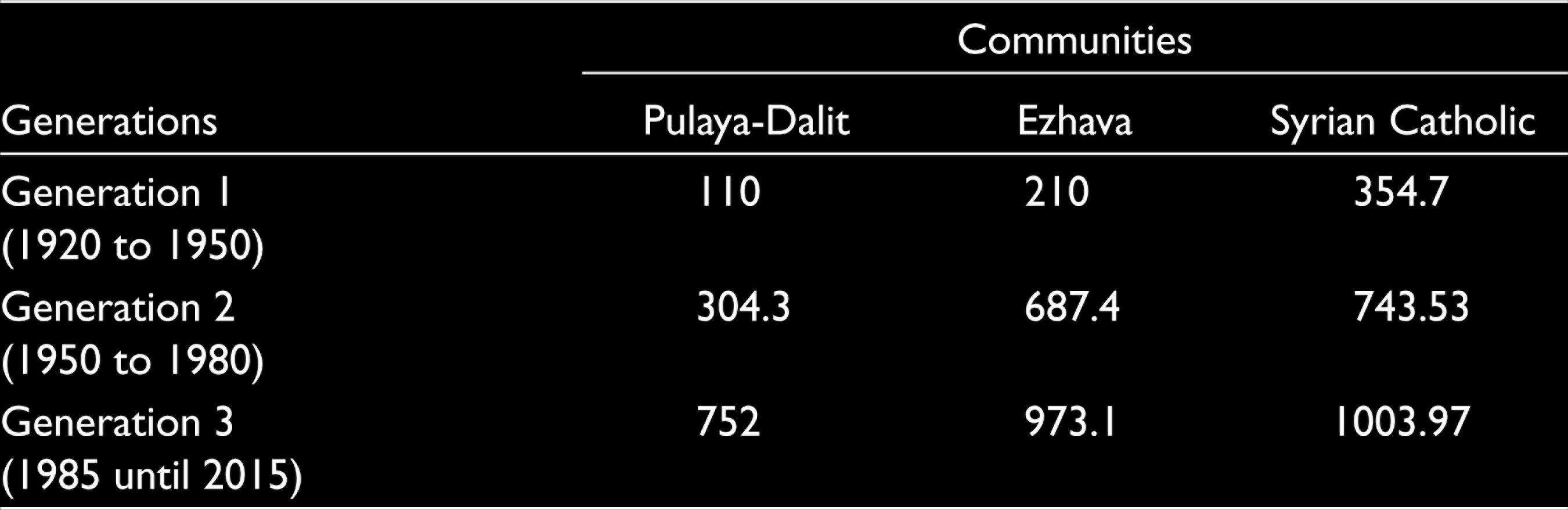
Table 3, on the educational attainment index, shows a holistic picture of the educational disparity between the three communities over generations. 13 For the third generation, inequalities across communities appear more pronounced. For instance, most people from the Syrian Catholic community concentrate on professional education, while people from the Pulaya community remain unable to access anything more than technical and minimum education. Notably, education has played a significant role in mediating occupational mobility across the communities; however, the persisting inequality in education has a complex relationship with occupational diversification. For instance, access to jobs abroad has laid the ground for certain courses among the Syrian Christian community. On the contrary, the Pulaya community could achieve formal occupations only through affirmative actions and educational attainment.
Intergenerational Educational Mobility.
Educational Attainment Index.
Geography of Social Life
The article conceives spatial mobility as a useful lens to understand relative social mobility. Therefore, it traces distance from the village for the major life events of individuals, such as the place of education, occupation and finding spouses. Relative social mobility can be explained through spatial mobility and the way it influences occupational and educational attainment compared to previous generations. In other words, the article argues that the networks and resources built through the spatial spread of major life events enable social mobility for communities. Thus, the article denotes the term geography of social life to discuss the spatial spread across the generations. One of the common assumptions of globalization studies is that today’s social world is dynamic thanks to the spatial movement of people (Deshpande, 2003). These assumptions are often pronounced by looking at communities and individuals for whom mobility is historically achieved. For instance, the disparity in proprietorship and social capital shapes various inequalities between communities in the region (Saradamoni, 1981; Yadu, 2015).
An understanding of distance for major life events gives a spatial view of social life. For this empirical demonstration, spatial locations are classified as the micro-region (0–15 km around the family home), the meso-region (15–100 km), the macro-region (100–500 km) and the national level (above 500 km). The final scale is abroad, which includes all regions outside India.
Table 4 shows that around 76% of the first generation of the Syrian Catholic community attained education from the micro-region. The primary destinations of the Syrian Catholic community for education were nearby Kalloorkad and Pothanikkad. Those who stayed on the riverside crossed the river to Pothanikkad, and those who went to Kalloorkad walked. About 24% of people attained education outside the micro-region in the first generation, and one person even went abroad for studies. In the second and third generations, the education levels of Syrian Catholics expanded further, but the spatial pattern was mainly confined to the macro-region. Families with adequate social and cultural capital, often with clergy family members, managed to get their children admitted to the first English medium schools. Nevertheless, the second-generation Syrian Catholics went to more distant places to get higher degrees.
Intergenerational Spatial Mobility in Place of Education.
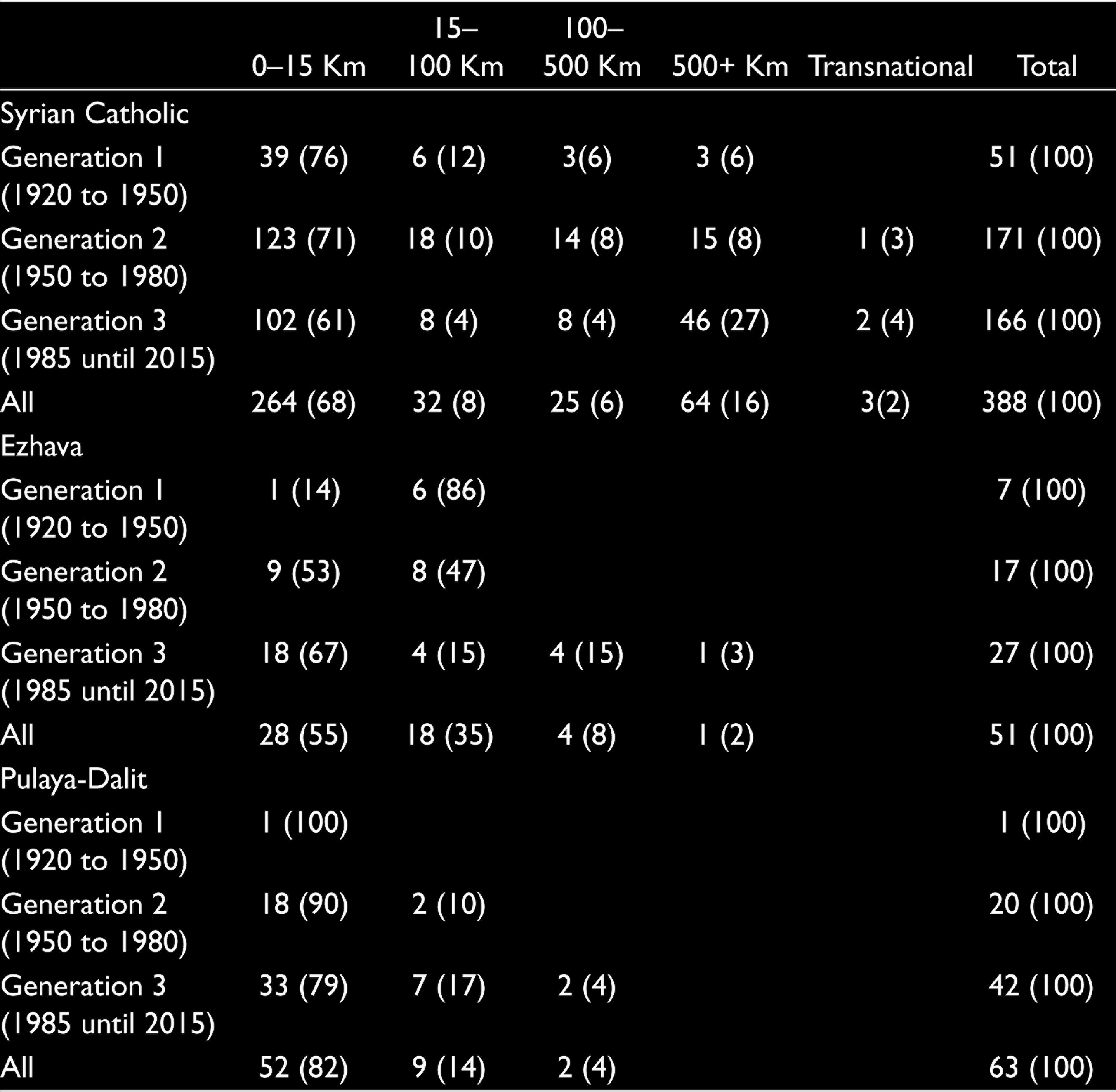
In terms of choice of educational institutions, Ezhava families tried to follow the success of the Syrian Catholics. The concentration of educational institutions in the micro-region explains why there is no spatial spread in the education of Ezhavas in the third generation. The difference in resources that existed in the rural economy explains the disparity in affordability of pursuing education further away. For the third generation of the Pulaya community, there is now a visible spatial spread of educational destinations to the meso-region where vocational institutions are situated, while educational opportunities remained limited to the micro-region before 1990. Most students were forced to drop out at the lower primary school level and entered agriculture as labourers. Consequently, the spatial spread of education among Pulaya families was limited to the micro-region because of their dependence on agricultural work shaped by historic land relations.
Table 5 shows the spatial spread of occupations across the communities. In the third generation of the Syrian Catholic community, 40% of people find jobs through transnational migration, and around 70% find employment outside the micro-region. There were several return migrants in the second generation. They came back to settle in the village after attaining a certain degree of prosperity abroad and then spent time cultivating their land. This pattern is changing as the third generation among the transnational migrants are less willing to return permanently. Many second-generation Syrian Christians and Ezhavas are now forced to accompany their children abroad to meet their caring needs.
Intergenerational Spatial Mobility in Occupation.
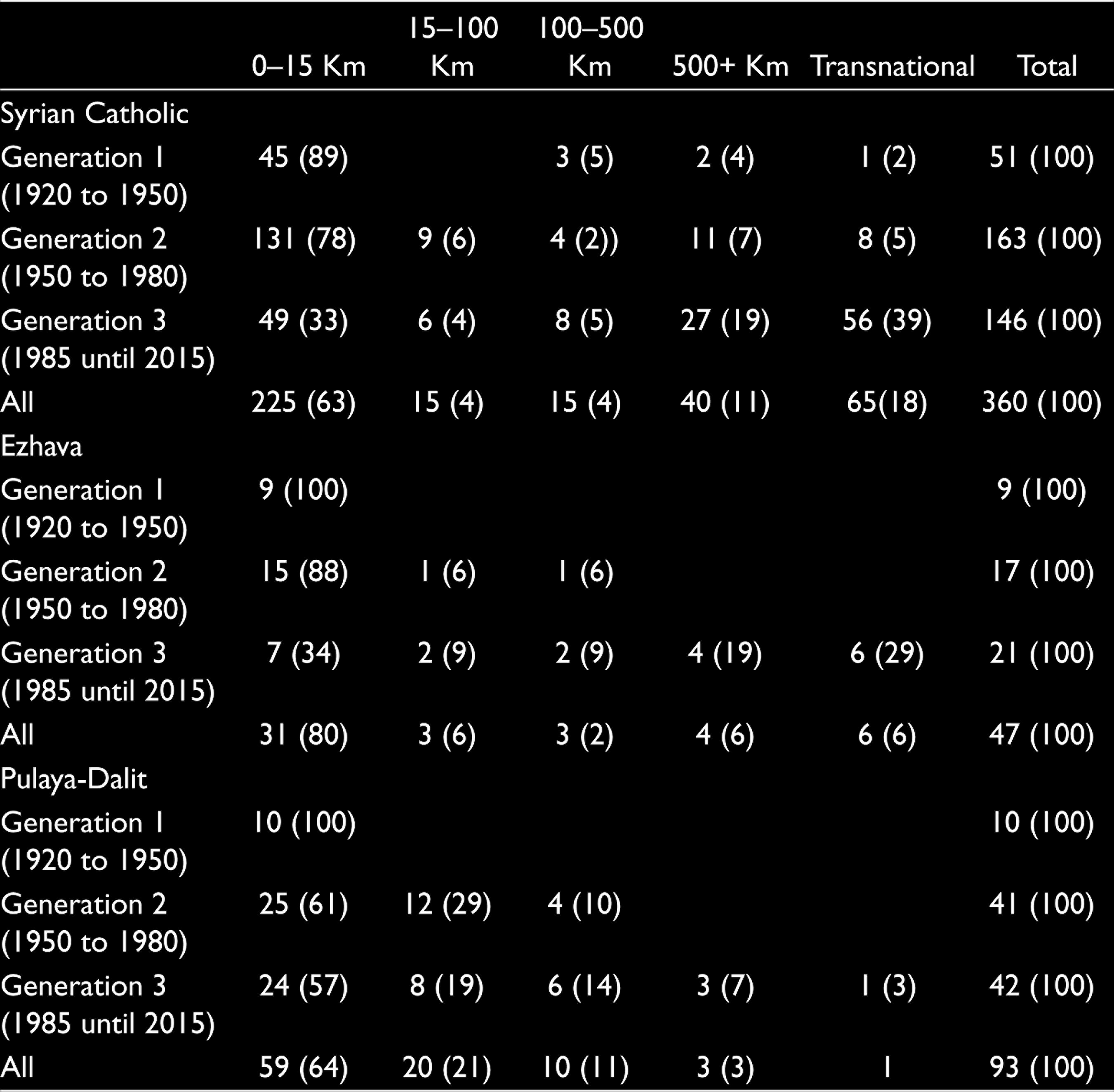
The spatial spread of the Ezhava community for employment was not wide in the first and second generations. Nevertheless, around 40% of the third generation of this community is now transnational in terms of employment. The spatial spread of the Ezhavas in finding jobs also relates to their educational attainment. Not surprisingly, it is the third generation that moved towards professional education and that became strongly transnational in terms of employment. Ezhava families’ educational and occupational patterns are now close to those of the Syrian Catholics. Transnational migrants from the Ezhava community are also employed in technical jobs.
Many people belonging to the Pulaya community came searching for employment from western parts of Ernakulam, got married, and settled in Kavakad. In the first generation, all worked as agricultural labourers in the village itself. However, the data shows that more than 40% of the second generation and more than 50% of the third generation travelled all over Kerala to work in a range of casual jobs. However, it is to be noted that only one man from the Pulaya community migrated abroad for employment.
The distance of marriage places is another indicator of upward mobility as it helps to strengthen a family’s social capital and networks by expanding their geographical reach. Therefore, Table 6 shows the spatial spread of finding spouses across the three communities. In the first generation, the spatial preference in finding marriage partners among the Syrian Catholic community was within the micro- (0–15 km) and meso-regions (15–100 km) of the village. We can see that there are not many changes over time in the spatial spread in finding partners among the Syrian Catholic community, even in the third generation. Around 18% of third generation found their partners from the meso-region. Marriages in the first generation were entirely arranged through kin networks and controlled by elders in the community. In other words, the Syrian Christian community in the village also represented an extended kin network that helped them keep their wealth in their kin network. The practice was conserved in many ways; for instance, marriage and family were strictly patriarchal, and widow remarriage and love marriages were frowned upon in the community. This also played a significant role in the material progress of the Syrian Christian families in the village. Furthermore, they never encouraged interdenominational marriages, and marriage preferences were undoubtedly based on the asset holdings and traditions of the family.
At present, Syrian Catholics from Kavakad settled in foreign countries prefer spouses from ‘aristocratic’ catholic families residing locally and nurtured with Syrian Christian moral values. Only 21% of Syrian Catholics found partners from outside the micro-region, despite the growth of transport and communication facilities, which reduced distance considerably.
Intergenerational Spatial Mobility in Spouse’s Place of Origin.
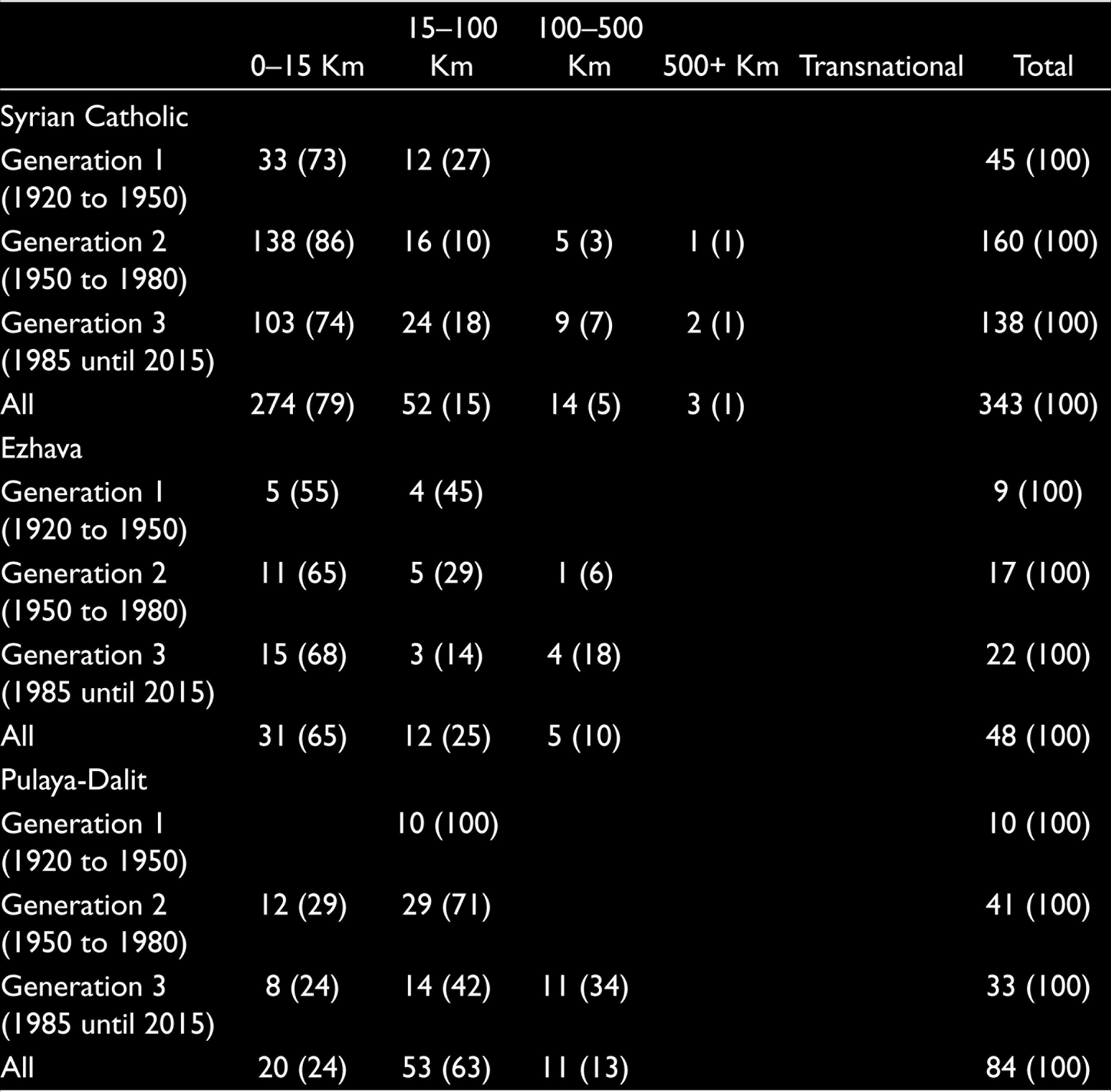
The spatial spread of the marriage alliance of the Ezhava community is not huge either. The earlier generations found their spouses through kin networks. Among the three generations, only 55% have found partners at the meso-region of the village. Interestingly, the marriage relations of the Ezhava community largely remain alliance-based even at present. However, in sharp contrast to Syrian Catholics, the Ezhavas and Pulayas were unable to use marriages to accumulate community resources. For Syrian Catholics, marriage strategies enabled the accumulation of community resources and social mobility. For them, the networks accumulated through marriage alliances facilitated access to information about and opportunities in education and employment.
Marriage and kinship in the Pulaya-Dalit community were distinctly different. Their marriage practices were mostly love marriages within the settlement or with people who came for employment. For instance, in the first generation, the spatial preference in finding marriage partners was within the village’s micro-region (0–15 km). These marriage practices offered limited chances for the mobility of community members since marital relations were not based on alliances between families. Therefore, the distance of marriage relations could not produce social capital through family networks for Pulaya-Dalit families. At present, however, the community’s marriage relations are changing towards arranged alliances through the use of marriage brokers. In the third generation, around 35% of the Pulaya community found partners from the meso-region.
My findings thus reveal that the spatial spread is clearly unequal between communities, in both the life events of occupation and education, as well as in the geography of social life. These differences intersect with opportunities for social mobility in complex ways. For instance, in the case of occupational mobility, the Syrian Catholics were able to capture professional education and skilled jobs abroad because of transnational mobility. At the same time, Pulayas continue to rely on casual jobs in the micro-region. Also, the region within which people from the Syrian Christian community find their spouses adds to the expansion of the community’s network in the micro- and meso-region. Notably, the Syrian Christians moved out of the micro-region in the first generation itself. By contrast, the Pulaya community in this region remains tightly localized. The discussion helps to understand the ways in which transnational migration, changes in educational attainment and chances for relative social mobility are all closely interconnected under contemporary globalization. However, this is not to argue that spatial mobility is not enhanced among the marginalized communities intergenerationally, but only that it has not reached the extent of mobility experienced by the dominant communities. The data thus allows us to conclude that there are stark inter-community differences in accessing transnational mobility in the local sending regions.
Transnational Migration and Local Communities
The Syrian Catholic community has the upper hand in transnational migration from Kavakad. Historically, the community was able to form networks by acquiring resources and various forms of capital, and the local development process was strongly skewed to their advantage (Luke, 2018). The previous discussion brought out the complex ways in which transnational migration opportunities produced relative social mobility for this community. The idea of transnationalism has been central to migration research over the last 30 years, emphasizing the emergence of a social process in which migrants establish social fields that cross geographic, cultural and political borders (Schiller et al., 1992).
Further, the word transnationalism has been subjected to much conceptual attention to denote the contemporary phase of international migration (Levitt, 2012; Schiller, 2018). Therefore, studies have looked at different dimensions of transnational processes in both receiving and sending regions (Osella & Osella, 2008). This section discusses the nature of transnational relations existing in the village across communities and shows how differential access to migration produces different experiences of transnationalism.
The first instances of migration 14 from the village did not necessarily generate networks. In the words of Babu from the Syrian Christian community who migrated to Australia: ‘We stay for a period of one to two years abroad and come back to Kavakad village for two to three months on vacation and return. In a way, we frequently visit the village, and the connection to the village was never lost’.
Gradually, however, the social capital of the aspiring migrant—in terms of their family networks abroad and the institutional networks of the church and the community—played an essential role in enabling transnational migration among the Syrian Christians. Many of the respondents in this research managed to get abroad through these networks. As Jose remembers,
[w]hen I went to the US, the extended family connected me to the Syrian Catholic community in Chicago, which led to connections with many priests and church present there. It helped a lot to settle myself in terms of finding a place to stay, new jobs there, etc.
Other migrants shared similar narrations of the church and the community’s involvement in facilitating migration.
As Babu remembers, ‘the material exchange of transnational villagers with the local church started in the 1970s. Whenever resources are needed for the renovation or construction of a parish church, authorities contact migrants from the parish’. The nature of church festivals in Kavakad became transformed in terms of spending and celebrations as the transnational community started sponsoring cultural programmes and feasts during parish festivals. The people who migrated to foreign lands with the help of kin entered a microcosm of their village community abroad. This microcosm was exclusive as it consisted only of the members of their community and kin network who are very often already known to each other. As Babu explains his transnational life,
[w]e have a small community in Brisbane, Australia; most of them are my wife’s relatives and people from her village. We started a small parish with the Malayali community and requested to appoint a priest there. We all left our village, but we want to continue the same faith and rituals. We invite and sponsor the travel of priests and bishops. Our family is very active in church activities there.
In the Syrian Christian community, 15 the transnational migrant aspires to take the entire family eventually. However, in the initial phases of migration, parents stayed abroad while children stayed back with their grandparents. According to Babu (quoted earlier), his children have spent a total of four years with their grandparents at different points in time.
The grandparents also visit their children overseas. The return visits of migrants to Kavakad bring many gifts in the form of money and new technologies to the extended family. Besides the visits, 16 the family as a social unit continues its relationship with kin abroad through social media interaction, primarily through Skype and telephone calls. In short, the earlier kinship practices of the Syrian Catholic community are being reproduced overseas by forming a community of extended and related families.
The transnational experiences of the other two communities in Kavakad are quite different and considerably less extensive. As 30-year old Rajesh from the Pulaya community points out: ‘as youngsters, we all aspire to go abroad after studies. I cannot take a loan to pay for the agent’s fees, and I do not have relatives to take me abroad’. The Ezhava community members are going abroad through agents, in contrast to the Syrian Catholic community, which has its own network to facilitate migration. For instance, Manoj from the Ezhava community says,
I finished a polytechnic course 10 years back. Many of my friends from other communities have migrated to foreign countries. I am working in Abu Dhabi for the last 3 years; until then, I was working in Cochin. I gave money to a travel agent and struggled hard to get my visa, while my Syrian Christian friends efficiently arranged it (through their community network).
This shows the differential access to international labour markets across the three communities. The Syrian Christian community migrates through its own network and secures professional jobs overseas. By contrast, migrants from more marginalized communities depend on other agencies and enter lower-end jobs. However, the transnational movement of the dominant community has brought unprecedented changes in many spheres. For instance, the prime income sources of the landowning families have changed to many other resources, predominantly remittances. It could be said that the Syrian Catholic families have achieved mobility away from the agricultural sector by investing their income from commercial crops and land into other forms of capital.
Conclusion
This article contributes to scholarship on persisting inequalities across rural communities in India despite growing levels of transnational migration, education and social mobility. The article sought to illustrate patterns of intergenerational social mobility and inequality among rural communities of Kavakad, a village in Kerala. The empirical evidence outlines the absolute mobility patterns that have emerged across communities over generations and the ways in which education plays an essential role in achieving intergenerational occupational mobility. However, the findings suggest that growing spatial mobility alongside other forms of mobility has reproduced the status and affluence of dominant communities. Furthermore, the article showed that the degree of spatial mobility plays a key role in determining the relative social mobility of communities, as we witnessed in the case of the Syrian Catholics of Kavakad. The establishment of a transnational social life, which is commonly studied in contemporary globalization studies, was particularly pronounced among the locally dominant community of Syrian Catholics.
Alarmingly, the inequality that existed in the form of land and other initial endowments between the communities of the village were carried forward to shape the mobility patterns of the communities in diverse ways. If transnational migration has been a key path towards maintaining economic dominance for the Syrian Christians, then circular migration has been an escape route for the more marginalized Pulaya-Dalits. The persisting inequality between communities is manifested in the way in which transnational migration benefits the dominant communities, while the marginalized continue to be in the back seat of the process. In particular, this is visible in the unequal access to international labour market opportunities across different communities.
The traditional stratification and networks of caste are not defunct rather they are actively shaping the patterns and gains from international migration. The relative social mobility across communities is explained by their unequal access to these globalized opportunities. What emerges is a complex picture of differential opportunities for transnational migration that bolsters long-standing social inequalities in Kavakad and persist despite years of migration and education and a substantial degree of social mobility. Moreover, it warrants a need for alternative development interventions at the local level to enhance spatial mobility among marginalized communities given their long-standing exclusion from international labour markets.
Footnotes
Acknowledgements
This article is drawn from a working paper published with the Centre for Development Studies, Thiruvananthapuram. I am grateful to Professor J. Devika for her comments and fruitful discussions. I am thankful to the anonymous referees and also the editor of the journal for providing valuable comments. My thanks are also due to Suravee Nayak for engaging with the earlier version of the article.
Declaration of Conflicting Interests
The author declared no potential conflicts of interest with respect to the research, authorship and/or publication of this article.
Funding
The author received no financial support for the research, authorship and/or publication of this article.