







Abstract
Using a literature review, tourist arrival data, interviews with tourists and tour guides, this article examines the role of hill stations established under the British colonial regime, and the subsequent development of the Ramayana Trail promoting Indian tourism to Sri Lanka and domestic tourism within Sri Lanka. Nuwara Eliya developed as a colonial hill station with the gradual installation of required infrastructure facilities, scenic mountainous landscape and desirable weather conditions conducive to holiday making among the colonial elites. While colonial rule formally ended in 1948, the plantation economy and the hill station continued shaping postcolonial developments in Sri Lanka. Building on the Ramayana mythology framed in ancient India and the urban infrastructure established in the colonial hill station, the Ramayana Trail developed in the postcolonial era, constituting a new form of pilgrimage plus tourism targeting designated Ramayana sites in Sri Lanka. This article examines the resulting expansion of tourism and related infrastructural development encompassing mountain landscape, new challenges encountered by the postcolonial state and the tourist industry in catering to the demands from the Ramayana pilgrims, the service providers and the local communities and possible ways of addressing these challenges evolved from the colonial era.
Introduction
Hill stations in South Asia cannot be understood merely as colonial leisure enclaves; they represent complex socio-spatial formations where environmental imaginaries, imperial governance and emerging forms of mobility converged. Rather than being simple sites of recreation, they functioned as laboratories 1 for the production of new landscapes, social hierarchies and cultural practices that linked colonial territories to broader global transformations in tourism and urbanization. In this context, the hill station encapsulates a singular temporality, a moment in the diffusion of a tourism model and practices developed at the same time in Europe, the villegiature (Sacareau, 2007; Sharma et al., 2022). Whether in India or Sri Lanka, the hill station embodies ‘one type of tourist place created ex-nihilo by British residents, and dedicated to their own recreation’ (Peyvel et al., 2025; Sacareau, 2007, p. 31). In that way, altitude was one of the chief considerations in the location of hill stations due to nineteenth-century ethno-medical beliefs about the health benefits of and comforts associated with life in a hilly environment.
Located in the central province of Sri Lanka, at an average altitude of 6,100 feet above sea level, Nuwara Eliya was established as a military sanatorium in 1829, in line with colonial hygienic theories that associated highland environments with climatic suitability and recuperation for European bodies. Nevertheless, it is routinely claimed that Nuwara Eliya was ‘discovered’ in 1819 by British officers during a hunting expedition (Cook, 1951, p. 341). This narrative of discovery contributed to sustaining a colonial representation of the central highlands as a largely uninhabited hinterland and covered by forest prior to 1815. 2 During the 1820s, the British consolidated their control over the hill country, notably under Governor Barnes, through the construction of roads and the progressive improvement of accessibility. This process was further intensified with the establishment of the Nanu Oya railway station in 1857. In this article, the resulting urbanization is conceptualized as upland urbanization, referring to the transformation of mountainous environments into corridors of human settlement, plantation production and leisure. Rather than being neutral processes, these transformations were shaped by colonial imaginaries that framed highland climates as both aesthetically desirable and physically beneficial—primarily for European residents—within the broader context of tropical upland habitats.
As such, upland urbanization can be understood as a multifaceted process that combined the extraction of natural resources, the organization of labour and the production of spaces of leisure and mobility, while simultaneously responding to colonial concerns over climate, health and productivity. Gradually, the environment of Nuwara Eliya was transformed into a picturesque landscape, reflecting the imprint of British cultural norms and institutional practices (Kenny, 1995; Wright, 1988). Largely inspired by British upland landscapes, colonial actors reconfigured the area according to the aesthetic categories of the picturesque and the sublime that were predominant in Europe at the time. This transformation was not limited to the material reordering of space; it also involved the production of new ways of seeing and interpreting the landscape. The morphological transformation of the environment thus went hand in hand with a reconfiguration of the gaze.
It was also accompanied by the formation of new social divisions between the impoverished workforce and the colonial elite. While the colonial elite, driven by romanticism, initially shaped the landscape in the image of their homeland, turning Nuwara Eliya into a ‘little England’, 3 the development of the plantation economy soon became a key impetus for Nuwara Eliya’s growth, as the surpluses generated by coffee soon to be replaced by tea plantations enabled expatriates to invest in the mountain resort, developing a model of racialized society based on the reproduction of an elite through the use of exclusive social clubs (Bhattacharya, 2012; Sacareau, 2007). Very quickly, a large part of the Nuwara Eliya district was converted to the plantation economy, thanks to the British capital, lucrative land concessions granted by the colonial administration and the labour of several thousand people recruited from the lowest end of the caste hierarchy in southern India to work as indentured labour (Bass, 2013; Hullop, 1994; Kanapathipillai, 2012).
To paraphrase Bennike (2017, p. 11), the hard labour of the Indian Tamil migrants served the British ambition of transforming the ‘jungle’ into ‘gardens’ and the massive ‘mountains’ into rolling ‘hills’. The application of this aesthetic in the production of a new landscape increased the attractiveness of Nuwara Eliya as a tourist destination for the European elite, concomitantly enabling the shift from a ‘wasteland’ into a commodified tourist hill station. Large amounts of forest were cleared to give way to the tea gardens. As Sarah Besky reminds us, ‘South Asian tea plantations were born of colonial enclosure and control […] (and) the plantation intertwines relationships of land and labour, race and class, production and reproduction in the past and in the present. Such constitutive relationships are difficult to disentangle’ (Besky, 2024, pp. 2212–2213).
In 1872, Sir William Gregory became the governor of Ceylon. He ordered the construction of his official residence in Nuwara Eliya, reinforcing the resort’s seasonal nature and its reputation for attracting people in search of social recognition. He also played a decisive role in reshaping representations of the city, promoting Nuwara Eliya as a summer resort defined by picturesque landscapes and leisure activities, while downplaying its associations with hard labour and precarious forms of belonging. This reconfiguration of the city’s image was further materialized through projects such as the construction of Lake Gregory, which significantly enhanced its leisure infrastructure. In 1873, Nuwara Eliya ceased to be a military sanatorium: While remaining the main resort and the seat of the district’s tax and judicial administration, it also became a seasonal holiday resort. The departure of the military marked the transition to the mountain resort. The same year, the Nuwara Eliya Gymkhana Club was founded, and two years later, the racecourse was built. The publications of Henry Cave, who was a publisher and importer residing in Colombo, reinforced this view of the mountain and ensured the dissemination of an idyllic, peaceful and pastoral landscape model (Wright, 1988).
Nuwara Eliya thus embodies the classic narrative of a formerly neglected region transformed into an extractive frontier, with the plantation embodying a specific moment in the global incorporation of capitalism, what some authors have referred to as the Plantationocene (Barua, 2023; Haraway, 2015; Tsing, 2015). As has already been shown in other geographical contexts, ‘within just a few decades of their arrival, the British had managed to turn this exceptional, mountainous frontier into a commodified space for tea production and leisure tourism’ (Bennike, 2017, p. 2). As a part of this colonization project, Nuwara Eliya was established as a hill station for European planters and administrators with a corresponding development as an urban centre catering to the needs of an expanding and increasingly dominant colonial elite from the late nineteenth century onwards. Nuwara Eliya attracted many holidaymakers, a situation that continued throughout the British period and early years of the post-independence era as well. The Sri Lankan elite produced by colonial and postcolonial transformations gradually walked into the shoes of the colonial masters. Tourism industry in Sri Lanka followed the footsteps of this colonial/postcolonial setting with the colonization of mountains for various purposes to drive population movement, upland urbanization and development in general. This ‘tourist gaze’ (Urry, 1990), forged during the colonial period after multiple reformulations and hybridizations, endures and is a vector for urbanization, commodification, land speculation and privatization. As such, this enduring tourist gaze has become one of the major drivers of urban development in the hill stations. On the other hand, the plantation labour of South Indian origin were confined to the drudgery of hard physical labour and subhuman living conditions in the coolie accommodation (labour lines), with no access whatsoever to the comforts, pleasures and modes of entertainment characteristic of the hill station.
Since the 1990s, the mountainous landscape of central Sri Lanka has been undergoing renewed transformations. In this region and elsewhere on the island, a growing set of religious, cultural and touristic practices has developed around sites reportedly associated with the Ramayana epic. Rather than referring to a bounded or institutionalized religious practice, this phenomenon draws on a broader constellation of veneration/adventure rediscovering the Ramayana story centred around the capture of Sita, the beloved queen of Ram, by Ravana, the king of Lanka and subsequent redeeming of her by Ram in a daring rescue operation across the Palk Strait. The legendary Ramayana story and related rituals have been widespread across the Indian subcontinent, with the possible exception of Sri Lanka, which ironically figures in the Ramayana story according to many interpretations. In any case, there has been a resurgence of the Ramayana story in Sri Lanka too, and an associated Ravana cult has emerged among the Sinhala Buddhists and Tamil Hindus in Sri Lanka during the period of civil war (1983–2009), as well documented in recent ethnographic research (Henry, 2023; Padma 2019). These developments involve the identification, reinterpretation and circulation of sites believed to be connected—whether materially or symbolically—to episodes of the epic. In doing so, they contribute to re-inscribing the central highlands within a localized sacred narrative of space that challenges colonial representations of the region as virtually uninhabited prior to the British colonization and intervention. While plantation development played a central role in integrating Nuwara Eliya into global capitalist circuits, these Ramayana-related practices do not originate from global capitalism as such, nor do they stem from a Western-centric ‘hegemonic power structure of globalization’ or ‘metro-centric urbanization’ (Kundu, 2017, p. v). Instead, the ‘Ramayana Trail’ can be understood as part of a diffuse and archipelagic form of ‘subaltern urbanization’ (Denis & Zérah, 2017), structured along corridors 4 that connect a dispersed array of sacred, pilgrimage/touristic sites, illustrated by the newly formed Ella site discussed in this essay. This form of upland urbanization involves the identification and development of Ramayana-related locations in the mountainous region, the reinterpretation of their past and their transformation into accessible destinations for both domestic visitors and Indian tourists. It also reflects the emergence of a hybrid form of mobility that combines elements of pilgrimage and cultural tourism, in which sanctity of selected mountain spaces coexist with practices of circulation, leisure, adventure and heritage-making. More broadly, the enduring significance of the Ramayana as a moral/cultural narrative framework specific to the South Asian context contributes to sustaining these mobilities and imaginaries beyond strictly religious practice (Mishra, 2023). These developments involve efforts to identify, formalize and promote sites that are legendarily associated with the Ramayana narrative, contributing to their growing visibility among Ram devotees in India and, to a lesser extent, among Ravana admirers/descendants in Sri Lanka. This process has facilitated the circulation of pilgrims and tourists from India to Sri Lanka, while also encouraging forms of domestic sightseeing within the island. As McKinley (2024) discovered in his recent ethnographic study of pilgrimage to Adam’s Peak, the mountain has emerged as ‘a center of the world’, attracting pilgrims and tourists from diverse backgrounds in Sri Lanka and abroad, as well as certain animal species to the central region in Sri Lanka.
Rather than constituting a bounded or institutionalized religious formation, these practices are better understood as a diffuse assemblage of devotional, cultural and political engagements with the Ramayana. Importantly, they also contribute to challenging colonial representations of the central highlands as a terra nullius prior to British intervention, by re-inscribing these landscapes within longer-standing narrative, symbolic and sacred geographies (Bennike, 2017; Fitzmaurice, 2008).
The religious dimension of these developments lies in the ways in which these sites are invested with sacred histories, devotional meanings and practices, including pilgrimage, ritual visitation and the veneration of mythical figures such as Rama, Sita or Ravana. This devotional engagement draws on the widespread cultural and religious significance of the Ramayana across the Indian subcontinent, where it functions not only as an epic narrative but also as a moral and symbolic canvas structuring social and political imaginaries (Mishra, 2023). While this influence extends into Sri Lanka, it does so within a cultural context largely shaped by Buddhism, where the Ramayana occupies a more ambivalent and uneven position (de Silva, 2014; Henry, 2023; Henry & Padma, 2019). In Hindu India, Rama occupies a central place in the ideological framework of Hindutva nationalism, reinforcing the political and religious significance of Ramayana-related mobilities. In Sri Lanka, by contrast, the figure of Ravana has been reinterpreted within both Tamil Hindu and Sinhala Buddhist contexts as an indigenous cultural hero known for his supernatural powers, inventions and historical narratives. In particular, some Sinhala nationalist narratives mobilize the Ravana story to assert a pre-Vijayan origin of Sinhala civilization, linking it to a supposed Yaksha heritage of earlier origin.
A substantial body of literature highlights the political and cultural significance of figures such as Rama and Ravana as central reference points in the formation of ethno-religious nationalisms in Hindu India, as well as in Tamil Hindu and Sinhala Buddhist contexts in Sri Lanka (de Silva, 2014; Henry, 2023; Henry & Padma, 2019; Padma, 2019). At the same time, a growing scholarship has examined how the Ramayana narrative has been incorporated into the popular culture and political imaginations of both India and Sri Lanka (Henry, 2023; Pollock, 1993). However, the ways in which these narrative and symbolic frameworks intersect with practices such as tourism, pilgrimage and cross-border travel across the Palk Strait remain less well understood. This article addresses this gap by examining how the development of the Ramayana Trail connects with the expansion of tourism and domestic travel in Sri Lanka and with broader processes of urbanization in the central highlands. In doing so, it situates these dynamics within the longer historical trajectory shaped by British colonialism and post-independence political aspirations and development strategies.
Research Questions and Methodology
In this article, we address three interrelated questions concerning the development of the Ramayana Trail in Sri Lanka. We first examine how visits to both long-established and newly configured sites associated with the epic have shaped the tourist industry, particularly in terms of promoting international tourism from India and expanding domestic tourism within Sri Lanka. We then explore the extent to which these visits by Indian and Sri Lankan visitors can be understood as pilgrimage, tourism or a combination of both, paying attention to the respective roles of faith and devotion as opposed to pleasure and sightseeing, and to the ways in which the tourism industry caters to these diverse expectations. Finally, we analyse how this recent tourist upsurge, centred on Ram and Ravana traditions, has influenced postcolonial urbanization patterns in Nuwara Eliya and surrounding regions, with particular attention to the social and environmental challenges associated with often unplanned urban development, as well as to possible ways of addressing them in order to ensure more sustainable outcomes.
This article interrogates tourism-induced urbanization processes in the Nuwara Eliya hill station and the newly formed Ella resort, partly influenced by the Ramayana Trail in the adjoining Badulla District. The analysis draws on a combination of field-based research and selected secondary sources. Fieldwork conducted in 2024 included focus group discussions with six groups of Indian tourists visiting Sri Lanka as part of the Ramayana Trail, as well as in-depth interviews with five tour guides and eight key informants connected to the tourism industry, the Ramayana Trail and urban development. These materials were used to map recent transformations in the tourism landscape of central Sri Lanka. In addition, the study makes use of official data on international tourist arrivals for the period 2023–2024, with particular attention to flows from India, while acknowledging the limitations and uneven availability of data on domestic travel to Ramayana sites. Historical and contextual insights are further informed by selected archival and scholarly sources on the development of hill stations and tourism in Sri Lanka and the wider South Asian region.
The methodology deployed had some limitations, including the small sample size relating to tour guides, and language difficulties and time constraints in communicating with Indian tourists. On the other hand, we did manage to get a rounded understanding of the interplay between tourism and urbanization in central Sri Lanka through this mixed methods approach consisting of a comprehensive literature review, secondary data analysis and gathering of primary data, mostly of a qualitative nature from the tourists, tour guides and service providers catering to the relevant groups of tourists.
We begin with an analysis of the broad pattern of colonization and urbanization in central Sri Lanka, with the Nuwara Eliya hill station as the hub of these processes from the onset of British rule in Sri Lanka. Then we consider the launch of the Ramayana Trail as an innovation in the tourist industry, building on historical legacy, cultural capital and geopolitics in the South Asian region. Third, we examine the development of Ella as a new tourist resort attracting both international and domestic tourists eager to explore both nature and culture. Finally, the article addresses the cumulative impact of the related processes of rapid urbanization of the hilly terrain, tourism development and competition for land and access to natural resources and the possible way forward for overcoming the resulting challenges in central Sri Lanka.
The article follows a political economy approach to understand the historical transformation of the mountainous region in central Sri Lanka through the establishment of a plantation economy and the formation of a hill station, followed by the development of the Ramayana Trail to cater to the needs and nationalist aspirations of the newly formed middle classes, both in India and Sri Lanka. We argue that the sustainability of the resulting urban forms calls for greater accommodation of social and cultural diversity, coexistence among different species and different human communities and greater environmental sensitivity.
Empire, Revenue Generation and Leisure in Central Sri Lanka
Colonial Legacies and the Origins of Upland Urbanization
The urbanization of Sri Lanka’s mountainous regions began under the British Raj following the annexation of the Kandyan Kingdom in 1815 and the establishment of an export-oriented plantation economy. Coffee, tea and rubber plantations integrated the central highlands into imperial circuits of production and exchange, while urban centres developed as administrative, transport and market hubs servicing plantation activity. Within this evolving spatial framework, Nuwara Eliya developed as a key node linking plantation production, colonial administration and emerging infrastructures for development, mobility and urbanization. Its growth was closely tied to the expansion of road and rail networks, which facilitated both the circulation of goods and the seasonal movement of colonial populations. These dynamics contributed to the consolidation of a distinct form of upland urbanization structured by the interdependence of economic extraction, governance and selective patterns of human settlement. Although a small permanent population—including administrators, military personnel and commercial growers—resided in the town, the hill station depended primarily on the seasonal influx of expatriate holidaymakers. Investment in hotels and leisure facilities was largely financed through plantation-generated wealth, while exclusive clubs and social institutions played a central role in reproducing elite networks. Membership in clubs such as the Hill Club, Golf Club and Gymkhana Club was tightly restricted, and these spaces functioned as key sites of social interaction, distinction and exclusion. Regular seasonal returns by the same social circles fostered durable elite relations, making hill-station holidaymaking distinct from what is sometimes identified as ‘frivolous tourism’ associated with pilgrimage sites in contemporary Sri Lanka (Pfaffenberger, 1979).
From its inception, Nuwara Eliya was marked by high land values, strict enforcement of municipal regulation and pronounced ethno-racial and class segregation. Urban zoning, property regimes and club-based social closure limited access to Europeans and a narrow circle of privileged visitors, while local residents and plantation workers entered the town primarily as service labour. This regulated and exclusionary urban form—maintained through both formal bylaws and informal social norms—defined the hill station throughout much of the colonial period. With a total resident population of 28,412 as of 2021, Nuwara Eliya remained a small town, in spite of its colonial legacy as a hill station (UDA, 2022). Despite its limited permanent population, Nuwara Eliya experienced pronounced seasonal expansion during the April–July summer months, underscoring its function as a cyclical leisure landscape rather than a conventional urban settlement.
From its inception until the early 1930s, Nuwara Eliya’s urban population grew slowly under conditions of tight European control, with Indian Tamil estate workers forming the core labour force. After the First World War, an outmigration of European settlers began, accompanied by the gradual acquisition of former European-owned properties by affluent investors from Colombo, many of whom used these houses as seasonal second homes. The most rapid demographic expansion occurred in the early post-independence period (1946–1953), when population growth accelerated markedly.
This growth was partly driven by politically mediated settlement initiatives led by T. William Fernando, a local politician who facilitated the state acquisition of neglected plantation land on the town’s periphery for redistribution among primarily Sinhala settlers from surrounding villages. 5 Many of these settlers later became successful upcountry vegetable producers. While Nuwara Eliya had originally been a carefully planned colonial town serving elite interests, postcolonial expansion increasingly diverged from this plan as political priorities shifted towards opening the town to a broader population, including the Sinhalese peasantry.
Until this period, most urban workers were Malaiyaha Tamils of estate origin, employed in hotels, markets and leisure facilities and largely housed in crowded line-room settlements—a colonial form of labour accommodation that, in many cases, continues to structure living conditions in the present (Bass, 2013). As highlighted by Jegathesan (2015) and Hullop (1994), these settlements are not merely residential spaces but are embedded within longer histories of dispossession, marginalization and restricted access to land, citizenship and social mobilities. Post-independence expansion produced significant urban sprawl, altering the character of the hill station and giving rise to peripheral settlements such as Shanthipura, Gamunupura and Kalapura—many of which trace their origins to Fernando’s settlement schemes in the 1960s.
Tourism Development, Real Estate Pressure and Planning Blind Spots
Tourism has had a significant impact on urban morphology in Nuwara Eliya, driving investment, rising land prices and changes in land-use patterns. As emphasized in the Greater Nuwara Eliya Development Plan (GNEDP), launched with a vision of the ‘Paradise of Misty Hill’, climatic distinctiveness and natural beauty remain key attractions for both domestic and international tourists. This expansion has accelerated the conversion of agricultural land and encouraged large-scale real estate projects, contributing to the privatization of the landscape. As of 2020, Nuwara Eliya was receiving approximately 950,000 domestic tourists and 135,000 foreign tourists annually, with the GNEDP projecting an increase in the arrival of international and domestic visitors to 4.5 million by 2030 (UDA, 2022).
Tourism-led urbanization has been driven largely by Colombo-based elites, whose investments have contributed to the reduction and replacement of tea plantations with alternative land uses. As Singh (2024, p. 8) observes, investment on the periphery of small towns is closely linked to the politics of accumulation and land capital. Interviews conducted for this study confirm that ownership of a second home in Nuwara Eliya functions as a marker of elite status, reinforcing the social centrality of private clubs and seasonal residence. This demand has stimulated vertical construction, speculative real estate development and unplanned expansion on the urban fringe, often encroaching on forest and water reservations. Such developments have intensified environmental vulnerability in an area already identified as landslide-prone, increasing exposure to climate-related risks and disasters.
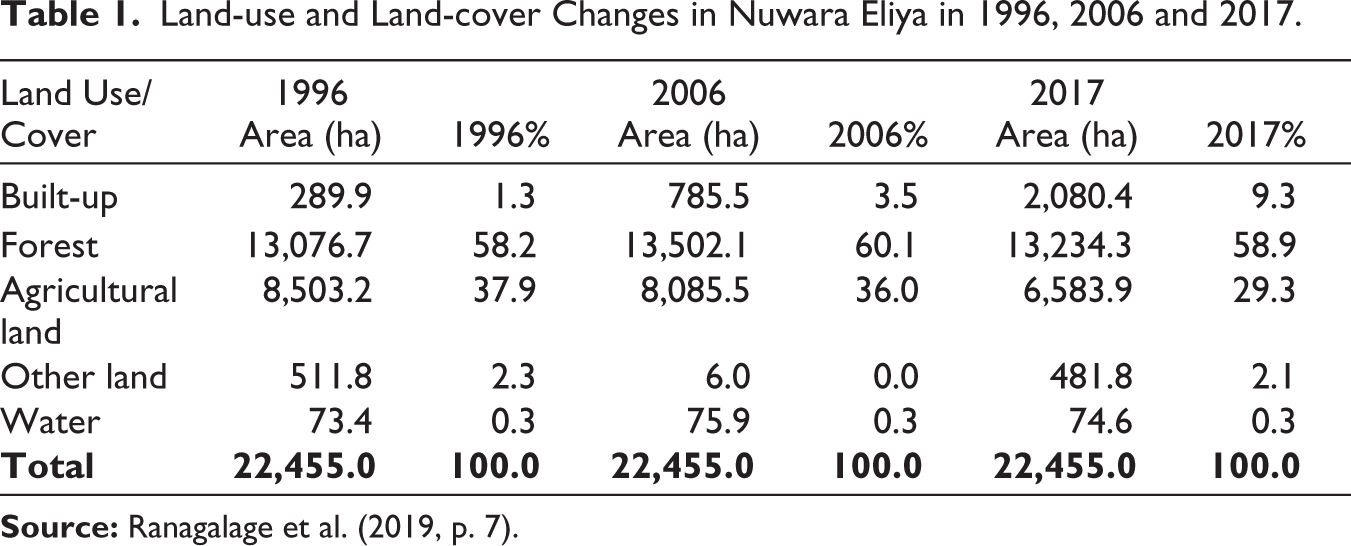
Empirical evidence from land-use and land-cover studies corroborates these trends. Using remote sensing data, Ranagalage et al. (2019) show that the built-up area of Nuwara Eliya increased from 1.3% in 1996 to 9.3% in 2017, while agricultural land declined from 37.9% to 29.3% (see Table 1). Although forest cover and water bodies remained relatively stable—suggesting some degree of environmental regulation—the rapid expansion of built-up areas, largely at the expense of farmland, has heightened pressure on slopes, drainage systems and municipal services. According to Andrieu et al. (this special issue), the urbanized area expanded from approximately 457 hectares in 1988 to about 1,123 hectares in 2022, producing a diffuse pattern of urbanization characterized by infill and scattered peripheral growth; the total urbanized area now stands at around 1,580 hectares. This diffuse expansion further complicates risk management in a fragile upland terrain.
Land-use and Land-cover Changes in Nuwara Eliya in 1996, 2006 and 2017.
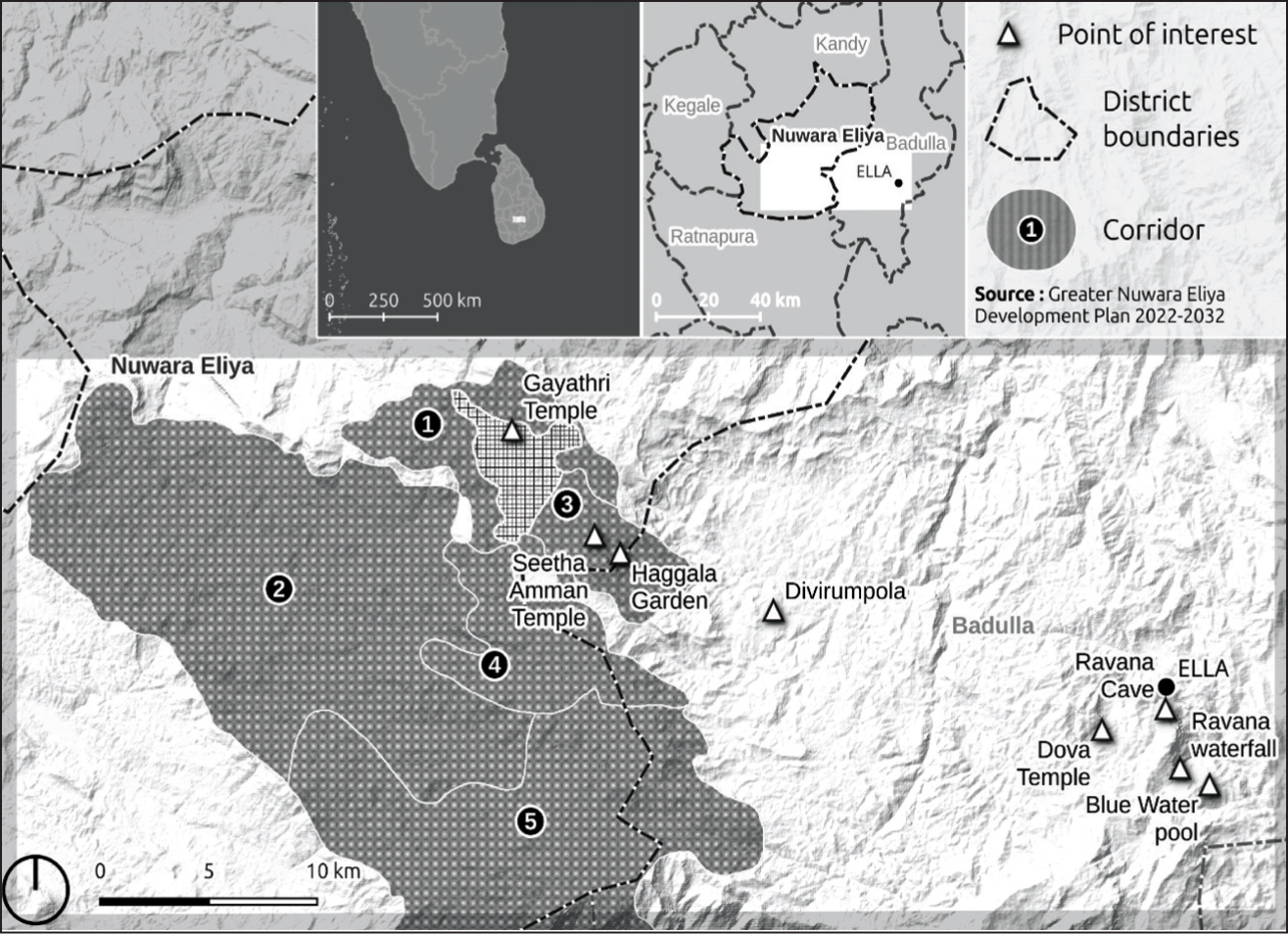
The GNEDP identifies five tourism-related development corridors: (a) the Central Tourism Area, (b) the Tea Tourism Cluster, (c) the Hakgala Flower and Vegetable Corridor, (d) the Dairy and Fruit Farming Area and (e) the Horton Plains Corridor. With the exception of Corridor (d), these zones largely build upon colonial-era spatial structures. Notably absent from this planning framework are Ramayana sites on the periphery of Nuwara Eliya, such as Sitaamman Kovil, despite their growing appeal to Indian pilgrims and tourists. This omission underscores the limitations of a hill station–centric planning approach, particularly as tourism-driven urbanization increasingly extends into environmentally sensitive and hazard-prone areas beyond the town’s historical core. The significance of this gap becomes clearer when viewed alongside the expansion of the Ramayana Trail into emerging tourism hubs such as Ella, where similar tensions between rapid development, weak regulation and environmental risk are evident (UDA, 2021, p. 14).
The hilly landscape around Nuwara Eliya, inclusive of mountains, waterfalls, caves and streams that have acquired their names and specific meanings within the Ramayana narrative and Ramayana Trail, is presented and understood as a means to discover and experience these sites from the angle of Indian tourists. 6
Pilgrimage, Tourism and the Politics of the Ramayana Trail
The Rise of the Ramayana Trail
The development of the Ramayana Trail emerged progressively in the late 1990s and early 2000s, as part of broader efforts to promote cultural and religious tourism between India and Sri Lanka. While some institutional actors identify the early 2000s as a key moment—particularly through initiatives involving the Sri Lanka Tourist Board and private tour operators—the trail is better understood as the outcome of a gradual process of site identification, narrative consolidation and tourism promotion. The Sri Lanka Tourism Development Authority (SLTDA) has identified around 50 Ramayana sites across the country, largely on the basis of folklore, with monuments and shrines at some locations supported by Indian authorities and Hindu religious organizations. The trail primarily attracts Indian visitors who combine religious devotion with sightseeing, many of whom venerate Rama as the hero of the Ramayana and the conqueror of Ravana, the Yaksha king of Sri Lanka, who, according to local narratives, abducted Sita and held her in captivity in the central highlands.
Alongside this, there has been a growing interest among Sinhala Buddhist admirers of Ravana in visiting many of the same sites, not to honour Rama but to celebrate Ravana as a heroic and indigenous figure. This Ravana-centred nationalism gained momentum after the military defeat of the LTTE in 2009 and was actively promoted by pro-government groups such as Ravana Balaya, contributing to broader efforts to reclaim Ravana as a primordial national hero. While several Sinhala nationalist scholars opposed state support for the Ramayana Trail—particularly its perceived promotion by the Indian government—these critiques, voiced most prominently at a national seminar in 2013, were short-lived given the trail’s contribution to sustaining Sri Lanka’s tourism industry (Henry & Padma, 2019; Padma, 2019).
Key Ramayana sites in Nuwara Eliya and Ella are shown in Figure 1. These include Sita Amman Kovil near Nuwara Eliya, Divurumpola—associated with Sita’s trial by fire—and, in Ella, Ravana Cave and Ravana Falls, which feature prominently in local folklore. Through such sites, the mountain landscape itself is narratively reconfigured, with scenic features woven into competing Ramayana interpretations. Despite differing moral readings among Rama and Ravana devotees, these myth-inflected landscapes simultaneously enhance the touristic appeal and devotional significance of the central highlands.
Tourism Corridors and Ramayana Heritage Sites in the Nuwara Eliya–Ella Region, Sri Lanka.
Pilgrimage and Tourism
The Ramayana Trail epitomizes the blurred boundary between pilgrimage and tourism widely discussed in the literature. As Willaime (2006, p. 775) observes, ‘the boundaries between the non-religious and the religious are tending to blur’, with pilgrimage becoming increasingly secular and tourism sometimes acquiring spiritual dimensions. Building on Graburn’s (1983) formulation of ‘play, pray and pay’, we examine the interplay and tensions among religious devotion, economic motivations and pleasure in practices that combine pilgrimage and tourism. In Sri Lanka, sites associated with Ramayana figures—many of whom have been subsequently deified or demonized in Hinduism and Buddhism—are typically located in visually striking natural settings such as mountain peaks and waterfalls, making them attractive to pilgrims and tourists from diverse religious.
Graburn’s insights, originally developed in the Japanese context, are equally applicable to Sri Lanka’s mountainous landscapes, most notably Adam’s Peak, a long-standing pilgrimage site shared by Buddhists, Hindus, Muslims and Christians (de Silva, 2014, 2016; McKinley, 2024). Both pilgrimage to Adam’s Peak and participation in the Ramayana Trail involve overlapping strands of devotion and leisure, respect for religious diversity and, at times, assertions of primordial loyalties and nationalist sentiments separating diverse ethno-religious conglomerates. Historically, pilgrimage has been a central feature of rural Sri Lankan society, functioning both as an act of faith and as a form of seasonal leisure following the agricultural cycle. Obeyesekere’s (1963) ethnography documents how religious motivation and the desire to escape agrarian drudgery jointly shaped collective pilgrimages, while Pfaffenberger (1983) later observed ‘serious pilgrims and frivolous tourists side by side’ at sites such as Adam’s Peak and Kataragama, often generating tensions.
In contrast to sacred mountain landscapes shaped by long-standing ritual and symbolic practices, colonial hill stations such as Nuwara Eliya were deliberately designed to marginalize or render invisible local religious expressions in an effort to homogenize and Westernize urban space. This strategy of exclusion produced the enclaved character of the hill station, insulating it from surrounding communities and sharply distinguishing it from nearby sacred landscapes associated with pilgrimage (Bhattacharya, 2012; Kennedy, 1996). These historical dynamics continue to inform the ways in which tourism has developed in the region, and provide an important backdrop for understanding how contemporary initiatives such as the Ramayana Trail intersect with, transform and at times challenge the inherited structures and meanings of the colonial hill station.
Hill Station Tourism and Ramayana Trail
Although material developments in the hill station—including roads, railways, the Hakgala Botanical Garden and the introduction of European crops—were widely celebrated by Sri Lanka’s emerging middle classes after 1900, a cultural disconnect with the hill station persisted among nearby local communities. This tension is illustrated by local narratives surrounding elephant hunting, a popular sport activity among some early British planters and military personnel. For Sinhala Buddhists, for whom the elephant is a sacred animal associated with the Temple of the Tooth and the annual Asala procession in Kandy, such practices were deeply offensive. The widespread view among Sinhala peasants in the area was that there were two notorious elephant killers among the British in Nuwara Eliya town. One was reportedly killed by lightning. The other had a natural death. However, his burial site in Nuwara Eliya cemetery is repeatedly struck by lightning year after year. Both these outcomes are seen as evidence of karmic retribution against what locals consider an immoral act in the British colonial era. In this instance, the British idea of recreation and pleasure obviously came into conflict with local values relating to the killing of animals, with elephants considered a sacred animal in local Buddhism.
Against this backdrop, it is necessary to assess the relative significance of tourism generated by the Ramayana Trail alongside the enduring legacy of the colonial hill station in central Sri Lanka. Nuwara Eliya has become a globally recognized tourist destination, its appeal reinforced by inherited infrastructure, historical memory and the desire to ‘consume colonial nostalgia’ (Peleggi, 2005), which continues to shape redevelopment and heritage projects such as the Grand Hotel. These initiatives, however, often privilege profit-driven tourism expansion over a more nuanced engagement with contested memories and local sensitivities. At the same time, the Ramayana Trail has contributed to the diversification of tourism by popularizing Nuwara Eliya and emerging destinations such as Ella among Indian visitors and diasporic communities.
While the Ramayana Trail has attracted criticism from some Sinhala nationalist groups—particularly in relation to questions of historicity, Indian geopolitics and its perceived association with Hindutva ideology (Padma, 2019)—its impact on tourism has been significant. More importantly, it offers the possibility of renewing a synthesis between pilgrimage and tourism and advancing forms of cultural tourism that move beyond an overreliance on coastal resorts (in Arugam Bay, for instance) or classical heritage sites such as Anuradhapura and Polonnaruwa.
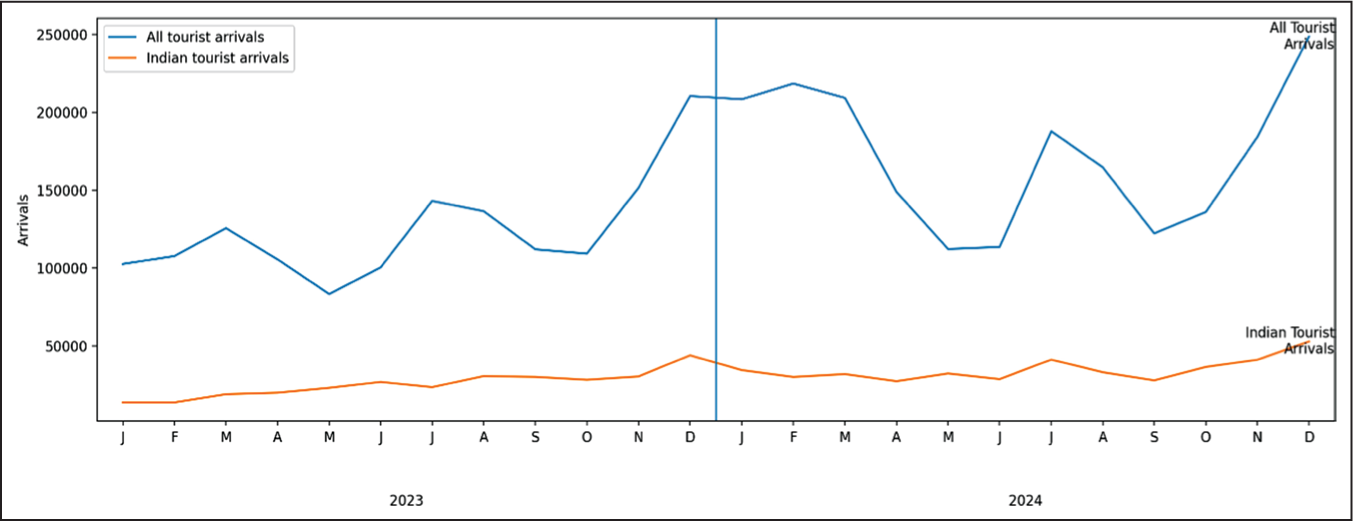
As a proportion of total arrivals, monthly tourist inflows from India ranged from 12.7% in February 2023 to 28.3% in May 2024. This relative increase should be interpreted in context, as overall tourist arrivals declined markedly in May 2024, making the higher share of Indian tourists partly a statistical effect. Nevertheless, the comparatively stable absolute number of Indian visitors during this period points to a degree of resilience in Indian tourist flows at a time when other markets were more volatile. This relative stability is consistent with the broader argument developed in this article regarding the role of regionally proximate, culturally embedded forms of tourism—such as pilgrimage-linked travel—in sustaining Sri Lanka’s tourism sector during periods of crisis (Figure 2). From the available national data, however, it is not possible to determine what proportion of Indian tourists participated in the Ramayana Trail, nor what share of Ramayana-related travel was directed specifically to the central mountainous region examined here.
We conducted in-depth interviews with five tour guides primarily involved in Ramayana tours and focus group discussions with six groups of Indian tourists during their visits to Sri Lanka from 2024 to 2025. One tour guide estimated that approximately 30 guides in Sri Lanka currently specialize in Ramayana tours (Ramayatra). According to another estimate, around one quarter of tourists visiting the central mountainous region in 2023 were Indian nationals, many of whom took part in the Ramayana Trail, although some Indian visitors bypassed the circuit in favour of beaches or historical sites in north-central Sri Lanka. Nevertheless, all guides interviewed agreed that Indian tourist arrivals have increased in recent years, partly due to the introduction of the Ramayatra. Typically, each tour group travels with one guide per bus and, in larger groups, a coordinator who manages site visits and accommodation. Organized tours usually last between four and eight days.
In addition to Ramayana sites, participants visited Buddhist shrines such as the Temple of the Tooth, botanical gardens, spice gardens, ayurveda outlets, viewpoints, gem shops and Indian restaurants. Most participants were familiar with Valmiki’s Ramayana and sought material confirmation of the narrative, for example, at Sita Amman Kovil in Nuwara Eliya, where they looked for Asoka trees (Asoka Vatika), Hanuman’s footprints, soil believed to be scorched by Hanuman’s burning tail, and, in Trincomalee, hot springs in Kanniya and the Koneswaram sites located along the east coast. As part of their training, tour guides were expected to narrate the Ramayana story, facilitate discussion and respond to visitors’ questions. All guides were fluent in English, and some spoke Indian languages such as Tamil and Hindi. One Tamil guide noted that he had acquired Hindi while working as a driver in Qatar. During one focus group discussion, a participant remarked: ‘Our faith in Ram has multiplied many folds during this trip. All Indians must experience this spiritual upliftment’.
Initially, only a small number of operators offered Ramayana tours, but major companies such as Jetwing and Aitken Spence have since entered the market in response to growing demand. These firms collaborate with Indian partners who recruit participants and disseminate information prior to departure, while former participants often encourage friends and relatives to join subsequent tours. Visitors came from diverse backgrounds, including professionals, businesspeople and farmers. Many were elderly (60 years and above), stayed in four- or five-star hotels, adhered to vegetarian diets and spent significantly on gemstones and Ayurvedic products. Hotels in Kandy, Nuwara Eliya and Trincomalee frequently employed Indian chefs to meet dietary expectations, and some service providers, such as spice gardens in Kadugannawa, offered Ayurvedic treatments targeting age-related ailments.
The religious and devotional aspects and pilgrimage characteristics of the trail are captured by the term ‘Ramyatra’, used by most Indian participants to describe the travels to Ramyana sites in India and extension of the pilgrimage to Sri Lanka. Added to this tour are complete vegetarianism during and for some period before participation in the trip, preparation in terms of dress code and application of sacred ash on the forehead, devotional postures vis-a-vis Ram, Sita and Hanuman in the relevant shrines and chanting of sacred mantras during participation in sacred rituals. Ramyatra is considered a spiritual experience of the highest order and a personal encounter with the divine by most participants. The sites visited as part of the trail (yatra) are considered both scenic and sacred, with some healing power compounded by ayurveda therapies, ritual bath (e.g., hotwells in Kanniya) and take-home herbal remedies sold in nearby shops. The rituals in the Hanuman temple in Ramboda and Sita Amman Kovil in Nuwara Eliya have a strong component of devotion and prayer, resonating the PPP formula of Graburn (1983).
Over the years, the spiritual/devotional aspects of Ramayana Trail have expanded with new constructions and practices being added to the sacred mountain scape. Most participants expressed a strong conviction that they had visited ‘authentic’ Ramayana sites and described the journey primarily as a spiritual experience. Many indicated that they would recommend the tour to others or consider returning. Complaints were limited and included time constraints, communication difficulties with local residents and the rigid structure of packaged tours. Participants often articulated negative portrayals of Ravana, and one tour guide observed: ‘I initially tried to correct their statements about Ravana, particularly when he was presented as a Rakshasa with evil qualities, but later I gave up when I realized it was impossible to change their preconceived views’.
Several broader trends emerge from these data. First, Indian tourist arrivals have played an important role in the recovery of Sri Lanka’s tourism sector following the 2019 Easter attacks, the COVID-19 pandemic and the 2022 economic crisis. Second, Indian arrivals show relatively little seasonal fluctuation, providing a degree of year-round stability compared to the marked seasonality of European and North American tourists. Third, while the absolute numbers of Indian tourists did not increase between 2023 and 2024, their stability contrasts with volatility in other tourist markets.
Data on domestic tourism remain limited. As a proxy, visitor statistics from the Hakgala Botanical Gardens indicate that in 2023 the site received 553,586 visitors, of whom 99.1% were domestic and only 0.9% foreign, suggesting the growing importance of domestic travel to former hill stations. However, data on visitation to religious sites such as Sita Amman Kovil in Nuwara Eliya or Dova Temple in Ella are not systematically collected by the SLTDA or other agencies, representing a key limitation of the available evidence.
Ella as a Small Town in the Hills and a New Tourist Resort
Ella can be understood as a distinct form of tourist urbanization in contrast to Nuwara Eliya, reflecting a shift from colonial planning to postcolonial, market-driven development. While Nuwara Eliya emerged through a highly structured colonial framework combining plantation economy, administrative control and elite leisure, Ella developed in the post-independence period under the influence of a demand-driven global tourism industry and state efforts to revitalize tourism during recurring economic crises. Unlike Nuwara Eliya, which was shaped by the centralized design of a hill station and imperial governance (see Figure 1), Ella was a spontaneous development in response to demand from domestic and international visitors. Its urbanization has unfolded incrementally, shaped by market demand, local political dynamics and the actions of dispersed actors. Governance remains relatively weak, as the town is administered by a Pradeshiya Sabha with limited financial and regulatory capacity.
Like many other small towns in the region, Ella began in the 1930s as a small-town centre catering to the nearby tea plantations. A transport agent originating from the South had begun to provide transport services to the local plantations. More people moved to Ella from outside in the period that followed to establish tea shops, boutiques and a collection of local produce such as vegetables. The establishment of the Ella–Wellawaya road and a nearby railway station facilitated the inward movement of people. This became a popular site for local visitors from the 1980s or so, due to the scenic attraction of a nearby waterfall (‘Ella’ literally means a waterfall), mountain peaks, caves and trekking paths. The place became popular with backpackers and other overseas travellers in the 1990s. Land grabbing, including the illegal acquisition of crown land by powerful people in the area, escalated in the latter part of the twentieth century. In the local historical narrative, a number of scenic places in the area, including Ravana fall, had been identified with the Ravana legend, but the area became an important site for Indian travellers after the Ravana trail was launched by tourist authorities in Sri Lanka and India after 2000. Currently, Ella is a leading attraction for nature lovers from abroad, Ravana enthusiasts from Sri Lanka and Ram followers from India, forming an important subset of the visitors to Ella.
There is some ambiguity about the population in Ella town. According to the Ella Development Plan of 2021, the Ella divisional secretary division consisted of 32 Grama Niladhari Divisions, of which 8 constituted the proposed Ella urban area. This urban region had a reported population of 9,860 people as of 2024. Apart from residents in these specified Grama Niladari divisions, those from surrounding areas commuted to work on a daily basis, including workers in tourist establishments. On the other hand, the flow of visitors from within and outside Sri Lanka adds to the population density in the urban area, including consumption of water, electricity and other utilities in this small town.
Although the Urban Development Authority has proposed a development plan (UDA, 2021), much of Ella’s growth continues through informal and semi-regulated processes. In this sense, Ella exemplifies what Denis and Zérah describe as subaltern urbanization: a trajectory unfolding outside metropolitan cores and master-plan regimes, driven by fragmented governance and market opportunities rather than centralized state policies and control mechanisms. A defining feature of Ella’s development is the role played by local communities in shaping the tourism economy, particularly through the rapid expansion of small-scale enterprises such as homestays, guesthouses, restaurants and tour guide services. Homestay accommodation has emerged as a key component of the local tourism boom, responding to increasing demand while providing income-generating opportunities for households and small and medium entrepreneurs (Danthanarayana et al., 2021). In many cases, engagement in tourism is driven by the need for supplementary income, limited employment opportunities and broader livelihood strategies, highlighting the embeddedness of tourism within local socio-economic structures.
Ella caters to both domestic and international tourists, enhancing its resilience during periods of volatility such as the COVID-19 pandemic. Its appeal lies in the combined use of environmental and cultural attractions, including mountain viewpoints, trekking routes, Ramayana sites such as Ravana Cave and Ravana Falls, colonial-era railway infrastructure and surrounding plantation landscapes. This diversity attracts visitors from Europe, India and the Middle East, as well as Sri Lankan travellers drawn by natural scenery and Ravana-related cultural narratives. At the same time, tourism has contributed to significant transformations in local lifestyles, consumption patterns and social relations, as increasing interaction with visitors reshapes everyday practices and community dynamics (Bandusena et al., 2023; Rasanjali et al., 2021).
The resort functions as a hybrid socio-economic space where multiple forms of mobility intersect, including leisure tourism, pilgrimage, adventure activities and informal exchange. It occupies an ambiguous position between village and town: While larger hotels have begun to emerge, much of the accommodation sector remains dominated by small-scale establishments, and local youth increasingly participate in tourism as guides, service workers or entrepreneurs. The expansion of tourism has also stimulated the development of local services, infrastructure and small businesses, reinforcing Ella’s integration into wider national and transnational tourism circuits.
Rapid expansion over the past 15 years has nevertheless generated serious challenges. Forest cover declined dramatically from about 1,000 acres in 1999 to just 3 acres in 2017 (UDA, 2021, p. 13), indicating severe environmental degradation linked to weak enforcement of environmental regulations. Unregulated construction, loss of greenery, inadequate solid-waste management and emerging competition over water and electricity have all been identified as growing concerns by officials and operators. These pressures are compounded by tensions between pilgrims and leisure tourists, Indian Ramyatra participants and Sri Lankan Ravana enthusiasts, and between formally approved establishments and a large informal tourism sector. In 2017, only about one quarter of Ella’s estimated 400 tourist accommodations were registered with the tourist board, reflecting land-title disputes, construction on environmental reservations and regulatory non-compliance. At the same time, tourism development has produced new forms of socio-cultural tension, including conflicts between different categories of visitors, between formal and informal operators and between economic development and environmental conservation.
Taken together, these dynamics illustrate the contradictions of tourism-led subaltern urbanization, in which rapid growth outside metropolitan planning frameworks generates both new economic opportunities and intensified socio-spatial inequalities. Ella thus represents not simply a secondary tourist destination, but a key site for understanding the contemporary formation of upland urbanization in Sri Lanka.
Conclusion
Sri Lanka has had a long and rich history of both pilgrimage and tourism. Nuwara Eliya hill station was a classic example of commercial tourism catering to the expatriate population in Ceylon established under the British Raj. In the post-independence era, it was difficult to maintain the hill station as a colonial enclave isolated from the local population. Ramayana Trail provides an interesting synthesis of pilgrimage driven by religious devotion and tourism for pleasure and entertainment purposes. It is a form of cultural tourism as outlined by Grayburn, more attuned to local culture and lifestyle. Moreover, in the Sri Lankan case, it has served to diversify tourism and attract a new category of visitors to Sri Lanka at a time of serious economic crisis and a resulting downturn in tourism in general. Ramyatra is driven by broadly South Asian cultural norms and may be seen as culturally inclusive and environmentally friendly from a multispecies perspective (McKinley, 2024). However, the actual reality is far more complex, as evident from the serious environmental consequences of rapid, extralegal tourism expansion in Ella and associated processes like the devastating reduction of forest cover. This article highlighted the drivers of upland urbanization in central Sri Lanka and the opportunities as well as the challenges they present. The Ditwah cyclone that affected central Sri Lanka in December 2025 and its adverse outcomes like heavy loss of human life, human displacement and destruction of the network of roads, railway tracks established way back in the colonial era, epitomize the downside of unplanned upland urbanization in an environmentally fragile region.
Sri Lanka badly needs to learn from accumulated local knowledge and the international best practices in urbanization of hilly areas, and customary local practices such as planetary pluralism derived from pilgrimage to Adam’s Peak (McKinley, 2024) and social harmony resulting from shared interreligious participation in pilgrimage to Kataragama and other multireligious sites (Pfaffenberger, 1979). Long-term sustainability of tourism as a viable economic enterprise may be problematic because of its potential adverse impact on the environment, vulnerability to disasters like COVID 19 and antagonistic reactions from local populations and its neocolonial legacy, particularly in a postcolonial nationalist setting (de Silva, 2016; Silva et al., 2021). Pilgrimage, on the other hand, had inbuilt mechanisms such as religious pluralisms associated with Adam’s Peak, which has become shared heritage among multiple religions until violent Sinhala nationalist mobs and politically motivated actors undermined the shared nature of this pilgrimage site and its legacy of interaction and exchanges among followers of different religious traditions (de Silva, 2016; McKinley, 2024). Ramayana Trail may or may not be a continuation of the same pattern under a new dispensation triggered by nationalist regimes in India and Sri Lanka, but it requires a closer examination from the angle of indigenizing tourism and broadening its support base. In any case, a political economy approach also attentive to geopolitics is needed to understand and respond to the challenges arising from haphazard tourist development and upland urbanization in central Sri Lanka. In the Ramayana Trail, an old, established mythical story widely held in the subcontinent has been given a neoliberal spin by the nationalist elites in India and Sri Lanka in ways that promote the tourist industry as well as the social and political orders in the two countries. In such an approach, we need to clearly understand who benefits from tourism/ pilgrimage and who does not, and how to make it a level-playing field not aligned with vested interests of one kind or another and superpower desire for strategic alliances. Despite all its weaknesses discussed in this article, the Ramayana Trail has indigenized tourism to a much greater extent compared to the colonial hill station operated on the basis of racial differences in entitlements and access to social clubs of diverse kinds.
It must be mentioned that the Ramayana story is not merely a mythical tract. It has produced multiple outcomes in the real world. Ramayana Trail, a significant flow of tourists and domestic travellers to the selected sites with the involvement of the organized private sector, establishment of sacred sites, with shrines for selected deities established by religious organizations such as the Chinmaya Mission, involved in the construction of the Hanuman temple in Ramboda, are some further outcomes of the Ramayana ontologies and epistemologies. We must also recognize that the Hindutva ideology in India and the Sinhala Buddhist ideology in Sri Lanka are dominant ideologies sustaining diverse Ramayana ontologies that shape developments in the South Asian region. Ramayana Trail and preceding processes of hill station tourism and mountain urbanization in central Sri Lanka are not isolated developments but interconnected regional processes with diverse economic, cultural and environmental consequences. Compared to colonial designations such as Gregory Lake, Grand Hotel and Gymkhana Club, in the Ramayana Trail, mountain tops and other local sites are identified by known Ramayana characters such as Ravana Rock, Seeta alle and Streepura (women’ s city) in line with the Ramayana tale. This may not be appealing to the extreme Sinhala sentiments looking to Buddhicize and Sinhalize the entire Sri Lankan landscape, as evident in the effort to identify Ravana as a cultural hero of the Sinhalese, but it has an opening for greater diversity than either Little England or Diyathilakapura, the traditional name of the nearby town of Hanguranketha. It must be noted here that the Ramayana tale has different readings in different parts of Asia depending on local interests.
As for the way forward for tourism and tourism-induced urbanization in Sri Lanka, it is necessary to combine cultural tourism with improved governance of tourism and upland urbanization processes in ways that minimize haphazard tourism development with adverse effects on social harmony and natural resource management in the affected areas. Nuwara Eliya hill station and Ella are worlds apart in respect of advancing the natural beauty of the landscape, promoting sustainable resource use practices and governance of urbanization processes and settlement planning. While the Ramayana Trail has certainly contributed to the advancement of tourism in Sri Lanka within a global environment of uncertainty and vulnerability, it has also produced new challenges for resource use and environmental conservation in ways that jeopardize the future of the tourism industry itself. The improved governance of tourism and urbanization processes is a prerequisite for stabilizing the way forward for the long-term viability of the tourist industry in Sri Lanka. While the sanctity of the mountain tops must be preserved and fostered, it should not serve as a restraint on law enforcement. The subaltern urbanization in Ella has facilitated the coexistence of international and domestic tourism as well as pilgrimage and tourism, but underlying potential tensions between Hindu nationalism in India and Sinhala nationalism in Sri Lanka, local residents, outside investors in tourism and visitors from outside the area remain unaddressed and unresolved at the present juncture (de Silva, 2014; Padma, 2019).
In summary, Sri Lanka has diversified tourism in ways that make it more sustainable and compatible with the emerging demands and takes advantage of various niche opportunities in the market. Ramayana Trail is one such opportunity attractive to a category of pilgrims/tourists from neighbouring India as well as Ravana enthusiasts in Sri Lanka. This has enabled the tourist industry in Sri Lanka to become resilient and bounce back after the recent decline in the tourist industry hit by multiple maladies. The data from Nuwara Eliya hill station and Ella presented in this essay do not indicate a consistent pattern in regard to the long-term impact of tourism on environment, economic and social stability of the industry, but the emergence of Ella as a new tourist resort catering to tourists from overseas as well as domestic tourists in ways that promote a form of heritage/cultural tourism may be seen as a positive development that has added to the diversity of tourist attractions in the country over and above the hill station established during the heyday of colonial rule. The article also pointed to several new challenges connected with the Ramayana Trail in Ella, such as urban sprawl, unregulated tourism expansion, environmental challenges generated by this development, as well as related tensions among different stakeholders and subaltern groups in the mountain landscape. The ongoing effort to rebuild Sri Lanka in the aftermath of the Distwah disaster should pay close attention to both positive and negative outcomes of developments pursued so far and cautiously guide upland urbanization in an environmentally friendly and socially sustainable manner.
Footnotes
Declaration of Conflicting Interests
The authors declared no potential conflicts of interest with respect to the research, authorship and/or publication of this article.
Funding
The authors disclosed receipt of the following financial support for the research of this article: This work was funded by the Subaltern Urbanization in the Touristic Mountains of Southern and South-Eastern Asia (URBALTOUR research project ANR-21-CE22-0008).