







Abstract
Homeschooling is an alternative educational approach where parents assume the responsibility of educating their children at home instead of enrolling them in formal schools. This study focuses on the lived experiences of parents of homeschoolers from Chennai District, Tamil Nadu, in India, offering a localised perspective of the homeschooling landscape. The article explores the perception of parents regarding the prevalence of homeschoolers, parental motivations and the teaching–learning processes using a qualitative case study approach. Snowball sampling was employed to identify participants and conduct in-depth interviews with 12 families. The study documented the nascent status of homeschooling in Chennai. It also highlighted the need for regulations and official records in non-intrusive ways. Parents prioritised dissatisfaction with the formal school system as a significant reason to homeschool over religious instruction and continuation due to COVID-19. The study reveals that homeschooling practices are characterised by flexibility, learner autonomy and personalised learning. Families adopt diverse curricula and pedagogy, ranging from unschooling to structured, board-aligned education. However, they also acknowledge the need to participate in formal board exams for higher education access. Also, it is perceived that homeschooling provides meaningful socialisation through broader community interactions, challenging the stereotype of isolation of homeschoolers. Challenges identified with regard to homeschooling include social stigma, parental self-doubt and overwhelming responsibilities. The study calls for improved school–home partnerships with broader community involvement to support inclusive learning environments.
Introduction
Homeschooling, recognised as an alternative schooling practice globally, is gaining momentum in India. Mehrotra (2007) argues that homeschooling is viable and inclusive for a diverse population. However, homeschooling is debated to be a controversial practice, owing to child safety, socialisation and other reasons. The authors observed that homeschooling practice in India does not gain momentum beyond social media platforms such as YouTube, Facebook and Instagram, where Indian parents post about their experiences.
Historically, education in India was community-centred (Kambala & Mathe, 2023). However, the advent of colonial education marked a significant shift. As Kumar (2005) notes, colonial education was not merely about imparting information; it acted as a tool for dominance. The British created it to divide and create a class of Indians to perpetuate colonial values and maintain social control. The colonisers aimed to shape a class of Indians who were Indian by birth and appearance, but English in their preferences, thinking and values (Macaulay, 1835). In response, social reformers in the late 1800s and early 1900s created schools, promoting alternative education systems as a means of social transformation, emphasising inclusivity (Mehrotra, 2007). Therefore, alternative schooling is not a new term for India.
According to Mehrotra (2007), alternative schooling constantly evolves with an aim for holistic development and focuses on the unique requirements and strengths of each child, in contextually relevant settings, integrating arts, crafts and life skills. Several families consider homeschooling as one of the alternative schooling choices, yet it is deemed unconventional in India. In this study, the authors refer to homeschooling as interpreted by Donnelly (2012), where learners are educated under parental supervision, generally at home rather than in conventional institutions.
According to Donnelly (2012), there is ‘no regulation’ for homeschooling practices in the Indian context. The Right to Free and Compulsory Education Act (RTE) 2009 (Ministry of Law and Justice, 2009) did not recognise homeschooling as a legal option. However, the Ministry of Human Resource Development clarified that parents are free not to send their children to a state school and that the RTE Act was not intended to micromanage parents. The ministry also stated that formal recognition of homeschooling was deemed unviable to ensure the universalisation of education. More recently, India’s education policy recognises the need for alternative schooling in light of access, equity, quality, affordability and accountability in education systems. Further, the National Education Policy (NEP) (2020) promotes the strengthening of Open and Distance Learning by the National Institute of Open Schooling (NIOS) and State Open Schools (Ministry of Education, Government of India, 2020, para 3.5), expanding to meet learning requirements. The National Credit Framework (Ministry of Education, Government of India, 2023) further legitimises homeschooling by allowing credit recognition and flexibility (para 2.3.3).
In this context, this study seeks lived experiences amidst the lack of regulatory frameworks in a traditional schooling society. The following narrative review highlights the research gaps that validate the significance of the present study.
Review of Related Literature
Homeschooling practice gained traction in the 1970s and 1980s due to the influence of John Holt, Ivan Illich and Raymond Moore (Nelson, 2014). This narrative review examines (a) the prevalence of homeschoolers, (b) motivations that drive parents to homeschool their children, and (c) the day-to-day practices of homeschoolers from open-access literature from 1985 to 2024 across global and Indian contexts.
Prevalence of Learners in Homeschooling
Among BRICS nations, Russia and South Africa only legally recognise homeschooling (De Beer et al., 2020). Homeschooling in India, though unregulated, is estimated to involve 500–1,000 students (Home School Legal Defense Association [HSLDA], 2019), with growth seen in cities like Bengaluru, Pune and Mumbai. Predominantly chosen for children aged 12–15, it gained broader acceptance during the COVID-19 pandemic (Dewra, 2021; Vijayakumar & Lawrence, 2021).
The literature records a lack of reliable data due to inconsistent state regulations and formal systems for tracking (Lees, 2010; Myers, 2022; Taylor, 1992). Several families further avoid registration due to privacy concerns or distrust of authorities, engaging in underground homeschooling (Lees, 2010). Self-selected samples also act as a hindrance to the representation of the broader population (Myers, 2022). Finally, the fluid nature of homeschooling itself complicates the enumeration, where families move in and out of homeschooling practice (Thomas, 2016). Therefore, the literature indicates variation in the prevalence of homeschoolers due to legal, cultural and socio-economic factors.
Reasons for Opting for Homeschooling
Van Galen (1986, 1988) classified homeschooling motivations into two groups: conservative Christians as ‘ideologues’, opposing school values, and ‘Pedagogues’, who sought a flexible approach. Expanding on this, Isenberg (2002) identified dissatisfaction with school quality, financial and family needs, and minimal influence of homeschooling laws on decision-making. Kingston and Medlin (2006) identified ‘socio-relational’ motivations, where parents choose homeschooling to foster stronger family bonds and promote positive social development. Data from US studies revealed diverse motivations, where 31% of parents cited concerns about the school environment, 30% religious reasons, 16% were dissatisfied with academic quality, and 14% had children with special needs (Princiotta & Bielick, 2006). Ninety one percentage of American parents cited safety and peer pressure, 77% moral instruction, and 74% dissatisfaction with academics as major drivers (Redford et al., 2017).
In Israel, Guterman and Neuman (2017) observed motivations such as poor school experiences and a desire for personalised learning, parents’ own negative experiences during their schooling, differences in educational philosophy, and parents’ need for closer relationships were some of the rationales for homeschooling. Similarly, in Eastern Europe, Rochovská et al. (2020) record motivations ranging from academic dissatisfaction and religious beliefs to geographic isolation and health concerns/giftedness. The COVID-19 pandemic resulted in increasing interest in homeschooling as a viable educational alternative. In Italy, Chinazzi and Fensham-Smith (2024) found that 63% of parents began homeschooling their children post-2020, citing pedagogical concerns and family well-being over religious motives. In India, homeschooling began in 1993, due to dissatisfaction with formal schooling methods, which prioritised exams, ranks and performance over meaningful education (Vijaysimha, 2007). Dewra (2021) found that parents in the Delhi NCR region chose homeschooling due to dissatisfaction with rote learning and a desire for personalised education.
Teaching–Learning Process in Homeschooling
Homeschooling involves the utilisation of diverse pedagogical strategies, of which direct instruction and independent study are the most popular. These strategies are reinforced by instructional material from established publishers, textbooks, workbooks and computer software. The phenomenon of unschooling also gained popularity, advocating experience-based learning incorporated into everyday life (Clements, 2002). Vijaysimha (2007) recounts that her family focused on exploration and real-world experiences. Children were actively participating in creating rules, planning timetables and shaping the curriculum, while learning from nature, experiments and daily life rather than heavy textbooks and rigid classrooms. For assessment and evaluation, the children prepared for NIOS, during which the focus remained on understanding and allowing children to take exams at their own pace. Achievement was measured with diverse academic pursuits.
Thomas (2017) noted that 68% of families followed an eclectic approach combining multiple curricula and learning resources. Further, 13% of the participants followed the unschooling approach. The study also shows that 5% of homeschooling parents use a ready-made, boxed curriculum, while 14% follow a classical approach tailored to age-appropriate learning methods. Sabol (2018) records the increasing role of technology, including computer literacy, online resources and interactive learning through field trips and reading activities. Kunzman and Gaither (2020) note that homeschooling practices range from formal, school-like structures to eclectic and flexible methods, with support from prepared curricula, co-ops and libraries.
In India, Gururaj (2021) highlights the influence of online platforms like Byju’s and distinguishes homeschooling from online schooling. Furthering this line of enquiry, Guterman et al. (2024) categorise homeschooling evaluation into four generations: summative (grades), formative (skills and self-regulation), goal-oriented (value-based learning) and constructivist (learner-directed evaluation).
Kunzman and Gaither (2020) record that findings on the socialisation of homeschoolers have been inconsistent. Abuzandah (2020) records that homeschoolers face social challenges when interacting with peers. However, other research suggests that homeschoolers who engage more frequently with peers tend to have better socialisation skills and reduced social pressure (Abuzandah, 2020; McCabe et al., 2021). The lack of negative peer pressure leading to growth of homeschoolers with authentic identities (McCabe et al., 2021) was also observed.
Dewra (2021) found that parents, especially mothers, initially doubted their homeschooling decision but later reported satisfaction and fulfilment. While family and social circles initially expressed scepticism, acceptance grew over time. Homeschooling parents in Russia report a lack of pedagogical competence, limited resources, psychological barriers (during the transition and implementation phase), societal misunderstanding and stress from motivating children. They also report role confusion between being a parent and a teacher, and address these issues by relying on intermediary organisations like corresponding schools, tutors and family schools. They also employ diverse materials, engage with online and offline communities and experience advocacy groups provide support (Lyubitskaya & Polivanova, 2022).
The literature reveals extensive global research on homeschooling. However, in India, despite the presence of homeschooling families, rigorous research remains limited. Recognising this gap, the authors seek to explore homeschooling in the Indian context. The subsequent section outlines the study’s research design, sampling techniques, data collection, analysis and limitations.
Research Design
According to Yin (2014), a case study design is particularly suitable for addressing questions such as ‘how’, ‘why’, ‘what’ and ‘who’. Therefore, it was deemed the most appropriate approach for this research. The study adopts the case study research design to explore homeschooling as a phenomenon within the context of Chennai. Given the study’s primary focus of exploring research questions regarding homeschooling practices, this design ensures depth and flexibility. Consistent with Merriam (2009), the research aims to develop heuristic insights by offering a deeper understanding and discourse within the urban Indian educational landscape.
Participants and Sampling
This study utilises the snowball sampling technique to identify and interview homeschooling families, as it is appropriate for exploratory research to identify information-rich cases through referrals from initial participants (Patton, 1990). The authors initially identified participants through a Facebook homeschooling group (The Chennai Homeschoolers) and an organisation called Cascade Learning Space, with initial participants referring to subsequent participants. The authors interviewed families with one or more homeschoolers residing in Chennai, a total of 20 parents from 12 families, ensuring that the cases have relevance to the phenomenon under investigation.
Data Collection
A semi-structured interview method was employed to gather insights from parents. According to Yin (2014), it helps to elicit responses that provide enriched personal insights, perceptions, attitudes and meanings. The semi-structured interview questions the parents regarding the prevalence of homeschooling, the rationale for homeschooling, the teaching–learning process and the socialisation of the homeschoolers. A pilot study was conducted with two homeschooling families to ensure credibility and extenuating bias in question design. While minimal response bias was observed, all responses were critically examined and contextualised in the discussion section. Respondent validation was undertaken by obtaining participant feedback on the emerging findings. Data collection continued until saturation was reached and no new information emerged. Discrepant case analysis was consciously employed by actively seeking data that could support alternative explanations, by probing and receiving continuous feedback (Merriam, 2009). Adopting a constructivist worldview (Creswell, 2009), the authors engaged in open-ended questioning and understood the context by visiting and gathering information personally. Interviews were conducted in the Tamil language between March and April 2023, each lasting 30–45 min. Informed consent was obtained by explaining the nature of the case study and requesting their voluntary involvement. Participants’ privacy and confidentiality were safeguarded, and all ethical guidelines were strictly followed throughout the research process.
Data Analysis
The data analysis was conducted by systematically organising data from field notes and interview transcripts into general categories related to the objectives. Parents’ responses were translated with careful attention, ensuring epistemological accuracy, maintaining confidentiality and respecting participants’ voices. The thematic analysis was conducted following the guide by Braun and Clarke (2006). The authors familiarised themselves with the data, generated initial codes, organised the codes into specific themes, reviewed the themes by ensuring accuracy concerning the context, defined and named the themes, and concluded by systematically writing a detailed report. Specific themes were further refined under general categories iteratively, using a coding scheme developed manually by the authors and reviewed by peers and experts. Both intersecting and non-intersecting themes were examined, using within-case and cross-case analysis to identify, categorise and explore commonalities and unique patterns in the data.
Results
Prevalence of Homeschoolers in Chennai City
The authors interviewed 12 homeschooling families, comprising six families with a single child and six with two children. In total, the study accounts for 18 homeschoolers. Learners ranged in age from 0 to 20 years: 2 were aged 0–5, 8 were aged 6–10, 5 were aged 11–15, and 3 were aged 16–20. All participating families predominantly belonged to middle- and high-income groups, and possessed a minimum of a Bachelor’s degree.
The lack of official statistics makes it difficult to estimate the number of homeschoolers, compare trends or plan for community building and resource allocation. Parents estimated that there could be around 500–600 homeschooling families in Chennai city alone. One parent remarked: […] I believe that there should be around five hundred to seven hundred homeschooling families in the city. But … I am not very sure of it. I am estimating this number based on the number of participants in the Facebook group. I personally know ten to twelve families.
Further, one of the homeschooling parents noted that the homeschooling movement in Chennai is in its nascent stages when compared to Pune, signalling that other cities (like New Delhi, Mumbai and Bangalore) have had homeschooling practices for decades.
Voice of Choice: Why Parents Opt for Homeschooling
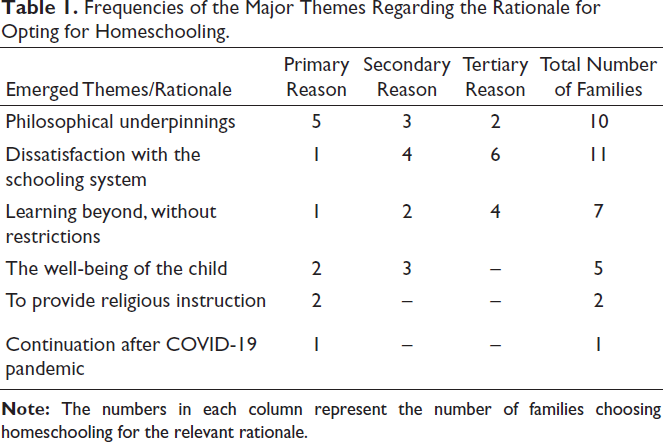
Interview responses were thematically categorised based on primary, secondary and tertiary motivations (see Table 1).
Frequencies of the Major Themes Regarding the Rationale for Opting for Homeschooling.
Dissatisfaction with the Schooling System
The most recurring motivation was dissatisfaction with the current schooling system. Parents criticised the overemphasis on rote learning, the autocratic system and the lack of individualised assessment: […] learning to learn is important; anyone can memorise, but to learn, to construct knowledge, and to critically analyse in all available opportunities is learning.
Further, reflecting on their own dissatisfaction with formal schooling, another parent posed a question: […] How many school-going kids are curious and excited to wake up and go to school? This is a fundamental question that parents have to ask themselves and discuss with their children. If a child is going to spend 6 to 7 hours every day in school, meaning they spend their childhood in school. How do we want our children to remember their childhood? What is childhood? Is it worth it?
Parents are further dissatisfied with the culture of competition, which conditions learners towards marks, and the lack of creativity of the formal education system. Also, parents stated that, in formal schooling, there is a gap between theory and practice, and gives rise to mechanised learning (limitations in time, space and pace), fearing no scope for intellectual or creative thriving.
Philosophical Underpinnings
Three families opted for Montessori philosophy for holistic growth, encompassing physical, cognitive, emotional and social: […] Not only having adopted Montessori Methods placed emphasis on my son’s uniqueness, but there is an environment of respect not only towards people or my son but even towards the learning. This has not only helped us to use available materials to learn, but give autonomy to my son to design and develop learning materials, and simultaneously learn.
Another family adopted a naturalistic philosophy, where the child’s natural potential was explored in organic settings. A parent was influenced by Freire’s problem-posing education and critiqued the current education system for not encouraging critical thinking and for a lack of engagement in real-world problems. Pragmatism was cited for its emphasis on practical learning and the application of knowledge to real-life situations. Across philosophical ideologies, there was a common thread of commitment to autonomy, relevance and critical engagement for learning.
Within Walls, Without Boundaries
The third most common reason for homeschooling was the autonomous nature, without a rigid curriculum and the ability to explore topics at will: […] the idea that learning for the sake of learning is precious. This is a hallmark characteristic of homeschooling. The ability to choose and pursue just their interest without any boundaries helps the children to learn […].
They stated that the prioritisation of exams restricts learning with its structure, while homeschooling offers the freedom to learn without any restriction and a significant improvement in learning experiences.
Prioritising the Well-being of the Learner
Five families cited concerns for their child’s mental and physical health and stated that school environments triggered anxiety and psychosomatic symptoms: […] It has rescued my child from formal school stress. It has set my child free from exam tension, peer pressure and has given a new sense of purpose for learning. Now learning is not just for validation. But for thriving and flourishing with good mental and physical well-being.
Another family commented that the health and hygiene practices in the school are not up to standard, highlighting the need for a conducive and healthy school environment.
To Provide Religious Instruction
Two families chose homeschooling to support religious learning, specifically in Vedic studies. One parent shared: […] my son had a natural calling towards learning Veda.
1
He attended regular school till class 6 and continued in a school that offered Vedas and regular education, but there was no progress in his Veda. He wanted to learn full-time Veda, and so we obliged to his desire.
Parents highlighted that, apart from cultural preservation, homeschooled children could pursue that which truly mattered to the learners.
The Pandemic’s Impact to Homeschooling
For one family, COVID-19 catalysed the shift due to the ineffectiveness of online classes, and they continued to homeschool. The parent reflected: […] We started homeschooling during COVID-19. When we had made that shift, we felt that homeschooling was more effective and engaging than staring at a screen all day.
Further, parents noted that there was no public awareness regarding the difference between homeschooling and attending online classes from school during COVID-19.
Teaching–Learning Processes of Homeschooling
This section presents the diverse practices employed by homeschooling families, focusing on scheduling, curriculum, assessment and socialisation.
The Rhythm of Learning: A Fluid Approach
Eight families reported a fluid approach, prioritising child-led schedules. A noteworthy observation is that families do not impose sleep schedules or meal timings; they allow the circadian rhythms
2
to regulate. A parent shared: […] Learning is not scheduled. Learning happens everywhere; we must be open and responsible to make the most out of each opportunity.
Each homeschooler contains unique academic needs on a day-to-day basis, and parents ensure it is child-centric rather than following prescribed or framing schedules without consulting their child. This practice facilitates parents to retain the organic nature of learning to ensure deeper engagement.
Curricular Pathways: From Unschooling to Formal Frameworks
Seven families embraced unschooling. 3 Three families followed the Montessori approach, combining structure, autonomy and hands-on learning
Two of the twelve families curate their own curriculum to ensure balancing current learning needs and developing credentials for future opportunities. These different approaches exhibit the ability of homeschooling to suit their child’s needs and learning style.
Pedagogical Approaches: A Mosaic of Methods
Families engaged in diverse pedagogies from project-based learning using digital tools to road schooling,
4
prioritising learning life skills first-hand. All families integrated ICT tools on an everyday basis. One of the families gamified
5
their learning experiences to leverage the video games (like Minecraft, The Legend of Zelda) and even normal board games to enhance engagement. Parents also stated that they do not adhere to one particular method, emphasising the adaptability and resourcefulness of the homeschooling practice. A parent commented: […] A homeschooling parent will utilise every opportunity to make it a learning opportunity, everything is a learning resource. Everything.
Use of diverse resources beyond traditional assigned books, such as online resources, libraries, museums and parks, and sharing resources as a part of the community, contributes to the dynamic learning environment.
Beyond Pen and Paper
All interviewed parents reported avoiding pen–paper tests or memory-based recall-type tests. Instead, they rely on observation, dialogue, worksheets, online quizzes, reviewing and project-based tasks. Four of eighteen learners had taken the board examination (10th-grade examination) as a necessity to obtain credentials, and other parents acknowledged the necessity of board exams for career progression in India. Despite their commitment, parents doubted their ability to provide adequate education. One parent reported that they often introspect if the decision to homeschool is their need or their child’s. Five of the twelve families faced challenges while navigating professional and personal commitments. Parents expressed their frustration, as homeschooling is unconventional and there is a prevalent social stigma against it in Indian society: […] People constantly keep asking if my child can write or read or even know English. It is not only insulting. There is a constant need to justify why we homeschool.
This stigma not only creates insecurity but also isolation and undermines parents’ confidence. Parents also voiced concerns if their children will be able to attend and excel in assessment and evaluation on par with peers attending formal school.
Homeschooling Does Not Equate to Isolation: Robust Socialisation of Homeschoolers
The homeschooling families challenge the conventional view that school is the ideal location for socialisation. They argued that this was due to the strict adherence to misguided discipline and dominance of school authority: […] In our schools, don’t teachers say keep quiet? or raise your hands, don’t talk… The only time that the children socialise is during their break time. The kids are conditioned to speak only after the bell, make noise after the bell. And the schools are clearly homogenous when it comes to social class. Because low and middle income parents choose a specific set of schools and high income parents choose a different one. There is a clear class division due to the fee that they can pay. So, how is the socialisation here diverse?
Homeschooling families in this study report limitations of formal schooling, where disparities in social interactions spanning different socio-economic backgrounds, ability and age groups are noted. Parents stated that their children do not have any restrictions on making friends. Based on the results, the authors in the following section discuss these results in relation to existing literature, theoretical frameworks and broader educational implications.
Discussion and Conclusion
The following section situates the results within the Indian context to critically examine their meanings and ramifications for educational policy and practice.
The authors framed the first research question to estimate the prevalence of homeschooling families in the city of Chennai. Methodological challenges such as the absence of records, registers and the lack of guidelines or laws in India are recognised as inherent challenges. Although the draft NEP (Ministry of Human Resource Development, Government of India, 2019, para. 8.4.2) proposed developing norms and recognising alternative schools, it has been excluded from the final policy document.
Parents in the present study estimated 500–600 homeschooling families, contradicting the range of 500–1,000 homeschoolers from the literature (HSLDA, 2019; Sinha, 2016). However, these estimations are unreliable, as they are primarily derived from social media sources, highlighting the need for reliable registries. Also, the Indian literature pertaining to homeschooling (Dewra, 2021; Khurjekar, 2020; Sinha, 2016; Vijayakumar & Lawrence, 2021; Vijaysimha, 2007) lacks clear methodologies, making such figures debatable. A similar trend is observed globally due to a lack of dedicated data collection and reluctance among families to self-identify (Kunzman & Gaither, 2013, 2020). Further, it is challenging to identify geographically dispersed homeschoolers due to the lack of a sampling frame (Collom & Mitchell, 2005).
Bartholet (2020) opined that the primary issue with the absence of records is not just to estimate the prevalence but also to trace homeschoolers, address child protection concerns and ensure that children’s rights are protected. Consequently, the lack of registers or records adds to the fear of the hidden dangers of homeschooling (Myers, 2022) that needs to be further explored in India. A mechanism for voluntary registration or data collection methods with large-scale surveys without enforcing restrictive regulations on homeschooled families can help understand the diverse educational landscape of India.
Dissatisfaction with the schooling system was a dominant theme, with concerns regarding rote learning, lack of critical thinking, rigid assessment and high-stress levels. This aligns with global literature (Isenberg, 2002; Murphy, 2014; Princiotta & Bielick, 2006; Redford et al., 2017; Rochovská et al., 2020) and reflects long-standing discontent. As Holt (1981) emphasised, parents feel that the fundamental problem in education is the nature of schooling itself. In the Indian context, these concerns are intensified by systemic pressures such as standardised tests and competitive exams, which parents believe limit exploration and creativity. This observation is supported by Kharbanda (2022), Mooij and Majumdar (2012) and Margaret (2023), who highlighted the dominance of marks-oriented success and the neglect of holistic learning, creating homogenised educational experiences.
These concerns suggest a shift towards experiential and skill-based learning. This paradigm shift, as proposed by the NEP (2020), aims to foster conceptual understanding, active learning, and skill- and student-centric approaches (Maiti et al., 2024). However, it remains to be seen how these policy changes will influence future homeschooling decisions.
As noted in the findings, parents’ dissatisfaction stemmed not only from their children’s experiences but also from their own negative schooling backgrounds. This intergenerational critique raises important questions about the autonomy of children in the decision to homeschool and whether their experiences are authentically self-driven or shaped by parental bias needs further probing.
Parents adopted varied educational philosophies and ideologies, such as Montessori’s holistic education, pragmatism, naturalism and problem-posing educational models. These results align with the initial categorisation of Van Galen (1986, 1988) but are not confined just to these binary categorisations. This could be due to India’s diverse and pluralistic contexts, which blend ideology and pedagogy to seek more holistic development.
Concerns about student well-being were significant. Parents cited the competitive schooling environment as a source of stress and anxiety. In particular, 85% of secondary school students in Chennai reportedly faced moderate to high levels of academic stress (Elavarasi & Rajendran, 2021). Furthermore, studies (Gautam & Sharma, 2024; Joy & Bindu, 2022; Kadir & Salija, 2018; Maitrik, 2024; Mayya et al., 2022) documented the academic stress owing to peer pressure. Also, recent findings of increasing mental health issues among adolescents (Balamurugan et al., 2024; Deb & Deb, 2025; Malhotra & Patra, 2014; Murthy, 2017; Raman & Thomas, 2023; UNICEF, 2021) are reported, due to stress from schooling. In contrast, homeschooling is perceived by parents as a more nurturing, individualised and flexible learning environment that supports emotional well-being. This underscores the critical link between well-being and learning, as supported by longitudinal studies demonstrating that early educational success positively influences adolescent mental health (Gutman et al., 2010).
According to parents, homeschooling also enables interest-driven, self-paced learning that breaks free from curriculum constraints and fosters deeper engagement. This aligns with the global literature (Chinazzi & Fensham-Smith, 2024; Eldeeb et al., 2024; Guterman & Neuman, 2017; Mandel, 2021; Ray, 2015; Thomas, 2017), which emphasises autonomy and flexibility while homeschooling.
Learning is integrated into everyday life, allowing children to develop practical life skills and fostering a lifelong love for learning. While long-term research on the impact of homeschooling in India is scarce, Murphy (2014) reports that homeschooled individuals often experience higher life satisfaction and are more likely to homeschool their children.
For one family in this study, the onset of the COVID-19 pandemic prompted the shift to homeschooling, citing the ineffectiveness of remote learning in traditional schools. Over time, this transition evolved into a conscious lifestyle choice. These findings are consistent with studies reporting a sustained rise in homeschooling in the post-pandemic period (Cheng & Watson, 2024; Duvall, 2021).
Unlike global literature, which highlights race (Fields-Smith, 2015; Fields-Smith & Kissura, 2013; Ray, 2015), special education (Cook et al., 2013; Maxwell et al., 2018; Morse & Bell, 2018; Parsons & Lewis, 2009; Ray, 2015; Smith & Nelson, 2015) and substance abuse or peer pressure (Redford et al., 2017) as significant factors in homeschooling decisions, these factors were not reported by families in the current study. This could be due to the changing sociocultural context of India, suggesting that there is a need for quantitative data over a time period to track parents’ motivation owing to specific key factors that continue to drive this educational choice.
The results suggest that the routines and timetables of learners belonging to homeschooling families differ and are not predetermined. Learning is viewed as an ongoing, holistic process as opposed to a time-constrained activity. This strategy defies traditional schooling standards and emphasises the dedication of the families to create intrinsic motivation and a love for learning. The results are in contrast to those of Thomas (2016), who observed that although homeschooling schedules differed, 73% of the families reported spending four or fewer hours per day on academic activities. This may be because of the differences in context between India and the West, especially in terms of rationale, availability of resources and academic culture. Importantly, hours devoted to academic activity are not always a measure of active engagement in learning. Further, the lack of formal academic hours questions how quality learning is ensured, especially in a country like India, where academic success is commonly gauged by performance on standardised tests.
While learner autonomy is fostered by flexibility, the long-term academic implications of such unscheduled learning strategies need further investigation. While the families in the present study embraced flexibility, it is also crucial to consider the potential challenges arising out of parents’ occupation that hinder reciprocal teaching, 6 as 16 out of 24 parents were working. However, in the Indian context, the family and neighbourhood provide shared learning experiences to the children (Tuli, 2012), and this might have addressed the challenges of the working parents.
The findings depict a range of curriculum approaches—from unschooling to regulated curricula (NIOS or IGCSE) that conform to examination boards. The school board is pursued by the families since there is a huge focus on standardised testing and certification to progress to higher studies. The question arises whether there is proper alignment between unschooling practices and the ability to attend board exams.
The finding is consistent with previous studies (Clements, 2002; Thomas, 2017), noting that parents individualise curricula by utilising an eclectic method from multiple sources. Parental skills, motivation and values play a key role in the customisation of learning experiences. With increased focus on experiential learning through real-life activities, homeschooling households do not merely depend on internet sources like Unacademy, Duolingo and Swayam, but also on communal sources such as museums, libraries, books and travelling, and merging with routine work like supermarket shopping and gardening to support the learning process, highlighting the ability to use these resources optimally for learning.
The adoption of unschooling is radical in Indian society, but it also mirrors the urgent need for learners’ autonomy driven by intrinsic curiosity and flexibility. Families interviewed followed constructivist, experiential and pragmatic approaches to learning. This coincides with Piaget’s theory of cognitive development (1952), Vygotsky’s theory of sociocultural (1980), Montessori’s philosophy (1912) and Kolb’s theory of experiential learning (2015). The parents’ adopting ‘road schooling’ to incorporate all travel as spontaneous learning is in agreement with Kolb (2015), regarding knowledge formation. Parents find satisfaction in gamification and play-based learning to conceptualisation among learners, which is in concurrence with Alotaibi (2024), highlighting the effectiveness of game-based learning.
In line with the deschooling ideology of Illich (1971), parents tutored with subject experts to mentor learning, providing ‘reference services’ based on the learner’s interest. Further, the notion of social and cultural capital (Bourdieu, 1986) suggests that parents’ ability to employ tutors or participate in homeschooling communities is not only a proactive response but may also reflect and reproduce class privilege. Here, critically, one has to observe that, to homeschool, parents need to be able to spend on resources, which a middle- and lower-class parent in India would find hard.
The assessment and evaluation choices of homeschooling families are not just a shift from traditional standardised testing but a critique on lack of inclusivity in testing methods in formal schools. Parents often pointed out that learning and flourishing happen with self-motivation as positive attributes of homeschooling. It is also relevant to note that minimal exposure to competitive settings of conventional extracurricular and co-curricular activities may impact the interpersonal abilities and resilience of the learners. Still, on practical grounds and utilitarian pragmatism, families fall into line with the formal system and undertake board examinations for career progression, which is driven by an examination system with marks and grades.
The parents in this research are aligned with the fourth generation, where assessment is student-centred, emphasising engagement, reflection and skill development (Guterman et al., 2024). Interestingly, homeschooling families reported success in board exams with little traditional preparation, demonstrating the possibility of self-directed, interest-based learning to facilitate learners to address competitive exams. Nevertheless, such results cannot be applied to all homeschoolers, as this largely relies on parental support and motivation, among others.
Parents highlight the socio-economic or age-group homogeneity and the restrictive environment of traditional schools as more significant challenges in formal schooling against socialisation, and report that homeschoolers get a diverse exposure and learn from every interaction. Further, this result is in accordance with Gaither (2009), Kunzman and Gaither (2013) and Medlin (2013), who state that interaction of homeschoolers with different age group members develops a sense of empathy and also leads to the development of positive relationships with peers and adults. Future research could investigate the long-term social and emotional outcomes of homeschoolers to fully evaluate the efficacy of homeschooling.
The pressure to homeschool with limited resources, as highlighted by participants, can be mitigated by an active homeschooling community. Parents also reported that they often have to justify their choice of homeschooling with evidence. This reflects the scrutiny and societal pressure placed on non-traditional education, driven by cultural preference for standardised schooling. Further, parental self-doubt that homeschooling benefits their child’s development or merely fulfils ideals is a major emotional and psychological challenge throughout the homeschooling journey. It can be addressed by parental self-reflection and robust community support. Similar concerns were reported by Lyubitskaya and Polivanova (2022) in Russia, where parents face constraints such as limited resources, lack of pedagogical competence and psychological barriers.
In addition, the burden of homeschooling, particularly the complexity of curriculum design, falls squarely on parents, often overwhelming them. This concentrated responsibility during homeschooling could strain parents’ well-being intensely. This challenge can be overcome by proper planning, with delegating the responsibilities to peer groups, other family members and subject professionals. Further, research studies that analyse study patterns and the experiences of parents can be conducted regarding the effectiveness of homeschooling practices, as there exists a severe gap in this research area in India.
The present study has implications for policymakers, teachers and parents for implementing a more child-centric school environment to promote holistic learning. This qualitative study has limitations due to a particular geographical context, and the results cannot be generalised to non-metropolitan areas. Further, it is limited by reliance on self-reporting, potential selection bias and limited samples. The phenomenon would be better understood with ethnographic studies involving multiple stakeholders. However, the present study sheds light on the realities of homeschooling families in Chennai, opening up avenues for stakeholders to prioritise learner agency, emotional well-being and contextual relevance.
Footnotes
Declaration of Conflicting Interests
The authors declared no potential conflicts of interest with respect to the research, authorship and/or publication of this article.
Funding
The authors received no financial support for the research, authorship and/or publication of this article.
